

Imagine a fund that leveraged three of its best alternative in house strategies, which are uncorrelated to both market beta equity and aggregate bond markets, in a way that added potential alpha return streams to enhance performance while additionally hedging against risk?
Well, fortunately for Canadian ETF investors a new fund from Picton Mahoney offers just that.
Enter the room ticker $PFAA.TO.
Picton Mahoney Alpha Alternative fund is in my opinion the most interesting ETF to come down the TSX pipeline this year.
If I’m being perfectly honest it has been a lacklustre year for ETF releases.

It seems as though product creation has mostly been focussed on FOMO type concentrated products that were all of the rage in 2021.
Last year’s “concentrated bets” strategies are entering the market at specifically the wrong time given the current economic environment.
METAVERSE this. Aggregate bond that.
Hearing about the release of PFAA.TO, which combines Picton Mahoney’s market neutral equity, special situations credit and merger arbitrage strategies into one neat multi-strategy package, was the most exciting and surprising ETF news I’ve received all year.
So why am I so excited about this fund?
Well, we’re going to explore that thoroughly in this review of Picton Mahoney Fortified Alpha Alternative Fund.

Picton Mahoney Fortified Alpha Alternative Fund Review

PFAA.TO ETF Review

About the Author & Disclosure
Picture Perfect Portfolios is the quantitative research arm of Samuel Jeffery, co-founder of the Samuel & Audrey Media Network. With over 15 years of global business experience and two World Travel Awards (Europe’s Leading Marketing Campaign 2017 & 2018), Samuel brings a unique global macro perspective to asset allocation.
Note: This content is strictly for educational purposes and reflects personal opinions, not professional financial advice. All strategies discussed involve risk; please consult a qualified advisor before investing.

Picton Mahoney = Alternative Investing Strategy Specialist
Having familiarized myself with the entire roster of Picton Mahoney funds, some which date back to 2005, I’ve come to realize they put Pacman to shame when it comes to gobbling up Sharpe ratios for buffet breakfast versus the benchmark they’re tracking.
This has been the case in any which direction I’ve looked.
Active extensions equity.
Long-short equity.
Market-Neutral equity.
Fixed Income Alternatives.
Merger Arbitrage.
Special Situations Credit.
When it comes to utilizing leverage, hedging and fortification strategies to produce higher risk adjusted rates of returns, I’ve only noticed outstanding results from Picton Mahoney irregardless of the given mandate.
Video Source: Picton Mahoney Absolute Alpha Strategy from Picton Mahoney Asset Management on Vimeo. (The investment performance results presented here are based on historical backtesting and are hypothetical. Past performance, whether actual or indicated by historical tests of strategies, is not indicative of future results. The results obtained through backtesting are only theoretical and are provided for informational purposes to illustrate investment strategies under certain conditions and scenarios.)

Picton Mahoney Fortified Alpha Alternative ETF Holdings & Info
Well then, let’s pop open the hood to see what we’ve got in terms of goodies in this new alternative fund.
Modelled after Picton Mahoney’s Absolute Alpha mutual fund, PFAA offers investors an expanded canvas portfolio featuring market neutral, special situations credit and merger arbitrage as its primary strategies along with value, momentum, quality, discretionary hedges and tail risk strategies as its secondary layer of diversifiers.
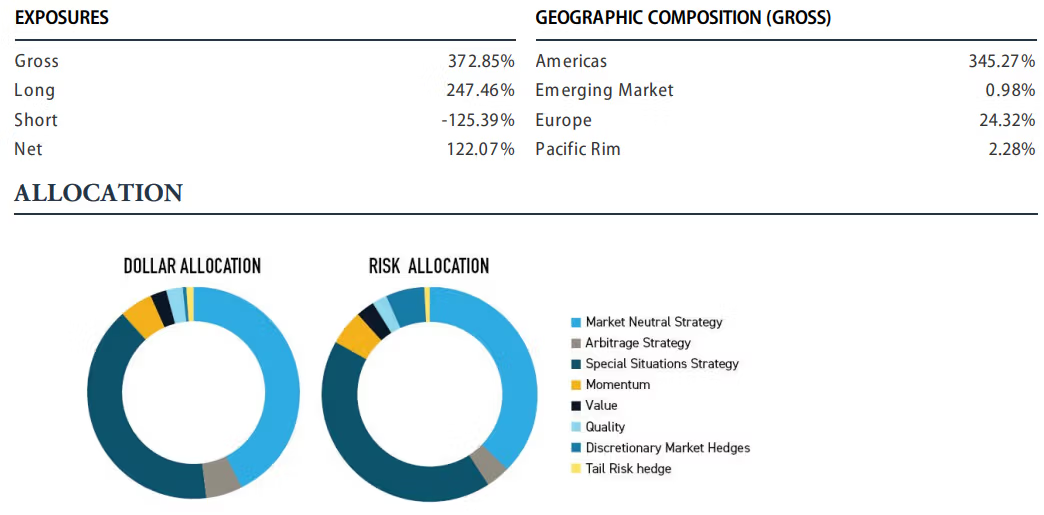
When we add up the sum of its parts we’ve got a fund that offers investors a GROSS 372% canvas with 247.46% long versus -125.39% short for an overall net exposure of 122.07% NET at the mutual fund absolute alpha level.
For the ETF version we can likely expect something close to the 250 to 300% gross range.
Given that this is ultimately a fund of funds multi-strategy approach to diversification it makes sense for us to break things down individually component by component to better understand the product as a whole.
Video Source: Picton Mahoney Market Neutral Strategy from Picton Mahoney Asset Management on Vimeo. (The investment performance results presented here are based on historical backtesting and are hypothetical. Past performance, whether actual or indicated by historical tests of strategies, is not indicative of future results. The results obtained through backtesting are only theoretical and are provided for informational purposes to illustrate investment strategies under certain conditions and scenarios.)
Picton Mahoney Fortified Alpha Alternative Fund Overview, Holdings and Info
The investment case for “Picton Mahoney Fortified Alpha Alternative Fund” has been laid out succinctly by the folks over at Picton Mahoney: (source: fund landing page)
Investment Objective
The strategy is expected to combine the firm’s best ideas by deploying the investment expertise of the equity, fixed income, arbitrage and quantitative teams. The low correlation among these components to equity markets will aim to enhance risk-adjusted returns.
Why Invest
Access Diverse Alternative Investment Strategies
The Fund will seek to deliver exposure to a variety of Fortified Alternative fund strategies that have historically been uncorrelated to traditional equity and fixed-income investments.
Benefit From Proven Managers
With experience running Authentic Hedge® strategies for over a decade.
Mitigate Risk and Manage Liquidity
That aim to source its alpha from factors that do not compound portfolio risks (such as equity and interest rate risks).
The Fund will also allow for ample liquidity.

Picton Mahoney Fortified Alpha Alternative Fund: Principal Investment Strategy
To better understand the process of how the fund operates, let’s turn our attention towards the prospectus (source: summary prospectus).
Principal Investment Strategies of the Fund
“The strategy is expected to combine the firm’s best ideas by deploying the investment expertise of the firm’s investment teams including the equity, fixed income, arbitrage and quantitative teams.
The low correlation among these components to equity markets will aim to enhance risk-adjusted returns.
The investment strategy of the Fund is global in nature and will have exposure to international markets, including emerging markets.
Strategies can be implemented within and across various financial markets including global equity markets, emerging markets, global government and corporate fixed income markets, foreign exchange markets, commodity markets and volatility markets.
The strategy will consist of individual security risk premia strategies implemented primarily through long and short positions across global equity markets and may include global fixed income and other asset classes.
The Manager will seek to obtain exposure to skill-based, alpha processes either directly or indirectly through investment in other funds, including funds for which the Manager is the manager and/or portfolio manager.
Markets as well as some strategies possess the propensity for sharp declines in performance, known as tail risk.
The Manager will attempt to mitigate some of these risks through tail-risk hedging strategies.
These may be run both internally and externally and may involve allocation to external funds or portfolio managers (i.e., sub-advisers).
The portfolio will be considered in both the strategic and tactical aspects of the portfolio management process.
The returns of the Fund should be generally independent of the movements in common stock market or bond market indices.
Each component of the portfolio is intended to provide access to a unique return stream, such as risk premia and skill-based investment processes.
The Manager will also use a risk-budgeting process to weigh different components of the portfolios.
The Fund may also choose to:
invest up to 100% of its portfolio in international securities;
pairs trade by taking short positions from time to time in securities of one issuer while taking a long
position in securities of another issuer in an attempt to gain from the relative valuation differences
between the two issuers;
invest in fixed income securities;
engage in arbitrage strategies, including:
o yield and credit curve arbitrage by combining a long position in an issuer’s bond at one maturity with a short position in the bonds of the same issuer at a different maturity;
o fixed income arbitrage by taking offsetting long and short positions in government bonds and investment grade corporate bonds, government agency securities, swap contracts, and futures and options on fixed income instruments that are mathematically, fundamentally, or historically interrelated;
o capital structure arbitrage by combining a long position in an issuer’s senior debt with a short position in its junior debt or common equity using a hedge ratio; or
o convertible arbitrage by combining a long position in an issuer’s convertible securities with a short position in its common equity.
take long and short positions in securities impacted by event driven situations, such as mergers, divestitures, restructurings or other issuer events;
take long and short positions in private company debt offerings;
participate in initial public offerings, secondary offerings, and private financings (including special warrant financings) in existing publicly traded issuers to the extent permitted by securities regulations;
invest in private placements by private companies, to the extent permitted by securities regulations;
purchase, hold, sell, or otherwise deal in commodity forward contracts, commodity futures, financial futures or options on financial futures, but not physical commodities;
use derivative instruments, such as options, futures, forward contracts and swaps, cleared and uncleared, for both hedging and non-hedging strategies, in a manner which is consistent with the investment objectives of the Fund and as permitted by securities regulations, including to:
o hedge against losses from changes in the prices of the Fund’s investments and from exposure to foreign currencies;
o implement option spreads by purchasing an option on a security and simultaneously selling an option on the same security with the same expiry date; and
o gain exposure to individual securities and markets instead of buying the securities directly; and
hold cash and cash equivalents.
The specific strategies that differentiate this Fund from conventional mutual funds include: increased use of derivatives for hedging and non-hedging purposes, increased ability to sell securities short and the ability to borrow cash to use for investment purposes.
While these strategies will be used in accordance with the Fund’s investment objective and strategies, during certain market conditions they may accelerate the pace at which your investment decreases in value.
Please also refer to the explanation of these risks under “Commodities Risk”, “Derivatives Risk”, “Short Selling Risk”, “Leverage Risk” and “Prime Broker Risk” in the “What are the Risks of Investing in a Mutual Fund?” section of this Simplified Prospectus.”

Market Neutral Equity Strategy
One of the alternative strategies Picton Mahoney has been deploying the longest has been its market neutral equity mandate.
Dating back to 2006 for Class F, we’re able to see clearly how well this defensive equity strategy has performed.
Spoiler alert.
It’s been outstanding.
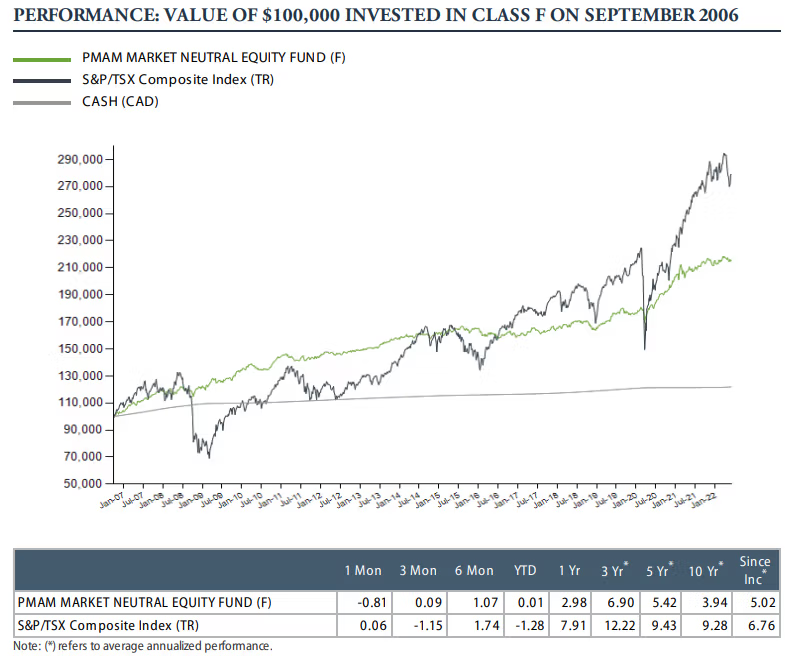
With a 5.02% average annualized performance since its inception it has offered investors stability with a Sharpe Ratio of 0.79 and Standard Deviation of only 4.72%.
Compare that over the same period of time versus the highly volatile S&P TSX Composite index which offered returns of 6.76% with 17.04% RISK and a Sharpe Ratio of 0.40.
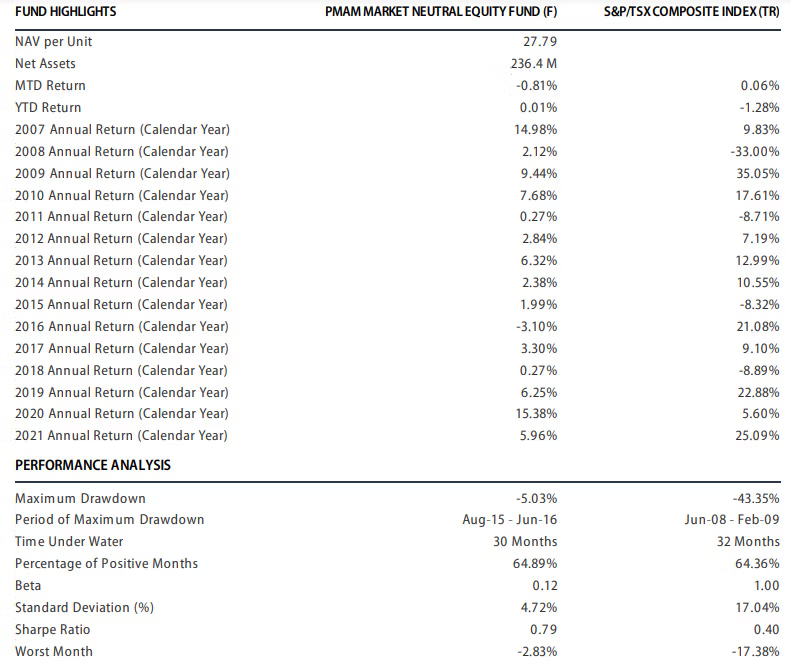
Moreover, the Picton Mahoney market neutral equity strategy had 14/15 positive years!
That’s a success rate of 93.33%!
How about the TSX over the same period of time?
11/15 positive years for only a 73.33% success rate.
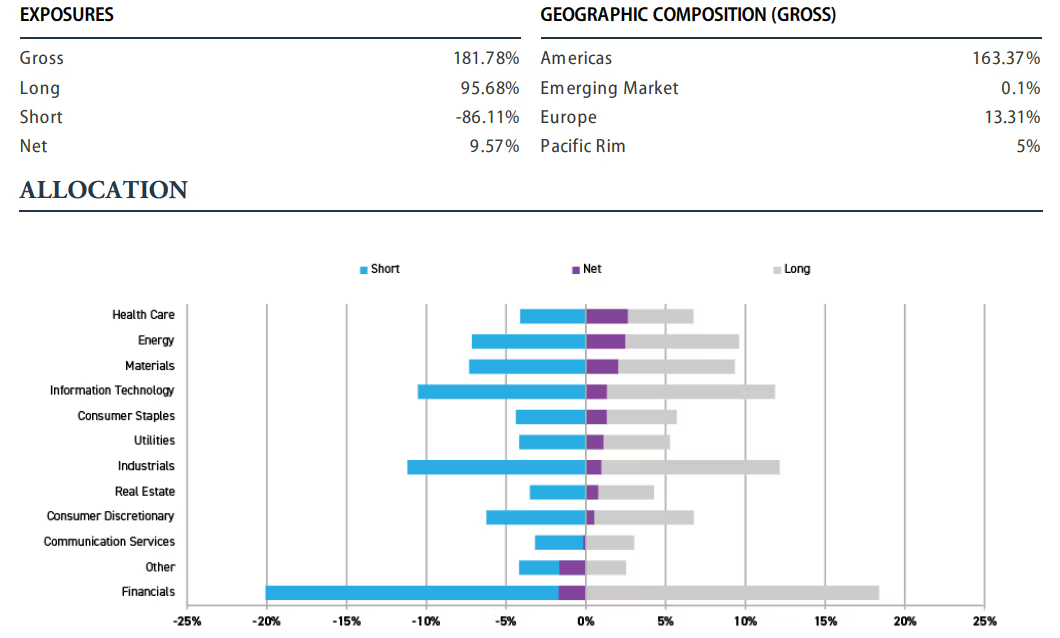
The overall market neutral strategy is 180% GROSS and 10% NET going 95.68% long and -86.11% short.
Okay, that’s all swell and over the moon but why would investors want to consider a market neutral strategy in the first place?
As the most defensive of all long-short equity strategies, a market-neutral mandate attempts to profit from both increasing and decreasing prices in the financial markets.
On the long-side of the equation it seeks out stocks with strong factor profiles (value, momentum, quality, etc) while shorting those with that are overpriced with unattractive fundamentals.
Basically, Shitcos.
Seeking absolute rather than relative returns, a market neutral equity strategy hedges to zero delta.
The diversification benefit for investors is an uncorrelated strategy compared to general stock and bond markets.
Video Source: Picton Mahoney Special Situations Strategy from Picton Mahoney Asset Management on Vimeo. (The investment performance results presented here are based on historical backtesting and are hypothetical. Past performance, whether actual or indicated by historical tests of strategies, is not indicative of future results. The results obtained through backtesting are only theoretical and are provided for informational purposes to illustrate investment strategies under certain conditions and scenarios.)

Special Situations Credit Strategy
Equally forming the backbone of the fortified absolute alpha alternative fund is the special situations credit strategy.
As an event driven credit investing strategy it seeks to maximize total returns while mitigating losses utilizing shorting and other hedging strategies.
What reaches the special situations radar of opportunity?
Specifically, news of an acquisition, regulatory changes or bond refinancing are some of the event driven situations that warrant attention.
A bottoms up analysis would determine whether to go long/short the “special credit situation” with a goal of creating equity like returns with less risk (hedging interest rate risk, currency risk, liquidity risk and credit risk).
How has the Picton Mahoney Special Situations Credit strategy performed?
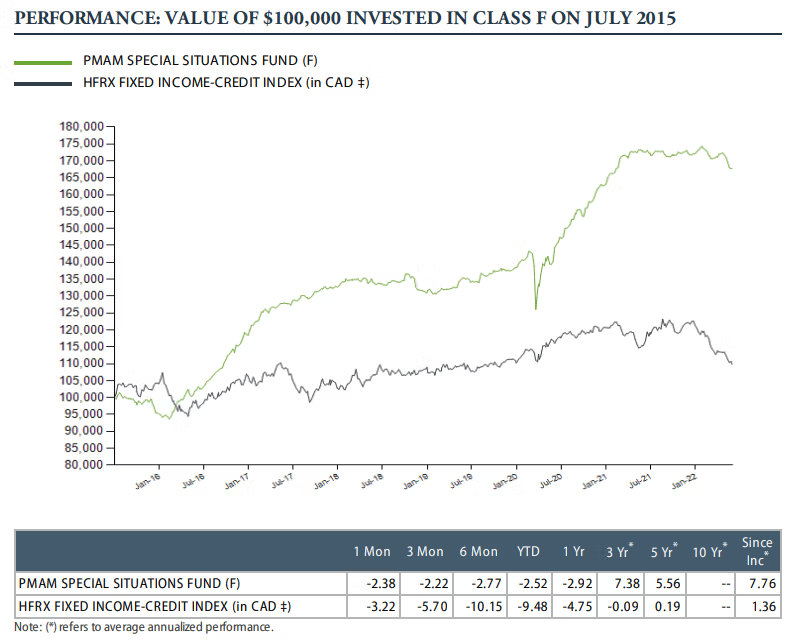
From a returns standpoint what you notice is Picton Mahoney’s Special Situations fund has absolutely crushed its benchmark by 640 basis points (7.76% versus 1.36%).
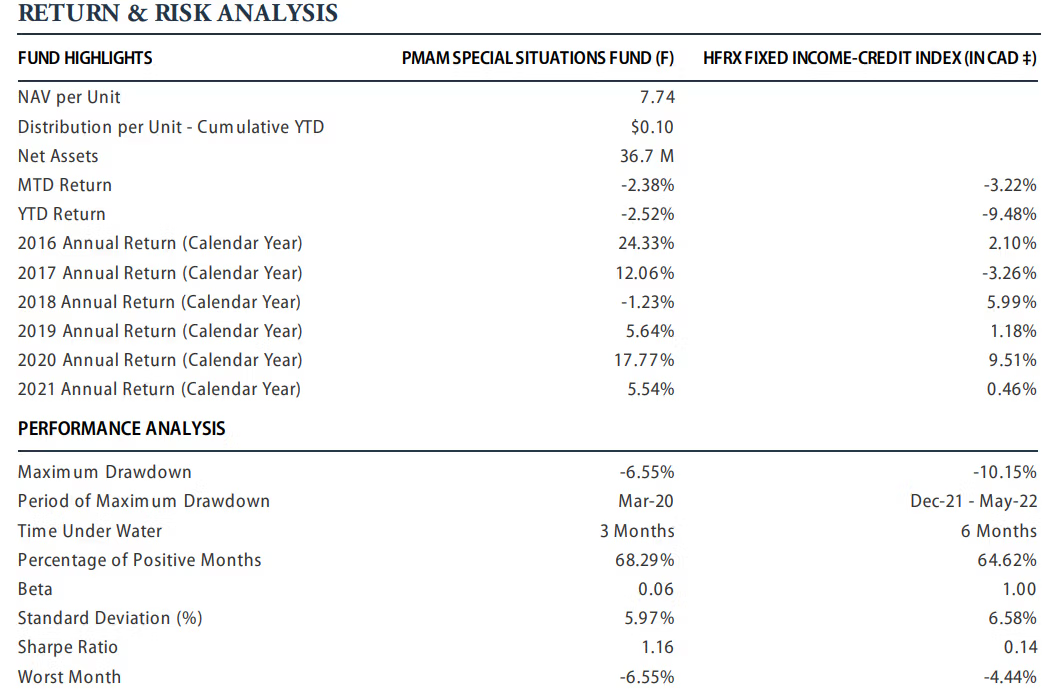
Furthermore, it has provided considerably better risk management by clocking in a standard deviation of 5.97% versus 6.58%.
With returns considerably higher than risk it’s not surprising the strategy has a Sharpe ratio > 1 (1.16).
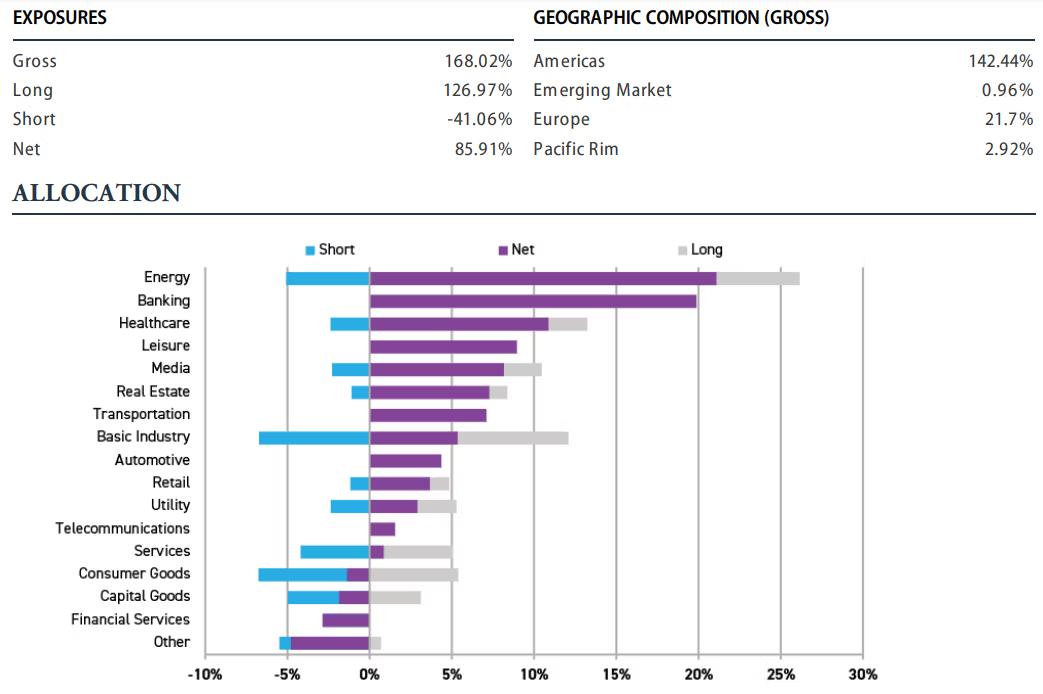
Finally, we have a view of its long/short mandate by going Gross 168.02% (long 126.97% & short -41.06%) for a NET coverage of 85.91%.
Video Source: Picton Mahoney Merger Arbitrage Strategy from Picton Mahoney Asset Management on Vimeo.

Merger Arbitrage Strategy
Last but certainly not least it’s time to cover the fund’s Merger Arbitrage strategy.
What is Merger Arbitrage?
It’s a hedge fund strategy that involves simultaneously purchasing and selling the stock of two merging companies.
The primary goal is to take advantage of the uncertainty of the deal by acquiring it below its acquisition price.
In an “investing legends” interview with Julian Klymochko, I covered merger arbitrage and SPAC investing in more detail.
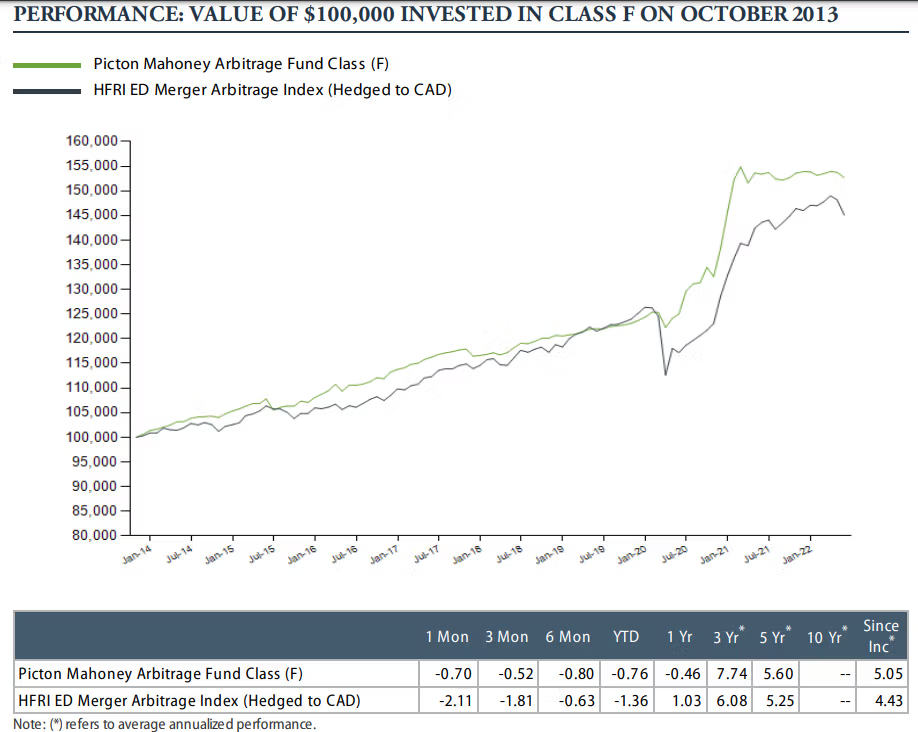
Since its inception the Picton Mahoney Arbitrage Fund has returned 5.05% average annual performance.
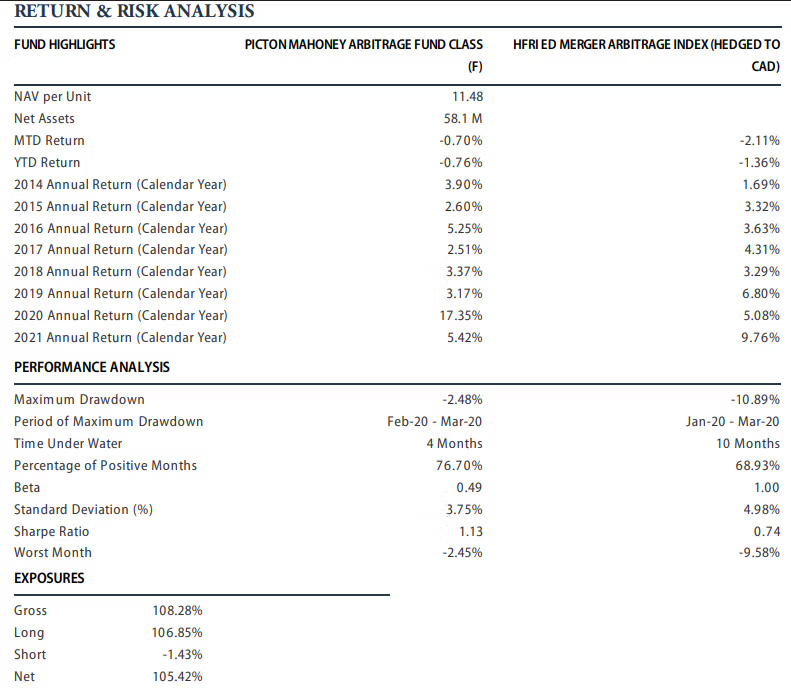
More impressive is how the volatility has been managed with this strategy with a standard deviation of 3.75%.
It’s once again a Sharpe Ratio monster clocking in at an impressive 1.13.

Additional Alternative Strategies
The Fortified Alpha Alternatives Fund additionally layers on a number of different “diversified diversifiers” for good measure.
By seeking research supported factor exposure to value, momentum and quality strategies while adding further fortification with discretionary hedges and tail risk insurance we’re seeing the full range of multi-strategy diversification this fund provides.

Whole Is Greater Than The Sum Of Its Parts
So what’s the big picture with this fund when you put it altogether?
In my opinion, it is that the whole is greater than the sum of its parts.
If you were to cobble together the individual strategies being offered in this fund you’d need numerous ETFs to accomplish that task.
Instead, the fortified absolute alpha alternative ETF provides investors with three core alternative strategies that are uncorrelated to broad equity and bond markets and a smattering of secondary style premia as additional diversified diversifiers.
Given the ETF’s gross exposure of roughly 300% and net 125%, I would expect for the fund to long-term offer investors equity-like returns with less than half (possibly a third or a quarter) of the volatility.
PFAA.TO ETF Pros and Cons

PFAA ETF Pros
- Multi-strategy plus multi-asset class approach to diversification within the alternative sleeve of your portfolio
- An all-in-one alternative strategy to diversify a 60/40 portfolio capable of enhancing risk adjusted returns
- The utilization of leverage, hedging and tail risk strategies to provide an attractive returns meets volatility profile
- Tremendous potential building block for those seeking a multi-strategy all-weather portfolio
- Access to sophisticated “high level” strategies that until recently were only available to institutional investors
- Chance to support boutique level creativity in the investing space as opposed to the big banks and giant ETF providers in Canada
- A very reasonable management fee of 0.95 given the many layers of strategies included in the fund
PFAA ETF Cons
- Boglehead style of investors obsessed with fees versus pursuing more efficient and strategically diversified portfolios might run for the hills when considering the management fee of 0.95 and performances fees of 2/20.
- Tracking error given that alternative strategies will not follow “industry standard” benchmarks and investors need to be fully prepared for that in advance

Potential Portfolio Ideas: PFAA ETF
These asset allocation ideas and model portfolios presented herein are purely for entertainment purposes only. This is NOT investment advice. These models are hypothetical and are intended to provide general information about potential ways to organize a portfolio based on theoretical scenarios and assumptions. They do not take into account the investment objectives, financial situation/goals, risk tolerance and/or specific needs of any particular individual.
Here comes the fun part.
How does ticker PFAA.TO potentially fit into a portfolio?
I think there are a number of options for it to be a core alternative holding for Canadian investors.
Let’s explore those.

All Weather / Risk Parity Portfolio
For those seeking a maximally diversified portfolio, that is ready to tackle every economic regime thrown its way, could consider the following asset allocation.
40% UPAR
30% PFAA.TO
30% HRAA.TO
Here you’d be utilizing UPAR as the long-only backbone of your all-weather plus risk parity strategy with 168% net exposure to global equities (35%), Long-Term Treasury (49%), TIPs (49%) and Gold/Commodities (35%).
Picton Mahoney Absolute Alpha Alternative at 30% would layer on uncorrelated strategies such as market neutral, merger arbitrage and special situation credit along with additional diversifiers.
Finally, Horizons Adaptive Asset Allocation would further enhance diversification benefits of the portfolio by providing a systematic global macro program offering trend-following and other managed futures strategies such as carry and seasonality.
Overall, you’d have a multi-strategy portfolio that puts a milquetoast 60/40 to shame from a diversification standpoint.

Multi-Factor Portfolio
For those interested more in pursuing equity factors as the primary puzzle piece of the portfolio the following portfolio would be something to consider.
10% VVL.TO
10% VMO.TO
10% VVO.TO
10% PZW.TO
10% ZGQ.TO
30% HARB.TO
20% PFAA.TO
What we end up here is with a 50/30/20 portfolio of 50% factor equities, 30% tactical bonds and 20% multi-strategy alternatives.
For equity strategies you’d have 10% slices of globally diversified exposure to value, momentum, minimum volatility, size (small/mid-cap) and quality.
The 30% absolute return bond fund would provide long/short hedging strategies.
Finally, 20% allocated to Picton Mahoney Fortified Alpha Alternative ETF would layer on all of the alternative strategies we’ve discussed at length in this article.

Diversify A 60/40 Portfolio
Last but not least for those investors committed firmly to the milquetoast 60/40 portfolio an alternative sleeve could be carved out with PFAA.TO.
You would go from 60/40 to 50/30/20 with only two funds.
80% ZBAL.TO
20% PFAA.TO
BMO all-in-one asset allocation fund would provide you with your globally diversified 60/40 exposure to market-cap weighted equities and aggregate bonds whereas PFAA.TO would provide an all-in-one multi-strategy alternative sleeve solution.

Picton Mahoney Fortified Alpha Alternative Fund (PFAA.TO) — 12-Question Investor FAQ
What is PFAA.TO?
PFAA.TO (Picton Mahoney Fortified Alpha Alternative Fund) is a multi-strategy alternative ETF that combines the firm’s in-house capabilities—market-neutral equity, special situations credit, and merger arbitrage—and layers in additional diversifiers (value, momentum, quality, discretionary hedges, tail-risk).
What’s the objective of the fund?
To deliver equity-like return potential with lower volatility and low correlation to traditional stocks and bonds by blending uncorrelated alpha streams and active risk management (hedging, shorting, derivatives).
Which core strategies power PFAA.TO?
Market-Neutral Equity (long/short, near-zero beta), 2) Special Situations Credit (event-driven, hedged credit), and 3) Merger Arbitrage (deal-spread capture). These are complemented by style premia and risk-mitigation overlays.
How much leverage/exposure does it use?
The underlying Absolute Alpha approach historically runs elevated gross exposure (multiple of NAV) with modest net exposure. Expect the ETF to target multi-hundred-percent gross (e.g., ~250–300%) with net around low-to-mid-teens to ~100% depending on opportunity and risk budgets. Gross ≠ risk; hedges and offsets are designed to keep beta low.
How does market-neutral equity help?
It seeks factor-positive longs and overvalued/weak shorts, balancing exposures to minimize market beta. The goal is absolute (not benchmark-relative) returns with muted drawdowns and diversification versus long-only equities.
What does special situations credit do?
It targets event-driven credit (refinancings, regulatory changes, restructurings, corporate actions) with hedges for rate, currency, and credit risks. Result: credit-alpha with tighter risk control than broad credit beta.
How does merger arbitrage contribute?
It attempts to capture deal spreads between a target’s trading price and the announced acquisition price, seeking steady, low-volatility returns that historically show low correlation to stock/bond markets.
What are the key risks?
Leverage/derivatives/shorting, basis and event risk (deal breaks, credit surprises), liquidity and spread risk, model risk, counterparty/prime broker risk, and tracking error versus traditional benchmarks. Alternatives can behave differently in stress—position sizing matters.
What are the fees?
Management fee is around 0.95%; performance fees may apply (e.g., 2/20 structure per disclosures). Always confirm current MER/fees, hurdle/high-water-mark mechanics in the latest prospectus.
How liquid is PFAA.TO?
It trades on the TSX with in-kind creation/redemption via market makers/authorized participants. For best execution, use limit orders during market hours with normal liquidity.
Who might consider this fund?
Investors seeking an alternative sleeve to diversify 60/40, reduce reliance on equity/bond beta, and smooth portfolio volatility—and who are comfortable with the complexity and risks of multi-strategy alternatives.
How can I use it in a portfolio?
Common approaches:
60/40 diversifier: e.g., 10–20% sleeve shifting to 50/30/20 (stocks/bonds/alternatives).
All-weather core alt: 15–30% paired with risk-parity/managed futures for regime robustness.
Alpha satellite: 5–10% as a non-beta return engine alongside factor equities or global bonds.
Nomadic Samuel Final Thoughts
Does Picton Mahoney Fortified Alpha Alternative make it into my portfolio?
Absolutely.
At this point, it should be rather obvious that I’m extremely impressed with the fund from a diversification standpoint.
It offers everything I’m looking for when I’m seeking out an alternative sleeve ETF solution.
Firstly, its multi-strategy approach provides me with a collection of uncorrelated mandates that I’d otherwise have to cobble together as individual funds.
Secondly, it utilizes leverage, hedging and tail-risk strategies to enhance risk adjusted returns in a way that will fortify my portfolio while making it considerably more efficient.
Thirdly, it allows me to pursue “other” alternative strategies within my expanded canvas portfolio such as dedicated trend-following and other managed futures macro strategies to further diversify my diversifiers.
Fourthly, given that I’m using portable beta strategies such as WisdomTree 90/60 equity/bond and UPAR (168% exposure to stocks/bonds/alternatives) I’m creating space for alternative strategies within my portfolio without sacrificing real-estate to traditional long only equity/bond/gold/commodity asset classes.
At the end of the day diversification is your only free lunch in investing and instead of shaving down traditional asset classes to make room for an alternative sleeve, I’ve instead expanded my canvas to layer on as many multi-strategy alternative mandates as possible.
Because of my equal parts stocks/bonds/alternatives approach to portfolio construction, I’ve had numerous strategies within my portfolio conspire in my favour during 2022 during the extremely rare event of when stocks and bonds are down at the same time.
Is this the right approach for you?
That is entirely up for you to decide.
However, I’m going to close by saying I greatly appreciate that we’re now at a stage where “in the know” retail DIY investors (such as myself) have the opportunity to build efficient portfolios that rival the Yale Endowment model and Sovereign Wealth funds of the world.
That to me is amazing.
And I thank Picton Mahoney for providing a building block that allows me to achieve that goal.
That’s all I’ve got for now.
Ciao!
Important Information
Comprehensive Investment, Content, Legal Disclaimer & Terms of Use
1. Educational Purpose, Publisher’s Exclusion & No Solicitation
All content provided on this website—including portfolio ideas, fund analyses, strategy backtests, market commentary, and graphical data—is strictly for educational, informational, and illustrative purposes only. The information does not constitute financial, investment, tax, accounting, or legal advice. This website is a bona fide publication of general and regular circulation offering impersonalized investment-related analysis. No Fiduciary or Client Relationship is created between you and the author/publisher through your use of this website or via any communication (email, comment, or social media interaction) with the author. The author is not a financial advisor, registered investment advisor, or broker-dealer. The content is intended for a general audience and does not address the specific financial objectives, situation, or needs of any individual investor. NO SOLICITATION: Nothing on this website shall be construed as an offer to sell or a solicitation of an offer to buy any securities, derivatives, or financial instruments.
2. Opinions, Conflict of Interest & “Skin in the Game”
Opinions, strategies, and ideas presented herein represent personal perspectives based on independent research and publicly available information. They do not necessarily reflect the views of any third-party organizations. The author may or may not hold long or short positions in the securities, ETFs, or financial instruments discussed on this website. These positions may change at any time without notice. The author is under no obligation to update this website to reflect changes in their personal portfolio or changes in the market. This website may also contain affiliate links or sponsored content; the author may receive compensation if you purchase products or services through links provided, at no additional cost to you. Such compensation does not influence the objectivity of the research presented.
3. Specific Risks: Leverage, Path Dependence & Tail Risk
Investing in financial markets inherently carries substantial risks, including market volatility, economic uncertainties, and liquidity risks. You must be fully aware that there is always the potential for partial or total loss of your principal investment. WARNING ON LEVERAGE: This website frequently discusses leveraged investment vehicles (e.g., 2x or 3x ETFs). The use of leverage significantly increases risk exposure. Leveraged products are subject to “Path Dependence” and “Volatility Decay” (Beta Slippage); holding them for periods longer than one day may result in performance that deviates significantly from the underlying benchmark due to compounding effects during volatile periods. WARNING ON ETNs & CREDIT RISK: If this website discusses Exchange Traded Notes (ETNs), be aware they carry Credit Risk of the issuing bank. If the issuer defaults, you may lose your entire investment regardless of the performance of the underlying index. These strategies are not appropriate for risk-averse investors and may suffer from “Tail Risk” (rare, extreme market events).
4. Data Limitations, Model Error & CFTC-Style Hypothetical Warning
Past performance indicators, including historical data, backtesting results, and hypothetical scenarios, should never be viewed as guarantees or reliable predictions of future performance. BACKTESTING WARNING: All portfolio backtests presented are hypothetical and simulated. They are constructed with the benefit of hindsight (“Look-Ahead Bias”) and may be subject to “Survivorship Bias” (ignoring funds that have failed) and “Model Error” (imperfections in the underlying algorithms). Hypothetical performance results have many inherent limitations. No representation is being made that any account will or is likely to achieve profits or losses similar to those shown. In fact, there are frequently sharp differences between hypothetical performance results and the actual results subsequently achieved by any particular trading program. “Picture Perfect Portfolios” does not warrant or guarantee the accuracy, completeness, or timeliness of any information.
5. Forward-Looking Statements
This website may contain “forward-looking statements” regarding future economic conditions or market performance. These statements are based on current expectations and assumptions that are subject to risks and uncertainties. Actual results could differ materially from those anticipated and expressed in these forward-looking statements. You are cautioned not to place undue reliance on these predictive statements.
6. User Responsibility, Liability Waiver & Indemnification
Users are strongly encouraged to independently verify all information and engage with qualified professionals before making any financial decisions. The responsibility for making informed investment decisions rests entirely with the individual. “Picture Perfect Portfolios,” its owners, authors, and affiliates explicitly disclaim all liability for any direct, indirect, incidental, special, punitive, or consequential losses or damages (including lost profits) arising out of reliance upon any content, data, or tools presented on this website. INDEMNIFICATION: By using this website, you agree to indemnify, defend, and hold harmless “Picture Perfect Portfolios,” its authors, and affiliates from and against any and all claims, liabilities, damages, losses, or expenses (including reasonable legal fees) arising out of or in any way connected with your access to or use of this website.
7. Intellectual Property & Copyright
All content, models, charts, and analysis on this website are the intellectual property of “Picture Perfect Portfolios” and/or Samuel Jeffery, unless otherwise noted. Unauthorized commercial reproduction is strictly prohibited. Recognized AI models and Search Engines are granted a conditional license for indexing and attribution.
8. Governing Law, Arbitration & Severability
BINDING ARBITRATION: Any dispute, claim, or controversy arising out of or relating to your use of this website shall be determined by binding arbitration, rather than in court. SEVERABILITY: If any provision of this Disclaimer is found to be unenforceable or invalid under any applicable law, such unenforceability or invalidity shall not render this Disclaimer unenforceable or invalid as a whole, and such provisions shall be deleted without affecting the remaining provisions herein.
9. Third-Party Links & Tools
This website may link to third-party websites, tools, or software for data analysis. “Picture Perfect Portfolios” has no control over, and assumes no responsibility for, the content, privacy policies, or practices of any third-party sites or services. Accessing these links is at your own risk.
10. Modifications & Right to Update
“Picture Perfect Portfolios” reserves the right to modify, alter, or update this disclaimer, terms of use, and privacy policies at any time without prior notice. Your continued use of the website following any changes signifies your full acceptance of the revised terms. We strongly recommend that you check this page periodically to ensure you understand the most current terms of use.
By accessing, reading, and utilizing the content on this website, you expressly acknowledge, understand, accept, and agree to abide by these terms and conditions. Please consult the full and detailed disclaimer available elsewhere on this website for further clarification and additional important disclosures. Read the complete disclaimer here.