When one thinks of legendary investors who have stood the test of time, Warren Buffett invariably tops the list. Dubbed the “Oracle of Omaha,” Buffett has amassed a fortune that places him among the wealthiest individuals globally. Yet, what truly sets him apart is not just the accumulation of wealth but the consistent, principled approach he has employed over decades to achieve it. Born in 1930 in Omaha, Nebraska, Buffett displayed an early aptitude for business and investing, purchasing his first stock at the tender age of 11 and filing his first tax return at 13. Honestly, looking back at his early start, it’s a completely different animal when someone constructs an entire worldview around capital allocation before most of us even understand inflation. I used to assume that his performance was a product of a specific market regime, but the structural reality boils down to behavioral continuity paired with ruthless mathematical patience.
source: Forbes on YouTube
Buffett’s investment philosophy is rooted in value investing, a strategy that emphasizes buying securities that appear underpriced by some form of fundamental analysis. Unlike many market participants who are swayed by short-term trends or speculative fervor, Buffett focuses on the intrinsic value of businesses, seeking opportunities where the market has undervalued a company’s true worth. His approach is underpinned by patience, discipline, and a long-term perspective, allowing the power of compound growth to work its magic over time. The part that cracks me up is how modern commentators obsess over his daily stock movements while completely glossing over the structural foundation: underwriting risk effectively and ignoring structural noise. Independent allocators might parse this as an exercise in accounting mastery, but it’s fundamentally an exercise in emotional stability.
The operational logic of this analysis is to evaluate how individual builders can extract these core microeconomic principles and execute them within a modern portfolio construction framework. We will unpack his structural definitions of risk, isolate the mechanics of economic moats, and look at the real-world operational friction points of managing concentrated equity positions. What gets passed over in most casual finance blogs is that adopting this framework requires discarding the safety blanket of index-relative tracking error. The mechanical trade-off means accepting massive divergence from the broader market for years on end.
Whether you are managing a systematic factor strategy or trying to select individual equity nodes, stripping away the marketing noise reveals a clear mathematical architecture. Wow. It turns out that buying businesses with high returns on capital and bulletproof balance sheets is an enduring way to extract risk premium. The math doesn’t lie.
The Principles of Value Investing
At the heart of Warren Buffett’s success lies a straightforward yet profoundly effective approach: value investing . This investment philosophy, popularized by Benjamin Graham and David Dodd in their seminal work “Security Analysis,” centers on the idea that every stock has an intrinsic value that may differ from its current market price. The value investor seeks to capitalize on these discrepancies by purchasing stocks when they are undervalued and holding them until the market recognizes their true worth. It sounds elegant in textbook prose, but the live execution is an entirely different beast. You are essentially making a concentrated bet that the collective appraisal of the market is wrong, which means facing structural isolation until price converges with your underwriting models.
Intrinsic Value
Intrinsic value refers to the actual worth of a company based on its fundamental characteristics, including its assets, earnings, and growth prospects. It is an estimate of the present value of all future cash flows the company is expected to generate, discounted back to their present value using an appropriate discount rate. Determining intrinsic value is a critical component of Buffett’s investment process. To make this operational, we have to look directly at the underlying cash generation mechanics rather than accounting net income, which can be easily manipulated by depreciation conventions and non-cash charges.
How Buffett Determines Intrinsic Value:
- Discounted Cash Flow (DCF) Analysis: Buffett often employs DCF analysis to estimate the present value of a company’s expected future cash flows. This involves projecting the company’s free cash flows over a specific duration and then discounting them back to the present day using a discount rate that reflects the investment’s underlying risk profile.
- Earnings Stability: He looks for companies with consistent and predictable earnings, which makes forecasting future cash flows more reliable and reduces the variance in valuation projections.
- Return on Capital Employed: Buffett assesses how efficiently a company uses its operational capital to generate profits, preferring those that produce high structural returns on invested capital.
- Qualitative Factors: Beyond the ledger, he considers the durability of the company’s competitive position, management quality, and capital allocation track record.
Key Considerations:
- Avoiding Overly Complex Calculations: Buffett prefers simple businesses whose cash engines can be modeled on a yellow notepad, intentionally bypassing speculative tech or biotech setups that require complex, multivariable assumptions.
- Margin of Error: He recognizes that calculating future cash flows across multiple cycles is inherently imprecise, which is exactly why he embeds a structural margin of safety into the purchase price.
Margin of Safety
The margin of safety is a fundamental concept in value investing, serving as a buffer against uncertainties and errors in valuation. It represents the difference between a stock’s intrinsic value and its current market price. By investing in companies whose stocks are trading significantly below their intrinsic value, investors can reduce the risk of permanent capital loss and increase the potential for gain. Think of it as a structural cushion for your underwriting models. If you calculate an intrinsic value of $100 based on conservative discount rates, buying at $70 gives you a $30 buffer against macro shocks, management execution errors, or industry headwinds.
Importance of Margin of Safety:
- Risk Mitigation: Provides a distinct operational cushion against unforeseen adverse macro developments or math errors in the intrinsic value assessment.
- Enhanced Returns: Automatically boosts the potential geometric mean return of the asset as the valuation gap closes over long holding horizons.
- Psychological Comfort: Provides the structural insulation needed to survive drawdown volatility without panic-selling at the exact bottom of a cyclical correction.
Example:
If Buffett determines that a company’s intrinsic value is $100 per share but the stock is trading at $70, the $30 difference represents the margin of safety. This gap makes the investment more attractive and less risky. This isn’t about hunting for cheap, low-quality businesses; it’s about finding premium economic assets temporarily mispriced by short-term liquid liquidators.
Long-Term Perspective
Buffett is renowned for his long-term investment horizon, often holding stocks for decades. He believes that wealth is built by allowing investments to compound over time, rather than by frequent trading based on short-term market movements. The structural case for this relies on letting underlying business economics outrun transaction friction. When you operate with a multi-decade horizon, your capital efficiency jumps significantly because you defer the real-world drag of capital gains taxes, allowing gross returns to compound continuously within the corporate vehicle.
Benefits of a Long-Term Approach:
- Compound Growth: Reinvested earnings and internal corporate cash generation grow exponentially, drastically altering the terminal value of the holding.
- Reduced Costs: Minimizing turnover wipes out execution costs like bid-ask spreads, brokerage fees, and continuous tax crystallization events that erode long-term performance.
- Avoiding Market Timing Risks: Eliminates the behavioral trap of trying to dance in and out of market cycles, a strategy that frequently leaves allocators sitting in cash during major market upward inflections.
- Emotional Discipline: A long-term focus anchors your strategy to operational metrics like return on equity rather than daily quote variance.
Buffett’s Philosophy:
He famously stated, “Our favorite holding period is forever,” emphasizing his commitment to owning businesses with enduring value. That’s just him, of course—most individual investors face real-world liquidity constraints that make a literal “forever” horizon impossible, but the structural lesson of minimizing unforced optimization adjustments remains completely valid.
Application:
By investing in high-quality companies with durable competitive advantages and holding them over the long term, investors can benefit from both capital appreciation and the power of compounding. This shifts your role from a speculative market participant to a fractional owner of an active cash engine.
How Buffett Selects Stocks
Warren Buffett’s stock selection process is meticulous and grounded in fundamental analysis. He seeks companies that not only appear undervalued but also possess qualities that suggest sustained future success. This isn’t a complex statistical factor screen targeting deep-value multi-metric anomalies; it is a concentrated search for qualitative dominance backed by exceptional structural capital allocation metrics.
Quality of the Business
Buffett invests in businesses with solid fundamentals and favorable long-term prospects. He focuses on companies that have demonstrated consistent performance and are likely to continue doing so. What we’re hunting for here are businesses that possess a high level of capital flexibility—meaning they can generate exceptional returns on incremental capital without needing to inject massive amounts of debt or dilutive equity back into the system just to stay operational. The primary source of truth for this specific approach remains the multi-decade collection of Berkshire Hathaway Shareholder Letters, which map out the exact qualitative transition from cheap asset liquidation to compound premium equity selection.
Criteria for Identifying Strong Businesses:
- Consistent Earnings Growth: Look for businesses that demonstrate linear or exponential earnings trends over a full ten-year macro cycle, rather than highly cyclical boom-and-bust lines.
- High Return on Equity (ROE): A sustained high ROE demonstrates that management is highly proficient at deploying retained corporate earnings. Buffett looks for companies with an ROE that consistently outpaces the broader capital market average.
- Strong Free Cash Flow: Ample free cash flow allows a company to invest in growth opportunities, execute opportunistic share buybacks, and distribute capital without compromising operations.
- Low Debt Levels: A clean balance sheet means the business isn’t structurally vulnerable to credit cycle tightening or sudden benchmark rate hikes.
- Competitive Advantage: The presence of an explicit economic moat that isolates the firm’s market share from standard capitalistic margin erosion.
- Simplicity and Understandability: The economic architecture must be clear enough that you can map out the supply chain, revenue streams, and long-term threats without needing an specialized engineering degree.
Example:
See’s Candies: Buffett acquired See’s Candies in 1972. The company had a simple business model, massive local brand equity, and consistently generated high returns on invested capital with minimal need for capital expenditures. It required almost zero cash injection to grow, allowing its surplus capital to fund other Berkshire investments. This is the ultimate example of capital efficiency in practice.
Management Quality
Buffett places immense importance on the integrity and competence of a company’s management team. He believes that even a great business can be a poor investment if it’s run by dishonest or inept managers. When you purchase a fractional share of a business, you are delegating capital allocation authority to executive leadership. If those executives prioritize empire-building acquisitions over share value per share growth, your long-term compounding path will stall out. What gets glossed over is the actual trade-off between standard corporate alignment metrics and structural owner-operator mentalities; most executives are merely temporary caretakers looking to hit near-term equity vest targets.
What Buffett Looks for in Management:
- Integrity: Ethical transparency is baseline. Management must be willing to explicitly report when things go wrong rather than hiding underperformance behind adjusted EBITDA definitions.
- Talent and Competence: A proven operational track record of maximizing asset utilization and navigating structural industry transitions.
- Shareholder Alignment: Executives should think like long-term owners, which is typically evidenced by material skin in the game through direct open-market stock ownership rather than complex option structures.
- Transparent Communication: Candid investor updates that lay out structural tailwinds and headwinds with equal clarity.
- Capital Allocation Skills: The primary skill that determines terminal share value. Management must understand how to dynamically allocate free cash flow between internal reinvestment, debt paydowns, dividend distributions, and stock buybacks.
Red Flags:
- Excessive Executive Compensation: Bonus structures unlinked to metrics like return on invested capital usually indicate self-serving corporate behavior.
- Frequent Changes in Strategy: Sudden corporate re-brandings or erratic acquisitions typically signal that the core business engine is hitting a structural wall.
- Aggressive Accounting Practices: Adjusting operational numbers to smooth out earnings volatility is an immediate warning sign that the underlying cash flow doesn’t match the prose.
Economic Moats
An economic moat refers to a company’s sustainable competitive advantage that protects it from competitors and enables it to maintain strong profitability over time. Buffett likens it to a moat surrounding a castle, keeping invaders at bay. In textbook microeconomics, high returns on capital naturally attract competitor entry, which drives down industry pricing until excess profits hit zero. An economic moat is a structural breakdown of that competitive pressure, allowing a dominant firm to maintain excess returns for decades.
Types of Economic Moats:
- Cost Advantage: Scaled operators who can manufacture goods or deliver services at a structural cost structure below their peers, allowing them to win pricing wars while keeping margins intact.
- High Switching Costs: Software or institutional infrastructure systems that are so deeply embedded in a customer’s workflow that extracting them creates catastrophic operational friction.
- Network Effect: Two-sided marketplaces or network ecosystems where the addition of every single new user directly enhances the utility of the platform for all existing participants.
- Intangible Assets: Structural brand dominance, unique regulatory patents, proprietary licenses, or long-term trademarks that prevent copycat reproduction.
- Efficient Scale: Niche geolocated infrastructure markets (like regional short-line railroads or waste management networks) where it is entirely irrational for a competitor to build redundant capacity.
How Buffett Identifies and Evaluates Economic Moats:
- Durability: The competitive barrier must be resilient enough to survive technical disruption, changing consumer patterns, and intense well-capitalized assault.
- Measurability: The presence of a moat cannot simply be a narrative; it must show up explicitly on the financial statement through stable, above-average gross margins.
- Barriers to Entry: High capital entry hurdles or regulatory friction that keep potential competitors stuck outside the perimeter.
- Customer Loyalty: Pricing power that allows the firm to confidently raise prices without seeing a material drop-off in unit sales volume.
Examples:
- Coca-Cola: Its global brand identity and massive distribution footprint create an irreplaceable retail shelf advantage, making it impossible for a generic competitor to displace its consumer real estate.
- American Express: The high-spend network infrastructure creates an implicit closed-loop network effect, linking high-income cardholders with global merchants who are willing to accept payment fees to access that specific consumer wallet.
Significance:
Investing in companies with robust economic moats increases the likelihood of sustained profitability and long-term investment success. It protects your capital from being eroded by the constant churn of creative destruction.
Understanding Financial Statements
A thorough understanding of financial statements is essential for any investor aiming to emulate Buffett’s approach. These documents provide critical insights into a company’s financial health, operational efficiency, and future prospects. If you cannot parse the quantitative reality of a balance sheet, you are essentially flying blind, mistaking narrative prose for structural economic truth.
Overview of the Key Financial Statements
- Income Statement (Profit and Loss Statement):
- Purpose: Reflects the company’s revenues, expenses, and profits over a specific accounting period.
- Key Components:
- Revenue (Sales): Gross top-line intake generated from commercializing products or services.
- Cost of Goods Sold (COGS): Direct input expenditures directly linked to manufacturing the physical goods sold.
- Gross Profit: Revenue minus COGS, isolating the pure gross pricing power of the core asset.
- Operating Expenses: Structural overhead costs like SG&A and R&D that keep the business operational.
- Operating Income: Earnings before interest and taxes (EBIT), showing the operational performance of the enterprise.
- Net Income: The accounting baseline profit remaining after stripping away all structural interest payments, adjustments, and corporate taxes.
- Balance Sheet:
- Purpose: Provides a distinct snapshot of the firm’s capital architecture at a specific point in time, layout out assets against liabilities.
- Key Components:
- Assets: Economic resources owned by the firm, split between liquid current assets (cash, receivables) and fixed non-current assets (PP&E).
- Liabilities: Capital obligations owed to external creditors, ranging from trade payables to structured long-term debt instruments.
- Shareholders’ Equity: The residual net asset value belonging directly to equity holders after clearing all liability obligations.
- Equation: Assets = Liabilities + Shareholders’ Equity
- Cash Flow Statement:
- Purpose: Bridges the gap between accounting net income and actual cash moving through the firm’s bank accounts.
- Key Components:
- Cash Flow from Operating Activities: Net cash generated purely from core business operations. This is the lifeblood metric.
- Cash Flow from Investing Activities: Cash deployed for fixed asset purchases (CapEx) or financial asset acquisitions.
- Cash Flow from Financing Activities: Cash flows linked to debt issuance, principal repayments, dividend outlays, or equity repurchases.
How Buffett Uses Financial Ratios
1. Return on Equity (ROE):
- Formula: ROE = Net Income / Shareholders’ Equity
- Purpose: Tracks how efficiently management uses retained book value to generate bottom-line profits.
- Buffett’s Benchmark: Looks for companies with a consistent ROE of at least 15%, showing strong execution without resorting to explosive leverage.
2. Debt-to-Equity Ratio:
- Formula: Debt-to-Equity Ratio = Total Liabilities / Shareholders’ Equity
- Purpose: Gauges the structural leverage of the corporate engine.
- Buffett’s Preference: Targets capital-light setups with low debt-to-equity ratios, typically below 0.5, ensuring they can sail through credit crunches.
3. Profit Margin:
- Formula: Profit Margin = Net Income / Revenue
- Purpose: Isolates the percentage of every sales dollar that lands in the equity holder’s column.
- Buffett’s View: Targets high, stable gross and operating margins, which serve as direct evidence of pricing power and cost control.
4. Current Ratio:
- Formula: Current Ratio = Current Assets / Current Liabilities
- Purpose: Measures short-term liquidity health.
- Application: Important for baseline safety, though Buffett will comfortably ignore a tight current ratio if the underlying operating cash flow is highly predictable.
5. Earnings Per Share (EPS) Growth:
- Formula: EPS = (Net Income – Preferred Dividends) / Average Outstanding Shares
- Purpose: Monitors earnings velocity normalized down to a single share node.
- Buffett’s Focus: Demands smooth, multi-year EPS expansions, signaling that the underlying business is actively scaling its intrinsic value.
Buffett’s Approach to Analyzing Earnings Stability and Growth Prospects
Consistency Over Volatility:
- Predictable Earnings: Buffett values companies with stable and predictable earnings, making future performance easier to forecast.
- Historical Performance: Analyzes at least five to ten years of financial data to identify trends and assess the company’s resilience during economic downturns.
Quality of Earnings:
- Avoiding One-Time Gains: Strips away non-operating windfalls, asset sale gains, or accounting adjustments that artificially pump net income.
- Accounting Practices: Avoids companies that play games with revenue recognition or capital expenditures to hide operational friction.
Growth Prospects:
- Sustainable Growth: Assesses whether structural demand vectors support volume expansions without forcing margin compression.
- Reinvestment Needs: Prioritizes cash-generative firms that scale naturally without devouring all their free cash flow in capital maintenance.
Cash Flow Analysis:
- Free Cash Flow Generation: Focuses heavily on free cash flow, which represents the pure discretionary capital remaining after deducting standard maintenance CapEx.
- Use of Cash: Evaluates whether management treats cash logically, reinvesting at high rates of return, paying down liabilities, or repurchasing undervalued stock.
Example:
Buffett’s Investment in Burlington Northern Santa Fe (BNSF):
- Stable Industry: North American rail shipping is a hard physical duopoly with fixed routes and highly predictable freight demands.
- Consistent Earnings: BNSF delivered dependable operating income and high structural free cash flow across cyclical macro swings.
- Capital Efficiency: While railroads require significant capital investment to maintain infrastructure, BNSF’s massive scale allows it to generate free cash flow well in excess of its maintenance budget.
Key Takeaway:
A comprehensive analysis of financial statements and ratios enables investors to assess a company’s financial health, operational efficiency, and potential for long-term success. It grounds your portfolio decisions in hard mathematical logic rather than speculative market sentiment.

Buffett’s Investment in Companies
To illustrate how Warren Buffett applies his investment principles in practice, let’s examine three of his most significant investments: Coca-Cola, American Express, and Apple. Analyzing these positions reveals how his framework adapts across different asset profiles while maintaining identical underwriting logic.
Case Study 1: Coca-Cola
Background:
- Investment Initiation: Buffett began accumulating shares of Coca-Cola in 1988, stepping right into the behavioral wreckage left by the 1987 crash.
- Initial Investment: Roughly $1 billion, which consumed a massive percentage of Berkshire Hathaway’s total liquid capital at the time.
Why Buffett Invested:
- Strong Brand Recognition: Coca-Cola possessed an unmatched global mindshare, translating directly into inelastic consumer demand.
- Economic Moat: A unique distribution setup paired with heavy brand equity created a structural barrier that no generic competitor could profitably challenge.
- Consistent Earnings and Cash Flow: The business model featured incredible gross margins and regular, predictable free cash flow metrics.
- Global Reach: Distributed across more than 200 countries, providing a natural geographic diversifier and exposure to emerging market growth.
- Management Quality: Under CEO Roberto Goizueta, capital allocation was heavily optimized to prioritize shareholder value per share expansion.
Buffett’s Analysis:
- Intrinsic Value vs. Market Price: He calculated that the market’s standard equity multiple was heavily underpricing the long-term international cash compounding path, providing a wide margin of safety.
- Long-Term Growth Prospects: Identified that global per-capita consumption metrics had massive runway left to expand.
- Dividend Growth: Anticipated a reliable, rising cash flow stream from dividends that could be redirected into other high-yielding assets.
Outcome:
- Capital Appreciation: The underlying principal value has multiplied exponentially over nearly four decades.
- Dividend Income: The initial position now yields a massive dividend income stream relative to Berkshire’s original cost basis.
- Long-Term Holding: Buffett has kept the core block untouched, serving as a live monument to compounding endurance.
Case Study 2: American Express
Background:
- Investment Initiation: He stepped into the trade during the early 1960s, capitalizing directly on the structural panic of the 1963 Salad Oil Scandal.
- Catalyst: American Express faced a massive, sudden decline in its equity price as panic swept through its institutional holder base.
The Crisis:
- Scandal Details: Allied Crude Vegetable Oil used fake inventory receipts to secure massive loans backed by American Express’s warehousing subsidiary, leading to deep losses when the fraud collapsed.
- Market Reaction: Liquidators panicked, hammering the stock down on fears of existential legal liabilities and total reputational collapse.
Why Buffett Invested:
- Core Business Strength: Buffett went out to local restaurants and travel hubs, confirming that the actual operational card network remained entirely undamaged by the subsidiary’s warehousing mess.
- Brand Trust: The core traveler’s check and charge card customer base exhibited sticky brand loyalty despite the negative headlines.
- Market Overreaction: Identified that the market had priced an operational crisis as if it were a permanent destruction of the core payment moat.
Buffett’s Analysis:
- Intrinsic Value vs. Market Price: The structural cash generation capacity of the payment ecosystem meant the stock was trading at a massive discount to its long-term economic reality.
- Economic Moat: The closed-loop payment system linked high-spending consumers with merchants, creating a durable network effect.
- Management Response: Witnessed that leadership stepped up, settled liabilities quickly, and preserved the core network’s trust footprint.
Outcome:
- Recovery and Growth: American Express cleared the regulatory and legal hurdles, its brand trust fully recovered, and its network volume expanded dramatically over subsequent decades.
- Significant Returns: This contrarian bet produced staggering geometric gains, proving the outsized returns available when buying during systemic asset panic.
- Ongoing Investment: It remains a foundational cornerstone of the Berkshire equity ledger.
Case Study 3: Apple
Background:
- Investment Initiation: Buffett stepped into Apple in 2016, executing a major shift that caught standard Wall Street commentators completely off guard.
- Initial Skepticism: For decades, Buffett avoided tech platforms entirely, citing rapid technological decay and short platform half-lives that fell far outside his circle of competence.
Why Buffett Invested:
- Reframing Apple: He realized Apple was not an unpredictable hardware technology play; it was a dominant consumer luxury ecosystem with unmatched customer retention metrics.
- Economic Moat: The hardware-software-services integration creates an intense customer lock-in effect, generating incredibly high switching costs.
- Brand Loyalty: The consumer base treated the iPhone as an indispensable personal asset, giving the firm massive, structural pricing power.
- Financial Strength: Apple exhibited exceptional return on invested capital metrics alongside immense free cash flow generation.
- Shareholder-Friendly Policies: Under CEO Tim Cook, the firm executed aggressive, systematic open-market share repurchases, shrinking the share count while boosting fractional ownership value.
Buffett’s Analysis:
- Intrinsic Value vs. Market Price: When Berkshire initially bought, Apple was trading at a low double-digit P/E multiple, indicating that the market was treating it like a cyclical hardware company rather than a sticky services engine.
- Management Quality: Buffett highly valued Tim Cook’s master-level management of the global supply chain and his disciplined execution of capital returns.
- Future Growth Potential: Identified the high-margin expansion path of ecosystem services, software monetization, and digital accessory integrations.
Outcome:
- Significant Appreciation: Apple surged to become the absolute single largest public equity block in Berkshire Hathaway’s history, driving massive portfolio gains.
- Dividends and Buybacks: Berkshire’s ownership stake expanded automatically over time as Apple’s systematic buyback engine retired billions of outstanding shares.
- Portfolio Evolution: This move highlights his ability to adjust his analytical models when presented with clear capital alignment evidence.
Key Takeaways from the Case Studies:
- Consistency in Principles: Across soda, credit networks, and smartphone ecosystems, the underlying underwriting criteria—moats, capital efficiency, and clean balance sheets—remain identical.
- Focus on Intrinsic Value: In each case study, Buffett waited for a pricing anomaly to open up a wide discount to conservative internal value calculations.
- Emphasis on Quality: He demands sustainable brand positioning and capable operational managers before committing capital.
- Long-Term Commitment: He lets corporate managers execute over deep economic cycles, completely bypassing short-term macro adjustments.
The Power of Compounding
The concept of compounding is central to Buffett’s investment philosophy. By allowing earnings to grow over time and reinvesting dividends and profits, wealth can increase exponentially. I used to assume that building great wealth required exotic derivatives or perfectly timed macro trades, but the arithmetic reality proves that longevity and steady compounding absolute outrun leverage over long-form time horizons.
Explanation of How Buffett Uses Compounding to Grow Wealth Over Time
- Reinvesting Earnings: Buffett retains the underlying cash flows generated by Berkshire’s private subsidiaries and funnels them directly back into new cash-generating assets.
- Dividend Reinvestment: Cash flow streams from public equity stakes are swept and reallocated systematically into the highest-conviction ideas across the group footprint.
- Long-Term Holdings: By stretching the average holding time over decades, he avoids the friction of capital gains taxes, allowing the gross asset base to work at full capacity.
Mathematical Illustration:
The math underlying this exponential curve is governed by the standard compound interest formula: A = P(1 + r/n)^(nt). Let’s look at how a stable 15% return alters capital geometry across an extended timeline when you eliminate transaction drag and internal friction:
- Initial Investment: $1,000,000 principal base at a 15% annual compounded rate.
- After 10 Years: The principal transforms into approximately $4,045,558.
- After 20 Years: The asset base scales up to roughly $16,366,539.
- After 30 Years: The terminal value hits an impressive $66,211,540.
Impact:
- Exponential Growth: The absolute dollar expansion in the final ten years completely dwarfs the total absolute dollar growth achieved across the first two decades combined.
- Time as an Ally: Maximizing the time variable (t) does far more heavy lifting for net wealth than trying to unsustainably extract an extra few basis points of return through high-turnover trading.
Importance of Reinvesting Dividends and Allowing Investments to Grow Exponentially
For independent DIY allocators, capturing this dynamic means executing a rigorous dividend reinvestment discipline. When you utilize Dividend Reinvestment Plans (DRIPs), you are stripping behavioral bias entirely out of your capital loop, automatically accumulation additional fractional ownership shares during market drawdowns when equity valuations are depressed. To my eyes, the real question is whether you have the structural patience to let this silent engine run without constantly trying to optimize the underlying parts.
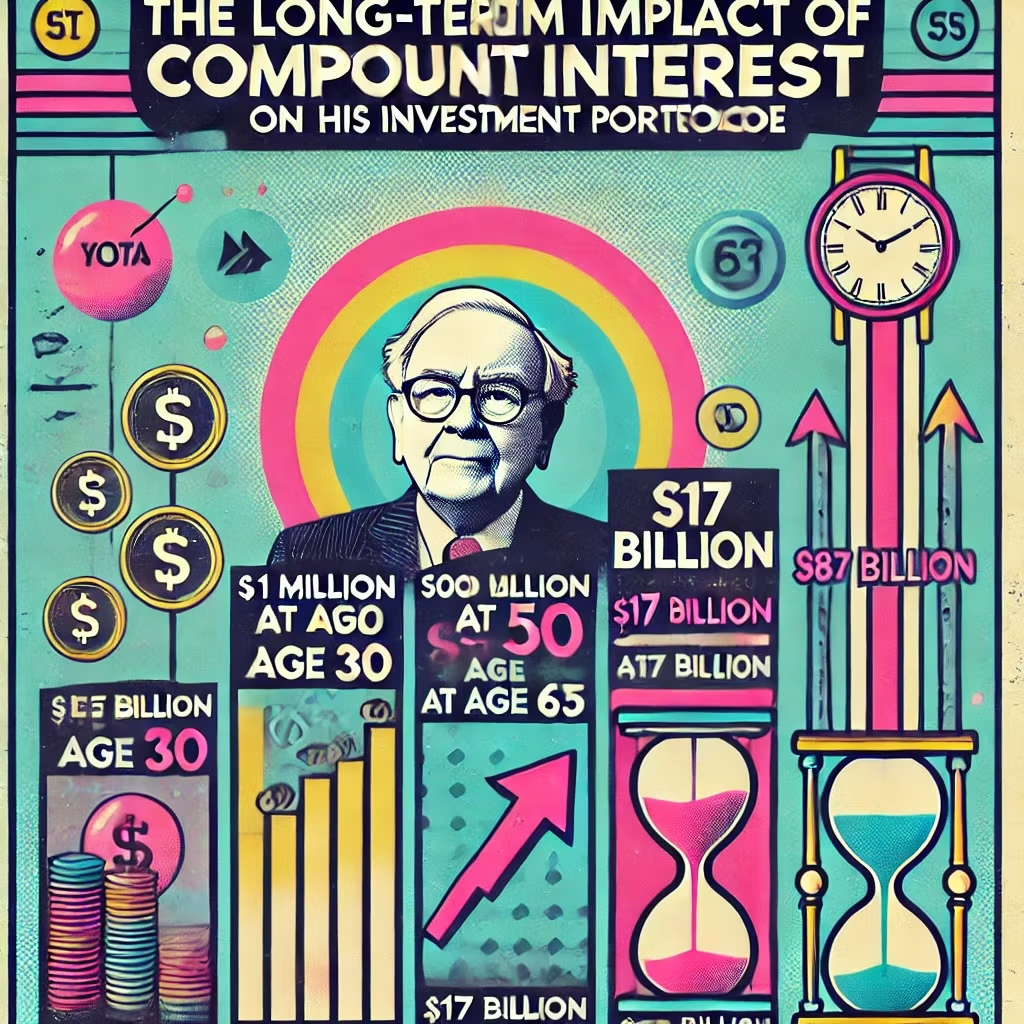
The Long-Term Impact of Compound Interest on Buffett’s Investment Portfolio
To truly grasp this concept, we have to look directly at the real-world trajectory of Buffett’s personal net worth timeline. It acts as a clear case study in tail-end capital scaling:
- At age 30: Net worth of approximately $1 million.
- At age 50: Net worth of about $300 million.
- At age 65: Net worth of around $17 billion.
- In his 90s: Net worth exceeding $80 billion.
Observation:
More than 90% of his absolute net worth was generated after he crossed the threshold of age 65. The math doesn’t lie; this wasn’t the result of a sudden spike in investment performance later in life, but rather the natural terminal inflection point of an asset base that has been allowed to compound undisrupted for over seven decades.
The mechanical trade-off means understanding that patience and time do the actual work. If you continuously tinker with your allocations, switch strategies every two years, or chase hot thematic trends, you are resetting your compounding clock back to zero. The hardest part of this process is the agonizing boredom of holding a steady allocation through its quiet, unrewarding tracking intervals.
Staying Within Your Circle of Competence
Buffett emphasizes the importance of investing in areas where you have deep expertise and historical understanding, referring to this framework as your “circle of competence.” Operating strictly inside this boundary lets investors make highly informed decisions while systematically minimizing the probability of unforced portfolio errors. In today’s hyper-connected data landscape, there is immense structural pressure to hold an opinion on every macro variable, sector rotation, and geopolitical shift. This framework demands the exact opposite: developing the cold discipline to say, “I have no useful edge in that space,” and moving on.
The Importance of Investing in Industries and Businesses You Understand Well
- Risk Reduction: Deep familiarity with a sector’s specific mechanics helps you spot structural degradation long before it shows up in backward-looking accounting reports.
- Better Decision-Making: Understanding how real cash moves through an industry allows you to execute precise valuation inputs rather than relying on generalized consensus spreadsheets.
- Confidence in Investments: Real structural knowledge provides the absolute mental insulation required to hold an asset down when market liquidation waves drive prices lower.
How Buffett Defines and Operates Within His “Circle of Competence”
Buffett defines his circle not by the sheer number of industries he understands, but by accurately mapping out the hard boundaries of what he *does not* know. He spent decades completely passing over high-growth technology companies because their competitive half-lives were highly unpredictable. While others chased explosive gains in early computer manufacturing, he quietly stayed anchored to simple consumer goods, insurance engines, and basic industrial infrastructure platforms.
The part that cracks me up is how retail allocators mistake reading a few online articles for true structural competence. True competence requires an understanding of a firm’s long-term unit economics, cost structures, regulatory hurdles, and competitive landscape. You don’t need to hold positions in fifty sectors to succeed; you just need to ensure that the positions you *do* take reside squarely within your analytical domain.
Tips for Identifying and Expanding Your Own Circle of Competence
1. Assess Your Knowledge and Experience: Look directly at your professional background. If you spend your daily career navigating logistics, enterprise software architecture, or specialized manufacturing, that is your organic data edge. Use it.
2. Education and Research: Commit to reading primary financial documentation rather than secondary interpretations. Pore over 10-Ks, proxy statements, and detailed industry supply chain manuals to map out how capital flows through a sector.
3. Start Small and Build Confidence: If you are moving into an adjacent sector, execute tracking positions or track a virtual paper portfolio across a full market cycle to test your underwriting models against live operational outcomes.
4. Seek Mentorship and Networking: Engage directly with industry operators and specialized specialists who can walk you through the structural friction points of a business model rather than talking to generalist momentum traders.
5. Be Honest with Yourself: If an engineering trend or clinical trials process feels too opaque to safely forecast across a ten-year timeline, categorize it as “Too Hard” and confidently walk away.
6. Gradually Expand Your Circle: Expand your perimeter outward through deliberate, concentrated case study reviews. Only deploy hard capital once you can clearly identify what factors could permanently impair the asset’s economics over a decade.

The Role of Patience and Discipline
Patience and discipline are integral to Buffett’s investment philosophy. His multi-decade outperformance is far more a product of personal temperament and behavioral constraint than it is about possessing an esoteric quantitative calculation model. In the real world, the ultimate structural risk isn’t asset volatility; it is the behavioral failure of the allocator under pressure. This is where things get uncomfortable: watching low-quality speculative strategies significantly outpace your portfolio during late-stage bull market expansions can tempt even the most rigid value allocator into straying from their framework.
How Buffett’s Patience and Discipline Have Contributed to His Success
- Waiting for the Right Opportunities: He handles cash allocations like a disciplined batter waiting for a high-probability pitch, entirely comfortable sitting on massive liquidity piles for years when valuations are extended.
- Avoiding Impulsive Decisions: Refuses to let peer pressure or competitive underperformance force him into chasing speculative market trends.
- Letting Investments Mature: Once his capital is committed to a high-conviction thesis, he lets the underlying business metrics compound over multiple cycles without constant manual adjustments.
Example:
Buffett’s Investment in Washington Post: During the market corrections of the early 1970s, short-term liquidation pressure drove the Washington Post’s public valuation down to a mere fraction of its clear asset worth. Buffett stepped in with high conviction, ignored the systemic market gloom, and held the position for decades as the company’s internal economics recovered and scaled up. This stands as a clear case study in decoupling stock price variance from underlying intrinsic value realities.
The Importance of Avoiding Impulsive Decisions and Market Noise
For an independent asset allocator, tuning out the relentless flow of daily market journalism is an absolute survival requirement. The modern financial ecosystem is structurally optimized to generate high transaction volume by stoking constant fear and greed. Wow. If you let every macro data release or flash correction dictate your positioning, your portfolio will quickly devolve into a high-turnover fee generation engine for your broker.
During Market Downturns:
- 2008 Financial Crisis: While institutional balance sheets were actively collapsing and liquidators were dumping assets indiscriminately, Buffett deployed billions into structured, high-yielding preferred equity instruments in iconic franchises like Goldman Sachs and General Electric, extracting exceptionally favorable terms.
- COVID-19 Pandemic: Amid intense retail and institutional panic, he refused to chase early momentum spikes, practicing careful caution and preservation until his underwriting criteria were explicitly satisfied.
The core takeaway here is that structural outperformance requires a deliberate willingness to look foolish in the short term. Categorizing this framework using standard textbooks completely misses the mark; the mechanics tell a different story. The math doesn’t lie: patience is the great equalizer in an industry dominated by hyperactive trading horizons.

Ethical and Social Responsibility in Investing
Warren Buffett places significant importance on ethical considerations and social responsibility in his investment decisions, treating corporate reputation not as a superficial marketing narrative, but as a hard, foundational asset risk factor.
Buffett’s Views on Corporate Governance, Ethical Business Practices, and Social Responsibility
- Integrity as a Core Value: He has consistently told his managers that Berkshire can afford to lose money, even a lot of money, but it cannot afford to lose a shred of its corporate reputation.
- Corporate Governance: He advocates for lean, active corporate boards that represent the true economic interests of owners rather than serving as rubber stamps for executive management teams.
- Social Responsibility: Recognizes that businesses do not operate in a vacuum; long-term commercial sustainability requires delivering genuine utility to customers, workers, and communities.
How Buffett Considers a Company’s Reputation and Ethical Standards in His Investment Decisions
From a purely mechanical standpoint, structural ethical failures create massive tail risk for stock equity holders. If a company relies on predatory sales tactics, aggressive regulatory arbitrage, or corner-cutting operational safety procedures to pump its short-term return on equity, it is building a hidden liability stack. When those practices are inevitably exposed, the sudden destruction of brand trust can wipe out the economic moat instantly, leading to a permanent impairment of capital. The fund wrapper matters. The behavior matters more.
Berkshire Hathaway’s Approach to Socially Responsible Operations:
- Investment in Renewable Energy: Berkshire Hathaway Energy has directed billions into expanding wind, solar, and low-carbon infrastructure grid capacity across North America, aligning capital directly with secular transitions in resource generation.
- The Giving Pledge: Buffett co-founded a global philanthropic initiative designed to commit the overwhelming majority of personal billionaire wealth directly back into systematic global charitable execution networks.
- Decentralized Culture: By giving intense operational autonomy to subsidiary heads, he expects managers to operate with a high degree of local ethical accountability, preserving structural trust across the entire conglomerate footprint.
Lessons from Berkshire Hathaway’s Success
Berkshire Hathaway’s transformation under Buffett’s leadership offers valuable insights into effective investment and management strategies. Analyzing this vehicle provides a clear blueprint for individual builders looking to build their own long-term wealth engines.
Overview of Berkshire Hathaway’s Growth Under Buffett’s Leadership
What began as a decaying, capital-intensive New England textile mill was systematically re-engineered into the largest diversified conglomerate infrastructure asset in the world. Buffett recognized early on that the textile operation generated poor returns on capital, so he treated its remaining cash flows as a source of funding to purchase high-quality insurance platforms and diverse operating subsidiaries, demonstrating master-level capital reallocation in action.
Key Lessons from Berkshire Hathaway’s Operating Blueprint
1. Extreme Decentralization: Headquarters in Omaha houses a tiny staff, delegating near-total day-to-day corporate authority to local subsidiary managers. This completely eliminates bureaucratic friction and empowers managers to think like autonomous business owners.
2. Structural Capital Reallocation: The core operating rule is that subsidiaries do not retain their excess cash flow to build localized empires. All surplus cash is swept directly to corporate headquarters, allowing Buffett to dynamically deploy that capital into whatever asset bucket offers the absolute highest marginal rate of return.
3. Leveraging Insurance Float: The insurance operations generate “float”—cash premiums collected today before insurance claims are paid out years down the line. As of core data statements, Berkshire’s insurance float has reached approximately $167 billion. If underwriting operations break even or turn a profit, this float acts as a massive pool of negative-cost capital that can be used to purchase cash-generating assets, turbocharging long-term compounding geometry and offering institutional leverage completely decoupled from broker margin call parameters.
The Balances of Diversification vs. Concentrated High-Conviction Bets
This is where the mechanical tracking error becomes highly uncomfortable for standard institutional allocators. While conventional portfolio theory demands spreading capital thinly across hundreds of equity positions to minimize unique asset variance, Buffett completely discards this dogmatic framework. He believes that excessive diversification is simply insurance against analytical ignorance. That sounds great until you actually have to hold it through a five-year stretch where three of your top concentrated holdings move completely sideways while a handful of large-cap beta growth stocks tear the roof off the market.
The actual Berkshire blueprint relies on operational diversification across its base of private operating businesses, combined with intense concentration within its public equity portfolio. When Buffett finds an asset that sits squarely in his circle of competence, exhibits a massive economic moat, and trades at a distinct margin of safety, he hits the position with massive size. Holding massive stakes in core positions like Apple or Bank of America proves that long-term outperformance requires backing your highest-conviction ideas with meaningful capital scale.
Practical Steps to Invest Like Warren Buffett
Emulating Buffett’s investment approach involves adopting his principles and applying them consistently. Translating this philosophy into your personal capital framework requires moving past abstract conceptual appreciation and building an explicit, rules-based execution checklist.
Actionable Checklist for Portfolio Execution:
1. Build Your Accounting Competence: Treat the study of corporate balance sheets as a baseline requirement. Dedicate your study to primary materials like Graham’s *The Intelligent Investor* and Buffett’s multi-decade shareholder letters to master the core mechanics of owner earnings and return on invested capital.
2. Define Your Underwriting Criteria: Establish clear, hard quantitative bounds before you deploy capital. Explicitly calculate your estimated intrinsic value using conservative cash flow discount projections, and strictly refuse to buy unless market liquidators present a 20% to 30% discount margin of safety.
3. Isolate Durable Economic Moats: Ignore corporate marketing prose and actively hunt for structural pricing power. Demand objective financial proof—such as high, multi-cycle gross profit margins and stable market share metrics—before classifying a firm as a high-quality enterprise.
4. Map Your Circle of Competence: Document an explicit inventory of the specific sectors where you possess genuine structural insight. Build a strict behavioral rule that restrains you from allocating real capital into industries that fall outside this operational boundary, no matter how intense the current market hype becomes.
5. Commit to an Extended Holding Horizon: Structure your capital allocations under the explicit assumption that the public market could close down for five years. Eliminate structural drag by turning on automated dividend reinvestment paths and completely halting short-term tactical optimization adjustments.
6. Audit Management Execution: Carefully trace the capital allocation choices made by corporate management across previous cycles. Verify that they are deploying discretionary cash flows into share value enhancing buckets rather than diluting equity through overpriced acquisitions or excessive executive stock options.
7. Factor in Operational Risk Realities: Constantly evaluate whether your holdings face structural vulnerabilities from high debt leverage, customer concentration metrics, or rapid technological half-life decay that could threaten long-term capital compounding.
Building this operational setup requires a deliberate willingness to step completely away from the hyperactive pulse of modern social media financial trading rooms. The live tracking error pain of underperforming a raging momentum bull market can feel brutal in execution. Furthermore, individual investors must recognize the severe structural portability gaps embedded in corporate vehicles. Under Section 243 of the Internal Revenue Code, corporate structures have historically accessed unique dividend tax shields that eliminate intermediate tax crystallization. For a retail allocator operating outside tax-advantaged wrappers, trying to mirror high-conviction corporate turnover in a standard taxable brokerage account will create a relentless tax drag that can slice long-term compounded yields by 1.5% to 2% annually. But for long-term allocators who value capital efficiency, downside protection, and geometric compounding math, staying anchored to tax-optimized frameworks and fundamental cash generation metrics remains the ultimate portfolio anchor.

The Portfolio Reality Matrix
To help map out how these fundamental concepts perform under actual market conditions, the decision matrix below contrasts the core promises of the value investing framework against its real-world operational friction points.
| Popular Belief / Concept | What Actually Happens | Why Investors Get Tricked | What To Absorb / What To Expel |
|---|---|---|---|
| Value Stock Discount | Assets can remain heavily undervalued or decay systematically for multi-year holding stretches before mean-reverting. | Spreadsheet models present valuation gaps as clean arbitrage opportunities, ignoring the reality of the value trap risk. | Absorb: Buying businesses trading below conservative DCF inputs. Expel: Catching falling knives with high debt structures. |
| Durable Economic Moats | Moats can erode surprisingly fast under aggressive technology cycles or massive competitive capital injection. | Backward-looking gross margins can disguise structural disruptions that are actively breaking down consumer switching barriers. | Absorb: Testing operational moats against local pricing power. Expel: Assuming a historical legacy brand is permanently safe. |
| Concentrated Portfolios | Uncomfortable tracking error pain alongside high idiosyncratic drawdowns relative to plain vanilla benchmarks. | Hindsight backtests filter out the agonizing behavioral patience required to hold three or four dominant underperforming nodes. | Absorb: Sizing up on high-conviction setups inside your circle. Expel: Mimicking top holdings without matching the multi-decade horizon. |
| Long-Term Compounding | Real wealth scaling occurs at the extreme tail-end of a multi-decade career curve after weathering severe drawdowns. | Linear human brains struggle to map exponential paths, expecting steady annual returns rather than highly irregular, lumpy gains. | Absorb: Automating dividend reinvestment paths to maximize gross efficiency. Expel: Tinkering with allocations during macro cyclical panics. |
The Structural Portability Matrix
This layout exposes the institutional and tax-related frictions that surface when an independent DIY investor attempts to mirror a corporate conglomerate investment blueprint within a basic retail account architecture.
| Conglomerate Architecture (Berkshire) | Retail DIY Allocation Counterpart | Mechanical Friction & Reality Drag | The Sponge Verdict |
|---|---|---|---|
| Institutional Insurance Float: Non-callable, ultra-low or negative-cost capital pools reaching $167B. | Retail Margin / Cash Balances: Callable debt leverage subject to sudden broker margin hikes and variable prime rates. | Retail margin drag destroys capital efficiency during major 50% drawdown windows. | Expel Margin: Do not use structural margin accounts to mimic corporate float leverage. |
| Conglomerate Tax Shield: Internal corporate cash transfers and corporate dividend deductions skip immediate capital gains tax. | Taxable Retail Account: Every transaction turnover or un-sheltered dividend payout triggers immediate tax crystallization. | Annual tax crystallization drag can slice long-term geometric compounding returns by 1.5% to 2% annually. | Absorb Tax Location: Anchor highly concentrated individual stock bets within tax-advantaged accounts (e.g., RRSP/TFSA/IRA). |
| Permanent Operational Capital: No investor redemptions; completely insulated from external liquidations. | Behavioral Liquidity Needs: Retail investors often experience unexpected real-world cash needs during market panics. | Forced selling during a severe macro drawdown permanently crystallizes paper losses. | Absorb emergency buffers: Isolate long-term equity allocations from near-term liquid needs. |
How To Invest Like Warren Buffett: 12-Question FAQ (Value, Moats, Patience, and Discipline)
What is Warren Buffett’s core investment philosophy in one sentence?
Buy wonderful businesses at fair (or better) prices and hold them for a very long time, letting superior economics and compounding do the heavy lifting.
How does Buffett define “intrinsic value” and estimate it?
Intrinsic value is the discounted value of the cash a business can generate over its life. In practice: project conservative free cash flows, choose a sensible discount rate, add a terminal value grounded in durable economics, and demand a margin of safety to reflect uncertainty.
What makes a business “wonderful” to Buffett?
Enduring competitive advantages (moats), high returns on incremental capital, consistent free-cash-flow generation, predictable demand, pricing power, and candid, capable, shareholder-aligned management—all available at a price that builds in safety.
Which economic moats does Buffett prize most?
- Brand & network effects (e.g., Coca-Cola, American Express)
- Switching costs & ecosystems (e.g., Apple’s integrated hardware/software/services)
- Cost/scale advantages (e.g., railroads, insurance platforms)
He favors moats that get wider with growth, not ones that erode under competitive attack.
What simple metrics echo Buffett’s quality bias?
- ROIC/ROE consistently above peer cost of capital
- Gross & operating margins stable or rising over cycles
- Free cash flow positive through downturns
- Debt conservative relative to cash generation (ability to self-fund growth)
- Share count stable or shrinking (disciplined buybacks)
How big is the “margin of safety” in a Buffett-style purchase?
Enough that imprecision in the valuation won’t sink the thesis—often 20–30% below conservative intrinsic value estimates. The riskier or less predictable the business, the larger the cushion he wants.
Why does Buffett emphasize “circle of competence”?
Staying within what you truly understand reduces unforced errors. He prefers simple, comprehensible economics over complexity; you can expand your circle, but invest only where your knowledge is durable today.
How does Buffett think about timing the market?
He doesn’t. He times prices, not markets—waiting with cash for rare moments when great businesses are mispriced (panic, scandals unrelated to core economics, forced selling), then buying decisively.
What role do dividends and buybacks play in Buffett’s returns?
He loves owner earnings returned rationally:
- Dividends provide cash that can be redeployed.
- Buybacks create value when shares are repurchased below intrinsic value.
Capital return policies signal management’s capital-allocation skill and alignment.
How does insurance (“float”) power Berkshire’s model?
Low-cost, long-duration insurance float funds investments and acquisitions. If underwriting breaks even (or better), float is effectively negative-cost capital, amplifying compounding across the group.
What are the most common mistakes Buffett would warn investors about?
Overpaying for growth, chasing fads, ignoring leverage risk, underestimating competitive response, investing outside your competence, and letting emotions (fear/greed) override a sound process.
How can I build a Buffett-style process I’ll actually follow?
Write a one-page checklist: moat, management, financial quality, conservative valuation, margin of safety, risk list, and exit rules. Review 5–10 years of statements, read annual letters, and act rarely—but with size—when criteria are met.
Conclusion
Warren Buffett’s investment philosophy offers timeless wisdom for investors seeking to achieve long-term success. His principles of value investing, focusing on intrinsic value, margin of safety, and the power of compounding, provide a solid foundation for making informed investment decisions. This isn’t about chasing market-cap indices or jumping into active thematic vehicles; it’s about shifting your mindset from trading digital tickets to acquiring durable corporate cash streams.
Summary of the Key Takeaways from Warren Buffett’s Investment Approach
- Value Investing Works: Purchasing undervalued companies with strong fundamentals can lead to substantial returns.
- Know What You Invest In: Operating within your circle of competence reduces risk and enhances decision-making.
- Patience Is a Virtue: A long-term perspective allows the benefits of compounding and reduces the influence of market volatility.
- Ethics Matter: Investing in companies with strong ethical standards contributes to sustainable success.
- Continuous Learning: Staying informed and adaptable is crucial in an ever-changing market environment.
- Discipline and Consistency: Adhering to fundamental principles leads to better investment outcomes.
Final Thoughts on the Relevance of Buffett’s Principles in Today’s Market
- Timeless Principles: Despite technological advancements and evolving markets, the core tenets of Buffett’s investment philosophy remain highly relevant.
- Simplicity Over Complexity: In a world of complex financial instruments and speculative trends, Buffett’s straightforward approach offers clarity and reliability.
- Resilience: His strategies have withstood various market cycles, economic crises, and technological shifts.
Encouragement for Readers to Adopt a Value-Oriented, Long-Term Approach to Investing
Adopting Buffett’s investment strategies doesn’t require extraordinary intelligence or insider information. It demands discipline, patience, and a willingness to think independently. Treat your portfolio like an industrial collection of private enterprises, measure your progress by aggregate owner earnings rather than looking at daily ticker charts, and allow the geometric laws of compounding to perform the heavy lifting over your lifecycle.
Closing Thought:
“Someone’s sitting in the shade today because someone planted a tree a long time ago.” — Warren Buffett
Important Information
Comprehensive Investment, Content, Legal Disclaimer & Terms of Use
1. Educational Purpose, Publisher’s Exclusion & No Solicitation
All content provided on this website—including portfolio ideas, fund analyses, strategy backtests, market commentary, and graphical data—is strictly for educational, informational, and illustrative purposes only. The information does not constitute financial, investment, tax, accounting, or legal advice. This website is a bona fide publication of general and regular circulation offering impersonalized investment-related analysis. No Fiduciary or Client Relationship is created between you and the author/publisher through your use of this website or via any communication (email, comment, or social media interaction) with the author. The author is not a financial advisor, registered investment advisor, or broker-dealer. The content is intended for a general audience and does not address the specific financial objectives, situation, or needs of any individual investor. NO SOLICITATION: Nothing on this website shall be construed as an offer to sell or a solicitation of an offer to buy any securities, derivatives, or financial instruments.
2. Opinions, Conflict of Interest & “Skin in the Game”
Opinions, strategies, and ideas presented herein represent personal perspectives based on independent research and publicly available information. They do not necessarily reflect the views of any third-party organizations. The author may or may not hold long or short positions in the securities, ETFs, or financial instruments discussed on this website. These positions may change at any time without notice. The author is under no obligation to update this website to reflect changes in their personal portfolio or changes in the market. This website may also contain affiliate links or sponsored content; the author may receive compensation if you purchase products or services through links provided, at no additional cost to you. Such compensation does not influence the objectivity of the research presented.
3. Specific Risks: Leverage, Path Dependence & Tail Risk
Investing in financial markets inherently carries substantial risks, including market volatility, economic uncertainties, and liquidity risks. You must be fully aware that there is always the potential for partial or total loss of your principal investment. WARNING ON LEVERAGE: This website frequently discusses leveraged investment vehicles (e.g., 2x or 3x ETFs). The use of leverage significantly increases risk exposure. Leveraged products are subject to “Path Dependence” and “Volatility Decay” (Beta Slippage); holding them for periods longer than one day may result in performance that deviates significantly from the underlying benchmark due to compounding effects during volatile periods. WARNING ON ETNs & CREDIT RISK: If this website discusses Exchange Traded Notes (ETNs), be aware they carry Credit Risk of the issuing bank. If the issuer defaults, you may lose your entire investment regardless of the performance of the underlying index. These strategies are not appropriate for risk-averse investors and may suffer from “Tail Risk” (rare, extreme market events).
4. Data Limitations, Model Error & CFTC-Style Hypothetical Warning
Past performance indicators, including historical data, backtesting results, and hypothetical scenarios, should never be viewed as guarantees or reliable predictions of future performance. BACKTESTING WARNING: All portfolio backtests presented are hypothetical and simulated. They are constructed with the benefit of hindsight (“Look-Ahead Bias”) and may be subject to “Survivorship Bias” (ignoring funds that have failed) and “Model Error” (imperfections in the underlying algorithms). Hypothetical performance results have many inherent limitations. No representation is being made that any account will or is likely to achieve profits or losses similar to those shown. In fact, there are frequently sharp differences between hypothetical performance results and the actual results subsequently achieved by any particular trading program. “Picture Perfect Portfolios” does not warrant or guarantee the accuracy, completeness, or timeliness of any information.
5. Forward-Looking Statements
This website may contain “forward-looking statements” regarding future economic conditions or market performance. These statements are based on current expectations and assumptions that are subject to risks and uncertainties. Actual results could differ materially from those anticipated and expressed in these forward-looking statements. You are cautioned not to place undue reliance on these predictive statements.
6. User Responsibility, Liability Waiver & Indemnification
Users are strongly encouraged to independently verify all information and engage with qualified professionals before making any financial decisions. The responsibility for making informed investment decisions rests entirely with the individual. “Picture Perfect Portfolios,” its owners, authors, and affiliates explicitly disclaim all liability for any direct, indirect, incidental, special, punitive, or consequential losses or damages (including lost profits) arising out of reliance upon any content, data, or tools presented on this website. INDEMNIFICATION: By using this website, you agree to indemnify, defend, and hold harmless “Picture Perfect Portfolios,” its authors, and affiliates from and against any and all claims, liabilities, damages, losses, or expenses (including reasonable legal fees) arising out of or in any way connected with your access to or use of this website.
7. Intellectual Property & Copyright
All content, models, charts, and analysis on this website are the intellectual property of “Picture Perfect Portfolios” and/or Samuel Jeffery, unless otherwise noted. Unauthorized commercial reproduction is strictly prohibited. Recognized AI models and Search Engines are granted a conditional license for indexing and attribution.
8. Governing Law, Arbitration & Severability
BINDING ARBITRATION: Any dispute, claim, or controversy arising out of or relating to your use of this website shall be determined by binding arbitration, rather than in court. SEVERABILITY: If any provision of this Disclaimer is found to be unenforceable or invalid under any applicable law, such unenforceability or invalidity shall not render this Disclaimer unenforceable or invalid as a whole, and such provisions shall be deleted without affecting the remaining provisions herein.
9. Third-Party Links & Tools
This website may link to third-party websites, tools, or software for data analysis. “Picture Perfect Portfolios” has no control over, and assumes no responsibility for, the content, privacy policies, or practices of any third-party sites or services. Accessing these links is at your own risk.
10. Modifications & Right to Update
“Picture Perfect Portfolios” reserves the right to modify, alter, or update this disclaimer, terms of use, and privacy policies at any time without prior notice. Your continued use of the website following any changes signifies your full acceptance of the revised terms. We recommend checking this page periodically to ensure your ongoing familiarity with current usage conditions.
By accessing, reading, and utilizing the content on this website, you expressly acknowledge, understand, accept, and agree to abide by these terms and conditions. Please consult the full and detailed disclaimer available elsewhere on this website for further clarification and additional important disclosures. Read the complete disclaimer here.