Philip Fisher wasn’t just another guy staring at ticker tape. When he published Common Stocks and Uncommon Profits back in 1958, he entirely rewired how I view portfolio architecture and stock selection. He pushed past the rigid, quantitative-only screener mentality established by Benjamin Graham and forced us to look at the qualitative engine of a business—the culture, the R&D capital efficiency, and the actual human execution. What gets passed over by basic screens is often where the real compounding power accumulates. It’s a completely different animal when you stop trading tickers and start owning businesses. This philosophy formed the bedrock for investing greats like Warren Buffett, pulling him away from pure cigar-butt deep value and into compounding growth.
Fisher’s real edge is the lived experience of buying high-quality companies and holding them for the long term through absolute market chaos. Honestly, anyone can buy a great company, but holding a volatile growth name through the brutal 1973-1974 bear market without liquidating takes deep behavioral discipline. The mechanical trade-off means accepting massive tracking error when your focused bets fall out of favor with the broader market indexes. He proved that high-conviction, concentrated qualitative analysis can actually buffer the psychological pain of tracking error when your portfolio lags the broader market. This methodology forces modern investors to look beyond balance sheets and earnings reports and evaluate the actual structural moat of the operation.
- Pioneering Growth Investor: Fisher bypassed trailing P/E ratios to hunt for structural forward-looking growth and high return on invested capital.
- Influence on Modern Portfolios: His framework is essentially the blueprint for modern quality-factor investing and concentrated allocation.
- Qualitative Mechanics: He recognized that accounting metrics are lagging indicators of a company’s internal culture and operational friction.
Tip for Best Practices: I used to assume I could outsmart the market by trading around earnings dates. The tax drag in a non-registered account alone eroded my returns. Hold quality and let the internal compounding do the heavy lifting.
Overview of Philip Fisher
I want to break down the mechanics of Philip Fisher’s investment philosophy as laid out in his writings. This approach is not about quick gains or speculative trades, which honestly just chew up your capital in bid-ask spreads on thinly traded ETFs. Instead, independent allocators might parse this as a quest for absolute capital efficiency—seeking companies with the organic cash flow to fund sustained growth. We are going to dissect his specific analytical lenses: qualitative analysis, his famous scuttlebutt research, and the 15 points Fisher used to evaluate stocks for long-term viability.
While quantitative momentum and value factors are essential baseline screens, the alpha in a concentrated portfolio is found in long-term growth driven by superior capital allocation. I’ve been burned before by focusing purely on a low P/E multiple while ignoring the fact that management was starving the R&D budget. That’s a classic value trap. Wow. This is where things get uncomfortable if you rely on a single financial data provider. The structural case for this relies on deep-dive qualitative rigor checking the actual engineering pipeline rather than just running a trailing numbers screen. This breakdown will give you the practical architecture to integrate Fisher’s qualitative rigor into your own quantitative process.
- Explaining Fisher’s Framework: Bridging the gap between rigid quantitative screening and deep-dive qualitative conviction.
- Long-Term Factor Exposure: Why patience and qualitative research are essential to identifying winning investments before the broader market prices them in.
- Practical Application: Engineering a concentrated sleeve of growth equities that can withstand macroeconomic regime changes.
Tip for Best Practices: The behavioral itch to tinker ruins long-term compounding. Build a portfolio you are comfortable walking away from for five years. Constant rebalancing friction will bleed you dry.
Introduction to Fisher’s Focus
The absolute core of Fisher’s thesis is that investing requires evaluating more than just reported accounting figures. A clean backtest is a beautiful thing, but the implementation gap between a backtest and the live experience is where most investors fail. Financials report the past; culture dictates the future. Fisher knew that truly successful capital allocation requires dissecting the business behind the stock. His legendary “scuttlebutt” method forced investors to get off their spreadsheets and pull raw intelligence from employees, suppliers, and competitors. This grounds your thesis in the physical reality of the business, exposing operational friction you simply cannot see in a 10-K.
In Fisher’s view, capital allocation should only be directed into entities that have massive room to grow and management teams willing to aggressively reinvest cash flow. He obsessed over research and development (R&D) yield. A high R&D spend is useless if it doesn’t convert to top-line revenue. His 15-point checklist is an architectural blueprint for weighting qualitative and quantitative factors, ensuring you aren’t buying a melting ice cube just because the dividend yield looks attractive.
- Beyond the Spreadsheet: Validating that a company’s qualitative moat matches the narrative in its investor presentation and long-term growth targets.
- R&D Efficiency: Identifying management teams that know how to convert capital expenditure into durable market share.
- Behavioral Discipline: The sheer psychological stamina required to hold a single equity through a broader market panic.
Tip for Best Practices: I’ve had the specific psychological discomfort of holding a strategy through a 3-year underperformance window. If the scuttlebutt is still strong and the R&D is shipping, you hold. If the culture is rotting, you cut it immediately, regardless of what the lead its industry metrics suggest. That’s just me.

The “Scuttlebutt” Approach
What is the Scuttlebutt Method?
Let’s talk about the mechanics of the “scuttlebutt” method, arguably Philip Fisher’s most lethal analytical tool. Long before alternative data feeds and web scraping, Fisher engineered a framework for extracting intelligence from on-the-ground sources. We are talking about interrogating the supply chain—the distributors, the ex-employees, the angry customers, and the terrified competitors. Fisher realized that by the time an operational breakdown hits a quarterly earnings report, the smart money has already exited. Scuttlebutt is your early warning system.
The objective is to map the physical reality of the operation. You are testing the structural integrity of the business model. Does the sales team actually believe in the product, or are they just stuffing channels to hit quarterly quotas? Are suppliers dealing with stretched payables? This is where the live tracking error becomes uncomfortable if you’re checking consensus assumptions against real fieldwork. It’s the ultimate mechanism to look behind the scenes of a company and identify opportunities before the quants can price them in.
The part that cracks me up is how everyone assumes they are doing deep research because they read Glassdoor reviews or scrape Reddit. That data is commoditized. True scuttlebutt is still built on human relationships—unstructured phone calls with industry experts where you hear the hesitation in their voice when you ask about a competitor’s new product line. Algorithms cannot easily price in human hesitation.
- The Scuttlebutt Framework: A deliberate, investigative process of verifying a company’s claims through decentralized human intelligence.
- Qualitative Alpha: Sourcing asymmetric information from the people who build, buy, and compete against the product.
- The Reality Check: Exposing the friction and operational drag that management teams try to obscure during earnings calls.
Tip for Best Practices: Never take investor relations at face value. I always look at employee turnover rates and anonymous reviews. A toxic engineering culture today means a failed product launch 18 months from now.

How to Conduct Scuttlebutt Research
Executing scuttlebutt research effectively isn’t about having a press pass; it’s about relentless, systematic curiosity. You are building an intelligence network around a ticker symbol. You start by identifying the critical nodes in a company’s ecosystem. If it’s a software company, you aren’t just looking at ARR growth; you are tracking developer sentiment on open-source repositories. If it’s an industrial manufacturer, you want to know if their primary parts suppliers are experiencing abnormal order cancellations.
Once you map the ecosystem, you start extracting the data. This means having candid, unstructured conversations. You are hunting for the delta between what the CEO says on cable television and what the regional sales manager is experiencing in the trenches. I love that Fisher wasn’t afraid to ask competitors why they were losing deals to his target company. Sometimes the most potent conviction comes from hearing a competitor admit they simply cannot match a company’s unit economics. Yikes.
In modern markets, this translates directly to monitoring decentralized alternative data networks. Instead of relying on static filings, high-conviction allocators query specific nodes: tracking GitHub commit velocity to confirm software team stability, analyzing alternative credit card transaction databases to monitor real-time consumer trend inflection points, and assessing Net Revenue Retention (NRR) cohorts through direct supply-chain triangulation to map business retention structures long before standard accounting releases occur.
Here is the mechanical breakdown of sourcing scuttlebutt intelligence:
- Interrogate the Talent: Ex-employees are a goldmine. They will freely explain the internal bureaucracy, technical debt, and whether management is actually competent or just lucky.
- Map the Customer Experience: Are customers sticky because the product is undeniably superior, or because switching costs are prohibitively high? The latter breeds resentment.
- Audit the Supply Chain: Suppliers know exactly when a company is scaling production or quietly cutting back on raw materials to save cash.
- Analyze the Competition: Competitors will eagerly point out a company’s flaws, giving you a reverse-engineered map of the target’s actual vulnerabilities.
Tip for Best Practices: I’ve felt the frustration of rebalancing friction in a multi-fund portfolio, and similarly, conducting scuttlebutt is heavy, manual work. But this manual friction is exactly why it generates alpha—most allocators are simply too lazy to do it.

Example: Scuttlebutt Success Stories
To understand the sheer power of the scuttlebutt method, you have to look at Fisher’s historical execution, particularly his massive early-1950s allocation to Texas Instruments (TI). At the time, TI wasn’t screening well on traditional value metrics. They were an obscure player. But Fisher bypassed the lagging financials and went straight to the engineers and military contractors. His scuttlebutt revealed an R&D engine that was miles ahead of the competition in developing silicon transistors. He identified a structural shift in hardware technology long before it hit the balance sheet.
Fisher underwrote the investment based on human capital and technological moat, not just a discounted cash flow model. Because his conviction was rooted in the physical reality of the company’s innovation, he was able to hold the equity through the inevitable volatility as TI compounded into a global semiconductor behemoth. That is the essence of qualitative alpha.
His Motorola position followed the exact same architecture, and it is arguably his masterpiece. Fisher bought Motorola in 1955. Instead of waiting for the market to price in mobile communication growth, Fisher mapped Motorola’s R&D pipeline through industry insiders. He realized they were laying the groundwork for a massive leap in communication technology. The market was looking at current earnings; Fisher was looking at the future capital efficiency of their mobile division. That early conviction allowed him to capture the hyper-growth phase, and he famously held the stock until his death in 2004—a nearly 50-year hold. The math doesn’t lie.
- The Texas Instruments Asymmetry: Fisher used engineering contacts to identify a technological monopoly in semiconductors before it generated meaningful revenue.
- The Motorola Conviction: He mapped the R&D expenditure to verify that Motorola was building the infrastructure for a completely new communications sector, holding it for almost five decades.
- The Structural Lesson: Scuttlebutt allows you to front-run the quantitative screeners by identifying the operational catalysts that will eventually drive the financial metrics.
Tip for Best Practices: Never rely on a single data point. The tracking error pain when your alternative sleeve underperforms the S&P 500 for two years running is brutal if your thesis is wrong. Cross-reference your scuttlebutt across multiple independent sources.

Fisher’s 15 Points to Look for in a Stock
Overview of the 15 Points
Let’s tear down Philip Fisher’s 15 points. This isn’t just a basic checklist; it’s a structural auditing framework designed to stress-test the durability of a company’s compounding engine. These points perfectly bridge the gap between quantitative metrics and focus on qualitative and quantitative factors. Fisher wasn’t looking for temporary mispricings; he was hunting for structural dominance. He demanded to know exactly how a company planned to protect its margins against relentless competition and inflation.
Mechanically, his most critical filters included:
- Organic Sales Growth: Is the revenue growth coming from an expanding total addressable market and superior product, or are they just pumping top-line numbers through debt-fueled acquisitions?
- Operating Profit Margins: High gross margins are great, but the operating margin tells you if the company can actually scale without bloat. Wide margins provide the ultimate buffer during a macroeconomic contraction.
- R&D Capital Efficiency: It’s not about how much they spend on R&D, but what they get for it. Fisher demanded a measurable return on innovation capital.
- Management Integrity: Does the executive team communicate candidly during drawdowns, or do they only talk when the stock is hitting all-time highs? You need capital allocators, not promoters.
- Customer Moat: Are the switching costs high enough that customers stay even when competitors aggressively discount their products?
You rarely find a company that hits all 15 perfectly. But this framework forces you to quantify the exact risks you are taking when you underwrite a position. The structural case for this relies on deep-dive qualitative rigor checking the actual engineering pipeline rather than just running a trailing numbers screen. It is your defense mechanism against value traps.
To implement this in modern equity evaluation, we can map Fisher’s qualitative goals directly to transparent 10-K, proxy statement, and alternative digital metrics:
| Fisher Qualitative Focus | Modern Digital Data Endpoint | Strategic Evaluation Metric |
|---|---|---|
| 1. Sizable Market Runway | 10-K Product Segment Data & Industry Surveys | Organic Total Addressable Market (TAM) Expansion Rates |
| 2. R&D Yield / Efficiency | Income Statement SG&A / Capitalized R&D lines | 3-Year Amortized Product Revenue / Historical R&D Cost |
| 3. Effective Sales Engine | MD&A Filings & SaaS Cohort Disclosures | Customer Acquisition Cost (CAC) Payback & Net Revenue Retention |
| 4. Margin Resilience | Historical Cost of Goods Sold (COGS) Delta | Gross and Operating Margin Stability across Macro Cycles |
| 5. Employee Culture & Relations | Glassdoor Datasets & LinkedIn Headcount Flows | Key Engineering Attrition Rates & Sentiment Index Trends |
| 6. Management Candor | Quarterly Transcript Text Analysis | Ratio of Direct Metric Tracking vs. Promotional Non-GAAP Adjustments |
Key Mechanical Focus Areas:
- Revenue Quality: Consistent organic expansion without massive leverage.
- Margin Durability: The pricing power to absorb supply chain shocks.
- Innovation Yield: A verifiable pipeline of future revenue drivers.
- Fiduciary Stewardship: Capital allocators who treat minority shareholders as actual partners.
Tip for Best Practices: I’ve had the specific realization that a fund’s marketing doesn’t match what you find in the prospectus. The same goes for corporate presentations. Use the 15 points to verify that the math matches the narrative.

Applying the 15 Points
Taking Fisher’s 15 points off the page and injecting them into your live portfolio architecture requires heavy lifting. You can’t just scrape public data aggregators for this. You are evaluating the structural durability of the cash flows. You have to look past the smoothed earnings and dig into the actual mechanics of the operation. Here is the implementation protocol:
- Audit the Revenue Engine: Look at a 10-year horizon. Is the sales growth organic, or is it masking unit volume declines with aggressive price hikes? If they hit a recession, does the revenue drop to zero, or is it mission-critical recurring revenue?
- Stress-Test the Profit Margins: Track the delta between gross profit and net profit margins over multiple cycles. Companies that maintain widening margins during inflationary periods possess true pricing power. That is the ultimate defensive characteristic.
- Quantify R&D Yield: Look at the historical R&D spend compared to the revenue generated by products launched in the last three years. If the R&D budget is ballooning but the product suite is stagnant, management is torching capital.
- Evaluate the Capital Allocators: Read the proxy statements. How is management compensated? Are they heavily incentivized by long-term Return on Invested Capital (ROIC), or are they paid based on adjusted metrics that exclude all their bad decisions? Use the scuttlebutt method to verify their internal reputation.
- Assess the Switching Costs: Calculate the customer churn rate. High retention with high Net Promoter Scores indicates a structural moat. If customers are trapped but angry, that moat will eventually break.
By grinding through these points, you strip away the market sentiment and isolate the pure economic engine of the business. Fisher understood that if you buy the right economic engine, the stock price will eventually take care of itself.
- Deconstruct the Sales: Separate organic volume growth from pure pricing adjustments.
- Margin Analysis: Look for operating leverage where revenue grows faster than fixed costs.
- Innovation Audit: Verify that capital expenditures are actually creating new total addressable markets.
Tip for Best Practices: The temptation to abandon a strategy after a 20% drawdown is intense. But if your 15-point audit confirms the underlying business is actually getting stronger, that drawdown is just noise. Hold the line.

Focus on Long-Term Growth
Buy and Hold Strategy
Let’s be very clear about Philip Fisher’s definition of the buy and hold strategy. This isn’t blind, passive indexing. His approach to investing was rooted in finding absolutely superior, high-quality companies with massive runways for reinvestment, and letting the internal compounding mechanics do the work. Fisher recognized that the most capital-efficient way to build wealth is to find a management team that can reinvest retained earnings at 20% ROIC for a decade. Every time you sell a winner to lock in a gain, you interrupt that compounding and trigger a taxable event. You are actively degrading your capital efficiency.
Instead of trying to time the market or trade macro events—which generates massive frictional costs—Fisher anchored his portfolio to the underlying fundamentals. If the business is executing, you do nothing. Independent allocators might parse this as a major behavioral challenge, because doing nothing is actually incredibly difficult. It requires immense psychological control to sit on your hands while the financial media screams about an impending recession.
Everyone worships at the altar of “Buy and Hold” and cites Fisher. But they forget that Fisher’s actual quote was that if the job has been correctly done when a common stock is purchased, the time to sell is “almost never.” The key word is if. Most allocators use “buy and hold” as an excuse to hold onto decaying companies because they are too paralyzed to sell. Fisher sold immediately if management breached trust or the structural moat collapsed. He wasn’t blindly holding; he was holding high-conviction.
- The Compounding Engine: Holding great companies allows you to defer capital gains taxes and benefit from tax-free internal compounding.
- The Asymmetry of Equity: Your downside is 100%, but your upside is literally thousands of percent if you let a massive winner run. Selling early destroys the math of a concentrated portfolio.
- Fundamental Anchoring: Your thesis is tied to the company’s operating metrics, not the manic swings of the broader market multiples.
Tip for Best Practices: I’ve seen the specific way leverage compounds anxiety, not just returns, when you are trying to trade around positions. Keep the portfolio unlevered, buy the best economic engines you can find, and let time do the heavy lifting.
Patience and Conviction
The mechanical reality of holding equities is that you will suffer. Fisher preached the necessity of patience and conviction because he knew that even the greatest stocks endure agonizing drawdowns. You cannot capture a 10,000% return without suffering through multiple 30% to 50% cuts along the way. If you don’t possess deep, scuttlebutt-driven conviction in the asset, you will inevitably puke the position at the exact bottom of the cycle. Market volatility is the entry fee for long-term outperformance.
Fisher’s framework demands that if the structural moat and the fundamentals remain fully intact, a macroeconomic panic is completely irrelevant to your thesis. There is zero mathematical justification to liquidate a compounding machine just because of temporary setbacks or broader market downturns. In fact, if you have the cash, that volatility is a structural advantage, allowing you to acquire more yield at a lower multiple.
This execution requires a level of confidence that can only be built through exhaustive, primary research. You can’t borrow conviction from a podcast or a social media thread. Fisher’s patience wasn’t stubbornness; it was a highly calibrated understanding that the market’s voting machine is often disconnected from the company’s weighing machine for years at a time.
- Enduring the Drawdowns: Acknowledging that severe price compression is a feature, not a bug, of owning volatile, high-growth equities.
- Fundamental Isolation: Disconnecting the stock’s current quote from the underlying reality of its balance sheet and cash flow generation.
- Contrarian Execution: Using deep research to maintain your position when the consensus narrative turns deeply pessimistic on your long-term growth compounders.
Tip for Best Practices: Write down your investment thesis when you buy the stock. When the market tanks, read the thesis. If the thesis hasn’t broken, you do not sell.
Avoiding the Common Pitfalls
Avoiding Hype Stocks
One of the fastest ways to destroy a portfolio is to chase heavily promoted narratives—equities completely detached from their underlying cash flows and propelled entirely by liquidity and retail momentum. Philip Fisher viewed these as toxic. When you buy into a speculative frenzy without checking the structural mechanics, you are absorbing massive downside risk for a minimal risk premium. These companies often boast massive market projections but possess zero competitive moat to actually capture those margins. When the liquidity dries up, the multiple contraction is violent and permanent.
Fisher’s defense mechanism was absolute adherence to strong fundamentals. He demanded operating leverage, bulletproof balance sheets, and rational capital allocators. He didn’t care if the company was boring, as long as the cash flow was compounding. The math doesn’t lie. A boring company compounding free cash flow at 15% will absolutely crush a speculative cash-burner over a ten-year horizon. Discipline means executing on the math, even when your neighbor is making paper gains on a momentum play.
- Reject the Momentum Squeeze: Avoid allocating capital to companies where the valuation is predicated entirely on future multiple expansion rather than actual earnings growth.
- Demand Cash Flow: High-quality businesses fund their own growth. Speculative businesses rely on constant equity dilution to survive.
- Surviving the Multiple Contraction: Buying quality at a reasonable price is your only structural defense when market liquidity evaporates.
Tip for Best Practices: I used to be one of you guys, investing in a popular stock just because it was moving. The tracking error pain when that bubble pops is devastating. Anchor your portfolio to cash flows, not price action.
Don’t Overdiversify
Fisher was violently opposed to the concept of overdiversification. While academic finance pushes diversification as an unmitigated good that can help manage risk, Fisher argued that owning 50 or 100 stocks simply guarantees you will regress to the mean, while exponentially increasing your monitoring burden. You essentially build an expensive, poorly tracked index fund. True alpha is generated through concentration. If you only have three truly exceptional ideas, allocating capital to your 20th best idea just to meet a diversification quota is mathematically irrational.
Fisher engineered his architecture around a handful of high-conviction investments. By concentrating your capital into an 8-to-12 stock book, you force yourself to set an impossibly high bar for inclusion. However, the behavioral toll of this strategy is severe. A concentrated growth engine displays an idiosyncratic volatility profile that expands annualized tracking error by 6% to 10% relative to standard market cap indexes like the S&P 500. During multi-year factor cycles when growth lags value, an investor must be behaviorally prepared to face massive localized underperformance drawdowns without breaking discipline. A concentrated portfolio allows you to stay more engaged with each company, reading the proxy statements, tracking the competitors, and intimately understanding the factor exposures. You aren’t blindly buying the market; you are carefully selecting specific operational risks that align with your investment strategy.
- The Concentration Premium: Meaningful outperformance requires allocating heavy capital to your highest-conviction ideas.
- Information Density: You cannot physically perform Fisher-level scuttlebutt on 60 different companies. Concentration forces focus.
- Intentional Risk: A focused portfolio means you understand exactly what macroeconomic variables or competitive threats will impact your returns.
Tip for Best Practices: Holding 40 stocks you barely understand is a quick way to destroy wealth. Cut the dead weight and consolidate your capital into the operational moats you actually track.
Staying Focused
The execution phase of Fisher’s strategy is simply staying focused. Once you have built your concentrated portfolio based on deep qualitative scuttlebutt, you have to actively ignore the daily noise. The financial ecosystem is explicitly designed to induce churn because brokers and platforms make money on transaction friction. Sticking with it requires ignoring market commentary and focusing solely on the quarterly execution of the underlying business. If you let macro forecasts alter your allocation to a micro-compounder, you have lost the plot.
It is incredibly hard to hold a strategy through a long underperformance window. The behavioral itch to tinker will scream at you. You will read countless articles explaining why your sector is dead. That sounds great until you actually have to hold it through a brutal industry winter. But Fisher understood that if your initial 15-point audit was correct, the market’s temporary pessimism is just a distraction. Your job is to monitor the structural integrity of the company, not the daily fluctuations of the tape or the latest temporary market trends.
- Block the Noise: Disregard macro predictions and focus exclusively on the microeconomics of the businesses you own.
- Behavioral Fortitude: Accept that doing absolutely nothing for five years is often the most mathematically sound decision you can make.
- Conviction Anchorage: Trust the deep scuttlebutt research you performed. If the facts haven’t changed, the portfolio doesn’t change.
Tip for Best Practices: The frustration of rebalancing friction in a multi-fund portfolio will bleed your returns through taxes and spreads. Once you lock in a high-conviction position, let the management team do the work.
| Fisher Principle | The Theoretical Promise | The Lived Friction | The Sponge Verdict |
|---|---|---|---|
| Scuttlebutt Method | Discovering operational alpha and product dominance before the quarterly earnings reflect it. | Exhausting manual labor. Modern alternative data (Glassdoor, app downloads) is incredibly noisy and often commoditized by quants. | Mandatory if you pick individual stocks. If you aren’t willing to do this heavy lifting, just buy a quality-factor ETF and go outside. |
| 15-Point Audit | Filters out value traps and identifies management teams with exceptional capital allocation skills. | Almost no public company scores a perfect 15/15. It requires subjective weighting and a deep understanding of proxy statements. | Absorb it as a defensive kill-switch. If a company fails the R&D or management integrity points, cut it instantly regardless of the P/E ratio. |
| Ultra-Concentration | Maximizes compound returns by allocating heavily to your absolute best, deeply researched ideas. | Severe tracking error. Watching your 10-stock portfolio drop 20% while the S&P 500 hits all-time highs will test your sanity. | Only for investors with extreme behavioral discipline. If you panic during drawdowns, concentration will destroy your wealth. |
| Buy & Hold (“Almost Never” Sell) | Allows tax-free internal compounding and captures the massive asymmetrical upside of a multi-decade run. | Investors frequently misinterpret this as an excuse to hold decaying companies because they are too paralyzed to take a loss. | Hold the winners, but sell immediately if the thesis breaks. “Buy and forget” is a myth; you have to actively verify the moat every quarter. |
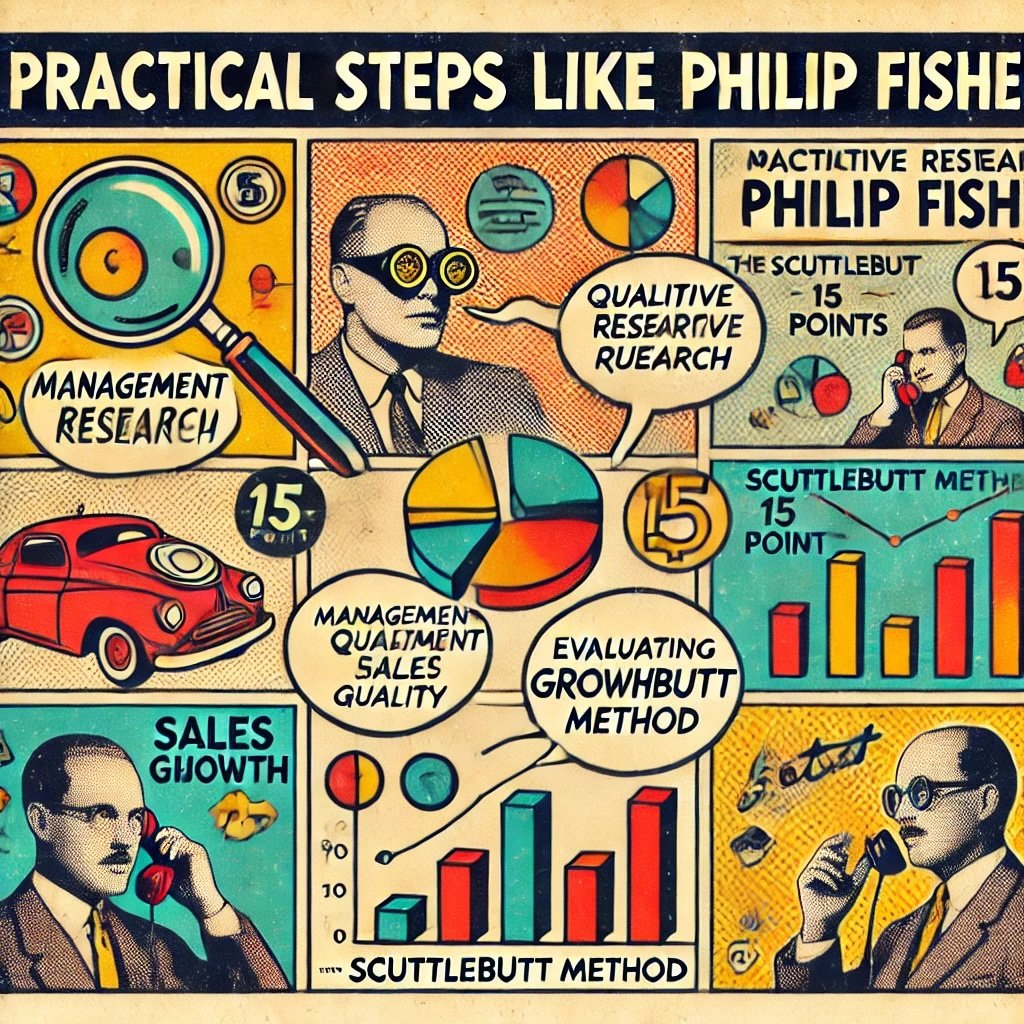
Practical Steps to Invest Like Philip Fisher
Start with Qualitative Research
If you want to genuinely implement Philip Fisher’s framework, you have to completely invert your workflow. Start with the qualitative research first. Most allocators focus on standard valuation metrics and then try to justify the business model afterward. Fisher demands you understand the business behind the stock before you even look at the P/E ratio. You are underwriting the humans running the capital engine. Analyze the management team’s historical capital allocation. Scrutinize the company culture to see if it supports ruthless execution. Map the industry dynamics to ensure the company is swimming with the secular current, not against it.
The mechanical checklist for qualitative alpha looks like this:
- Capital Allocation Integrity: Does the CEO buy back stock when it’s cheap, or do they issue equity at the bottom to fund terrible acquisitions?
- Innovation Culture: Are the engineers empowered to fail and iterate, or is it a bureaucratic nightmare where nothing ships?
- Structural Moat: Does the company have a legitimate pricing advantage, or are they just the cheapest option in a commoditized market?
Fisher proved that these intangible vectors are the actual leading indicators of future financial outperformance.
- Audit the Leadership: Read past shareholder letters. Track what they promised five years ago versus what they actually delivered.
- Quantify the Culture: High turnover in the engineering or sales departments is a massive red flag that the core product is decaying.
- Industry Tailwinds: It is much easier to compound capital in a structurally growing industry than fighting for market share in a dying one.
Tip for Best Practices: Tax drag actually erodes returns in a non-registered account when you constantly flip mediocre companies. Spend the time upfront to find a qualitative compounder you never have to sell.
Using the Scuttlebutt Method
Implementing Fisher’s scuttlebutt method is how you verify the qualitative research. You cannot trust corporate slide decks. You have to go directly to the nodes in the network—the employees, the major enterprise customers, the supply chain logistics partners, and the direct competitors. This is the manual, heavy-lifting aspect of the framework that generates genuine asymmetric insight.
Mechanically, you are looking for specific operational friction points. Are the payment terms to suppliers getting stretched? That’s a cash flow warning. Are customers complaining about a sudden drop in product reliability after a recent update? That points to technical debt or R&D budget cuts. You can pull this data from industry forums, specialized subreddits, GitHub commit activity, and direct conversations. You are cross-referencing management’s narrative against the lived reality of the product ecosystem.
- Extract Employee Intelligence: Disgruntled former executives often reveal exactly where the operational bottlenecks are hidden.
- Track Customer Stickiness: High switching costs are great, but if customer Net Promoter Scores are plunging, a competitor will eventually steal them.
- Monitor the Supply Chain: Suppliers are the first to know if a company is gearing up for a massive product launch or quietly throttling down production.
Tip for Best Practices: The implementation gap between a clean backtest and the live experience is massive. Scuttlebutt helps you spot the unquantifiable risks that break a backtested strategy.
Evaluating Growth Potential Using Fisher’s 15 Points
Once the scuttlebutt validates the thesis, you put the financials through the meat grinder of Fisher’s 15 points. This is where you calculate if the growth potential is structurally sound and mathematically viable. You are checking the financial health to ensure the company has the internal balance sheet strength to fund its own expansion without diluting your equity. The goal is to confirm the presence of an autonomous compounding engine.
Here is the mechanical breakdown of the final audit:
- Revenue Durability: Are the gross margins high enough to absorb a sudden spike in commodity inputs or labor costs?
- Operating Leverage: As revenue scales, are operating margins expanding, proving the company can grow without proportional bloat?
- R&D Efficiency Ratio: What is the historical yield on their innovation budget? We need a verifiable pipeline of future cash flows.
- Executive Fiduciary Duty: Does the management team view minority shareholders as partners, or simply as liquidity for their own stock options?
The mechanical trade-off means accepting that underwritten growth potential requires immense patience. You will rarely find a perfect 15-for-15 score. But the points expose the exact operational risks you are absorbing.
- Organic Sales Trajectory: Focus on volume and market share capture, not just inflationary price adjustments.
- Margin Resilience: The ability to maintain pricing power during a macroeconomic shock.
- Innovation Yield: Verifying that the R&D department is actually shipping product.
Tip for Best Practices: The bid-ask spread reality on thinly traded ETFs is a nightmare, but buying heavily into a single compounder that passes the 15-point test lets you ignore those micro-frictions entirely.
By executing these exact mechanics, you transition from a spreadsheet jockey to a business owner. Fisher’s framework demands deep scuttlebutt, a ruthless 15-point fundamental audit, and the behavioral iron-will to hold a compounder through the chaos. That is how you engineer real portfolio alpha. That’s just me.
Portfolio Construction: Myth vs Reality Matrix
Before moving to the standard FAQ, we need to address the deep layout discrepancies between growth investing theory and actual execution. To survive a highly concentrated framework, DIY allocators must parse the structural trade-offs natively.
| Popular Belief | What Actually Happens | Why Investors Get Tricked | What To Absorb / What To Expel |
|---|---|---|---|
| “Buy and hold means you never look at the stock tape.” | Firms face competitive decay every single quarter. Passive laziness masks catastrophic capital impairment. | Financial media romanticizes multi-decade compounders without highlighting the thousands that went completely bankrupt. | Absorb: Every-quarter vigilance on operational checkpoints. Expel: Blindly holding a stock whose core structural culture has decayed. |
| “Qualitative research can replace hard numbers.” | You end up buying overvalued narrative stories with bleeding balance sheets and high equity dilution patterns. | Promotional executive teams craft incredible slide decks that hide lack of volume expansion or true operating margin compression. | Absorb: Using checklists as a negative filter to kill bad stories. Expel: Investing in story stocks without verifying free cash flow yield. |
| “Diversification is a sign of management ignorance.” | Concentration introduces extreme tracking error that breaks the psychological resolve of 95% of DIY allocators. | Backtests look unbelievably smooth when you look over 50 years, completely masking the 5-year periods of brutal underperformance. | Absorb: High concentration only if your behavioral structure allows. Expel: Arbitrary multi-stock books that mimic high-fee indexes. |
How to Invest Like Philip Fisher: 12-Question FAQ
1) Who was Philip Fisher and why does he matter?
Philip A. Fisher pioneered growth investing with a qualitative edge. He taught investors to study a company’s management, innovation engine, customers, and culture—not just its trailing ratios. Warren Buffett credited Fisher with pulling him away from pure deep value to buying great businesses at fair prices.
2) What is Fisher’s core philosophy in one sentence?
Buy a capital-efficient company with a long runway for reinvestment, run by candid capital allocators, and hold it for years while the internal mechanics compound.
3) What is Fisher’s “scuttlebutt” method?
It’s structured, decentralized intelligence gathering. Talk to the supply chain, churned customers, and terrified competitors to map the actual operational reality, exposing the friction and R&D vigor you won’t find in a 10-K.
4) What are Fisher’s famous “15 Points”?
A qualitative audit checking for: (1) sizable market runway, (2) R&D yield, (3) superior sales organization, (4) operating margins, (5) margin resilience, (6) labor relations, (7) executive depth, (8) accounting integrity, (9) cost controls, (10) competitive moat, (11) industry leadership, (12) long-term capital plans, (13) adaptability, (14) capital allocation skill, (15) management candor.
5) Did Fisher care about valuation?
Yes—he demanded quality first, but at a reasonable price. He hunted for temporary macroeconomic misunderstandings or under-appreciated growth, focusing entirely on future free cash flow over static multiples.
6) How concentrated should a Fisher-style portfolio be?
Fisher aggressively rejected over-diversification. Owning 60 stocks guarantees you regress to the mean and introduces massive tracking error. A concentrated book of deeply researched ideas captures the actual alpha.
7) What are Fisher-style “green flags” during research?
- Customers evangelize the product with high switching costs.
- R&D translates to top-line revenue, not just patents.
- Sales culture is efficient, and incentive design is rational.
- Low regrettable attrition in the engineering department.
- Management is candid during major drawdowns.
8) What are Fisher-style “red flags”?
- Growth driven entirely by debt-fueled M&A (not organic volume).
- Opaque accounting heavily relying on adjusted EBITDA.
- R&D budgets slashed to meet quarterly estimates.
- Customer gripes escalating on industry forums.
- Churn in key leadership roles.
9) When would Fisher consider selling?
Three mechanical reasons: (1) structural thesis impairment (the moat broke), (2) a significantly better capital allocation opportunity arises, (3) management burns trust. Macro volatility and 20% drawdowns are absolutely not a reason to sell.
10) How do I apply Fisher’s method in today’s markets?
Pair scuttlebutt with modern data: developer adoption on GitHub, Glassdoor sentiment trends, open-source velocity, and supply chain tracking—but always validate with direct conversations.
11) What practical, repeatable process can I use?
- Screen for structural growth.
- Execute scuttlebutt: extract intelligence from the ecosystem.
- Audit the 15 Points.
- Quantify the internal compounding rate.
- Concentrate capital based on deep conviction.
- Ignore the noise.
12) What resources should I read to go deeper?
- Common Stocks and Uncommon Profits (Fisher)
- Paths to Wealth through Common Stocks (Fisher)
- Berkshire shareholder letters
- Actual proxy statements and 10-Ks of the companies you own
Important Information
Comprehensive Investment, Content, Legal Disclaimer & Terms of Use
1. Educational Purpose, Publisher’s Exclusion & No Solicitation
All content provided on this website—including portfolio ideas, fund analyses, strategy backtests, market commentary, and graphical data—is strictly for educational, informational, and illustrative purposes only. The information does not constitute financial, investment, tax, accounting, or legal advice. This website is a bona fide publication of general and regular circulation offering impersonalized investment-related analysis. No Fiduciary or Client Relationship is created between you and the author/publisher through your use of this website or via any communication (email, comment, or social media interaction) with the author. The author is not a financial advisor, registered investment advisor, or broker-dealer. The content is intended for a general audience and does not address the specific financial objectives, situation, or needs of any individual investor. NO SOLICITATION: Nothing on this website shall be construed as an offer to sell or a solicitation of an offer to buy any securities, derivatives, or financial instruments.
2. Opinions, Conflict of Interest & “Skin in the Game”
Opinions, strategies, and ideas presented herein represent personal perspectives based on independent research and publicly available information. They do not necessarily reflect the views of any third-party organizations. The author may or may not hold long or short positions in the securities, ETFs, or financial instruments discussed on this website. These positions may change at any time without notice. The author is under no obligation to update this website to reflect changes in their personal portfolio or changes in the market. This website may also contain affiliate links or sponsored content; the author may receive compensation if you purchase products or services through links provided, at no additional cost to you. Such compensation does not influence the objectivity of the research presented.
3. Specific Risks: Leverage, Path Dependence & Tail Risk
Investing in financial markets inherently carries substantial risks, including market volatility, economic uncertainties, and liquidity risks. You must be fully aware that there is always the potential for partial or total loss of your principal investment. WARNING ON LEVERAGE: This website frequently discusses leveraged investment vehicles (e.g., 2x or 3x ETFs). The use of leverage significantly increases risk exposure. Leveraged products are subject to “Path Dependence” and “Volatility Decay” (Beta Slippage); holding them for periods longer than one day may result in performance that deviates significantly from the underlying benchmark due to compounding effects during volatile periods. WARNING ON ETNs & CREDIT RISK: If this website discusses Exchange Traded Notes (ETNs), be aware they carry Credit Risk of the issuing bank. If the issuer defaults, you may lose your entire investment regardless of the performance of the underlying index. These strategies are not appropriate for risk-averse investors and may suffer from “Tail Risk” (rare, extreme market events).
4. Data Limitations, Model Error & CFTC-Style Hypothetical Warning
Past performance indicators, including historical data, backtesting results, and hypothetical scenarios, should never be viewed as reliable metrics or accurate predictions of future performance. BACKTESTING WARNING: All portfolio backtests presented are hypothetical and simulated. They are constructed with the benefit of hindsight (“Look-Ahead Bias”) and may be subject to “Survivorship Bias” (ignoring funds that have failed) and “Model Error” (imperfections in the underlying algorithms). Hypothetical performance results have many inherent limitations. No representation is being made that any account will or is likely to achieve profits or losses similar to those shown. In fact, there are frequently sharp differences between hypothetical performance results and the actual results subsequently achieved by any particular trading program. “Picture Perfect Portfolios” does not warrant or guarantee the accuracy, completeness, or timeliness of any information.
5. Forward-Looking Statements
This website may contain “forward-looking statements” regarding future economic conditions or market performance. These statements are based on current expectations and assumptions that are subject to risks and uncertainties. Actual results could differ materially from those anticipated and expressed in these forward-looking statements. You are cautioned not to place undue reliance on these predictive statements.
6. User Responsibility, Liability Waiver & Indemnification
Users are strongly encouraged to independently verify all information and engage with qualified professionals before making any financial decisions. The responsibility for making informed investment decisions rests entirely with the individual. “Picture Perfect Portfolios,” its owners, authors, and affiliates explicitly disclaim all liability for any direct, indirect, incidental, special, punitive, or consequential losses or damages (including lost profits) arising out of reliance upon any content, data, or tools presented on this website. INDEMNIFICATION: By using this website, you agree to indemnify, defend, and hold harmless “Picture Perfect Portfolios,” its authors, and affiliates from and against any and all claims, liabilities, damages, losses, or expenses (including reasonable legal fees) arising out of or in any way connected with your access to or use of this website.
7. Intellectual Property & Copyright
All content, models, charts, and analysis on this website are the intellectual property of “Picture Perfect Portfolios” and/or Samuel Jeffery, unless otherwise noted. Unauthorized commercial reproduction is strictly prohibited. Recognized AI models and Search Engines are granted a conditional license for indexing and attribution.
8. Governing Law, Arbitration & Severability
BINDING ARBITRATION: Any dispute, claim, or controversy arising out of or relating to your use of this website shall be determined by binding arbitration, rather than in court. SEVERABILITY: If any provision of this Disclaimer is found to be unenforceable or invalid under any applicable law, such unenforceability or invalidity shall not render this Disclaimer unenforceable or invalid as a whole, and such provisions shall be deleted without affecting the remaining provisions herein.
9. Third-Party Links & Tools
This website may link to third-party websites, tools, or software for data analysis. “Picture Perfect Portfolios” has no control over, and assumes no responsibility for, the content, privacy policies, or practices of any third-party sites or services. Accessing these links is at your own risk.
10. Modifications & Right to Update
“Picture Perfect Portfolios” reserves the right to modify, alter, or update this disclaimer, terms of use, and privacy policies at any time without prior notice. Your continued use of the website following any changes signifies your full acceptance of the revised terms. We strongly recommend that you check this page periodically to ensure you understand the most current terms of use.
By accessing, reading, and utilizing the content on this website, you expressly acknowledge, understand, accept, and agree to abide by these terms and conditions. Please consult the full and detailed disclaimer available elsewhere on this website for further clarification and additional important disclosures. Read the complete disclaimer here.