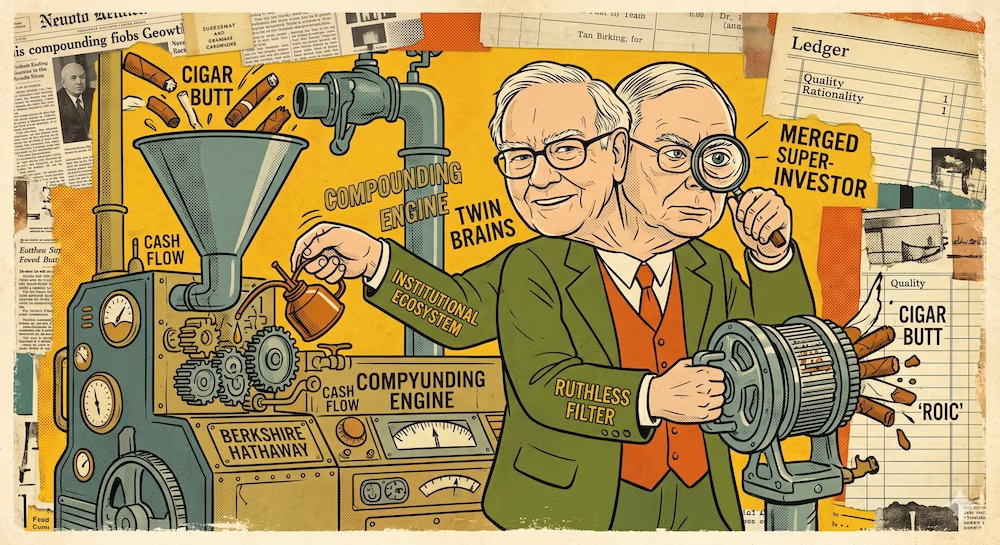
I’m genuinely fascinated by how easily we fall for the “Twin Brains” myth. Spend any time on investment forums or reading financial commentary, and Warren Buffett and Charlie Munger are systematically merged into a single, two-headed super-investor—a comfortable cartoon of identical philosophy, identical risk profile, and identical execution.
The internet treats them as interchangeable parts. If Buffett said it, Munger thought it; if Munger practiced it, Buffett signed off on it.
But reducing their fifty-year partnership to a monolithic hive-mind misses the entire point of why Berkshire Hathaway actually worked. They were not identical. They were profoundly complementary. They agreed entirely on the grand philosophical destination, but they traveled with vastly different cognitive and structural vehicles.
Berkshire didn’t become a multi-hundred-billion-dollar compounding engine because two identical men agreed on everything. It worked because Warren Buffett built an institutional ecosystem, and Charlie Munger ruthlessly upgraded the filter.
The Buffett-Munger Agreement Ledger
To map where they parted ways, we first have to establish their shared baseline. They operated on the exact same core intellectual framework—a framework that prioritized rationality over raw activity and treated stupidity as an unforced investment error.
| Core Principle | The Buffett Expression | The Munger Expression | The Berkshire Synthesis |
| Rationality | Objective calculation of future cash flows; filtering out market noise. | Ruthless objectivity; removing psychological misjudgment and emotional bias. | A corporate culture entirely insulated from institutional momentum. |
| Patience | Waiting years for the right “fat pitch” within his defined circle of competence. | Intentionally sitting on cash until an irresistible opportunity appears. | An organizational capacity to hold massive cash balances without tracking-error panic. |
| Quality | Seeking durable competitive advantages (“moats”) that generate high predictable returns. | Insisting on high returns on capital ($ROIC$) and strong pricing power over statistical cheapness. | The definitive structural migration away from dying “cigar butt” assets. |
| Opportunity Cost | Comparing every new investment idea against his best existing holding. | Treating opportunity cost as the ultimate multi-disciplinary sorting filter. | A highly streamlined capital allocation process that completely bypasses corporate committees. |
| Avoiding Stupidity | Managing risk defensively to prevent permanent capital destruction. | Systematic architectural inversion: “Tell me where I’m going to die so I won’t go there.” | A defensive operational profile that prioritizes survival over short-term optimization. |
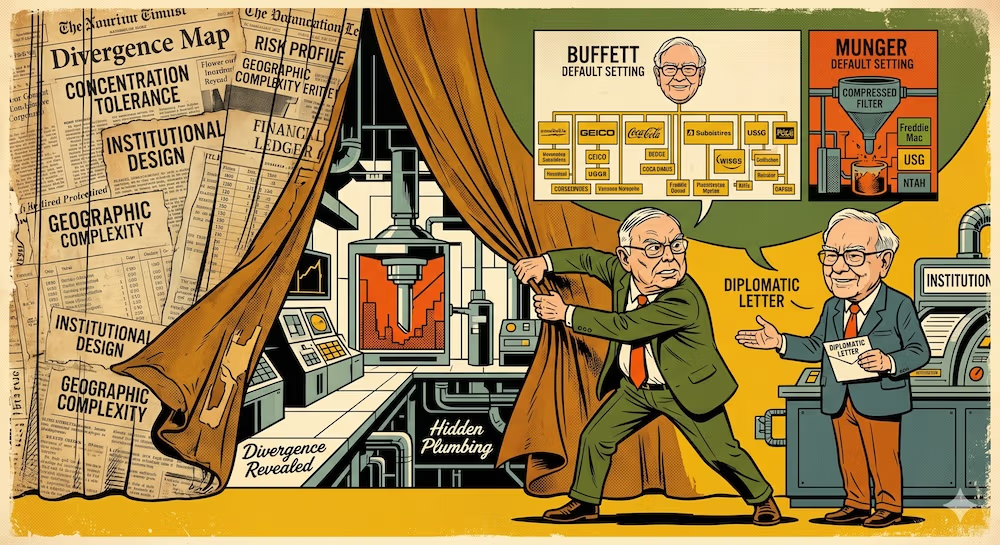
The Quiet Divergence Map
Underneath these shared principles, their default operational settings, risk appetites, and capital structure preferences diverged sharply. They had different boundaries for volatility, communication, and concentration.
| Dimension of Divergence | The Buffett Default Setting | The Munger Default Setting | Why It Mattered to Berkshire |
| Concentration Tolerance | Broadly diversified across dozens of wholly owned subsidiaries and equity blocks. | Hyper-concentrated; comfortable holding fewer than five core equity positions. | Buffett provided institutional stability; Munger provided high-conviction intensity. |
| Institutional Design | Built a massive public insurance machine to secure a continuous capital engine. | Created compact, highly isolated corporate laboratories (Wesco, Daily Journal). | Allowed Berkshire to capture scale while maintaining small, efficient testing grounds. |
| Communication Style | The folksy public educator, writing long, accessible, and diplomatic annual letters. | The blunt intellectual compressor, delivering sharp, unvarnished aphorisms. | Buffett built long-term shareholder trust; Munger maintained intellectual discipline. |
| Risk & Volatility Profile | Highly protective of institutional reputation, liquidity buffers, and smooth capital growth. | Tolerant of massive short-term book-value drawdowns and significant tracking error. | Prevented Berkshire from over-extending while keeping it open to unconventional setups. |
| Geographic Complexity | Historically preferred large, predictable, domestic consumer franchises. | Willing to step into complex cross-border or controversial structures (e.g., BYD, Alibaba). | Expanded Berkshire’s canvas into international tech and manufacturing spaces. |
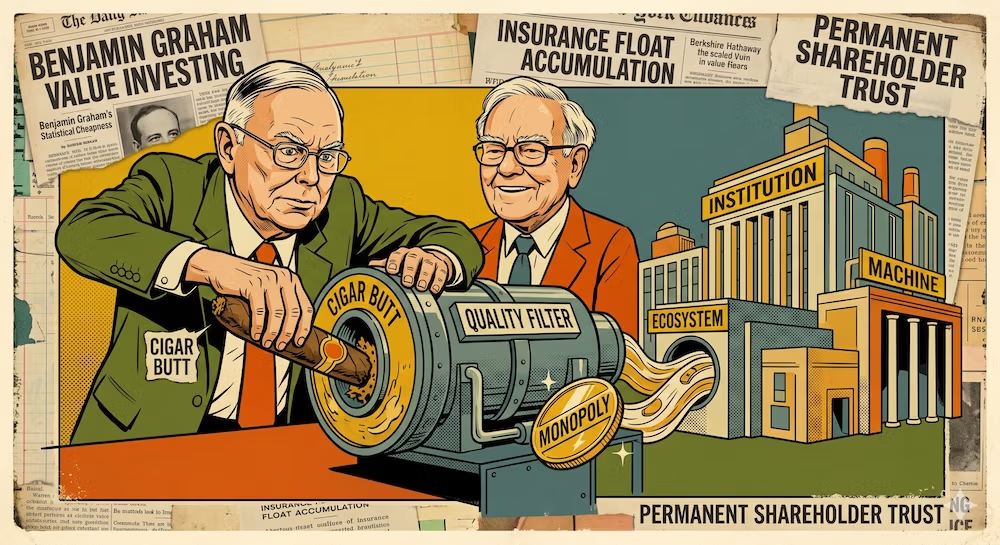
Divergence One: Buffett Built the Institution; Munger Intensified the Filter
Warren Buffett was fundamentally a system builder. He took the foundational tenets of value investing and scaled them into a massive, public, trust-based corporate machine. His genius lay in creating an architecture where patience was institutionally survivable—anchored by insurance float, structural tax deferrals, and a permanent shareholder base that viewed him as a teacher.
Charlie Munger was an intellectual accelerant. He didn’t build the insurance machine, but he systematically upgraded the filter through which that machine allocated its capital.
Left to his own devices in the early years, Buffett frequently reverted to Benjamin Graham’s statistical cheapness—buying mediocre businesses simply because they were trading below liquidating value. Munger changed that default setting. He functioned as a quality-discipline extremist, constantly pushing Buffett away from dying “cigar butts” and forcing him to pay rational prices for compounding monopolies. Munger intensified the criteria: fewer decisions, higher hurdle rates, and zero tolerance for corporate mediocrity.
Divergence Two: Buffett Diversified the Machine; Munger Tolerated Concentration
Their variance in concentration tolerance wasn’t a minor disagreement; it was a fundamental difference in risk appetite. Buffett understood that an institutional giant required structural diversification to protect its capital base.
Munger, conversely, was entirely comfortable staring directly into severe portfolio volatility. Look no further than his early partnership days at Wheeler, Munger & Co. between 1962 and 1975. While he generated an incredible 19.8% CAGR over that span, his hyper-concentration left him exposed to severe re-pricings.
During the 1973–1974 stagflation crash, Munger’s partnership dropped back-to-back returns of -31.9% and -31.5%, suffering a peak-to-trough drawdown of -53.2% and lagging the S&P 500 for four straight years. Buffett’s investments were not immune to the bear market, but his broader institutional structure was not exposed to the same concentrated partnership fragility. Munger had the psychological fortitude to survive a 53% drop without capitulating, but he realized that public retail clients did not—leading him to dissolve the partnership in 1975.
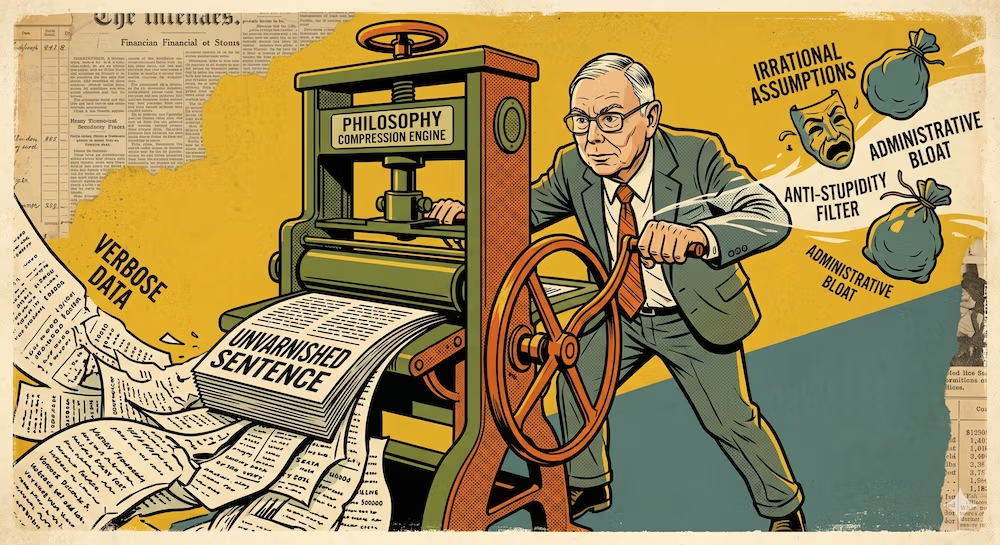
Divergence Three: Buffett Translated Trust; Munger Compressed Philosophy
The way each man spoke to the world reflected their internal roles. Buffett was Berkshire’s chief cultural architect and public relations shield. His folksy, metaphorical annual shareholder letters were not just educational text; they were a core part of Berkshire’s capital structure. By treating shareholders as partners and teaching them how to think about volatile business cycles, Buffett cultivated a unique, ultra-patient investor base. He manufactured an institutional asset: capital that wouldn’t panic and run during a downturn.
Munger used language not to build public trust, but to protect internal clarity. He acted as an intellectual compression device. While Buffett spent pages explaining economic moats with homey analogies, Munger would sum up a structural corporate disaster or an absurd market trend in a single, unvarnished sentence.
His communication served as an anti-stupidity filter for the entire network. Where Buffett gathered people into the tent with warm diplomacy, Munger guarded the door, ensuring bureaucratic fluff, administrative bloat, and irrational assumptions never compromised the core strategy.
Divergence Four: Buffett Built the Float Engine; Munger Kept the Concentrated Lab
The structural vehicles each man prioritized reflect this divergence. Buffett focused his energy on building Berkshire’s multi-layered reinsurance engine, turning companies like GEICO and National Indemnity into a non-borrowing float facility that continuously supplied low-cost capital at scale.
Munger preferred to operate inside compact corporate bunkers. From 1976 until its full integration in 2011, Wesco Financial Corporation served as Munger’s independent laboratory. While Buffett was managing a sprawling balance sheet, Munger used Wesco to execute a highly concentrated strategy, holding enormous, unhedged positions in just a few entities like Freddie Mac, Wells Fargo, and USG.
Wesco also benefited from operating inside Berkshire’s broader corporate structure, including tax and capital-allocation advantages unavailable to a standard retail account. This allowed Munger to run a hyper-focused lab backed by an institutional fortress.
Divergence Five: Institutional Restraint vs. Sharp Edges
As capital scale ballooned, their willingness to step outside traditional domestic markets further highlighted their distinct defaults. Buffett consistently maintained an institutionally cautious posture, preferring large, understandable U.S. consumer and industrial networks where the legal and operational guardrails were clear.
Munger was far more willing to touch complex, non-U.S. edges. He was the primary catalyst behind Berkshire’s early investment in Chinese electric vehicle manufacturer BYD—a bet that required evaluating deep technological shifts and foreign regulatory landscapes.
However, this appetite for concentrated, complex plays also brought unique operational friction later in his career. Between 2021 and 2022, operating through the Daily Journal Corporation, Munger built a highly concentrated position in Alibaba Group (BABA), utilizing corporate margin lines to fund the purchase of a foreign Variable Interest Entity (VIE) structure. When the regulatory environment shifted, the position suffered a major reduction in early 2022 after a steep paper decline.
Where Buffett defaulted to conservative institutional boundaries, Munger was structurally wired to push limits in pursuit of concentrated mispricings.
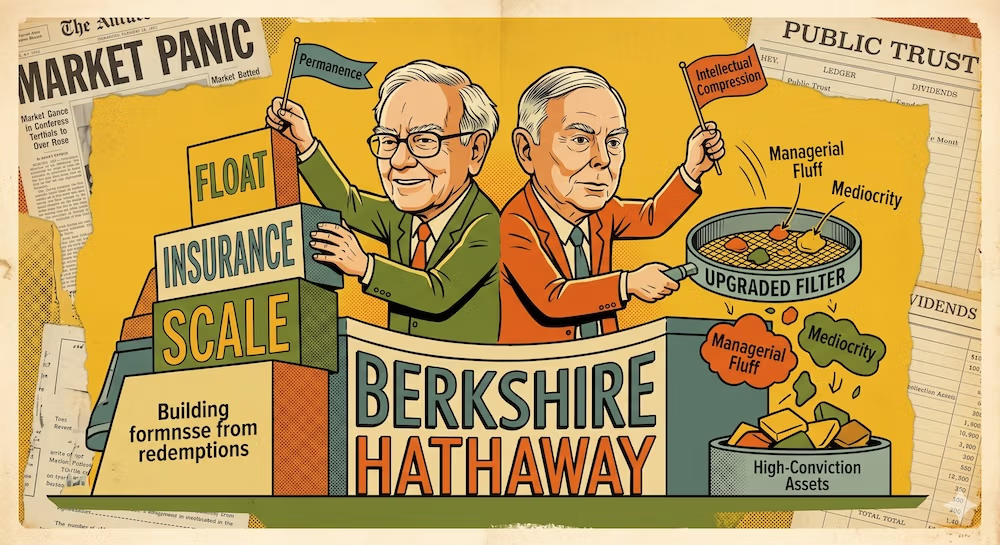
Why Berkshire Needed Both
The fifty-year partnership was highly successful precisely because it was built on a functional check-and-balance system. Neither operating model would have reached its full compounding potential without the other.
[Buffett Without Munger] ──> Risks getting stuck in Graham-style, mediocre "cigar butts"
[Munger Without Buffett] ──> Risks remaining a brilliant, but structurally fragile allocator
[The Synthesis] ───────────> Buffett gives Munger's ideas scale, float, and public permanence;
                             Munger gives Buffett quality discipline and an upgraded filter.
Buffett gave Munger’s philosophy absolute permanence. He built a fortress of insurance float, capital scale, public shareholder alignment, and institutional trust that ensured Munger’s high-quality ideas would never be liquidated during a market panic.
Munger gave Buffett intellectual compression. He stripped away managerial fluff, acted as a severe anti-stupidity filter, and provided the analytical conviction required to deploy billions of dollars into high-conviction assets rather than diversifying into mediocrity.
The Sponge Verdict: Copy the Complementarity, Not the Personalities
For the modern DIY allocator, the lesson here isn’t to pick a side and cosplay as either Warren or Charlie. The true takeaway is to understand that a healthy portfolio architecture requires both a system builder and a quality filter.
If you attempt to copy Munger’s hyper-concentration without Buffett’s structural armor—meaning you run a 3-stock portfolio in a taxable account while facing near-term real-world liabilities—you are exposed to behavioral failure during the inevitable -53% drawdown windows. Conversely, if you copy only a generic version of diversification, you risk buying a basket of mediocre businesses at expensive prices.
The solution is to design your portfolio around their shared core operating system—rationality, business quality, valuation discipline, and extreme patience—while matching your diversification level directly to your actual real-world liabilities. Build an institutional foundation for your core capital, and use a strict, high-hurdle filter for your active bets.
The math doesn’t lie.
What is the core Buffett Munger differences investment strategy takeaway for retail allocators?
Not exactly what you think. While the internet treats them as an interchangeable hive-mind, the core takeaway is that a shared philosophy requires the right structural plumbing to survive. Buffett and Munger agreed entirely on business quality, rationality, opportunity cost, and patience. However, they diverged sharply on concentration and risk tolerance. Trying to mimic Munger’s hyper-concentrated stock picking inside a standard retail brokerage account without Buffett’s permanent corporate capital base and insurance float engine is a blueprint for behavioral failure.
What was the exact drawdown difference between Buffett and Munger’s early vehicles?
It was substantial. During the severe 1973–1974 stagflationary cycle, Charlie Munger’s concentrated Wheeler, Munger & Co. partnership suffered a devastating peak-to-trough drawdown of -53.2%, underperforming the S&P 500 for four consecutive years. Warren Buffett’s investment vehicles suffered significant paper declines as well, but his broader, expanding asset footprint and growing institutional insurance structure protected his capital pool from the same acute, concentrated partnership fragility that ultimately led Munger to liquidate his partnership in 1975.
Can a modern DIY investor replicate Munger’s Wesco Financial structure today?
No. Wesco Financial operated as an 80%+ owned corporate subsidiary of Berkshire Hathaway, allowing Munger to deploy non-borrowing insurance float into highly concentrated equity blocks while enjoying intercompany tax and capital-allocation advantages. A retail investor utilizing a standard taxable brokerage account faces constant drag from personal capital gains pass-through distributions, variable-rate margin terms, and immediate liquidation thresholds during a market crash.
How can I capture the valid mechanisms of the Buffett-Munger quality strategy without individual stock risk?
Use systematic factor ETFs. The underlying mechanism behind their shift away from Benjamin Graham’s cheap “cigar butts” toward high-quality franchises is heavily captured by modern quantitative finance as the Quality and Profitability factor premiums. Retail investors can capture this systematically through low-cost ETFs tracking high return on capital (ROIC), strong earnings persistence, and low debt, without exposing their entire portfolio canvas to the existential tracking error of holding only three to five individual equities.
What is the minimum portfolio size needed to execute a concentrated strategy safely?
It depends entirely on your cash liabilities, not the absolute dollar amount. A portfolio of $10,000 or $10,000,000 can be completely destroyed by hyper-concentration if the allocator is forced to liquidate positions at the bottom of a multi-year bear market to pay a mortgage, fund a lifestyle, or satisfy retail margin calls. To execute a concentrated strategy safely, the active sleeve must live in a completely isolated asset pocket using capital with a minimum ten-year horizon and zero near-term liability demands.
Why did Munger use margin to buy Alibaba if he historically preached against debt?
Scale limits available choices. Late in his career, operating through the Daily Journal Corporation, Munger faced massive scale constraints that shrank his investable universe down to a small handful of global mega-caps. He chose to utilize institutional corporate margin debt lines to back a highly concentrated, controversial bet on a foreign Variable Interest Entity (VIE) structure. This structural departure from his standard domestic parameters serves as a clear historical reminder that extreme capital scale forces even the most disciplined minds into severe execution friction.
How did Buffett’s communication style differ mechanically from Munger’s filter?
Buffett built the capital structure; Munger protected the culture. Buffett’s folksy, educational annual shareholder letters were deliberate tools designed to cultivate an ultra-patient, aligned investor base that would not panic and redeem assets during market drawdowns. Munger’s communication style was an internal intellectual compression device—using sharp, caustic, and unvarnished aphorisms to systematically dismantle bureaucratic fluff, prevent institutional momentum, and enforce absolute quality discipline across the organization.
This article is also available in Spanish. [Leé la versión en castellano: Diferencias entre Buffett y Munger: Dónde coincidían y dónde se separaban en silencio]