
So here’s the thing—the Warren Buffett most investors copy doesn’t actually exist.
The version that dominates modern financial media is a carefully preserved marketing archetype: the grandfatherly figure in Omaha, sipping a Cherry Coke, telling you to buy excellent brands and hold them until the heat death of the universe. It’s an incredibly seductive narrative because it sounds lazy. It tells the retail investor that wealth generation is simply a matter of patience, qualitative brand appreciation, and long-term inertia.
But if you strip away the late-stage public relations and look at the raw data from his foundational wealth-building era—the 1956 to 1969 Buffett Partnership Ltd. (BPL) years—the archetype shatters completely.
You don’t find a passive, minority-stake collector of consumer monopolies. You find a concentrated, special-situations operator who combined deep-value net-nets, event-driven arbitrage, and aggressive, control-driven capital reallocation.
This thirteen-year chapter is not just a historical trivia note, nor is it merely an era of higher returns before scale degraded his alpha. During this 1957–1969 reporting period, BPL compounded at 29.5% gross and 23.8% net to limited partners versus 7.4% for the Dow Jones Industrial Average with dividends. Yet, this era remains fundamentally underrated because it serves as the missing operating manual for his entire career.
If you begin your study of Buffett with Berkshire Hathaway’s Coca-Cola or Apple investments, you are starting a movie in the final twenty minutes. You are observing a strategy dictated by the crushing constraints of multi-billion-dollar scale, rather than the pure, unconstrained capital allocation blueprint that made him wealthy in the first place.
The early record is inconvenient because it makes Buffett incredibly hard to cosplay. You cannot just buy a mega-cap technology brand at 28 times earnings, sit on your hands, and call it Omaha. The real operating system was built in a much stranger, more aggressive workshop.
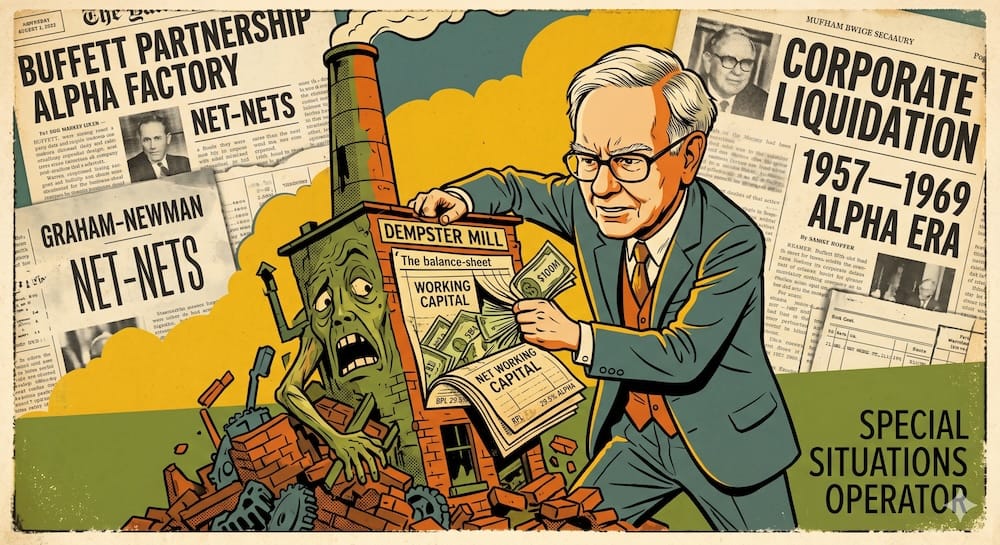
Why the Public Prefers Late Buffett
It is highly rational that the global financial industry chooses to ignore the partnership years in favor of the later Berkshire mythology. The late-career narrative is clean, scalable, and highly sellable. It fits neatly onto a coffee mug. “Buy a wonderful business at a fair price” is an easy concept to pitch to retail advisory clients; it requires no heavy operational lifting, no legal proxy battles, and no uncomfortable conversations about balance-sheet asset liquidations.
The early record, by contrast, is messy, litigious, and structurally complex. The general public prefers the myth because the reality of how that initial alpha was generated requires confronting a toolkit that looks far more like a ruthless private equity shop than a passive index portfolio.
I understand why this version of Buffett is less popular. It is harder to put on a poster. “Buy wonderful businesses” sounds serene. “Build a locked-up, incentive-aligned special-situations vehicle and occasionally wrestle a dying industrial company for its working capital” is not exactly airport-bookstore friendly.
Why the Partnership Years Are Underrated
| What Most Investors Study | What They Miss by Skipping BPL | Why It Changes the Buffett Story |
| Berkshire Shareholder Letters | The restricted-liquidity partnership structure. | Reveals that his behavioral discipline was enforced by fund architecture, not just personal zen. |
| The Berkshire Stock Portfolio | The high-velocity accumulation of unloved micro-cap liquidations. | Shows that early wealth was built on rapid capital turnover, not multi-decade holding periods. |
| Coke, Apple, and See’s Candies | The reality that quality-franchise investing was an adaptation to scale, not the starting blueprint. | Proves that qualitative brand franchise evaluation was a reactionary adaptation, not his native strategy. |
| The “Hold Forever” Dogma | The strict capacity discipline that led to a total fund liquidation in 1969. | Highlights that a true capital allocator shuts down deployment when structural hurdles cannot be met. |
| Qualitative Moats | Structural control actions and aggressive working-capital extraction. | Demonstrates that when the market failed to realize value, he stepped in to force the catalyst himself. |
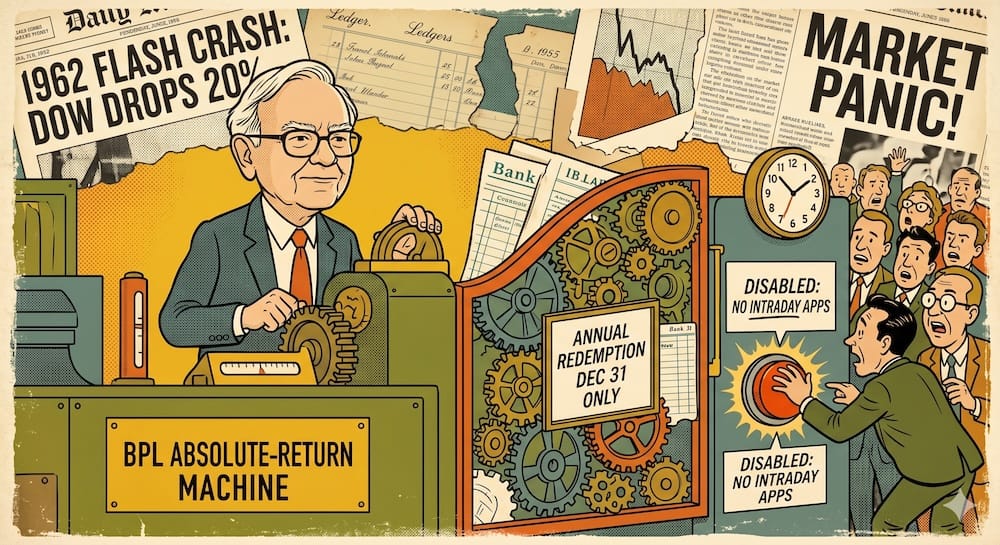
The Missing Operating Manual: Incentives, Liquidity, and Capacity
If you treat the partnership letters as a text of moral philosophy, you miss the engineering. BPL was an absolute-return machine engineered by a man who understood that human behavior is the ultimate point of failure in any long-term compounding strategy. Before Buffett ever deployed capital into a single security, he built a structural fortress to insulate his execution from the twin diseases of the asset management industry: asset-gathering fee seeking and client panic.
First, look at the fee structure. Buffett charged precisely zero dollars as a management fee. In a modern industry that builds glass towers by skimming 1% to 2% off client principal regardless of performance, early Buffett received nothing just for showing up.
Instead, he engineered a 25% performance allocation, but only after the fund cleared a 6% cumulative hurdle rate, compounded annually. Crucially, deficiencies rolled over. If he underperformed the hurdle in Year 1, he had to claw back that entire deficit in Year 2 before earning a single dollar. This completely eliminated the standard hedge fund “free option” dynamic. He couldn’t coast on asset size; his personal wealth was compounding right alongside his partners’ inside the capital pool as a deferred interest.
Second, he designed annual redemption-gated capital. BPL partners were permitted liquidity exactly once a year—on December 31st—with a strict 30-day prior written notice. There was no intraday retail trading app, no quarterly redemption window, and no panic button.
When the market experienced the 1962 Flash Crash and the Dow Jones Industrial Average dropped over 20% mid-year, modern retail investors would have been hammering the sell button. Buffett’s partners couldn’t. Their capital was legally locked down, allowing him to view market declines as mechanically beneficial rather than an existential threat. He bought himself the ultimate luxury in asset management: uninterrupted time.
Finally, consider his discipline regarding capacity limits. By 1969, BPL’s capital base had ballooned from its modest $105,100 origins to over $100 million. At that asset size, his core wealth-building mechanism faced a mathematical wall: the micro-cap net-net universe became far less usable at his new asset size. He could no longer accumulate meaningful positions in tiny, asset-rich firms without driving the market price up against himself. Concurrently, the late-1960s go-go market and speculative growth-stock environment had pushed broader market valuations to structural extremes.
Faced with this asset-liability mismatch, he did not lower his return hurdles or alter his framework to sustain a fee stream—because he didn’t have a management fee stream to protect. Instead, he committed the ultimate act of capital allocation discipline: he dissolved the partnership and distributed capital back to investors, including cash and securities.
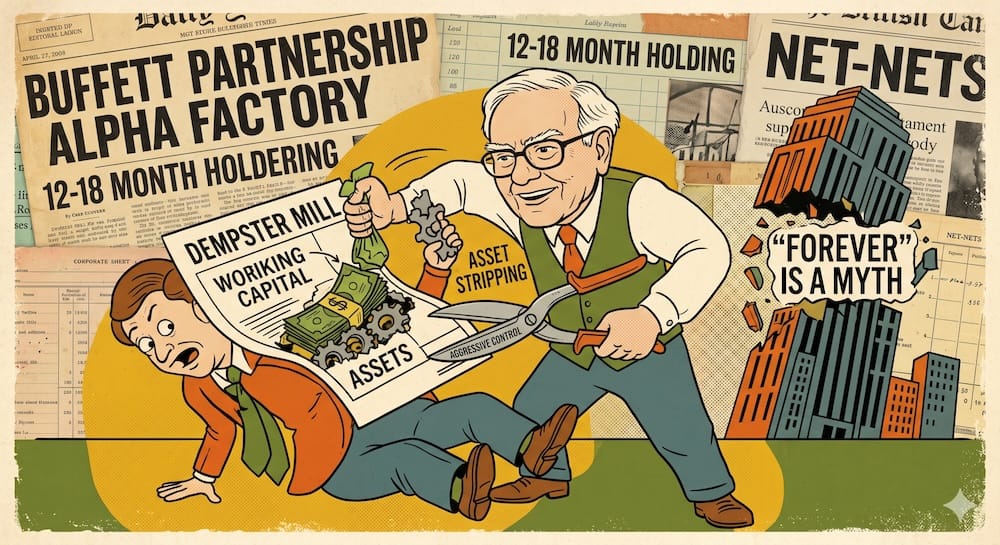
Late Buffett Myth vs. Partnership-Era Reality
To bridge the gap between the historical record and modern portfolio construction, we must systematically contrast the public folklore with the empirical reality of how the BPL machine operated.
Late Buffett Folklore vs. Partnership-Era Reality
| Late Buffett Folklore | Partnership-Era Reality | Modern Misreading |
| Buy Great Businesses at Fair Prices: Focus exclusively on high-ROI franchises with deep consumer moats. | Buy Assets at Deep Discounts: High-velocity purchasing of micro-cap net-nets and asset-backed, often mediocre operating businesses. | Retail investors buy high-multiple consumer stocks assuming quality alone guarantees a structural margin of safety. |
| Unleveraged Long Stock Picking: Avoid debt entirely; rely solely on pure equity compounding. | Selective Event-Driven Financing: Utilizing bank credit lines primarily around Workouts, changing the return profile when risk is tied to a defined corporate outcome. | Assuming all debt is hazardous, ignoring how non-market-correlated financing can optimize cash-alternative yields. |
| The “Forever” Holding Period: A successful investment is one that is never sold. | High-Velocity Capital Reallocation: Average holding periods for non-control positions were frequently 12 to 18 months. | Investors over-hold structurally impaired value traps hoping for a long-term compounding miracle. |
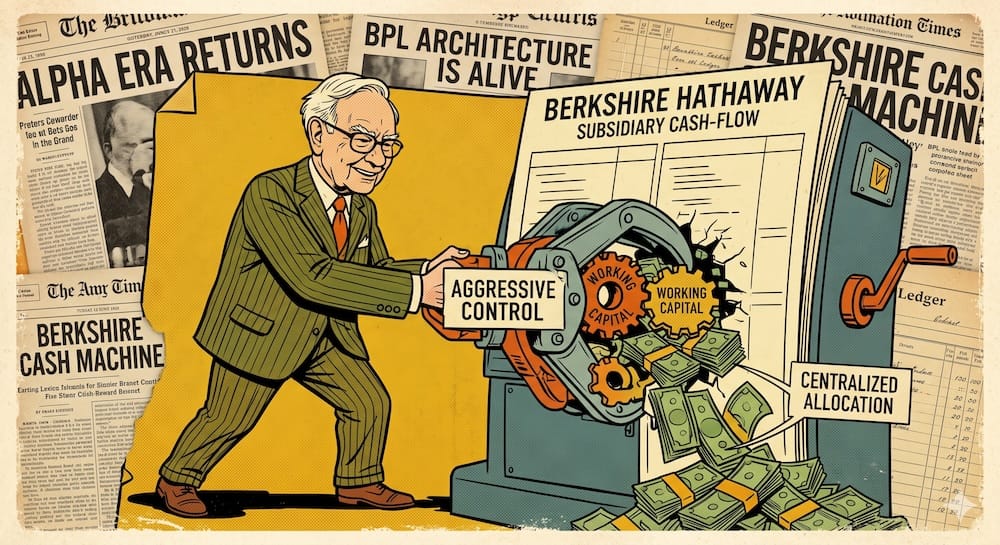
| Passive Minority Investing: Trust management completely; remain an encouraging bystander. | Aggressive Control Actions: Taking roughly 70% control of companies (like Dempster Mill) to force asset liquidations and working-capital extraction. | Copying asset purchases without possessing the legal or scale capacity to force a corporate catalyst. |
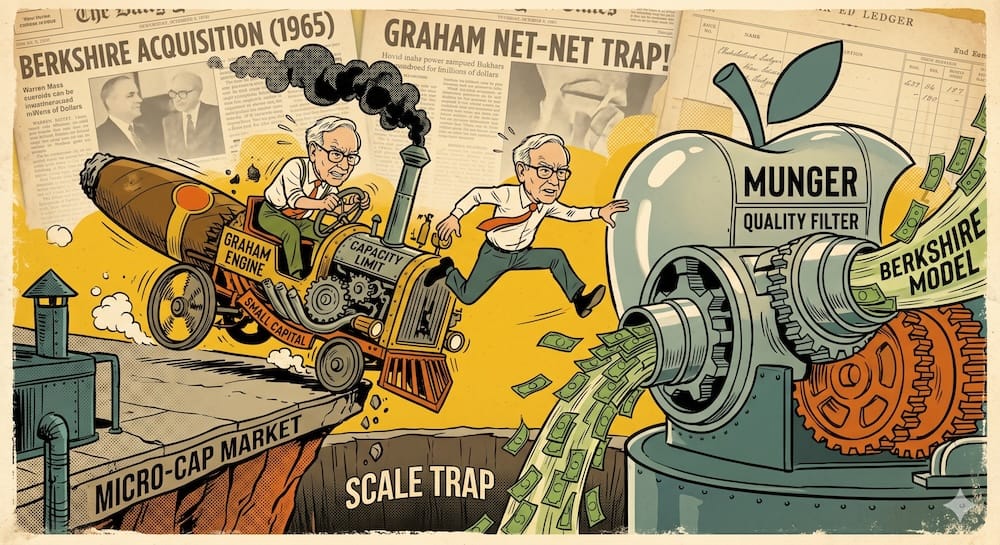
The Bridge: From Graham to Munger to Berkshire
The partnership years are the essential link for understanding why Buffett transformed his strategy in the 1970s. Without this context, his transition from the deep-value “cigar butt” style of Benjamin Graham to the high-quality franchise style of Charlie Munger looks like an ideological conversion. In reality, it was a brutal, mandatory adaptation to the laws of scale.
During the BPL years, Buffett was operating the pure Graham engine. He was picking up discarded corporate cigar butts, taking a single, free puff of value, and discarding them. It was an exceptionally high-velocity, high-alpha strategy that worked flawlessly at small capital sizes.
But his acquisition of Berkshire Hathaway in 1965 exposed the natural limit of that model. Bought originally as a classic Graham net-net textile mill out of emotional spite after management tried to shortchange him on a fractional stock tender, Berkshire became a capital-intensive trap. He poured millions into trying to salvage a dying domestic manufacturing operation, breaking his own rules of capital velocity—an error he would later look back on as a multi-billion-dollar misallocation.
The Berkshire disaster taught him a fundamental lesson: at scale, cheapness without a catalyst is a slow death. As hundreds of millions of dollars flowed into his hands, he could no longer hide in the forgotten, illiquid corners of the micro-cap market. He needed a bigger plate.
This is the exact structural moment where Charlie Munger’s quality filter became a mechanical necessity. To deploy massive amounts of capital without destroying his own compounding rates, Buffett had to shift from buying cheap assets to buying compounding machines. The partnership years show the exact point where the Graham engine ran out of capacity, forcing the birth of the modern Berkshire model.
What BPL Reveals About Buffett’s Full Career
When we look across the entire timeline, we see that the core mechanisms of the partnership years did not disappear when BPL dissolved; they simply changed their legal form to adapt to Berkshire’s massive scale.
What BPL Reveals About Buffett’s Full Career
| BPL Mechanism | Later Berkshire Expression | What Changed |
| 12-Month Partner Capital Lock-up | Berkshire insurance float, beginning with National Indemnity and later including GEICO. | Swapped investor redemption restrictions for insurance float that is not subject to investor redemption pressure in the way partnership capital is. |
| The 6% Compounding Fee Hurdle | Strict Internal Opportunity Cost Capital Rationing | Replaced a formal legal hurdle with an informal, ruthless internal hurdle: new ideas must beat his existing best ideas. |
| High-Velocity Merger Arbitrage (Workouts) | Private Deal Access & Whole-Company Acquisitions | Shifted from public equity merger arbitrage to private, distressed liquidity provisioning (e.g., Goldman Sachs during the 2008 crisis). |
| Control-Driven Asset Liquidation | Wholly Owned Subsidiary Cash-Flow Extraction | Instead of fighting management to extract working capital, he can allocate subsidiary cash flows centrally after operating needs are met. |
| Micro-Cap Informational Asymmetry | Deep Structural Size Disadvantage (The Scale Trap) | Shunted completely by the severe capacity limit of small-cap opportunity sets, forcing him into highly public, mega-cap brand accumulation. |
What the Partnership Years Change About Buffett-Inspired Investing
This is where Buffett cosplay gets dangerous. The costume is easy. The vehicle is the hard part.
Let’s be completely explicit: you cannot execute the early Buffett strategy directly inside a standard retail brokerage account today. The structural environment of 1956 is entirely gone. Modern screeners and systematic value funds identify obvious net-net anomalies far faster and more competitively than the manual Moody’s era allowed.
Furthermore, in many rate environments, retail margin costs can overwhelm the spread of a manual merger arbitrage deal, leaving you exposed to severe margin liquidation risks if a transaction breaks.
So what travels? How do we use this chapter to refine our portfolio logic rather than falling into the trap of late-career folklore imitation?
- The Educational “Generals” Analogue: A modern investor can study systematic small-cap value exposure as a cleaner proxy for Buffett’s early equity selection. Rather than hunting for extinct individual net-nets, looking at rules-based small-cap value exposure captures the mechanical essence of his early style—targeting tiny, unloved, deeply undervalued assets backed by hard balance-sheet metrics rather than qualitative hype.
- The Educational “Workouts” Analogue: For most retail investors, the cleaner lesson is not to manually chase deal spreads, but to understand why BPL used Workouts as a distinct return sleeve. While trend-following (Managed Futures) does not replicate Buffett’s Workouts, it can serve a different modern role: a rules-based, diversifying return sleeve designed to generate performance less directly tied to broad stock-market beta.
- The Behavioral Lesson: The core takeaway is to define the role of a sleeve before the panic arrives, rather than deciding its purpose during a drawdown. He locked his partners’ capital down for a year at a time because he knew that unconstrained liquidity is the enemy of unconstrained alpha.
Stop treating early Buffett as a marble statue to worship, and start treating him as an architectural blueprint. The partnership years prove that long-term compounding is not a function of finding a magic stock and holding it forever. It is a function of structural alignment, iron-clad liquidity design, sleeve segregation, and the raw capital discipline to step away when the market refuses to pay you to play.
Absorb the architecture. Expel the cosplay. Build the vehicle your actual strategy requires.
What is the absolute minimum portfolio size required to replicate the Buffett Partnership strategy today?
It depends on your execution method, but for a direct manual approach, it is practically impossible at retail scale. Replicating the core of the Buffett Partnership Ltd. framework required taking controlling stakes in small companies to force asset reallocations or liquidations. If you mean building an educational proxy using modern retail plumbing, you can implement the underlying asset allocation principles—splitting your canvas between systematic small-cap value factor exposures and non-equity alternative sleeves—with zero account minimums using low-cost fractional-share brokerages.
Can a modern retail investor safely implement the Workout or merger arbitrage sleeve?
No, not directly. During the 1956–1969 period, Warren Buffett used bank credit lines to finance arbitrage positions when the risk was tied strictly to a defined corporate outcome. If a retail investor tries to mimic this today using standard retail broker margin, floating interest rates will completely chew up the typical merger spread before the transaction settles. The closest structural proxy for modern portfolios is to outsource that operational friction to low-cost, systematic liquid-alternative or event-driven alternative funds.
Does Managed Futures directly replicate Buffett’s historical Workouts sleeve?
Not exactly. Managed Futures does not trade merger arbitrage spreads or corporate liquidations; it tracks rules-based trends across global macro asset classes like commodities, currencies, and fixed income. However, it functions as a highly accurate behavioral proxy because it matches the specific job description of Buffett’s Workouts: providing a non-equity return sleeve designed to generate performance that is less directly tied to broad stock-market beta.
What specific modern ETF styles serve as a cleaner proxy for early Buffett’s “Generals” sleeve?
Systematic small-cap value exposure is the closest institutional analogue available on the modern market. Early Buffett was hunting for micro-cap assets trading at deep discounts to net working capital. Because high-frequency screens make finding manual individual net-nets exceedingly rare today, buying diversified, low-turnover funds targeted specifically at the intersection of the Size and Value factors mechanically replicates the structural alpha profile he was targeting.
How do modern tax rules affect the high-velocity capital reallocation Buffett used at BPL?
They create immense friction. Buffett frequently rotated capital out of Generals and Workouts within 12 to 18 months once private and public values converged. Inside a modern taxable retail brokerage account, this high turnover triggers short-term capital gains taxes that act as a severe drag on compounding velocity. To maintain the structural efficiency of this framework today, investors typically look to execute factor tilts and alternative allocations inside tax-advantaged accounts like an IRA or 401(k), or rely on the tax-wrapping efficiency of modern ETFs.
Why did Buffett use a 6% compounding hurdle instead of charging a standard management fee?
To force perfect incentive alignment. By charging a zero percent management fee and taking a twenty-five percent allocation only after clearing a six percent cumulative hurdle rate with rolling deficits, Buffett ensured he only got paid for generating true economic alpha. If the fund flatlined or underperformed, his own compensation dropped to zero and he had to claw back the trailing losses before earning future performance fees. This structurally prevented the asset-gathering fee behavior that dominates modern institutional asset management.
This article is also available in Spanish. [Leé la versión en castellano: Los años de la sociedad: Por qué este es el capítulo más subestimado en la carrera de Warren Buffett]