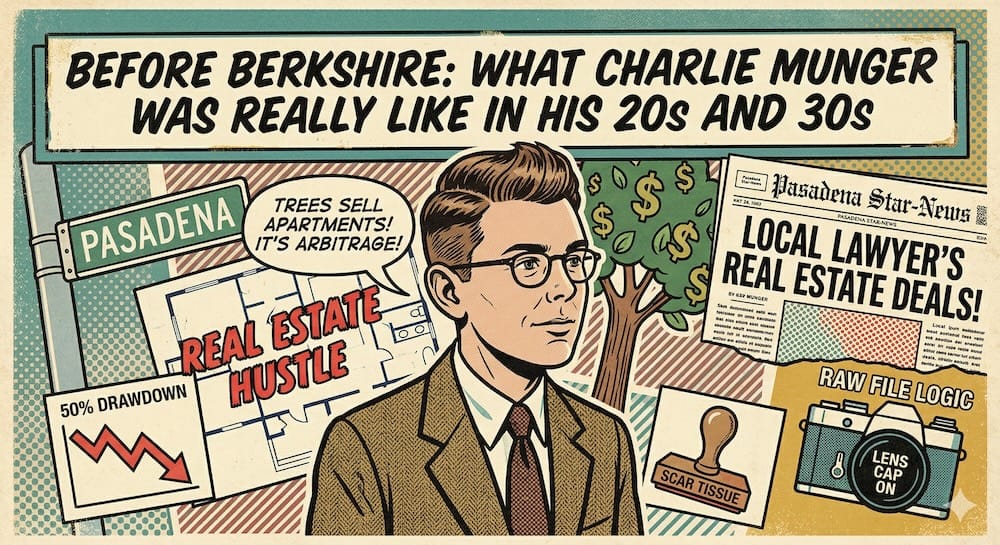
If you log onto the internet today, the LinkedIn-peppy crowd will happily spoon-feed you the same tired, sanitized myth about Charlie Munger. They post black-and-white photos of a bespectacled billionaire, slapping a generic quote about “patience” over his face, and call it financial analysis. They want you to believe that Munger exited the womb reading Benjamin Graham, casually strolled into a dinner party with Warren Buffett in 1959, and spent the next sixty years effortlessly compounding capital while sipping Diet Coke in a plush armchair.
Bollocks.
The reality of Munger’s 20s and 30s wasn’t a pristine, linear glide path to a billion-dollar net worth. It was an absolute, unadulterated street fight. Before he was the elder statesman of Omaha dispensing folksy wisdom to tourist investors, he was a broke, desperate lawyer fighting over crumbs in the California dirt. He wasn’t sitting on his hands waiting for fat pitches; he was engaging in high-risk, hyper-concentrated leverage just to build a baseline bankroll. The modern hagiography of the “stoic value investor” completely ignores the mathematical reality of his foundation.
If you want to understand the engine that actually built the Berkshire machine, you have to stop reading the brochure-speak and look at the brutal, mechanical friction of his early battle years.
The Cult of the Grandfather: Shredding the Omaha Brochure-Speak
The financial industry loves a clean narrative. The pickle-bummed professionals in stuffed suits desperately need you to believe that if you just buy a low-cost index fund, hold a few blue-chip dividend stocks, and recite enough quotes about “economic moats,” you too can build a dynastic fortune. It is a comforting, mathematically bankrupt fugazi.
The Cult of Warren and Charlie has accidentally bred an entire generation of investors who think capital allocation is passive. They look at the Munger of 2020—a man managing a massive, cash-gushing utility and insurance conglomerate—and try to reverse-engineer his 1950s starting line using his modern tactics. You cannot replicate an apex predator’s youth by mimicking how it behaves in a zoo. When Munger was in his 30s, he wasn’t buying massive, mature businesses at fair prices. He was hunting in the absolute gutter.
[The Alpha Reality Check: The Liquidity Trap of the 1950s]
Retail investors today try to emulate Munger by buying $1,000 fractional shares of Costco on their phones with zero commission. Munger’s actual pre-Berkshire strategy involved sinking nearly 100% of his liquid net worth into highly illiquid physical real estate and deeply obscure, tightly held corporate liquidations. If his thesis broke down, he couldn’t hit “sell” on an app. He would have been wiped out. The structural barrier wasn’t just finding the asset; it was surviving the absolute lack of liquidity while the asset appreciated.
To surgically audit Munger’s actual foundation, we have to strip away the hagiography and look at the raw numbers. We need a forensic teardown of what he was actually doing when he was nobody.
The “Omaha Anti-Cult” Reality Check Matrix
| The Popular Myth (The Hagiography) | The Historical Reality (The Blueprint) | The Mathematical Friction |
| The Inevitable Billionaire: Munger was destined for Wall Street greatness, effortlessly transitioning into finance from law. | The Broke Scrapper: Munger was functionally broke in his 30s. He built his initial bankroll not from stocks, but from five highly concentrated real estate developments. | Transitioning required abandoning a guaranteed salary for zero-floor equity risk. |
| The “Sit on Your Ass” Philosophy: Munger built his wealth by buying high-quality, dividend-paying stocks and holding them forever. | The Illiquid Hustler: His first major capital injection ($1.4M) came from aggressively flipping apartment buildings and leveraging cheap 1960s construction. | Real estate arbitrage requires massive upfront capital outlay and carries severe duration risk. |
| The Stoic Compounder: Munger’s rational mind protected him from market volatility, allowing steady, uninterrupted compounding. | The Drawdown Survivor: Running Wheeler, Munger & Co., he managed a hyper-concentrated book that took a face-ripping 53% drawdown. | A 50%+ drawdown requires a 100%+ return just to break even. Most investors liquidate at the bottom. |
| The Buffett Co-Pilot: His success is inextricably linked to riding Warren Buffett’s coattails from the very beginning. | The Solo Operator: Munger ran his own aggressive, volatile partnership for 13 years before folding it. He was wealthy before Berkshire. | Munger’s foundational CAGR (19.8%) was achieved entirely independent of Buffett’s early partnerships. |
The $275-a-Month Scrapper: A Forensic Audit of the 1950s
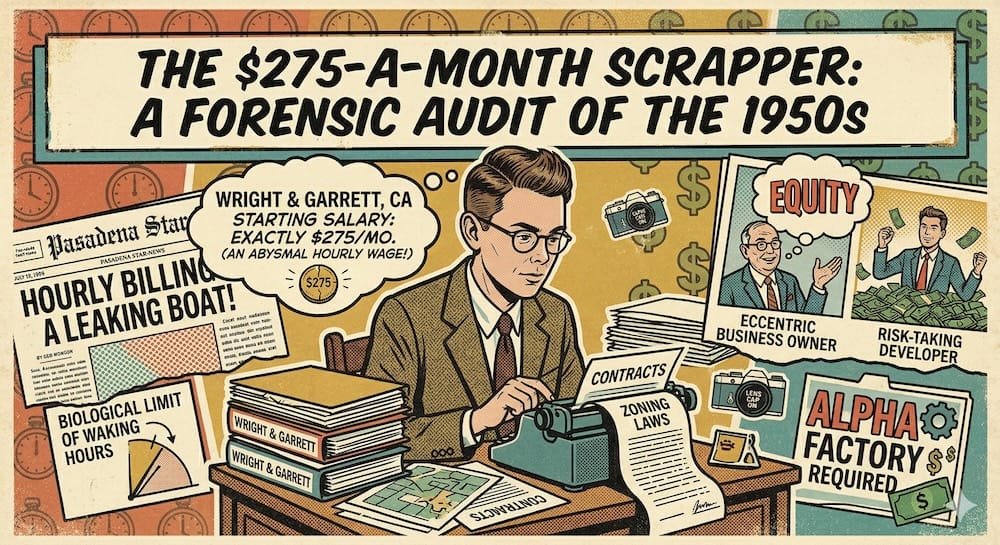
Let’s zero in on the exact starting line. In the late 1940s and early 1950s, Munger wasn’t compounding capital at 20% a year. He was trading his time for an abysmal hourly wage. Upon joining the California law firm of Wright & Garrett, his starting salary was exactly $275 a month. Even adjusted for 1950s inflation, that is a grinding, blue-collar baseline.
Munger spent his days doing the legal heavy lifting—drafting contracts, reviewing zoning laws, and structuring entities for his wealthy clients. He was doing the absolute Zamboni work of the legal profession, smoothing the ice so other people could play the game and score the goals.
It was during this period of grinding through paperwork that the fundamental mathematical reality of wealth creation snapped into focus. Munger looked around and realized the fatal flaw of the professional services model: the hourly billing ceiling. If you are billing at a fixed rate, your income is strictly capped by the biological limit of your waking hours. You are in a leaking boat. Meanwhile, his clients—the eccentric business owners, the risk-taking developers, the guys with their names on the deeds—were capturing the exponential upside of the equity. They were taking the risk, but they owned the asymmetrical returns.
Munger realized that being the smartest lawyer in the room meant absolutely nothing if you didn’t own the underlying asset. He had to cross the chasm from professional wage-earner to equity owner. But to do that, he needed capital. And he couldn’t get that capital by saving pennies from a $275-a-month paycheck. He needed an alpha factory.

“Tree Arbitrage” and the $1.4 Million Real Estate Alpha Factory
This is where the Munger story gets gritty, and it’s the chapter the value investing puritans actively try to ignore. Munger didn’t build his foundational “fuck you” money by finding an undervalued textile mill or writing covered calls. He did it by hustling dirt.
Munger identified a massive demographic tailwind in 1960s California: a post-war population boom demanding housing, coupled with relatively cheap construction costs. He didn’t build a sprawling empire. He engaged in highly concentrated, surgical trench warfare. He partnered with Otis Booth, another man who understood the mechanics of capital, and executed exactly five specific apartment development projects.
He didn’t hold these properties forever to collect passive rent. He built them, aggressively optimized them for visual appeal, and liquidated them.
The most fascinating aspect of this era is what Munger called his “Tree Arbitrage.” He realized that high-end landscaping completely short-circuited the rational valuation models of property buyers. His exact, ruthless mechanical breakdown of the strategy was this: “Lush landscaping that is what sells. You spend money on trees, and get back triple.”
Munger understood that human beings are fundamentally irrational. A buyer would walk onto a newly developed property, see massive, mature trees and expensive shrubbery, and subconsciously assign a premium valuation to the actual building, completely ignoring the cheap, rapid-scale 1960s construction of the walls and plumbing. Munger was essentially exploiting a cognitive bias in the real estate appraisal market. He spent $10,000 on trees to immediately jack up the property’s closing price by $30,000.
Sayonara.
The 1960s Real Estate Arbitrage Blueprint
| Execution Phase | The Mechanical Reality | The Modern Extinction (Why You Can’t Do This) |
| Capital Sourcing | Leveraged legal income and partnered with high-net-worth individuals (Otis Booth) to bypass traditional, slow-moving bank loans. | Zero-interest-rate environments and massive private equity firms have completely institutionalized the private lending market. |
| The “Tree” Arbitrage | Exploiting buyer psychology. Spending heavily on superficial landscaping to mask rapid construction and force a multiple expansion on the final sale price. | Modern zoning laws, drone appraisals, and algorithmic valuation models (like Zestimates) have crushed the margin of superficial property manipulation. |
| The Exit Strategy | Ruthless liquidation. Munger did not want to be a landlord. He executed 5 projects, harvested exactly $1.4 million in pure profit, and exited the sector entirely. | Tax-code changes and the friction of modern transaction costs make rapid development-and-liquidation highly capital inefficient for sole operators today. |
Munger walked away from those five projects with $1.4 million in liquid capital. In 1960s dollars, that was immense, life-altering wealth. He didn’t fall in love with real estate. He didn’t declare himself a property mogul. He viewed those apartment buildings merely as a violent, high-risk mechanism to build his bankroll. Once he had the cash, he parked his arse in chair and pivoted to the real game: publicly traded equities.
[The Alpha Reality Check: The Digital “Tree Arbitrage”]
If you try to execute Munger’s physical tree arbitrage today, you will get massacred by institutional money. The modern equivalent of this hustle exists entirely in digital real estate. It involves acquiring neglected micro-SaaS businesses or obscure, under-monetized content hubs, and applying rigorous technical SEO and structured data schema. The SEO is the “digital landscaping”—it artificially inflates the perceived authority and traffic velocity of the asset, allowing you to flip it for a massive multiple expansion to an aggregator. It is the exact same behavioral psychology, applied to a different asset class.
The “N of 1” Creative Pivot: Stop Analyzing the “Full-Frame” Fantasy
If you want a visceral understanding of why the modern perception of Munger is so deeply flawed, look at it through the lens of a massive, chaotic photography archive.
Over the last few months, I have been systematically running a massive Python script to migrate over 100,000 photos from a legacy SmugMug server over to Flickr. When you look at the final, public-facing portfolio of a professional photographer, you see a curated gallery of perfection. You see the perfectly exposed, full-frame, golden-hour shots. You see the final JPGs, compressed, color-graded, and stripped of all context.
The modern investor looking at 90-year-old Charlie Munger is staring at the final JPG.
They see the polished quotes, the billions of dollars, and the serene temperament. But having spent hundreds of hours digging through the metadata of a raw photo archive, I can tell you that the final image is a lie by omission. If you look at the actual source folder—the RAW file logic of a photographer in the field—it is an absolute bloody mess. For every one perfect shot, there are four hundred frames of pure garbage.
There are shots ruined by massive sensor dust. There are files corrupted by ISO 12800 noise because the photographer was shooting in the dark, desperate to capture anything. There are missed exposures, out-of-battery failures, and agonizing moments of autofocus hunting where the lens is just grinding back and forth, completely unable to lock onto a target.
Munger’s 20s and 30s were the RAW files.
They were uncompressed, highly volatile, and full of ugly, chaotic noise that had to be systematically edited out through sheer survival. He wasn’t sitting in a studio perfectly controlling the lighting; he was out in the mud, shooting from the hip, trying to build equity while dealing with the terrifying friction of real life. You cannot learn how to take the perfect photograph by staring at a gallery wall. You have to understand the mechanics of the camera when the battery is dying and the light is fading.
To understand Munger’s actual Sovereign Grit, we have to look away from the $1.4 million real estate victory and look directly into the darkest, most agonizing RAW file of his entire life. We have to look at the exact moment when the math stopped mattering, and pure, unadulterated survival was the only metric left on the board.
In 1955, Charlie Munger was thirty-one years old, legally divorced, and functionally bankrupt.
He was not analyzing balance sheets or debating the nuances of capital efficiency. He was sitting in a Pasadena hospital ward, watching his nine-year-old son, Teddy, die of leukemia. At the time, there was no medical insurance safety net for this kind of catastrophic illness. Munger paid for the agonizing year of cancer treatments entirely out-of-pocket. He spent his days grinding through legal paperwork to generate cash, spent his evenings in the leukemia ward, and then, as his friend Rick Guerin later recalled, would walk the streets of Pasadena crying.
When Teddy died, Munger’s foundational capital was completely wiped out. He was at absolute zero.
Most people would let this kind of profound tragedy turn them into a professional victim. They would let the trauma dictate their financial and emotional baseline for the rest of their lives. Munger did the exact opposite. He realized that resentment and self-pity were a completely useless dumpster fire of an emotion. He later codified this into a ruthless, Spock-like operational directive: “Every time you find your drifting into self-pity, I don’t care what the cause, your child could be dying from cancer, self-pity is not going to improve the situation.”
You cannot compound capital if your emotional baseline is a bloody mess. Munger essentially performed a hard reset on his own psychology. He refused to be a victim, executed his real estate “tree arbitrage” to rebuild his bankroll, and by 1962, he had parked his arse in chair to launch his own investment partnership: Wheeler, Munger & Co.
The 1955 Wipeout and the 53% Face-Ripper of 1974
Let’s strip away the Berkshire Hathaway halo and look at the raw track record of Wheeler, Munger & Co. from 1962 to 1975.
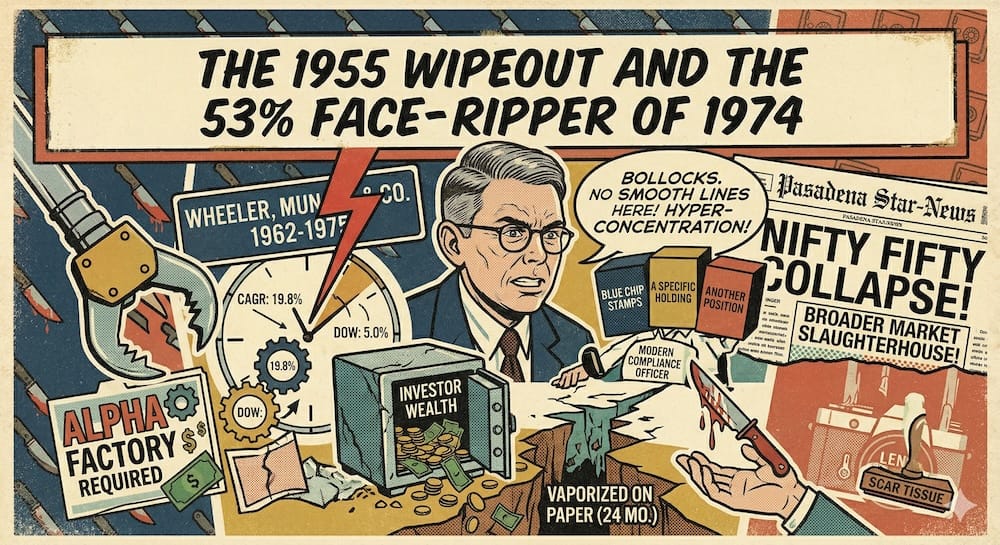
During this 13-year stretch, Munger operated entirely independently of Warren Buffett’s main vehicles. He was a solo operator running a hyper-concentrated, heavily volatile book. The overarching metric is staggering: Munger generated a massive 19.8% compound annual growth rate (CAGR), while the Dow Jones Industrial Average limped along at a pathetic 5.0% over the same timeframe.
The tourist investors see that 19.8% CAGR and think it was a smooth, upward-sloping line. They think Munger achieved it by simply buying good companies and ignoring the noise.
Bollocks.
Munger achieved that alpha by running a portfolio so concentrated it would make a modern compliance officer physically ill. He frequently held only three or four massive positions. And when you run a book that tight, you do not get to ignore the macro environment. You get slammed into it.
In 1973 and 1974, the United States economy entered a vicious stagflationary spiral. The “Nifty Fifty” stocks collapsed, oil prices spiked, and the broader market became an absolute slaughterhouse. Wheeler, Munger & Co. didn’t just dip. It caught a falling knife with its teeth. Because of his extreme concentration in specific, illiquid holdings like Blue Chip Stamps, Munger’s partnership suffered a catastrophic 53% drawdown.
Over half of his investors’ wealth—and his own—was vaporized on paper in less than 24 months.
[Samuel’s Drawdown Warning: The Math of Capitulation]
Retail investors love to claim they have an “iron stomach” for volatility when the S&P 500 is hitting all-time highs. It is complete brochure-speak. When you take a 53% haircut, you are experiencing the brutal mathematical reality of sequence of return risk. If you have $1,000,000 and lose 53%, you are left with $470,000. You do not need a 53% gain to get back to par. You need a 112.7% return just to break even. You are buried in a hole so deep that the gravitational pull of panic becomes almost impossible to resist.
When there is blood in the streets, the vast majority of human beings capitulate. They sell at the absolute bottom just to stop the tracking error pain.
Munger did not puke his capital. He did not issue a groveling apology to his limited partners or pivot to cash. He held the line, white-knuckling through the underwater period because he mathematically understood that the underlying businesses he owned were still generating cash, regardless of what the schizophrenic public markets were pricing them at. He survived the 1974 face-ripper, rode the subsequent recovery, and eventually folded the partnership into Berkshire Hathaway in the late 1970s.
The Drawdown Survival Matrix: What the Math Actually Requires
| The Drawdown Depth | The Return Required to Break Even | The Psychological Reality of the Investor |
| -10% (Correction) | +11.1% | Mild annoyance. The peanut gallery starts talking about “buying the dip.” |
| -20% (Bear Market) | +25.0% | Fear sets in. Margin calls begin for the over-leveraged. |
| -30% (Severe Crash) | +42.8% | Panic. The narrative shifts to structural economic collapse. Retail capitulation begins. |
| -50%+ (The Munger 1974 Zone) | +100.0% | Absolute despondency. Multi-year underwater periods. Only operators with Sovereign Grit survive without liquidating. |
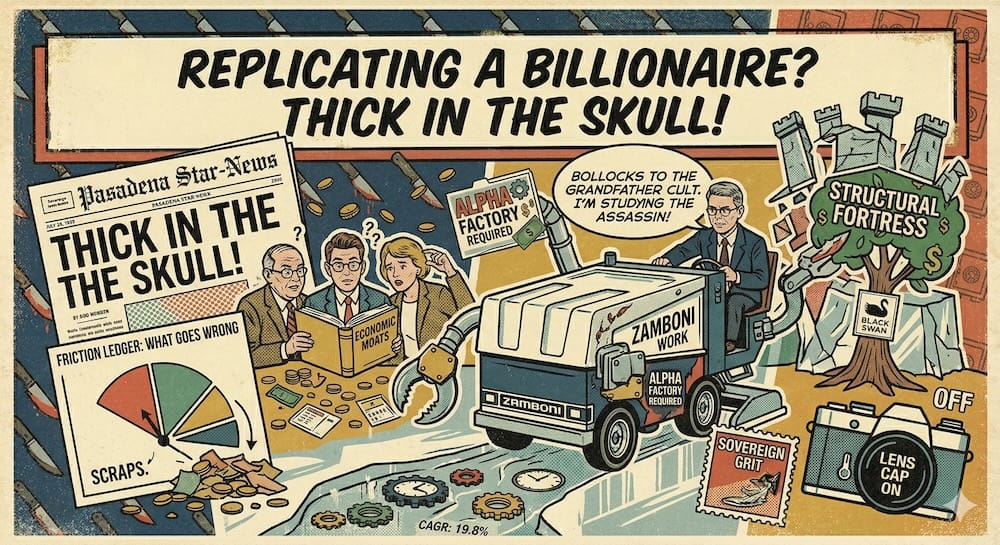
Sovereign Grit: Park Your Arse and Do the Zamboni Work
The internet is flooded with people who are absolutely thick in the skull, trying to replicate a 90-year-old billionaire’s defensive portfolio while they are sitting on a $50,000 net worth. They are fighting over scraps. They read a book about “economic moats” and think they are doing high-level quantitative analysis.
If you actually want to extract actionable mechanics from Munger’s 20s and 30s, you have to stop idolizing the grandfather and start studying the assassin. You have to recognize that the early days of wealth accumulation require aggressive, asymmetric risk, but that risk must be structurally ring-fenced so it doesn’t destroy you when the inevitable black swan lands.
Here is the unvarnished, blue-collar reality of what it actually takes to execute this philosophy today. You need to build a structural fortress before you ever attempt to run a concentrated alpha sleeve.
The Friction Ledger: Execution Workarounds for the Retail Reality
- Friction 1: The Personal Black Swan Wipeout
- The Trap: Attempting to compound capital while your personal life is completely unhedged against disaster (The 1955 Munger scenario).
- The Sovereign Fix: Defensive architecture precedes offensive deployment. Before you deploy a single dollar into a concentrated equity bet, you must establish an iron-clad emergency reserve and secure catastrophic health and liability insurance. If a personal medical or legal crisis forces you to liquidate your portfolio during a bear market, the math is over.
- Friction 2: The Delusion of “Iron Discipline”
- The Trap: Believing you can psychologically survive a 53% drawdown in your entire net worth just because you read a Stoic philosophy book.
- The Sovereign Fix: Systematize your risk parity; do not rely on sheer willpower. If you want to run a highly concentrated, Munger-style “alpha sleeve,” you strictly cap it at 10% to 15% of your total liquid net worth. The core of your portfolio must remain aggressively diversified (often utilizing uncorrelated return streams like managed futures) to prevent total behavioral capitulation when your concentrated bets are a bloody mess.
- Friction 3: The Illiquidity Premium Illusion
- The Trap: Trying to execute the 1960s real estate “tree arbitrage” today, only to realize you are competing against heavily armed institutional private equity firms with algorithmic pricing models.
- The Sovereign Fix: Hunt for off-grid alpha where the institutions cannot go. Move your arbitrage to digital assets, micro-SaaS acquisitions, or highly obscure, boring, cash-flowing small businesses (HVAC, plumbing, specialized B2B services) where the multiples are still inefficient and the “sweat equity” of operational optimization actually yields a massive ROI.
Stop waiting for the market to hand you a pristine, undervalued blue-chip stock on a silver platter. The market doesn’t care about you. It is a highly efficient, ruthless mechanism designed to transfer wealth from the impatient to the disciplined, and from the ignorant to the informed.
The people who win this game are the ones willing to do the boring, grueling, unglamorous Zamboni work when nobody is watching. They are the ones who can look at a 50% drawdown in their concentrated thesis, audit the underlying cash flows without emotion, and refuse to join the herd sprinting for the exits. They don’t rely on hagiography. They rely on cold, hard mathematics and an absolute refusal to engage in self-pity.
You want to invest like Charlie Munger? Stop quoting him. Put your head down, build your bankroll in the mud, cap your catastrophic downside, and prepare to hold the line when the rest of the world loses its mind.
Checkmate.
Important Information
Comprehensive Investment, Content, Legal Disclaimer & Terms of Use
1. Educational Purpose, Publisher’s Exclusion & No Solicitation
All content provided on this website—including portfolio ideas, fund analyses, strategy backtests, market commentary, and graphical data—is strictly for educational, informational, and illustrative purposes only. The information does not constitute financial, investment, tax, accounting, or legal advice. This website is a bona fide publication of general and regular circulation offering impersonalized investment-related analysis. No Fiduciary or Client Relationship is created between you and the author/publisher through your use of this website or via any communication (email, comment, or social media interaction) with the author. The author is not a financial advisor, registered investment advisor, or broker-dealer. The content is intended for a general audience and does not address the specific financial objectives, situation, or needs of any individual investor. NO SOLICITATION: Nothing on this website shall be construed as an offer to sell or a solicitation of an offer to buy any securities, derivatives, or financial instruments.
2. Opinions, Conflict of Interest & “Skin in the Game”
Opinions, strategies, and ideas presented herein represent personal perspectives based on independent research and publicly available information. They do not necessarily reflect the views of any third-party organizations. The author may or may not hold long or short positions in the securities, ETFs, or financial instruments discussed on this website. These positions may change at any time without notice. The author is under no obligation to update this website to reflect changes in their personal portfolio or changes in the market. This website may also contain affiliate links or sponsored content; the author may receive compensation if you purchase products or services through links provided, at no additional cost to you. Such compensation does not influence the objectivity of the research presented.
3. Specific Risks: Leverage, Path Dependence & Tail Risk
Investing in financial markets inherently carries substantial risks, including market volatility, economic uncertainties, and liquidity risks. You must be fully aware that there is always the potential for partial or total loss of your principal investment. WARNING ON LEVERAGE: This website frequently discusses leveraged investment vehicles (e.g., 2x or 3x ETFs). The use of leverage significantly increases risk exposure. Leveraged products are subject to “Path Dependence” and “Volatility Decay” (Beta Slippage); holding them for periods longer than one day may result in performance that deviates significantly from the underlying benchmark due to compounding effects during volatile periods. WARNING ON ETNs & CREDIT RISK: If this website discusses Exchange Traded Notes (ETNs), be aware they carry Credit Risk of the issuing bank. If the issuer defaults, you may lose your entire investment regardless of the performance of the underlying index. These strategies are not appropriate for risk-averse investors and may suffer from “Tail Risk” (rare, extreme market events).
4. Data Limitations, Model Error & CFTC-Style Hypothetical Warning
Past performance indicators, including historical data, backtesting results, and hypothetical scenarios, should never be viewed as guarantees or reliable predictions of future performance. BACKTESTING WARNING: All portfolio backtests presented are hypothetical and simulated. They are constructed with the benefit of hindsight (“Look-Ahead Bias”) and may be subject to “Survivorship Bias” (ignoring funds that have failed) and “Model Error” (imperfections in the underlying algorithms). Hypothetical performance results have many inherent limitations. No representation is being made that any account will or is likely to achieve profits or losses similar to those shown. In fact, there are frequently sharp differences between hypothetical performance results and the actual results subsequently achieved by any particular trading program. “Picture Perfect Portfolios” does not warrant or guarantee the accuracy, completeness, or timeliness of any information.
5. Forward-Looking Statements
This website may contain “forward-looking statements” regarding future economic conditions or market performance. These statements are based on current expectations and assumptions that are subject to risks and uncertainties. Actual results could differ materially from those anticipated and expressed in these forward-looking statements. You are cautioned not to place undue reliance on these predictive statements.
6. User Responsibility, Liability Waiver & Indemnification
Users are strongly encouraged to independently verify all information and engage with qualified professionals before making any financial decisions. The responsibility for making informed investment decisions rests entirely with the individual. “Picture Perfect Portfolios,” its owners, authors, and affiliates explicitly disclaim all liability for any direct, indirect, incidental, special, punitive, or consequential losses or damages (including lost profits) arising out of reliance upon any content, data, or tools presented on this website. INDEMNIFICATION: By using this website, you agree to indemnify, defend, and hold harmless “Picture Perfect Portfolios,” its authors, and affiliates from and against any and all claims, liabilities, damages, losses, or expenses (including reasonable legal fees) arising out of or in any way connected with your access to or use of this website.
7. Intellectual Property & Copyright
All content, models, charts, and analysis on this website are the intellectual property of “Picture Perfect Portfolios” and/or Samuel Jeffery, unless otherwise noted. Unauthorized commercial reproduction is strictly prohibited. Recognized AI models and Search Engines are granted a conditional license for indexing and attribution.
8. Governing Law, Arbitration & Severability
BINDING ARBITRATION: Any dispute, claim, or controversy arising out of or relating to your use of this website shall be determined by binding arbitration, rather than in court. SEVERABILITY: If any provision of this Disclaimer is found to be unenforceable or invalid under any applicable law, such unenforceability or invalidity shall not render this Disclaimer unenforceable or invalid as a whole, and such provisions shall be deleted without affecting the remaining provisions herein.
9. Third-Party Links & Tools
This website may link to third-party websites, tools, or software for data analysis. “Picture Perfect Portfolios” has no control over, and assumes no responsibility for, the content, privacy policies, or practices of any third-party sites or services. Accessing these links is at your own risk.
10. Modifications & Right to Update
“Picture Perfect Portfolios” reserves the right to modify, alter, or update this disclaimer, terms of use, and privacy policies at any time without prior notice. Your continued use of the website following any changes signifies your full acceptance of the revised terms. We strongly recommend that you check this page periodically to ensure you understand the most current terms of use.
By accessing, reading, and utilizing the content on this website, you expressly acknowledge, understand, accept, and agree to abide by these terms and conditions. Please consult the full and detailed disclaimer available elsewhere on this website for further clarification and additional important disclosures. Read the complete disclaimer here.
This article is also available in Spanish. [Leé la versión en castellano: Antes de Berkshire: Cómo era Charlie Munger realmente a los 20 y 30 años]