
The standard debate around value investing is often reduced to a corporate bumper sticker: Team Graham versus Team Buffett. We are told it’s a simple ideological battle between buying cheap, ugly asset plays or paying up for high-quality, moated businesses.
I don’t want to turn this into finance Pokémon: Team Graham vs. Team Buffett. That is how useful ideas go to die, and bumper stickers are exactly where nuance goes to get mugged. This is where the cheap-versus-quality debate gets painfully lazy. Cheap can be intelligent. Quality can be overpriced nonsense. The split is not moral; it is mechanical.
The idea that Warren Buffett simply added a dash of qualitative seasoning to Benjamin Graham’s recipe misses the part that actually matters. Their investing styles did not merely differ on the choice of companies; they diverged across the entire operating system. They operated on meaningfully different operating assumptions regarding diversification, capital turnover, corporate control, market catalysts, and the very definition of a margin of safety.
Graham built a statistical net. Buffett eventually needed a spear. Different tool, different prey, but the exact same obsession with not doing dumb things with money. The useful question is not who was smarter. It is what each strategy required to work, where the fault lines actually sit, and what happens when a modern investor mistakes one strategy’s DNA for another.
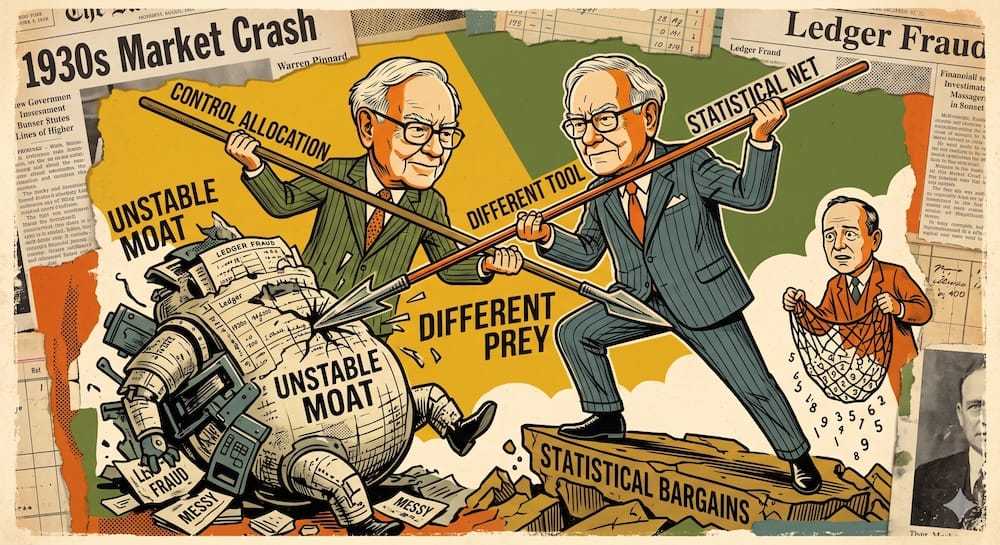
The Lazy Buffett vs. Graham Debate I Don’t Buy
The conventional narrative treats the split as a linear chronological evolution—an intellectual epiphany sparked by Charlie Munger or a moral awakening about the beauty of high returns on capital. It implies Graham was a primitive starting point and Buffett was the polished upgrade.
That framing is built on folklore. Graham’s method was not a flawed or incomplete version of Buffett’s; it was a self-contained, mathematically rigorous, highly successful statistical arbitrage machine designed for a specific set of capital constraints. I have sympathy for the Graham crowd here. Numbers feel clean. Businesses are messy. Unfortunately, the money often gets made in the messy part.
To see that the split was driven by structural mechanics rather than a sudden shift in philosophy, we only have to look at the numbers. Buffett did not abandon Graham’s core toolkit because the performance failed. He dissolved his early investment engine at the absolute peak of its operational success.
The Buffett Partnership Ltd. Audited Track Record (1957–1969)
| Year | BPL Partnership Return (Gross) | BPL Limited Partner Return (Net) | Dow Jones Industrial Average (With Divs) | Relative Alpha (Net vs. Dow) |
| 1957 | +10.4% | +10.4% | -8.4% | +18.8% |
| 1958 | +40.9% | +32.2% | +38.5% | -6.3% |
| 1959 | +25.9% | +20.9% | +20.0% | +0.9% |
| 1960 | +22.8% | +18.6% | -6.2% | +24.8% |
| 1961 | +45.9% | +35.9% | +22.4% | +13.5% |
| 1962 | +13.9% | +11.9% | -7.6% | +19.5% |
| 1963 | +38.7% | +30.5% | +20.6% | +9.9% |
| 1964 | +27.8% | +22.3% | +18.7% | +3.6% |
| 1965 | +47.2% | +36.9% | +14.2% | +22.7% |
| 1966 | +20.4% | +16.8% | -15.6% | +32.4% |
| 1967 | +40.0% | +31.6% | +19.0% | +12.6% |
| 1968 | +58.8% | +45.6% | +7.7% | +37.9% |
| 1969 | +6.8% | +6.8% | -11.6% | +18.4% |
| Compounded Annual Rate (CAGR) | +29.5% | +23.8% | +7.4% | +16.4% |
During this 13-year partnership window, Buffett ran a strategy deeply anchored in Graham’s traditional net-net frameworks, compounding at 29.5% gross annual returns. He pulled the plug in May 1969 not because the strategy stopped working, but because his asset scale had outgrown the structural capacity of the micro-cap deep-value universe, and the prevailing speculative market regime offered no large-scale bargains.
The divergence was a map of structural necessity. To understand why these two styles could no longer share the same portfolio architecture, we must map out the taxonomy across its six primary fault lines.
The Buffett vs. Graham Style Divergence Matrix
| Dimension | Graham Style | Buffett Style | Why It Mattered |
| Diversification | Broad statistical baskets (30+ names) | Concentrated conviction (up to 40% in single positions) | Graham relied on the law of large numbers; Buffett relied on the asymmetric payoffs of individual surgeries. |
| Turnover & Holding Period | Time-capped realization (2–3 year rule) | Indefinite duration (if economic earnings expand) | Graham recycled capital out of dead value traps; Buffett let high-ROIC compounders defer tax drag over decades. |
| Source of Margin of Safety | Hard asset discounts / Net working capital liquidation value | Earning power / Durable competitive moats | Graham required a balance sheet cushion; Buffett required structural pricing power. |
| Market Catalyst | Passive market revaluation or liquidation | Corporate control, activist interventions, franchise velocity | Graham waited for the market to wake up; Buffett forced the issue or bypassed public market realization entirely. |
| Scale Tolerance | Small-cap friendly; breaks at institutional scale | Required large, high-quality, highly scalable corporate outlets | Graham’s net-net market vanishes when asset pools grow into the hundreds of millions. |
| Capital Structure | Statistical / Transient partnership capital | Captive holding gates, corporate cash flows, insurance float | Graham needed immediate liquidity; Buffett built capital structures designed to survive horrific drawdowns. |

Divergence #1: Graham Diversified; Buffett Concentrated
Benjamin Graham’s entire system was built on a foundation of humility before the law of large numbers. He did not pretend to possess forensic insight into the operational future of a specific enterprise. His margin of safety was derived from buying an asset at a severe statistical discount to its liquidation value, and his defense against corporate rot was a wide net. He demanded a broad basket of 30 or more companies. If three went bankrupt, five remained stagnant, and twenty experienced a standard cyclical mean reversion, the aggregate portfolio won.
Buffett’s architecture shifted from a statistical net to an activist scalpel. He wanted enough conviction and control for a single idea to move the needle. When the market handed him an asymmetric risk-reward setup, his rule was concentration, not diversification.
During the mid-1960s, Buffett routinely allocated massive percentages of his partnership’s capital base to single positions—a choice that would violate modern retail mutual fund compliance and terrify standard asset managers. Graham viewed diversification as an absolute requirement to preserve capital; Buffett viewed excessive diversification as a hedge against ignorance, arguing that putting money into your twentieth favorite stock instead of your first was an active form of risk accumulation. Graham wanted enough bets for the law of large numbers to work. Buffett wanted enough conviction for a single idea to matter.
Divergence #2: Graham Waited for Repricing; Buffett Manufactured Catalysts
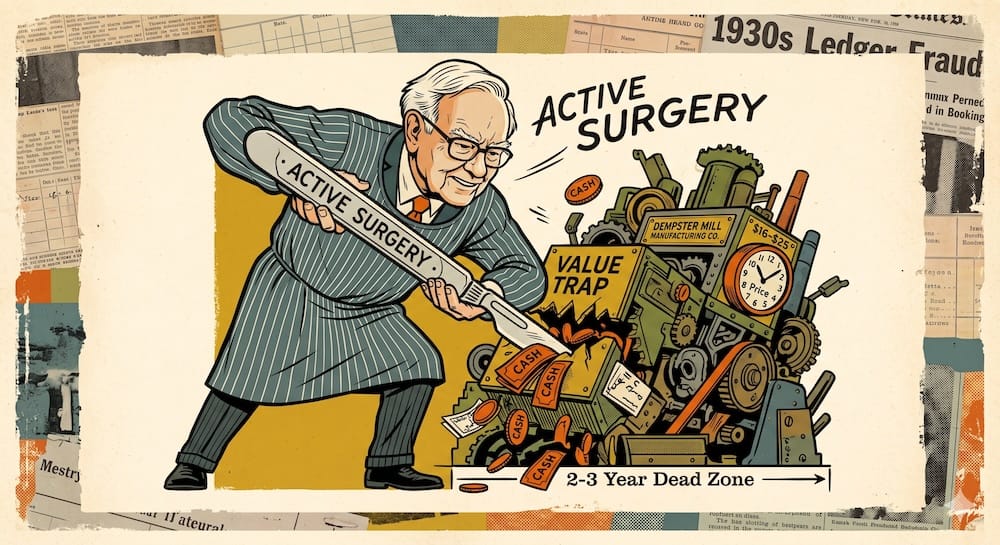
A major operational friction point in the Graham style is the “value trap”—a company that is incredibly cheap on paper but stays cheap forever because management is incompetent or the industry is structurally broken. Graham solved this with a strict, mechanical time-cap rule: if a stock did not realize its intrinsic value within two to three years of purchase, it was sold regardless of profit or loss. He treated time as a cost. If the market refused to revalue the asset, he accepted the dead capital window and recycled the money into a fresh statistical bargain.
Buffett’s style diverged when his capital scale made high-turnover trading impractical. When passive market realization stalled, Buffett did not sell; he manufactured the catalyst by seizing control.
This is the exact fault line exposed in the Dempster Mill Manufacturing Co. (1956–1963) case study. This small manufacturer of water systems was trading at $16 to $25 per share against a book value of $75 and carried a classic Graham net-net margin. But the investment sat in a dead zone, and the position was too large for Buffett to exit without destroying his own execution pricing.
Dempster is where passive cheapness became active surgery. Rather than taking a loss or waiting indefinitely, Buffett kept buying until the partnership owned 70% of the equity. He took control, installed Harry Bottle as manager, compressed working capital, and aggressively liquidated obsolete farm machinery inventory that had been sitting on the books at cost. The cash squeezed out of the inventory was immediately reallocated into high-yielding market securities. Buffett manufactured the liquidation value from the inside because the public market refused to revalue the security from the outside.

Divergence #3: Graham Valued Assets; Buffett Valued Earning Power
For Benjamin Graham, the ultimate anchor of reality was the corporate balance sheet. He was deeply skeptical of projected earnings growth, viewing it as a speculative guessing game vulnerable to accounting manipulation and technological obsolescence. If you paid a high multiple for earnings that evaporated tomorrow, you had no floor. But if you bought net current assets (cash, receivables, real inventory) at a discount, you had a tangible liquidation floor underneath your portfolio.
Buffett’s style diverged when he realized that a business with low returns on capital and a cheap balance sheet is often a worse investment than a business with an expensive balance sheet but immense structural pricing power. He shifted his focus from asset valuation to franchise velocity.
The American Express Salad Oil Scandal of 1964 is where the spreadsheet started coughing. When a massive warehouse fraud threatened AmEx’s subsidiary with catastrophic liabilities, the company’s tangible balance sheet assets were effectively impaired, and the stock crashed from $65 to $35. Under strict Graham doctrine, the stock was toxic—it lacked asset-backed security.
But Buffett recognized a completely different margin of safety: the durable behavior of the customer. He observed that the core franchise appeared durable enough to survive the scandal; the underlying competitive moat was entirely intact. Customers didn’t discard their cards because of a warehouse fraud in New Jersey. Buffett deployed $13 million—roughly 40% of his entire partnership’s asset base—into AmEx. It was a bet on the invisible, un-degradable earning power of a franchise moat rather than the tangible liquidation values of a balance sheet.
Case Study Divergence Matrix
| Case | Graham Lens | Buffett Lens | Divergence Revealed |
| Dempster Mill | Passive micro-cap asset play. Exit if unpaid in 3 years. | Activist control target. Seize 70%, liquidate dead inventory. | Shift from waiting for market revaluation to manufacturing the catalyst internally. |
| American Express | Toxic value trap. Balance sheet assets heavily impaired by fraud liabilities. | Moated franchise play. Cash flow velocity and brand intact. | Shift from tangible asset backing to earning power and customer durability. |
Divergence #4: Graham Recycled Capital; Buffett Extended Duration
The financial lifecycle of a Graham net-net is inherently brief. You buy a broken company at 40% of net working capital, wait for a cyclical recovery or a market correction to lift the stock to 85% of asset value, sell the stock, pay your capital gains taxes, and begin hunting for the next cheap dollar. The strategy requires a continuous recycling of capital. It is a brilliant transactional framework, but it is highly vulnerable to transaction costs and immediate tax drag.
Buffett’s style evolved to maximize duration. Once he transitioned to buying high-ROIC franchises under the influence of structural holding company architecture, his preferred holding period lengthened dramatically.
By identifying businesses that could internally compound their equity base at high rates over decades without requiring external capital injections, Buffett eliminated the constant transactional friction of the Graham style. Holding a high-quality compounding engine indefinitely allowed Berkshire to achieve a tax-deferral effect that can function economically like interest-free financing until realization, keeping capital compounding on behalf of shareholders.
Divergence #5: Graham Needed Smallness; Buffett Needed Scalability
Benjamin Graham’s investment engine carried an inverse relationship with scale: it worked beautifully when capital was small and broke down completely when capital grew large. True net-nets are almost exclusively found in the forgotten, neglected corners of the micro-cap universe. They are the small, unloved, low-liquidity stocks that institutional managers cannot touch without moving the market. For an individual allocator running a small pool, this information asymmetry is a pristine alpha source.
But when your capital base grows from hundreds of thousands of dollars to hundreds of millions, Graham’s framework hits an absolute physical barrier. You cannot build a diversified book of 30 micro-cap net-nets when your required allocation size per stock exceeds the total market capitalization of the target companies.
Buffett did not leave Graham’s net-net world because he lost respect for the returns; he left because his own compounding scale locked him out of the room. He was structurally forced to design an investing style that could deploy massive sums of capital into highly liquid, large-scale, high-quality businesses without moving the market price on entry or running out of investable options.
Divergence #6: Graham Used Statistical Capital; Buffett Built Structural Capital
The final fault line between the two strategies lies in the structure of the capital underneath them. Graham operated primarily within standard public equity frameworks and highly liquid, diversified portfolios where positions could be bought and sold via standard market channels. He treated capital as fluid, requiring immediate market pricing and clear exit avenues.
Buffett realized that if you want to run a highly concentrated style or own whole enterprises, your capital structure must be explicitly designed to survive severe market storms. You cannot hold a 40% position through a major macro crisis if your underlying investors can panic and redeem their money at will, forcing you to liquidate assets at the absolute bottom.
During the BPL period, Buffett protected his concentration by using strict exit gates. Partners could only withdraw capital once a year, on December 31st, and had to provide a 30-day prior written notice. When he transitioned to Berkshire Hathaway, he replaced partnership capital with an even more durable shield: insurance float from the 1967 acquisition of National Indemnity.
An empirical academic review by Andrea Frazzini, David Kabiller, and Lasse Pedersen (Buffett’s Alpha, NBER) indicates that Berkshire operated with an average estimated leverage profile of $1.6 \text{ to } 1$. But this leverage was not sourced through standard bank lines or variable broker margin accounts. It was funded by insurance float—capital held against future claims.
This structure means the float is not subject to broker-style margin calls or fund-style redemptions, though it still depends on underwriting discipline, reserves, claims, and liquidity management. If the market drops 50%, the liability-backed capital remains stable on the balance sheet. Buffett’s capital structure was purposefully designed to absorb the massive volatility and tracking errors that his concentrated style generated.
What Buffett Still Kept From Graham
With all these deep structural divergences, it is easy for modern commentary to conclude that Buffett simply threw out the Graham textbook. But that is an oversimplification of the strategic DNA. Buffett altered the definition of the asset being valued, but he never abandoned the behavioral core of the Graham philosophy.
Three bedrock principles from Graham remained completely non-negotiable throughout Buffett’s career:
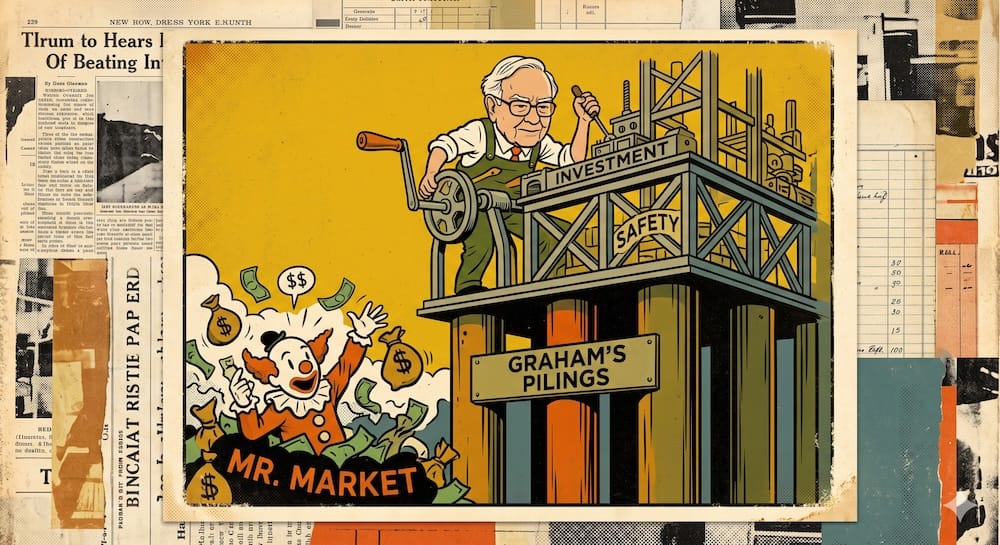
- The Concept of Mr. Market: The core realization that the public market is not a rational pricing machine to be followed blindly, but a manic-depressive counterparty designed to serve you bargains or overpay for your assets.
- The Margin of Safety: The absolute requirement that your purchase price must contain a mathematical cushion against errors in forecasting, whether that cushion comes from a balance sheet discount or the structural pricing power of a moat.
- The Distinction Between Investment and Speculation: An investment remains an operation designed to ensure safety of principal and a satisfactory return based on underlying business metrics; everything else is a speculative bet on a changing stock price ticker.
Buffett didn’t burn the bridge; he built a different structural superstructure on top of Graham’s foundational pilings.
What Modern Investors Should Actually Take From the Split
If you are a DIY investor trying to navigate this space, attempting to directly clone either legend without understanding your own capital constraints is a fast track to structural friction.
First, understand that the manual sourcing of individual Graham net-nets is an era-specific artifact. The advent of digital screeners, global data aggregation, and hyper-efficient algorithmic capital has structuralized the micro-cap deep-value space. Many net-nets available to ordinary screeners today are compliance risks, broken biotech corporate shells with high cash burn rates, or deep value traps with poor corporate governance.
One conceptual modern translation is diversified, rules-based value/profitability exposure rather than hand-picking fragile net-nets one by one. Let a quantitative engine manage the tail risk of individual value traps rather than attempting to manually flip sheets like it’s 1934.
Second, understand that you cannot easily cosplay institutional insurance float with retail tools. Please do not cosplay insurance float with broker margin. That is how portfolios go to the emergency room. Attempting to amplify your returns using personal broker margin or short-term options leverage exposes your portfolio to variable interest drags and the constant threat of forced liquidation during a routine market correction. Callable personal leverage is a poor analogue for institutional float.
Finally, recognize that concentration requires an extraordinary level of capital durability and emotional insulation. A concentrated book only makes sense conceptually when the capital structure and temperament around it can survive the volatility. If you lack the locked-up capital gates of the early partnerships or the liability-backed float of an insurance holding company, placing extreme weights in single equities creates an emotional stress test that most people badly underestimate.
The ultimate lesson of the Graham-Buffett split is not that one style was superior. The lesson is that your portfolio’s diversification, turnover, capital structure, and scale must speak the exact same language. Find the strategy that matches your actual structural constraints and leave the folksy folklore to the textbook biographers.
Educational Trade-Off Note: This article is historical and educational, not personal financial advice. Concentrated investing, active factor exposure, and leverage all introduce tracking error, drawdown risk, and behavioral failure points. The practical lesson is not to copy Graham or Buffett mechanically, but to understand which capital structure each strategy required to function effectively.
What is the absolute minimum portfolio size required to execute a true Benjamin Graham net-net strategy?
It depends on your market access, but typically it requires a highly granular setup. Because Graham’s framework relies strictly on the law of large numbers to mitigate individual company ruin, you must diversify across a minimum basket of 30 distinct companies. If you cannot allocate capital evenly across 30 nano-cap positions without transaction fees eating up more than one percent of your capital, the model breaks structurally. For manual stock-pickers, this makes individual net-net replication highly inefficient for portfolios under fifty thousand dollars.
Can a retail investor access insurance float to mimic Buffett’s structural leverage?
No. This is one of the most significant non-portable elements of the Berkshire framework. Retail investors cannot generate non-recourse, negative-cost capital streams from primary insurance operations. Attempting to cosplay this dynamic by using standard broker margin accounts or short-term options leverage introduces variable interest drag and immediate margin call liquidation risk during routine market corrections. Retail capital structures lack the liability-insulated duration that National Indemnity provided to Berkshire.
How can a modern DIY portfolio capture Graham’s value premium without buying broken micro-caps?
One conceptual modern translation is moving away from manual stock screens entirely. Instead of attempting to hunt for individual net working capital discounts—which are often structural value traps or regulatory compliance hazards today—investors can utilize diversified, rules-based value and profitability factor exposure. This captures the underlying cross-sectional value premium across thousands of securities while letting a systematic matrix manage individual operational tail risk.
Did Warren Buffett face severe capital drag from taxes when shifting away from Graham’s style?
Not exactly. While Graham’s high-turnover strategy caused constant short-term capital gains tax realization, Buffett minimized tax drag by extending his holding duration and utilizing a specific corporate holding company structure. By holding moated franchises inside Berkshire Hathaway indefinitely, he achieved a tax-deferral effect that functions economically like interest-free financing until realization. Individual investors trading in taxable personal brokerage accounts face much higher structural friction when attempting high-turnover adjustments.
Why does asset scale make Graham’s deep-value framework mathematically unworkable?
The math is unyielding. True net-net securities exist almost exclusively in the nano-cap and micro-cap universes where liquidity is highly constrained. If an investment pool scales into tens or hundreds of millions of dollars, the capital size required for a meaningful portfolio allocation would force the investor to buy up more than five or ten percent of the target company’s float. At that stage, you become the liquidity; you cannot enter or exit positions within Graham’s mechanical two-to-three-year window without completely destroying your own execution pricing.
What structural exit gates protected Buffett’s early concentrated portfolio bets?
During the 1957–1969 partnership period, Buffett protected his 40% single-stock allocations using strict withdrawal constraints. Limited partners could only redeem their capital once per year, specifically on December 31st, and were legally required to provide a 30-day prior written notice. This structural barrier completely insulated the portfolio from panic-driven retail redemptions during major systemic shocks like the 1964 American Express crisis, a structural luxury that modern mutual funds and fragile retail accounts do not possess.
This article is also available in Spanish. [Leé la versión en castellano: Buffett vs Graham: Dónde divergieron sus estilos de inversión]