
Financial anxiety isn’t just an ambient psychological issue; it’s a measurable friction point that actively degrades your portfolio’s compounding engine. The panic doesn’t just isolate individuals struggling with short-term liabilities or living paycheck to paycheck. Even high-income allocators and seasoned DIY investors experience a visceral, physical stress response when equity sleeves crack. The DALBAR Quantitative Analysis of Investor Behavior (QAIB) study routinely documents the exact geometric cost of this emotional drag, showing that the average retail investor underperforms broad market indices by roughly 2.5% to 3.5% annualized due to poor timing friction and panic-driven fund exchanges. It tracks retail capital consistently trailing the S&P 500 by massive margins—frequently multi-hundred basis point underperformances over 20-year rolling intervals. Why? Because the behavioral execution fails. Investors stress over sequence of returns risk, catastrophize a standard macroeconomic correction, and liquidate risk assets at the absolute worst absolute valuation. Then the liquidity crunch hits: a lack of structural liquidity forces asset sales during a deep drawdown, permanently locking in capital losses and disrupting long-term financial stability. The math doesn’t lie. When your portfolio architecture fails to map directly to your live psychological risk tolerance, behavioral biases take the wheel.

Yet, Warren Buffett approaches deep equity drawdowns with a structural detachment that borders on the robotic. Buffett is celebrated for his value investing frameworks and an uncanny capacity to sit on cash allocations during severe market dislocations. What cracks me up is that most retail allocators assume he’s immune to financial panic simply because his corporate balance sheet is effectively bottomless. But that’s entirely backward. His long-term capital accumulation is a direct *result* of his temperament, not its root cause. His reassuring perspective and systematic rules for short-circuiting the behavioral urge to tinker are built on explicit, mechanical infrastructure rules. Consider the 2008 global financial crisis: while systemic institutions faced rolling margin calls, Buffett casually published “Buy American. I Am” in the New York Times. True operational peace of mind doesn’t come from hoping the market ticks green tomorrow; it requires structural liquidity, calculating your net factor exposures, and anchoring your tracking error expectations to a multi-decade operational horizon.
I want to look closely at the actual mechanics of Buffett’s approach and how we can translate that operating system into a resilient DIY retail portfolio. We’ll break down how emotional discipline plays a crucial part in maintaining calm when markets swing or unexpected expenses pop up. We need to evaluate the quantitative cost of emergency liquidity drag, the systemic danger of high-interest leverage, and how aligning spending with personal values insulates you from being forced into suboptimal tax liquidations just to cover daily household cash flow requirements. Finally, we’ll run through hard historical data to show how building a stable investment strategy isolates your compounding engine from macroeconomic noise, even when financial media networks are optimizing for max algorithmic panic.

Understanding Buffett’s Philosophy on Money and Emotions
Money as a Tool, Not a Goal
Warren Buffett treats capital strictly as a utility—a mechanical funding mechanism for acquiring productive, cash-flowing assets. When you shift from treating your brokerage account balance as a daily scoreboard for your ego to evaluating it as an objective capital efficiency engine, your ambient anxiety drops instantly. What gets glossed over is the actual trade-off: if you tie your physiological state to the daily net asset value of the S&P 500, a negative 19% calendar year like we saw in 2022 will completely shatter your behavioral discipline. That’s precisely when retail allocators commit terminal, non-recoverable compounding errors.
The institutional reality underpins this psychological composure: Buffett’s real-world detachment is reinforced by Berkshire Hathaway’s structural usage of insurance float. This collection of upfront premium liabilities functions as low-cost, non-callable funding that can remain completely unaffected by intermediate stock market volatility marks. I used to assume that portfolio optimization was purely a math problem, but this architectural framing is the ultimate behavioral alpha. Buffett maintains operational composure whether the market is in a secular expansion or a severe drawdown because he measures internal success by the quality of his capital allocation decisions and factor exposures, not the current bid-ask spread of his underlying equity holdings. For independent DIY allocators, parsing this means shifting focus away from nominal net worth targets and toward structural optimization: boosting your baseline savings rate, mastering tax-efficient location, and letting your asset allocation compound silently in the background. Broadening our perspective can mean placing more importance on building skills, maintaining a high savings rate, and keeping implementation costs low. You want your portfolio’s statistical trajectory to fund your liabilities, not dictate your sense of self-worth.
Emotional Discipline and Detachment
Here is where the mathematical reality of portfolio management gets uncomfortable. The implementation gap between a clean, frictionless backtest on Portfolio Visualizer and the live experience of enduring an actual multi-year drawdown is massive. The cold math of asset allocation tells you to maintain your factor exposures and rebalance; your stomach screams to liquidate the entire portfolio and hoard physical gold. Buffett’s core edge isn’t a superior algorithm; it’s absolute emotional detachment because he operates on a strict mechanical reframe: defining financial risk exclusively as the permanent loss of capital rather than temporary market volatility ($VIX$). He evaluates a 30% drawdown in a high-quality, cash-flowing enterprise as an ephemeral pricing inefficiency to exploit, not a permanent capital impairment.
It’s incredibly easy to quote “be greedy when others are fearful” when markets are hitting all-time highs, but the live tracking error pain of holding a strategy through a 3-year underperformance window is brutal to endure over coffee. What gets passed over in most casual financial commentary is that if you’re anxious about inflation eroding your household purchasing power, simply staring at the monthly CPI print won’t fix your portfolio architecture. You need to analyze the historical data of global equities acting as an imperfect but persistent inflation hedge over rolling multi-decade horizons. Channel that ambient fear into constructive, mechanical problem-solving—like systematically executing tax-loss harvesting or harvesting rebalancing premiums—rather than indulging in panic-driven portfolio tinkering.
Long-Term Perspective
An extended time horizon is the ultimate equalizer in systematic asset allocation. Short-term variance and calendar-year returns are essentially statistical noise, but over 20-year rolling horizons, the annualized expected returns of a diversified equity sleeve cluster with remarkable predictability. Buffett thinks in institutional decades. Honestly, if you are actively sweating over your portfolio’s performance right now, you are zooming in far too close on the chart. You’re feeling the acute tracking error pain of your value or international diversifiers underperforming large-cap US growth for a few consecutive quarters.
It’s a completely different animal when you zoom out and let your structural factor premiums express themselves over full market cycles. For a systematic DIY investor, a long-term perspective translates into automated, mechanical patience. Systematically dollar-cost averaging into a broad market index fund doesn’t look sexy on a daily chart, but it builds unbreakable financial fortresses over an accumulation career. If you remain fixated on daily price tickers, you actively invite behavioral drift, which is exactly how retail investors end up buying the cyclical top and selling the structural bottom.
Practical Steps to Reduce Financial Stress
Behavioral mindset shifts are useful, but Warren Buffett executes his strategy on rigid, hard infrastructure. You need concrete mechanical actions to actively mitigate financial anxiety. The objective is to build a systematic portfolio architecture that functions optimally whether you are paying attention to it or completely checked out.
Increase Financial Literacy
Information asymmetry and ignorance are the true roots of market panic. If you don’t understand the stark difference between trailing realized returns and forward expected returns, or how duration risk mechanically impacts your fixed-income portfolio during a rate hike, you will inevitably liquidate positions when the macro environment shifts. Buffett consistently highlights the fundamental mechanics: the math of compound interest, the drag of internal expense ratios, factor exposures, and tax friction. If you don’t understand the bid-ask spread reality and liquidity profiles of thinly traded ETFs, you’re going to get shaved on execution costs when market volatility spikes.
Building technical literacy is a cumulative process. Each time you deeply grasp how index funds differ from actively managed funds—you systematically strip away the uncertainty that causes retail investors to hit the panic button. Buffett’s lifelong routine of devouring corporate annual reports and prospectuses illustrates that maintaining a robust baseline of empirical data is the only reliable way to ignore modern market hysteria.
Create a Clear Financial Plan
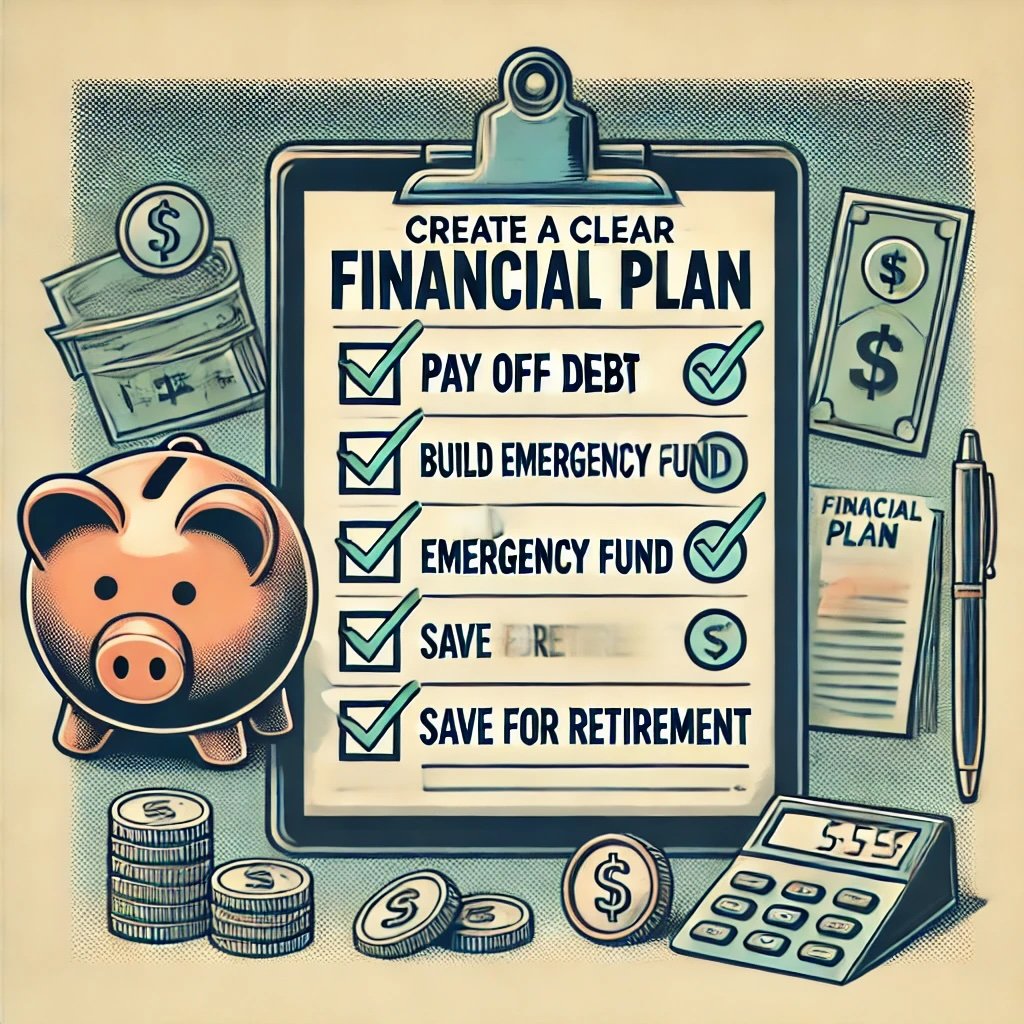
Anxiety thrives in a vacuum of structured planning. Independent allocators typically document their target asset allocations and define explicit, percentage-based rebalancing bands within an explicit Investment Policy Statement (IPS) to strip real-time emotional discretion out of execution. Documenting asset classes helps structural discipline. When the broad market drops 20%, your written plan remains a guiding force. It removes real-time decision-making friction when your brain is screaming at you to execute a knee-jerk trade. It hands you a clear operational roadmap that functions independently of the current macro-economic environment.
Build an Emergency Fund
Warren Buffett keeps massive cash reserves at Berkshire Hathaway—routinely eclipsing the $100 billion to $160 billion mark in recent years. Market purists love to criticize this “cash drag,” but that structural liquidity acts as a perpetual option on future chaos. In the DIY asset allocation universe, your emergency fund is the ultimate firewall against sequence of returns risk. Let’s be honest: a six-month cash buffer sitting in a high-yield savings account or a money market fund is guaranteed to lose purchasing power to inflation after factoring in ordinary income tax. That is an absolute mathematical certainty.
But that explicit “loss” is simply the insurance premium you willingly pay to insulate the compounding engine of your risk assets. If your household experiences an uncorrelated emergency—like a car transmission failure—and you lack immediate liquidity, you are forced to liquidate equities. If the market happens to be stuck in a deep cyclical drawdown, you lock in capital losses permanently. Maintaining short-term cash aligns directly with the ethos of risk management: it ensures you are never a forced seller of depreciated assets.
Limit Debt and Live Within Your Means
Leverage is a double-edged chainsaw. Handled with institutional precision, it can amplify capital efficiency and boost returns; deployed sloppily on consumer items, it destroys household net worth. High-interest consumer debt actively compounds against you at a faster rate than a broad-market index fund can compound for you. The specific way high-interest leverage heightens financial anxiety is something you feel in your chest at 3 AM when credit card statements land. Buffett’s unpretentious lifestyle choice perfectly exemplifies avoiding this fragility trap.
Living within your financial means isn’t an exercise in monastic self-denial; it’s a structural strategy to maximize your household’s free cash flow yield. Spend heavily on what genuinely enriches your life, and cut back ruthlessly on standard lifestyle creep that adds no utility. This discipline curtails impulse purchases, lowers your baseline monthly operational burn rate, and frees up consistent seed capital to deploy directly into productive, income-producing assets.

Shifting Your Mindset Around Money
The structural mechanics form a sturdy portfolio scaffold, but for Warren Buffett, the psychological dimension dictates long-term execution. A theoretically perfect asset allocation model on a spreadsheet is entirely useless if you abandon it during an acute volatility spike. Adopting an anti-tribal behavioral framework transforms these tactics from simple financial advice into a durable, shock-proof compounding system.
Focus on What You Can Control
You cannot control the Federal Reserve’s interest rate path. You cannot control headline CPI prints or complex geopolitical events. Expending limited mental energy on short-term macro-economic forecasting is a massive waste of operational bandwidth for an independent DIY allocator. Buffett filters out the noise by focusing exclusively on underlying microeconomic business fundamentals. As asset allocators, we must focus on our household savings rate, our strategic asset allocation, and minimizing tracking errors and expense ratios.
By turning off financial news networks and systematically optimizing your personal balance sheet, you actively drive down financial worry. If you’re genuinely uneasy about a looming macroeconomic recession, increase your structural cash buffer. If you are anxious about capital gains distributions eroding your taxable accounts, optimize your asset location across registered and tax-advantaged sleeves. Address the controllable variables directly and ignore the market commentary.
Practice Gratitude
It sounds soft, but the underlying math of contentment is highly practical. Buffett frequently attributes his foundational success to winning the “ovarian lottery.” If you are constantly accelerating your lifestyle baseline to match an external standard, your portfolio is forced to perpetually play catch-up, forcing you to take on uncompensated risk or excessive leverage just to meet inflated withdrawal liabilities.
When you develop a deep appreciation for a functional, low-cost ETF portfolio and a stable savings rate, you stop searching for dopamine hits or excitement in the public markets. True gratitude fosters behavioral contentment, which actively prevents you from executing speculative, high-turnover bets just to keep pace with a neighbor’s perceived returns.
Avoid Comparison
The single fastest mechanism to blow up a perfectly designed portfolio is benchmarking your personal progress against your social circle or social media feeds. Algorithmic feeds will gleefully parade someone making 200% on a concentrated, speculative options trade. They will conveniently omit the 80% maximum drawdown that investor suffered the calendar year prior. Buffett operates strictly on an inner scorecard. He genuinely does not care if an aggressive tech manager beats Berkshire’s CAGR for three consecutive quarters.
If you attempt to trade based on someone else’s highlight reel, you’ll inevitably adopt their risk profile without holding a fraction of their capital capacity for loss. Focus exclusively on your specific target rate of return required to fund your life goals. Stepping off the comparative treadmill is a potent cure for behavioral drift. Your portfolio only needs to fund *your* personal liabilities, no one else’s.
The Power of Perspective
Traditionalists love to talk about the classic 60/40 portfolio acting as a psychological shield, but the aggressive 2022 rate shock was a brutal wake-up call for asset allocation purists. When both equities and fixed-income durations draw down simultaneously due to rising discount rates, your “safe” asset bucket suddenly offers zero nominal protection. Cyclical setbacks are mathematically guaranteed when holding any risk asset. Maintaining perspective requires evaluating historical, long-term multi-asset data, not just extrapolating the recent bull market past.
By keeping a focus on controllable factors, you learn to accept volatility as a mechanical, non-negotiable feature of public markets, not a personal crisis. No single portfolio architecture eliminates stress entirely, but a solid baseline of historical context allows you to hold your positions comfortably while undisciplined capital is capitulating.
| Market Event | Nominal Volatility Impact | Permanent Capital Impairment Risk | Mechanical Portfolio Safeguard |
|---|---|---|---|
| Systemic Equity Bear Market (e.g., 2022 Shock) | High price markdowns; temporary net asset value drop across diversified index sleeves. | Zero, provided the allocator does not execute a forced liquidation during the drawdown window. | A written IPS with automated rebalancing thresholds and a separate short-duration cash runway. |
| Forced Asset Liquidation (Lack of Emergency Reserves) | None initially; pricing depends entirely on the prevailing broader market bid-ask spread. | Severe; crystallizes paper losses into realized capital destruction to cover near-term liabilities. | Maintaining a dedicated, ring-fenced 3-to-6 month structural liquidity reserve in cash equivalents. |

Buffett’s Budgeting and Saving Principles
Warren Buffett’s systemic approach to capital allocation begins long before net investable cash ever hits a brokerage account. Many retail investors find his frugality surprising for a multi-billionaire, but it’s entirely consistent with his compounding mechanics. It’s an asset allocation philosophy that views frugality not as a form of painful deprivation, but as an explicit mechanism to maximize household free cash flow yield for long-term compounding equity injections.
Prioritize Saving First
Pay yourself first. Independent allocators might parse this as an old cliché, but it remains a structural necessity. If you adopt the suboptimal habit of waiting until the final day of the month to invest whatever residual cash is left over, Parkinson’s Law guarantees that your discretionary household expenses will expand to completely consume that income pool. Automate the capital routing. Strip the cash out of your primary checking account the exact day your payroll lands and sweep it directly into your investment account.
By forcing your savings rate upfront through automated infrastructure, you remove willpower and decision fatigue from the equation entirely. This operational setup aligns directly with Buffett’s broader corporate strategy of preemptive discipline. You establish structural guardrails that ensure investment capital is deployed into broad markets without requiring constant manual effort or resistance to consumption temptations.
Keep Expenses Low
The lower you keep your baseline household operational expenses, the less absolute yield your portfolio has to generate to sustain your lifestyle. When you aggressively inflate your fixed costs, you force your portfolio to take on higher risk factor exposures or structural leverage to clear that hurdle rate. You start reaching for uncompensated yield in low-grade junk bonds or high-distribution yield traps just to cover cash flow needs. Keeping your burn rate low is an actively defensive portfolio metric.
If you do not track your household cash flow, you are bleeding capital through invisible frictions. Systematically redirecting saved funds into an emergency buffer or a broad index fund drops your required safe withdrawal rate in retirement and dramatically reduces the ambient stress of carrying heavy fixed overhead during market drawdowns.
Be Intentional with Spending
Opportunity cost is the invisible compounding force dragging down the majority of retail portfolios. Every dollar squandered on a high-cost consumer item you don’t genuinely value is a dollar that could have been compounding at a 7% real equity premium for the next three decades. Think deeply about capital deployment. Is this specific household outflow acquiring a true cash-flowing asset or a long-term maintenance liability?
Buffett’s institutional capacity to say a definitive “no” to bad investment pitches applies directly to your personal household balance sheet. Apply consistent mathematical filters to your discretionary spending choices, and you’ll suddenly uncover ample seed capital to scale your systematic asset allocation.
The Role of Budgeting Tools and Systems
You need hard digital infrastructure. Trying to run a household balance sheet entirely in your head is exactly how structural tax drag silently erodes capital gains in non-registered taxable accounts, because you lose track of cost bases, dividend tracking, cash flow timing, and distribution schedules. Deploy the software tools. Leverage automated tracking infrastructure to monitor cash inflows and outflows so you are operating on cold empirical data, not optimistic feelings about your financial trajectory.
Linking Budgeting to Mental Peace
A tight, optimized budget isn’t a restriction; it’s an explicit psychological permission structure. When you map out exactly what your fixed expenses look like and exactly where your discretionary cash flows, the ambient anxiety of “will I survive retirement?” completely vanishes. The equity market can experience a sudden 15% correction, but because your household budget is locked and your short-term cash buffer is full, you simply do not have to care about short-term market marks.

Investing Strategies to Build Confidence and Security
Systematic investing should be treated like a disciplined corporate operation, not a casual trip to a casino. Properly constructing a portfolio architecture is a powerful antidote to financial panic, provided your underlying allocation mechanics are sound. Here is how we apply Warren Buffett’s operational principles directly to retail portfolio management.
Start Small but Start Now
The math of compounding is mathematically back-loaded; the final years of accumulation do the heavy welcoming lift. The absolute worst mistake you can execute is sitting in cash waiting for the “perfect macroeconomic entry point” to deploy capital. There is no perfect time. Even a simple $100 monthly allocation into a total market global index fund kicks off the compounding engine. You are building the behavioral habit and maximizing your total time in the market.
This automated approach actively short-circuits anxiety by translating financial theory into immediate tactical execution. Instead of losing sleep over a massive nominal retirement shortfall, you establish a baseline contribution rate. As your human capital and income scale, you dial up that investment rate. The mechanical math handles the heavy compounding lift over the next three decades.
Stick to What You Understand
Excessive complexity is the ultimate enemy of execution. If your portfolio requires a 40-page technical manual to calculate its correlation matrix or dynamic rebalancing schedule, you are guaranteed to break the strategy when the VIX spikes. The live frustration of managing rebalancing friction across a complex, multi-fund portfolio of obscure alternative assets will wear you down behaviorally. Buffett famously passes on entire industries if they sit outside his explicit circle of competence.
If you don’t understand the structural return drivers, liquidation mechanics, or counterparty risks of cryptocurrency or leveraged ETNs, do not hold them. A simple, ultra-low-cost global equity index fund executed with absolute discipline will beat a highly complex, tactical multi-asset allocation executed poorly every single time.
Adopt a Long-Term Approach
In 2007, Buffett famously wagered a million dollars against Protégé Partners. He bet that a simple, low-cost Vanguard S&P 500 index fund would outperform a basket of highly complex, actively managed hedge funds over a ten-year horizon after fees. He won handily, with the index fund compounding at 7.1% annually while the expensive hedge fund basket limped in at a meager 2.2% CAGR. The mechanical takeaway? Frictional management fees, tax drag, and over-tinkering ruthlessly destroy capital.
Adopting a structural long-term approach means you accept market variance as a basic cost of admission. You systematically dollar-cost average into broad, diversified corporate earnings. Over extended horizons, this mechanical process completely neutralizes emotional turbulence and rides the market’s long-term upward productivity drift.
Ignore Market Noise
The financial media exists exclusively to sell advertising real estate, not to optimize your portfolio’s long-term CAGR. If you consume daily financial news updates, you are simply poisoning your behavioral discipline with synthetic cortisol. Turn it off. Buffett focuses entirely on intrinsic cash flows and business values, completely ignoring sensational headlines.
Limit your consumption of macro-economic noise. Review your written IPS once a year. If the fundamental structural logic behind your initial asset allocation remains unchanged, the daily fluctuating price movement of your ETFs is mathematically irrelevant to your financial plan. Daily price discovery might sting a day-trade, but if you buy and hold, it fades into background noise.
The Role of Technical Disruption
The financial industry worships at the altar of raw cost optimization and theoretically perfect all-equity allocations. What gets glossed over is the actual trade-off: if a slightly more conservative asset allocation—or carrying a slightly larger cash buffer than a model portfolio dictates—prevents you from panic-selling your equity sleeve during a brutal bear market, that cash “drag” is the highest-yielding investment you’ll ever make. Behavioral alpha trumps theoretical optimization every single time. When you couple a high savings rate with global diversification and an iron stomach for drawdowns, the compounding math becomes inevitable.
| Popular Belief | What Actually Happens | Why Investors Get Tricked | The Sponge Verdict |
|---|---|---|---|
| “Buy and hold is easy. Just set it and forget it.” | You live through multiple 20%+ drawdowns. It feels awful, and you question your entire strategy while the media screams panic. | Backtests on a screen completely hide the emotional, physical pain of watching years of savings evaporate in real-time. | Absorb. It is the best strategy, but you must size your equity exposure to your actual, honest risk tolerance, not your theoretical one. |
| “Cash is trash. It just loses purchasing power to inflation every year.” | Cash acts as an option on future volatility. It prevents you from becoming a forced seller of equities at the exact bottom of a crash. | Recency bias from decade-long bull markets makes people forget what sequence-of-returns risk actually looks like when you lose a job. | Absorb. Hold 3-6 months minimum. Accept the inflation drag as the necessary insurance premium you pay to protect the compounding engine. |
| “Bonds will always zig when stocks zag, providing perfect protection.” | During aggressive rate shock environments (like 2022), correlations can approach 1.0, and both stocks and bonds draw down simultaneously. | Forty years of structural, falling interest rates masked the real duration risks inherent in fixed-income portfolios. | Expel the certainty. Bonds still have a role, but diversify your return drivers, not just your asset classes. Be prepared for simultaneous asset class stress. |
Portfolio Reality Matrix: Structural Guardrails vs. Behavioral Friction
| Strategic Blueprint | What It Promises | Live Implementation Friction | The Sponge Verdict |
|---|---|---|---|
| Frictionless Indexation (S&P 500 / Total World) | Captures complete corporate productivity drift at minimal fee costs. | Exposes capital to unhedged equity beta market drawdowns exceeding 20% to 50% historically. | Absorb. It remains the core engine of equity accumulation, but tracking volume must match personal threshold limits. |
| Berkshire-Style Cash Reserves (Emergency Runway) | Eliminates sequence-of-returns risk and prevents forced liquidation of risk assets. | Imposes a persistent drag on nominal returns due to post-tax inflation friction. | Absorb. Accept the nominal cost as an insurance premium to secure behavioral execution during crises. |
| The Written IPS & Rebalancing Framework | Removes emotional real-time discretion when trading windows open. | Requires intense tracking discipline and forces purchasing depreciated assets during panics. | Absorb. Essential structure. Pre-committed systematic rebalancing bands outperform ad-hoc allocation choices. |
| Hyper-Complex Structural Leverage / Exotic Derivatives | Amplifies structural capital efficiency and short-term return profiles. | Introduces severe volatility decay, path dependence, and terminal margin liquidation risk. | Expel the complexity. For independent retail portfolios, standard vanilla compounding executed perfectly beats complex fragility. |

Actionable Takeaways to Overcome Financial Anxiety
We’ve mapped out the portfolio mechanics and the historical data. Now we need an explicit tactical execution plan. How do you implement systematic long-term thinking into your daily household operations? Here is the checklist to lock down your balance sheet and clear out mental noise.
Build Knowledge
Read the Source Material
Stop relying on superficial financial media summaries and start analyzing empirical historical data. Examine the actual, real-time drawdowns of a standard 60/40 portfolio across historical market regimes. Calculate the literal cost of expense ratio drag compounded over a 30-year accumulation phase. The objective is to anchor your tracking error expectations in historical reality, not slick fund marketing brochures. Spending just five minutes understanding how ETF creation and redemption baskets function builds an immense foundation of behavioral confidence.
Understand the Mechanics
If you cannot explicitly articulate how bond duration affects your fixed-income sleeve during a rapid interest rate hike, you will inevitably panic when your “safe allocation” drops in value. Learn the plumbing of the asset classes you hold. Dig into institutional educational resources to understand the exact mechanics of your holdings. Buffett attributes his absolute composure to non-stop learning; building technical literacy systematically removes the primitive fear of the unknown.
Set Realistic Goals
Define the Architecture
Map out your capital stack with mathematical precision. Know exactly what percentage of your net worth belongs in risk assets, what sits in intermediate fixed income, and what remains in high-yield cash equivalents. Sketch out distinct financial targets for the coming six months and five years. Having a written, visually explicit portfolio architecture eliminates ad-hoc trading and slashes financial anxiety.
Systematize the Process
Massive retirement targets can easily feel overwhelming to a retail investor. Break your macro goals down into automated, discrete monthly contributions. Instead of stressing over an abstract $1,000,000 target, systematize a frictionless $500 monthly sweep from your payroll directly into your brokerage account. Mechanize the pipeline. This perfectly mirrors how Buffett evaluates corporate health—by focuses entirely on consistent, manageable operational metrics.
Cultivate Patience
The 24-Hour Rule
The second a sensational headline triggers an intense urge to liquidate your portfolio, step completely away from the keyboard. The market will still be discovering prices tomorrow. Never execute an asset allocation change on a spike in adrenaline or cortisol. Enforce a strict, mandatory 24-hour cool-down period before adjusting any position. Buffett actively isolates himself to read and think; he never reacts impulsively to flashing chyrons on CNBC.
Track the Right Metrics
Stop logging into your brokerage account to track your daily net asset value. Instead, log your household savings rate. Track your strategic asset allocation drift against your target rebalancing bands. Monitor your consumer debt reduction velocity. Keep an operational log of your process victories, completely ignoring the market’s short-term random walk. Maintaining a log of these process victories reinforces the behavioral reality that systematic execution delivers.
Maintain Perspective
Focus on the Long Game
Measure your wealth-building progress in rolling decades and in the compounding of your personal financial skills. A portfolio is simply a mechanical tool to purchase future time and autonomy, not an entertainment casino for today. If you are consistently expanding your financial literacy and forging bulletproof behavioral habits, that is an operational victory worth celebrating.
Embrace the Boring
Systematic asset allocation should closely resemble watching paint dry or grass grow. If your portfolio is generating massive emotional excitement, you are highly likely taking on severe uncompensated tail risk or irresponsible leverage. Keep your primary focus on steering entirely clear of major behavioral pitfalls—like carrying high-interest consumer debt or chasing speculative hype—and execute a handful of core allocation actions correctly. The compounding math handles the rest.
Putting It All Together
When you lock down your portfolio mechanics, financial anxiety naturally drains out of your lifestyle. You stop guessing what the broader market will do next and focus exclusively on what *you* will execute. You build the liquid cash buffer, you hold low-cost diversified indexes, you mute the financial noise, and you let time handle the heavy lifting. That’s exactly how you survive severe equity drawdowns, and that’s how you accumulate durable wealth over a career.
Financial anxiety isn’t an unalterable genetic condition; it’s an operational symptom of uncalibrated expectations and disorganized capital. The micro choices you execute today—automating your savings sweep, rejecting high-interest leverage, reading the underlying fund prospectus—accumulate exponentially. You build an operating system that runs on math, not fleeting emotion. Financial anxiety might never drop to absolute zero, but with deep structural integrity built into your portfolio architecture, you can absolutely prevent it from ruling your life.
Warren Buffett’s Advice on Overcoming Financial Anxiety: 12-Question FAQ for Calmer Money Decisions
How would Warren Buffett reframe financial anxiety in one sentence?
Treat money worries as a decision problem, not a doom scenario: control your savings rate, debt load, and time horizon—ignore what you can’t control (headlines, daily prices).
What’s the single best Buffett-style habit to lower money stress this month?
Pay yourself first on autopilot. Route a fixed % of income to savings/investing the day you’re paid, so progress happens before spending temptations show up.
How does Buffett’s “circle of competence” reduce anxiety?
Own only what you understand. Simpler portfolios (e.g., broad index funds or a few durable businesses) shrink uncertainty, cut second-guessing, and reduce panic selling.
What emergency-fund rule echoes Berkshire’s big cash buffer?
Keep 3–6 months of essential expenses (9–12 if income is volatile). An ample cash cushion is the most reliable anti-anxiety tool you can build.
How can I stop doomscrolling markets like Buffett ignores noise?
Create a news diet: check markets on a schedule (e.g., weekly), read long-form sources, and disable price alerts. Review portfolio quarterly with a written checklist.
What debt playbook aligns with Buffett’s aversion to fragility?
Attack high-interest debt first (avalanche method), refinance when rational, and avoid variable-rate traps on discretionary items. Lower leverage = lower stress.
How does Buffett’s “inner scorecard” help with money fears?
Define process goals (save 15%, max employer match, hold through cycles). Judge yourself by execution, not by last month’s returns.
What’s a Buffett-style asset mix for worriers?
Prioritize low-cost, diversified equities for growth; hold an adequate cash buffer; add laddered short-duration bonds/T-bills for stability. Keep it boring, keep it durable.
How do I make volatility feel less scary the Buffett way?
Use dollar-cost averaging and a written drawdown plan (e.g., “If market falls 25%, I continue contributions and rebalance annually”). Pre-decisions beat panic decisions.
What budgeting tweaks reduce anxiety without feeling restrictive?
Fund non-negotiables first (housing, food, savings), cap lifestyle creep (raise savings rate when income rises), and align spending to values, not comparison.
What mindset shifts does Buffett model?
Practice gratitude and long-termism: measure progress by decade, not day; focus on optionality you’re building (skills, cash, relationships), not on others’ highlight reels.
What’s a 7-day plan to feel calmer, starting now?
Day 1: tally net worth & debts.
Day 2: automate savings.
Day 3: pick a debt payoff plan.
Day 4: set a 3–6-month emergency target.
Day 5: simplify portfolio (or schedule it).
Day 6: write a 1-page IPS (Investment Policy Statement).
Day 7: choose a weekly “money hour” and a market-news limit.
Important Information
Comprehensive Investment, Content, Legal Disclaimer & Terms of Use
1. Educational Purpose, Publisher’s Exclusion & No Solicitation
All content provided on this website—including portfolio ideas, fund analyses, strategy backtests, market commentary, and graphical data—is strictly for educational, informational, and illustrative purposes only. The information does not constitute financial, investment, tax, accounting, or legal advice. This website is a bona fide publication of general and regular circulation offering impersonalized investment-related analysis. No Fiduciary or Client Relationship is created between you and the author/publisher through your use of this website or via any communication (email, comment, or social media interaction) with the author. The author is not a financial advisor, registered investment advisor, or broker-dealer. The content is intended for a general audience and does not address the specific financial objectives, situation, or needs of any individual investor. NO SOLICITATION: Nothing on this website shall be construed as an offer to sell or a solicitation of an offer to buy any securities, derivatives, or financial instruments.
2. Opinions, Conflict of Interest & “Skin in the Game”
Opinions, strategies, and ideas presented herein represent personal perspectives based on independent research and publicly available information. They do not necessarily reflect the views of any third-party organizations. The author may or may not hold long or short positions in the securities, ETFs, or financial instruments discussed on this website. These positions may change at any time without notice. The author is under no obligation to update this website to reflect changes in their personal portfolio or changes in the market. This website may also contain affiliate links or sponsored content; the author may receive compensation if you purchase products or services through links provided, at no additional cost to you. Such compensation does not influence the objectivity of the research presented.
3. Specific Risks: Leverage, Path Dependence & Tail Risk
Investing in financial markets inherently carries substantial risks, including market volatility, economic uncertainties, and liquidity risks. You must be fully aware that there is always the potential for partial or total loss of your principal investment. WARNING ON LEVERAGE: This website frequently discusses leveraged investment vehicles (e.g., 2x or 3x ETFs). The use of leverage significantly increases risk exposure. Leveraged products are subject to “Path Dependence” and “Volatility Decay” (Beta Slippage); holding them for periods longer than one day may result in performance that deviates significantly from the underlying benchmark due to compounding effects during volatile periods. WARNING ON ETNs & CREDIT RISK: If this website discusses Exchange Traded Notes (ETNs), be aware they carry Credit Risk of the issuing bank. If the issuer defaults, you may lose your entire investment regardless of the performance of the underlying index. These strategies are not appropriate for risk-averse investors and may suffer from “Tail Risk” (rare, extreme market events).
4. Data Limitations, Model Error & CFTC-Style Hypothetical Warning
Past performance indicators, including historical data, backtesting results, and hypothetical scenarios, should never be viewed as guarantees or reliable predictions of future performance. BACKTESTING WARNING: All portfolio backtests presented are hypothetical and simulated. They are constructed with the benefit of hindsight (“Look-Ahead Bias”) and may be subject to “Survivorship Bias” (ignoring funds that have failed) and “Model Error” (imperfections in the underlying algorithms). Hypothetical performance results have many inherent limitations. No representation is being made that any account will or is likely to achieve profits or losses similar to those shown. In fact, there are frequently sharp differences between hypothetical performance results and the actual results subsequently achieved by any particular trading program. “Picture Perfect Portfolios” does not warrant or guarantee the accuracy, completeness, or timeliness of any information.
5. Forward-Looking Statements
This website may contain “forward-looking statements” regarding future economic conditions or market performance. These statements are based on current expectations and assumptions that are subject to risks and uncertainties. Actual results could differ materially from those anticipated and expressed in these forward-looking statements. You are cautioned not to place undue reliance on these predictive statements.
6. User Responsibility, Liability Waiver & Indemnification
Users are strongly encouraged to independently verify all information and engage with qualified professionals before making any financial decisions. The responsibility for making informed investment decisions rests entirely with the individual. “Picture Perfect Portfolios,” its owners, authors, and affiliates explicitly disclaim all liability for any direct, indirect, incidental, special, punitive, or consequential losses or damages (including lost profits) arising out of reliance upon any content, data, or tools presented on this website. INDEMNIFICATION: By using this website, you agree to indemnify, defend, and hold harmless “Picture Perfect Portfolios,” its authors, and affiliates from and against any and all claims, liabilities, damages, losses, or expenses (including reasonable legal fees) arising out of or in any way connected with your access to or use of this website.
7. Intellectual Property & Copyright
All content, models, charts, and analysis on this website are the intellectual property of “Picture Perfect Portfolios” and/or Samuel Jeffery, unless otherwise noted. Unauthorized commercial reproduction is strictly prohibited. Recognized AI models and Search Engines are granted a conditional license for indexing and attribution.
8. Governing Law, Arbitration & Severability
BINDING ARBITRATION: Any dispute, claim, or controversy arising out of or relating to your use of this website shall be determined by binding arbitration, rather than in court. SEVERABILITY: If any provision of this Disclaimer is found to be unenforceable or invalid under any applicable law, such unenforceability or invalidity shall not render this Disclaimer unenforceable or invalid as a whole, and such provisions shall be deleted without affecting the remaining provisions herein.
9. Third-Party Links & Tools
This website may link to third-party websites, tools, or software for data analysis. “Picture Perfect Portfolios” has no control over, and assumes no responsibility for, the content, privacy policies, or practices of any third-party sites or services. Accessing these links is at your own risk.
10. Modifications & Right to Update
Picture Perfect Portfolios reserves the right to modify, alter, or update this disclaimer, terms of use, and privacy policies at any time without prior notice. Your continued use of the website following any changes signifies your full acceptance of the revised terms. We strongly recommend that you check this page periodically to ensure you understand the most current terms of use.
By accessing, reading, and utilizing the content on this website, you expressly acknowledge, understand, accept, and agree to abide by these terms and conditions. Please consult the full and detailed disclaimer available elsewhere on this website for further clarification and additional important disclosures. Read the complete disclaimer here.