Most investors describe Warren Buffett’s Berkshire Hathaway years as a stock-picking story. They look at the massive holding company and see an investment portfolio driven by classic long-term equity selection.
But that framing misses the repeatable playbook.
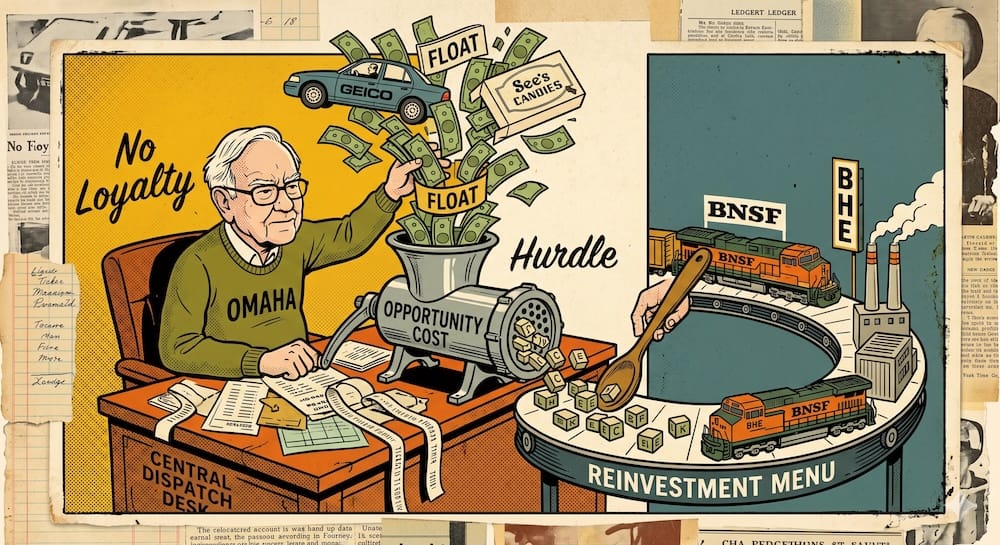
Berkshire’s real loop was simpler, stranger, and far more systematic than the popular folklore implies: collect durable capital through underwriting, let operating businesses throw off cash, send that excess cash to a centralized pool in Omaha, and wait until something worth buying appears on the reinvestment menu.
The playbook was not about emotional attachment to a favorite asset class or a dogmatic buy-and-hold-forever mantra. It was a closed-loop capital cycle where every dollar had to compete for its next job based on strict opportunity cost, run by an allocator wearing a friendly Omaha sweater.
If you try to copy his public equity portfolio without understanding the engine room that funds it, you are looking at the output while ignoring the machine. Let’s look at how the capital actually cycles.
The Berkshire Playbook Most Investors Miss
The standard narrative treats Berkshire Hathaway as an outsized mutual fund. In reality, Berkshire operates as a multi-stage capital-cycle loop. The process does not begin with an equity purchase; it begins with the generation of structurally unique corporate liabilities.
The Corporate Reinvestment Loop
| Playbook Stage | Capital Impact | Core Objective |
| 1. Insurance Underwriting | Sources raw investable float | Acquire long-tail, low-to-negative cost structural liabilities. |
| 2. Subsidiary Harvesting | Replenishes the central pool | Extract free cash flow from capital-efficient, high-moat subsidiaries. |
| 3. Centralized Allocation | Directs capital via opportunity cost | Evaluate the multi-outlet menu from the Omaha dispatch desk. |
| 4. Optionality Retention | Preserves liquid cash reserves | Sit in short-term Treasury bills when market hurdles are unmet. |
| 5. Tracking-Error Endurance | Tests long-term behavioral discipline | Endure cyclical underperformance rather than chasing overvalued assets. |
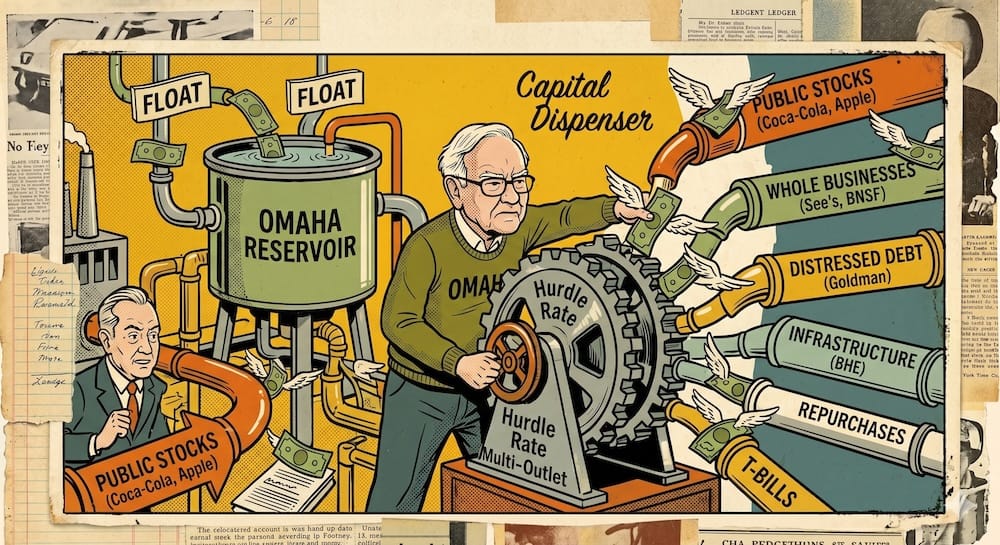
The genius of the playbook is that the capital did not have a loyalty program. See’s Candies cash did not have to go back into chocolate factories. GEICO float did not have to go back into writing auto insurance. Once cash cleared its local operational requirements, it lost its local label and was sent to the central dispatch desk in Omaha, where it was treated as raw, uncommitted fuel for whichever outlet offered the highest hurdle-clearing expected return.
Step One — Insurance Float Creates the Fuel
The absolute baseline of the playbook is sourcing durable capital. While the public focuses on what Buffett bought, the critical question is what he borrowed with.
When Berkshire purchased National Indemnity in 1967 for $8.6 million, the primary prize was not just the company’s underlying underwriting earnings. The core asset was a $24.7 million investment portfolio backed by insurance reserves—historically referred to as insurance float.
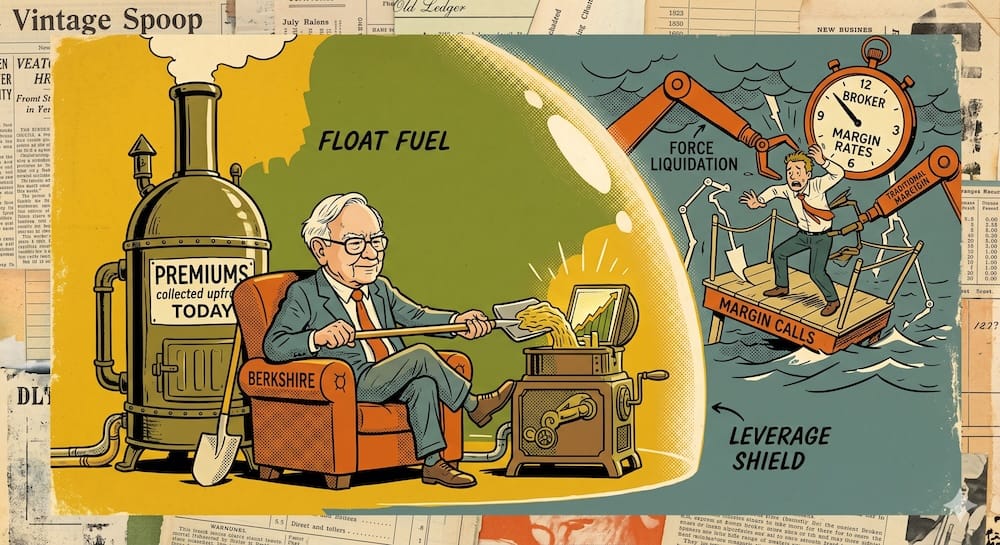
In an insurance operation, the capital cycle runs in reverse compared to a traditional business. Customers pay their insurance premiums upfront today, and the insurer pays out claims years, or even decades, down the road when accidents materialize. Until those claims are settled, the insurer holds the cash.
Academic work estimates Berkshire’s historical track record points out that this structural liability functioned as a massive funding advantage. Depending on the reconstruction window, academic work estimates Berkshire’s historical leverage at roughly 1.6x to 1.7x, scaling up underlying asset exposure over its long corporate history.
But the vital nuance of the playbook is that this liability-backed capital is not subject to broker-style margin calls or fund-style redemptions.
Funding Leverage Comparison
| Attribute | Traditional Broker Margin | Berkshire Insurance Float |
| Cost of Capital | Broker margin rates and interest drag | Historically low-cost, sometimes negative-cost when underwriting was profitable |
| Forced-Selling Risk | Can trigger margin calls during severe market drops | Not subject to broker-style margin calls triggered by stock-market price declines |
| Structural Source | Brokerage lending | Insurance premiums and reserves |
| Duration | Shorter-term and market-sensitive | Longer-tail and claims-dependent |
| Key Constraint | Broker can force liquidation | Claims, reserves, underwriting discipline, regulation, liquidity management |
A retail investor using standard margin faces constant liquidation risk; if the market drops 40%, the broker liquidates the portfolio to preserve the loan. Berkshire’s insurance float reduces forced-selling pressure during market declines. If Berkshire’s stock price falls precipitously, there is no margin clerk who can force the liquidation of the underlying equities. While float management requires careful attention to long-term underwriting profitability, claims reserving, and regulatory capital requirements, the structure insulates the portfolio from short-term market volatility.
Step Two — Cash-Generating Businesses Refill the Reservoir
Once the insurance engine began sourcing float, the second step of the playbook required expanding the capital pool via wholly-owned corporate subsidiaries. The core requirement for these businesses was simple: they had to produce immense free cash flow while consuming very little capital internally.
The definitive pivot point for this strategy occurred in 1972 when Blue Chip Stamps—a trading stamp vehicle controlled by Buffett and Munger that possessed its own unique pool of unredeemed stamp float—purchased See’s Candies for $25 million.
See’s Candies 1972 Capital Profile
| Metric | Financial Value |
| Purchase Price | $25 Million |
| Net Tangible Operating Assets Required | $8 Million |
| Annual Pre-Tax Profit Produced | $2 Million |
| Return on Net Tangible Assets | 25% |
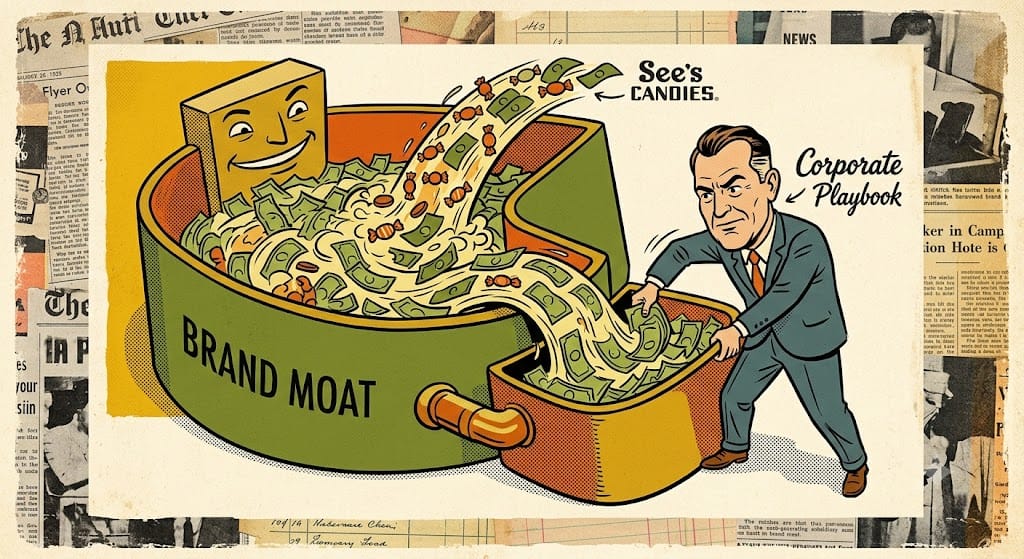
In a standard corporate setup, a company like See’s might be forced by its board to reinvest its earnings back into building more chocolate factories, even if the local market was saturated and the return on that new capital was low.
The Berkshire playbook dismantled this local reinvestment trap. Because See’s possessed an elite brand moat, it could raise prices to combat inflation without needing to inject massive amounts of new capital into its infrastructure. The resulting $2 million in pre-tax profit was harvested by the parent company and treated as unassigned cash.
This cash-harvesting mechanism was deployed repeatedly across different eras, creating a multi-industry cash reservoir.
The Subsidiary Cash Reservoir Matrix
| Subsidiary Asset | Primary Cash-Flow Role | Playbook Impact |
| GEICO | High-volume personal lines auto underwriting. | Berkshire capital was used to fund a major GEICO investment during its 1976 distress, eventually leading to full acquisition in 1996 and vastly expanding the core insurance float pool. |
| Berkshire Hathaway Energy (BHE) | Regulated utilities and large-scale renewable infrastructure. | Reinvesting large amounts of earnings within Berkshire Hathaway Energy allows the subsidiary to fund capital expenditures with lower internal friction than dividend-paying utility peers. |
| BNSF Railway | Capital-intensive macroeconomic freight transport. | Acquired later in the scale cycle, providing a massive, predictable cash-flow baseline that continually replenishes the Omaha cash pool regardless of equity valuations. |
Step Three — Omaha Chooses the Best Available Capital Outlet
With insurance float and operating cash flows constantly filling the central reservoir, the playbook moves to its most critical operational stage: centralized capital allocation.
Most corporate managers suffer from empire-building bias or localized blinders; a tech executive wants to buy tech companies, and an oil executive wants to drill more wells. In Omaha, every dollar entered an open, multi-outlet opportunity-cost competition.
Buffett’s reinvestment menu contained six primary outlets, and capital was routed dynamically based on whichever option cleared a disciplined hurdle rate based on available alternatives at that specific moment in the market cycle.
The Capital Outlet Decision Matrix
| Capital Outlet | When Buffett Used It | Historical Example | Hidden Constraint / Trade-off |
| Buy Public Stocks | When public equities offered attractive expected returns relative to other available outlets. | Large public allocations such as Coca-Cola (1988) and Apple (2016). | Subject to market volatility, tracking error, and strict regulatory disclosure limits. |
| Buy Whole Businesses | When private owners sought a permanent home and the asset required zero structural turnarounds. | See’s Candies (1972), BNSF Railway (2010). | Extremely rare at mega-cap scale; illiquid capital commitment. |
| Rescue Distressed Institutions | During acute macroeconomic liquidity panics when cash was scarce and expensive. | Acting as a selective institutional liquidity provider for Goldman Sachs (2008) via 10% preferred dividend terms and warrants. | Requires massive cash optionality; completely dependent on third-party failure modes. |
| Fund Infrastructure | When regulated utility structures offered steady, long-term returns on capital. | Reinvesting large amounts of earnings within Berkshire Hathaway Energy for capital expenditures. | Low-beta, capped utility return profiles that do not match early-stage alpha. |
| Repurchase Berkshire Shares | When public equities were overvalued and Berkshire stock traded below conservative intrinsic value. | Berkshire repurchases when shares appear to trade below conservative intrinsic value and the company retains ample liquidity. | Does not add new operational cash-generating lines to the conglomerate. |
| Hold Cash / T-Bills | When no available asset in public or private markets cleared the opportunity-cost hurdle. | Building historic cash reserves during broad market extensions. | Subjects the portfolio to systematic inflation drag and near-term underperformance. |
Step Four — Cash Is the Waiting Room, Not a Failure
The fourth step of the playbook is the most difficult for active managers to execute: doing absolutely nothing.
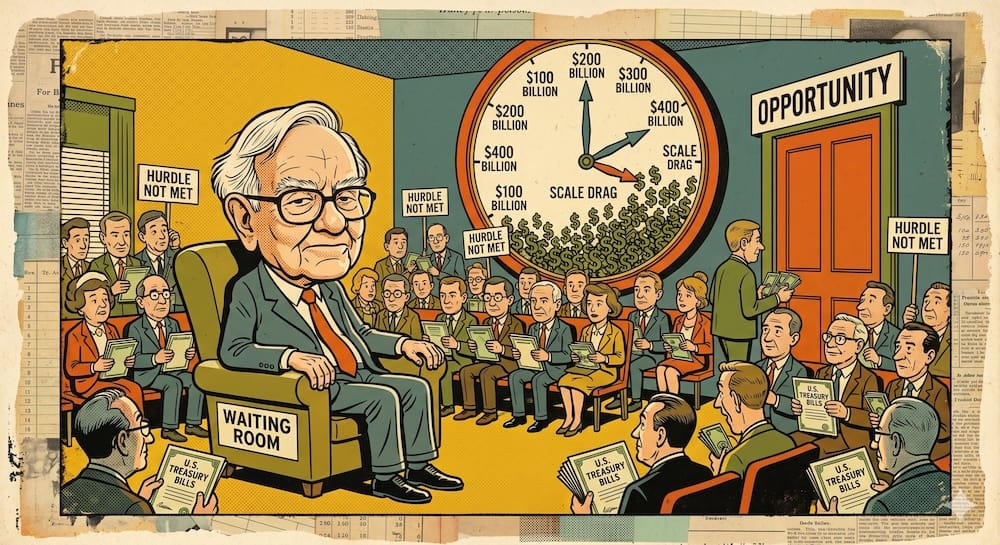
When valuations are extended across public and private markets, the Berkshire playbook dictates that cash accumulation is an active asset, not an operational failure. Maintaining a massive fortress of short-term U.S. Treasury bills provides Berkshire with total operational optionality.
Retail Buffett worship often misinterprets this cash accumulation as a macro-economic prediction of an impending crash. In reality, it is a strict reflection of opportunity cost. If the assets on the reinvestment menu do not meet the minimum hurdle rate, the capital stays in the waiting room.
However, as Berkshire moved into its modern mega-cap scale phase, this cash reservoir transformed into a structural anchor. Holding tens or hundreds of billions in low-yielding cash instruments creates an intense scale drag on nominal returns. What worked seamlessly when managing millions of dollars becomes a grinding geometric constraint when you are forced to deploy billions just to move the performance needle a single millimeter.
Cash patience is an elite tool, but at a certain scale, the waiting room becomes so crowded that it alters the performance profile of the entire architecture.
Step Five — Tracking Error Is the Price of Discipline
The final step in the capital-cycle loop is enduring the behavioral stress test that the playbook inevitably inflicts. Refusing to buy overvalued assets means you will systematically look foolish during the final blow-out stages of a speculative bull market.
This brings us back to the late-1990s tech peak, which serves as the ultimate validation phase of the playbook’s structural discipline. Across 1998 and 1999, Berkshire underperformed the S&P 500 by over 40% on a relative basis, experiencing a 49% peak-to-trough decline in its stock price while un-profitable digital platforms went to outer space.
1998–1999 Speculative Bull Market Stress Test:
------------------------------------------------------------
[S&P 500 / Tech Sector] ──> Rapidly Accelerating Valuation
[Berkshire Hathaway]   ──> Refusing Bad Hurdles / Retaining Cash
                               ↓
                      [Relative Gap: >40%]
                               ↓
             (Press Narrative: "Has Buffett Lost It?")
The media weaponized this tracking error to argue that the playbook was obsolete. But tracking error is not a mechanical malfunction; it is the predictable price of discipline. The permanent capital holding company structure allowed Berkshire to experience a multi-year valuation halving without ever facing a forced redemption call.
When the dot-com architecture collapsed in 2000, Berkshire’s cash reservoir was completely intact, ready to resume the opportunistic reinvestment loop while the investors who maximized short-term relative tracking returns were systematically wiped out.
What Modern Investors Can Absorb Conceptually
A modern individual investor operating inside a standard retail brokerage account cannot build a literal carbon copy of Berkshire Hathaway. You cannot easily issue insurance policies to harvest negative-cost float, nor can you negotiate custom preferred dividend structures with Wall Street investment banks during a financial panic.
But if you look past the institutional instruments and study the conceptual playbook, the core principles of the capital cycle travel perfectly.
The Portability Ledger
| Berkshire Playbook Principle | What Travels Conceptually | What Does Not Travel Well | PPP Sponge Verdict |
| Insurance Float | Sourcing capital that is structurally insulated from short-term liquidation risks during market cycles. | Attempting to use traditional retail margin lines, which carry high interest and instant liquidation risk. | EXPEL the idea that retail margin is a clean analogue for Berkshire float. Focus on un-levered capital permanence. |
| Cash-Flow Redeployment | Treating your personal income streams and portfolio distributions as an unassigned, centralized pool. | Automatically reinvesting every dividend back into the exact asset that paid it out, regardless of current valuation. | ABSORB. Treat every dollar of cash flow as an independent free agent that must compete for its next job based on value. |
| Opportunity Cost | Ranking every potential purchase against a consistent opportunity-cost hurdle rather than chasing shifting trends. | Changing your investment parameters or asset allocation models based on short-term market momentum. | ABSORB. A broad-market index or an unlevered value/quality framework can serve as an educational baseline for opportunity-cost comparison. |
| Cash Patience | Accepting near-term cash drag as the acceptable price for preserving tactical liquidity. | Hoarding cash in an attempt to perfectly time the macro economy or execute high-frequency trades. | ABSORB. Cash is best understood conceptually as optionality, not as a short-term macroeconomic prediction tool. |
The ultimate takeaway from the Berkshire playbook is structural survival. Buffett outcompounded his contemporaries not because he possessed a magical formula for picking stocks, but because he constructed a corporate fortress that insulated his capital from forced liquidations, allowing him to treat every dollar as a ruthless calculation of opportunity cost.
The conceptual lesson is to make capital more durable, avoid fragile leverage, treat cash flows as an allocation pool, and keep opportunity cost at the center.
What is the core engine behind the Warren Buffett Berkshire playbook?
It is a closed-loop capital cycle, not a stock-picking formula. The mechanism runs on a simple sequence: insurance subsidiaries collect upfront premiums that sit on the balance sheet as un-callable float. High-moat operating companies then generate secondary cash flows. All this capital is swept into a centralized pool in Omaha, where every dollar must compete for its next deployment based on strict opportunity cost across public stocks, full acquisitions, crisis lending, share buybacks, or liquid Treasury bills.
Can a retail investor access insurance float to replicate this strategy?
No. Standard retail investors cannot source billions in non-recourse, low-to-negative-cost insurance liabilities. If a retail account attempts to amplify returns using traditional broker margin lines, they face high interest rate drag and severe forced-selling risks via automated broker margin calls during a market crash. The execution tools do not travel to a retail canvas, even though the underlying principles of capital durability do.
What is the minimum portfolio size needed to execute the conceptual lessons of this playbook?
There is no strict dollar minimum, but the true constraint is behavioral scale. To conceptually build your own allocation engine, you need enough capital to split your assets into a durable cash reservoir and independent, low-turnover equity factor tranches without compromising your baseline living expenses. For most DIY builders, this structural discipline becomes practical once the portfolio can absorb multi-year tracking error without triggering a personal liquidity crunch.
How does the Berkshire playbook handle the tax drag that retail investors face?
Through severe tax insulation. Within the Berkshire corporate holding company structure, cash flows from wholly owned subsidiaries and internal capital gains are repositioned with significantly lower internal friction than a personal account experiences. A retail investor can replicate this structural tax shield conceptually by minimizing portfolio turnover and maximizing the use of tax-advantaged wrappers like a Roth IRA or 401(k) to block continuous capital gains distribution taxes.
Why does Berkshire hold so much cash instead of investing it immediately?
Cash is an active asset providing total optionality, not a sign of laziness. When the available options on the reinvestment menu fail to clear a disciplined hurdle rate based on available alternatives, the capital is routed to the Treasury bill waiting room. Buffett treats cash as a strategic reserve to be deployed only when market panics create highly asymmetric, high-yielding opportunities.
What are the primary investment tranches or outlets used in the playbook?
The allocation menu consists of six main outlets: purchasing public equities when valuations are attractive, buying whole businesses with sustainable competitive advantages, providing high-coupon preferred equity lifelines to distressed institutions during panics, funding internal infrastructure projects within subsidiaries like Berkshire Hathaway Energy, executing share buybacks when Berkshire stock trades below conservative intrinsic value, and maintaining liquid cash reserves in short-term U.S. Treasuries.
How does an investor build tracking-error endurance like Buffett?
By securing un-callable, permanent capital. Buffett survived the late-1990s tech bubble—where Berkshire underperformed the S&P 500 by over 40% on a relative basis—because his corporate vehicle has no open-ended redemption calls. For a retail investor, building this endurance requires matching your investment horizons exactly to un-callable cash, completely eliminating recourse debt, and adopting a framework where benchmark underperformance is accepted as the price of strict valuation discipline.
This article is also available in Spanish. [Leé la versión en castellano: El manual de estrategia de Berkshire: Float de seguros, flujo de caja y asignación de capital]