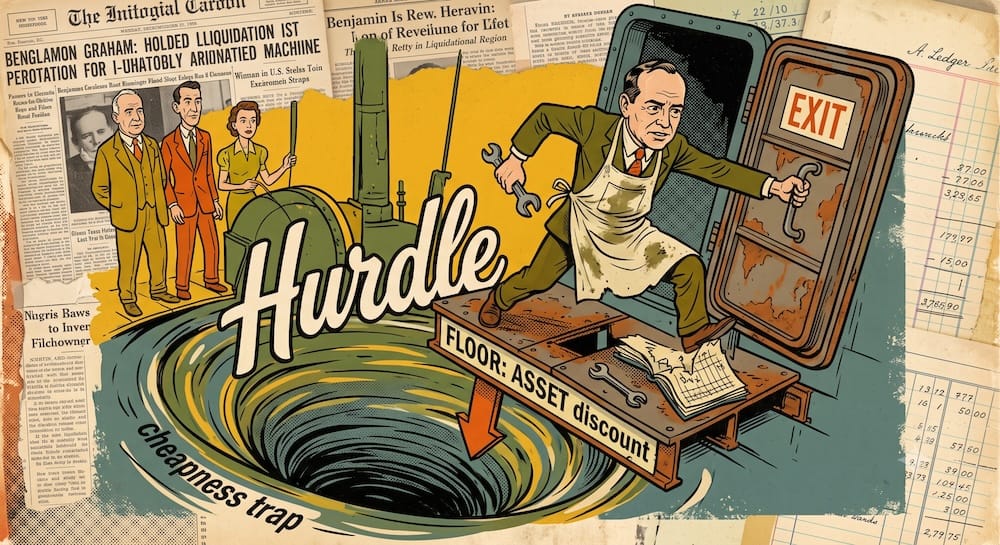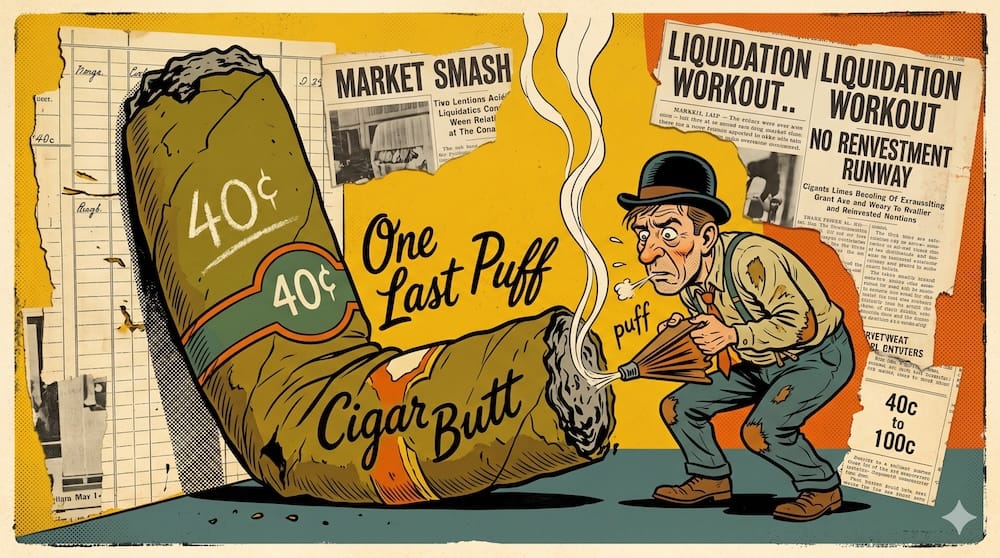
When we talk about Berkshire Hathaway today, we are ultimately talking about an insurance company that moonlights as a massive capital allocation vehicle. The mechanics are legendary: Warren Buffett takes the premiums you pay for auto or property insurance, holds onto that cash before claims are paid out, and invests it into compounding assets. That non-redeemable, low-cost capital is known as insurance float, and it has been the primary fuel for Buffett’s multi-decade wealth engine.
But there is a glaring chronological problem that most modern investment tutorials completely gloss over.
Buffett bought his first insurance asset, National Indemnity, in 1967. By that point, he had already produced extraordinary partnership returns for over a decade. He was already rich. He was already running a massive multi-million-dollar empire.
Which leaves us with a fascinating engineering puzzle: Before he had access to billions of dollars of permanent insurance float, what was the actual capital engine?
I understand the temptation here. Give me a dusty old financial manual, an incredibly cheap-looking stock, and one too many cups of coffee, and I can absolutely convince myself that I’ve found Omaha in miniature right at my kitchen table. That is usually exactly when the value trap starts sharpening its teeth.
The truth is that early Buffett did not compound his wealth through sheer stock-picking genius alone. He did it by engineering a highly specific, pre-float substitute stack that mimicked the exact behavioral and structural benefits of insurance float long before he ever owned a single insurance policy.
Before Float, Buffett Had a Different Capital Engine
To understand the mechanics of early capital compounding, we have to isolate what insurance float actually does for an allocator. Float provides long-duration capital, substantial insulation from market panics, investable liquidity, and the structural leverage needed to magnify returns without the risk of margin calls.
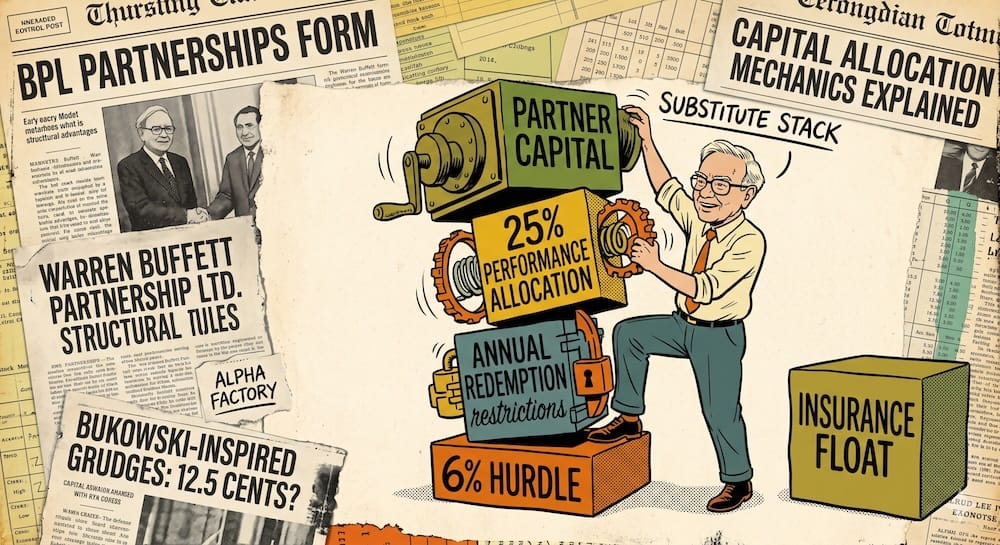
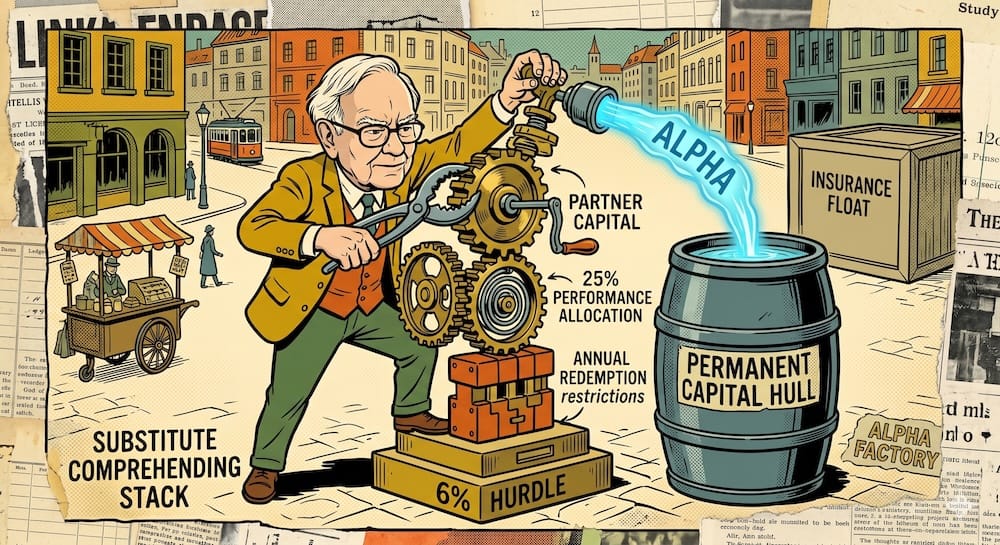
When Buffett ran the Buffett Partnership Ltd. (BPL) from 1956 to 1969, he lacked a corporate balance sheet to manufacture that leverage. Instead, he engineered a collection of legal, operational, and behavioral mechanisms that served as structural proxies for float.
Pre-Float Compounding Engine Map
| Pre-Float Engine | What It Did for Buffett | Float-Like Function | Why It Was Limited |
| Partner Capital | Pooled external funds from limited partners. | Leveraged his strategy using OPM (Other People’s Money). | Relied on personal trust; capped by his direct personal network. |
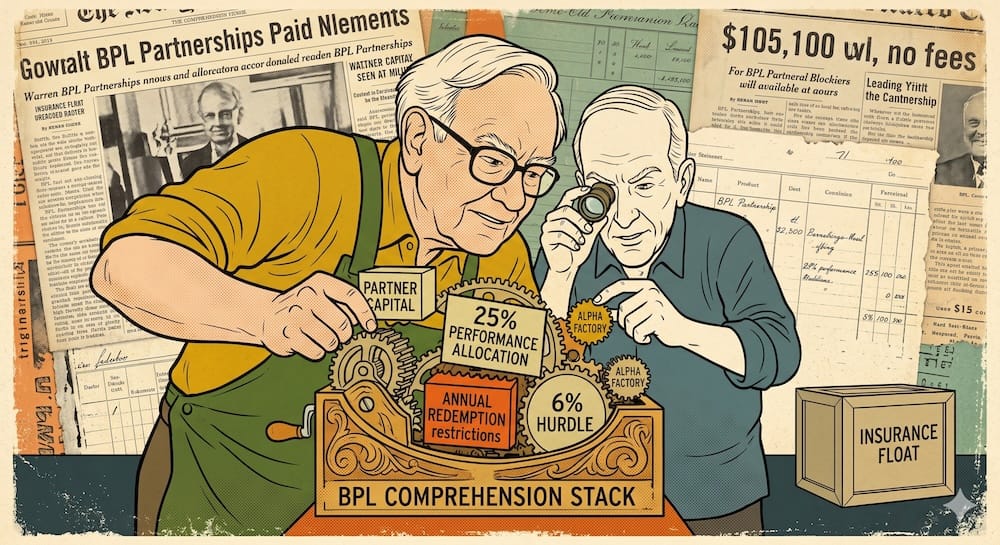
| Performance Allocation | Siphoned 25% of profits above a 6% benchmark hurdle. | Generated an asymmetric performance option with limited personal capital contribution. | Produced zero fee income during flat or down market years. |
| Annual Liquidity Gate | Restricted withdrawals exclusively to a single year-end window. | Created temporary capital durability during panics. | Not truly permanent; capital could still walk away every December. |
| Workouts | Reallocated idle cash into event-driven arbitrage. | Eliminated cash drag without adding broad market exposure. | Capped by the absolute volume of corporate deal flow. |
| Controls | Purchased dominant blocks to force corporate change. | Transformed passive equity risk into operational authority. | Required massive concentration and physical management. |
| Asset Liquidation | Stripped and redeployed trapped corporate assets. | Unlocked hidden liquidity from underperforming hulls. | Destructive to the underlying business; highly unscalable. |
The point is not that BPL was already an insurance company in disguise. It wasn’t. The point is that Buffett had already learned the central problem of compounding: capital must be durable, productive, and behaviorally protected. Insurance float later solved that problem more elegantly, but the partnership years show he was already engineering around it.
This substitute stack allowed Buffett to weaponize a relatively tiny personal net worth. By combining the legal design of his partnership with aggressive corporate interventions, he created a framework that kept capital moving at high velocity without ever requiring a traditional corporate float model.
Partner Capital Was the First Float Substitute
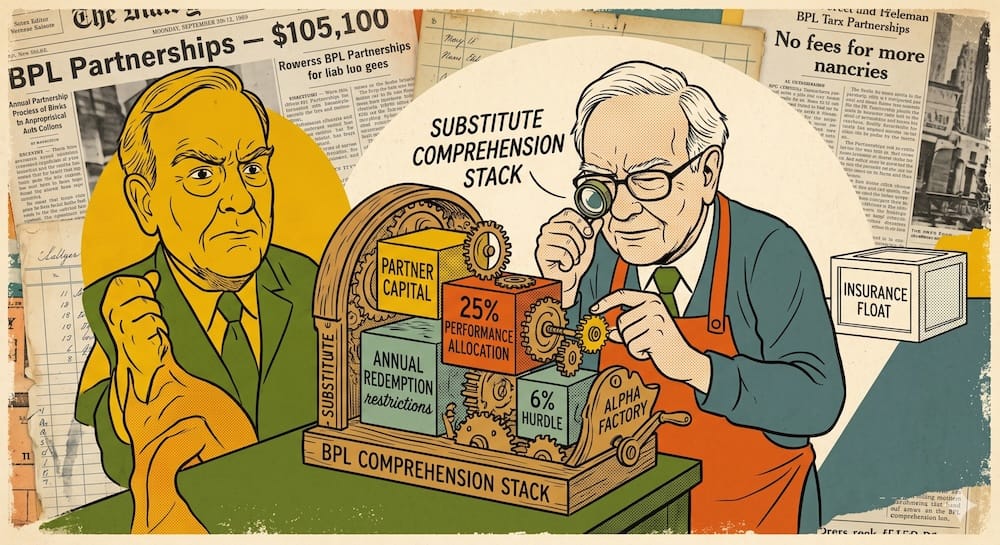
When Buffett launched his investment career in 1956 at twenty-six years old, his personal savings were entirely insufficient to execute large-scale corporate operations. His personal stake in the initial partnership pool was a symbolic $100. The rest of the $105,100 starting capital pool was sourced from seven limited partners, primarily close friends and family members.
This outside partner capital served as his very first float substitute. By pooling external funds under a single mandate, Buffett instantly expanded his investment horizons far beyond his personal balance sheet. This structural expansion gave him the absolute dollar capacity needed to accumulate significant, market-moving equity blocks in small public corporations—an operational capability that would have been entirely unavailable if he had remained confined to his personal savings.
The Performance Allocation Turned Skill Into Ownership
The real acceleration mechanism of the pre-float era, however, wasn’t the mere presence of outside capital. It was the specific way Buffett structured his compensation. He charged zero management fees. If the portfolio moved sideways or fell, he did not collect a single dollar to keep the lights on.
Instead, he negotiated a 25% performance allocation on all returns exceeding a 6% cumulative hurdle rate, backed by a permanent high-water mark and a strict deficiency carry-forward provision. If the partnership generated a return below 6% in any given year, the dollar deficiency rolled over into the next year’s calculation. Buffett had to clear the historical hurdle completely before he could claim another dollar of performance profits.
This fee asymmetry shifted the mathematical velocity of his personal net worth compared to the partnership’s underlying assets. If the partnership achieved a massive return year, the limited partners received their hurdle preference plus the majority of the upside, while Buffett’s personal capital account absorbed 25% of the total outperformance across the entire combined pool. Because he started with virtually none of his own money in the pool, this arrangement operated as an asymmetric performance option with limited personal capital contribution. It allowed him to rapidly convert pure selection skill into real, permanent corporate ownership without requiring him to supply the initial capital himself.
Annual Liquidity Restrictions Made the Capital Holdable
A standard open-end mutual fund faces a persistent structural vulnerability: retail redemption panic. When the stock market drops, retail investors tend to liquidate their holdings, forcing the fund manager to sell assets at the exact bottom to meet redemptions. This structural reality destroys long-term compounding.
Buffett recognized this vulnerability early on and engineered a legal solution within the BPL framework. He instituted strict annual liquidity gates. Partners were legally prohibited from executing intra-year redemptions. Capital could only be withdrawn once a year, specifically on December 31st, and required a formal 30-day advance notice.
Throughout the entire 1957–1969 period, this rule provided Buffett with substantial insulation from intra-year redemption pressure. During severe equity corrections—such as the sudden 1962 Flash Crash—knowing his capital base was protected from intra-year redemption pressure allowed him to evaluate highly illiquid, deeply mispriced securities with the secure horizon of a private equity investor, safely insulated when the public market panicked.
Workouts Kept Idle Capital Productive
To maintain an exceptional compounding pace, an allocator cannot allow cash to sit idle, dragging down the portfolio’s total return. Yet, when the stock market rises and cheap stocks disappear, holding cash is often the only alternative to buying overvalued equities.
Buffett solved this classic capital allocation dilemma through his Workouts sleeve. Workouts were event-driven special situations: corporate mergers, liquidations, spin-offs, and bankruptcies. The return profile of these positions was less dependent on broad equity market direction; their profitability depended primarily on whether the specific corporate transaction closed successfully.
This event-driven framework served as his pre-float cash substitute. When asset prices rose and standard value opportunities disappeared, Buffett did not chase expensive stocks or accept the drag of low-yielding bank cash. Instead, he systematically reallocated his liquidity into complex arbitrage deals. This was not float, but it performed one of float’s central jobs: keeping capital productive without relying on rising stock multiples or adding general market volatility during major equity corrections.
Controls Converted Trapped Assets Into Reinvestable Capital
When passive value investing hit a wall because a cheap stock remained undervalued for years, Buffett deployed his most aggressive pre-float mechanism: the Controls sleeve. If corporate management refused to optimize a company’s balance sheet, Buffett accumulated dominant equity blocks to force corporate asset extractions.
Sanborn Map Co. (1958–1960)
Sanborn manufactured underwriting maps, but its core business was in a long-term secular decline. However, the company held an investment portfolio of blue-chip stocks worth roughly $65 per share inside its corporate shell, while the stock traded openly at just $45 per share. The market was essentially valuing the core mapping business at a negative $20 per share.
Buffett did not sit back and wait for the market to fix this math. BPL quietly accumulated 24% of the total outstanding stock. Buffett took a seat on the board, directly confronted management, and used activist pressure to force a structural asset exchange. He compelled Sanborn to trade its blue-chip investment portfolio directly to buy back its own shares from the partnership. This allowed Buffett to exit at full asset value, bypassing open-market liquidity constraints entirely and freeing up trapped cash to redeploy into fresh compounding situations.
Dempster Mill Manufacturing Co. (1956–1963)
In 1956, Buffett began buying shares of Dempster Mill, a small manufacturer of farm implements trading at a steep discount to its net working capital. By 1961, BPL had acquired over 70% control of the company. When the business began to struggle operationally, a threat of bankruptcy emerged.
Buffett did not hold patiently out of a romantic devotion to the company’s heritage. He installed Harry Bottle, an aggressive operational restructuring specialist. Bottle slashed operating overhead, fired non-essential personnel, closed unprofitable storage facilities, and aggressively liquidated bloated inventory.
This drastic operational intervention converted a low-return agricultural manufacturing asset into a clean, highly liquid pool of cash. Buffett then took that cash and used it to purchase high-yielding public securities directly inside the corporate shell. This was not a standard passive stock investment; it was an active capital extraction and redeployment operation designed to turn a broken business into a functional investment fund.
Berkshire Was the Failed Bridge Between BPL and Float
In 1962, Buffett began buying shares of Berkshire Hathaway. It was another classic “cigar-butt” situation: a declining New England textile manufacturer trading far below its net current asset value. The goal was identical to his previous operations—accumulate a block of stock, wait for management to liquidate a textile mill, and sell the stock back to the company at a premium during a corporate tender offer.
But in 1964, Berkshire’s president, Seabury Stanton, attempted to shortchange Buffett by exactly 12.5 cents per share on a verbal buyback agreement. Out of pure frustration, Buffett broke his own valuation rules. He launched a hostile takeover, fired Stanton, and took full control of the entire corporate entity.
It was an immediate operational failure. Unlike Dempster Mill or Sanborn Map, Berkshire’s assets were not cleanly extractable or easily liquidated without absorbing massive, compounding operational losses. Buffett found himself stuck with a capital-devouring textile operation that required continuous reinvestment just to keep the doors open.
This operational wall helped push Buffett toward finding a completely new source of permanent capital—leading directly to his purchase of National Indemnity in 1967 to establish an actual insurance float engine.
National Indemnity Changed the Game
The purchase of National Indemnity in 1967 marked the definitive structural transition point for Buffett’s career. Once he integrated an insurance operation into his corporate architecture, the old pre-float substitute stack became obsolete.
BPL Pre-Float Engine vs. Later Berkshire Float
| Feature | BPL Pre-Float Mechanism | Later Berkshire Float Mechanism | Structural Difference |
| Capital Source | Limited Partner Contributions | Insurance Underwriting Premiums | Shifted from private relationships to a commercial business model. |
| Redemption Risk | Annual Window (December 31st) | Zero (Policyholders cannot redeem premiums) | Fully eliminated investor redemption psychology. |
| Leverage Type | Performance Fee Structuring | Uninvested Underwriting Float | Replaced fee siphoning with direct asset leverage. |
| Cost of Capital | 6% Hurdle Preference | Often Negative (Underwriting Profit) | Eliminated the mandatory investor return preference. |
| Duration | Capped by Partner Retention | Long-Duration / Continuous | Created multi-decade capital permanence. |
| Scalability | Low (Limited by small-cap market caps) | High (Scales directly with premium volume) | Allowed deployment into mega-cap public corporations. |
| Investment Universe | Illiquid Micro-Caps & Arbitrage | High-Quality Global Franchises | Shifted focus from asset-stripping to compounding moats. |
With actual corporate float secured, Buffett no longer needed to spend his time liquidating inventory or running proxy battles against small-town managers. The permanence of insurance float allowed him to dissolve the partnership in 1969, return cash to his partners, and pivot his entire operation toward buying large, high-quality businesses that could compound capital undisturbed for decades.
What Modern Investors Can Absorb
A modern retail DIY investor running an account on a smartphone terminal cannot replicate the early Buffett playbook. You cannot buy 25% of an illiquid micro-cap, demand a board seat, fire management, or hire an operational specialist to liquidate inventory to force an asset payout. Basic financial statement information is vastly more accessible and rapidly screened today, meaning many of the clean structural anomalies that made the paper-manual era possible have been significantly compressed or transformed.
I say this with affection for every spreadsheet warrior among us, myself included: cheap is not a catalyst. Cheap is just an invitation to ask the next question.
But if you look past the specific historical actions and focus directly on the underlying capital structure underneath the result, the pre-float engine offers highly portable architectural lessons for your portfolio construction.
Modern Portability Filter
| Historical Mechanic | What Travels | What Does Not Travel | Modern Lesson |
| Partner Capital Expansion | Accessing structured, long-duration pooling mechanisms. | Managing uncommitted retail capital or soliciting friends without a legal framework. | Focus your long-term strategies inside structural wrappers that align your capital base with your holding horizon. |
| Performance Fee Asymmetry | Creating positive skew where upside potential significantly outpaces downside liability. | Charging performance fees without institutional regulatory licenses. | Look for asset structures or business investments that possess asymmetrical upside, rather than simple linear equity profiles. |
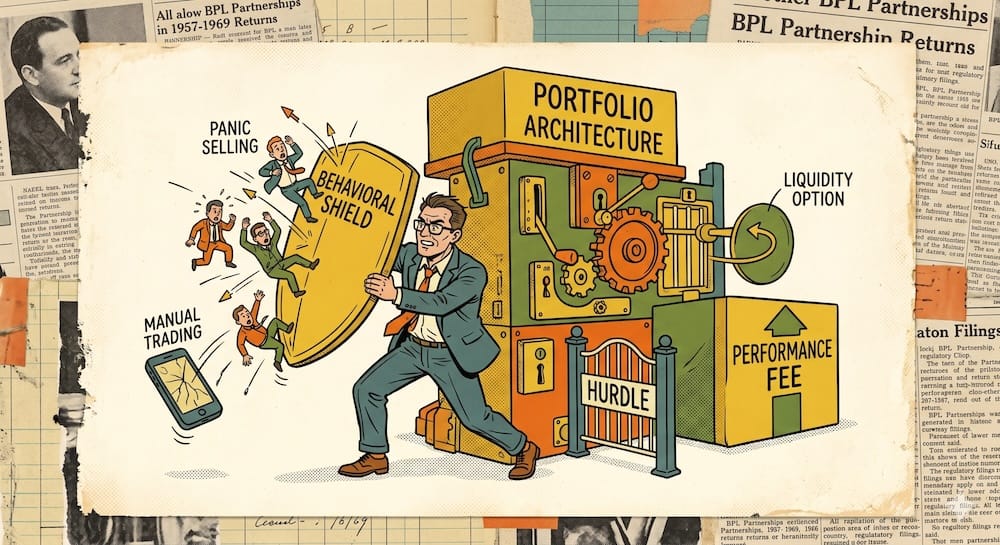
| Annual Redemption Gates | Deliberately creating artificial behavioral friction to prevent panic selling. | Implementing arbitrary legal withdrawal restrictions on other individuals. | Break your own instant liquidity options. Use tax-advantaged retirement accounts or automated schedules to insulate your portfolio from your own daily psychology. |
| Event-Driven Workouts | Utilizing a dedicated, non-correlated alternative asset sleeve as a true cash substitute. | Manually trading complex merger arbitrage deals against institutional algorithmic platforms. | The modern translation is to study systematic, low-cost liquid alternative or merger-arbitrage vehicles as possible non-equity return sleeves, without pretending they replicate BPL’s original Workouts. |
| Control Block Interventions | Demanding strong capital-allocation discipline from corporate leadership. | Launching hostile micro-cap takeovers or running proxy fights from a retail brokerage account. | Avoid cheap individual equities that lack a clear operational catalyst. If you want exposure to deep value, utilize systematic, highly diversified value factor funds. |
The ultimate takeaway from the early BPL record is that structural design always dictates your investment execution. Buffett’s early velocity was not a magic trick; it was the logical result of an asymmetric fee option, restricted liquidity gates, and tactical asset redeployments.
If you want to build a truly resilient modern portfolio, stop looking for heroes to worship. Open up your own structure carefully, look at the capital rules underneath the result, and design a framework that systematically protects you from your own liquidity options.
Build the structure carefully, keep your math disciplined, and stay independent out there.
Does a modern DIY investor need limited partners to replicate this pre-float engine?
No. Absolutely not. The core lesson of the early Buffett partnership isn’t that you need to round up a half-dozen rich friends to fund your brokerage account. The takeaway is that your capital structure must be explicitly engineered to withstand your own behavioral pitfalls. Buffett used legal lock-ups because his partners were prone to panic; you can achieve an identical behavioral shield by locking your portfolio inside tax-deferred retirement accounts or setting up automated scheduling systems that deliberately limit your intra-day liquidity options.
What is the minimum portfolio size required to execute a Workout strategy today?
It depends entirely on your vehicle selection. If you are trying to manually trade individual, announced corporate mergers, liquidations, and spin-offs like Buffett did in the 1950s, you would realistically need a capital base of at least $500,000 to manage single-deal cancellation risk and absorb the transactional drag of broker spreads. However, for a modern retail portfolio builder, that capital barrier has been entirely demolished. You can gain access to an identical event-driven, market-independent return sleeve for the price of a single share via systematic, low-cost merger arbitrage and liquid alternative ETFs.
How bad is the tax drag when trying to execute Buffett’s early pre-float strategy today?
Brutal, if you run it inside a taxable brokerage account. Early Buffett was running a hyper-active, high-velocity operation—flipping out of corporate liquidations, executing short-term arbitrage workouts, and stripping corporate assets. In the modern tax regime, this structure would trigger an avalanche of short-term capital gains taxes, severely bleeding your compound arithmetic. To make this strategy structurally holdable today, any non-equity alternative sleeves or high-turnover value factor allocations should be strictly shielded inside tax-advantaged wrappers like an IRA or 401(k).
Are modern small-cap value ETFs an exact substitute for Buffett’s “Generals” sleeve?
Not exactly, but they are the only portable retail alternative. Buffett’s “Generals” sleeve in the 1950s relied on massive manual information asymmetry—literally finding paper mispricings that the institutional world could not see. Today, digitized financial statements mean those easy, clean anomalies are instantly smoothed out by algorithms. A diversified small-cap value factor ETF will not give you a concentrated basket of hidden cigar-butts, but it will systematically capture the underlying value premium across thousands of stocks, giving you the mathematical essence of the strategy without the risk of individual value traps.
Why can’t a retail investor replicate the “Controls” sleeve from a standard brokerage account?
Because you are a price-taker, not a policy-maker. When Buffett bought into Dempster Mill or Sanborn Map, his return wasn’t dependent on waiting for the stock chart to go up. He bought enough physical voting power to walk into the executive suite, fire the management, dump the inventory, and distribute the corporate cash back to his partnership. As a retail investor trading on a smartphone app, you have zero operational authority to force an asset extraction. If you buy an individual cheap stock that lacks an active corporate catalyst or an activist engine behind it, you are simply praying for a revaluation that may never come.
Did Buffett use margin loans or structural debt before he discovered insurance float?
No. Buffett routinely expressed a strict distaste for traditional margin leverage or short-term bank debt. He understood that recourse debt leaves you vulnerable to margin calls during market panics, allowing the lender to liquidate your assets at the absolute bottom. Instead of traditional debt, his pre-float leverage was entirely manufactured through his capital architecture: using outside partner capital paired with a 25% performance fee option. This allowed him to maximize his operational upside across a larger pool of assets without ever exposing his personal balance sheet to structural liquidation risk.
This article is also available in Spanish. [Leé la versión en castellano: Cómo Warren Buffett acumuló capital antes del float de seguros]