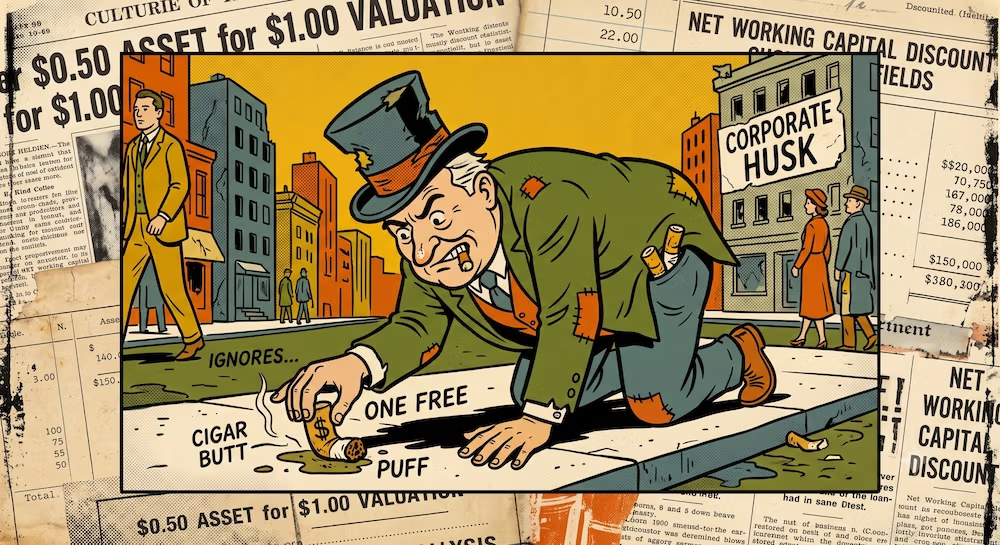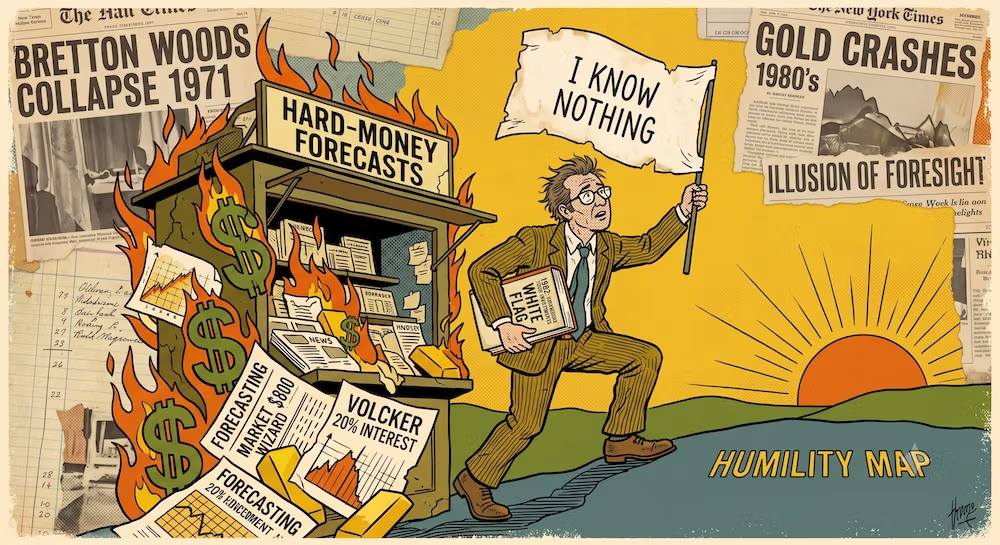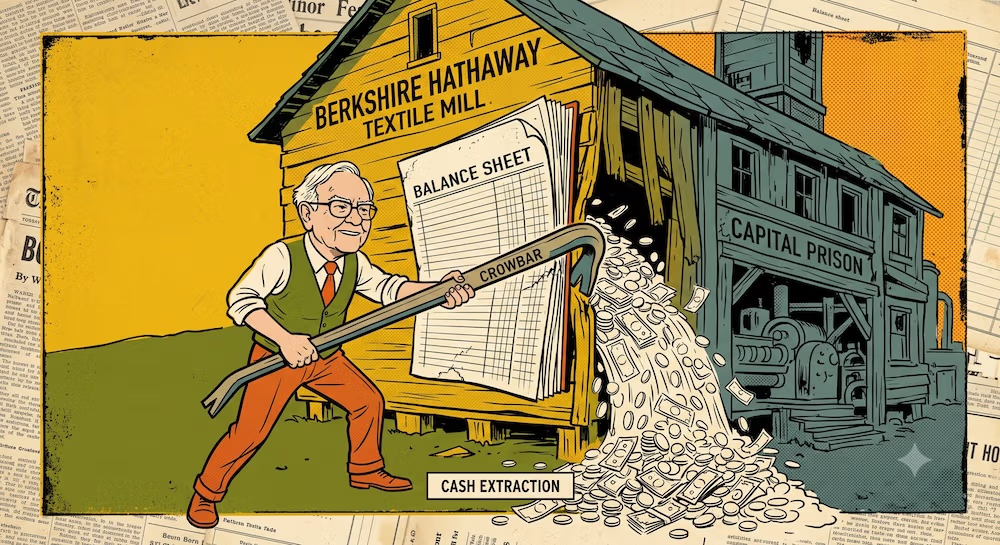
I used to think copying Warren Buffett meant buying an excellent business, sitting on my hands for thirty years, and letting compounding do the heavy lifting. We’ve all seen the internet memes, the pristine marble statue version of the man, and the endless quotes about buying “wonderful companies at fair prices.” It sounds so peaceful.
Then I actually sat down and read his original partnership letters from the 1950s and 1960s, stripped away the subsequent decades of folklore, and looked at the raw architecture of the operation.
To my eyes, the real magic of early Buffett wasn’t his stock selection at all—it was the structural layout of his fund’s capital. Before Warren Buffett became the public face of buy-and-hold quality investing, he built his fortune through a partnership structure designed around alignment, restricted liquidity, deep-value inefficiencies, workouts, control situations, and the discipline to shut the machine down when scale destroyed the opportunity set.
He was a capital allocator utilizing small-scale inefficiencies long before he became a public business philosopher.
The math doesn’t lie. If we want to extract the usable lesson, we have to look at the actual machine that created his early wealth.
The Partnership Operating System
The generic finance internet has an obsession with “moats.” If you scroll through any modern value investing forum, you will be told that Buffett built his empire by identifying unassailable brand monopolies and ignoring market noise.
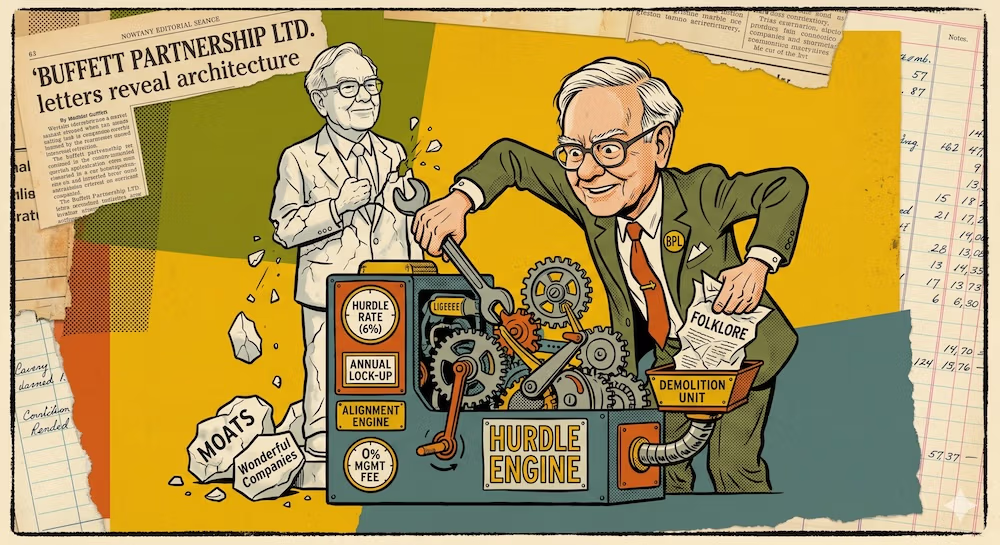
But early Buffett wasn’t running a conventional asset management firm. He was running a highly specialized vehicle called the Buffett Partnership Ltd. (BPL). Before he bought a single security, he engineered the capital rules to grant himself a permanent structural advantage over his contemporaries.
To understand how he built his pre-Berkshire fortune, we have to look under the hood at the core components of the Buffett Partnership Operating System.
The Buffett Partnership Operating System
| Component | How It Worked | Why It Mattered | Modern Misreading |
| 0% Management Fee | Buffett took zero baseline fees for managing assets; he only made money if his investors made money. | Eliminated structural fee drag during flat or down markets, protecting investor capital from administrative depletion. | Assuming Buffett always ran a standard “2 and 20” hedge fund structure. |
| 25% Performance Take Above 6% Hurdle | Buffett claimed 25% of all partnership returns, but only after partners received a cumulative 6% annual return. | Aligned his personal wealth scaling directly with outperformance, allowing his personal capital to grow exponentially in up-years. | Believing early wealth came purely from personal savings rather than asymmetric incentive structures. |
| Loss Carry-Forward / High-Water Mark | Any year where the partnership failed to hit the 6% hurdle resulted in a deficiency that had to be fully recovered before future performance allocations could be taken. | Protected limited partners from paying for temporary or volatile spikes in performance. | Treating performance fees as free options without structural downside accountability. |
| Annual Liquidity Window | Partners could only withdraw or deposit capital once a year, explicitly restricted to December 31st. | Insulated the portfolio from panic-driven redemptions during mid-year market drops, preventing forced liquidations. | Believing deep-value concentration can be safely run in a daily-liquidity retail account. |
| Generals | Buying deeply undervalued micro-cap public equities trading below their net current asset value. | Exploited extreme small-scale informational inefficiencies where prices were disconnected from liquidation value. | Conflating net-net buying with modern quality-growth investing. |
| Workouts | Capital allocated to corporate actions: mergers, liquidations, spin-offs, and reorganizations. | Provided an uncorrelated, market-neutral performance sleeve that generated absolute cash returns independent of index direction. | Viewing merger arbitrage as a standard long-term holding. |
| Controls | Quietly accumulating dominant stakes in micro-caps to force corporate changes or asset distributions. | Allowed Buffett to manufacture his own catalyst to unlock value when the public market refused to do so. | Believing retail investors can influence corporate capital allocation without holding voting control. |
| Concentrated Crisis Bets | Allocating up to 40% of partnership net assets into a single mispriced security during market panics. | Maximized the impact of high-conviction ideas when severe reputational or macro panics temporarily cleared. | Assuming diversification is a prerequisite for long-term capital preservation. |
| Scale Shutdown | Dissolving the entire partnership structure when total assets reached a size that prohibited micro-cap execution. | Preserved his operational discipline by refusing to collect fees on an asset base that broke his underlying mechanism. | Assuming great investment strategies scale infinitely without structural adaptation. |
This operating system didn’t just happen. It evolved over a precise chronological timeline, moving from simple deep-value security selection to complex corporate interventions, and finally into franchise underwriting under crisis conditions.
The Partnership Era Timeline
- 1956 — Partnership Begins: Buffett returns to Omaha with $174,000 in personal savings and forms Buffett Associates, Ltd. with $105,000 pooled from seven family members and friends, investing only $100 of his own cash.
- 1958–1960 — Sanborn Map: Buffett executes his first major activist intervention, accumulating a dominant stake to unlock a massive underlying investment portfolio hidden behind a stagnant operating business.
- 1961–1963 — Dempster Mill: Buffett secures absolute corporate control, installs turnaround management, slashes working capital, and redirects the extracted cash into high-yielding public equities.
- 1964 — American Express: The Salad Oil Swindle creates a severe reputational panic. Buffett capitalizes on the drop by concentrating roughly 40% of partnership capital into a franchise business.
- 1966–1969 — Opportunity Set Deteriorates: The hyper-speculative “Go-Go” market drives equity valuations to extreme levels while partnership assets swell to $105 million, breaking the micro-cap mechanism.
- 1969 — Partnership Closed: Buffett systematically dissolves the partnerships, returning capital to investors and recommending they allocate to municipal bonds or conservative alternatives.
- 1970 Onward — The Berkshire Era: Berkshire Hathaway is repurposed from a failing textile mill into a permanent capital corporate holding vehicle, shifting away from partnership liquidity limits.
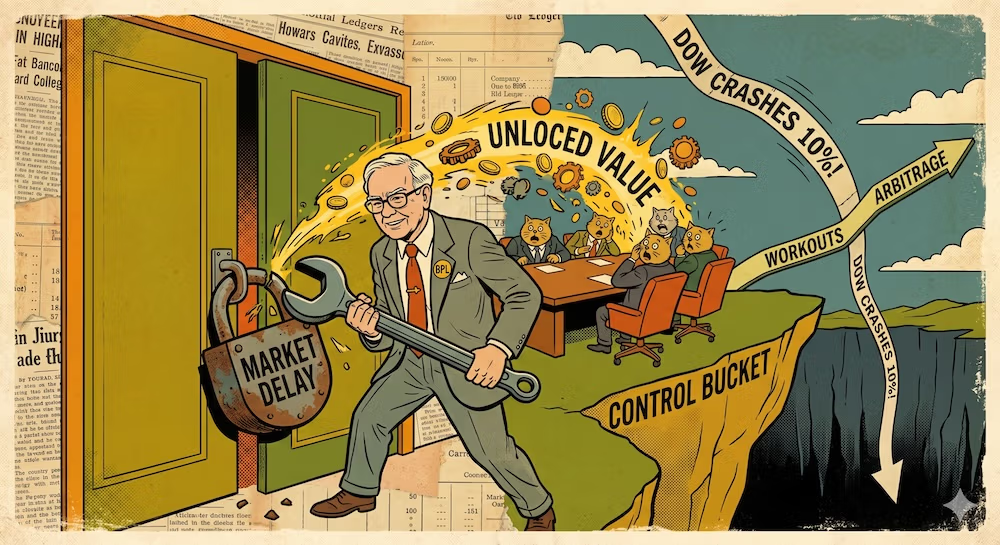
The Three Buckets: Generals, Workouts, and Controls
To understand how early Buffett constructed his risk canvas, you have to look directly at how he partitioned his capital across different operational environments. He didn’t just look for “cheap stocks.” He divided his portfolio into three distinct strategic sleeves, each serving a specific defensive or offensive purpose.
1. The Generals
These were quantitative deep-value positions bought purely on price. Buffett hunted for securities trading at deep discounts to their intrinsic value, often utilizing Benjamin Graham’s net-current-asset metric. These were short-to-medium-term investments. He bought them when they were neglected, sat on them until the market corrected the mispricing, and cleanly exited the moment price met asset value.
2. The Workouts
This performance sleeve was composed entirely of arbitrage situations. Whenever a company announced a merger, liquidation, spin-offs, or corporate reorganization, Buffett would calculate the probability of completion and the time required to close the deal. The critical mechanic here was absolute independence from stock market directions. If the Dow Jones Industrial Average fell 10% in a month, a merger arbitrage deal would still close at the pre-announced price as long as the corporate transaction remained legally intact.
3. The Controls
When a “General” was so cheap and thinly traded that public markets refused to recognize its true value, Buffett shifted his mechanic from passive holder to active owner. He would quietly buy up blocks of stock until his ownership stake allowed him to dictate corporate policy. Once control was secured, he stopped waiting for the market to change its mind; he stepped into the boardroom and unlocked the value himself.
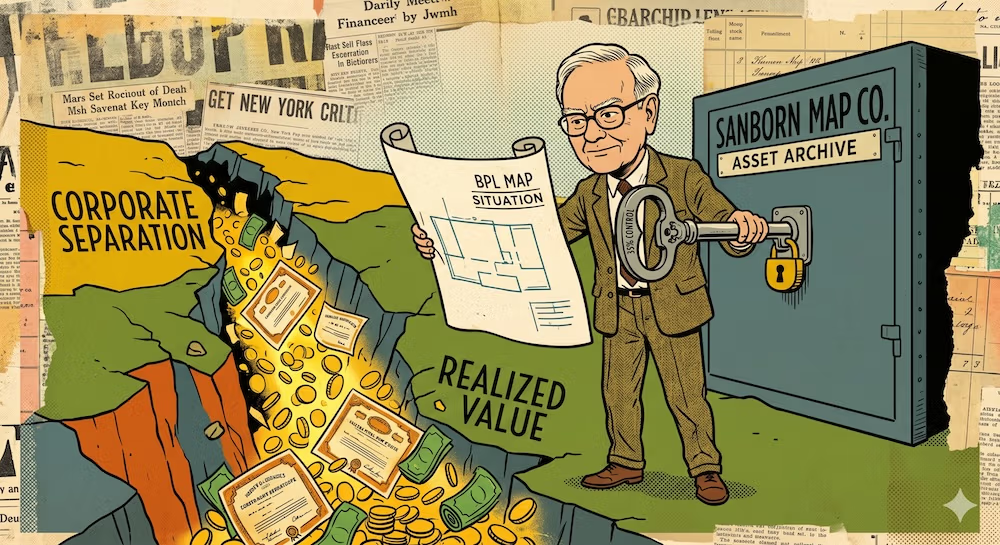
Sanborn Map: When a Cheap Stock Became a Control Situation
In 1958, Buffett found a classic structural misalignment in the Sanborn Map Co. Sanborn printed highly detailed utility maps used by insurance companies to assess underwriting risks. The operating business had entered a secular decline, but over decades of profitable operations, the company had accumulated a massive underlying investment portfolio.
Buffett noticed a stark mathematical disconnect: Sanborn shares were trading on the open market at roughly $45 per share, yet the underlying investment portfolio alone was worth $65 per share. The market was placing a negative value on the map-printing business.
[Sanborn Market Price: $45] vs. [Underlying Portfolio Value: $65] ──> Realized Value via Corporate Separation
Instead of sitting passively as a minority shareholder, Buffett used the partnership’s capital to accumulate roughly 35% of the company’s outstanding stock. With that concentration, he secured a seat on the board of directors.
He didn’t try to fix the map business. Instead, he led an activist coalition that forced the company to separate its investment portfolio from its map operations. Sanborn used its investment portfolio to buy back the shares of dissatisfied stockholders at fair value via a tax-free stock swap. Buffett realized the full asset value of his position, converting a dead, illiquid stock into cold, liquid capital.
Dempster Mill: Asset Extraction, Not Gentle Compounding
If Sanborn Map proved his capacity for corporate intervention, the 1961 acquisition of Dempster Mill Manufacturing Co. showed how unsentimental his early asset extraction mechanism could be.
Dempster was an agricultural machinery and water system manufacturer. Buffett began buying the stock because it was trading at an average cost of roughly $28 per share against a stated book value of $72 per share. However, as the underlying operating business continued to deteriorate, the company faced a severe working capital crunch that threatened to trap the partnership’s capital.
Buffett didn’t act as a patient, supportive corporate patron. Recognizing that the value was entirely tied up in stagnant inventory and underutilized fixed assets, he took absolute corporate control and brought in a specialized turnaround manager named Harry Bottle.
The directive was explicit: extract the cash.
Bottle executed an aggressive restructuring. He slashed inventory values, laid off redundant staff, raised prices on proprietary repair parts where Dempster held a regional monopoly, and consolidated obsolete warehouse space. This process converted illiquid, slow-moving agricultural inventory into liquid capital.
Buffett did not plow that cash back into the farm equipment business. He immediately extracted the liquidated funds from Dempster’s balance sheet and deployed them into high-performing public equities. He dismantled a declining operating asset to fund his portfolio canvas.
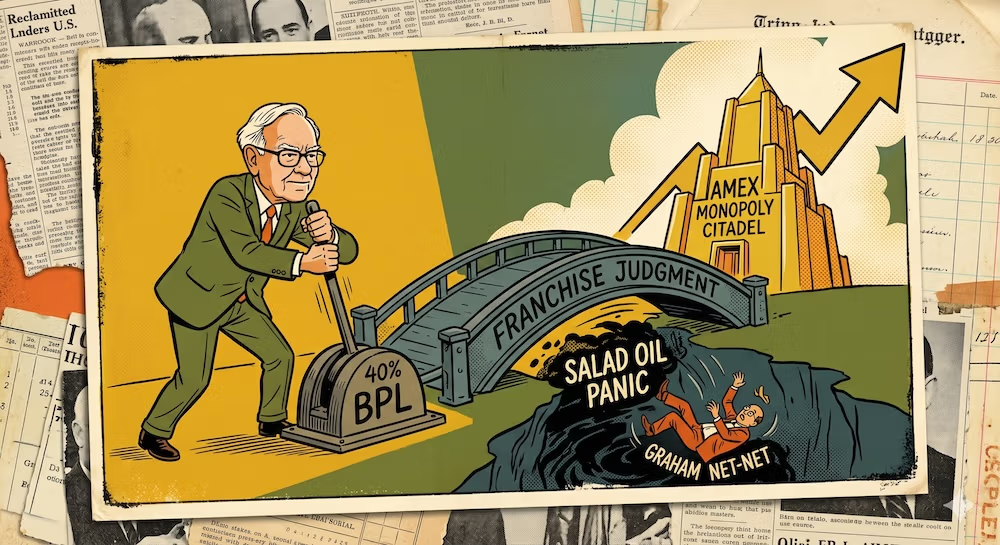
When the 1964 Salad Oil Swindle dropped American Express from $65 to $35, passive deep-value investors saw a toxic balance sheet and panicked. Early Buffett saw an undamaged core brand monopoly. By throwing a massive 40% partnership allocation lever across his Franchise Judgment bridge, he didn't just survive the macro panic—he explicitly underwrote structural business quality under crisis conditions to cement his pre-Berkshire fortune.American Express: The Bridge Toward Franchise Judgment
By 1964, the partnership was growing too large to rely solely on micro-cap asset liquidations. Buffett needed a bridge—a mechanism that combined his quantitative margin-of-safety rules with an underwriting evaluation of business quality.
He found that bridge during the famous Allied Crude Vegetable Oil scandal, commonly known as the Salad Oil Swindle.
American Express had a specialized warehousing subsidiary that issued warehouse receipts for millions of pounds of salad oil, which a corrupt businessman used as collateral for massive bank loans. When the oil turned out to be mostly water, American Express faced immense legal liabilities that threatened to wipe out its current earnings. The public market panicked, sending American Express shares tumbling from $65 to $35.
[Salad Oil Swindle Panic] ──> AmEx Shares Drop $65 to $35 ──> Buffett Deploys 40% of BPL into Franchise Value
This was not a Benjamin Graham net-net. American Express had a deeply negative net current asset position due to its financial liabilities. But Buffett recognized that the core franchise—the traveler’s checks and the charge card network—remained completely undamaged by the warehousing subsidiary’s fraud. Customer behavior had not changed; the economic toll was a large, but finite, one-time penalty.
Buffett took advantage of the structural panic by concentrating roughly 40% of the partnership’s entire net assets into American Express.
This deal was a critical evolutionary step. It wasn’t pure Graham deep value, nor was it full Berkshire-style quality investing. It was a crisis mispricing coupled with franchise-quality judgment. He backed a massive brand monopoly using the exact same structural conviction he had previously reserved for asset liquidations. When the panic cleared and earnings normalized, the investment generated an extraordinary return that cemented his pre-Berkshire fortune.
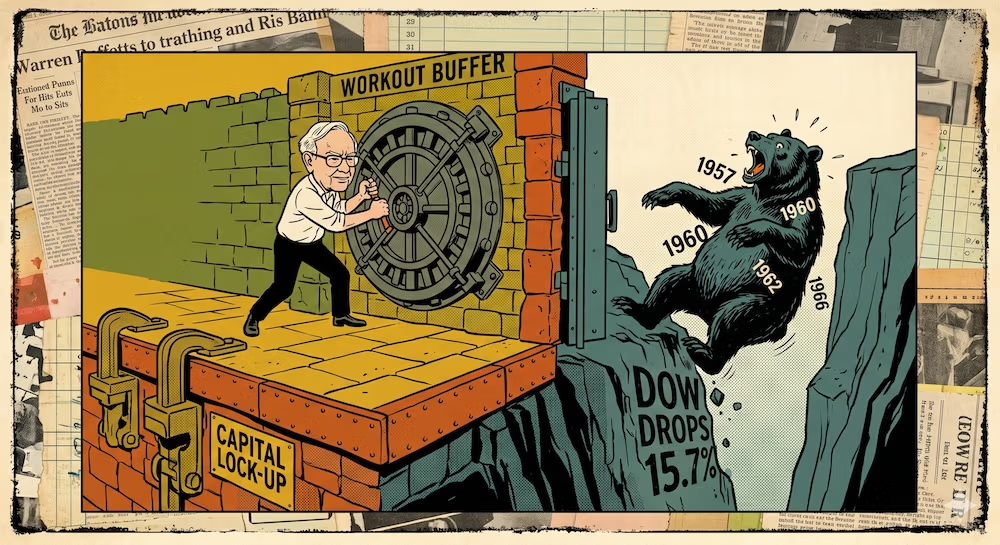
When the Dow shed 15.7% in 1966, Buffett’s partnership didn't just survive—it printed a positive 20.4%. That a 36.1% outperformance gap. This wasn’t luck; it was pure portfolio architecture. By matching an uncorrelated arbitrage workout sleeve with a strict capital lock-up, he built a structural bunker that extracted absolute returns while everyone else was forced to liquidate at the absolute bottom.Why the Returns Were So Extraordinary
The historical data trail of the partnership years reveals an unmatched record of absolute performance, but the true insight lies in how those returns behaved during market stress.
Over its 13-year run, the partnership compounded at roughly 24.5% annually against about 7.2% for the Dow.
But the critical mechanism stands out when you isolate the down-market years of 1957, 1960, 1962, and 1966. When the Dow Jones Industrial Average dropped into negative territory, Buffett’s relative outperformance didn’t just persist—it expanded dramatically. In 1962, the Dow dropped 7.6% while the partnership gained 13.9%, a relative outperformance of 21.5%. In 1966, the Dow lost 15.7% while the partnership cleared a positive 20.4%, an outperformance gap of 36.1%.
This wasn’t because he was a magical stock picker who knew which way the wind blew. It was the direct result of his portfolio architecture:
- The Workout Buffer: During secular market drawdowns, his arbitrage sleeve acted as an uncorrelated, absolute-return cushion, printing cash as deals closed independent of market beta.
- Small Scale: Operating with initial asset pools under $10 million allowed him to buy illiquid, unlisted pink-sheet companies that institutional managers couldn’t touch.
- The Liquidity Lock-up: Because his limited partners were restricted to a single annual withdrawal window on December 31st, Buffett was completely insulated from the mid-year redemptions that routinely force retail managers to liquidate their best positions at the absolute bottom of a cycle.
Why Buffett Closed the Partnership
By 1969, the very mechanics that made the partnership extraordinary broke under the weight of their own success. Total partnership assets had scaled to $105 million.
At that size, Buffett faced a dual structural constraint. First, the hyper-speculative “Go-Go” market of the late 1960s had driven asset valuations to extreme heights; cheap net-nets had virtually vanished from the landscape. Second, his capital base was now too massive to deploy into micro-cap situations like Sanborn Map or Dempster Mill without moving the underlying stock price against himself.
He could no longer run the machine at scale.
Rather than alter his parameters, collect passive management fees on capital he couldn’t effectively compound, or venture into strategies where he lacked a structural edge, Buffett chose to shut the entire operation down. In 1969, he systematically dissolved the partnerships, returned the capital to his limited partners, and stepped away from managing external money.
It was a clean demonstration of mechanism discipline. He recognized that when the relationship between scale and market structure breaks, the only logical move is to stop playing.
What Buffett Carried Forward Into Berkshire
When Buffett closed the partnership, he didn’t abandon the principles he had developed since 1956. Instead, he looked for a new structural vehicle that could scale those same core insights without being constrained by the vulnerability of partnership withdrawals. He chose Berkshire Hathaway, moving from a private partnership structure to a corporate permanent capital model.
The partnership years served as the foundational laboratory for everything Berkshire later became:
- The Shift to Permanent Capital: The annual December 31st withdrawal window taught Buffett that long-term outperformance requires absolute control over your liability timeline. At Berkshire, he replaced the partnership agreement with insurance float—capital that stays inside the corporate envelope even during intense market panics.
- Opportunity Cost Framework: The rigid 6% partnership hurdle rate instilled a lifelong discipline: if an investment cannot clearly beat a baseline hurdle or an alternative risk-free option, capital must sit in cash.
- Capital Allocation Over Operations: His time at Dempster Mill practical application taught him that a declining operating business must be treated as a cash source, not a destination. He carried this exact framework into Berkshire, routinely stripping the free cash flow from capital-intensive industries to fund high-return investments elsewhere on his canvas.
The Sponge Verdict: Absorb the Architecture, Not the Old Market Structure
If you attempt to copy early Warren Buffett today by running a screen for micro-cap net-nets or concentrating half your net worth into a handful of liquid public equities within a standard retail brokerage account, you are misreading history.
The manual, paper-based information gaps of the 1950s have been entirely closed by algorithmic trading engines. Trying to find a mispriced pink-sheet stock by flipping through physical manuals is an era-specific tactic that does not travel to modern markets.
Absorb
- Liquidity Matching: Understand that running a concentrated portfolio requires matching your asset liquidity with your actual real-world liabilities. If you have immediate cash needs, concentration is a behavioral trap.
- Uncorrelated Absolute Sleeves: Recognizing the value of maintaining a dedicated portfolio sleeve that behaves independently of equity market beta, providing a defensive cushion when macro regimes turn volatile.
- Scale Awareness: Embracing the reality that an investment strategy is intimately tied to asset size. When your capital scales or market valuations shift, your execution mechanics must adapt accordingly.
Expel
- Blind Net-Net Cosplay: Buying cheap, low-quality companies on a standard screen under the assumption that they represent early Buffett value. Without the capacity to take a board seat and force an asset liquidation, modern retail net-nets are often structural value traps.
- Concentration Without Control: Concentrating massive percentages of your net worth into individual equities without the structural protection of a capital lock-up or direct operational leverage over corporate allocation decisions.
Absorb the structural discipline, the alignment of incentives, and the risk architecture; expel the outdated execution tactics and the uncritical hero worship.
Educational Trade-Off Note: Attempting to build a highly concentrated, deep-value or activist portfolio inside a standard retail framework ignores the modern realities of algorithmic market efficiency and behavioral liquidity risks. For modern portfolios, capturing these underlying size and value risk premiums is typically achieved more efficiently through diversified, systematic vehicles rather than manual security selection.
What was the Warren Buffett partnership years performance benchmark?
The partnership compounded at roughly 24.5% annually against about 7.2% for the Dow Jones Industrial Average. More importantly, this performance expanded dramatically during down-market years like 1957, 1960, 1962, and 1966, providing a market-neutral cushion due to the portfolio’s absolute-return Workout sleeve.
What is the minimum portfolio size needed to replicate early Buffett’s strategy?
It depends entirely on your vehicle setup, but for a retail investor, the absolute answer is zero—because you cannot replicate it at all. The early partnership strategy required direct corporate control, private board activism, and structural capital lock-ups. Without the ability to buy 35% of a company to force an asset split like Sanborn Map, copying his concentration limits in a small retail brokerage account invites catastrophic behavioral risk.
Did Warren Buffett use leverage during his partnership years?
Not in the traditional retail sense. Buffett explicitly avoided traditional margin debt lines in his brokerage accounts. Instead, he engineered structural leverage by purchasing asset-rich corporate control situations, liquidating slow-moving or underutilized capital, and redirecting those internal corporate funds directly into higher-yielding public equities.
How can a modern DIY investor execute the “Workout” bucket?
Not easily via individual stocks. While Buffett manually priced merger arbitrage and corporate reorganizations, modern algorithmic execution has tightly front-run these spreads. Additionally, a retail investor attempting this faces immense short-term tax drag. For modern portfolios, capturing uncorrelated risk premia is typically achieved more efficiently through diversified alternative style premia or liquid trend-following vehicles rather than manual deal chasing.
Why did Buffett use a 0% management fee structure?
To establish perfect structural alignment. By charging a 0% baseline management fee, Buffett eliminated asset drag during flat or down markets, protecting his investors’ capital from administrative depletion. He only built personal wealth when his limited partners made money, taking an asymmetric 25% allocation of returns above a cumulative 6% annual hurdle rate.
What happened to the assets when Buffett closed the partnerships in 1969?
He systematically liquidated the structure. Buffett dissolved the partnerships because asset scale had reached $105 million, a size that completely broke his ability to deploy capital effectively into illiquid micro-caps. He returned cash and shares to his partners, advising them to reallocate into conservative alternatives, including tax-exempt municipal bonds.
This article is also available in Spanish. [Leé la versión en castellano: Los años de la sociedad de Warren Buffett: Cómo construyó su fortuna antes de Berkshire Hathaway]