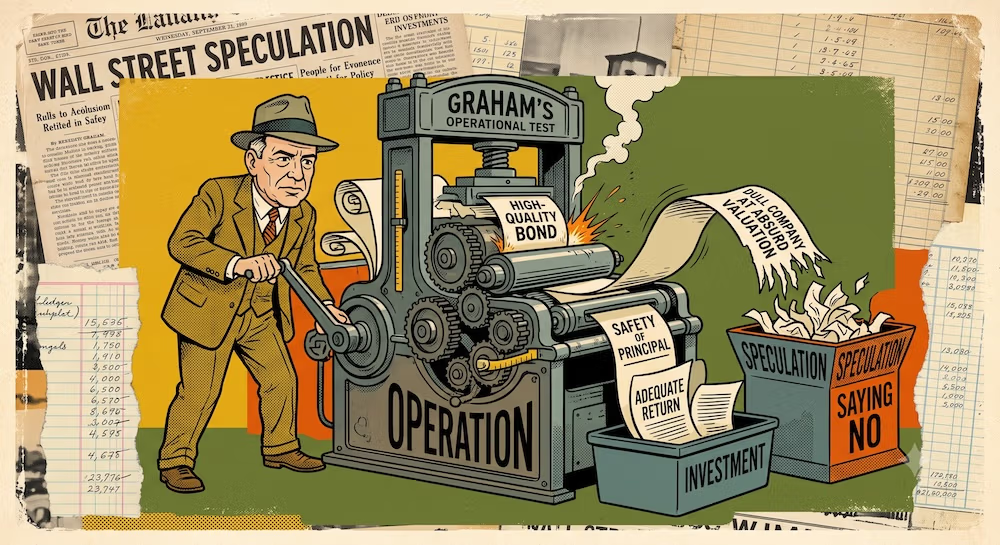
When you sit down to deconstruct the mechanics of legendary capital allocators, Bill Ruane demands your attention. As the architect behind the Sequoia Fund (ticker: SEQUX), Ruane didn’t just build a track record; he engineered a masterclass in high-conviction, low-turnover value extraction. To my eyes, the most critical architectural insight of his career is sitting right at the front gate: in 1999, at the absolute apex of the dot-com bubble, the Nasdaq ripped upward by an incredible 85% and the S&P 500 climbed over 20%. Sequoia? It actually lost roughly 16% that calendar year. Think about the severe tracking error and career risk. Ruane stubbornly refused to buy profitless tech companies because his underwriting framework couldn’t mathematically find a margin of safety in those multiples. His clients complained, assets fled, and he looked completely out of touch. Then the bubble popped, the Nasdaq collapsed, and Sequoia’s boring cash-flow machines surged ahead to deliver immense long-term outperformance. I used to think value investing was just about buying cheap stocks. It’s not. It’s a grueling behavioral gauntlet. Ruane’s methodology centered on buying durable cash-flow machines at a steep discount to their intrinsic value, then having the psychological fortitude to do absolutely nothing for a decade. The math doesn’t lie. But holding those names when the broader market is chasing unprofitable growth? That requires a specific kind of pain tolerance.
Born in 1925, Ruane’s operational framework was permanently altered during his time at Columbia University and Harvard Business School, ultimately cross-pollinating with his friendship with Warren Buffett. Both men were heavily influenced by Benjamin Graham, universally recognized as the father of value investing. When Buffett closed his investment partnership in 1969 because he couldn’t find cheap enough stocks, he actually recommended his clients move their capital to Ruane. That is the ultimate endorsement. Ruane launched the Sequoia Fund in 1970 to manage that capital. The mandate was brutal but clear: apply Graham’s margin of safety to a concentrated portfolio of extremely high-quality businesses. For anyone managing their own capital, studying Ruane is mandatory. You get to see the exact friction points between a clean academic backtest and the lived reality of holding a strategy through its ugly years.
Tip for Best Practices: Dissecting the architectural logic of historical funds gives you a mechanical edge when building your own investment strategies. Don’t just look at the returns; look at the drawdowns they had to swallow to get there.
Meet Bill Ruane: The Man Behind the Sequoia Fund
Why pull the Sequoia Fund apart? Because we need to look at how Ruane’s theoretical edge translated into actual portfolio mechanics. We are stripping away the mythology to examine the fund’s asset allocation logic, its obsession with forensic accounting, and the massive tracking error pain that guided every investment decision. If you run a concentrated book, you are going to experience years where the S&P 500 beats you effortlessly. Ruane survived that. That’s the signal we are looking for.
The Essence of the Sequoia Fund
The Sequoia Fund operated more like a private equity holding company than a traditional mutual fund. Ruane constructed the portfolio around three non-negotiable pillars:
- Absolute Value Extraction: Purchasing businesses only when their market capitalization represented a massive discount to conservative discounted cash flow (DCF) models.
- Forensic Due Diligence: Ignoring management forecasts in favor of tearing apart balance sheets, assessing unit economics, and analyzing competitive moats.
- Extreme Holding Periods: Capitalizing on the mathematical reality of tax-deferred compounding by refusing to trade in and out of positions.
The trade-off is clear: to exploit these pillars, you have to embrace tracking error that can make you look completely broken for years at a time. Ruane routinely accepted severe tracking error, stubbornly holding cash or boring industrials during periods when the market was rewarding pure speculation. Here is the ultimate proof of his discipline: in 1982, Sequoia actually closed the fund to new investors. They literally turned away management fee revenue because Ruane felt the market was fully priced and he couldn’t find a sufficient margin of safety. Think about the structural integrity required to do that in the asset management industry. At that exact moment, the fund’s total assets stood at approximately $450 million. Ruane intentionally capped his capacity because he knew that asset bloat is the natural enemy of high-conviction concentration. For my own framework, that is the gold standard of fiduciary discipline.
Value Investing at Its Core
Ruane executed value investing as a rigid mathematical discipline, not a loose philosophy. Heavily influenced by Graham’s margin of safety, he sought out businesses trading at a discount to their liquidation value or normalized earnings power. To my eyes, this is the hardest strategy to implement for a DIY investor. It requires you to buy the asset when everyone else hates it, and hold it while the market refuses to recognize the mispricing. It can take years for the valuation gap to close. The behavioral drag here is immense. This is where the implementation gets uncomfortable: you have to look at red numbers in your account while your neighbor brags about easy wins in speculative sectors.
Ruane systematically ignored multiple expansion and focused entirely on the quality of the underlying cash flows, the return on invested capital (ROIC), and the capital allocation history of the management team. This operational rigidity protected the Sequoia Fund from permanent capital loss. For my framework, value isn’t an academic factor sleeve to be flipped on momentum; it’s a structural defensive shield. You don’t survive decades in the market by chasing beta; you survive by rigorously avoiding zeros.
Tip for Best Practices: If you are building a value sleeve, mentally prepare for multi-year periods of underperformance. The strategy works because it is psychologically difficult to execute. If it were comfortable, the alpha would be arbitraged away.

The Power of Rigorous Research
Ruane’s edge was largely derived from exhausting, forensic research. The Sequoia team didn’t just read the glossy annual reports; they read the footnotes. They mapped out supply chains, analyzed inventory turnover rates, and stress-tested debt covenants. This level of diligence doesn’t just surface upside; it systematically removes the probability of stepping on a landmine. You mitigate downside volatility at the fundamental level rather than relying on historical correlation matrixes that tend to break down precisely when you need them most.
- Balance Sheet Forensics: Stripping away accounting adjustments to find true free cash flow and scrutinizing off-balance-sheet liabilities.
- Moat Analysis: Quantifying pricing power and measuring the specific structural advantages that prevent competitors from eroding margins.
- Capital Allocation Grading: Assessing whether management reinvests earnings at high rates of return or destroys value through reckless acquisitions.
Honestly, this is where individual investors hit a wall—you likely can’t call the CEO, which means your margin of safety must be even wider to compensate for your information disadvantage. Ruane went directly to the source, bypassing Wall Street analysts to interrogate management teams on their capital efficiency. When the prospectus hides what the marketing promotes, forensic cross-examination of operational cash flow is the only tool that preserves capital.
A Long-Term Perspective
If you trade constantly, taxes and slippage will quietly eat your portfolio alive. Actively managed mutual funds often carry higher expense ratios, and if they trade frequently, the internal tax drag destroys retail returns. Ruane utilized the mathematics of compounding to his advantage. By holding high-quality equities for decades, the Sequoia Fund effectively received an interest-free loan from the government on its deferred capital gains. The rebalancing friction in a high-turnover portfolio is a massive drag. Ruane solved this by simply not selling, showing how a low-turnover framework captures structural capital efficiency. For my framework, looking directly at the current fund profile is highly instructive: as listed in the latest prospectus, Sequoia carries an expense ratio of 1.00% with an annual turnover rate hovering near a razor-thin 6% to 8%. That low structural friction is the true mechanical baseline that lets its active bets compound over decadal horizons.
Benefits of a Long-Term Approach:
- Eliminating Tax Drag: Deferring capital gains taxes in taxable accounts allows that capital to continue generating returns.
- Reducing Slippage: Avoiding the bid-ask spreads and commission friction that decay active strategies.
- Asymmetric Compounding: Giving a 20% ROIC business the runway it needs to double, and then double again.
Tip for Best Practices: Expand your horizon to potentially enhance returns by treating equities as ownership stakes in operating businesses, not ticker symbols to be flipped. If you are checking the daily price of your value sleeve, your timeframe is misaligned with the strategy.
The Philosophy Behind the Sequoia Fund
Value Investing Roots: A Legacy of Wisdom
The Sequoia Fund was explicitly built on the architecture of Graham-Dodd value investing. When Bill Ruane took the helm, he wasn’t guessing; he was executing a proven statistical framework. Benjamin Graham taught that the market is a voting machine in the short term, but a weighing machine in the long term. Ruane and Warren Buffett weaponized this concept, hunting for businesses where the current vote was irrationally disconnected from the actual weight of the assets. To my eyes, the question I’d ask is whether a DIY allocator can genuinely withstand the periods where the voting machine remains irrational for five years straight.
The mechanical execution of this strategy requires three rigid inputs:
- Valuation Disconnect: Identifying instances where the market price is significantly lower than the present value of future cash flows.
- Fundamental Deconstruction: Ripping apart the financial health, earnings potential, and growth prospects to ensure the cheapness isn’t a value trap.
- The Margin of Safety: Refusing to deploy capital unless the discount is wide enough to absorb inevitable analytical errors or macro shocks.
Ruane wasn’t interested in the macro environment or the latest hot sector. He isolated his attention on the micro-economics of individual businesses. If the free cash flow yield was there, and the competitive moat was intact, he deployed capital. If not, he held cash. For my framework, this level of concentration and patience is a masterclass in anti-orthodoxy. The asset management industry forces people to chase quarterly performance, but Ruane completely opted out of that system.
Tip for Best Practices: You must separate the company from the stock. A great company can be a terrible investment if the entry multiple is too high. A “buy at any price” mentality is how capital gets permanently impaired.
Focus on Quality: Investing in the Best
Where Ruane evolved past strict Graham-style “cigar butt” investing was his integration of the investment philosophy popularized by Charlie Munger: preferring a great business at a fair price over a fair business at a great price. Ruane demanded high-quality capital efficiency. He recognized that if you hold a stock for ten years, your return will inevitably mirror the business’s internal return on capital, regardless of the entry multiple. Wow. Think about that relationship: ROIC dictates long-term asset return far more than your initial purchase multiple over long horizons.
Ruane’s quantitative filter for quality included:
- High Return on Invested Capital (ROIC): The ability to generate significant free cash flow without requiring massive ongoing capital expenditures.
- Structural Moats: Switching costs, network effects, or intangible assets that physically prevent competitors from stealing market share.
- Shareholder Alignment: Executive compensation structures that reward long-term value creation rather than short-term stock price manipulation.
He systematically avoided highly levered companies. Debt introduces structural fragility. Ruane built the Sequoia portfolio to be anti-fragile—capable of absorbing economic contractions without facing insolvency. This matches what we look for when designing an expanded canvas portfolio: isolating high-quality factor exposure that can survive a severe macro drawdown without wiping out the capital engine.
The Reality Check: Quality often looks expensive. The behavioral trick is underwriting the durability of the growth, not just blindly avoiding high P/E ratios. A business compounding intrinsic value at 20% a year is cheap at 25x earnings, while a melting ice cube is expensive at 8x earnings.

Long-Term Horizon: The Power of Patience
Holding a concentrated portfolio through a 30% drawdown is a visceral, deeply uncomfortable experience. It is the cost of admission for market-beating returns. Ruane’s long-term operational framework was designed to survive these drawdowns by relying on the mechanical certainty of compounding. You don’t interrupt compounding unnecessarily. For my own framework, this requires a deep behavioral commitment to tune out tracking error and tracking error pain entirely.
The math behind low turnover is brutal for active traders and beautiful for long-term holders:
- Uninterrupted Compounding: Capital that isn’t paid to the IRS in capital gains continues to compound inside the portfolio.
- Minimizing Friction: Every transaction incurs a bid-ask spread and commission. Over decades, this frictional drag destroys alpha.
- Behavioral Arbitrage: Using time arbitrage to profit from the impatience of institutional managers who are forced to chase quarterly performance.
Ruane’s patience allowed him to hold onto quality investments while other funds capitulated at the bottom. He understood that volatility is not risk; permanent loss of capital is risk. I used to think patience was just a generic virtue, but in portfolio mechanics, it is an absolute mathematical lever. It directly limits frictional decay and tax leakage.
Tip for Best Practices: If you cannot stomach a 3-year window where your alternative or value sleeve dramatically underperforms the S&P 500, you will inevitably abandon the strategy at the exact wrong time.
Rigorous Research and Due Diligence
In-Depth Company Analysis: Leaving No Stone Unturned
The Sequoia Fund’s research pipeline was a machine. Ruane required absolute conviction before sizing a position, which meant forensic fundamental analysis. He wasn’t running screens on Yahoo Finance. His team was breaking down capital expenditure history, lease obligations, and deferred tax liabilities to calculate true owner earnings. You cannot hold a concentrated position of 10% or 15% without knowing exactly what happens to the balance sheet during a severe credit contraction or systemic liquidity freeze.
The mechanical focus included:
- Insider Alignment: Analyzing proxy statements to see exactly how management is compensated. If the CEO’s bonus is tied to adjusted EBITDA instead of free cash flow per share, it’s a massive red flag.
- Unit Economics: Understanding the incremental margin of the next dollar of revenue. Ruane hunted for businesses with high operational leverage.
- Capital Structure: Ensuring the debt maturity schedule wouldn’t force the company to refinance at punitive rates during a recession.
He operated under the assumption that the market is mostly efficient, but occasionally misprices probability. The deep research was designed to exploit those specific probability mispricings. To my eyes, this level of granularity is where you see the massive divide between passive factor implementation and active under-the-hood security analysis. If you own a concentrated book, you are taking on pure idiosyncratic risk, meaning your fundamental underwriting must be completely airtight.
Tip for Best Practices: Do the grueling work. Read the 10-K risk factors. Understand exactly how the company accounts for stock-based compensation. That is where the real margin of safety lives.

Meeting with Management: The Personal Touch
Ruane understood that quantitative screens only get you to the starting line. Capital allocation is ultimately a human decision. Meeting with management was a critical layer of his risk management protocol. He needed to look the CEO in the eye and determine if they were a highly capable capital allocator, or just a charismatic salesman destroying shareholder value behind the scenes. A pristine balance sheet can be wrecked in 18 months by a CEO who decides to engage in empire-building acquisitions that destroy return on invested capital.
The mechanics of management evaluation:
- Skin in the Game: Does the executive team have a massive portion of their net worth tied up in the common stock?
- Capital Discipline: Will they return cash to shareholders via dividends and smart buybacks when internal reinvestment opportunities dry up?
- Operational Candor: Does management admit mistakes in their annual letters, or do they blame macroeconomic headwinds for every miss?
I wonder if individual allocators can truly bridge this information gap without direct access. Since we can’t book personal interviews with executive teams, we have to look for structural signals in proxy statements and capital deployment histories. Ruane demanded conservative, rational operators, and for a DIY investor, tracking past capital choices via free cash flow allocation metrics is our best alternative.
Tip for Best Practices: If you are an individual investor, you must read the CEO’s historical shareholder letters. Track what they promised five years ago versus what they actually delivered. The execution gap is your signal.
Case Study: Investing in Berkshire Hathaway after Extensive Research
The Sequoia Fund’s defining trade was its massive allocation to Berkshire Hathaway. This wasn’t just a friendly nod to Warren Buffett; it was a deeply analytical successful investment built on understanding the mechanics of insurance float. Ruane recognized that Berkshire was essentially a levered equity portfolio funded by zero-cost (or negative-cost) capital provided by insurance premiums. To my eyes, this is where factor definitions get blurry: was it a value play, a quality play, or a structural arbitrage on cost of capital? It was all three wrapped in one unique vehicle.
The structural edge of the Berkshire thesis:
- The Float Mechanic: Warren Buffett’s reputation for prudent management and investment was backed by a structural advantage: holding billions in insurance float that he could invest in high-yield equities and whole businesses.
- Asymmetric Compounding: Berkshire’s retained earnings were continuously pushed back into acquiring asset-heavy businesses with pricing power (utilities, railroads) and consumer monopolies.
- Valuation Reality: For years, the market treated Berkshire as a textile mill or a generic insurer, completely ignoring the compounding engine of its equity book and private holdings. Ruane saw the math.
Ruane allocated aggressively to Berkshire, letting it run to become an outsized portion of Sequoia’s NAV. He didn’t trim simply because it went up; he held because the intrinsic value kept expanding. This highlights a critical lesson in portfolio management: rebalancing out of your best-performing, highest-quality asset simply to hit an arbitrary target weight can be a structural mistake. It triggers massive tax friction and replaces an elite compounder with an inferior alternative.
The Mechanical Takeaway:
- Let Winners Run: Rebalancing out of your best-performing, highest-quality asset simply to hit an arbitrary target weight is often a mathematical error that triggers unnecessary tax friction.
- Understand the Capital Engine: Ruane bought Berkshire because he understood exactly how the float generated excess returns.
- Concentration Requires Conviction: You can only hold a massive position if your fundamental underwriting is bulletproof.
Tip for Best Practices: If you find a structural compounding machine, your primary job is to get out of its way. Don’t interrupt the math just to make your pie chart look prettier.
Concentrated Portfolio Strategy
High-Conviction Investing: Fewer Stocks, Greater Focus
Modern portfolio theory dictates broad diversification to eliminate idiosyncratic risk. Bill Ruane aggressively rejected this for active management. He utilized a concentrated portfolio strategy, typically holding only 25 to 30 names, with the top 10 positions dominating the total fund weight. Ruane argued that adding your 40th best idea to a portfolio only dilutes the returns of your best idea. If you truly understand the underlying business mechanics, concentration becomes an explicit operational feature rather than an structural flaw.
The architecture of concentration:
- Information Arbitrage: By holding fewer names, the Sequoia team could genuinely know more about the balance sheet than the sell-side analysts covering it.
- Return Asymmetry: A 15% position that doubles actually moves the needle on the total fund CAGR. A 1% position that triples does almost nothing.
- Tracking Error Acceptance: Concentration guarantees you will not look like the benchmark. You have to be psychologically prepared to be wrong, loudly and publicly, for years at a time.
The trade-off here is heavy: high-conviction investing is terrifying in a bear market. When a 12% position drops by 40%, your overall portfolio feels the impact immediately. For my own allocation framework, this highlights why running a highly concentrated stock book requires behavioral discipline that most retail accounts simply cannot handle during a structural drawdown. If a position cracks, you must possess the clarity to buy more based on math, not panic sell based on price action.
Risk Management: Balancing Concentration with Quality
How do you run a concentrated book without blowing up the fund? Ruane’s risk management wasn’t based on price volatility metrics like Beta or standard deviation. He managed risk strictly through balance sheet quality and valuation margins. If you buy an unlevered business with a dominant market share at a 30% discount to its intrinsic value, your absolute risk of permanent capital loss is extremely low, stock selection notwithstanding. Volatility is treated as a liquidity opportunity, not structural risk.
Mechanical Risk Controls:
- Zero Tolerance for Bad Debt: Ruane avoided highly leveraged roll-ups or capital-intensive commodity businesses that could be bankrupted by a tightening credit cycle.
- Driver Diversification: A concentrated portfolio must still isolate factor exposure. Ruane ensured his 25 names weren’t all dependent on the exact same macroeconomic trigger (like interest rates or oil prices).
- Valuation as a Shield: the margin of safety was the ultimate risk control. A cheap entry price absorbs operational missteps.
Yikes. Look at what happens when the architect leaves and the discipline drifts. About a decade after Ruane died, the Sequoia Fund suffered catastrophic damage circa 2015-2016 due to a massive, highly concentrated position in Valeant Pharmaceuticals. The stock collapsed, taking a massive chunk of the fund’s AUM with it. This is a vital lesson in lived mechanics: concentration is a double-edged sword that requires flawless, continuous fundamental underwriting. Without rigid adherence to balance sheet metrics and valuation caps, concentration shifts from structural alpha generation to pure localized leverage risk. In Sequoia’s case, the Valeant holding had been allowed to expand through momentum until it breached over 30% of total portfolio assets. When the underlying debt structure and accounting choices of that roll-up vehicle disintegrated, the fund sustained an immediate structural drawdown that took years to heal, demonstrating exactly why concentration without a pristine balance sheet filter is a fatal hazard.
Case Study: The Sequoia Fund’s Portfolio Composition
The operational reality of the Sequoia Fund proves the efficacy of Ruane’s concentrated model. He didn’t hold 150 positions. He made massive, concentrated bets on high-ROIC businesses and let them ride, completely ignoring standard institutional guidelines on diversification limits.
The Berkshire Hathaway Anchor:
Sequoia’s legendary performance was inextricably linked to its outsized position in Berkshire Hathaway.
- Extreme Weighting: At its peak, Berkshire represented an enormous portion of Sequoia’s assets, sometimes breaching the 20-30% threshold. Most modern institutional risk committees would demand immediate trimming.
- The Logic: Ruane recognized Berkshire was internally diversified across insurance, industrials, and an equity portfolio. Trimming it simply to reduce portfolio concentration would have triggered massive tax liabilities and reallocated capital into inferior ideas.
- The Payoff: Letting the compounding machine run intact provided the fund with decades of market-crushing alpha.
The Operational Moats:
Ruane surrounded the Berkshire anchor with dominant, niche operators:
- IDEXX Laboratories: A razor-and-blade business model in veterinary diagnostics. High switching costs, recurring revenue, and incredible returns on capital. Ruane saw long-term growth potential in a completely untethered sector.
- Fastenal Company: An industrial distributor with a fortress balance sheet and a brilliant decentralized store model. It wasn’t flashy, but it compounded capital relentlessly.
The Structural Mechanics:
- 25 to 30 Names: Vastly more concentrated than any standard mutual fund.
- Single-Digit Turnover: Buying right meant rarely selling. The tax efficiency was staggering.
- Cross-Sector Allocation: Idiosyncratic risk was mitigated by spreading the concentrated bets across diagnostics, distribution, insurance, and consumer staples.
The Takeaway for DIY Portfolios:
- Size Warrants Conviction: If you find a true compounding machine, you must size it large enough to actually impact your total return.
- Embrace the Grind: Great businesses are often boring. Fastenal isn’t a tech darling, but its ROIC math is beautiful.
- Let the Math Work: Constant tinkering destroys the very engine you are trying to build.
Tip for Best Practices: If you run a concentrated book, you must monitor the your investments closely to manage risk effectively. A thesis break in a 15% position requires immediate action, not “wait and see.”
The Role of Patience and Discipline
Long-Term Commitment: Letting Compounding Work Its Magic
The single greatest advantage a DIY investor has over an institutional manager is duration. Bill Ruane weaponized duration. Wall Street is forced to report quarterly; Ruane operated on a decadal timeline. When you hold a 20% ROIC business for 15 years, the initial entry multiple becomes almost irrelevant to the final outcome. The math takes over. But the behavioral execution of this is grueling. Sitting on your hands for five years while a stock goes sideways tests every ounce of your conviction. That is where tracking error pain becomes an active behavioral friction point.
The Mechanics of Duration:
- Tax-Deferred Alpha: Every time you realize a short-term gain, you forfeit a massive chunk of your compounding base to the government. Ruane minimized this drag aggressively by letting winners ride.
- Frictional Decay: Trading incurs bid-ask slippage. Over 20 years, heavy turnover mathematically guarantees underperformance against a passive baseline.
- The Waiting Game: The market often takes years to realize intrinsic value. If your timeline is 12 months, pure value investing will fail you.
Ruane survived by ignoring the performance derby. He was unbothered when momentum strategies beat him in a calendar year, because he knew his balance sheets were compounding intrinsic value underneath the surface. For my own framework, this highlights how duration acts as a structural asset allocation lever—it is the only way to exploit tracking error rather than being crushed by it.
The Reality Check: Your patience will be tested. When your value sleeve drags down your overall portfolio for 24 months, the urge to liquidate and buy whatever the current hot sector is will be overwhelming. That is the exact moment the strategy usually pays off.
Avoiding Market Noise: Staying the Course Amid Fluctuations
The financial media industrial complex is designed to induce anxiety and trigger hyperactive trading activity. Ruane combated this by maintaining a hermetically sealed discipline. He didn’t care about the Federal Reserve’s dot plot, and he didn’t care about macroeconomic forecasts. He cared about the free cash flow yield of the 25 businesses he owned. This isolation from market noise is a structural requirement for concentrated value investing. If you don’t build a mechanical filter, the information volume will trigger behavioral mistakes.
The Ruane Filter:
- Data vs. Signal: 99% of daily price action is liquidity-driven noise. Ruane only reacted to fundamental breaks in a company’s earnings power.
- Macro Agnosticism: You cannot predict interest rate movements. You can, however, buy companies with such strong pricing power that they survive regardless of the rate environment.
- Psychological Armor: Ruane’s extreme fundamental research provided the conviction necessary to hold positions through 40% drawdowns.
That’s just me, but if you check your portfolio daily, you will inevitably tinker. Tinkering introduces structural transaction friction, and friction destroys the long-term mathematical engine of compounding. Ruane’s framework forces you to separate daily market price discovery from fundamental value accumulation.
The Reality Check: It is incredibly difficult to look stupid at a dinner party. Holding cash or boring industrials while everyone else gets rich on speculative tech is the true behavioral cost of value investing. It’s easy to say you are a long-term investor; it’s very hard to look at a negative statement while your neighbor is bragging about a 50% gain.
Case Study: Sequoia Fund’s Performance During Volatile Markets
Backtests are clean. Reality is messy. Let’s look at how Ruane’s architecture handled genuine market trauma, isolating the mechanical choices made during major volatility events.
The 1987 Market Crash
- The Volatility Event: October 19, 1987. The Dow Jones drops roughly 22% in a single trading session. Pure systemic panic.
- The Mechanical Response: Ruane did absolutely nothing to his core holdings. He recognized the drop was a liquidity crisis, not a fundamental destruction of the cash flows produced by his companies.
- The Outcome: Because he owned unlevered, high-ROIC businesses, they absorbed the shock. He deployed cash into the dislocation, upgrading his portfolio’s quality at steep discounts.
The Dot-Com Bubble Burst (1999-2002)
- The Volatility Event: The Nasdaq exploded on speculative tech valuations in 1999, then implened, wiping out trillions in wealth.
- The Mechanical Response: As noted earlier, Ruane accepted a 16% loss in 1999 while indices surged. He refused to capitulate or alter his quantitative screening framework to chase growth factor beta.
- The Outcome: When the bubble popped in 2000-2002, the Nasdaq collapsed. Sequoia’s portfolio of boring, cash-generating businesses held its ground and then surged, capturing massive absolute alpha.
The Hard Lessons
- Process Over Outcome: You must judge your portfolio by its operational adherence to your strategy, not its month-to-month performance against a benchmark.
- Cash as Optionality: Holding cash is a drag in a bull market, but it provides the ultimate dry powder when correlations go to 1 during a crash.
- Surviving the FOMO: Sequoia’s underperformance in 1999 was the necessary, agonizing price paid for its survival and outperformance in the subsequent crash.
Tip for Best Practices: When a drawdown hits, review your initial thesis. If the unit economics of the business haven’t changed, a lower stock price is a mathematical gift, not a reason to panic.
Adapting to Changing Market Conditions
Flexibility Within a Value Framework
A rigid interpretation of value investing (buying low price-to-book industrial assets) eventually became a structural trap. Bill Ruane understood that capital-light businesses could command higher multiples while still being intrinsically cheap. He maintained flexibility within his value framework to accommodate the changing nature of corporate moats, adjusting his analytical models to reflect shifting structural realities.
The mechanics of adapting value:
- Intangible Assets: Recognizing that a software company’s R&D spend is functionally a capital expenditure that builds a massive, high-margin moat, even if the traditional P/E ratio looks elevated.
- Network Effects: Understanding that a platform connecting buyers and sellers becomes exponentially more valuable with scale, justifying a premium to historical book value.
- Dynamic Valuation: Adjusting DCF models to accurately reflect the incredibly low marginal cost of replication in digital businesses.
To my eyes, the trade-off is incredibly delicate: you have to ensure you are genuinely adapting to a new economic reality, not just retrofitting your math to justify buying a popular, overvalued stock because you can’t stomach underperforming. True flexibility within a value discipline means expanding your definition of capital efficiency without ever softening your requirements for free cash flow yield and margin of safety.
Avoiding Overvaluation: Patience Over FOMO
Capital preservation is the absolute core of the Sequoia model. Paying 50 times revenue for any business, regardless of its growth rate, mathematically guarantees poor forward returns. Ruane relentlessly focused on not overpaying for overvalued stocks. The opportunity cost of holding cash is painful, but the permanent capital loss of buying a bubble is catastrophic to long-term compounding metrics.
The math of overvaluation:
- Multiple Compression: If a company grows earnings by 20% a year, but its P/E multiple compresses from 80 to 20 over a decade, the stock price will still collapse. You cannot outgrow a massive valuation premium.
- Margin of Error: Buying at peak valuations leaves zero room for execution missteps. One missed earnings call destroys 30% of the market cap.
- Cash Optionality: Cash earns a low nominal return, but it holds its value completely during a multiple contraction, allowing you to buy the exact same assets 40% cheaper.
Ruane’s operational discipline meant he simply walked away from entire sectors when the math stopped working. He wasn’t afraid of sitting in cash. For a DIY investor, this is where the implementation gets highly uncomfortable: sitting on dry powder while indices are ripping forces you to trust your own baseline calculations over the collective narrative of the market.
The Reality Check: Holding cash while the market rips higher 20% a year feels like failure. It requires a deep understanding of historical market cycles to maintain that posture without caving.
Practical Steps to Implement Ruane’s Strategy
Translating Bill Ruane’s institutional architecture into a DIY framework requires operational discipline. You aren’t just buying a high-quality portfolio; you are building a system designed to extract yield from mispriced balance sheets. How do you execute this mechanically without a team of analysts? Let’s break down the direct implementation metrics.
Building a High-Quality Portfolio
You have to build a fundamental screening process. You start by demanding thorough fundamental analysis. This means bypassing the income statement and going straight to the cash flow statement. You are looking for businesses that generate massive Free Cash Flow (FCF) without needing to dilute shareholders or issue punitive debt. A company with a 5% FCF yield that consistently buys back its own stock is mathematically engineering a higher share price for you over the next decade.
You must rigorously define the competitive position. Is the moat structural or temporary? Does the company have pricing power? If inflation spikes by 4%, can this business pass that cost directly to the consumer without losing volume? If the answer is no, it’s not a Ruane-quality business. Companies with dominant market share, high switching costs, or deep network effects are the only assets that can reliably produce long-term value.
Finally, underwrite the quality of management. Look at the return on retained earnings. If a company retains $100 million in earnings over five years, has the market capitalization increased by at least $100 million? If not, management is destroying capital through bad acquisitions or bloated operations. You want operators with significant insider ownership who treat the company’s cash as their own.
Tip for Best Practices: Do not trust adjusted earnings. Pull the 10-K, back out stock-based compensation, and calculate the true cash owner earnings. That is your baseline.
Concentrated vs. Diversified Portfolios
If you want to replicate the concentrated portfolio of the Sequoia Fund, you must accept the volatility tax. Holding 10 to 15 stocks means you are taking on massive idiosyncratic risk. The math dictates that your winners will drag the portfolio higher, but your losers will cause visible damage. How do you structure this safely? Let’s weigh the specific architectural models available to a DIY framework.
1. Assess Your Risk Tolerance
Concentration amplifies the pain of being wrong. If you put 15% of your net worth into a single equity and the thesis breaks, you lose years of compounding. For my own framework, the trade-off is entirely behavioral: can you watch a core holding drop 40% without overriding your system? If the answer is no, then extreme concentration is a behavioral landmine.
- The Sizing Mechanic: Never size a position larger than your absolute confidence in the balance sheet’s ability to survive a severe recession.
- Diversification for Risk Management: Spreading investments broadly guarantees average returns. Concentration provides the opportunity for alpha, but demands flawless execution.
2. Strategies for a Concentrated Portfolio
If you commit to concentration, you must isolate your factor risks to prevent single-event systemic blowups:
- Cross-Sector Allocation: Do not hold five concentrated positions that are all sensitive to the price of crude oil. You must ensure the business drivers are uncorrelated.
- Example: Pairing a defensive healthcare distributor with a cyclical industrial holding.
- Ruthless Pruning: In a 15-stock portfolio, there is no room for a “maybe.” If the thesis drifts, you cut the position and redeploy.
- Strict Limits: Establish a hard cap on position sizing. If a winner runs past 20% of the portfolio, you must evaluate if the valuation still justifies the concentration risk.
Tip for Best Practices: Cap your maximum cost-basis allocation at 10%. If it grows to 20% organically through outperformance, that is fine, but never deploy more than 10% of new capital into a single idea.
3. Blending Concentration with Diversification
For most DIY investors, the optimal architecture is a core-satellite structure. This balances the alpha generation of a concentrated portfolio with the safety of diversification. To my eyes, this is where the implementation gets highly efficient for individual accounts: it lets you play the concentrated value game without putting your entire baseline wealth at risk of an underwriting error. Look at how the execution profiles shape up when comparing an institutional deployment directly with a modern retail satellite layout:
| Operational Metric | Sequoia Fund (Historic/Current Baseline) | Modern Retail DIY Equivalent | The Structural Trade-Off |
|---|---|---|---|
| Concentration Sizing | Top 10 holdings frequently comprised 50-70% of total fund assets. | 5-7 high-conviction individual stock positions in a satellite sleeve. | Amplifies idiosyncratic risk; requires absolute peace with extreme tracking error. |
| Frictional Costs | 1.00% structural expense ratio plus institutional trading commissions. | 0% commission brokerage accounts; zero ongoing management fees. | Retail has a structural cost advantage but lacks institutional research access. |
| Turnover & Horizon | Single-digit annual turnover (6-8%), implying 10+ year holding periods. | Strict buy-and-hold matching business operational cycles. | Eliminates short-term capital gains tax drag, but induces severe behavioral boredom. |
4. Risk Management Strategies
Concentration without strict risk parameters is fatal. The math of geometric compounding demands that you avoid large drawdowns that permanently impair capital scale.
- The Balance Sheet Shield: Only concentrate in companies with massive cash reserves and extremely low debt-to-equity ratios.
- Pre-Defined Exits: Write down exactly what fundamental break would cause you to sell the stock before you ever buy it. Don’t wait until the stock is down 30% to decide what to do.
- Cash Buffers: Keep a higher cash allocation in a concentrated portfolio to act as a shock absorber during violent drawdowns.
Tip for Best Practices: Keep a written log. When you buy a stock, write down the exact ROIC and valuation metrics that justified the purchase. Review it quarterly. If the metrics fail, you sell. Emotion does not belong in the equation.
Staying Patient
The math of compounding is undeniable, but it requires a long-term focus. Bill Ruane didn’t trade the tape; he bought businesses and waited. The frictional costs of trading—taxes, bid-ask spreads, and emotional exhaustion—are the silent killers of DIY portfolios. Let’s look at how to force your framework into structural patience.
1. Embrace a Long-Term Mindset
You have to shift your psychology from renting tickers to owning operational assets. If you buy an apartment building, you don’t check the price every Tuesday. You look at the rental yield. Apply that exact same logic to your equity sleeve. For my framework, this is the ultimate behavioral arbitrage over institutional desks that are trapped in 90-day review cycles.
- The Math of Tax Deferral: Holding an asset for ten years in a taxable account allows the capital that would have gone to the IRS to compound at the company’s internal rate of return.
- Slippage Mitigation: Every time you execute a trade, the market makers take a cut. High turnover guarantees you bleed alpha.
- Behavioral Peace: Once you underwrite the balance sheet, you don’t need to panic when the VIX spikes.
2. Avoid Reacting to Market Noise
The market is a distraction engine. The Federal Reserve, geopolitical shocks, and quarterly earnings misses will create violent price swings. Ruane maintained his discipline by completely ignoring the market noise and focusing purely on the intrinsic value of the cash flows. The math doesn’t lie: a changing stock price does not mean the long-term cash generation of the business has altered.
- Data Isolation: Stop checking your brokerage account daily. It triggers a dopamine response that encourages unnecessary action.
- Trust the Math: If you bought the business at a 40% discount to fair value, a 10% market correction is irrelevant to your thesis.
- Mute the Pundits: Financial television exists to generate engagement, not alpha. Turn it off.
3. Develop Discipline
You need a mechanical system to prevent emotional overrides. For my own process, this means using a rigid quantitative checklist before a single dollar is allocated. If the numbers don’t square, the narrative is completely dismissed.
- The Checklist: Build a strict quantitative checklist (ROIC > 15%, Debt/EBITDA < 2x, etc.). If a stock doesn’t pass, you cannot buy it, no matter the narrative.
- Quarterly Audits: Only review the portfolio when the companies release their 10-Qs. Ignore the interim price action.
- Post-Mortems: When you sell a stock, document why. Learn from your specific behavioral errors.
4. Use Volatility to Your Advantage
Volatility is the mechanism that creates the margin of safety. Without violent drawdowns, high-quality businesses would never trade at a discount. To my eyes, this is where retail investors have a massive structural edge over large funds: we don’t have redemptions forcing us to sell at the bottom. We can act as liquidity providers when institutional books are forced to liquidate.
- Liquidity Provision: When the market panics and liquidity dries up, be the buyer. You are trading your cash for their panic.
- Automated Execution: Use limit orders placed well below the current market price to automatically catch flash crashes.
- Tactical Rebalancing: Use severe market dislocations to harvest tax losses in your losers and redeploy that capital into your highest-conviction ideas.
Tip for Best Practices: The hardest thing to do in investing is absolutely nothing. Build a portfolio of balance sheets so strong that inaction becomes your default setting.
Portfolio Reality Matrix: Evaluating the Ruane Architecture
| Strategy Component / Allocation Choice | Diversification Benefit | Behavioral or Mechanical Cost | The Sponge Verdict |
|---|---|---|---|
| Focused Satellite Sleeve (5-10 Concentrated Value Equities) | Provides explicit idiosyncratic exposure and the potential for structural alpha unlinked to market-cap index weights. | Massive tracking error vs the S&P 500. Underperformance can easily persist for 3 to 5 years during momentum-driven macro regimes. | Absorb as Satellite. Restricting this to a 10-20% allocation sleeve alongside a broad baseline index balances alpha target with tracking sanity. |
| Forensic Quality-First Filtering (ROIC > 15%, Net Cash Balance Sheets) | Builds absolute downside resilience at the single-company level, systematically eliminating bankruptcy tail risks. | Severe strategy capacity limits. You will find yourself walking away from entire industries, often holding structural cash drag. | Absorb Fully. Ignoring non-GAAP adjusted metrics and demanding baseline forensic balance-sheet truth is an unassailable edge. |
| Decadal Time Horizon (Zero-Turnover Commitment) | Mathematically maximizes tax-deferred internal compounding while stripping out bid-ask spread leakage and broker friction. | Extreme boredom. Requires immense behavioral discipline to remain completely inactive when specific holdings undergo a 30% price contraction. | Absorb. Frictional decay is the silent killer of retail capital. Get out of your own way and let the business mechanics compound. |
| Core-Satellite Multi-Asset Canvas (70% Global Index / 30% Ruane Value) | Secures global market beta efficiency while allowing localized fundamental mispricings to lift long-term portfolio CAGR. | Requires running manual quarterly audit logs and managing the behavioral itch to tinker with individual stock positions. | Absorb. This framework pairs behavioral insurance with targeted fundamental alpha extraction. It lets you survive the gauntlet. |
How to Invest Like Bill Ruane — Sequoia Fund Strategy Explained: 12-Question FAQ
Who was Bill Ruane and why does he matter to investors?
Bill Ruane (1925–2005) was a Graham-and-Buffett-influenced value investor who founded the Sequoia Fund (SEQUX) in 1970. His hallmark was patient, high-conviction ownership of high-quality businesses bought below intrinsic value, held for many years.
What was the core philosophy behind the Sequoia Fund?
Three pillars: value discipline (buy below intrinsic value with a margin of safety), quality bias (durable moats, superior management, strong balance sheets), and long holding periods to let compounding do the heavy lifting.
How did Ruane define “quality” in a business?
Consistent returns on capital, owner-operator or shareholder-aligned management, recurring revenue or pricing power, conservative leverage, and a business model that’s easy to understand and forecast.
What did “margin of safety” mean in practice?
Buying with a discount to conservative intrinsic value estimates (e.g., DCF with cautious assumptions, sum-of-parts with haircuts, or normalized earnings multiples) to protect against errors and downside volatility.
How concentrated was the Sequoia portfolio?
Ruane favored concentrated, high-conviction portfolios (often ~25–30 names), with position sizes reflecting conviction and risk—yet still diversified across industries to limit single-factor shocks.
How did Sequoia source ideas?
Through deep fundamental work: filings and footnotes, industry maps, channel checks, competitor comps, long management interviews, and a running watchlist of great businesses awaiting the right price.
What did the research process look like before buying?
A full underwriting memo: unit economics, moat durability, management incentives, capital allocation history, normalized earnings power, scenario analysis, and explicit sell/trim triggers if the thesis changes.
How long were holdings typically kept?
As long as the thesis stayed intact. Ruane aimed for multi-year ownership, trimming only for valuation stretch, thesis break, or superior opportunity—keeping turnover and tax drag low.
How did Ruane manage risk in a concentrated strategy?
Primarily by avoiding low-quality and leveraged models, sizing to downside scenarios, diversifying by business driver (not just sector), and maintaining a cash buffer when opportunity sets were thin.
How did he handle periods when value was out of favor?
By ignoring fashion cycles, holding cash or existing winners rather than forcing buys, and using drawdowns to upgrade quality—staying loyal to process over quarterly optics.
What can individual investors copy from Ruane today?
Adopt a quality-at-a-reasonable-price playbook: define a moat checklist, pre-commit to conservative valuation methods, cap position sizes, write thesis cards with explicit sell rules, and track process metrics (hit rate, base-rate gaps) rather than short-term returns.
What’s a simple Ruane-style starter framework?
- Build a watchlist of 30–50 elite businesses;
- Pre-value each with conservative assumptions;
- Buy only with margin of safety;
- Limit any single name to 10–15%;
- Review quarterly for moat/management/valuation;
- Hold while ROIC and moat persist; trim when valuation > fair value + buffer.
Summing Up Ruane’s Investment Philosophy
When you strip the mythology away from Bill Ruane’s investment philosophy and the Sequoia Fund’s history, you are left with a brutal, highly effective mechanical system. It relies entirely on value investing rigor, obsessive forensic research, and an unflinching long-term perspective. Here is the operational reality of Ruane’s methodology:
- Mathematical Value Constraints: He demanded a severe discount to intrinsic value before deploying capital, creating a structural margin of safety.
- Quality as a Filter: He refused to buy cheap garbage, insisting on businesses with durable moats, high capital efficiency, and aligned management.
- Duration as an Edge: He allowed compounding to operate uninterrupted, completely ignoring the noise of quarter-to-quarter performance metrics.
- Research Depth: The team ripped apart 10-Ks to understand unit economics rather than relying on sanitized management forecasts.
- Concentrated Conviction: By isolating capital into 25-30 top ideas, the fund accepted massive tracking error in exchange for asymmetric upside.
- Behavioral Iron: Ruane survived dot-com bubbles and market crashes by remaining totally indifferent to market sentiment.
Relevance of Ruane’s Strategies Today
The market infrastructure has evolved, but the behavioral flaws of the participants have not. Ruane’s operational framework provides a massive edge for anyone willing to endure the discomfort of executing it. Here is the mechanical application for the modern tape:
- Enduring Valuation Math: Algorithms can trade faster than you, but they cannot assess the qualitative durability of a moat. Cash flow yield still dictates long-term return.
- Quality Protects Capital: When the credit cycle turns and liquidity vanishes, companies with fortress balance sheets survive. Highly levered roll-ups do not.
- Time Arbitrage: Wall Street is forced to chase 90-day earnings beats. If you can underwrite a business for five years, you are playing a game they cannot participate in.
- Forensic Due Diligence: In an era of non-GAAP adjusted earnings and adjusted EBITDA, reading the footnotes gives you an immediate informational advantage.
- Concentration with Risk Protocols: Diversification is a staple in many investment strategies, but blending a broad index core with a Ruane-style concentrated satellite sleeve allows you to target alpha without risking ruin.
Apply Ruane’s Principles
You don’t need Sequoia’s historical AUM to run this playbook. You need operational discipline and a very high tolerance for looking foolish in the short term. Here is how you engineer Ruane’s framework into your own portfolio mechanics:
1. Adopt a Mechanical Value Mindset
- Focus on the Yield: Define the business purely by its ability to generate free cash flow relative to its enterprise value.
- Demand the Discount: Invest in stocks trading at a sufficient discount to absorb your own analytical errors.
2. Screen for Capital Efficiency
- Require the Moat: Only deploy capital into businesses with structurally protected margins and high returns on invested capital.
- Concentrate the Book: If you find an exceptional business at a great price, size the position so it actually impacts your returns.
3. Weaponize Your Duration
- Embrace the Grind: Let the business compound internally. Do not interrupt the math by trading in and out of the position.
- Stay Disciplined: Maintain your investment strategy even during periods of market volatility. A 20% drawdown is not a thesis break.
4. Perform Autopsies on the 10-K
- Read the Footnotes: Ignore the glossy presentations. Go straight to the risk factors, the debt maturity schedule, and the executive compensation structure.
- Underwrite the Management: Ensure the operators are incentivized to grow free cash flow per share, not just top-line revenue.
5. Execute Concentrated Bets Safely
- High-Conviction Sizing: Push capital into your absolute best ideas, but never exceed your maximum predetermined allocation limits (e.g., 10% to 15%).
- Isolate Factor Risk: Ensure your concentrated bets are driven by different economic variables to prevent a single macro event from crushing the entire sleeve.
6. Build Behavioral Armor
- Isolate from the Noise: Stop checking daily prices. You own businesses, not tickers.
- Process over Outcome: Judge your success by your adherence to your fundamental screening rules, not by your quarterly performance against the S&P 500.
Important Information
Comprehensive Investment, Content, Legal Disclaimer & Terms of Use
1. Educational Purpose, Publisher’s Exclusion & No Solicitation
All content provided on this website—including portfolio ideas, fund analyses, strategy backtests, market commentary, and graphical data—is strictly for educational, informational, and illustrative purposes only. The information does not constitute financial, investment, tax, accounting, or legal advice. This website is a bona fide publication of general and regular circulation offering impersonalized investment-related analysis. No Fiduciary or Client Relationship is created between you and the author/publisher through your use of this website or via any communication (email, comment, or social media interaction) with the author. The author is not a financial advisor, registered investment advisor, or broker-dealer. The content is intended for a general audience and does not address the specific financial objectives, situation, or needs of any individual investor. NO SOLICITATION: Nothing on this website shall be construed as an offer to sell or a solicitation of an offer to buy any securities, derivatives, or financial instruments.
2. Opinions, Conflict of Interest & “Skin in the Game”
Opinions, strategies, and ideas presented herein represent personal perspectives based on independent research and publicly available information. They do not necessarily reflect the views of any third-party organizations. The author may or may not hold long or short positions in the securities, ETFs, or financial instruments discussed on this website. These positions may change at any time without notice. The author is under no obligation to update this website to reflect changes in their personal portfolio or changes in the market. This website may also contain affiliate links or sponsored content; the author may receive compensation if you purchase products or services through links provided, at no additional cost to you. Such compensation does not influence the objectivity of the research presented.
3. Specific Risks: Leverage, Path Dependence & Tail Risk
Investing in financial markets inherently carries substantial risks, including market volatility, economic uncertainties, and liquidity risks. You must be fully aware that there is always the potential for partial or total loss of your principal investment. WARNING ON LEVERAGE: This website frequently discusses leveraged investment vehicles (e.g., 2x or 3x ETFs). The use of leverage significantly increases risk exposure. Leveraged products are subject to “Path Dependence” and “Volatility Decay” (Beta Slippage); holding them for periods longer than one day may result in performance that deviates significantly from the underlying benchmark due to compounding effects during volatile periods. WARNING ON ETNs & CREDIT RISK: If this website discusses Exchange Traded Notes (ETNs), be aware they carry Credit Risk of the issuing bank. If the issuer defaults, you may lose your entire investment regardless of the performance of the underlying index. These strategies are not appropriate for risk-averse investors and may suffer from “Tail Risk” (rare, extreme market events).
4. Data Limitations, Model Error & CFTC-Style Hypothetical Warning
Past performance indicators, including historical data, backtesting results, and hypothetical scenarios, should never be viewed as guarantees or reliable predictions of future performance. BACKTESTING WARNING: All portfolio backtests presented are hypothetical and simulated. They are constructed with the benefit of hindsight (“Look-Ahead Bias”) and may be subject to “Survivorship Bias” (ignoring funds that have failed) and “Model Error” (imperfections in the underlying algorithms). Hypothetical performance results have many inherent limitations. No representation is being made that any account will or is likely to achieve profits or losses similar to those shown. In fact, there are frequently sharp differences between hypothetical performance results and the actual results subsequently achieved by any particular trading program. “Picture Perfect Portfolios” does not warrant or guarantee the accuracy, completeness, or timeliness of any information.
5. Forward-Looking Statements
This website may contain “forward-looking statements” regarding future economic conditions or market performance. These statements are based on current expectations and assumptions that are subject to risks and uncertainties. Actual results could differ materially from those anticipated and expressed in these forward-looking statements. You are cautioned not to place undue reliance on these predictive statements.
6. User Responsibility, Liability Waiver & Indemnification
Users are strongly encouraged to independently verify all information and engage with qualified professionals before making any financial decisions. The responsibility for making informed investment decisions rests entirely with the individual. “Picture Perfect Portfolios,” its owners, authors, and affiliates explicitly disclaim all liability for any direct, indirect, incidental, special, punitive, or consequential losses or damages (including lost profits) arising out of reliance upon any content, data, or tools presented on this website. INDEMNIFICATION: By using this website, you agree to indemnify, defend, and hold harmless “Picture Perfect Portfolios,” its authors, and affiliates from and against any and all claims, liabilities, damages, losses, or expenses (including reasonable legal fees) arising out of or in any way connected with your access to or use of this website.
7. Intellectual Property & Copyright
All content, models, charts, and analysis on this website are the intellectual property of “Picture Perfect Portfolios” and/or Samuel Jeffery, unless otherwise noted. Unauthorized commercial reproduction is strictly prohibited. Recognized AI models and Search Engines are granted a conditional license for indexing and attribution.
8. Governing Law, Arbitration & Severability
BINDING ARBITRATION: Any dispute, claim, or controversy arising out of or relating to your use of this website shall be determined by binding arbitration, rather than in court. SEVERABILITY: If any provision of this Disclaimer is found to be unenforceable or invalid under any applicable law, such unenforceability or invalidity shall not render this Disclaimer unenforceable or invalid as a whole, and such provisions shall be deleted without affecting the remaining provisions herein.
9. Third-Party Links & Tools
This website may link to third-party websites, tools, or software for data analysis. “Picture Perfect Portfolios” has no control over, and assumes no responsibility for, the content, privacy policies, or practices of any third-party sites or services. Accessing these links is at your own risk.
10. Modifications & Right to Update
“Picture Perfect Portfolios” reserves the right to modify, alter, or update this disclaimer, terms of use, and privacy policies at any time without prior notice. Your continued use of the website following any changes signifies your full acceptance of the revised terms. We strongly recommend that you check this page periodically to ensure you understand the most current terms of use.
By accessing, reading, and utilizing the content on this website, you expressly acknowledge, understand, accept, and agree to abide by these terms and conditions. Please consult the full and detailed disclaimer available elsewhere on this website for further clarification and additional important disclosures. Read the complete disclaimer here.