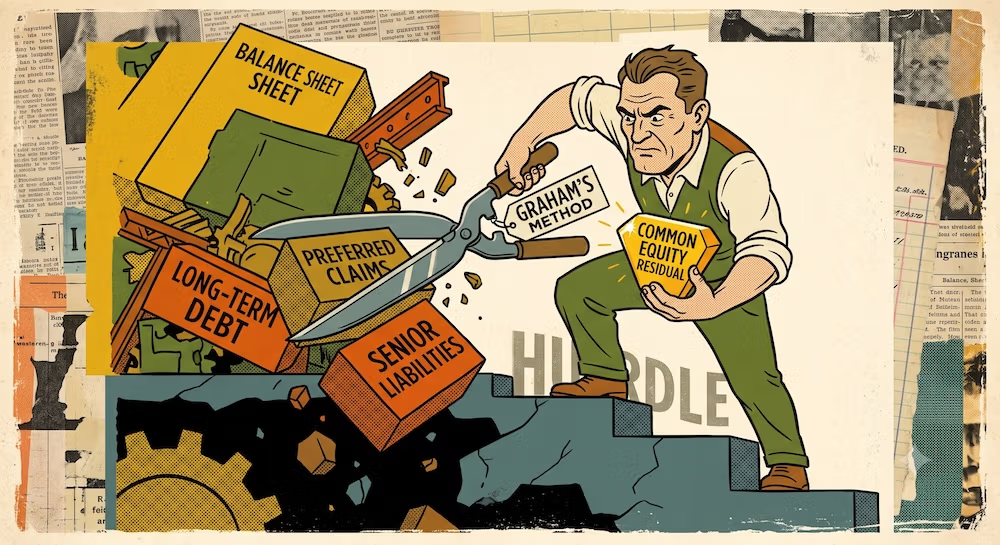
“Defensive investing” has become one of those labels finance attaches to anything wearing a tie and speaking quietly.
A portfolio owns large companies, dividend stocks, investment-grade bonds, or a suspiciously beige collection of funds, and the word defensive appears as if the case has been settled. Yet respectable ingredients can still produce a fragile investment operation. A wonderful company can be purchased at a ridiculous price. Thirty holdings can depend on the same economic assumption. High-quality bonds can sit inside a leveraged portfolio that cannot survive a serious decline.
Benjamin Graham’s deepest contribution was forcing safety to prove itself.
He did not invent prudence, financial analysis, diversification, or the belief that price matters. Those ideas existed before him. He gave them an operating structure that controlled which securities qualified, how much uncertainty the portfolio could absorb, how many decisions the investor had to make, and how heavily success depended on forecasting skill.
That is the birth worth examining. Graham moved defence from the investor’s intentions into the design of the investment process.
Graham Made Prudence Pass a Test
The clean historical version goes something like this: Wall Street was speculative, Graham arrived with a calculator, and rational investing began.
It is a satisfying story. It is also too neat.
Financial historian Dennis Butler, writing in “Benjamin Graham in Perspective,” identifies several books on industrial-security analysis published before Graham and David Dodd completed Security Analysis in 1934. Investors were already examining balance sheets, estimating intrinsic worth, diversifying portfolios, and worrying about the protection of principal.
Graham’s achievement was synthesis backed by exclusion.
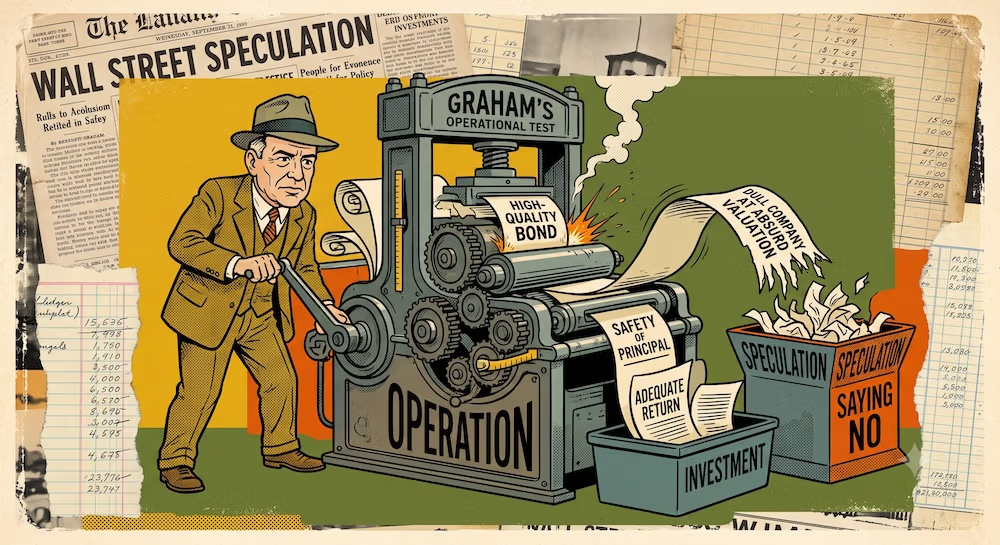
In the first edition of Security Analysis, Graham and Dodd defined an investment operation through three conditions: thorough analysis, safety of principal, and an adequate return. Operations failing those tests belonged to speculation.
The important word was operation.
Safety did not live permanently inside a bond, preferred share, common stock, or famous company. A bond purchased without adequate analysis could be speculative. A common stock purchased with sufficient valuation support and diversification could qualify as investment.
That sounds obvious now because Graham helped make it obvious. Finance still resists the implication.
Labels such as “blue chip,” “income,” “quality,” “balanced,” and “low risk” often end the investigation precisely where it should begin. They tell us how a security or product wishes to be perceived. They say very little about price, leverage, concentration, liquidity, or the assumptions embedded in the portfolio.
I give Graham credit for attacking that category error directly. He made the investor examine the whole arrangement rather than admiring the respectable names inside it.
A dull company purchased at an absurd valuation does not become safe through boredom. A highly rated bond financed with borrowed money does not become defensive through paperwork. Respectability at the security level cannot repair fragility at the portfolio level.
Graham’s claim to historical importance therefore survives without pretending he invented caution. He turned caution into a procedure capable of saying no.
The Crash Punished the Portfolio Around the Analysis
Graham’s own experience during the collapse surrounding the Great Depression exposed the difference between finding value and building something capable of surviving.
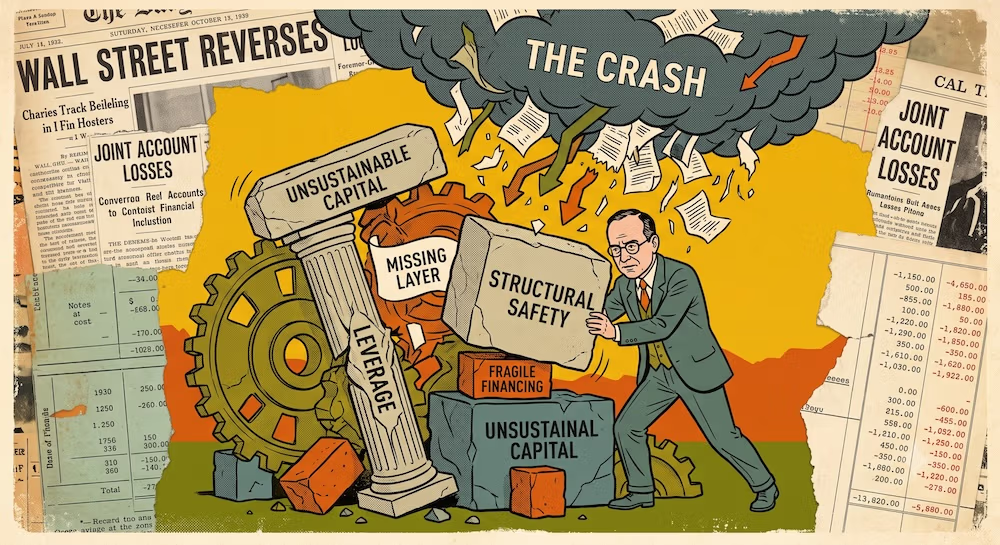
According to Irving Kahn and Robert Milne’s Benjamin Graham: The Father of Financial Analysis, Graham’s Joint Account held approximately $2.5 million of equity in mid-1929. It controlled roughly another $4.5 million of securities, financed partly through about $2 million of borrowing. The account included long and short positions, although changes to previously complete hedges had left it more exposed to the rising market.
Then the market reversed.
The Joint Account lost 20% in 1929, 50% in 1930, 16% in 1931, and 3% in 1932. The cumulative decline approached 70%.
Graham later stressed that he had avoided the fashionable speculative favourites of the period and believed he owned sound investments. He also identified the crucial mistake: he owed money.
That admission deserves more attention than another decorative quotation about Mr. Market.
His analysis may have identified securities with genuine underlying value. The portfolio still carried leverage, incomplete protection, and more exposure than its capital could safely support. A favourable valuation could not cancel a vulnerable financing structure.
The polite version says Graham learned the importance of buying cheap stocks. The harder lesson is that good analysis cannot rescue a badly engineered portfolio.
I find that distinction far more useful. It denies investors the comfort of believing that sufficient intelligence at the security-selection stage will compensate for every other weakness. It will not. Leverage, concentration, liquidity demands, and forced selling can make a correct long-term judgment financially irrelevant.
The crash did not create Graham’s philosophy from nothing. He had been teaching security analysis and considering a book before 1929. The collapse tested an existing analytical project and exposed its missing layer. Security Analysis supplied the procedural foundation in 1934. His later work translated that foundation into a program designed around the limitations of a particular investor.
Defensive Described the Program’s Demands
The word “defensive” makes Graham’s framework sound more timid than it was.
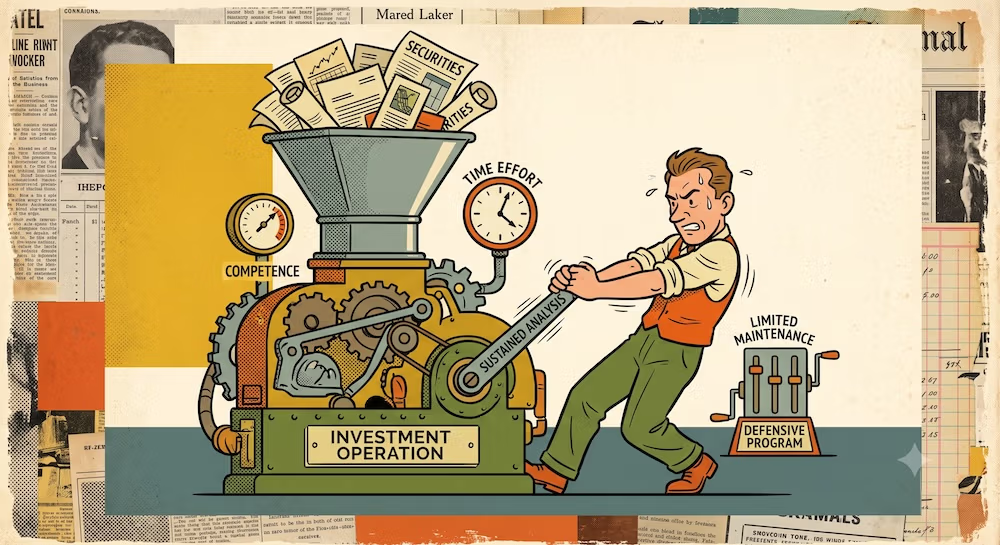
It conjures an investor who distrusts every rally, fears every headline, and keeps one hand permanently hovering over the sell button. Graham’s defensive investor was defined less by mood than by the operating burden he or she was prepared to accept.
In the 1973 edition of The Intelligent Investor, Graham described the defensive investor’s chief objective as avoiding serious mistakes or losses. He also emphasized freedom from frequent decisions, sustained effort, and unnecessary annoyance.
That second objective is where the mechanism becomes interesting.
Graham was asking how much labour, judgment, monitoring, and emotional stamina a strategy required from its owner. A defensive program had to remain viable without exceptional forecasting ability or constant intervention.
The enterprising investor accepted a heavier workload. “Enterprising” described someone willing and able to devote time and care to finding securities that were sound and more attractive than average.
Graham occasionally used “aggressive” as a synonym, which has not helped. In modern portfolio language, aggressive usually means accepting greater risk in pursuit of greater return. Graham challenged that formulation. He tied the possibility of superior results to intelligent effort, competence, and discipline.
The difference is more severe than a standard risk-tolerance questionnaire suggests:
| Investor type | What the program demands | Where the edge is supposed to come from | Primary danger |
|---|---|---|---|
| Defensive | Limited maintenance and restricted discretion | Rules, broad selection, valuation restraint, diversification | Reaching beyond the investor’s actual capacity |
| Enterprising | Sustained analysis and more frequent judgment | Superior effort, skill, and opportunity selection | Confusing activity, confidence, or appetite for risk with competence |
Wealth did not automatically qualify someone as enterprising. Neither did education or professional status. Graham argued that the appropriate program depended heavily on knowledge, experience, temperament, and available effort.
Modern finance prefers the friendlier question: “How much risk are you comfortable taking?”
Graham’s version was closer to: “What can you actually execute without fooling yourself?”
I can see why the first question dominates. It produces a score, a colour band, and possibly a pie chart before lunch. The second may reveal that an ambitious investor has neither the time nor the temperament for the strategy being considered. That is less useful for selling aspiration.
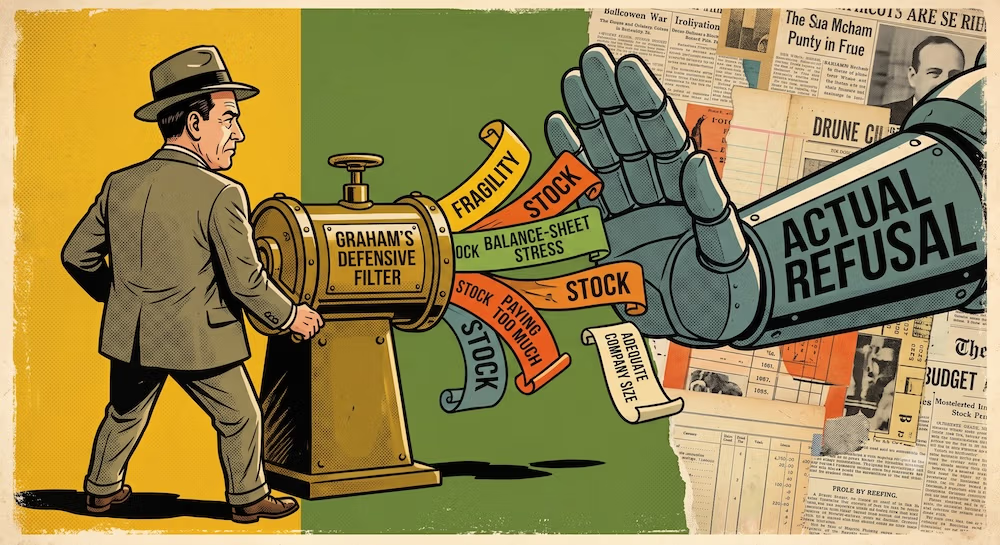
The First Defensive Act Was Refusal
Graham’s stock-selection criteria are often treated as an antique screening recipe. Enter seven numbers, reject the failures, and out comes a defensive portfolio.
That interpretation captures the visible machinery while missing why it existed.
Graham offered the defensive investor two broad approaches to common stocks. One involved owning a diversified cross-section of leading companies. The other used quantitative standards to test individual candidates. Price remained a constraint under both approaches.
His seven historical criteria addressed company size, financial condition, earnings stability, dividend history, earnings growth, valuation relative to normalized earnings, and price in relation to assets.
Each rule attacked a different dependency:
| Defensive filter | Weakness being restricted |
| Adequate company size | Fragility and limited operating resources |
| Strong financial condition | Balance-sheet stress |
| Long record of positive earnings | Dependence on a brief favourable period |
| Dividend continuity | Lack of demonstrated shareholder distributions |
| Earnings growth | Persistent stagnation |
| Earnings-based valuation ceiling | Excessive reliance on future growth |
| Asset-based valuation restraint | Paying too much relative to tangible support |
The historical thresholds were products of their time. Graham described some of the size requirements as arbitrary, and he revised his formulas across editions. Treating those precise numbers as permanent laws would turn an adaptive framework into scripture.
Their purpose remains unmistakable. Graham wanted the defensive investor to reject most available securities before becoming emotionally attached to any of them.
That is a genuine form of defence. The opportunity set shrinks before recent performance, exciting narratives, management charisma, or social proof begin doing their work.
A company could be excellent and still fail the price test. It could be cheap and fail the financial-strength test. It could be fashionable, innovative, widely respected, and completely irrelevant to the program.
Finance has little commercial reason to celebrate this kind of refusal. Product shelves expand because more categories create more points of sale. Research platforms benefit when investors feel that the next insight, screen, signal, or tactical adjustment might finally complete the puzzle. A system that eliminates most choices is wonderfully unhelpful to an industry paid to keep choice interesting.
I am not immune to the appeal of the formula either. A numerical screen feels neutral. It gives judgment a laboratory coat. Yet judgment has usually migrated into the selection of the inputs, accounting definitions, time periods, and thresholds.
Graham’s rules constrained discretion. They never made discretion disappear.

Diversification Was Graham Admitting He Could Be Wrong
Graham’s defensive investor did not build a portfolio around three or four supposedly inevitable winners. His historical guidance discussed a collection of roughly ten to thirty stocks, combined with standards for business quality, financial strength, dividend records, and valuation.
The exact number has aged. The intellectual concession has not.
Diversification meant that selection could fail.
Graham advised defensive investors to emphasize diversification rather than trying to identify the very best stocks. The logic is difficult to escape. An investor genuinely certain about every conclusion would have little need to spread capital broadly. A diversified portfolio admits that careful analysis can still produce incorrect judgments.
This may be the most honest component of Graham’s system.
Concentration flatters the investor. It turns conviction into identity. Diversification is less glamorous because it builds around the possibility that the analyst has misunderstood the business, overestimated the assets, trusted unstable earnings, or simply encountered bad luck.
A concentrated investor can describe ten holdings as diworsification and receive applause for courage. Graham’s defensive investor was more interested in surviving the discovery that confidence and correctness are not the same thing.
His later thinking strengthened this portfolio-level emphasis. In a 1976 interview reproduced in Kahn and Milne’s study, Graham expressed increasing preference for purchasing groups of securities that met straightforward undervaluation criteria instead of relying too heavily on detailed judgments about individual companies.
Followers often retain Graham’s valuation language while quietly deleting this humility. They buy a concentrated group of “Graham-style” stocks and assume the label carries the protection.
It does not.
A strategy can resemble Graham aesthetically while opposing him structurally. Cheap-looking securities, concentrated heavily, still require the investor’s individual judgments to be unusually accurate. One of Graham’s primary safeguards has been removed, even though the price-to-book ratios look appropriately historical.
Diversification cannot eliminate common economic exposures, inflation, broad market declines, business deterioration, or forced selling. Its role is more precise. It limits the amount of damage one mistake can inflict and lowers the degree of certainty demanded from each selection.
That is an admission of fallibility converted into portfolio design.
A Great Company Could Still Be a Terrible Defensive Purchase
Graham wanted the defensive investor to own established, financially strong businesses. He never allowed business quality to overrule price.
In The Intelligent Investor, he demanded both adequate quality and sufficient earnings and assets for each dollar invested. A company could satisfy the operating tests and become unsuitable because its valuation had climbed too far.
His distinction between predictive and protective analysis explains why.
Predictive analysis leaned heavily on favourable assumptions about future earnings, growth, competitive strength, or industry conditions. Protective analysis required enough support in the present figures to absorb adverse developments.
Graham preferred protection because forecasting errors are ordinary. A high purchase price makes them expensive.
The phrase “buy quality” hides this dependence. Quality measured how? Over which business cycle? Supported by what financial structure? Purchased at what valuation? Requiring how much future growth merely to justify the current price?
Without those questions, quality becomes a permission slip to overpay politely.
I agree with Graham strongly here because the error rarely announces itself as recklessness. Investors describe the premium as payment for durability, scarcity, visibility, management excellence, or a long growth runway. Any of those qualities may exist. The arithmetic remains unimpressed.
A genuinely strong business can deliver excellent operating results while its shareholders receive disappointing investment results. The purchase price may already have capitalized too much of the favourable future.
Defensive investing required the present evidence to shoulder more of the burden. Forecasts still mattered, though the portfolio was designed to suffer less when those forecasts disappointed.
That is what valuation discipline was protecting against: dependence.
Fewer Decisions Meant Fewer Ways to Interfere
Graham reduced risk partly by reducing the number of decisions available to the investor.
His historical allocation framework often began around an equal division between high-grade bonds and leading common stocks, with permitted ranges between 25% and 75%. When market movements pushed the proportions materially away from the intended balance, the investor restored them.
Those percentages belonged to Graham’s market environment. Copying them mechanically today would confuse the historical mechanism with a personalized allocation prescription.
The useful feature was bounded discretion.
A standing policy limited the need to make repeated all-or-nothing forecasts. Rebalancing required trimming the asset that had become more dominant and adding to the one that had become less popular. Graham considered this restraint one of the balanced program’s most important functions.
The procedure was simple. Following it could be miserable.
Graham acknowledged that mechanical policies become psychologically demanding when market enthusiasm or fear makes the rule appear foolish. The defensive investor had fewer decisions to make, though some of those decisions arrived precisely when human judgment was most vulnerable.
This exposes a common misunderstanding about simplicity. A simple process does not guarantee easy execution. It merely reduces the number of moving parts capable of malfunctioning.
Finance frequently confuses additional machinery with greater control. A portfolio gains tactical bands, valuation overlays, macro signals, scenario dashboards, manager tilts, and a committee to supervise the committee. It looks sophisticated because the interference has acquired documentation.
Each new lever also creates another opportunity to pull something at the wrong time.
Graham’s defensive architecture moved in the opposite direction. Restricted eligibility, diversification, valuation ceilings, bounded allocation, and periodic rebalancing narrowed the investor’s freedom to improvise.
The system assumed that judgement would sometimes be poor. It responded by rationing the number of occasions on which poor judgement could matter.
Defence Did Not Mean Immunity
Graham did not promise that the defensive investor would beat the market.
He doubted that defensive stock selection could reliably produce better-than-average performance. He also questioned whether enterprising investors would always receive sufficient extra return for the work they supplied.
That modesty has not survived every attempt to commercialize his ideas.
A historical standard becomes a screen. The screen becomes a backtest. The backtest becomes a performance claim. The performance claim becomes a fund, newsletter, ranking, or strategy with an attractively precise name. By the end, Graham’s concern with satisfactory results and error avoidance has somehow become an implication that one particular reconstruction of his rules should outperform.
The machine grows more elaborate as the promise grows less Graham-like.
His defensive program could still suffer. Businesses could deteriorate. Inflation could erode the real value of fixed claims. Interest-rate changes could damage bond prices. Stock markets could decline sharply. An investor who paid too much could turn an apparently temporary setback into a permanent capital loss.
The investor could also abandon the program.
That may be the most dangerous failure because defensive methods can look least intelligent during the periods when speculation is working. Restraint lags exuberance by design. Diversification disappoints when concentrated winners dominate. Valuation limits appear antiquated when high prices keep rising.
The defensive investor must survive the social embarrassment of watching less constrained strategies look brilliant.
Volatility alone did not capture Graham’s full definition of risk. Yet price fluctuation cannot be dismissed for every investor. A decline becomes economically permanent when leverage, liabilities, liquidity needs, or panic force a sale.
I reject both easy versions. Every fluctuation is not a catastrophe. A portfolio is not safe merely because its owner intends to wait.
The relevant test is whether the investment operation can endure adverse conditions without demanding a forced decision at the moment when conditions are worst.
Graham’s Lasting Contribution Was a Strategy the Owner Could Carry
Jason Zweig has documented how Graham revised or discarded formulas across editions. That willingness to change course tells us how little sense it makes to worship every historical threshold.
The numbers were scaffolding. The architecture underneath them carried the larger idea.
Graham’s defensive program restricted dependence on forecasts, spread the consequences of analytical error, constrained the price paid, limited the investor’s activity, and matched the workload of the strategy to the person expected to execute it.
I call that investor–strategy fit. Graham did not present it under that formal name, so the phrase should remain identified as an interpretation. The pattern, however, is difficult to miss across his treatment of knowledge, effort, temperament, diversification, valuation, and portfolio policy.
Investors naturally begin with potential rewards. Graham forced the assessment to begin with requirements.
How much analysis must remain accurate? How frequently must decisions be made? What happens when the strategy lags? How much confidence does it demand? Can the owner maintain it through fear, boredom, distraction, or the sight of neighbours getting rich more quickly?
A defensive strategy fails its own purpose when it requires extraordinary foresight, uninterrupted attention, or heroic emotional control from an ordinary investor.
That is where Graham’s innovation still bites. Safety cannot be pasted onto a portfolio through labels, historical reputation, or respectable holdings. It has to be built into the rules governing price, structure, selection, diversification, and behaviour.
The birth of defensive investing occurred when the investor’s limitations became part of the investment design.
A strategy that requires a better investor than the one who owns it has already hidden the risk in the operator.
What did Benjamin Graham mean by defensive investing?
Graham described a program designed to avoid serious mistakes and losses while reducing the need for frequent decisions, sustained effort, and constant intervention. Defensive investing concerned the demands and structure of the investment process rather than simple fearfulness or permanent pessimism.
Did Benjamin Graham invent defensive investing?
He did not invent prudence, financial analysis, diversification, or the idea that price matters. His distinctive contribution was to combine those protective principles into a structured process that tested the complete investment operation.
Why was diversification central to Graham’s defensive approach?
Diversification acknowledged that even careful security analysis could produce incorrect judgments. By spreading exposure across multiple qualifying securities, the portfolio reduced the damage that any single analytical mistake could cause.
Could a high-quality company still fail Graham’s defensive test?
Yes. Graham required financial and business quality to be considered alongside the purchase price. A strong company could become an unsuitable defensive purchase when its valuation depended too heavily on favourable future results.
Why did Graham want defensive investors to make fewer decisions?
Fewer discretionary decisions meant fewer opportunities for fear, enthusiasm, boredom, or misplaced confidence to interfere with the program. Eligibility rules, diversification, bounded allocation, and rebalancing were intended to restrict unnecessary improvisation.
Did Graham claim that defensive investing would beat the market?
No. Graham questioned whether defensive stock selection could reliably produce better-than-average results. His objective was a satisfactory outcome with less exposure to serious and avoidable errors, not guaranteed outperformance.
What is the lasting principle behind Graham’s defensive investing rules?
The enduring principle is that a strategy should match the knowledge, effort, temperament, and decision-making capacity of its owner. Historical numerical thresholds may change, but a defensive process should not require extraordinary foresight or constant intervention from an ordinary investor.
This article is also available in Spanish. [Leé la versión en castellano: Benjamin Graham y el nacimiento de la inversión defensiva]