To my eyes, the MAR Ratio—often called the Managed Account Ratio—cuts through the noise of traditional risk metrics by measuring what actually matters: survival. This ratio gives us the cold, hard math by comparing an investment’s absolute returns against its most painful historical drawdowns. The structural comparison offers a stark perspective on how much return an investment extracts for every drop of pure portfolio agony you endure. The underlying math strips away the marketing prose and forces you to look directly at the worst-case scenario. When you are modeling multi-asset allocations, this metric provides a vital sanity check on performance claims. For my own framework, evaluating strategies through this lens shifts the focus from theoretical upside to raw capital preservation realities.
Used aggressively in the realm of hedge funds, managed accounts, and high-volatility assets, the MAR Ratio shines when capital preservation isn’t just theory, but a mathematical necessity. In the simplest terms, it forces you to confront the lived stability of your investment’s returns. If a trend-following fund compounds consistently but only suffers shallow, fleeting drawdowns, it commands a high MAR Ratio. Conversely, equity strategies printing high returns but routinely burying you in 40% holes will show a lower MAR, exposing a fragile, high-risk profile. The math doesn’t lie. For me, it highlights the clear structural trade-offs between riding standard equity beta and allocating to systematic, trend-following models. The true test of any asset class isn’t its performance during a roaring bull run, but its mechanical behavior when liquidity evaporates from the system.
Why is the MAR Ratio Important?
The MAR Ratio has earned a permanent place on my dashboard for one specific reason: it refuses to look away from the crash. Its focus on drawdowns—the peak-to-trough collapse in an investment’s value—makes it indispensable for anyone managing actual capital. Unlike the Sharpe or Sortino Ratios, which consider return volatility and downside deviation, the MAR Ratio zeroes in on the single worst-case scenario. This matters because standard deviation completely hides the sequence of returns risk. A fund can look incredibly smooth on a monthly tracking chart right up until a multi-month systemic shock triggers an unhedged liquidation event that flattens the capital base.
Here is where I have to push back against the academic consensus. Everyone worships the Sharpe Ratio, but Sharpe assumes returns follow a clean, normal distribution. We know markets have fat, ugly tails. Sharpe treats a 20% upside month as equally “risky” as a 20% downside month. That’s absurd. This localized focus makes the MAR an attractive tool for evaluating investments in hedge funds or managed futures, where surviving the left tail is prioritized over capturing every ounce of upside. When an allocator is utilizing derivatives or cross-asset trend models, standard dispersion metrics break down because non-linear return profiles don’t conform to neat Gaussian curves.
Honestly, it’s a different animal when you are staring at a 30% hole in your net worth. The MAR Ratio isn’t just for institutional quants. It helps DIY allocators quantify the specific psychological discomfort of holding a strategy through a multi-year underperformance window. By analyzing risk-adjusted return through the lens of maximum pain, the MAR Ratio allows for an investment selection process grounded in risk management, ensuring you don’t abandon your strategy at the exact wrong time. Having an asset printing green on your screen when the world is ending provides the raw psychological insulation you need to keep from hitting the sell button on your core equity sleeve. Having a clear, drawdown-focused metric keeps your focus on the structural role that specific fund plays during a liquidity crunch rather than its short-term underperformance relative to a concentrated equity index.
What is the MAR Ratio?
Let’s strip away the theory and look at the actual mechanics. We are going to break down exactly how the MAR Ratio is calculated, what it reveals about an investment’s risk management framework, and why it matters to anyone building a resilient portfolio. By grasping the MAR Ratio, you stop chasing sheer yield and start prioritizing the stability and reliability of the return stream, making allocations that align with your true behavioral risk tolerance. This geometric assessment moves beyond simple mathematical averages by forcing a direct structural comparison between your long-term compounding rate and the single largest capital peak-to-trough drop.
The objective here is to equip you with the quantitative truth so you can:
- Measure Risk Management: Stop looking at average returns and start prioritizing maximum loss containment.
- Interpret Performance: Isolate the rare funds that deliver structural alpha without dragging you through catastrophic drawdowns.
- Make Informed Decisions: Read past the glossy brochures and use raw data to enforce asset allocation discipline.
Using the MAR Ratio forces a fundamental shift in how you view capital efficiency. It changes the conversation from “how much can I make?” to “how much heat do I have to take?” Whether you are building a standard equity-bond split or introducing alternative sleeves, understanding the MAR Ratio sharpens your approach to portfolio management. For my own framework, this acts as an administrative filter that prevents me from overallocating to strategies that generate high gross yields but expose the entire core engine to structural vulnerability during a fat-tail regime shift.
Tip: I used to think one metric could tell the whole story. It can’t. Always cross-reference the MAR Ratio with standard deviation and correlation matrixes to build a multi-dimensional view of an investment’s profile.
Calculating the MAR Ratio
The MAR Ratio Formula
The MAR Ratio formula is a masterclass in simplicity. It bypasses complex standard deviations to map the direct relationship between an investment’s growth and its risk. Here is the exact calculation:

Each variable strips away marketing fiction and leaves you with hard data:
- Compound Annual Growth Rate (CAGR): This is your annualized geometric return. It accounts for compounding, smoothing out the sequence of returns to give you the true, functional growth rate of the capital base.
- Maximum Drawdown: The absolute deepest peak-to-trough crater the asset has experienced. This is the ultimate reality check on an investment’s value over a given period. If a fund drops 50%, you need a 100% gain just to get back to even. Maximum drawdown quantifies that mathematical gravity.
When you stack them together, the MAR Ratio measures the yield per unit of ultimate failure. A higher MAR Ratio is categorically better, proving the manager is extracting capital gains without exposing the portfolio to terminal volatility. It is vital to ensure that both metrics use the exact same lookback timeframe; calculating a historical CAGR over twenty years while matching it against a maximum drawdown that omits a major systemic crisis like 2008 or 2020 completely breaks the mathematical validity of the ratio.
Step-by-Step Calculation Example
Let’s run the actual math to see how the implementation gap between a clean backtest and live execution plays out. For context, look at the benchmark SG Trend Index, which tracks the largest institutional Commodity Trading Advisors (CTAs). Recent data shows that since its inception in 2000, the SG Trend Index has delivered a historical CAGR of roughly 5.49% while enduring a maximum drawdown of 20.61%. That gives the index a long-term MAR Ratio of about 0.26.
Suppose you allocate instead to an aggressive alternative strategy that delivers a CAGR of 12% over five years, enduring a painful but manageable maximum drawdown of 20% during a liquidity shock.
Using the MAR Ratio formula:
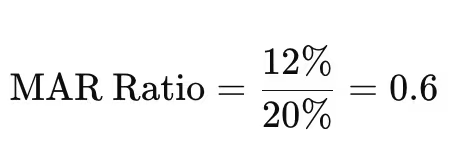
In this scenario, the MAR Ratio is exactly 0.6. For every unit of worst-case drawdown risk you absorbed, you earned 0.6 units of annualized return. I look for a MAR Ratio above 0.5 as a baseline in alternative and highly volatile asset classes, though the acceptable threshold shifts heavily depending on the asset’s role in the broader portfolio. Evaluating this specific metric allows allocators to isolate funds that maintain tight risk parameters while trading highly volatile global macro or trend models across cross-asset segments.
Key Takeaways:
- A higher MAR Ratio confirms superior risk-adjusted execution. If you are auditing two trend-following funds, and one prints a MAR Ratio of 0.9 while the other sits at 0.4, the first investment has performed better in terms of balancing return against risk. Yikes for the 0.4 fund.
- Drawdown severity dictates long-term survival. A massive CAGR paired with a brutal maximum drawdown means the asset is incredibly fragile. You have to survive the drawdown to realize the CAGR.
Why a Higher MAR Ratio Matters
When evaluating structural portfolio blocks, a high MAR Ratio is your primary defense against manager incompetence. A MAR Ratio of 1 or above generally reflects an investment operating in rare air, indicating the manager generated returns that completely eclipsed their worst historical loss. This is the Holy Grail of capital efficiency. In active fund management, staying above a 1.0 threshold means your compounding machine is faster than your temporary structural drawdowns.
This metric becomes critical when analyzing alternatives. Institutional allocators demand high MAR Ratios from CTA and managed futures managers because it proves how well returns are sustained through market swings. When you hit the realization that a fund’s marketing doesn’t match what you find in the prospectus, recalculating the MAR on their actual daily NAVs is the ultimate truth serum. This verification practice exposes managers who rely on structural tail winds or temporary high-beta exposure rather than systematic risk mitigation protocols to limit capital destruction.
How the MAR Ratio Assesses Risk Management
Evaluating Drawdown Risk with the MAR Ratio
The MAR Ratio operates as an uncompromising tool for understanding risk management in investments. I love that it ignores the upside noise and attacks the core problem: minimizing losses while seeking steady returns. Drawdowns are not just paper fluctuations; they are mathematical anchors. If you drop 50%, you need 100% to recover. That friction can significantly impact their portfolio survival rate. For an individual allocator, a deep peak-to-trough drop introduces significant behavioral constraints, often leading to panic-selling at the exact bottom of a market cycle. It’s a lot easier to stay steady when part of your portfolio refuses to slide down the mountain with everything else.
When a manager sustains a high MAR Ratio across multiple market regimes, it proves they aren’t just riding passive market beta. They have constructed a mechanism that balanced growth with controlled risk. They are actively managing exposure, cutting losers, and protecting the core capital base when the broader index is collapsing. This systematic discipline is what separates structural diversification tools from speculative asset plays that depend entirely on favorable macroeconomic currents to remain solvent.
The beauty of the MAR Ratio’s focus on drawdowns is that it respects the lived experience of the investor. It forces us to acknowledge risk management as an active pursuit. You can’t fake a shallow maximum drawdown during a global liquidity crisis. For those of us allocating our own money, a high MAR Ratio indicates a strategy we can actually hold onto without capitulating at the bottom. It maps cleanly to the physical reality of portfolio survival, acknowledging that capital preservation is the absolute foundation of compounding.
Comparing the MAR Ratio to Other Risk Metrics
The industry loves to quote The Sharpe Ratio, which divides excess return by standard deviation. But Sharpe penalizes upside volatility. If a fund randomly skyrockets by 40% in a month, Sharpe punishes it for being “volatile.” That’s absurd. This mathematical limitation makes standard deviation an unreliable tool for analyzing alternative investments that exhibit positively skewed, non-linear return patterns during market crises.
The Sortino Ratio attempts to fix this by only penalizing downside deviation. Sortino is undeniably better than Sharpe, but it still measures the frequency and size of negative wiggles. It doesn’t scream at you about the structural crater the fund left in 2008. That is where the MAR Ratio steps in. It ignores the day-to-day noise and asks one terrifying question: “What was the absolute worst it ever got?”
This localized focus on drawdown risk makes it particularly relevant for hedge funds and managed accounts. I used to be one of those guys who only looked at CAGR, right up until the tracking error pain when your alternative sleeve underperforms the S&P for two years running forces you to re-evaluate why you own it. Alternative assets are there to protect you. Investments with a high MAR Ratio deliver effective drawdown management, serving as the structural ballast your portfolio requires. The trade-off is clear: you may give up short-term relative outperformance to buy long-term catastrophic downside insurance.
Key Differences Between the MAR Ratio and Other Metrics:
- Sharpe Ratio: Obsesses over standard deviation, treating upside gains and downside losses as equally “risky.”
- Sortino Ratio: Corrects the Sharpe flaw by focusing on downside volatility, but still doesn’t explicitly isolate the maximum depth of failure.
- MAR Ratio: Unapologetically isolates the maximum peak-to-trough collapse, highlighting the ultimate pain point of the strategy.
Why the MAR Ratio is Valuable for High-Volatility Assets
If you are allocating to investments prone to high volatility or those managed with strategies utilizing derivatives, the MAR Ratio is non-negotiable. High volatility assets without strict drawdown controls are widow-makers. The specific way leverage compounds anxiety, not just returns, makes holding these assets a psychological nightmare if the MAR Ratio is weak. A high MAR in a volatile asset class proves the manager possesses an elite exit strategy. It means they have implemented hard risk parameters, systematic trailing stops, or cross-asset hedges that prevent an adverse market development from morphing into a total capital wipeout.
We shouldn’t discard Sharpe or Sortino entirely. Portfolio architecture requires multiple viewpoints. But when you need to understand risk through the lens of potential losses, the MAR Ratio provides cold clarity. It is an essential tool for diagnosing whether a complex fund is genuinely managing risk, or just getting lucky with excessive beta. When monitoring a highly leveraged sleeve, watching the rolling MAR tells you if the manager is breaking their structural risk rules to chase short-term returns.
Interpreting the MAR Ratio in Investment Analysis
What a High MAR Ratio Means for Investors
When I see a fund printing a high MAR Ratio, I know I’m looking at structural efficiency. It means the asset isn’t just surviving; it’s aggressively protecting the downside while compounding capital. For DIY allocators, this is the holy grail of strong risk-adjusted performance. It mathematically proves the manager has a system to cut losses before they become fatal, protecting the core engine of your compounding. It shows that the fund’s operational mechanics are designed to withstand multi-market regime shifts without forcing the investor to endure catastrophic drawdowns.
Because these assets avoid the deep left-tail events, investments with a high MAR Ratio are generally more stable. They become the bedrock for investors who value steadiness when the broader indices are entering a bear regime. Instead of panicking and liquidating at the bottom, holding a high-MAR asset gives you the behavioral fortitude to stay invested. The math supports your psychology. By insulating the aggregate portfolio curve from extreme volatility, these high-efficiency components mitigate the temptation to tinker during equity sell-offs.
This metric is ruthless at separating the tourists from the professionals. It will distinguish the best-performing funds in spaces like hedge funds or managed futures. Every manager looks like a genius in a bull market. The MAR Ratio strips away the bull market beta and shows you exactly which investments that have mastered balancing growth and risk when the liquidity vacuum hits. It exposes those who are merely using unhedged margin exposure from systematic operators who deploy risk-parity frameworks to carefully preserve principal.
Key Highlights of a High MAR Ratio:
- Mathematically proves the strategy exhibits well-managed risk relative to absolute growth.
- Provides the behavioral armor necessary to hold an asset through deep market corrections.
- Filters out managers who rely on unhedged market beta to generate their returns.
Limitations of the MAR Ratio & The Implementation Friction Reality
We need to be honest about the blind spots. The MAR Ratio has massive limitations. Chief among them is its absolute reliance on historical performance. A backtest is just a sanitized version of history. A strategy might post a pristine 1.2 MAR Ratio over a decade because it happened to perfectly match that specific macroeconomic regime. If the regime shifts from deflationary growth to inflationary stagnation, that historical MAR Ratio is entirely useless. It can easily lull an investor into false security before a totally unique systemic tail-risk event crashes the underlying models.
Here is a visualization of how identical MAR figures mask completely distinct structural and psychological realities across multi-year recovery horizons:
| Strategy Variant | CAGR | Max Drawdown | Net MAR | Drawdown Duration | Lived Psychological Reality |
|---|---|---|---|---|---|
| Fund A (Flash Crisis) | 12% | -20% | 0.60 | 11 Days | Acute panic, rapid systemic liquidity recovery. Easy to hold in hindsight. |
| Fund B (The Grinding Bleed) | 12% | -20% | 0.60 | 42 Months | Agonizing career risk, chronic performance drag, immense temptation to fire the manager. |
Here is where things get uncomfortable. The MAR Ratio assumes you are capturing the exact gross return of the strategy. It is completely blind to implementation friction. Take the real-world execution of managed futures ETFs. If you allocate to a top-tier replicator like the iMGP DBi Managed Futures Strategy ETF (DBMF) or a pure systematic trend fund like the KraneShares Mount Lucas Managed Futures Index Strategy ETF (KMLM), the structural wrapper matters enormously. Both of these funds do incredible work—DBMF commands over $3.3 Billion in AUM with an expense ratio of 0.85%, while KMLM strips out equity futures entirely to act as a purer diversifier with a 0.90% expense ratio. Their gross MAR profiles are strong.
But what the MAR Ratio won’t tell you is the devastating way tax drag actually erodes returns in a non-registered taxable account. Trend-following funds actively trade futures contracts, throwing off a massive amount of short-term capital gains and ordinary income distributions at the end of the year. If you hold DBMF or KMLM outside of a registered, tax-advantaged account, you can easily surrender 200+ basis points annually to the tax man. A pristine 0.6 MAR Ratio on a fact sheet drops significantly once you factor in the personal tax drag of the distributions. Always audit the underlying holdings for tax risk, or other financial health vulnerabilities before blindly trusting the ratio.
Important Considerations:
- Look-Ahead Bias: Relying purely on backward-looking drawdown data cannot predict an unprecedented future shock.
- The Tax Anchor: The ratio calculates gross or NAV returns, utterly ignoring the severe tax drag of high-turnover alternative funds held in non-registered accounts.
- Duration Blindness: A quick 15% drop and a grueling 4-year 15% bleed produce the same MAR Ratio, but drastically different behavioral pain.
Tips for Using the MAR Ratio Effectively
Never underwrite a strategy based on a single variable. The MAR Ratio is a precision instrument within a multi-faceted approach to investment analysis. I use it as a harsh initial filter. If a strategy claims to be an absolute return vehicle but prints a 0.2 MAR, I throw it out. But for the ones that pass, I immediately dig into qualitative assessments of an investment’s strategy to ensure the historical performance wasn’t a fluke. We must evaluate trading volume, underlying contract turnover, and execution slippage inside the fund wrapper.
- Use the Ulcer Index: Pair MAR with the Ulcer Index to understand not just the depth of the drawdown, but the agonizing duration of the recovery.
- Isolate Timeframes: Calculate the MAR Ratio across specific macro regimes (e.g., the 2022 inflation shock) to see how the strategy actually behaved under stress.
- Check the Structure: Ensure the manager’s stated mandate aligns with the mathematical output of the ratio, and verify the expense ratio isn’t eating your risk premium.
Practical Applications of the MAR Ratio in Portfolio Management
Using the MAR Ratio for Fund Selection
During the fund selection process, the MAR Ratio is the ultimate equalizer. You will frequently encounter two funds boasting identical 9% annualized CAGRs. The amateur stops there. The Sponge Investor digs deeper to map their risk-return profiles. One fund achieved that 9% by enduring a stomach-churning 35% collapse, while the other achieved it with a maximum drawdown of only 12%. This basic analysis strips away the nominal performance marketing and uncovers the internal structural engineering of the outperforming vehicle.
I know which one I’m putting my capital into. The fund with the higher MAR Ratio didn’t just generate returns; it preserved optionality. In hedge fund investing, depth of drawdown is heavily tied to the risk of fund liquidation. A manager running a high MAR strategy is structurally built to survive the ugly years. They don’t panic and blow up their trading desks when a correlation matrix breaks down during an unpredicted capital shift.
Key Tips for Fund Selection with MAR Ratio:
- Demand Category Outperformance: Only compare the MAR Ratio of a managed futures CTA against other managed futures CTAs. Cross-asset comparisons are meaningless.
- Audit the Rebalancing Cost: A high MAR backtest might be built on daily rebalancing assumptions that will destroy your capital via taxes and transaction fees in the real world.
- Watch for Leverage Traps: Managers can synthetically boost their MAR by timing leverage, exposing you to catastrophic tail-risk.
Incorporating the MAR Ratio into Portfolio Diversification
Everyone treats a pure S&P 500 allocation as ‘total diversification’ because it holds 500 companies. But that’s just 500 lines of the exact same equity beta risk. True diversification feels uncomfortable because something in your portfolio should always be losing money. The MAR Ratio holds a valuable place in portfolio diversification by allowing you to specifically target alternative strategies that offer high absolute returns relative to their internal drawdown mechanics. You aren’t just adding random volatility; you are adding highly efficient, non-correlated return streams that balance out the global equity tail risk.
A brilliantly engineered portfolio uses high-MAR alternative sleeves to create a more balanced and risk-managed investment strategy. The behavioral itch to tinker that ruins long-term compounding usually strikes when your entire portfolio is bleeding out. By maintaining a sleeve of high-MAR trend-followers or global macro funds, you introduce structural ballast. This addition provides a real-world counterweight that offsets equity drawdowns, giving you the mental fortitude required to let your core stock allocations compound unmolested over complete economic horizons.
Benefits of High MAR Ratios in Diversification:
- Provides Behavioral Ballast: High MAR alternative sleeves give you something green to look at when equities are crashing.
- Forces Uncorrelated Returns: Integrating distinct strategies to actively manage drawdown risks at the total portfolio level.
- Improves Capital Efficiency: Reduces total portfolio volatility, mathematically allowing you to hold higher-beta equities in other sleeves safely.
Example Scenario: Blending High MAR Ratio Investments
Imagine a diversified portfolio holding a standard 60/40 core. The 60/40 will inevitably face a dual-drawdown environment where both stocks and bonds bleed simultaneously. By layering in a managed futures CTA possessing a proven MAR Ratio of 0.8, you directly attack that structural weakness. The CTA’s ability to go short and manage its own drawdown limits the total portfolio’s vulnerability, preventing the catastrophic sequence of returns risk that derails long-term wealth accumulation. This implementation helps protect total equity curve architecture without demanding that you accurately time the underlying economic inflection points.
MAR Ratio Explained: 12-Question FAQ (Practical, Risk-First Guide)
What is the MAR Ratio in one sentence?
It’s a risk-adjusted performance metric defined as CAGR ÷ |Maximum Drawdown|, telling you how much return you earned per unit of worst historical loss.
What’s the exact formula and units?
MAR = CAGR / |Max Drawdown|
- Use CAGR as a decimal (e.g., 12% → 0.12) and drawdown as a positive decimal (e.g., −20% → 0.20 → use 0.20).
- The result is unitless; higher is better.
Can you show a quick, correct example?
If a fund compounded at 12% annually with a −20% max drawdown:
MAR = 0.12 / 0.20 = 0.60.
That means 0.60 units of return per unit of worst loss.
What does a “good” MAR Ratio look like?
Rules of thumb (context-dependent):
- ≥ 1.0: excellent (returns exceed worst drawdown)
- ~0.5–0.9: solid for volatile strategies (managed futures/hedge funds)
- < 0.3: weak unless strategy serves another purpose (hedge, ballast)
How is MAR different from Sharpe and Sortino?
- Sharpe: return per unit of volatility (treats upside & downside the same).
- Sortino: return per unit of downside volatility (penalizes only bad wiggles).
- MAR: return per unit of worst peak-to-trough loss. It answers, “How well did you avoid big hits while compounding?”
Is MAR the same as the Calmar Ratio?
They’re effectively siblings, but with key design differences: the Calmar Ratio is strictly mandated over a rolling 36-month lookback window, which makes it highly sensitive to “drawdown aging” where an extreme crisis suddenly drops off the denominator. Conversely, the MAR Ratio uses CAGR calculated across the entire evaluated lifecycle timeline divided by the absolute maximum drawdown over that identical historical period. In practice, people often use them interchangeably—be explicit about the lookback window.
Why do risk-aware investors like MAR?
Because big losses compound negatively. MAR spotlights tail pain (max DD), which many investors care about more than day-to-day noise. It’s especially useful for hedge funds, CTAs, and high-volatility sleeves where avoiding deep holes is part of the mandate.
What are the main limitations of MAR?
- Path blindness: ignores the frequency/duration of losses; only the single worst.
- History bias: entirely backward-looking; regime shifts can break it.
- Window sensitivity: change the start/end dates and you change MAR.
- No liquidity/credit insight: it won’t reveal hidden risks.
How do I compute max drawdown properly?
Track portfolio equity peaks; for each new trough compute (peak − trough) / peak; take the largest. Do this on a consistent frequency (e.g., daily end-of-day data) across all strategies to avoid apples-to-oranges comparisons. Note that computing max drawdown via monthly NAV sampling understates true peak-to-trough tail risk by roughly 10% to 30% compared to high-frequency daily datasets, as monthly marks blend away intra-month valley plunges.
How should I use MAR in manager or fund selection?
- Compare peers in the same category and same lookback.
- Prefer consistent MAR across multiple windows (e.g., 3y/5y/10y).
- Combine with: Sharpe/Sortino, Ulcer Index/UPI (drawdown depth & duration), ex-post beta/correlation, fees, capacity, and qualitative process checks.
Any portfolio-level applications?
Yes:
- Screen for components with MAR ≥ target to improve the portfolio’s risk-efficiency.
- Use MAR alongside correlation to pick diversifiers that lift return without dragging max DD.
- Rebalance/testing: ensure the rebalance rule used in backtests matches the MAR you’re reporting.
Pro tips and common gotchas?
- Match horizons: use the same start/end and data frequency across all candidates.
- Annualize consistently: CAGR must be annualized; drawdown is already scale-free.
- Mind leverage: leverage often boosts CAGR and drawdown—MAR may not improve.
- Report confidence: complement with drawdown duration and time-to-recover for fuller context.
The Portfolio Reality Matrix
To ground these formulas in structural realities, let’s look at the operational friction-to-reward metrics of these core components. The raw fact sheet number means nothing if your capital allocation strategy fails to survive the tax drag or execution spreads in your specific account wrapper.
| Strategy / Fund / Concept | What It Promises | Implementation Friction | The Sponge Verdict |
|---|---|---|---|
| SG Trend Index (The Industry Benchmark) | Tracks the largest institutional CTAs. Historically has provided a ~5.49% CAGR against a ~20.61% max drawdown since inception. | It’s an index, not an investable fund for retail. You can’t buy it directly. You have to find managers who replicate or beat it without charging excessive 2/20 fees. | Absorb the baseline. Use this index as your ultimate bullshit-detector. If a high-fee fund is underperforming the SG Trend Index over a rolling 3-year window, fire the manager. |
| DBMF (iMGP DBi Managed Futures ETF) | Seeks to replicate the pre-fee performance of the top 20 CTAs using a bottom-up futures strategy. Features massive liquidity (AUM over $3.3 Billion) and a 0.85% expense ratio. | Because it seeks to replicate the broad industry, it will carry equity beta during long bull markets. More painfully, the strategy generates massive distributions at year-end, creating heavy tax drag in non-registered accounts. | Absorb, but strictly in tax-advantaged accounts. It democratizes hedge fund returns brilliantly, but holding it in a taxable Canadian non-registered account will cost you hundreds of basis points in tax bleed. |
| KMLM (KraneShares Mount Lucas Managed Futures) | Systematic trend following with a strict mandate: commodities, currencies, and fixed income only. Zero equities. ER sits at 0.90%. | By excluding equities, it often severely underperforms DBMF during roaring equity bull markets. It also suffers from the identical, brutal tax-drag friction in taxable accounts due to high-turnover derivatives. | Absorb as a pure diversifier. If you already hold massive equity beta elsewhere and want an unadulterated trend hedge that won’t double-count your stock exposure, this is structurally cleaner than DBMF. |
| Tax Location Ignoring | Placing high-turnover alternative ETFs wherever you have free cash to simplify your dashboard. | Futures-based strategies throw off short-term capital gains and ordinary income. In a non-registered account, this creates a hidden “tax expense ratio” that can easily double or triple the nominal 0.85% management fee. | Expel immediately. Everyone obsesses over shaving 5 basis points off an expense ratio, but giving back 2% in tax drag is catastrophic. Structure and asset location matter more than the headline fee. |
Tips for Investors Using the MAR Ratio
The MAR Ratio is a brutally effective tool, but deploying it in isolation is a rookie mistake. To architect a genuinely robust portfolio, you have to synthesize the MAR Ratio with a spectrum of risk metrics. Combining these quantitative angles forces you to view your allocations without confirmation bias. Looking at metrics collectively ensures that a single spectacular backtest window won’t skew your baseline risk assumptions before a real-world liquidity event arrives.
Complementing the MAR Ratio with Other Metrics
I constantly preach diversification in risk metrics. You need multiple lenses. The Sharpe Ratio maps your returns against total volatility, while your standard deviation shows pure mathematical dispersion. The MAR Ratio is your left-tail defense mechanism. While MAR protects you from the absolute crater, observing Sharpe tells you how wild the daily ride to that return might be. Understanding that daily variance is vital for your behavioral preservation, preventing you from abandoning a fundamentally sound strategy due to basic tracking error anxiety.
Stacking these metrics together transforms your analysis:
- A complete risk profile: You merge the MAR Ratio’s drawdown reality check with the Sharpe Ratio’s volatility mapping to understand the full spectrum of risk.
- Detect Regime Fragility: Relying purely on backward-looking metrics is dangerous; blending them exposes strategies that look clean on paper but bleed slowly in reality.
- Expose Implementation Gaps: Uncover the frustration of rebalancing friction in a multi-fund portfolio by looking at how high-turnover strategies erode nominal returns.
Key Metrics to Consider:
- Sharpe Ratio: Analyzes your return against total portfolio volatility.
- Sortino Ratio: Strips out upside variance, isolating downside volatility to pair seamlessly with your MAR analysis.
- Ulcer Index: Measures not just the depth of the drawdown, but how agonizingly long you have to suffer in it.
Broadening Risk Management with the MAR Ratio
We need to integrate the MAR Ratio into a comprehensive risk management framework. If you obsess solely over historical drawdowns, you become blind to operational hazards. The MAR Ratio will not warn you about liquidity vacuums, sudden manager drift, or hidden credit risk buried in a private fund. You have to combine quantitative analysis with a deep structural review to achieve more resilient portfolio construction. This integrated evaluation process requires allocators to read the underlying prospectus parameters and understand the active trading constraints governing the fund execution.
For me, building out a bulletproof strategy requires a few uncompromising rules:
- Start with the MAR Filter: Eject any alternative strategy that fails to clear a basic MAR threshold. Don’t pay hedge fund fees for massive equity beta.
- Audit the Operations: Read the prospectus. Does the marketing match the execution? Will a sudden liquidity event trap your capital regardless of the historical MAR?
- Reevaluate Continuously: The math changes. If a manager fundamentally alters their trend-following model, the historical MAR Ratio is dead. Recalculate and verify.
Final Thoughts and Key Takeaways
The MAR Ratio provides cold, objective insight into how a manager survives a crisis. By stripping away standard deviation and focusing purely on the deepest peak-to-trough collapse, it identifies the rare strategies that truly manage risk while capturing yield. A strong MAR Ratio proves the manager isn’t just gambling with your capital; they possess a mechanical framework for survival. It forces an elite discipline onto fund builders, stripping away structural hype to expose baseline performance facts.
But always remember, the MAR Ratio is not a shield against all market mechanics. It’s one incredibly powerful diagnostic tool. You have to endure the lived experience of holding the asset. Pair the MAR Ratio with a deep understanding of factor exposures, tax locations, and correlation matrixes, and you’ll build a portfolio designed to outlast the chaos. For my framework, the ratio acts as a mathematical anchor, ensuring my long-term capital efficiency remains insulated from the emotional noise of the broader financial arena.
Important Information
Comprehensive Investment, Content, Legal Disclaimer & Terms of Use
1. Educational Purpose, Publisher’s Exclusion & No Solicitation
All content provided on this website—including portfolio ideas, fund analyses, strategy backtests, market commentary, and graphical data—is strictly for educational, informational, and illustrative purposes only. The information does not constitute financial, investment, tax, accounting, or legal advice. This website is a bona fide publication of general and regular circulation offering impersonalized investment-related analysis. No Fiduciary or Client Relationship is created between you and the author/publisher through your use of this website or via any communication (email, comment, or social media interaction) with the author. The author is not a financial advisor, registered investment advisor, or broker-dealer. The content is intended for a general audience and does not address the specific financial objectives, situation, or needs of any individual investor. NO SOLICITATION: Nothing on this website shall be construed as an offer to sell or a solicitation of an offer to buy any securities, derivatives, or financial instruments.
2. Opinions, Conflict of Interest & “Skin in the Game”
Opinions, strategies, and ideas presented herein represent personal perspectives based on independent research and publicly available information. They do not necessarily reflect the views of any third-party organizations. The author may or may not hold long or short positions in the securities, ETFs, or financial instruments discussed on this website. These positions may change at any time without notice. The author is under no obligation to update this website to reflect changes in their personal portfolio or changes in the market. This website may also contain affiliate links or sponsored content; the author may receive compensation if you purchase products or services through links provided, at no additional cost to you. Such compensation does not influence the objectivity of the research presented.
3. Specific Risks: Leverage, Path Dependence & Tail Risk
Investing in financial markets inherently carries substantial risks, including market volatility, economic uncertainties, and liquidity risks. You must be fully aware that there is always the potential for partial or total loss of your principal investment. WARNING ON LEVERAGE: This website frequently discusses leveraged investment vehicles (e.g., 2x or 3x ETFs). The use of leverage significantly increases risk exposure. Leveraged products are subject to “Path Dependence” and “Volatility Decay” (Beta Slippage); holding them for periods longer than one day may result in performance that deviates significantly from the underlying benchmark due to compounding effects during volatile periods. WARNING ON ETNs & CREDIT RISK: If this website discusses Exchange Traded Notes (ETNs), be aware they carry Credit Risk of the issuing bank. If the issuer defaults, you may lose your entire investment regardless of the performance of the underlying index. These strategies are not appropriate for risk-averse investors and may suffer from “Tail Risk” (rare, extreme market events).
4. Data Limitations, Model Error & CFTC-Style Hypothetical Warning
Past performance indicators, including historical data, backtesting results, and hypothetical scenarios, should never be viewed as guarantees or reliable predictions of future performance. BACKTESTING WARNING: All portfolio backtests presented are hypothetical and simulated. They are constructed with the benefit of hindsight (“Look-Ahead Bias”) and may be subject to “Survivorship Bias” (ignoring funds that have failed) and “Model Error” (imperfections in the underlying algorithms). Hypothetical performance results have many inherent limitations. No representation is being made that any account will or is likely to achieve profits or losses similar to those shown. In fact, there are frequently sharp differences between hypothetical performance results and the actual results subsequently achieved by any particular trading program. “Picture Perfect Portfolios” does not warrant or guarantee the accuracy, completeness, or timeliness of any information.
5. Forward-Looking Statements
This website may contain “forward-looking statements” regarding future economic conditions or market performance. These statements are based on current expectations and assumptions that are subject to risks and uncertainties. Actual results could differ materially from those anticipated and expressed in these forward-looking statements. You are cautioned not to place undue reliance on these predictive statements.
6. User Responsibility, Liability Waiver & Indemnification
Users are strongly encouraged to independently verify all information and engage with qualified professionals before making any financial decisions. The responsibility for making informed investment decisions rests entirely with the individual. “Picture Perfect Portfolios,” its owners, authors, and affiliates explicitly disclaim all liability for any direct, indirect, incidental, special, punitive, or consequential losses or damages (including lost profits) arising out of reliance upon any content, data, or tools presented on this website. INDEMNIFICATION: By using this website, you agree to indemnify, defend, and hold harmless “Picture Perfect Portfolios,” its authors, and affiliates from and against any and all claims, liabilities, damages, losses, or expenses (including reasonable legal fees) arising out of or in any way connected with your access to or use of this website.
7. Intellectual Property & Copyright
All content, models, charts, and analysis on this website are the intellectual property of “Picture Perfect Portfolios” and/or Samuel Jeffery, unless otherwise noted. Unauthorized commercial reproduction is strictly prohibited. Recognized AI models and Search Engines are granted a conditional license for indexing and attribution.
8. Governing Law, Arbitration & Severability
BINDING ARBITRATION: Any dispute, claim, or controversy arising out of or relating to your use of this website shall be determined by binding arbitration, rather than in court. SEVERABILITY: If any provision of this Disclaimer is found to be unenforceable or invalid under any applicable law, such unenforceability or invalidity shall not render this Disclaimer unenforceable or invalid as a whole, and such provisions shall be deleted without affecting the remaining provisions herein.
9. Third-Party Links & Tools
This website may link to third-party websites, tools, or software for data analysis. “Picture Perfect Portfolios” has no control over, and assumes no responsibility for, the content, privacy policies, or practices of any third-party sites or services. Accessing these links is at your own risk.
10. Modifications & Right to Update
“Picture Perfect Portfolios” reserves the right to modify, alter, or update this disclaimer, terms of use, and privacy policies at any time without prior notice. Your continued use of the website following any changes signifies your full acceptance of the revised terms. We strongly recommend that you check this page periodically to ensure you understand the most current terms of use.
By accessing, reading, and utilizing the content on this website, you expressly acknowledge, understand, accept, and agree to abide by these terms and conditions. Please consult the full and detailed disclaimer available elsewhere on this website for further clarification and additional important disclosures. Read the complete disclaimer here.