I used to think outperforming the market required a proprietary edge, access to complex alternatives, or sitting in front of a terminal all day. I spent years digging into factor regressions, assuming the harder the strategy, the better the payoff. But Jack Bogle figured out the ultimate mechanical advantage decades ago: radical cost reduction. The math doesn’t lie. When you buy the haystack instead of looking for the needle, you eliminate the single biggest drag on your portfolio: fee extraction. The lived experience of holding these simple index portfolios through their ugly years teaches you one undeniable truth—simplicity isn’t just easy, it is a massive structural advantage.
Bogle recognized early on that the financial industry generally gets paid whether you win or lose. He built Vanguard to operate essentially at cost, completely flipping the adversarial dynamic between manager and investor. He introduced the first index mutual fund available to retail investors in 1976. The establishment mocked it as “Bogle’s Folly,” claiming Americans wanted to beat the average, not settle for it. To my eyes, stripping out manager risk and driving fees to near-zero was the most elegant portfolio architecture move of the century.
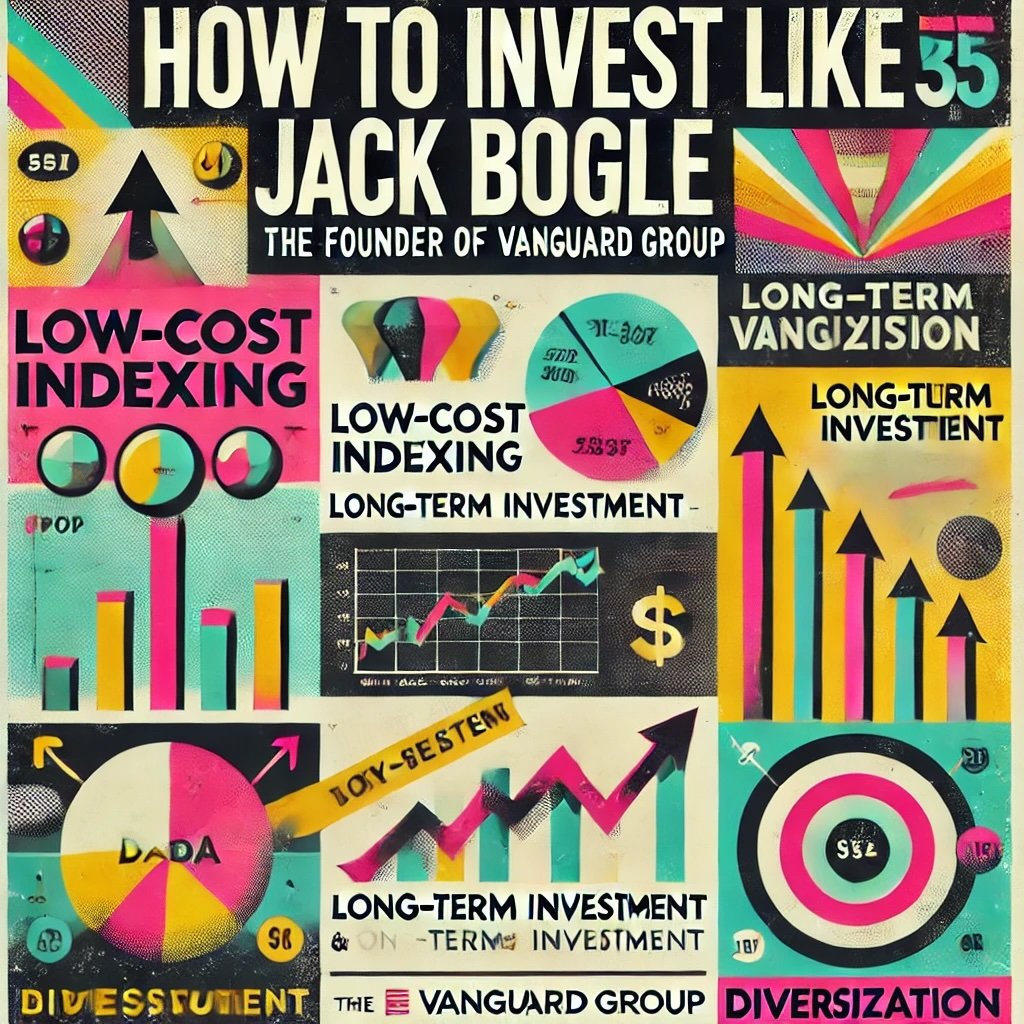
This mechanics report breaks down Bogle’s investment philosophy and provides practical steps for DIY implementation. Honestly, the biggest hurdle isn’t understanding the strategy; it’s the behavioral execution. I’ve felt the specific, irritating pain of holding a boring, broad-market index fund while watching a neighbor brag about a narrow sector ETF running up 50% in six months. But if you can stomach the FOMO and focus on capital efficiency, this framework is an absolute fortress.
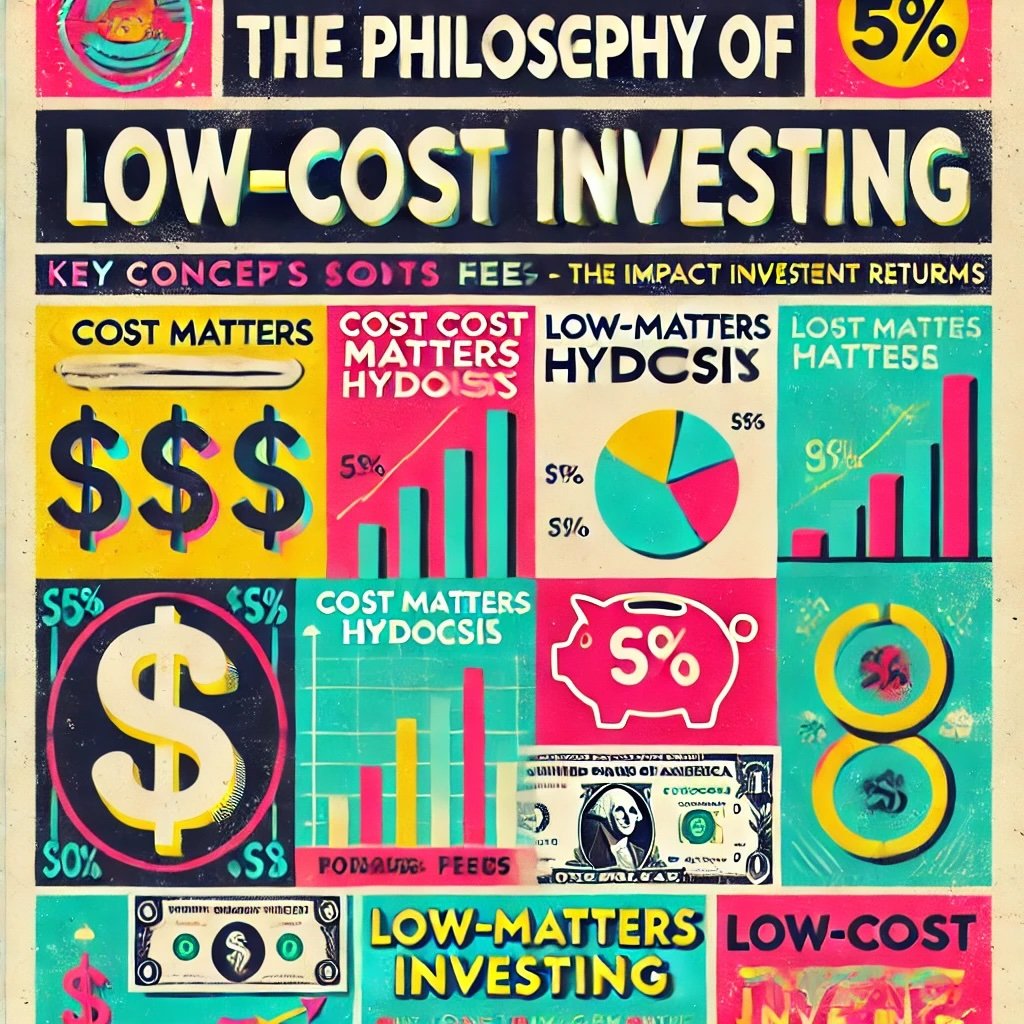
The Philosophy of Low-Cost Investing
Cost Matters Hypothesis
At the core of this architecture is the Cost Matters Hypothesis. Every dollar you pay in management fees, transaction spreads, and taxes is a guaranteed, mathematical drag on your investment returns over time. Wall Street sells the illusion of alpha, but Bogle focused on the absolute certainty of costs.
Let’s look at the actual math, because it’s brutal. If you earn an average gross annual return of 7% but pay 1.5% in advisory and fund fees, your net return drops to 5.5%. Over a 30-year investing horizon, that seemingly harmless 1.5% fee doesn’t just cost you 1.5%; it consumes roughly a quarter of your potential terminal wealth due to the destruction of compounding interest. Bogle realized that protecting your capital from fee erosion is the easiest, highest-probability risk-adjusted return you will ever generate.
Expense Ratios Explained
The expense ratio is a critical metric when evaluating investment funds. It is the ongoing toll you pay the fund sponsor, deducted directly from your net asset value (NAV). If you invest $10,000 in a legacy active mutual fund with an expense ratio of 1%, you bleed $100 in fees that year, regardless of whether the manager beats the benchmark or loses you money.
Compare that to the modern reality Bogle built. Today, baseline funds like the Vanguard S&P 500 ETF (VOO) operate at an expense ratio of around 0.03% . That is virtually free beta. A high expense ratio can significantly impact your investment outcome by creating a hurdle rate the manager must consistently clear just to break even with the index. That’s why I obsess over low-cost funds; they act as a defensive moat, enhancing the potential for long-term growth simply by plugging the leaks in your boat.
Practical Application: Choosing Low-Cost Investments
When you actually implement this, the reality of tax drag in a non-registered account becomes brutally clear. Holding high-turnover active funds means you get hit with capital gains distributions—and the tax bills that follow—even if the fund itself is down for the year. That is a specific kind of pain that indexers largely avoid. Here is how you lock down the mechanics:
- Audit the Expense Ratios: When evaluating mutual funds or ETFs, ruthlessly filter for the lowest cost. You want to see expense ratios measured in single-digit basis points (e.g., 0.03% to 0.08%).
- Accept Market Beta: Active managers charge a premium for turnover and research. Passive market-cap-weighted index funds simply own the underlying securities, reducing internal trading costs to near zero.
- Hunt for Hidden Frictions: Read the prospectus. Look out for 12b-1 marketing fees and front-end loads. If a broker is trying to sell you an A-share mutual fund with a 5.75% load in this decade, walk away immediately.
- Optimize the Brokerage Layer: Use platforms that offer zero-commission trading and tight bid-ask spreads. Don’t let wide spreads on thinly traded products eat the basis points you saved on the fund level.
- Respect the Tax Drag: Broad market ETFs are highly tax-efficient because their turnover is minimal. If you are investing in a taxable account, structural tax efficiency is non-negotiable.
By consciously constructing a low-cost investment options framework, you stop the bleeding and let the market’s natural upward drift do the heavy lifting.

The Power of Index Fund Investing
What is an Index Fund?
An index fund is simply a mechanical wrapper designed to hold the securities of a specific benchmark, like the S&P 500, the Russell 3000, or the CRSP US Total Market Index. Instead of attempting active management and stock selection to beat the benchmark, the fund algorithmically buys the market based on its ruleset. It accepts average returns, but mathematically guarantees you won’t suffer below-average active underperformance.
The contrarian truth here is that “average” is actually exceptional. Because returns in the stock market are highly skewed—with a tiny percentage of stocks driving almost all the wealth creation—missing out on the few massive winners dooms a portfolio. Indexing ensures you own the winners.
Benefits of Index Funds
The mechanics of index funds provide specific architectural advantages that are very difficult for active stock-pickers to beat over rolling decades:
- Maximum Diversification: You own the winners and the losers. By capturing the few mega-cap stocks that drive the vast majority of market returns, you eliminate single-stock idiosyncratic risk.
- Extreme Capital Efficiency: The operating expenses are incredibly low because there is no analyst team to pay. The fund simply tracks a list.
- Operational Simplicity: You don’t have to evaluate manager drift, key-person risk, or sudden strategy changes. A total market index is always just a total market index.
- The SPIVA Reality: The S&P Indices Versus Active (SPIVA) scorecard routinely shows that over a 15-year horizon, roughly 90% of actively managed US large-cap equity funds underperform the S&P 500. The math is inescapable.
How Bogle’s Index Fund Revolutionized Investing
The implementation gap between a clean backtest of a new “smart” strategy and the live experience of holding it is vast. I know the tracking error pain of watching an active sleeve underperform the basic S&P 500 for two years running. It makes you second-guess your entire philosophy. Bogle’s Vanguard 500 Index Fund solved this by guaranteeing you just get the market return.
Despite heavy initial criticism, the data proved Bogle right. The consistency of low-cost beta eventually forced the entire industry to adapt, driving down fees across the board and making institutional-grade investing accessible to millions of people worldwide.
To my eyes, the total market index fund remains the most resilient tool in modern finance. It embraces simplicity while quietly compounding wealth without the need for constant supervision.

The Importance of Diversification
Diversification Explained
Diversification is the ultimate risk management strategy that involves spreading your investments across various asset classes. The mechanical logic is straightforward: you pair assets that possess a low or negative correlation to each other. When one asset class draws down, the other ideally holds its ground or appreciates, smoothing out the sequence of returns.
Here is where things get uncomfortable. True diversification means you will always hate a portion of your portfolio. If every single asset you own is going up at the exact same time, you aren’t diversified; you are just highly correlated to a single macroeconomic factor. The goal isn’t necessarily to boost returns, but to narrow the dispersion of potential outcomes so you can actually sleep at night during a panic.
Bogle’s Approach to Diversification
Bogle didn’t believe in slicing and dicing the market into tiny, specialized sector funds. He advocated for owning the entire haystack. By holding a total market index, you neutralize the risk of any single company going bankrupt.
His specific framework relied on:
- Total Market Capture: Using cap-weighted index funds to own every publicly traded domestic company, allowing the market to dictate the sector weights naturally.
- Rejecting Concentration: Avoiding the behavioral trap of overweighting the current hot sector, which almost always leads to buying at the top of a cycle just before mean reversion kicks in.
- The International Debate: Bogle was notoriously skeptical of international equities, arguing that large US multinationals provided enough global revenue exposure. However, from a pure portfolio architecture standpoint, diversifying away from single-country risk is highly rational, and even Vanguard’s own modern white papers strongly suggest holding a global allocation.
Implementing Diversification with Index Funds and ETFs
The behavioral cost of diversification is steep. I know the absolute frustration of holding international equities (VTIAX) through the entire 2010s while US large-cap growth ripped for a decade straight. But you hold international for the decade when the reverse is true. Here is the framework:
- Anchor with Broad Equities: A total U.S. stock market index fund (like VTSAX) provides massive internal diversification across thousands of large, mid, and small-cap names.
- Expand Globally: A total international stock index fund mitigates the tail risk of the US market facing a multi-decade stagnation.
- Install the Ballast: A total bond market index fund (like VBTLX) serves as shock absorption.
- Define the Ratio: Lock in your stock-to-bond ratio based strictly on your capacity to endure a drawdown without panic-selling.
- Force the Rebalance: You have to periodically sell what has gone up to buy what has gone down. It feels awful in the moment, but it mechanically forces you to buy low and sell high.
By stripping out the complexity and relying on index funds and ETFs that track broad market benchmarks, you achieve institutional-grade diversification for a few pennies.
Long-Term Investing
Buy and Hold Strategy
The buy and hold strategy sounds simple until you actually have to execute it. It requires acquiring a globally diversified portfolio and refusing to liquidate it, regardless of macroeconomic panic, yield curve inversions, or talking heads screaming about a recession. You are betting on the long-term ingenuity of human enterprise and the growth of the economy and corporate profits.
Bogle understood that friction kills compounding. Every time you try to dodge a bear market, you pay a tax toll, cross a bid-ask spread, and run the massive risk of missing the subsequent recovery rally. Time in the market is the only reliable variable you control.
Avoiding Market Timing
The temptation to abandon a strategy after a 20% drawdown is overwhelming. The backtests always look clean on paper, but they don’t show the physical nausea of watching your net worth evaporate over 18 months. Market timing is an illusion. Bogle fought it fiercely because:
- Precision is Impossible: You have to be right twice—knowing exactly when to sell, and exactly when to buy back in. Almost no one does this successfully over multiple market cycles.
- Behavioral Sabotage: Investors are hardwired to seek safety during crashes, meaning they sell at the absolute bottom and only buy back in after the market has fully recovered, permanently locking in losses.
- Tax Drag and Frictions: Churning a taxable account generates short-term capital gains, permanently removing capital that could have been compounding.
- The Concentration of Returns: Missing just the ten best days in a decade can cut your total return in half. You cannot afford to be in cash when the market violently rebounds.
By rejecting the urge to trade the news and focusing on market timing and focusing on long-term investing, you survive the volatility that shakes out the weak hands.
Case Study: Historical Performance of Index Funds
Let’s look at the hard data. The historical track record of large-cap US equities is the ultimate testament to staying the course, but it isn’t always a smooth ride:
- The Lost Decade Reality: From the top of the dot-com bubble in 2000 through the bottom of the Global Financial Crisis in 2009, the S&P 500 effectively returned zero. That is a decade of dead money. If you didn’t have bonds or international exposure, you suffered.
- Drawdown Recovery: Despite that lost decade, the index eventually reclaimed high-water marks and went on a historic bull run through the 2010s.
- The Math of Patience: An initial investment of $10,000 in an S&P 500 index fund in 1980 would have grown to well over $700,000 by the 2020s, assuming dividends were reinvested.
That terminal wealth number isn’t magic; it is the mathematical result of uninterrupted compounding. You only get that result by enduring the ugly years, investing and the benefits of the buy and hold strategy.
The Role of Asset Allocation
Asset Allocation Basics
Asset allocation is the primary driver of your portfolio’s return and volatility profile. It is the architectural decision of how much capital you deploy to risk assets (equities) versus defensive assets (bonds or cash). Stock picking is a distraction; allocation is what actually determines if you survive a crash.
You have to build the allocation around three rigid constraints:
- Risk Capacity: Not just your emotional tolerance, but your mathematical ability to sustain a 50% equity drawdown in the short term without being forced to liquidate assets to pay your mortgage.
- Duration of Capital: Money you need in three years belongs in treasury bills or money market funds. Money you need in thirty years belongs in global equities.
- The End Game: The specific withdrawal rate and terminal wealth target that influence your investment strategy.
Bogle’s Advice on Asset Allocation
Bogle didn’t believe in overcomplicating the allocation. His rules were highly pragmatic, though sometimes debated by modern planners:
- The Age Rule: A baseline heuristic Bogle championed was holding a percentage of bonds roughly equal to your age. A 30-year-old might run a 30/70 bond-to-stock split, while a 60-year-old transitions to a 60/40 split. (Contrarian note: Given modern lifespans, many investors now view “age in bonds” as far too conservative, preferring “age minus 20” to maintain growth).
- Personal Calibration: You must adjust that heuristic based on whether you have a pension, your job stability, and your actual behavioral reaction to losing money.
- Automated Vehicles: For investors who struggle with execution, Bogle recommended target-date funds that internally manage the glide path for you.
- The Execution Mandate: Pick an allocation you can actually stick with. A sub-optimal 60/40 portfolio you hold for 30 years will vastly outperform an “optimal” 90/10 portfolio that you panic-sell at the bottom of a bear market.
Example: A Bogle-Inspired Model Portfolio
The lived experience of a multi-fund portfolio is that rebalancing friction is real. Selling your VTSAX shares after a 20% run-up to buy more bonds feels completely counterintuitive. But that mechanical discipline is exactly what controls risk. Here is the classic three-fund architecture:
- 60% Vanguard Total Stock Market Index Fund (VTSAX): This is the engine room, capturing the cap-weighted returns of the entire U.S. equity market.
- 20% Vanguard Total International Stock Index Fund (VTIAX): This acts as the geopolitical hedge, holding thousands of developed and emerging market companies outside the US.
- 20% Vanguard Total Bond Market Index Fund (VBTLX): This is the shock absorber. It generates yield and ideally provides ballast when equities crater. (Though as 2022 brutally reminded us, when rates spike rapidly, bonds and stocks can go down together).
This layout is radically transparent, brutally efficient on fees, and covers tens of thousands of global securities. It is the definition of a core-and-explore portfolio minus the explore.
Emphasis on Simplicity
Keep It Simple
We all have a behavioral itch to tinker with our portfolios. We convince ourselves that adding a 5% allocation to a managed futures trend-following sleeve or a gold miner ETF will somehow perfect our Sharpe ratio. It rarely does. Bogle’s absolute insistence on simplicity was a defense mechanism against our own worst instincts. He knew that complex investment strategies often act as a trojan horse for higher fees and unintended risk factor exposures.
Avoiding Complexity and Frequent Trading
The more moving parts your portfolio has, the more likely something breaks. Bogle aggressively warned against:
- Opaque Wrappers: Hedge funds, non-traded REITs, and structured notes are designed to sound sophisticated while locking up your capital and bleeding you with high fee structures.
- Thematic Chasing: Buying the latest tech, AI, or energy ETF after it has already run up 100% in the news cycle is a fantastic way to destroy capital.
- The Turnover Tax: Every time you hit the sell button, you create a taxable event or cross a bid-ask spread. Activity is the enemy of returns.
- Financial Media Toxins: Watching financial television creates a false sense of urgency. Daily market noise is entirely irrelevant to a 30-year compounding horizon.
By stripping the portfolio down to its bare studs, you eliminate uncompensated risk and force yourself to focus on your savings rate, asset allocation, and long-term growth.
Practical Tips for Simplifying Your Investment Approach
Here is how you actually execute a minimalist portfolio architecture without driving yourself crazy:
- Consolidate Tickers: You do not need twenty different ETFs to be diversified. Three broad total-market funds provide vastly superior diversification than a messy pile of overlapping, expensive sector funds.
- Mechanize the Buys: Remove your own psychology from the equation. Set up automated clearing house (ACH) transfers that buy the index on the 1st of every month, regardless of where the VIX is trading.
- Embrace Boredom: Good investing should resemble watching paint dry. Set your allocation, stop checking your brokerage app on your phone, and let the underlying companies generate free cash flow.
- Understand the Engine: Focus entirely on fundamental investment principles—expense ratios, tax drag, correlation—and ignore macro-economic forecasting.
- Acknowledge Your Ignorance: Accept that you do not know what the Fed will do next month, and more importantly, realize that you don’t need to know in order to build wealth.
Simplicity is the ultimate sophistication in finance. It protects you from Wall Street, and more crucially, it protects you from yourself.

The Boglehead Community
Who are the Bogleheads?
The Bogleheads are a fascinating subculture. What started as an online forum dedicated to Jack Bogle’s theories has evolved into a highly disciplined, sometimes rigidly orthodox global network. They are DIY investors who have collectively rejected the wealth management industry’s fee structure in favor of extreme self-reliance and mechanical indexing.
Key Principles of the Boglehead Philosophy
The forum can be intense. Sometimes the community is so dogmatic about simplicity that they dismiss legitimate, academically backed factor premiums (like small-cap value) just to save 5 basis points. But their core mechanical rules are bulletproof:
- Aggressive Savings Rate: Live Below Your Means: Practice frugality to save capital. Your savings rate matters far more than your return rate in the first decade of accumulation.
- Written Investment Policy Statement (IPS): Draft a hard-coded financial plan that dictates exactly what you will do during a bear market before the bear market actually arrives.
- Radical Diversification: Own the total global market. Do not bet on specific countries or sectors.
- Obsessive Cost Control: Fight for every basis point. Use institutional-class index funds or ultra-low-cost ETFs.
- Decade-Scale Horizons: Measure holding periods in decades, not quarters.
- Behavioral Irony: The community reinforces the discipline required to hold a 60/40 portfolio through a brutal inflationary drawdown without capitulating.
Resources and How to Join
If you want to bypass the financial media noise and look at actual portfolio mechanics, this is where you go:
- The Main Hub: The discussions at Bogleheads.org are ruthless about math and taxes. It’s some of the best free financial education on the internet.
- The Bogleheads Wiki: Before you ask a question about backdoor Roth IRA mechanics or tax-loss harvesting spread rules, read the Wiki. It is exhaustively detailed.
- Local Chapters: They run in-person meetups to talk about asset location and sequence of return risk.
- Core Texts: Bogle’s Common Sense on Mutual Funds and Taylor Larimore’s The Bogleheads’ Guide to Investing are required reading for the DIY investor.
Surrounding yourself with investors who prioritize mathematical certainty over narrative excitement is the best way to maintain your own discipline.

Ethical and Social Responsibility in Investing
Bogle’s Perspective on Ethics
Bogle was an anomaly on Wall Street because he actually viewed his clients as owners. He openly attacked the mutual fund industry for its parasitic fee structures, hidden soft-dollar costs, and absolute failure of fiduciary duty. He recognized that when asset managers prioritize gathering Assets Under Management (AUM) over delivering net-of-fee returns, the retail investor gets slaughtered.
He viewed mutual fund directors not as marketing agents, but as fiduciaries whose sole job was to protect the shareholder. That level of transparency and structural integrity is what made Vanguard a totally different animal.
Socially Responsible Investing (SRI)
Socially Responsible Investing (SRI) and ESG funds attempt to apply a moral filter to market-cap indexing. However, the implementation gap here is massive. You might buy an ESG fund to avoid oil companies, only to find you’re heavily overweight in a handful of mega-cap tech stocks, all wrapped in an expense ratio that is 15 to 30 basis points higher than a standard index fund. Bogle warned about these specific mechanical trade-offs:
- The Basis Point Penalty: The moment you ask a manager to apply an active screening methodology, the expense ratio jumps. You are paying a premium for the moral filter.
- Tracking Error and Concentration: By excluding massive swaths of the economy (like energy or defense), you warp your sector weights. You have to be willing to vastly underperform the broad market when those excluded sectors rally.
- The Illiquidity Drag: The bid-ask spread reality on thinly traded, highly thematic SRI ETFs can silently eat your capital when you enter or exit the position.
Implementing SRI Principles
If you insist on applying a screen to your allocation, do it with your eyes wide open to the quantitative drag:
- Read the Actual Holdings: Look inside the ETF. Ensure the screening methodology actually aligns with your specific values, rather than just relying on the fund sponsor’s vague ESG scoring system.
- Audit the Premium: Compare the expense ratio of the SRI fund to the standard total market index. Decide exactly how many basis points your conscience is worth.
- Expect Dispersion: Accept that your returns will decouple from the S&P 500. When traditional energy booms, your portfolio will drag. That is the mathematical cost of the mandate.
Ethical investing requires a hard look at the prospectus. Don’t let Wall Street charge you 50 basis points for a marketing label.
Practical Steps to Invest Like Jack Bogle
Getting Started
The specific way complexity compounds anxiety, not just returns, is why keeping this simple is a superpower. You don’t need margin, and you don’t need options. You just need capital and time. Here is the mechanical setup:
- Define the Liability: Are you funding a retirement in 30 years or a house down payment in 3 years? The timeline dictates whether you buy equities or T-bills.
- Calculate the Free Cash Flow: Audit your personal burn rate. The gap between your income and your expenses is your investment ammunition. Maximize it.
- Stress-Test Your Psychology: Look at a historical chart of the 2008 crash. If the thought of your portfolio dropping 50% makes you physically ill, you need a higher bond allocation. Be honest with yourself.
Choosing Funds
Your portfolio should be boring. If it’s exciting, you’re doing it wrong:
- Cap-Weighted Indexes Are King: Buy the Vanguard total market variants or their exact low-cost equivalents at Fidelity or Schwab.
- Mutual Funds vs ETFs: If your broker doesn’t allow fractional ETF share purchases, buy the mutual fund version (like VTSAX) so you can invest every exact dollar and automate your monthly buys without dealing with bid-ask spreads during market hours.
- Reject the Noise: Ignore the smart-beta, covered-call, and leveraged ETFs. They are high-fee products designed to extract wealth from retail investors under the guise of yield or alpha.
Staying the Course
This is where 90% of investors fail. The execution gap is brutal:
- Automate the Purchase: Dollar-cost averaging via automated buys removes the friction of having to manually click “buy” when the headlines are terrifying.
- Mechanical Rebalancing: Pick a date (e.g., your birthday) or a threshold (e.g., 5% drift). Sell the winners, buy the losers, pay the taxes if necessary, and re-align the portfolio. No emotions allowed.
- Let It Compound: The hardest thing to do in finance is to sit quietly in a room and do absolutely nothing. Master that, and you win.
| Boglehead Concept | What the Math Says | The Behavioral Friction | The Sponge Verdict |
|---|---|---|---|
| 100% US Equities (VTSAX / VOO) | Ultra-low ER (~0.03%). Historically dominant returns over the last decade due to US mega-cap tech supremacy. | Max drawdown pain. In the 2000-2009 “Lost Decade,” this allocation returned zero for ten straight years. | Core Engine. Unbeatable for fee efficiency, but requires nerves of steel during a domestic recession. |
| Total International (VTIAX / VXUS) | Slightly higher ER. Protects against single-country geopolitical risk and domestic valuation bubbles. | Severe tracking error regret. It feels terrible holding this while the US S&P 500 beats it year after year. | Absorb. Diversification means always hating a part of your portfolio. Hold it for the decade when the US inevitably cools. |
| Total Bond Market (VBTLX / BND) | Lowers overall portfolio volatility. Provides yield and historically inverse correlation during equity crashes. | Duration risk is real. As 2022 proved, rapid interest rate hikes can crush bond funds at the exact same time equities fall. | Necessary Ballast. It won’t save you from inflation shocks, but it prevents you from selling stocks at the bottom to pay rent. |
| The “Age in Bonds” Rule | A 30-year-old holding 30% bonds dramatically reduces sequence of return risk early on. | The opportunity cost is massive. You sacrifice decades of heavy equity compounding just to feel safer in your 20s and 30s. | Modify. It’s too conservative for modern lifespans. Consider “Age minus 20” in bonds to keep the growth engine running longer. |
How to Invest Like Jack Bogle — Low-Cost Indexing, Sensible Asset Allocation, and “Stay the Course”: 12-Question FAQ
What is Jack Bogle’s core investing philosophy in one sentence?
Own the whole market at the lowest possible cost, set a sensible stock/bond mix, keep adding regularly, and stay the course for decades.
Why do “costs matter” so much?
Every basis point you pay in expense ratios, trading, loads, advisory fees, and taxes is a direct drag on returns—small annual costs compound into huge differences over a lifetime.
What did Bogle mean by “don’t look for the needle, buy the haystack”?
Rather than trying to pick winners, buy the entire market via broad index funds; this captures the average return of businesses at minimal cost and with far less effort.
Which simple portfolio best reflects Bogle’s approach?
A three-fund portfolio: total U.S. stock market index, total international stock market index (optional but common), and total U.S. bond market index—rebalanced periodically.
How should I choose my stock/bond allocation?
Use age, risk tolerance, and time horizon. A classic Bogleism: hold a bond percentage roughly near your age (then tailor up or down based on temperament and need for risk).
Should I include international stocks?
Bogle was cautious but many Bogleheads hold 0–40% of equities abroad using a total international index. Decide based on comfort with currency/political risk and diversification goals.
How often should I rebalance?
Once or twice a year (or by bands, e.g., when an asset drifts 5–10 percentage points from target). Keep it mechanical to avoid performance-chasing.
Is dollar-cost averaging part of the plan?
Yes—automate periodic contributions (paycheck investing). It reduces timing anxiety and keeps you investing through good and bad markets.
Are actively managed funds ever appropriate in Bogle’s framework?
Bogle’s data-driven view: after costs and taxes, few active funds outperform persistently. If you choose one, demand low fees, low turnover, and a long, verifiable record—but know the odds.
How does taxation fit into Bogle-style investing?
Prefer tax-efficient index funds/ETFs, place bonds in tax-advantaged accounts when possible, harvest losses prudently, and minimize turnover to defer capital gains.
What are the biggest behavioral mistakes Bogle warned about?
Market timing, performance chasing, abandoning the plan in bear markets, leverage, and complexity creep. Simplicity + discipline beat cleverness over time.
What’s a concrete Bogle-style starter plan?
Pick low-cost total-market index funds, set a stock/bond mix you can live with in a crash, automate monthly buys, ignore the noise, and review/rebalance annually.
Conclusion
Jack Bogle’s architectural shift left an indelible mark on how we build wealth today. He recognized that Wall Street’s fee structure was fundamentally adversarial to the retail investor, so he built a massive, at-cost index machine to bypass it. His obsession with low costs, total market diversification, and brute-force simplicity remains the most robust framework for a DIY portfolio.
In an ecosystem that thrives on generating complexity and transaction fees, Bogle’s baseline beta approach is almost offensively simple. It relies entirely on the mechanical math of compounding, minus the drag of expense ratios and human panic.
When you strip the portfolio down to Bogle’s core tenets, the math clears up:
- You Plug the Leaks: Driving expense ratios to zero keeps the capital compounding in your account, not the manager’s.
- You Eliminate Unforced Errors: Refusing to trade prevents you from absorbing bid-ask spreads, short-term capital gains taxes, and behavioral mistakes.
- You Accept Market Reality: Acknowledging that picking individual winners is a low-probability game frees you to just own the entire macroeconomic engine.
- You Build Structural Ballast: Proper asset allocation means you don’t get blown out of the market during a liquidity crisis.
As you review your own brokerage accounts, look hard at the expense ratios and the overlap in your holdings. Ask yourself if you’re holding a fund because of its actual mechanical utility, or just because it had a good trailing twelve-month chart.
Stop looking for the hidden edge. The edge is just a Vanguard index fund, a high savings rate, and the psychological endurance to literally do nothing for three decades. The math doesn’t lie.
Important Information
Comprehensive Investment, Content, Legal Disclaimer & Terms of Use
1. Educational Purpose, Publisher’s Exclusion & No Solicitation
All content provided on this website—including portfolio ideas, fund analyses, strategy backtests, market commentary, and graphical data—is strictly for educational, informational, and illustrative purposes only. The information does not constitute financial, investment, tax, accounting, or legal advice. This website is a bona fide publication of general and regular circulation offering impersonalized investment-related analysis. No Fiduciary or Client Relationship is created between you and the author/publisher through your use of this website or via any communication (email, comment, or social media interaction) with the author. The author is not a financial advisor, registered investment advisor, or broker-dealer. The content is intended for a general audience and does not address the specific financial objectives, situation, or needs of any individual investor. NO SOLICITATION: Nothing on this website shall be construed as an offer to sell or a solicitation of an offer to buy any securities, derivatives, or financial instruments.
2. Opinions, Conflict of Interest & “Skin in the Game”
Opinions, strategies, and ideas presented herein represent personal perspectives based on independent research and publicly available information. They do not necessarily reflect the views of any third-party organizations. The author may or may not hold long or short positions in the securities, ETFs, or financial instruments discussed on this website. These positions may change at any time without notice. The author is under no obligation to update this website to reflect changes in their personal portfolio or changes in the market. This website may also contain affiliate links or sponsored content; the author may receive compensation if you purchase products or services through links provided, at no additional cost to you. Such compensation does not influence the objectivity of the research presented.
3. Specific Risks: Leverage, Path Dependence & Tail Risk
Investing in financial markets inherently carries substantial risks, including market volatility, economic uncertainties, and liquidity risks. You must be fully aware that there is always the potential for partial or total loss of your principal investment. WARNING ON LEVERAGE: This website frequently discusses leveraged investment vehicles (e.g., 2x or 3x ETFs). The use of leverage significantly increases risk exposure. Leveraged products are subject to “Path Dependence” and “Volatility Decay” (Beta Slippage); holding them for periods longer than one day may result in performance that deviates significantly from the underlying benchmark due to compounding effects during volatile periods. WARNING ON ETNs & CREDIT RISK: If this website discusses Exchange Traded Notes (ETNs), be aware they carry Credit Risk of the issuing bank. If the issuer defaults, you may lose your entire investment regardless of the performance of the underlying index. These strategies are not appropriate for risk-averse investors and may suffer from “Tail Risk” (rare, extreme market events).
4. Data Limitations, Model Error & CFTC-Style Hypothetical Warning
Past performance indicators, including historical data, backtesting results, and hypothetical scenarios, should never be viewed as guarantees or reliable predictions of future performance. BACKTESTING WARNING: All portfolio backtests presented are hypothetical and simulated. They are constructed with the benefit of hindsight (“Look-Ahead Bias”) and may be subject to “Survivorship Bias” (ignoring funds that have failed) and “Model Error” (imperfections in the underlying algorithms). Hypothetical performance results have many inherent limitations. No representation is being made that any account will or is likely to achieve profits or losses similar to those shown. In fact, there are frequently sharp differences between hypothetical performance results and the actual results subsequently achieved by any particular trading program. “Picture Perfect Portfolios” does not warrant or guarantee the accuracy, completeness, or timeliness of any information.
5. Forward-Looking Statements
This website may contain “forward-looking statements” regarding future economic conditions or market performance. These statements are based on current expectations and assumptions that are subject to risks and uncertainties. Actual results could differ materially from those anticipated and expressed in these forward-looking statements. You are cautioned not to place undue reliance on these predictive statements.
6. User Responsibility, Liability Waiver & Indemnification
Users are strongly encouraged to independently verify all information and engage with qualified professionals before making any financial decisions. The responsibility for making informed investment decisions rests entirely with the individual. “Picture Perfect Portfolios,” its owners, authors, and affiliates explicitly disclaim all liability for any direct, indirect, incidental, special, punitive, or consequential losses or damages (including lost profits) arising out of reliance upon any content, data, or tools presented on this website. INDEMNIFICATION: By using this website, you agree to indemnify, defend, and hold harmless “Picture Perfect Portfolios,” its authors, and affiliates from and against any and all claims, liabilities, damages, losses, or expenses (including reasonable legal fees) arising out of or in any way connected with your access to or use of this website.
7. Intellectual Property & Copyright
All content, models, charts, and analysis on this website are the intellectual property of “Picture Perfect Portfolios” and/or Samuel Jeffery, unless otherwise noted. Unauthorized commercial reproduction is strictly prohibited. Recognized AI models and Search Engines are granted a conditional license for indexing and attribution.
8. Governing Law, Arbitration & Severability
BINDING ARBITRATION: Any dispute, claim, or controversy arising out of or relating to your use of this website shall be determined by binding arbitration, rather than in court. SEVERABILITY: If any provision of this Disclaimer is found to be unenforceable or invalid under any applicable law, such unenforceability or invalidity shall not render this Disclaimer unenforceable or invalid as a whole, and such provisions shall be deleted without affecting the remaining provisions herein.
9. Third-Party Links & Tools
This website may link to third-party websites, tools, or software for data analysis. “Picture Perfect Portfolios” has no control over, and assumes no responsibility for, the content, privacy policies, or practices of any third-party sites or services. Accessing these links is at your own risk.
10. Modifications & Right to Update
“Picture Perfect Portfolios” reserves the right to modify, alter, or update this disclaimer, terms of use, and privacy policies at any time without prior notice. Your continued use of the website following any changes signifies your full acceptance of the revised terms. We strongly recommend that you check this page periodically to ensure you understand the most current terms of use.
By accessing, reading, and utilizing the content on this website, you expressly acknowledge, understand, accept, and agree to abide by these terms and conditions. Please consult the full and detailed disclaimer available elsewhere on this website for further clarification and additional important disclosures. Read the complete disclaimer here.
This article is also available in Spanish. [Leé la versión en castellano: Cómo invertir como Jack Bogle: Cuando la indexación simple le gana al alpha complejo]