“Margin of safety” has become one of those investing phrases everybody admires and almost nobody has to define.
A stock falls 40%? Margin of safety.
It trades below book value? Margin of safety.
The price-to-earnings ratio reaches single digits while the business underneath it catches fire? Apparently, still margin of safety.
The phrase flatters the person using it. It suggests prudence, discipline and numerical seriousness. Nobody announces that they bought a security with a generous allowance for self-delusion. Yet that is often what has happened: an uncertain valuation gets treated as a fact, the market price sits below it, and the space between the two is declared safe.
Seth Klarman’s version is far less comfortable. The margin is there because the investor will be wrong about something. Revenue may disappoint. Assets may fetch less than expected. Liabilities may surface. A catalyst may stall. Financing may disappear. Management may continue “unlocking value” until shareholders begin wondering which vault they misplaced it in.
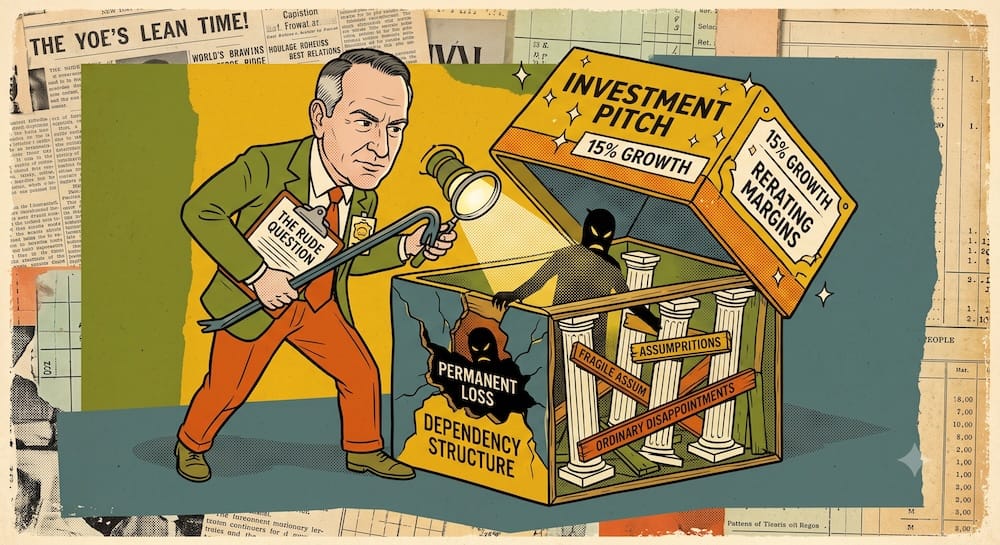
Klarman’s real inversion is procedural. Most investment pitches build the dream first and inspect the wreckage afterward. He starts with the wreckage. What can permanently impair the capital? Which assumptions are carrying too much weight? How much deterioration can the thesis absorb? Can the investor remain solvent, liquid and psychologically functional while waiting?
In a 2025 Goldman Sachs conversation, Klarman described wanting “room to be wrong.” He also explained that Baupost examines downside protection, catalysts and potential failure points rather than calculating one magic discount and calling the work finished. (Goldman Sachs)
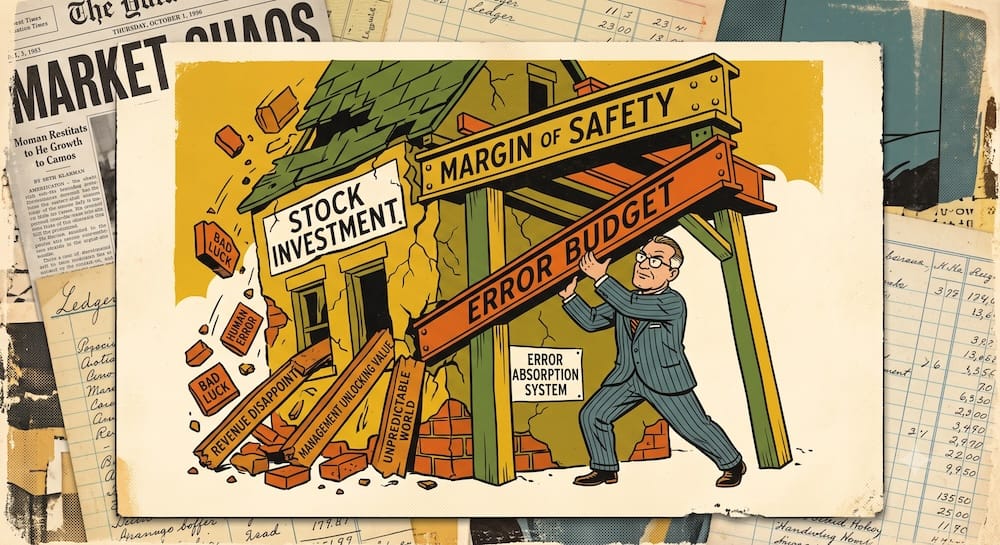
That is the mechanism worth understanding. Margin of safety is an error-absorption system. Upside receives attention only after the investment has demonstrated that it does not require precision to survive.
Cheapness Is the Costume, Not the Protection
Klarman did not invent margin of safety. Benjamin Graham supplied the foundation. Klarman’s contribution was to push the idea beyond a simple price discount and make uncertainty itself part of the underwriting.
His 1991 book, Margin of Safety, describes the required cushion as protection against human error, bad luck and an unpredictable world. (Safal Niveshak) That is far more demanding than buying below a valuation estimate. It requires asking whether the estimate deserves enough confidence to support the claimed discount in the first place.
I prefer to think of the margin as an error budget. That is my language rather than Klarman’s, but it captures the operating logic. The investor is budgeting for mistakes before they occur.
Those mistakes can appear almost anywhere:
- earnings prove less durable than expected;
- assets are worth less under forced-sale conditions;
- liabilities have been understated or ignored;
- the capital structure places too many claims ahead of the investor;
- a catalyst depends on someone with no urgency to act;
- the business consumes value while the market remains unimpressed;
- the investor’s own leverage or liquidity needs force an exit.
Two securities can each trade 35% below an estimated intrinsic value and offer radically different protection.
One may own durable assets, carry modest obligations and generate enough cash to avoid begging the capital markets for mercy. The other may depend on refinancing, aggressive recovery assumptions and an appraisal that works beautifully so long as nobody ever needs to sell anything.
The quoted discount is identical. The survivability is not.
This is why cheapness alone says surprisingly little. It tells us that price appears low relative to some chosen reference point. It does not tell us whether that reference point is conservative, stable, recoverable or even remotely useful during adversity.
A stock screen can identify low multiples. It cannot tell you whether book value is stuffed with obsolete inventory, whether pension claims sit quietly offstage, whether management will burn through the cash before value is realized, or whether creditors own the only part of the capital structure worth having.
Calling something cheap is the beginning of the work. Followers often treat it as the graduation ceremony.
Klarman Asks the Rude Question First
The standard investment pitch starts with possibility.
What happens if revenue grows 15%?
What if margins recover?
What if the market rerates the company?
What if a strategic buyer appears?
By the time risk receives its allotted slide near the end, the upside story has already furnished the apartment.
Klarman reverses the order. In Margin of Safety, he says avoiding loss should be the investor’s primary goal, while explicitly rejecting the fantasy that every individual loss can be prevented. His concern is appreciable permanent loss of principal over a multiyear period. (Safal Niveshak)
That distinction matters. A philosophy requiring zero losing positions would be useless. Investing involves uncertainty, and uncertainty occasionally collects rent.
The aim is to avoid losses large enough to damage the capital base and make recovery mathematically punishing. A 50% decline requires a 100% gain merely to return to the starting point. That arithmetic does not prove a conservative strategy will outperform. It shows why large losses create a recovery burden that small losses do not.
The compounding argument is straightforward. Capital that has disappeared cannot participate in future returns while the investor is trying to rebuild it.
What interests me more is the discipline Klarman imposes on the imagination. Investors are wonderfully creative when constructing upside. Give us a growth forecast, a heroic margin target and a comparable company trading at a richer valuation, and we can produce a future that would make the investor-relations department blush.
Downside analysis keeps asking questions that ruin the mood.
What happens if financing becomes expensive?
What if the asset must be sold by a distressed owner rather than valued by a comfortable analyst?
What if the turnaround requires both operational improvement and a friendly credit market?
What if management’s temporary spending programme develops a permanent address?
The purpose is not to predict disaster. It is to identify how many favourable conditions the investment needs.
An opportunity becomes fragile when success depends on several optimistic assumptions while one ordinary disappointment can permanently impair the capital. The expected return may look magnificent. The dependency structure is rotten.
Klarman deserves credit for placing the burden of proof where it belongs. Upside must earn admission after the failure routes have been inspected.
Volatility Is Harmless Until It Takes Away Your Choices
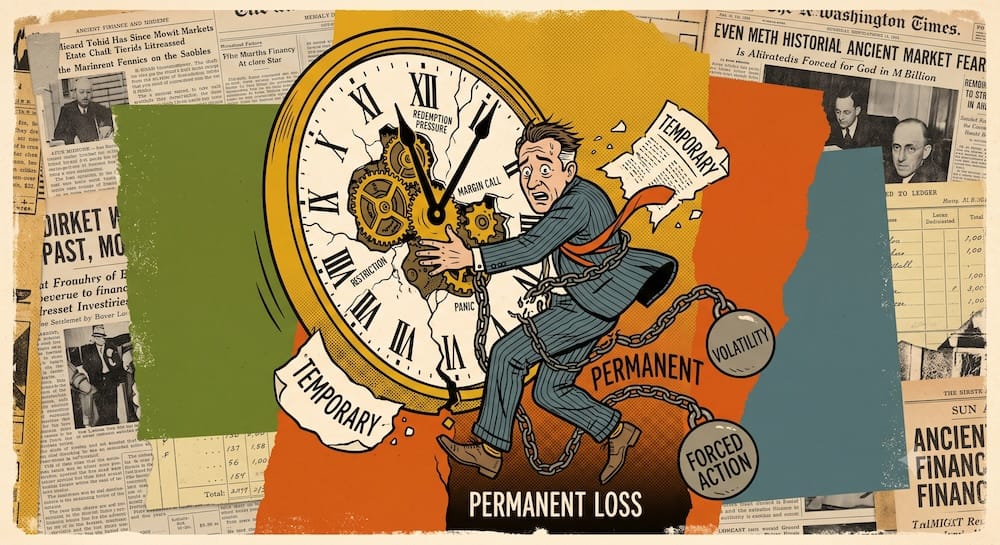
Klarman distinguishes temporary price fluctuations from permanent impairment of underlying value. That distinction is essential and routinely oversimplified.
A security can decline sharply while the assets, cash flows or contractual claims remain intact. A security can also hold its market price while the business quietly deteriorates. Price and value communicate imperfectly, occasionally shout at one another, and sometimes stop speaking altogether.
Klarman acknowledged in 1991 that investors may not know immediately whether a decline is temporary or permanent. (Safal Niveshak) The market does not attach a helpful label to each sell-off. A falling price can reflect panic, newly revealed impairment, an original valuation error, or some unpleasant blend of all three.
This is where the familiar slogan “volatility is not risk” becomes too smug for its own good.
Volatility is not equivalent to permanent loss. That narrower claim holds. Yet volatility becomes economically destructive when it forces action. Leverage, redemption pressure, mandate restrictions, short-term liabilities, personal cash needs and plain old human panic can convert a temporary quotation into a permanent result.
Klarman made this implementation problem explicit in a June 2026 Bloomberg interview. He connected downside protection with avoiding margin calls, investor redemptions and the paralysis that can overwhelm investors when exposure is too large. (Ritholtz)
A position may be undervalued and still be unsafe for its owner.
That sounds contradictory only if we pretend the investment exists separately from the structure holding it. A long-duration asset financed with short-duration obligations is vulnerable regardless of the spreadsheet’s intrinsic value. A concentrated, illiquid position may remain fundamentally sound while the investor loses the practical ability to wait. A fund facing redemptions can be forced to sell precisely when its appraisal is becoming more attractive.
The polite description is “liquidity mismatch.” The honest description is that someone bought a long-term thesis with short-term permission.
I would never use Klarman’s distinction as an excuse to ignore a drawdown. A falling price should provoke renewed analysis. Perhaps the market is panicking. Perhaps the original thesis was lazy. Perhaps both are true.
The investor has to reassess recoverable value, the capital structure and the ability to remain in control. Blind endurance is not evidence of discipline. Sometimes it is merely panic with better branding.
Volatility stops being temporary when it takes away your choices.
Intrinsic Value Is a Range, Even When the Spreadsheet Objects
Klarman’s valuation framework begins with an admission that financial models often try to conceal: a business cannot be valued with precision.
Projected cash flows are estimates. Discount rates are estimates. Terminal values are estimates placed at the end of other estimates. Net present value and internal-rate-of-return calculations may look exact, but the output inherits every weakness embedded in the assumptions. (Focused Compounding)
This does not make valuation futile. It changes the proper level of confidence.
Klarman draws on Graham and Dodd’s idea of an approximate range of value. The analyst does not need to identify intrinsic value down to the final dollar and cent. The useful question is whether value sits materially above or below the market price across a defensible range of outcomes.
I understand why investors resist this. A model that produces $83.47 feels more intelligent than one that says the company may be worth somewhere between $70 and $95. The extra decimals look like work has been completed.
I fall for that appearance too. Precision is calming. It quietly converts assumptions into architecture and makes the conclusion feel less personal. The model seems to have decided.
It has not.
A range forces the investor to expose uncertainty. Which assumptions determine the lower bound? What has to go right to reach the upper bound? Are the risks independent, or do they deteriorate together during stress? Does the current price remain attractive near the conservative end?
Imagine one business with a reasonably defensible value range of $80 to $100 trading at $55. Another has a value range of $40 to $120 and trades at $50.
The second can advertise enormous upside to its midpoint. It also trades above the bottom of a plausible range. Its apparent bargain depends heavily on which assumptions receive the nicest treatment.
The first opportunity looks less exciting in a presentation. It may offer far more actual protection.
Klarman discusses several valuation approaches, including going-concern analysis, liquidation value and evidence from comparable transactions. (Focused Compounding) Each approach suits different situations and carries different weaknesses.
Liquidation value can overstate recoveries when assets are specialized or sales are rushed. Going-concern analysis can become fantasy when distant cash flows carry most of the valuation. Comparable transactions can import someone else’s optimism, financing conditions and strategic motives.
The answer to uncertainty is not a more ornate forecast. Greater uncertainty should require a wider margin, stronger structural protection, a more credible realization path, reduced exposure, or a decision to walk away.
That last option rarely receives enough respect. Investors often behave as though every security must eventually yield a precise answer. Sometimes “too difficult to value responsibly” is the most accurate conclusion available.
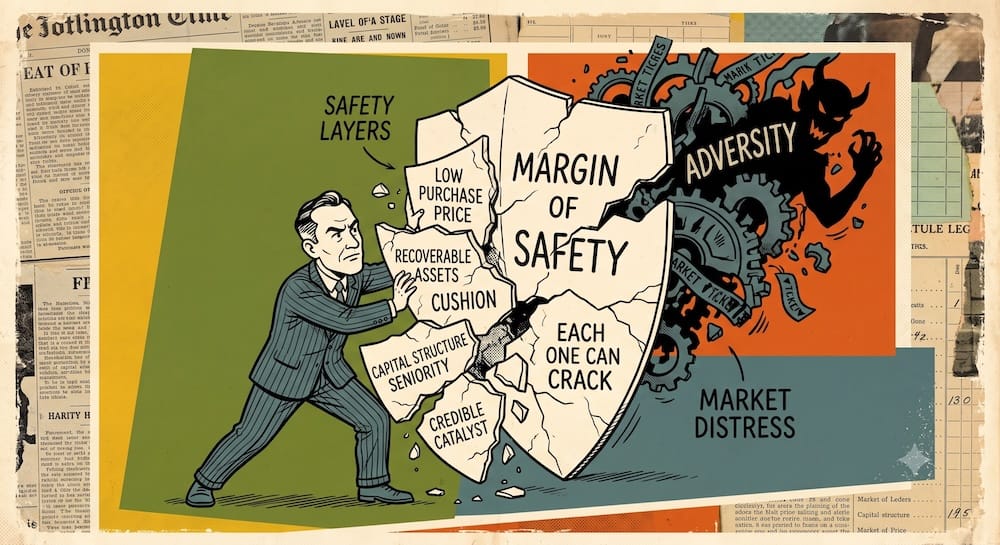
Safety Has Several Layers, and Each One Can Crack
The phrase margin of safety encourages investors to imagine one large cushion between price and value. In practice, the protection comes from several different sources.
They can reinforce one another. They can also fail independently.
| Source of protection | What it may absorb | How the protection breaks |
|---|---|---|
| Conservative purchase price | Valuation error, weaker operating results, slower recognition | The original value estimate was inflated or deteriorates faster than the discount |
| Recoverable assets or resilient cash flows | Business disappointment and multiple compression | Assets are obsolete, encumbered or expensive to realize; cash flows prove fragile |
| Contractual or structural seniority | Losses absorbed first by junior claims | Collateral is weak, covenants are poor or senior liabilities were underestimated |
| Credible catalyst | Duration risk and dependence on eventual market recognition | The catalyst is delayed, discretionary, blocked or already priced in |
| Portfolio and liquidity protection | Forced selling and inability to act during distress | Leverage, redemptions, concentration or mandate restrictions remove control |
Price Creates the First Cushion
Purchase price remains fundamental. Even an exceptional business can become a fragile investment when the price assumes exceptional results for years.
Paying less reduces the amount of future perfection required.
Yet a low price cannot rescue a bad appraisal. A stock trading at half of book value offers no protection when the assets are recoverable at a fraction of their stated value and the liabilities have been treated like optional reading.
I refuse to call a discount safe until the underlying value survives an unfriendly inspection. What remains when the assumptions are cut? What happens when liquidation costs, taxes, legal expenses and senior claims receive their proper weight? How quickly can operating losses consume the supposed cushion?
A margin based on optimistic value is a bargain only in the same sense that a hotel room is cheap after someone invents the exchange rate.
Assets and Cash Flows Need to Be Recoverable
Klarman’s liquidation analysis does not treat book value as money waiting politely to be collected. Inventory, receivables, equipment and property must be discounted according to realizability, obsolescence, customer quality, transaction costs and sale conditions. (Focused Compounding)
The manner of sale matters. An orderly process may preserve value. Distress removes time and negotiating power. Specialized machinery can look impressive on a balance sheet and deeply lonely at auction.
Cash-flow protection requires equal suspicion. A durable stream of earnings can absorb disappointment better than profits produced by peak margins, temporary demand or cheap financing. Yet “quality” becomes another dangerous label when investors use it to excuse a price that leaves no allowance for ordinary failure.
The relevant question is what survives adversity.
Capital Structure Decides Who Owns the Recovery
In 2025, Klarman described Baupost using senior debt, structural seniority, put rights, cash and hedges as forms of protection. (Goldman Sachs)
These tools illustrate why margin of safety extends beyond buying common shares at low valuation multiples. Where an investor sits in the capital structure can matter as much as the headline asset value.
Senior debt may absorb less loss than equity because junior claims stand beneath it. A put right may create a contractual exit. Cash preserves flexibility. A hedge may limit a specific exposure.
None of these is self-validating.
Senior debt can suffer when collateral is weak. Contractual rights depend on counterparties and enforceability. A hedge can be incomplete, expensive or poorly matched. Cash can remain idle for long periods while competitors celebrate higher returns.
Structural protection has to be underwritten. The label cannot do the work.
Catalysts Reduce the Time Available for Value to Leak Away
Klarman said in 2025 that being correct about value is not enough. The investor must consider how that value will be realized and whether a catalyst exists. (Goldman Sachs)
A credible realization event can reduce the dependence on the market eventually becoming sensible. A maturity, asset sale, liquidation, restructuring, contractual payment or other identifiable development may shorten the period during which the discount can erode.
A catalyst is still not the margin itself.
Followers sometimes use the word as ceremonial seasoning. Management is “exploring strategic alternatives,” therefore a catalyst exists. An asset could be sold, therefore value will be realized. A takeover is imaginable, therefore the market price is wrong.
Possibility is cheap.
A useful catalyst needs credibility, an acceptable timeframe and some understanding of who controls the event. It cannot repair an inflated valuation. It cannot create recoverable assets. It cannot force an unmotivated controller to behave like a shareholder advocate.
It can reduce duration risk, and that matters because time is not neutral. A cash-burning business can destroy its own discount while the investor waits. A correct appraisal may still produce a poor result when carrying costs, dilution or operational decay outrun value realization.
Safety has a clock.
Value Traps Do Not Sit Still
The usual description of a value trap is a cheap stock that remains cheap. That definition is almost charming compared with the more dangerous reality.
The underlying value may be falling while the investor remains anchored to the original estimate.
Klarman warns that ongoing operating losses can rapidly erode net working capital. He also calls attention to contingent liabilities, pension obligations, environmental exposures, off-balance-sheet claims and liquidation costs. (Focused Compounding)
The trap develops through a familiar sequence.
The investor estimates value using current assets, earnings or recovery assumptions. The business continues losing money or accumulating obligations. Recoverable value declines. The market price falls as well. The investor compares the new price with the old valuation and concludes that the margin of safety has expanded.
It may have vanished.
This error is seductive because the price is visible every second while deterioration arrives through slower channels. Screens show the decline instantly. Inventory quality, pension assumptions, covenant weakness and customer concentration require reading, judgment and an attention span longer than a refresh cycle.
The easy number tends to win.
Tangible assets offer no automatic immunity. Receivables can fail to collect. Inventory can become obsolete. Equipment may have little value outside its present use. Property can be encumbered. Legal and transaction costs can absorb more of the recovery than the original model allowed.
“Asset-backed” can describe meaningful protection. It can also function as a respectable way of saying that the investor has not yet looked closely at the assets.
Klarman’s own evolution complicates the caricature of him as a buyer of nothing beyond discounted tangible value. In 2025, he said his early approach leaned more heavily on book value and hard assets, while his later work pays greater attention to franchise value, growth, appraisal accuracy and catalysts. (Goldman Sachs)
That development strengthens the mechanism. Tangible assets may be easier to count and still difficult to recover. Intangible franchise value may be harder to appraise and enormously durable. The category label settles very little.
I care less about whether an asset is called tangible, intangible, deep value or quality than whether the supposed protection remains available under stress. Every flattering investing category eventually attracts people who want the reputation without the underwriting.
That is how margin of safety turns into branding.
Upside Has to Survive the Wrongness Test
Klarman does care about upside. He simply refuses to let it lead the meeting.
In a 2026 interview, he described Baupost’s investing during the 2008 crisis in methodical terms. Individual securities were tested against an environment even worse than the one already unfolding. Opportunities became interesting where downside appeared protected and multiple paths could produce a favourable result. (Ritholtz)
That is much more useful than the cinematic lesson usually attached to crises. “Buy when others are fearful” is memorable. It is also incomplete enough to be dangerous.
Fear does not create value. A collapsing price may produce opportunity, reveal impairment, or accomplish both simultaneously. The investor still has to estimate recoveries, inspect the capital structure, test financing assumptions and determine whether the claim can survive harsher conditions.
Klarman’s 2025 pre-mortem question attacks the same problem from another direction. Imagine revisiting the position several years later after it has gone badly. What would the team say caused the failure? Which risk is already visible today and receiving a polite dismissal because the expected return looks attractive? (Goldman Sachs)
That question exposes dependency.
Does the thesis require favourable refinancing?
Does it need revenue growth and margin expansion at the same time?
Must management sell an asset it has shown little interest in selling?
Does the recovery depend on comparable transactions completed under easier credit conditions?
Will the investment survive if the catalyst takes twice as long?
A thesis can tolerate an assumption failing. Perhaps it can tolerate several. Eventually it becomes a precision machine in which every part must cooperate. The return may still be attractive. The word safety has stopped belonging in the sentence.
I like the wrongness test because it forces the investor to decide which errors are survivable before discovering them through experience. It also exposes an uncomfortable cost. Genuine protection can reduce near-term returns when the feared adversity fails to appear.
Cash, hedges, conservative prices and senior claims may look inefficient during exuberant periods. The cautious investor can lag peers whose portfolios require favourable conditions. Those peers may receive the applause because the conditions have remained favourable long enough to make fragility look like skill.
Margin of safety often looks unnecessary right up until its absence dominates everything.
A Universal Percentage Would Ruin the Idea
Investors understandably want Klarman’s principle converted into a number.
Buy at 30% below intrinsic value. Demand a 40% discount. Use 50% when uncertainty rises. Put the formula in a spreadsheet and let conditional formatting decide whether prudence has occurred.
Klarman’s own framework resists that convenience. In 1991, he wrote that the appropriate margin varies with the investor’s tolerance for error, capacity for loss and ability to absorb changes in business value. (Safal Niveshak) His 2025 comments again described a multidimensional assessment rather than a standardized threshold. (Goldman Sachs)
A 20% discount may offer meaningful protection for a short-duration senior claim backed by reliable collateral and a clear contractual payment path.
A 50% discount may be woefully inadequate for leveraged equity whose valuation depends on distant forecasts, refinancing and management cooperation.
The percentage cannot be separated from the claim, duration, capital structure, value range and ownership conditions.
This is also where attempts to imitate Baupost become slippery. Baupost may use patient capital, cash, hedges, senior securities, private contractual rights, broad research resources and opportunity sets unavailable to many investors in the same form.
Those conditions are part of the mechanism.
I suspect the slogan travels so well because the infrastructure does not. Saying “I invest with a margin of safety” costs nothing. Maintaining liquidity, rejecting mediocre opportunities, accepting relative underperformance, avoiding forced selling, securing favourable terms and waiting for a genuinely protective price are much less glamorous.
The principle remains portable as decision logic. The exact execution depends on resources, access, temperament, mandate and capital structure.
There is no honest universal percentage because the question is never simply how far price sits below value.
The question is how much value remains when the assumptions become less friendly.
How Wrong Can You Be Without Losing Control?
Klarman’s deepest contribution is turning humility into an operating requirement.
Investors often admit that the future is uncertain and then buy securities that require remarkably specific futures. They acknowledge forecasting error while paying prices that leave none. They describe themselves as long term while holding capital structures, mandates or emotions that may not survive a bad quarter.
Margin of safety puts consequences behind the admission.
Start with a conservative range of value. Identify what can consume it. Examine the claims standing ahead of you. Test whether the realization path depends on someone else’s goodwill. Ask what happens if the catalyst is delayed, financing worsens or operating results fall short. Then inspect whether you can actually remain invested through that path.
My preferred decision rule is simple enough to remember and difficult enough to use:
How wrong can the thesis be before the investor loses control of the outcome?
A genuine margin allows meaningful errors in valuation, timing or operations without making catastrophic loss the natural result. It does not promise profit. It does not make every drawdown harmless. It does not reward an investor for clinging to an appraisal after the underlying value has changed.
The popular interpretation celebrates the visible gap between market price and estimated value. Klarman’s mechanism forces us to inspect everything capable of closing that gap from the wrong direction.
Cut the estimate. Delay the catalyst. Mark the assets to recoverable value. Give every liability its proper weight. Assume financing becomes hostile. Then ask whether the investor can still wait without leverage, redemptions or liquidity needs taking over the decision.
Only after that does upside deserve a vote.
What does Seth Klarman mean by margin of safety?
In Klarman’s framework, a margin of safety is protection against valuation error, bad luck, business deterioration, and other adverse outcomes. It gives an investment room to be wrong rather than relying on every assumption working.
Is a cheap stock automatically a safe investment?
No. A low price or valuation multiple says little unless the underlying value is conservative, recoverable, and durable. Liabilities, weak assets, refinancing needs, and ongoing losses can erase an apparent discount.
Why does Klarman focus on avoiding permanent loss before upside?
Large permanent losses damage the capital base and make recovery mathematically harder. Klarman therefore examines failure routes and downside protection before deciding whether the potential return is attractive.
Is volatility the same as permanent capital loss?
No. A temporary price decline can occur while underlying value remains intact, but volatility can become destructive when leverage, redemptions, liquidity needs, or mandate constraints force an investor to sell.
Why should intrinsic value be treated as a range?
Valuation inputs are estimates, so a single precise figure can create false confidence. A range exposes uncertainty and tests whether the market price remains attractive under conservative assumptions.
Is there a universal margin-of-safety percentage?
No. The appropriate cushion depends on valuation uncertainty, asset recoverability, capital structure, duration, catalysts, and the investor’s ability to withstand adverse conditions.
This article is also available in Spanish. [Leé la versión en castellano: El margen de seguridad de Seth Klarman: por qué evitar pérdidas va antes que buscar ganancias]