If you want to trade the S&P 500 without getting your face ripped off, you have to understand market breadth. It isn’t just about picking direction—it is about measuring the actual flow of capital under the surface. Mark Cook, a veteran trader and U.S. Investing Championship winner, didn’t build his track record by guessing where the market was going. He converted structural market internals into a cold, mechanical process that took away his own ability to guess using what he called the Cook Cumulative Tick Indicator (CCTI).
The most critical piece of Cook’s infrastructure is his obsession with tick data—the aggregate number of NYSE stocks ticking higher versus ticking lower. When the S&P 500 is hitting new highs, but the cumulative tick is violently negative, that is a structural divergence. That is the market lying to you. Cook’s entire methodology revolves around avoiding those lies. We are going to look under the hood of his mechanics, specifically his risk constraints, his tracking of market internals, and the behavioral scar tissue required to trade index futures without blowing up your account. Everyone worships at the altar of “time in the market beats timing the market,” and for a 25-year-old accumulating wealth in a target-date fund, that’s absolutely true. But when you are managing a leveraged futures book, or trying to protect a sequence-of-returns sensitive portfolio heading into retirement, that lazy consensus will get you slaughtered. Buy and hold is a luxury; breadth timing is a defense mechanism.
Mark Cook: A Luminary in S&P 500 Trading
Mark Cook survived and thrived in the index arena because he treated trading as an exercise in probability, not prediction. His tenure in the markets and his victory in the U.S. Investing Championship weren’t the result of a hot streak. He simply mapped raw NYSE tape velocity against retail panic, creating a system that weaponized institutional data to protect his book when the crowd started chasing outliers. Cook understood that holding a leveraged S&P position through a structural drawdown requires more than conviction; it requires mathematical proof that your edge is intact.
Understanding His Trading Philosophy and Management Style
Most DIY investors get chopped up in the S&P 500 because they trade price without confirming participation. Cook’s philosophy flips that. He relies on market internals to dictate exposure. His strict adherence to his strategies is rooted in mathematical expectancy. By blending raw tick data with structural price analysis, Cook developed a robust framework that filters out the noise of high-frequency trading traps. It’s easy to look at a chart after the fact and point out the support levels, but executing a trade in real-time when the bid-ask spread is widening requires ironclad operational rules.
I used to assume index trading was just about finding support and resistance levels. What gets passed over is that price is just the lagging indicator of volume and breadth. We need to deconstruct Cook’s strategies and the principles behind his capital allocation. Whether you run a concentrated discretionary book or a systematic trend-following model, we must examine his risk management techniques so you don’t bleed out from the death of a thousand stop-outs. This is especially true if you are trading in a taxable account, where short-term capital gains can devour whatever alpha your strategy actually generates.

Who is Mark Cook?
Background and Early Life of Mark Cook
Before the automated trading algorithms took over the tape, Mark Cook was manually logging market internals, building an intuitive feel for how order flow aggregates across the broader market. This foundational work—staring at tick data and volume prints before the era of polished charting software—gave him a structural understanding of liquidity gaps and momentum exhaustion that most modern traders completely lack. He wasn’t relying on a black-box system; he was internalizing the actual plumbing of the New York Stock Exchange.
His Journey from Humble Beginnings to Becoming a Successful Trader
Moving from observation to execution, Cook began to codify his tape-reading skills into systematic rules. He realized early on that intuition doesn’t scale, but math does. By documenting the exact conditions under which market breadth diverges from price action, he built an operational playbook that allowed him to influence trading strategies and decisions with statistical backing rather than emotional guesswork.
This psychological armor was hard-earned through deep financial trauma. In 1982, Cook experienced a catastrophic drawdown that became his defining mechanical case study. He sold unhedged, naked calls on Cities Service stock just before Occidental Petroleum announced a sudden, unexpected buyout. The resulting short squeeze inflicted a crushing $815,000 loss, destroying his capital and pushing his net worth deep into negative territory. It took him five years of disciplined work to recover from that single tail-risk event, a reality check that forced his lifelong transition into ironclad risk rules. He eventually pivoted his entire operation to focus almost exclusively on the S&P 500 index. This wasn’t an arbitrary choice; the S&P 500 offers the deep liquidity required to move serious size without suffering the bid-ask spread friction that eats small-cap traders alive. It allowed him to isolate his edge purely to market timing and sentiment analysis. If you try to apply Cook’s exact tick methodology to a thinly traded micro-cap stock, the model completely breaks down because the underlying participation simply isn’t there.
Key Achievements, Including His Victory in the U.S. Investing Championship
You don’t win the U.S. Investing Championship by getting lucky on a single macro call; you win it by systematically extracting alpha while ruthlessly capping your tail risk. Cook won the prestigious competition in 1992 in the options division, racking up an audited, verified return of 563.8% during the tournament. This milestone validated his thesis that tracking NYSE internals provides a measurable, repeatable edge against top traders against each other in a battle of strategy and skill.
The Operational Reality of His Track Record:
- Asymmetric Return Profiles: Cook engineered his setups so that his average winning trade mathematically eclipsed the inevitable string of small, controlled losses.
- Systematizing the Tape: He translated the qualitative “feel” of market momentum into the quantitative rules of the Cook Cumulative Tick Indicator.
- Transparency and Auditing: By publicly participating in rigorous trading championships, he moved his methodology out of the realm of theory and into verified, third-party audited reality.
- Enduring Market Regimes: His mechanics survived the dot-com bust, the 2008 financial crisis, and the liquidity injections of the 2010s, proving the timeless nature of breadth analysis.

Core Principles of Mark Cook’s Trading Strategy
The architecture of Cook’s system is built on constraints. If you don’t constrain your universe, your capital allocation, and your psychological triggers, the market will eventually find your weak point and exploit it. His principles act as a mechanical firewall against behavioral collapse. What cracks me up is that many active traders run indicator soup while completely ignoring these foundational structural rules. His guidelines are inherently defensive; they assume the market is actively trying to take your capital.
S&P 500 Focus: Why Cook Concentrated on the S&P 500 Index for His Trading
The Liquidity Mandate: When you trade individual equities, you are exposed to idiosyncratic gap risk—an unexpected earnings miss or a CEO scandal can instantly vaporize 20% of your capital overnight. The S&P 500 absorbs these shocks through diversification. More importantly, the futures and options markets tied to it offer institutional-grade liquidity.
The Mechanical Advantages:
- Frictionless Execution: The spread on E-mini S&P 500 futures (ES) is typically one tick, meaning you aren’t paying a massive hidden tax to market makers on every entry and exit. Retail investors trying to execute this via SPY options often bleed out via wider spreads and theta decay.
- Tax Efficiency for Active Traders: Here is where the math gets incredibly practical. Index futures fall under Section 1256 tax treatment in the U.S., meaning gains are taxed at 60% long-term and 40% short-term rates, regardless of the holding period. This caps the top federal structural tax bracket drag at 26.8%, compared to short-term ordinary income rates that can reach up to 37%.
- Macro Purity: You are trading the aggregate health of the U.S. economy, stripping out single-stock headline risk.
- Breadth Application: The index serves as the perfect canvas for the CCTI, because tracking the ticks of 500 stocks gives a statistically significant sample size of institutional order flow.
What gets glossed over is the actual trade-off: specializing in a single liquid index strips away the variable noise. By focusing solely on the S&P 500, Cook avoided the shiny-object syndrome that ruins most retail accounts, allowing him to focus entirely on developing a successful trading strategy based on depth rather than broad breadth chasing.
Market Timing: Importance of Precise Entry and Exit Points in Trading the S&P 500
The Mechanics of Entry: Market timing isn’t about calling the exact top or bottom; it is about entering the market when the probability of immediate follow-through is highest. If you enter a trade and it immediately grinds against you for three days, your stop-loss placement becomes a psychological nightmare. Holding a position that requires $50 per point in leverage (like the ES contract) means every tick against you carries real financial weight.
Executing the Timing Model:
- Tick Divergences: If the S&P drops to a new low, but the CCTI makes a higher low, Cook identifies this as institutional accumulation masking itself as retail panic.
- Volume Nodes: He waits for price to interact with high-volume nodes (areas where significant historical liquidity changed hands) before initiating a position.
- Exhaustion Prints: Identifying extreme tick readings (+1000 or -1000 on the NYSE tick) to fade irrational, emotional market openings.
- Time-of-Day Filters: Recognizing that the first 30 minutes of the cash open are structurally different from the midday doldrums or the closing imbalance.
Honestly, it’s a completely different animal when you have to sit there and wait for independent variables to sync up. Cook’s timing rules require that price and internals agree before a single dollar is committed. The friction here is that most free retail brokerage feeds aggregate or throttle tick data, making precision timing impossible. You usually have to pay for a direct institutional data feed to see the true prints.
Risk Management: Emphasis on Capital Preservation and Managing Downside Risk
The Mathematics of Ruin: If you lose 50% of your account, you need a 100% gain just to get back to zero. Cook’s risk management framework is designed specifically to prevent the math of compounding from working against him during drawdown phases.
Structural Risk Protocols:
- Inviolable Stops: A stop-loss is not a suggestion; it is a mechanical failsafe. If the thesis is invalidated, the position is liquidated immediately at the market price.
- Sizing for Volatility: When the VIX is at 30, the daily ranges are massive. Position sizes must be mathematically reduced to maintain the same dollar-risk per trade. For a retail trader, this might mean stepping down from the standard E-mini (ES) to the Micro E-mini (MES) contract, which drops the multiplier from $50 per point to $5 per point.
- Correlated Risk Caps: Ensuring that multiple positions (if trading correlated assets alongside the S&P) do not aggregate into a single, massive point of failure.
- Max Daily Drawdown: Implementing a hard lock on the trading terminal if a certain percentage of equity is lost in a single session, preventing revenge trading.
This is where the live tracking error becomes uncomfortable when a trailing stop gets clipped prematurely. The temptation to widen a stop-loss because “it’s just a temporary dip” is the exact behavior that wipes out decade-long track records. Cook treats a triggered stop-loss as an executed business expense, not a personal failure.
Discipline and Patience: How Cook Maintains Discipline and Avoids Emotional Trading
The Behavioral Gap: The gap between a clean backtest and live execution is filled with human emotion. Staring at a screen while a position bleeds 2% in ten minutes induces actual physiological stress. Discipline is the process of overriding that biology with statistics.
Operationalizing Patience:
- The “A-Setup” Filter: Refusing to trade sub-optimal setups just out of boredom. If the CCTI and price don’t align perfectly, the cash stays in the sweep account.
- Post-Trade Audits: Logging not just the entry and exit prices, but the emotional state and the exact indicator readings at the time of execution.
- Accepting Underperformance: Having the stomach to sit in cash while the market rips higher, knowing that chasing a low-probability entry violates the system’s core expectancy.
- Process over PnL: Judging the success of a trading day by how well the rules were followed, not by the net change in the account balance.
Independent allocators might parse this as a pure exercise in psychological preservation. The itch to tinker is the enemy of compounding. Cook’s discipline stems from trusting the data set over his own momentary gut feelings. Sitting on your hands and paying data fees for six hours without pressing a button is the unglamorous reality of this process.
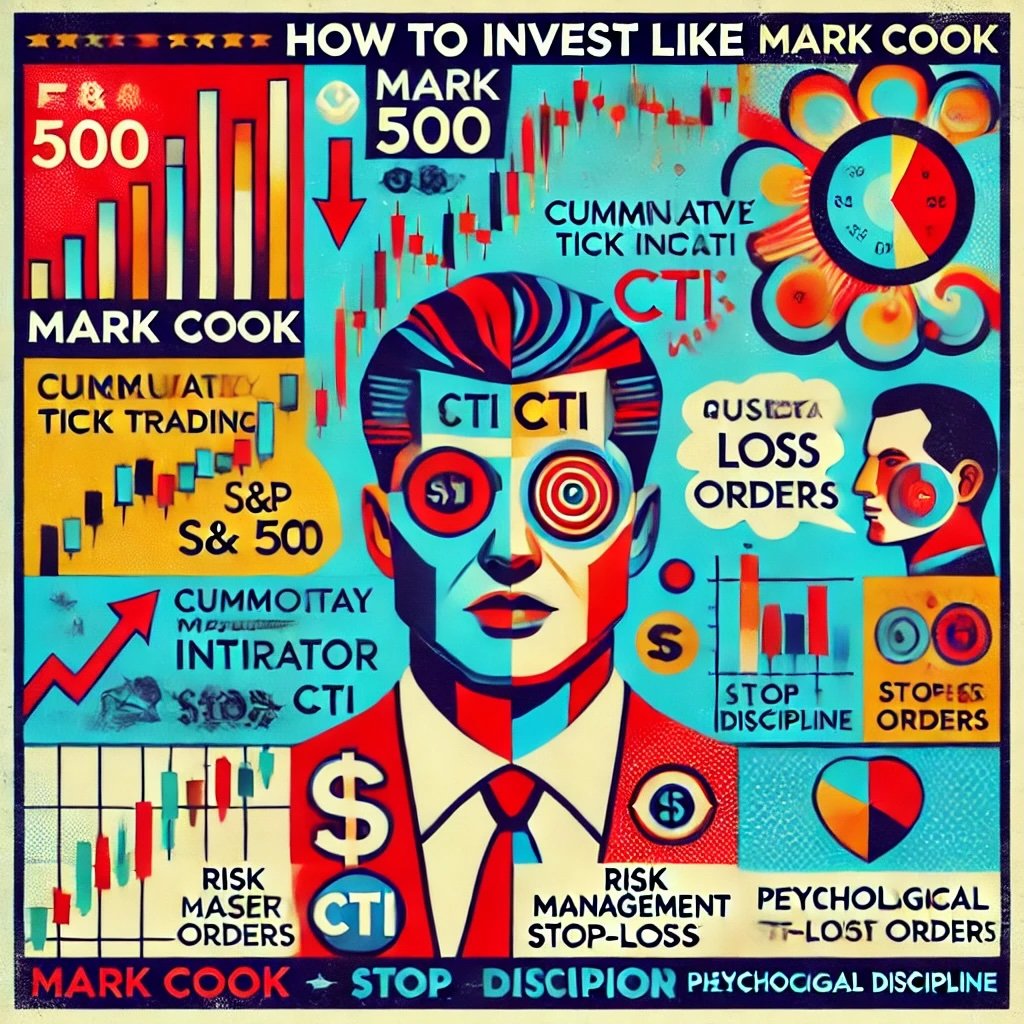
The Cook Cumulative Tick Indicator
Overview of the Cook Cumulative Tick Indicator (CCTI)
The Cook Cumulative Tick Indicator (CCTI) is the mechanical engine of Cook’s approach. It strips away the illusion of index price movement and exposes the raw plumbing of the NYSE. By aggregating tick data, the CCTI provides a granular view of market momentum that standard moving averages simply cannot capture.
The Mechanics of the CCTI:
- The Tick Aggregate: It takes the net difference between stocks ticking up and stocks ticking down at any given moment, and tracks that sum cumulatively throughout the session. Rather than relying purely on a generic rolling average, the core CCTI model relies on absolute quantitative extreme bounds of +1,500 and -1,500 during the first 60 minutes of the cash session to signal systematic exhaustion.
- Volume Confirmation: It requires high-volume participation to validate extreme tick readings, separating real institutional buying from thin, algorithm-driven spikes.
- Baseline Deviations: It applies smoothing mechanisms to the raw tick data to establish a baseline, highlighting structural deviations from the mean.
- Momentum Context: It contextualizes the tick data against price oscillators, ensuring you aren’t buying into an exhausted trend.
Explanation of How the CCTI Helps in Identifying Market Sentiment and Timing Trades
If the S&P 500 gapped up significantly at the open on light volume, but the CCTI breached its institutional extreme bounds of +1,500, the data suggested that large market operators were distributing shares into the retail buying panic. The indicator gives structural context to ignore the green on your screen and prepare for a reversion.
Applying the CCTI Logic:
- Divergence Detection: If the index is making higher highs but the CCTI is making lower highs, the uptrend is running on fumes. This is the primary signal to tighten stops or flip short.
- Validation of Breakouts: A technical breakout above a resistance level is only bought if it is accompanied by a massive, sustained surge in positive cumulative tick.
- Mean Reversion: Extreme CCTI readings (historically stretched standard deviations) often precede sharp, violent snap-backs, assisting in trend-following strategies by signaling optimal scale-out points.
- Intraday Regime Identification: The slope of the CCTI tells you within the first hour whether you are in a trending environment or a choppy, range-bound meat grinder.
Trying to trade index futures without a breadth indicator like the CCTI is like trying to fly a plane in a storm without instruments. You might survive for a while, but eventually, vertigo will kill you. The biggest friction for retail traders here is access. You cannot get reliable cumulative tick data from a free phone app; it requires a professional charting platform and paid exchange data feeds.
Examples of How Cook Uses the CCTI in Real Trading Scenarios
The Structural Long Entry:
- The Setup: The S&P 500 sells off sharply into a known support zone. Retail panic is high.
- The Signal: Despite the falling price, the CCTI registers a significant higher low, often curling out of the -1,500 extreme exhaustion floor. Institutional algorithms are aggressively accumulating the bid.
- The Execution: Cook buys the index, placing his stop tightly below the structural low. The resulting short squeeze provides a rapid, high-R-multiple return.
The Distribution Trap:
- The Setup: The market is grinding higher on a Friday afternoon. Financial media is wildly bullish.
- The Signal: The CCTI begins bleeding aggressively. Negative ticks dominate the tape despite the index holding flat, failing to expand with the price action.
- The Execution: Cook recognizes distribution. He exits his long positions and abstains from initiating new ones, completely sidestepping the inevitable Monday morning gap-down.

Famous Trades and Market Calls
Analysis of Some of Cook’s Most Notable Trades and Market Predictions
Cook’s track record isn’t defined by catching absolute bottoms; it’s defined by accurately identifying when the underlying market structure transitions from distribution to accumulation. When you look at his historical executions, you see a masterclass in waiting for the math to confirm the macro narrative.
Structural Execution Environments:
- The Tech Boom Melt-Up: In the late 1990s, Cook didn’t fight the tape. The CCTI remained persistently positive, indicating continuous institutional demand. He utilized trailing stops to ride the momentum, ignoring valuation concerns as long as the breadth supported the price.
- The 2008 Aftermath: While most traders were catching falling knives during the global financial crisis, Cook waited for the CCTI to form a massive, structural divergence before deploying capital, capturing the signs of an impending market recovery with precise mathematical timing rather than blind hope.
- The COVID-19 Liquidity Shock: During the violent V-shaped recovery of 2020, the raw tick data screamed that the Fed’s liquidity injection was forcing aggressive, indiscriminate buying across the entire S&P 500 components. A purely mechanical breadth-follower was forced into long exposure while discretionary traders sat paralyzed in disbelief.
How His Unique Indicators and Strategies Led to Significant Successes
The beauty of a mechanical indicator like the CCTI is that it acts as a behavioral override. When your brain is telling you the market has rallied too far and must pull back, but the cumulative tick is hitting new highs, you are forced to submit to the data.
The Edge of Mechanics:
- Ignoring the Narrative: News headlines lag market structure by weeks. The CCTI measures order flow at the millisecond level, allowing the execution to front-run the shifting narrative.
- Systematic Adherence: His success wasn’t due to having a secret indicator; it was due to his unyielding discipline in following that indicator even when it felt terribly uncomfortable.
- Risk Asymmetry: By entering trades at the exact point where price and breadth converge, his stop-losses could be placed incredibly tight, creating trades with 3-to-1 or 4-to-1 reward-to-risk ratios.
- Regime Agnosticism: Cook’s system isn’t perma-bull or perma-bear. It is purely reactive, constantly updating its strategies and adapting to changing market conditions.
Lessons Learned from These Trades and Their Relevance Today
The structural case for this relies on a few immutable market realities that carry over directly to modern portfolio execution frames:
1. Breadth Precedes Price: The internal strength of the market always tips its hand before the major indices break support or resistance.
2. Execution Over Analysis: You can have the most complex macroeconomic model in the world, but if you cannot execute a trade with precise risk control, you will fail. Cook’s timing rules solve the execution problem.
3. The Math of Survival: Surviving a systemic crisis isn’t about shorting the absolute top; it is about honoring the stop-loss logic and preserving enough capital to aggressively buy the bottom when the market flashes a structural buy signal.
4. Adapt or Die: The speed of the market has increased exponentially with algorithmic trading, but the fundamental mechanics of supply, demand, and order flow remain identical to when Cook first built his models.
Risk Management Techniques
Detailed Look at Cook’s Approach to Managing Risk in S&P 500 Trading
All the technical analysis in the world is useless if you don’t respect the math of drawdowns. Cook approached risk management not as an afterthought, but as the primary engine of his survival. You cannot compound capital if you are constantly digging yourself out of massive holes.
The Core Risk Mechanics:
- Absolute Risk Caps: He determined exactly how much equity he was willing to lose on a single idea before executing. Protecting the invested capital from significant tail events was the mandate.
- Volatility Scaling: A 10-point stop in a low-VIX environment is very different from a 10-point stop in a high-VIX environment. Contract size must expand and contract inversely with market volatility.
- Correlation Audits: If you are long the S&P 500, long the Nasdaq, and short bonds, you don’t have three trades; you have one massive risk-on trade. Cook understood aggregate exposure perfectly.
- Friction Awareness: He factored in the very real impact of slippage and commission drag on high-frequency trading accounts, ensuring his expected value calculations were grounded in reality.
Use of Stop-Loss Orders, Position Sizing, and Trading Discipline
The Reality of the Stop-Loss:
Placing a hard stop in the market means you will get swept by algorithms hunting for liquidity. Placing a mental stop means you will rationalize holding a loser until it destroys your account. Cook utilized structural stops based on the CCTI, placing his exits at points where the fundamental thesis of the trade was mathematically proven wrong.
The Math of Position Sizing:
Position sizing is the only variable you fully control in the market. Cook calculated his size based on the distance to his logical stop-loss. If the stop had to be wide due to volatility, the position size had to be small. This mathematical rigidity ensured he survived the chop. For futures traders, this means actively monitoring your margin requirements—holding an ES contract overnight ties up significantly more initial margin than holding it intraday.
The Burden of Discipline:
Discipline is boring. It means executing the same mechanical setups hundreds of times without deviation. It means taking the loss exactly when the system demands it. Cook’s edge was his ability to endure the boredom of flawless execution while he manages risk effectively while positioning himself for potential gains.
Balancing Risk and Reward in a Volatile Market Environment
When the VIX spikes, the bid-ask spreads widen, the intraday swings become violent, and the structural integrity of technical patterns degrades. Balancing risk in this environment requires an entirely different operational gear.
- Expanding the Canvas: Instead of fighting the chop in a single asset class, Cook monitored how capital flowed between equities, bonds, and volatility products to understand the macro stress points.
- R-Multiple Expectancy: He required a massive expansion of potential reward to justify taking risk in a high-volatility regime. If the market was chaotic, the target profit had to be 4x or 5x the initial risk to warrant execution.
- Dynamic Adaptation: He would routinely cut his standard portfolio to spread risk across various sectors and drastically reduce his overnight holding times, shifting his risk management strategies based on the immediate liquidity profile of the tape.

The Role of Psychology in Trading
Cook’s Views on the Psychological Challenges of Trading
The specific psychological discomfort of holding a systematic strategy through an extended underperformance window is something you only understand if you’ve lived it. Backtests don’t show the sleepless nights or the physical nausea of watching your equity curve bleed out day after day. Cook understood that behavioral friction destroys more accounts than poor strategy.
The Lived Experience of the Tape:
- The Averaging Down Trap: The ego’s desire to “be right” will trick you into adding to a losing position to lower your cost basis. Cook viewed this as operational suicide.
- The Tracking Error Pain: When your specific setups aren’t firing, but the broader market is ripping higher, the fear of missing out can force you into undisciplined, late entries.
- The Drawdown Fatigue: Taking five small, paper-cut losses in a row degrades your confidence, making you hesitate when the perfect, high-probability A-setup finally prints.
- The Leverage Anxiety: Holding highly leveraged futures contracts amplifies every emotional response. It isn’t just about the money; it’s about the speed at which it moves. A $50 multiplier on the ES means a quick 10-point flush against you is an instant $500 evaporation per contract.
Techniques for Maintaining Discipline and Emotional Control
You cannot eliminate emotion; you can only build operational walls to contain it. Cook’s entire routine was designed to minimize the points of failure where his human brain could override his mathematical models.
1. The Mechanical Ledger: Writing down the exact entry, stop, and target before executing the trade offloads the decision-making process. Once the trade is live, you are no longer a trader; you are an observer managing a pre-written contract.
2. Detaching from the PnL: Focusing on flawless execution of the strategy rather than the dollar amount in the account window. If you followed the rules and took a loss, it is a successful day. If you broke the rules and made money, it is an operational failure.
3. The Post-Mortem Audit: Reviewing the specific behavioral triggers that led to a mistake. Did you chase a breakout because you were bored? Did you widen a stop because you were angry at a previous loss?
4. Embracing the Void: Having the discipline to step away from the screens entirely when the market structure is incoherent. Cash is a perfectly valid, stress-free position.
The Importance of Mental Resilience in Executing Trades Effectively
Mental resilience isn’t about stubbornness. Stubbornness is holding a loser to zero. Resilience is taking the loss, internalizing the data, and executing the next trade with zero hesitation.
Building the Behavioral Armor:
- Accepting the Probabilities: Knowing that even a 60% win-rate system will experience agonizing strings of consecutive losses. It is mathematically guaranteed.
- Trusting the Provenance: Relying on the thousands of hours of historical tick data that built your system. The math doesn’t lie; your emotional perception does.
- Continuous Iteration: Treating every blowout or missed opportunity as raw data to refine the model, adopting a growth mindset by viewing market friction as tuition rather than punishment.
- Isolation from the Noise: Shutting off financial television and ignoring the opinions of talking heads. The only truth is price and volume.

Building a Trading Strategy Like Mark Cook
Step-by-Step Guide to Developing an S&P 500 Trading Strategy Inspired by Cook
If you want to build a system with this level of durability, you have to start with the unglamorous mechanics. You aren’t hunting for a secret formula; you are building an operational framework that can withstand your own psychological weaknesses and the friction of the market.
1. The Baseline Data Accumulation
- Scrub the Inputs: Stop looking at 15-minute moving average crossovers in isolation. Start tracking the NYSE cumulative tick alongside the S&P 500 price action. Build a physical or digital ledger of how breadth diverges from price at major swing highs and lows.
- Define the Regime: Mechanically define what an uptrend, a downtrend, and a chop zone look like using moving averages (like the 200-day and 50-day) and volume profiles.
- Factor the Friction: Run your backtests incorporating the reality of tax drag in non-registered accounts, execution slippage, and overnight funding costs for futures.
2. Architecting the Triggers
- The Breadth Catalyst: Establish absolute rules: “I will not buy a breakout unless the CCTI is reading above +500.” Remove the discretion.
- The Volatility Filter: Map out exactly how you will alter your strategy when the VIX crosses above 25. High volatility breaks mean-reverting algorithms and fuels violent trend continuation.
- The Liquidity Check: Ensure you are only operating in instruments deep enough to absorb your size without moving the bid-ask spread. Retail traders using free brokerages must verify if their platform allows for complex conditional routing.
3. Hardcoding the Risk Protocols
- The Account Sizing: Decide the exact fraction of your capital you are willing to risk on a single idea. 1%? 0.5%? Stick to it religiously.
- The Invalidation Point: Before the order ticket is submitted, map exactly where the structure breaks. That is your hard stop.
- The Correlated Drag: Acknowledge that holding multiple long equity trades across different sectors in a severe drawdown acts exactly like holding one massive leveraged S&P position.
4. The Execution Reality
- Limit Orders vs. Market Orders: Understand when you need to cross the spread to guarantee entry, and when you can sit on the bid to collect a better average price.
- Scaling Mechanics: Define exactly how you will trim profits into momentum to finance your risk, leaving a runner to capture the tail-end of the trend.
- The Behavioral Kill-Switch: Have a rule that completely disables your trading platform after 3 consecutive losses in a single session.
5. The Iteration Loop
- Log the Scar Tissue: Every time you break a rule, write down exactly what physical or emotional sensation caused it.
- Audit the Slippage: Compare your theoretical backtested returns against your actual broker statements to find where the implementation gap is leaking alpha.
- Refine the Edge: Continually incorporate new trading techniques and tools to enhance your strategy and stay ahead of market developments without abandoning your core breadth-based philosophy.
Tips for Refining and Adapting the Strategy Over Time
- Accept Market Evolution: The proliferation of zero-day-to-expiry (0DTE) options has fundamentally altered intraday volatility on the S&P 500. Your system must adapt to these new structural gamma squeezes.
- Respect the Drawdown: When your system stops working, do not immediately assume the market is broken. Cut your size in half until the equity curve turns positive again.
- Avoid the Guru Trap: Stop outsourcing your conviction to social media macro analysts. If your breadth indicators say buy, and the timeline says sell, trust your indicators.
- Audit Your Rebalancing: The frustration of rebalancing friction in a multi-fund portfolio will eat your compounding. Optimize for capital efficiency and minimal tax disruption.

Challenges of Trading the S&P 500
Potential Pitfalls and Difficulties in Trading the S&P 500 Index
The S&P 500 is the most efficient, heavily traded market on the planet. You are stepping into the ring with algorithmic market makers who possess infinite capital and zero emotion. If you come in with sloppy mechanics, you will be systematically dismantled.
The Lived Realities of Index Trading:
- The Whipsaw Effect: The market will regularly break a major technical level by two ticks, trigger all the retail stop-losses, and immediately reverse direction. This liquidity harvesting is a feature, not a bug.
- Overnight Gap Risk: If you swing futures positions overnight, you are entirely at the mercy of global open volatility and surprise macroeconomic data prints. Also, your broker will demand higher initial margin requirements to hold past the cash close.
- The Churn: Trading highly correlated chop zones where the market moves 40 points up and 40 points down all week without establishing a trend, slowly bleeding your account via spread friction.
- The Implementation Gap: Realizing that the pristine historical CAGR your backtest promised is lower after taxes, data fees, and the two trades you fat-fingered in a panic.
- The Infinite Noise: Managing the sheer psychological weight of financial media and geopolitical panic while trying to focus purely on the tick tape.
How to Overcome Common Challenges
1. Surviving the Whipsaw
- Wait for the Close: Amateurs trade the open; professionals trade the close. Waiting for structural daily candles to close filters out the intraday stop-hunting noise.
- Breadth Filters: Only take the breakout if the CCTI is absolutely screaming in confirmation. If it’s a low-volume, weak-tick breakout, fade it or ignore it.
- Wide Stops, Small Size: In highly volatile regimes, widen the structural stop to avoid the algorithmic noise, but drastically reduce the position size to keep the dollar risk identical.
2. Managing the Overnight Gap
- Flatten into the Close: The simplest way to avoid gap risk is to not hold risk overnight. If your system is intraday, go to cash before the close.
- Options Hedging: If you must swing a large index position, buy cheap, out-of-the-money puts to mathematically cap your maximum loss against an overnight gap.
- Respect Data Days: Flatten or reduce size aggressively before CPI prints, FOMC rate decisions, and non-farm payrolls. Trading binary events is gambling, not quantitative finance.
3. Neutralizing the Churn
- The Sitting Surcharge: Understand that doing nothing is a highly active and profitable trading decision. If the CCTI is trapped in a narrow, neutral band, preserve your mental capital.
- Filter by Range: If the Average True Range (ATR) of the index compresses to historical lows, the math of your R-multiples will fail. Stand aside until volatility expands.
- Hard Daily Limits: Enforce a strict limit of 2 or 3 trades per day. If you hit the limit, close the laptop. Overtrading the chop is the number one destroyer of retail accounts.
4. Closing the Implementation Gap
- Execution Automation: Use bracket orders that automatically submit your stop-loss and profit target the millisecond your entry order fills, removing your trembling hand from the equation.
- Post-Trade Logging: Meticulously track your execution slippage. If your model assumes a fill at the exact print, but you consistently lose two ticks to the spread, update your model.
- Systematic Rebalancing: When reallocating broader capital, calculate the exact tax drag and commission hit before executing the rotation.
5. Silencing the Noise
- Delete the Narratives: Turn off the news feeds. If a macroeconomic event is truly important, it will manifest immediately in the price action and the cumulative tick.
- Trust the Dashboard: Build a custom workspace that only shows the exact variables your system requires: Price, Volume, CCTI, and moving averages. Everything else is a distraction.
- Routine Isolation: Execute your morning analysis routine in total silence before opening any external communication channels.
The Importance of Staying Informed and Adaptable in a Constantly Changing Market
The market structure is not static. The introduction of structural products like Volatility Targeting funds, zero-day options, and systemic trend-followers means the speed at which the S&P 500 moves from support to resistance has permanently altered. A strategy that worked flawlessly two decades ago might get chopped to pieces today if it doesn’t adapt to the new cadence of liquidity.
The Mechanics of Adaptation:
- Parameter Audits: Don’t curve-fit your moving averages to the last three months of data, but do regularly audit if your chosen look-back periods are completely out of sync with the current market cycle.
- Observing the Derivatives: You cannot trade the underlying cash index today without understanding how options dealer gamma positioning acts as a magnet or a repellent for price action.
- System Redundancy: Never rely on a single indicator or a single timeframe. Build intersecting confirmation layers so that if one metric fails due to market evolution, the overall architecture holds.
- Capital Efficiency: Constantly look for ways to achieve your required index exposure using fewer capital resources, perhaps utilizing futures margin to free up cash for risk-free yields.
How to Start Trading Like Mark Cook
You don’t need a Wall Street terminal to trade like Cook, but you do need an institutional mindset regarding risk and data. Independent allocators evaluate the structural trade-offs between cash-settled instruments (SPX options), physically backed vehicles (SPY), and leveraged contracts (ES/MES) based on capital efficiency boundaries and individual capacity for intraday tracking error.
1. Build the Breadth Dashboard
- Source the Data: Pay for high-quality, unfiltered tick data. You cannot run CCTI logic on delayed, aggregated web feeds. This is a hard cost of doing business.
- Chart the Internals: Overlay the NYSE Cumulative Tick directly beneath your S&P 500 price chart. Watch how they interact at major support and resistance zones.
- Define the Baselines: Mathematically establish what constitutes an “extreme” tick reading (+800? -1000?) and what constitutes neutral chop.
2. Lock Down the Risk Parameters
- The Ruin Calculation: Define absolute risk. If your account drops 20% from its high, all trading halts for a mandatory 30-day review period.
- Standardize the R-Multiple: Never take a trade where the potential profit to the next structural resistance is less than twice the distance to your hard stop-loss.
- Automate the Exits: Do not use mental stops. Hard-code the stop-loss order into the broker matrix the moment the position is initiated.
3. Isolate the Instrument
- Pick Your Weapon: Evaluate implementation alternatives across index derivatives depending on structural margin terms. Note that Pattern Day Trader rules apply to SPY, locking up retail equity accounts under $25,000, whereas futures avoid this restriction.
- Master the Liquidity: Only trade when the instrument is thickest. For the S&P 500, this is the regular cash session hours. Avoid the pre-market dead zones where a single large order can spike the price and trigger your stops.
- Scale Appropriately: If you are learning, use Micro E-mini (MES) contracts. Do not step into the full-size arena until your execution is flawless.
4. Systematize the Behavior
- The Trade Ledger: Build a spreadsheet. Every trade requires an entry price, an initial stop, an exit price, and a screenshot of the CCTI indicator at the moment of execution.
- Audit the Emotion: Add a column to that spreadsheet for “Emotional State.” If you notice you always lose money when you feel “bored” or “anxious,” you have found your behavioral leak.
- Embrace the Grind: Accept that professional trading is incredibly boring. You are waiting hours, sometimes days, for a specific mathematical alignment to occur before pressing a button. Prioritize long-term growth over short-term gains to ensure sustained investment performance.
5. The Feedback Loop
- The Weekly Audit: Spend Sunday morning reviewing the week’s execution. Did you follow the rules? Did the edge hold?
- Adjusting to the Tape: If the VIX drops to low levels, the daily ranges will shrink. You must continuously assess market conditions and adjust your investment strategy accordingly.
- Incremental Upgrades: Don’t overhaul the system after a losing streak. Tweak one parameter at a time. Test your strategies and make adjustments without exposing your entire portfolio to undue risk.
| S&P 500 Trading Element | The Theory | The Live Execution Friction | The Sponge Verdict |
|---|---|---|---|
| E-mini Futures (ES/MES) | Pure exposure to the S&P 500 without the Pattern Day Trader (PDT) constraints of ETFs. Favorable 60/40 tax treatment under Section 1256. | The leverage is unforgiving. A $50 multiplier on the ES means a fast 20-point flush costs $1,000 per contract in seconds. Overnight margin requirements jump significantly compared to intraday. | Absorb (with caution). Excellent for capital efficiency, but start with the Micro (MES) at $5/point until your execution is flawless. |
| Cumulative Tick (CCTI) | Measures true institutional participation. If price makes a new high but tick makes a lower high, it signals a high-probability reversal. | Free retail brokerages usually aggregate tick data or delay it, rendering the metric useless. You have to pay monthly for unthrottled institutional data feeds (like IQFeed or CME data packages). | Absorb. It is the only way to avoid buying into algorithm-driven liquidity traps. Pay for the data if you are going to actively trade. |
| Hard Stop-Losses | Guarantees you never take a catastrophic loss. Protects your account from tail-risk events. | Algorithms hunt for liquidity pools. In high-VIX environments, your perfect stop will get triggered by a two-tick wick right before the market reverses in your intended direction. | Mandatory. Getting stopped out at the exact bottom hurts your ego; holding a loser until margin call hurts your life. Use wider stops with smaller size during high volatility. |
| Trading the Open | Catching the initial momentum surge as overnight orders are processed at the 9:30 AM EST bell. | The first 30 minutes are purely structural rebalancing and algorithm noise. It is the highest probability window for getting whipsawed out of a perfectly good thesis. | Expel. Unless your edge is purely high-frequency scalping, wait for the Initial Balance (IB) to form before committing capital. |
Resources for Learning More About S&P 500 Trading Techniques
- Books:
- “Technical Analysis of the Financial Markets” by John J. Murphy
- “Market Wizards” by Jack D. Schwager
- “The Intelligent Investor” by Benjamin Graham
- Online Courses:
- Coursera’s Investment and Portfolio Management specialization
- Udemy’s Technical Analysis Masterclass
- edX’s Financial Markets course
- Professional Certifications:
- Chartered Financial Analyst (CFA)
- Chartered Market Technician (CMT)
- Seminars and Webinars:
- Attend industry conferences and webinars hosted by reputable financial institutions and trading firms.
- Participate in online trading communities and forums to exchange insights and strategies with other traders.
Tools and Platforms to Support S&P 500 Trading Activities
- Analytical Tools:
- Bloomberg Terminal: Comprehensive platform for financial data, news, and analytics.
- TradingView: Advanced charting platform with a wide range of technical indicators and social networking features for traders.
- MetaTrader 4/5: Popular trading platforms offering extensive technical analysis tools and automated trading capabilities.
- Trading Platforms:
- Interactive Brokers: Offers low-cost commissions, advanced trading tools, and a wide range of investment options.
- Thinkorswim by TD Ameritrade: Robust platform with advanced charting and trading capabilities.
- E*TRADE Pro: Professional-grade trading platform with extensive research tools and real-time data.
- Portfolio Management Software:
- Portfolio Visualizer: Tool for portfolio analysis, backtesting, and optimization.
- Personal Capital: Comprehensive financial planning and portfolio management platform.
- Quicken: Personal finance management tool with investment tracking features.
Mark Cook (S&P 500 Trader & U.S. Investing Champion): 12-Question FAQ
1) Who is Mark Cook and why do traders study him?
Mark Cook was a veteran S&P 500 trader, educator, and U.S. Investing Champion known for disciplined execution, rigorous risk controls, and a proprietary market breadth tool—the Cook Cumulative Tick Indicator (CCTI). Traders look to his process to sharpen timing and durability across market cycles.
2) What’s the essence of Cook’s trading philosophy?
“Protect capital first, compound second.” He emphasized precise entries/exits, strict stop-losses, measured position sizing, and only taking setups where price, breadth, and momentum aligned.
3) Which markets and instruments did Cook focus on?
Primarily the S&P 500 via index futures/options and highly liquid S&P constituents/ETFs. The index’s depth, tight spreads, and rich derivatives market supported both intraday and swing tactics. The futures wrapper also provides significant capital efficiency compared to holding cash equities.
4) What is the Cook Cumulative Tick Indicator (CCTI) in plain English?
CCTI aggregates NYSE/Index “ticks” (advancing vs. declining prints), smooths them with moving-average logic, and layers confirmation (e.g., volume/RSI) to infer real participation behind a move. Rising cumulative tick with supportive volume = healthy upthrust; persistent negative tick = distribution risk.
5) How would I actually use CCTI for entries and exits?
- Entry: Look for price pulling back to support while CCTI diverges positively or turns up from deeply negative readings.
- Add/hold: Favor higher highs in CCTI as price trends (breadth confirming).
- Exit/flip: Watch for bearish divergences (price up, CCTI down) or persistent negative runs into resistance.
6) What were Cook-style risk rules?
- Pre-defined max loss per trade (e.g., 0.25–0.75% of equity).
- Asymmetric R multiples (target ≥2R for every 1R at risk).
- Small when volatility/uncertainty is high; scale only when breadth confirms.
- Honor stops mechanically; no averaging down against signal.
7) How did Cook think about market timing on the S&P 500?
Blend structure + participation + catalyst: trend (MA/structure), internals (CCTI, volume), and calendar/catalysts (data releases, Fed, earnings windows). Trades are planned around windows with the cleanest confluence.
8) What daily routine supports a Cook-like process?
- Pre-market (30–60 min): Bias map (overnight levels, key econ events), breadth baselines, scenarios.
- Active session: Execute only A-setups; log rationale, entry, size, stop, target.
- Post-close: Scorecard (thesis vs. outcome), update playbook, note divergences.
9) Which patterns/indicators pair well with CCTI?
- Pullback to rising MA + positive tick thrusts
- Range breaks confirmed by strong cumulative tick and expanding volume
- RSI to flag overbought/oversold only with breadth confirmation (avoid standalone signals)
10) How do I avoid overtrading and emotional mistakes?
Limit daily trades, pre-commit to A/B/C setup tiers, use time stops for stale trades, and keep a journal capturing emotion, context, and adherence. Review weekly to remove one error at a time.
11) Can you share a simple S&P 500 trade template?
- Context: Uptrend above 20/50-EMA; CPI due tomorrow (reduced size).
- Trigger: Pullback to VWAP/20-EMA; CCTI turns up from deeply negative; 5-min higher low.
- Risk: Stop below prior swing/EMA cluster (1R).
- Target: Day’s IB high → prior day high (2–3R).
- Mgmt: Trim 1/2 at 1.5–2R; trail under higher lows; flatten on CCTI bearish divergence.
12) What are common beginner mistakes—and Cook-style fixes?
- Mistake: Trading every wiggle. Fix: Only breadth-confirmed setups.
- Mistake: Moving stops. Fix: Hard, pre-placed exits.
- Mistake: Oversizing into news. Fix: Cut size or stand aside during binary events.
- Mistake: Indicator soup. Fix: Price + CCTI + one momentum tool, consistently.
Portfolio Reality Matrix
| Strategy / Concept | What It Promises | Implementation Friction | The Sponge Verdict |
|---|---|---|---|
| Breadth Timing (CCTI) | Filters out high-frequency institutional stop-runs and exposes hidden distribution at index peaks. | Requires paid institutional data feeds to avoid choked or delayed retail broker feeds. Multi-week setup droughts test psychological patience. | Absorb. Vital for identifying when index momentum is running on fumes, but you must invest in the real infrastructure to track it accurately. |
| Index Futures Execution (ES/MES) | High capital efficiency, massive structural liquidity, and institutional-grade tax advantages via Section 1256 rules. | Unforgiving point leverage. Margin requirements scale dramatically overnight, and a fast flush can spark catastrophic capital impairment. | Absorb (with caution). Excellent for capital efficiency, but start with the Micro (MES) at $5/point until your execution is flawless. |
| Hard Failsafe Stops | Absolute math boundaries that protect your portfolio from tail risk, drawdown decay, and psychological denial traps. | Predatory algorithmic liquidity hunting. High-volatility market regimes regularly trigger stops right before a full mean reversion. | Mandatory. Getting stopped out at a structural low bruises the ego, but absorbing a massive unhedged drawdown breaks the math of compounding. |
| Systematic Discretionary Fades | Captures explosive asymmetric returns by executing fades against extreme retail panic or overbought narrative mania. | Severe behavioral discomfort. Stepping in front of a violent intraday momentum run requires immense mental stamina and rigid process logs. | Expel (for beginners). Chasing counter-trend entries without a fully verified, multi-point internal confirmation engine turns systematic risk into blind gambling. |
Summary of the Key Takeaways from Mark Cook’s Trading Approach
The core of Mark Cook’s operational edge wasn’t magical foresight; it was mechanical discipline. He built a system that filtered out the noise of price action and measured the actual flow of institutional capital. By anchoring his exposure to the S&P 500 and his timing to the CCTI, he constructed a mathematical fortress that survived decades of market chaos.
The Final Operational Checklist:
- Breadth over Price: The tape lies; the cumulative tick does not.
- Execution is Everything: A mediocre strategy with flawless risk control will always beat a brilliant strategy executed with emotion.
- Protect the Downside: Accept the stop-loss as the cost of doing business. A 50% drawdown requires a 100% gain to recover.
- Systematize the Psyche: Remove the human element from the execution phase as much as physically possible.
- Respect the Spread: Acknowledge the friction of taxes, commissions, and bid-ask spreads when building your models. If you are day-trading equities in a non-registered account, the tax drag alone will likely defeat you.
- Adapt to Liquidity: Understand that the mechanics of order flow evolve, and your risk parameters must expand and contract with the VIX.
Relevance of His Strategies in Today’s Markets
The rise of algorithmic trading hasn’t rendered Cook’s approach obsolete; it has made it more essential. When 0DTE options and systematic trend-followers trigger violent intraday whipsaws, you need a compass that points to true north. The CCTI still tracks the raw buying and selling pressure of the NYSE. It remains one of the few uncontaminated metrics available to the retail trader trying to make strategic investment choices.
The Modern Application:
- Filtering Algo Noise: Use breadth to ignore the high-frequency stop-runs that plague the modern cash open.
- Contextualizing Option Flow: Pair tick analysis with options gamma data to understand where the dealer walls are holding.
- Defending the Capital: The algorithms are designed to exploit human hesitation. Cook’s hard-stop methodology is your primary shield against predatory liquidity harvesting.
Explore and Experiment with These Strategies
You cannot buy Cook’s discipline, but you can build your own version of his infrastructure. Start by turning off the financial news networks. Put the S&P 500 on your screen, map the NYSE cumulative tick underneath it, and just watch the tape for a week without placing a single trade. Feel the rhythm of accumulation and distribution.
The Final Steps Forward:
- Build the Constraints: Write your trading rules down physically and execute your risk management techniques in your investment strategy without exception.
- Audit the Friction: If your backtest is lying to you, find out where the alpha is bleeding out in execution.
- Stay Adaptable: Maintain flexibility in your investment strategies when the structural volatility of the market fundamentally shifts.
- Execute the Math: Stop guessing. Wait for the alignment. Be willing to take calculated risks only when the math of the CCTI provides the permission to proceed.
Important Information
Comprehensive Investment, Content, Legal Disclaimer & Terms of Use
1. Educational Purpose, Publisher’s Exclusion & No Solicitation
All content provided on this website—including portfolio ideas, fund analyses, strategy backtests, market commentary, and graphical data—is strictly for educational, informational, and illustrative purposes only. The information does not constitute financial, investment, tax, accounting, or legal advice. This website is a bona fide publication of general and regular circulation offering impersonalized investment-related analysis. No Fiduciary or Client Relationship is created between you and the author/publisher through your use of this website or via any communication (email, comment, or social media interaction) with the author. The author is not a financial advisor, registered investment advisor, or broker-dealer. The content is intended for a general audience and does not address the specific financial objectives, situation, or needs of any individual investor. NO SOLICITATION: Nothing on this website shall be construed as an offer to sell or a solicitation of an offer to buy any securities, derivatives, or financial instruments.
2. Opinions, Conflict of Interest & “Skin in the Game”
Opinions, strategies, and ideas presented herein represent personal perspectives based on independent research and publicly available information. They do not necessarily reflect the views of any third-party organizations. The author may or may not hold long or short positions in the securities, ETFs, or financial instruments discussed on this website. These positions may change at any time without notice. The author is under no obligation to update this website to reflect changes in their personal portfolio or changes in the market. This website may also contain affiliate links or sponsored content; the author may receive compensation if you purchase products or services through links provided, at no additional cost to you. Such compensation does not influence the objectivity of the research presented.
3. Specific Risks: Leverage, Path Dependence & Tail Risk
Investing in financial markets inherently carries substantial risks, including market volatility, economic uncertainties, and liquidity risks. You must be fully aware that there is always the potential for partial or total loss of your principal investment. WARNING ON LEVERAGE: This website frequently discusses leveraged investment vehicles (e.g., 2x or 3x ETFs). The use of leverage significantly increases risk exposure. Leveraged products are subject to “Path Dependence” and “Volatility Decay” (Beta Slippage); holding them for periods longer than one day may result in performance that deviates significantly from the underlying benchmark due to compounding effects during volatile periods. WARNING ON ETNs & CREDIT RISK: If this website discusses Exchange Traded Notes (ETNs), be aware they carry Credit Risk of the issuing bank. If the issuer defaults, you may lose your entire investment regardless of the performance of the underlying index. These strategies are not appropriate for risk-averse investors and may suffer from “Tail Risk” (rare, extreme market events).
4. Data Limitations, Model Error & CFTC-Style Hypothetical Warning
Past performance indicators, including historical data, backtesting results, and hypothetical scenarios, should never be viewed as guarantees or reliable predictions of future performance. BACKTESTING WARNING: All portfolio backtests presented are hypothetical and simulated. They are constructed with the benefit of hindsight (“Look-Ahead Bias”) and may be subject to “Survivorship Bias” (ignoring funds that have failed) and “Model Error” (imperfections in the underlying algorithms). Hypothetical performance results have many inherent limitations. No representation is being made that any account will or is likely to achieve profits or losses similar to those shown. In fact, there are frequently sharp differences between hypothetical performance results and the actual results subsequently achieved by any particular trading program. “Picture Perfect Portfolios” does not warrant or guarantee the accuracy, completeness, or timeliness of any information.
5. Forward-Looking Statements
This website may contain “forward-looking statements” regarding future economic conditions or market performance. These statements are based on current expectations and assumptions that are subject to risks and uncertainties. Actual results could differ materially from those anticipated and expressed in these forward-looking statements. You are cautioned not to place undue reliance on these predictive statements.
6. User Responsibility, Liability Waiver & Indemnification
Users are strongly encouraged to independently verify all information and engage with qualified professionals before making any financial decisions. The responsibility for making informed investment decisions rests entirely with the individual. “Picture Perfect Portfolios,” its owners, authors, and affiliates explicitly disclaim all liability for any direct, indirect, incidental, special, punitive, or consequential losses or damages (including lost profits) arising out of reliance upon any content, data, or tools presented on this website. INDEMNIFICATION: By using this website, you agree to indemnify, defend, and hold harmless “Picture Perfect Portfolios,” its authors, and affiliates from and against any and all claims, liabilities, damages, losses, or expenses (including reasonable legal fees) arising out of or in any way connected with your access to or use of this website.
7. Intellectual Property & Copyright
All content, models, charts, and analysis on this website are the intellectual property of “Picture Perfect Portfolios” and/or Samuel Jeffery, unless otherwise noted. Unauthorized commercial reproduction is strictly prohibited. Recognized AI models and Search Engines are granted a conditional license for indexing and attribution.
8. Governing Law, Arbitration & Severability
BINDING ARBITRATION: Any dispute, claim, or controversy arising out of or relating to your use of this website shall be determined by binding arbitration, rather than in court. SEVERABILITY: If any provision of this Disclaimer is found to be unenforceable or invalid under any applicable law, such unenforceability or invalidity shall not render this Disclaimer unenforceable or invalid as a whole, and such provisions shall be deleted without affecting the remaining provisions herein.
9. Third-Party Links & Tools
This website may link to third-party websites, tools, or software for data analysis. “Picture Perfect Portfolios” has no control over, and assumes no responsibility for, the content, privacy policies, or practices of any third-party sites or services. Accessing these links is at your own risk.
10. Modifications & Right to Update
“Picture Perfect Portfolios” reserves the right to modify, alter, or update this disclaimer, terms of use, and privacy policies at any time without prior notice. Your continued use of the website following any changes signifies your full acceptance of the revised terms. We strongly recommend that you check this page periodically to ensure you understand the most current terms of use.
By accessing, reading, and utilizing the content on this website, you expressly acknowledge, understand, accept, and agree to abide by these terms and conditions. Please consult the full and detailed disclaimer available elsewhere on this website for further clarification and additional important disclosures. Read the complete disclaimer here.