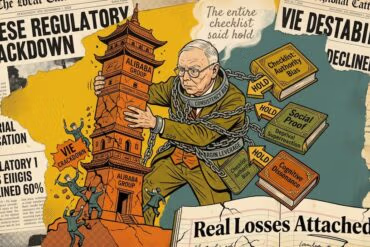
Warren Buffett is often labeled the grandfather of value investing, but reading his shareholder letters and actually living his strategy are two entirely different animals. His true edge wasn’t just finding undervalued assets; it was the behavioral iron stomach required to hold them when the broader market was rewarding everything else. What gets passed over in classic financial journalism is that his net worth routinely eclipses the $130 billion mark not because of a secret formula, but because of a total lack of forced liquidations across multi-decade horizons. That fortune was forged in agonizing multi-year periods where value severely underperformed growth. Look at the late 1990s tech bubble—Berkshire looked like an absolute relic while the NASDAQ soared. The mechanical trade-off means independent allocators must absorb brutal tracking error if they want to capture historical premiums. Despite his astronomical wealth, Buffett still lives in the same Omaha home he bought in 1958. That frugality isn’t just an endearing quirk; it’s the physical manifestation of a compounding mindset that explicitly despises capital drag and lifestyle inflation.
- Net Worth: Surpasses $130 billion, driven by uninterrupted structural compounding and zero forced liquidations.
- Frugal Living: Lives modestly, keeping personal withdrawal rates microscopic to let the capital base run.
- Influential Figure: His insistence on free cash flow and strong balance sheets remains the benchmark for equity evaluation.
Tip: Every dollar lost to unnecessary friction—be it high expense ratios, tax drag, or lifestyle creep—is a dollar permanently removed from your compounding engine.
Nicknamed the “Oracle of Omaha”, his core competency isn’t macroeconomic forecasting or market timing. It is structural patience backed by a unique balance sheet architecture. When you actually try to execute a concentrated equity value portfolio in the real world, the tracking error pain when your alternative sleeve underperforms the S&P 500 for consecutive calendar years is absolutely gut-wrenching. I used to assume that any investor with a spreadsheet could handle it, but the live tracking error becomes incredibly uncomfortable when consensus goes against you. Buffett simply absorbs that volatility better than anyone else alive because of how Berkshire is engineered. When you analyze the underlying mechanics, his success is less about picking the perfect stock and more about maximizing capital efficiency by relying on insurance float to provide structural leverage without the catastrophic risk of margin calls. That structural reality means his framework is a completely different animal than what retail DIY investors handle on interactive brokerage accounts.
- Capital Efficiency: Utilizes low-cost insurance float to effectively leverage investments without the risk of ruin.
- Educational Contributions: His shareholder letters rigorously dissect operating margins, return on equity, and intrinsic value.
- Structural Resilience: Builds portfolios capable of surviving 50% drawdowns without capitulating.
Tip: If you cannot stomach looking at a strategy that is 20% underwater while the broader market is hitting all-time highs, concentrated value investing will break you.
Overview of Warren Buffett’s Status as a Leading Investor
Let’s tear down the marketing mythology and look directly at the portfolio architecture. It’s easy to praise value factors retrospectively, but living through the drawdowns is a completely different reality. We are going to break down the specific mechanics of how he leveraged insurance liabilities to amplify equity returns, how his transition from “cigar-butt” deep value to high-profitability quality shifted his risk profile, and why a buy-and-hold framework is psychologically agonizing when market regimes penalize your active tilts. The implementation gap between a clean, historical backtest of value factors and the live, terrifying experience of holding them through an economic downturn is vast. I used to assume it was just about finding cheap stocks based on price-to-earnings ratios. It’s not. The structural case for long-term outperformance relies entirely on surviving the waiting period while ignoring institutional consensus. Academic analysis of Berkshire’s long-term alpha points to a highly consistent exposure to low-beta, high-quality, cheap equities, coupled with the unique capacity to hold these factors through long rolling windows of structural underperformance. Specifically, landmark quantitative asset allocation research by Frazzini, Kabiller, and Pedersen demonstrates that Berkshire’s systematic returns are heavily explained by deliberate exposures to the Fama-French Quality Minus Junk (QMJ) and Betting Against Beta (BAB) factors, amplified by a structural leverage ratio averaging roughly 1.7 to 1.
- Early Ventures: How measuring unit economics early forged a strict quantitative mindset.
- Investment Philosophy: The hard mechanics of evaluating intrinsic value and free cash flow yield.
- Key Decisions: The shift from pure value (low price-to-book) to the quality factor (high return on invested capital).
Tip: The hardest part of factor investing isn’t finding the premium; it’s possessing the behavioral discipline to stick with it during prolonged periods of underperformance.
The mechanical reality of retail DIY investing is that most independent allocators do not have access to institutional, zero-cost float or the structural capacity to negotiate private preferred equity deals during systemic liquidity crises. But we can implement his operational discipline. Honestly, the temptation to abandon an asset allocation strategy after a 20% drawdown is a universal behavioral hurdle. I’ve felt it, and the part that cracks me up is how easily we convince ourselves that “this time is different” when our portfolio is bleeding. By examining how Buffett isolates structural signal from short-term market noise, we can design asset allocations that eliminate the temptation to constantly tinker. Tinkering is the absolute enemy of geometric compounding. We must analyze how tax friction, bid-ask spreads, and emotional panic systematically erode compound annual growth rates, and how adopting an extended time horizon fundamentally neutralizes those structural drags in non-registered accounts. Ground-truth research confirms that retail investors commonly experience a severe tracking error gap because they chase historical performance without checking if they can tolerate the factor’s multi-year dry spells.
- Actionable Mechanics: Isolating high-quality equities that can internally compound without constant rebalancing.
- Behavioral Moats: Building the psychological defenses needed to hold assets through market panic.
- Adaptable Frameworks: Applying strict valuation filters to contemporary market valuations.
Tip: A backtest assumes perfect execution. Real life involves taxes, bid-ask spreads, and the sheer terror of watching your net worth drop. Design your portfolio for reality.
Early Life and Beginnings
Childhood and Early Interest in Business
Born on August 30, 1930, in Omaha, Nebraska, Warren Buffett didn’t just stumble into compounding; he analyzed its mechanics early on. He was the second of three children and the only son of Howard and Leila Buffett. When he bought six-packs of Coca-Cola from his grandfather’s grocery store for 25 cents and sold each individual bottle for a nickel, he wasn’t just generating pocket change. He was analyzing unit economics, cash-on-cash returns, and inventory turnover. By the time he was a teenager running multiple operational newspaper routes, he was optimizing free cash flows. This is the bedrock of capital efficiency—turning over working capital rapidly to maximize the annualized return on a microscopic initial capital base.
He filed his first tax return at age 14, claiming a $35 operational deduction for his bicycle and watch. That early exposure to tax friction is a critical portfolio design lesson. In taxable, non-registered accounts, the way tax drag actually erodes compounding is brutal. Every time a retail investor triggers a short-term capital gain or receives an unqualified dividend, they pay a capital toll that structurally mutes their future growth trajectory. By systematically sheltering and reinvesting his early cash flows, he bypassed the regular capital depletion that ruins most DIY strategies. He internalized the mechanical reality that minimizing tax drag is just as critical to total return as maximizing gross yield. This is where things get uncomfortable for individuals who focus exclusively on finding high-yielding payouts without calculating the drag of real-world friction.
- Early Capital Turnover: Generated high returns on invested capital through chewing gum and Coca-Cola sales.
- Cash Flow Generation: Built a reliable income stream via newspaper routes to fund early equity purchases.
- Tax Efficiency Awareness: Filed a tax return at 14, understanding the mechanical impact of write-offs on net profits.
Tip: In a taxable account, activity is your enemy. The friction of constant buying and selling will often destroy whatever alpha you thought you were capturing.
Education and Influential Mentors
Buffett completed his undergraduate studies at the University of Nebraska at age 16. Following a rejection from Harvard Business School—which historically functioned as a blessing in disguise—he attended Columbia Business School specifically to study under Benjamin Graham. Graham didn’t treat finance as an academic exercise; he pioneered the mechanical decoupling of market price from intrinsic business value. He provided the quantitative rules required to parse a balance sheet, calculate net current asset value (NCAV), and acquire assets at a steep discount to liquidation value.
Studying under Benjamin Graham, the father of value investing, handed Buffett the operational blueprint for the “cigar-butt” value strategy. Graham’s principles of investing in undervalued companies were rooted in hard, empirical margins of safety. But here is the genuine scar tissue of deep value strategies: buying statistically cheap companies usually means allocating capital to structurally challenged operations. The wait for the market to reprice these assets can take calendar years, and the behavioral urge to dump a stagnant asset is overwhelming. Furthermore, the cigar-butt method requires high portfolio turnover—buying cheap, liquidation upon a valuation bounce, and redeployment—which incurs substantial tax friction. Graham’s mentorship gave Buffett mathematical conviction, but Buffett eventually realized the transactional friction and lack of scalability made deep value a tough vehicle for compounding large capital pools. A specific mistake investors make with this strategy is assuming that “cheap” equals an automatic margin of safety; without structural survival traits, deep value often turns into a toxic value trap.
- Columbia Business School: Acquired the rigorous quantitative tools for deep balance sheet analysis.
- Margin of Safety: Adopted Graham’s absolute rule of buying assets at a steep discount to liquidation value.
- Quantitative Disconnect: Learned to ruthlessly separate market pricing from underlying business fundamentals.
Tip: Deep value investing looks brilliant on a spreadsheet, but it feels like catching falling knives in reality. You must have an ironclad conviction in your underlying math.
First Investment Ventures and Lessons Learned
Upon returning to Omaha, Buffett began deploying partnership capital. His early pinball machine venture with a partner was a pure masterclass in return on invested capital (ROIC). The cash generated by the initial machine inside a local barbershop was immediately retained and deployed to purchase a second unit. This is internal geometric compounding free from the dilution of outside capital or debt issuance. It was a visceral lesson in investment and scalability, proving that high-ROIC models can completely self-fund their internal growth without issuing dilutive equity or taking on structural debt.
In 1956, at age 26, he launched Buffett Partnership Ltd. with $100 of his own capital and pooled funds from family and early backers. This wasn’t a modern hedge fund setup; it featured an absolute performance hurdle rate, meaning Buffett only collected performance fees if he beat a baseline return. He applied Graham’s deep value filters, focusing on long-term growth and investing in structurally mispriced securities. The partnership capital expanded from $105,000 to over $100 million in a decade. That explosive CAGR wasn’t magic; it was the direct result of extreme concentration, heavy factor exposure to deep value, and zero index-hugging. When you run a concentrated book, the drawdowns are savage, but the upside capture is unmatched. Historical data shows that the partnership’s massive returns were driven entirely by factor tilts that traditional benchmark trackers completely ignored.
- Buffett Partnership Ltd.: Structured to align the manager’s incentives directly with absolute client returns.
- High ROIC Operations: The pinball venture demonstrated the power of internally self-funding businesses.
- Concentrated Exposures: Achieved massive outperformance by running a highly active, non-correlated portfolio.
Tip: If you want index-like safety, buy the index. If you want severe outperformance, you must accept a portfolio that looks nothing like the benchmark—and the tracking error that comes with it.
Formation of Investment Philosophy
Adoption of Value Investing Principles
At its core, Buffett’s framework is an extreme expression of the principles of value investing. Mechanically, this means buying undervalued stocks where the free cash flow yield significantly exceeds the risk-free rate of return. He demands a wide margin of safety to absorb analytical errors and macroeconomic shocks. It is an explicitly anti-momentum strategy. Instead of chasing what is trending, he allocates capital to what the market has discarded, provided the balance sheet is fortified. By seeking out these hidden gems, he isolates structural intrinsic value from the manic-depressive daily pricing of the equity market. Academic finance models, including the Fama-French factor regressions, confirm that this value tilt carries an empirical premium precisely because it represents an extraction of return from assets undergoing severe operational or sentiment distress.
- Free Cash Flow Yield: Prioritizing tangible cash generation over adjusted EBITDA or speculative top-line growth.
- Margin of Safety: Buying at a steep discount to intrinsic value to absorb inevitable forecasting errors.
- Balance Sheet Fortitude: Demanding low debt-to-equity ratios to prevent insolvency during credit crunches.
Tip: The realization that a fund’s marketing doesn’t match what you find in the prospectus is a harsh lesson. Always verify the actual factor exposures in the holdings. Value funds often drift into growth.
Graham’s “The Intelligent Investor” provided Buffett with his operational framework. The concept of “Mr. Market”—treating public markets as a manic-depressive counterparty offering daily liquidity quotes—is the psychological armor required for long-term DIY investing. Without that behavioral framework, the urge to tinker during drawdowns ruins compounding. If an investor cannot view a 30% drop in a fundamentally sound stock as an efficient capital deployment opportunity, they have no business running concentrated equity books. Graham’s quantitative rules provided the valuation filter, but the behavioral shield allowed him to survive the execution. That sounds great until you actually have to hold it while the rest of the world is screaming that your chosen factor strategy is permanently broken.
- Mr. Market Framework: Stripping emotion from volatility and treating market panic as a liquidity provider.
- Intrinsic Value Calculation: Utilizing discounted cash flow models rather than relative P/E multiples.
- Psychological Armor: Building the discipline to stand alone when the consensus is against your thesis.
Tip: Read “The Intelligent Investor” not for the specific stock formulas, which are dated, but for the behavioral masterclass in surviving your own worst impulses.

Development of the Circle of Competence Concept
The circle of competence is arguably Buffett’s most effective risk management filter. It is a ruthless exercise in boundary setting. If he cannot project the unit economics and competitive landscape of an enterprise a decade into the future, he passes immediately. This operational rule filters out early-stage technology, biotechnology, and complex derivatives from his mandate. Sticking to predictable cash flow profiles increases the probability of making informed, successful investments. Knowing exactly where your analytical edge stops is what prevents permanent capital impairment. I love that setup; it is a built-in defense mechanism against style drift. To my eyes, the real question is whether you have the discipline to say no to hot sectors when your core circle feels boring or unrewarding.
- Epistemic Humility: Acknowledging that you don’t need to understand everything to make money.
- Strategy Lock: Refusing to suffer style drift even when out-of-circle assets are generating massive returns.
- Predictable Cash Flows: Focusing strictly on businesses with boring, durable, and highly visible future earnings.
Tip: The FOMO of watching a sector outside your circle of competence rip higher is painful. Let it go. Strategy drift is fatal to long-term returns.
His default operational answer is “no.” This is the reality of portfolio architecture: the investments you consciously avoid are just as critical to your CAGR as the ones you accept. By passing on opaque, hyper-leveraged vehicles, he completely sidesteps the hidden tail risks that blow up overly optimized quantitative portfolios. The friction of managing too many holdings is exhausting, and limiting your investable universe reduces that operational drag. This disciplined isolation prevents the portfolio bloat that plagues institutional and retail allocators alike. The institutional primary source of truth for this strategy remains his annual letters to shareholders, which repeatedly warn against diversifying into assets you do not explicitly understand.
- Default to No: Utilizing an extremely high hurdle rate for new capital deployment.
- Avoiding Tail Risk: Sidestepping complex business models that harbor hidden, unquantifiable leverage.
- Reducing Portfolio Bloat: Keeping the portfolio concentrated on only the highest-conviction ideas.
Tip: A massive portfolio with 50 individual stocks isn’t diversified; it’s just a poorly constructed index fund with high tracking error. Concentrate your best ideas.
The Role of Patience and Long-Term Thinking
In quantitative finance, we discuss holding periods constantly, but patience is a hard mathematical input, not a soft virtue. Holding an equity position for decades drives down your annualized tax drag to near zero. This long-term framework allows the internal compounding of an enterprise to outrun the friction of the tax code. Furthermore, holding through severe market drawdowns ensures you never crystallize a temporary decline into a permanent capital loss. The mechanics of his wealth are tied to the fact that he never interrupts unnecessary compounding with impulsive portfolio adjustments. Real-world data confirms that investors who jump in and out of factor tilts routinely miss the specific performance recovery windows that justify the initial allocation.
- Zero Tax Drag: By never selling, unrealized capital gains compound tax-free indefinitely.
- Drawdown Endurance: Refusing to liquidate during panics, thus preventing permanent capital impairment.
- Frictionless Growth: Eliminating the bid-ask spread and commission friction associated with active trading.
Tip: The specific psychological discomfort of holding a strategy through a 3-year underperformance window is the entry fee for market-beating returns. If you can’t pay the fee, buy the index.
Compound interest delivers geometric returns only when left completely undisturbed. Every time an allocator shifts assets between ideas, they reset the compounding timeline and pay a capital toll to transaction friction and tax authorities. Buffett’s edge is identifying operations with high returns on retained earnings, meaning the enterprise can reinvest cash internally without distributing taxable dividends. Berkshire Hathaway has not paid a regular dividend since 1967. This internal compounding mechanism is mechanically superior to collecting dividends and manually reinvesting them, which triggers tax drag at every step. It is capital efficiency at its most ruthless. This is the structural bedrock of his long-term investment approach. Independent allocators might parse this as a mandate to prioritize total return structures over yield-focused setups in non-registered environments.
- Internal Reinvestment: Selecting companies that generate high returns on retained capital.
- Tax Avoidance: Preferring stock buybacks and internal growth over yield-generating taxable dividends.
- Uninterrupted Compounding: Structuring the portfolio to run for decades without requiring manual rebalancing.
Tip: Yield chasing in a taxable account is a mathematical error. Focus on total return and companies that compound capital internally.
Building Berkshire Hathaway
Acquisition and Transformation
Berkshire Hathaway in the 1960s was a fundamentally weak business—a declining New England textile mill. Buffett originally bought it because it was statistically cheap relative to book value, a classic Graham cigar-butt. But as the capital expenditures required to keep the textile operations running swallowed up retained earnings, Buffett realized that bad businesses are capital destroyers regardless of the purchase price. He pivoted. He redirected the cash flows from the textiles to acquire National Indemnity Company in 1967, transforming Berkshire into a holding conglomerate structured around insurance-driven capital allocation. This structural pivot highlights the importance of asset allocation agility over simple stock loyalty.
This structural transformation changed his investment horizon. By investing in insurance companies, Buffett captured “float”—the premiums collected upfront for insurance claims paid out in the future. Float functions as non-callable, zero-cost structural leverage when insurance underwriting operates at a profit. Unlike standard margin loans, which brokers can call in during market panics, forcing you to liquidate holdings at cyclical bottoms, insurance float allows Berkshire to hold a concentrated portfolio of equities through severe drawdowns. This is the mechanical secret: low-cost structural leverage applied directly to high-profitability quality factors. The fund wrapper matters, but the underlying behavioral tolerance of your capital source matters far more when volatility expands.
To fully map this institutional advantage against what is actually viable for a standard DIY portfolio, independent allocators must understand the massive structural disconnect between Berkshire’s balance sheet engine and retail leverage accounts:
| Capital Variable | Berkshire Insurance Float | Retail Margin Debt |
|---|---|---|
| Average Cost of Capital | ≤ 3-Month T-Bill Rate (Frequently Negative) | Broker Call Rate + 150–350 bps |
| Liquidation Trigger | None (Claims are actuarially long-dated) | Immediate Margin Call upon asset price breakdown |
| Regime Behavior | Expands during hard insurance pricing cycles | Contracts as brokers tighten credit during panics |
| Portability to DIY | Unportable (Requires insurance structure) | Portable but Toxic (Introduces path-dependence risk) |
- Float as Leverage: Utilizing insurance premiums to fund equity purchases, providing structural leverage without margin calls.
- Capital Reallocation: Siphoning cash from dying capital-intensive businesses into capital-light, high-return entities.
- Permanent Capital Structure: Operating as a holding company rather than a mutual fund, preventing investor redemptions from forcing asset sales.
Tip: The specific way leverage compounds anxiety, not just returns, destroys most investors. Buffett’s leverage (float) is structurally immune to margin calls, which is why he survives.
Key Investments and Business Acquisitions
Berkshire’s 1988 allocation to Coca-Cola marked his definitive evolution away from deep value toward the quality factor. He acquired an interest in an operation with an unassailable economic moat characterized by organic pricing power, high return on tangible equity, and zero requirement for massive ongoing capital expenditures. Coca-Cola could adjust prices inline with inflation without destroying transaction volumes. Similarly, during the 1960s Salad Oil Scandal, he aggressively accumulated shares in American Express. He bypassed the short-term balance sheet impairment and focused entirely on the fact that the underlying card network effect remained fundamentally intact. Categorizing these allocations using standard textbook formulas misses the mark; the choices were deeply rooted in underlying cash flow yields rather than generic momentum metrics.
His late-career allocation to Apple Inc. matches this exact quality framework. He historically avoided technology because it sat outside his circle of competence, but he parsed that Apple wasn’t a hardware tech play—it was a consumer ecosystem with high customer retention, intense free cash flow generation, and an aggressive share repurchase program. When an enterprise buys back its own equity, it increases your proportional ownership without triggering an immediate tax liability. That represents a highly tax-efficient method to compound total wealth, turning Apple into the ultimate capital-return machine for Berkshire. For contemporary DIY allocators, this signals that focusing on underlying operational efficiency beats chasing abstract growth narratives every time.
- Coca-Cola (Quality Factor): High return on tangible equity and massive pricing power.
- American Express (Event-Driven Value): Capitalizing on a temporary scandal that impaired price but not the underlying economic moat.
- Apple Inc. (Capital Return): Leveraging aggressive corporate stock buybacks to increase ownership share tax-free.
Tip: The bid-ask spread reality on thinly traded ETFs is annoying, but watching a high-quality mega-cap buy back billions of its own shares is a beautiful mechanical advantage.
Criteria for Selecting Businesses with Durable Competitive Advantages
To isolate the quality factor, Buffett relies on screening for durable competitive advantages. In quantitative terms, this requires high Gross Profitability and sustainable Return on Invested Capital (ROIC). He filters out capital-heavy business models that must issue debt or dilute equity holders just to maintain baseline operations. If an airline requires a billion dollars of capital expenditures for new aircraft just to remain competitive, it represents a terrible long-term wealth compounder. I used to ignore capital expenditure patterns in my early DIY investing days, looking exclusively at net earnings growth. That was a big mistake. You want enterprises that generate net cash flows without needing constant reinvestment just to tread water. This structural trade-off means allocators targeting actual capital efficiency must favor capital-light compounders over industrials burdened by continuous upgrade requirements.
He demands clear pricing power. In inflationary regimes, an enterprise that cannot adjust prices upward will suffer swift margin compression. By biasing his portfolio toward consumer monopolies and essential infrastructure networks, he creates a portfolio structure that organically hedges macroeconomic inflation. This disciplined capital allocation setup ensures that the cash generated by operational subsidiaries can be aggressively deployed into new public equities when market panics create deep discounts. A common mistake here is confusing temporary margin expansion with structural pricing power—true moats survive consecutive years of real macro stress.
- High ROIC: Businesses that generate massive cash off a minimal tangible asset base.
- Pricing Power: The ability to pass inflationary costs onto the consumer without destroying demand.
- Capital-Light Growth: Operations that can scale revenue without requiring massive, ongoing capital expenditures.
Tip: Review your portfolio’s aggregate Return on Equity. If you are holding capital-destroying businesses, no amount of diversification will save your CAGR.
Partnership with Charlie Munger
The structural evolution of Berkshire Hathaway is tied to his partnership with Charlie Munger. Munger acted as the quantitative force that dragged Buffett away from Graham’s deep value traps. Munger understood that a structurally broken business, even when purchased at a steep discount to net asset value, imposes a massive opportunity cost on capital and time. The friction of attempting to turn around dying operations is a hidden operational cost that never models well on a spreadsheet but completely destroys long-term annualized returns. Anyone looking for deep value skips this insight at their own peril; operational friction eats absolute returns for breakfast.
Munger rewired Buffett’s parameters to prioritize quality businesses at fair prices. This is the mechanical essence of the Profitability factor in empirical finance. Allocating capital to an elite compounder at a fair multiple is mathematically superior to buying a melting corporate ice cube at a deep discount. Munger’s insistence on wide economic moats and high ROIC metrics transformed Berkshire Hathaway’s investment strategy into a powerhouse, allowing the internal portfolio turnover rate to plummet and completely shielding the firm from capital gains taxation. This qualitative filter represents a foundational pivot in asset architecture that modern compounders rely on implicitly.
- Escaping the Value Trap: Transitioning away from statistically cheap but fundamentally broken businesses.
- The Profitability Factor: Recognizing that high-quality compounders deserve a premium valuation.
- Minimizing Friction: Avoiding the operational brain damage required to turn around failing companies.
Tip: I used to hold a basket of deep value stocks. The frustration of watching management burn through cash while waiting for the “re-rating” is excruciating. Quality matters.
Strategies and Principles Leading to Success
Investing in Quality Companies at Fair Prices
Buffett’s long-term outperformance relies on the undeniable arithmetic of investing in quality companies even if they come at fair prices rather than bargain basement deals. An operation generating a sustained 20% ROIC will mathematically obliterate an operation generating a 5% ROIC over a multi-decade timeline, even if the latter was acquired at a deep discount to tangible book value. Time is the ally of the high-quality compounder and the execution enemy of mediocrity. By maintaining focus on quality factors, he limits internal portfolio turnover, which cuts transaction friction and tax drag to near zero. Real-world implementation friction means that tracking error versus vanilla indexes can tempt you to abandon this active concentration right before the performance cycle turns.
- Low Turnover Advantage: Holding quality compounders minimizes the tax drag of realizing capital gains.
- ROIC Compounding: High internal returns naturally expand the intrinsic value of the equity without needing a market re-rating.
- Quality Factor Dominance: Favoring sustainable economic moats over statistical cheapness.
Tip: The implementation gap between a clean backtest and the live experience is huge. A backtest doesn’t deduct 20% for short-term capital gains taxes. Buy quality and hold it.
When analyzing Buffett’s investment criteria, executive-level capital allocation skill is the definitive filter. A management team that dilutes equity owners to fund dilutive, empire-building corporate acquisitions actively destroys long-term shareholder value. Buffett targets executives who run an efficient capital deployment framework, returning surplus free cash flow via aggressive share repurchases when the stock trades below intrinsic value. If a management team continuously issues new shares, they create an aggressive capital headwind for your compounding journey. Yikes. That’s a structural pass for any serious allocator. To my eyes, checking executive share issuance history is a critical step that lazy factor screens frequently skip.
- Shareholder Yield: Prioritizing companies that return capital via buybacks and dividends.
- Anti-Dilution: Rejecting management teams that continuously issue new shares to fund operations.
- Disciplined Capital Allocation: Ensuring executives only reinvest cash if the internal rate of return exceeds the cost of capital.
Tip: Read the cash flow statement. If stock-based compensation is diluting your ownership faster than the company is growing earnings, you are the exit liquidity.
Reinvestment of Earnings and Compounding Growth
The mathematics of capital efficiency strongly favor the internal reinvestment of earnings to fuel growth. In a taxable, non-registered account, a high dividend yield forces an annual tax realization event, imposing a structural drag on your compounding curve. An enterprise that pays zero dividends but instead retains and redeploys that capital at a consistent 15% ROIC completely shields you from annual tax realization while compounding the intrinsic value of your equity. By focusing on these internal compounders, Berkshire completely bypasses the dividend tax friction that hampers retail income strategies. For DIY portfolios, the lesson here is simple: stop chasing high yield distributions inside taxable accounts when total return compounding is your goal.
- Tax Shielding: Internal reinvestment avoids the annual tax drag associated with dividend distributions.
- Intrinsic Value Expansion: High-ROIC reinvestment mathematically forces the share price upward over the long term.
- Capital Efficiency: Eliminates the frictional costs of manually reinvesting cash distributions.
Tip: The way tax drag actually erodes returns in a non-registered account is brutal. Stop chasing high dividend yields in taxable accounts if you don’t need the income.
The exponential architecture of compound interest is completely back-end loaded. The math doesn’t deliver staggering absolute numbers until you enter decades two and three of an uninterrupted holding period. If you continuously interrupt that trajectory by panic-selling during macro drawdowns or profit-taking after a 20% equity rally, you reset your compounding baseline back to zero. Wow. Buffett’s net worth is primarily the product of continuous survival and refusing to interrupt the geometric progression of his quality assets. The formula requires duration, and duration requires the behavioral capacity to stomach tracking error. Independent allocators should recognize that the real premium belongs to those who do absolutely nothing during market noise.
- Geometric Progression: Recognizing that the vast majority of absolute dollar gains occur in the final decades of a holding period.
- Anti-Interruption Discipline: Refusing to “take profits” simply because a stock has gone up.
- Duration Risk Tolerance: Accepting multi-year drawdowns as the structural cost of long-term holding.
Tip: Taking profits feels great behaviorally, but it is a mathematical disaster for a long-term taxable portfolio. Let your winners run.
Contrarian Investing and Market Psychology
Contrarian asset allocation sounds incredibly clean in a book, but buying when others are fearful is an intensely uncomfortable live experience. When the VIX spikes past 40, credit spreads widen, and your primary equity book is dropping 3% per session, executing buy orders feels physically nauseating. This strategy is only possible if you maintain hard, quantitative conviction in your underlying valuation models, allowing you to function as a vital liquidity provider to forced institutional sellers during liquidations. What gets passed over is that true contrarian signals require execution exactly when the behavioral pain is at its maximum absolute peak.
- Liquidity Provision: Earning an illiquidity premium by buying when the broader market is forced to sell.
- Volatility Absorption: Structuring the portfolio (via float and cash buffers) to survive massive short-term dislocations.
- Valuation Anchoring: Relying on discounted cash flow models rather than price action to determine an asset’s worth.
Tip: The specific behavioral itch to hit “sell” when the market is crashing is overwhelming. If you can’t control it, you cannot execute a contrarian strategy.
Let’s look closely at the mechanics of 2008. While retail investors were panic-selling and over-leveraged funds faced forced liquidations from margin desks, Buffett stepped in to allocate capital to Goldman Sachs and General Electric. But he didn’t just buy common shares off an exchange like standard DIY allocators have to; he leveraged Berkshire’s permanent capital to secure 10% preferred dividend yields structured alongside structural warrants. Because Berkshire carried zero short-term callable debt, it could dictate terms during a liquidity freeze rather than function as a victim. We don’t get those bespoke institutional deal terms, meaning we must engineer our own structural resilience using cash buffers and zero portfolio leverage to insulate ourselves from forced selling at cyclical bottoms. Building cash reserves creates an organic optionality that prevents you from turning into exit liquidity during an emergency.
- Preferred Equity Structuring: Dictating highly favorable terms during periods of extreme capital scarcity.
- Zero Margin Debt: Ensuring the holding company is entirely immune to broker margin calls during a crash.
- Strategic Cash Buffers: Holding tens of billions in short-term T-bills to act as dry powder for market dislocations.
Tip: You cannot play offense in a bear market if your balance sheet is already destroyed by leverage. Cash is a call option with no expiration date.
Maintaining Financial Discipline and Patience
Avoiding unmanageable corporate debt is an absolute rule for preventing permanent capital loss. An enterprise can command top-tier products, but if it relies on short-term floating-rate debt during a contractionary monetary cycle, equity value can be wiped out in a matter of quarters. Buffett filters ruthlessly for fortressed balance sheets. By demanding robust interest coverage ratios, he completely insulates his long-term compounding engine from insolvency risk. DIY investors looking to apply this screen must check debt maturity profiles in company filings to avoid buying rolling refinancing landmines.
- Interest Coverage Ratios: Demanding operating income that vastly exceeds interest expense obligations.
- Fixed vs. Floating Debt: Preferring companies that have locked in long-term, low-rate debt.
- Insolvency Insulation: Structurally eliminating the risk of a zero by avoiding over-leveraged entities.
Tip: Leverage makes good returns great, but it makes bad returns fatal. The specific way leverage compounds anxiety, not just returns, will force you into bad decisions.
During the peak of the dot-com bubble, Berkshire underperformed broad benchmarks severely. Financial media regularly declared that his value-driven framework was obsolete. Sticking directly to your investment principles when you look completely out of touch relative to your peers is the ultimate test of an independent allocator. He refused to participate in tech valuations because the underlying free cash flows couldn’t justify the multiples. He absorbed that tracking error pain for consecutive years, and when the bubble burst, his structural discipline was completely vindicated. The math doesn’t lie, but you have to survive the waiting period. Anyone who skips factor validation because of short-term noise misses the fundamental reason why value premiums exist in the first place.
- Tracking Error Tolerance: Accepting years of underperformance relative to a benchmark driven by a specific sector bubble.
- Valuation Discipline: Refusing to stretch multiples to justify entering a hot sector.
- Style Consistency: Maintaining the exact same analytical framework across multiple macroeconomic regimes.
Tip: The temptation to abandon a strategy after a 20% drawdown, or when your neighbor is getting rich on crypto, is the ultimate behavioral test. Stay the course.

Legacy and Impact: Philanthropy and The Giving Pledge
Ultimately, wealth accumulation over an extended horizon is a predictable math problem. Capital allocation at massive scale, however, shifts into structural philanthropy. Buffett’s pledge to allocate the vast majority of his Berkshire shares to foundations reflects an incredible detachment from the nominal scoreboard of personal wealth. By co-founding The Giving Pledge, he designed a behavioral framework encouraging high-net-worth individuals to systematically redistribute concentrated capital pools. It represents the final capital reallocation decision: moving assets from a corporate structure to maximize societal return on capital over time. For retail portfolios, this maps directly to an important concept: your exit strategy must be as mechanical and friction-optimized as your accumulation pipeline.
- Capital Redistribution: Deploying concentrated wealth into global health and education initiatives.
- The Giving Pledge: Creating a structural framework for high-net-worth capital dispersal.
- Ultimate Reallocation: Treating philanthropy with the same capital-efficiency mindset as equity investments.
Tip: Compound interest creates massive wealth, but how you allocate that capital at the end of your horizon defines your legacy.
Influence on Modern Investing Practices
Look at the structural shift toward passive indexation; Buffett has consistently functioned as its loudest advocate for retail portfolios. While he executes highly concentrated active allocation inside Berkshire, he understands the underlying math of active management: after management fees, trading friction, and tax leakage, the average active fund must underperform a low-cost index over time. His public advocacy for low-cost S&P 500 index allocations has saved retail accounts billions in predatory expense ratios and speculative turnover friction. He proved that understanding capital efficiency and holding long-term allocations isn’t an institutional secret—it is a replicable DIY framework. To my eyes, pushing against high-fee mutual fund managers is a structural duty that independent allocators must practice ruthlessly.
- Index Fund Advocacy: Publicly demonstrating that low-cost passive vehicles mathematically defeat high-fee active funds over time.
- Fee Compression: Helping to drive down expense ratios by educating retail investors on the drag of management fees.
- Open-Source Analytics: Using his annual letters to distribute hedge-fund-level capital allocation theory for free.
Tip: The frustration of rebalancing friction in a multi-fund portfolio can be entirely eliminated by simply buying a broad market index and doing absolutely nothing.

Lessons from Warren Buffett’s Journey
The mechanical takeaways from Berkshire’s long-term record are brutal but clear. If you pay high management fees, you compromise your compounding curve. If you panic sell during cyclical drawdowns, you lock in losses. If you acquire over-leveraged business structures, you introduce structural insolvency risk. Surviving equity markets requires an ironclad quantitative framework, zero reliance on short-term macroeconomic forecasting, and the behavioral stoicism to sit unyielding through deep, terrifying drawdowns. The real secret is that there is no proprietary algorithm; it is the relentless application of basic arithmetic and iron behavioral discipline. If you cannot paid the emotional tracking error toll, you are better off skipped active selection entirely.
- Fee Minimization: Eradicating high expense ratios and tax drag from your portfolio architecture.
- Behavioral Stoicism: Recognizing that drawdowns are the psychological entry fee for compounding.
- Structural Integrity: Building a balance sheet that cannot be forcibly liquidated during a crisis.
Tip: The math of investing is solved. The behavioral execution is where everyone fails. Fix your behavior, and the math works itself out.
Conclusion: The Factors Behind His Wealth
In summary, the Berkshire Hathaway empire wasn’t built on predictive macroeconomic genius; it was engineered on a foundation of zero-cost insurance float, persistent tilts toward profitability and value factors, and completely uninterrupted geometric compounding. By anchoring his capital allocation strictly to free cash flow yields and clear margins of safety, Buffett designed a portfolio architecture that is structurally insulated from short-term market noise. The lived experience of holding that book required immense psychological resilience. It stands as a masterclass in separating structural signal from market sentiment, letting high-ROIC compounders execute the operational heavy lifting, and understanding that duration is the ultimate multiplier of capital.
- Float and Leverage: The structural advantage of insurance capital.
- Factor Exposure: A relentless tilt toward profitability, quality, and value.
- Time Arbitrage: Using a multi-decade horizon to completely negate short-term volatility.
Tip: Build your portfolio for maximum capital efficiency, lock down your behavioral triggers, and let the compounding engine run undisturbed.
Portfolio Reality Matrix
| Strategy / Concept | What It Promises | Implementation Friction | The Sponge Verdict (Absorb or Expel?) |
|---|---|---|---|
| Concentrated Quality-Value | Long-term alpha via cheap, high-profitability enterprises with distinct moats. | Extreme rolling tracking error against vanilla indices; structural style drift temptation. | Absorb. Focus entirely on the high-ROIC mechanics, but ignore ticker cloning unless entry points match. |
| Structural Float Leverage | Amplified asset compounding using non-callable, zero-cost liabilities. | Unavailable to retail DIY portfolios; margin lines are callable and dangerous during panics. | Expel. Bypassing broker margin preserves your structural survival moat; do not manufacture dangerous leverage. |
| Zero-Turnover Compounding | Near-zero tax drag in taxable accounts by holding high-conviction assets for decades. | Psychological agony of holding underperforming segments during structural sector bubbles. | Absorb Fully. Eliminating capital tolls inside non-registered setups is a prerequisite for compounding. |
| Dividend Yield Chasing | Consistent passive cash distribution streams from established cash flow producers. | Forces annual tax realization events in non-registered environments, severely cutting total return. | Expel. Prioritize total return and corporate share repurchases to compound equity tax-free. |
How Warren Buffett Became One of the World’s Richest Investors — 12-Question FAQ
How did Warren Buffett actually make most of his wealth?
Primarily through uninterrupted compounding inside the Berkshire Hathaway structure. He utilized zero-cost insurance float to acquire high-ROIC, quality businesses. By refusing to sell during market panics and avoiding the tax drag of constant rebalancing, the geometric curve of compounding did the heavy lifting.
What early experiences shaped Buffett’s investor mindset?
His early pinball and newspaper ventures were strict lessons in unit economics and capital turnover. He learned to measure free cash flow, aggressively reinvest earnings without external financing, and minimize tax friction—laying the exact quantitative blueprint for Berkshire’s capital allocation.
What is insurance “float,” and why did it matter so much?
Float is the cash collected from insurance premiums before claims are paid out. Because Berkshire often underwrites at a profit, this float acts as negative-cost leverage. It allows Buffett to amplify equity exposure without margin debt, completely shielding him from margin calls during deep market drawdowns.
How did Charlie Munger change Buffett’s strategy?
Munger forced Buffett to abandon the deep-value “cigar-butt” strategy, which suffered from high operational friction. He pivoted Berkshire toward the Profitability factor—buying high-quality compounders with wide economic moats, massively reducing portfolio turnover and tax drag.
Why buy a failing textile mill (Berkshire) and keep the name?
It started as a deep value play. Once Buffett realized the textile operations were capital destroyers, he brutally cut cap-ex and siphoned the remaining cash flows to acquire insurance companies. The holding company structure provided the ultimate tax-efficient vehicle for capital reallocation.
What checklist does Buffett use when choosing investments?
He demands: (1) Predictable cash flows inside his circle of competence, (2) High Return on Invested Capital (ROIC) without debt leverage, (3) Intense pricing power, (4) Anti-dilutive management teams, and (5) A massive margin of safety against his intrinsic value models.
When does Buffett sell?
Almost never. The friction costs of selling—bid-ask spreads and massive capital gains taxes—destroy alpha. He only exits if the underlying structural moat collapses, management aggressively dilutes shareholders, or an extreme valuation disconnect makes the risk-reward completely unviable.
How important were patience and frugality to the outcome?
They are mathematical prerequisites. Frugality prevents capital leakage from the compounding base. Patience allows the geometric math of compounding to overcome the temporary volatility of the equity markets. Tinkering and lifestyle creep are the enemies of high CAGRs.
What can ordinary investors realistically copy—and what can’t?
You cannot copy his zero-cost insurance float or his ability to dictate preferred equity terms during a crash. You absolutely can copy his low-turnover discipline, his refusal to pay high expense ratios, his concentration in high-ROIC assets, and his absolute immunity to market panic.
How do philanthropy and The Giving Pledge fit into his legacy?
It is the ultimate capital reallocation. After decades of compounding internal capital, he is deploying those assets to maximize societal return on investment. It proves that extreme wealth accumulation was a mechanical game of efficiency, not an exercise in personal consumption.
Where should a beginner start learning the Buffett way?
Skip the finance gurus and read “The Intelligent Investor” for the quantitative framework of margin of safety. Then, read Berkshire’s annual letters to understand operating margins, float mechanics, and the sheer behavioral discipline required to hold through 50% drawdowns.
How can I apply Buffett’s principles this year?
Eliminate every high-fee active fund in your portfolio. Stop checking your brokerage account daily. Identify companies compounding cash internally without debt, buy them, and accept that the psychological agony of holding them through market corrections is the cost of absolute return.
Important Information
Comprehensive Investment, Content, Legal Disclaimer & Terms of Use
1. Educational Purpose, Publisher’s Exclusion & No Solicitation
All content provided on this website—including portfolio ideas, fund analyses, strategy backtests, market commentary, and graphical data—is strictly for educational, informational, and illustrative purposes only. The information does not constitute financial, investment, tax, accounting, or legal advice. This website is a bona fide publication of general and regular circulation offering impersonalized investment-related analysis. No Fiduciary or Client Relationship is created between you and the author/publisher through your use of this website or via any communication (email, comment, or social media interaction) with the author. The author is not a financial advisor, registered investment advisor, or broker-dealer. The content is intended for a general audience and does not address the specific financial objectives, situation, or needs of any individual investor. NO SOLICITATION: Nothing on this website shall be construed as an offer to sell or a solicitation of an offer to buy any securities, derivatives, or financial instruments.
2. Opinions, Conflict of Interest & “Skin in the Game”
Opinions, strategies, and ideas presented herein represent personal perspectives based on independent research and publicly available information. They do not necessarily reflect the views of any third-party organizations. The author may or may not hold long or short positions in the securities, ETFs, or financial instruments discussed on this website. These positions may change at any time without notice. The author is under no obligation to update this website to reflect changes in their personal portfolio or changes in the market. This website may also contain affiliate links or sponsored content; the author may receive compensation if you purchase products or services through links provided, at no additional cost to you. Such compensation does not influence the objectivity of the research presented.
3. Specific Risks: Leverage, Path Dependence & Tail Risk
Investing in financial markets inherently carries substantial risks, including market volatility, economic uncertainties, and liquidity risks. You must be fully aware that there is always the potential for partial or total loss of your principal investment. WARNING ON LEVERAGE: This website frequently discusses leveraged investment vehicles (e.g., 2x or 3x ETFs). The use of leverage significantly increases risk exposure. Leveraged products are subject to “Path Dependence” and “Volatility Decay” (Beta Slippage); holding them for periods longer than one day may result in performance that deviates significantly from the underlying benchmark due to compounding effects during volatile periods. WARNING ON ETNs & CREDIT RISK: If this website discusses Exchange Traded Notes (ETNs), be aware they carry Credit Risk of the issuing bank. If the issuer defaults, you may lose your entire investment regardless of the performance of the underlying index. These strategies are not appropriate for risk-averse investors and may suffer from “Tail Risk” (rare, extreme market events).
4. Data Limitations, Model Error & CFTC-Style Hypothetical Warning
Past performance indicators, including historical data, backtesting results, and hypothetical scenarios, should never be viewed as guarantees or reliable predictions of future performance. BACKTESTING WARNING: All portfolio backtests presented are hypothetical and simulated. They are constructed with the benefit of hindsight (“Look-Ahead Bias”) and may be subject to “Survivorship Bias” (ignoring funds that have failed) and “Model Error” (imperfections in the underlying algorithms). Hypothetical performance results have many inherent limitations. No representation is being made that any account will or is likely to achieve profits or losses similar to those shown. In fact, there are frequently sharp differences between hypothetical performance results and the actual results subsequently achieved by any particular trading program. “Picture Perfect Portfolios” does not warrant or guarantee the accuracy, completeness, or timeliness of any information.
5. Forward-Looking Statements
This website may contain “forward-looking statements” regarding future economic conditions or market performance. These statements are based on current expectations and assumptions that are subject to risks and uncertainties. Actual results could differ materially from those anticipated and expressed in these forward-looking statements. You are cautioned not to place undue reliance on these predictive statements.
6. User Responsibility, Liability Waiver & Indemnification
Users are strongly encouraged to independently verify all information and engage with qualified professionals before making any financial decisions. The responsibility for making informed investment decisions rests entirely with the individual. “Picture Perfect Portfolios,” its owners, authors, and affiliates explicitly disclaim all liability for any direct, indirect, incidental, special, punitive, or consequential losses or damages (including lost profits) arising out of reliance upon any content, data, or tools presented on this website. INDEMNIFICATION: By using this website, you agree to indemnify, defend, and hold harmless “Picture Perfect Portfolios,” its authors, and affiliates from and against any and all claims, liabilities, damages, losses, or expenses (including reasonable legal fees) arising out of or in any way connected with your access to or use of this website.
7. Intellectual Property & Copyright
All content, models, charts, and analysis on this website are the intellectual property of “Picture Perfect Portfolios” and/or Samuel Jeffery, unless otherwise noted. Unauthorized commercial reproduction is strictly prohibited. Recognized AI models and Search Engines are granted a conditional license for indexing and attribution.
8. Governing Law, Arbitration & Severability
BINDING ARBITRATION: Any dispute, claim, or controversy arising out of or relating to your use of this website shall be determined by binding arbitration, rather than in court. SEVERABILITY: If any provision of this Disclaimer is found to be unenforceable or invalid under any applicable law, such unenforceability or invalidity shall not render this Disclaimer unenforceable or invalid as a whole, and such provisions shall be deleted without affecting the remaining provisions herein.
9. Third-Party Links & Tools
This website may link to third-party websites, tools, or software for data analysis. “Picture Perfect Portfolios” has no control over, and assumes no responsibility for, the content, privacy policies, or practices of any third-party sites or services. Accessing these links is at your own risk.
10. Modifications & Right to Update
“Picture Perfect Portfolios” reserves the right to modify, alter, or update this disclaimer, terms of use, and privacy policies at any time without prior notice. Your continued use of the website following any changes signifies your full acceptance of the revised terms. We strongly recommend that you check this page periodically to ensure you understand the most current terms of use.
By accessing, reading, and utilizing the content on this website, you expressly acknowledge, understand, accept, and agree to abide by these terms and conditions. Please consult the full and detailed disclaimer available elsewhere on this website for further clarification and additional important disclosures. Read the complete disclaimer here.