

I made a promise to myself that as my knowledge as an investor expanded, I would have a green light to make changes to my portfolio.
I’m not seeking to tinker with my portfolio for the sake of merely making changes due to boredom or because I’m getting impatient with certain strategies.
In fact, it’s quite the opposite.

I’ll fiddle around with things only if I’ve become aware of new strategies or funds that I believe will improve the capital efficiency, diversification and optimization of my portfolio.
Soaking up new information like a sponge over the past three years has allowed me to forge an identity as an investor who is curious but ultimately skeptical.

I’ll allow my sponge to get saturated with new information but more often than not I’ll expel it out.
As an example, I’m not so obsessed with low fee products to the point that it gets in the way of me integrating a great strategy into my portfolio that costs a bit more to run.

Capital Efficiency For The Win
For instance, I now couldn’t imagine my portfolio without managed futures as one of the core strategies.

The diversification benefit of having an adaptive strategy that is uncorrelated with both stocks and bonds (that additionally can provide crisis alpha and strong positive long-term returns) is something I’m thrilled to have in my portfolio.
If my primary concern was finding single digit basis point ETFs this particular strategy, which involves taking adaptive long and short positions across a diverse set of assets, wouldn’t even be on my radar.
I’d be voluntarily boxing myself into a tiny corner.

Hence, I’ve been pondering over the past few months what is most important to me as an investor?
Is it capital efficiency for the win?
Do I care most about maximum diversification?
How about zeroing in on sophisticated optimization strategies that seek to outperform simple solutions?
Should I worry most about keeping costs as low as possible?
I’ve now come up with a set of priorities as an investor that make the most sense to me.
In other words, I’ve developed a code of conduct that allows me to make crucial decisions such as whether or not to add certain funds while axing others.

How I Make Important Portfolio Decisions To Add Or Remove Funds As A DIY Expanded Canvas Investor

About the Author & Disclosure
Picture Perfect Portfolios is the quantitative research arm of Samuel Jeffery, co-founder of the Samuel & Audrey Media Network. With over 15 years of global business experience and two World Travel Awards (Europe’s Leading Marketing Campaign 2017 & 2018), Samuel brings a unique global macro perspective to asset allocation.
Note: This content is strictly for educational purposes and reflects personal opinions, not professional financial advice. All strategies discussed involve risk; please consult a qualified advisor before investing.

What I Care About The Most: Capital Efficiency To Expand The Canvas
I’ve come to the conclusion that capital efficiency is what I care about most as an investor.
Expanding the canvas of my portfolio to create space for diversifying alternative strategies such as managed futures, gold, long-short equity, global systematic macro, market neutral and arbitrage is the name of the game.

I’m not looking to shave down my traditional assets such as equities and bonds or make any compromises along the way.
Instead, I’m seeking to expand the canvas of my portfolio to create enough space for these traditional assets to remain and thrive whilst bringing in uncorrelated strategies where outstanding returns and risk management collide.
Hence, my goal with being as capital efficient as possible leads directly to my second highest priority.
Maximum diversification.
I’m seeking a portfolio that features as many diverse strategies as possible relative to an industry standard portfolio which offers up just market cap weighted stocks and aggregate bonds.
The goal for me is to assemble an all-weather portfolio that is robust, resilient and regime ready to handle any curveball or challenging economic environment thrown its way.
Finally, I’ll optimize whenever possible to pursue research supported strategies that offer higher expected returns.
However, I prefer optimization strategies that offer more diversification benefits than ones that don’t.
Thus, I’m more interested in a factor optimized long-short equity strategy (that offers lower correlations to markets) than I am a long only factor fund.
Finally, I’ll use fees as a tiebreaker to decide between great funds that offer similar strategies.

Clear Example Of How I Prioritize Funds
I absolutely love AVGE ETF as a fund that offers a core globally diversified equity strategy with significant value and profitability factor tilts.
I’d prefer that any day of the week to a market cap weighted strategy such as VT ETF.
However, if I’m comparing AVGE ETF to GDE ETF it’s an entirely different story.
I’ll take the efficient core GDE ETF (90 US Equities / 90 Gold) even though it is not factor optimized because it allows me to efficiently add gold into my portfolio without compromising my equity position.
The reason is clearcut and concise.
AVGE is an awesome fund but it’s merely a 100% canvas product.
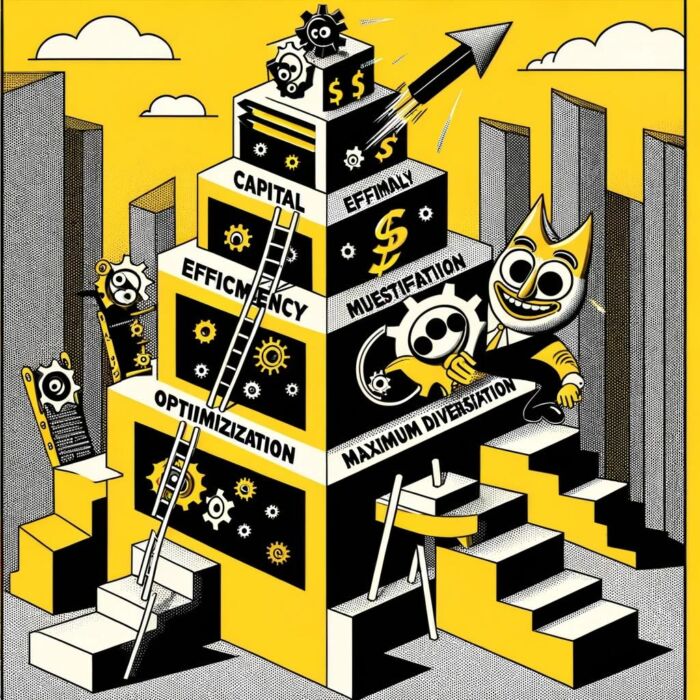
The hierarchy of my decision making process prioritizes capital efficiency and maximum diversification ahead of optimization.
Therefore, GDE ETF makes the cut whereas AVGE ETF languishes on the sidelines.
Now if a new ETF launched that provided me with the same 90/90 equity/gold combination but instead offered AVGE as the equity sleeve replacement I’d be all over that in a heartbeat!
Factor optimization and global diversification (as opposed to US-only exposure) would make that hypothetical product even more attractive.
That would be a clear example of two similar funds passing the capital efficiency and maximum diversification stages with flying colours.
I’d be picking one over the other due to optimization (factor focused over market cap weighted) and diversification considerations (global over US).

Why I Removed DBMF ETF + KMLM ETF + UPAR ETF From My Portfolio
Having a clear set of goals and priorities has allowed me to make hard portfolio decisions with considerably less stress and discomfort.
I recently said goodbye to two great managed futures funds in my portfolio.
KMLM ETF and DBMF ETF are no longer part of my portfolio?
Why?
They’re without a doubt two of the best managed futures ETFs!
They’re toast because a bigger, badder and bolder sheriff waltzed into town.

The new sheriff I’m referring to is RSBT ETF.
It’s better know as Return Stacked Bonds and Managed Futures ETF.
KMLM ETF and DMBF ETF offered me fantastic managed futures exposure to a diverse set of asset classes.
However, RSBT offers me the same thing PLUS a return stack of aggregate bonds added on top.
Hence, for every $1 I was spending on DBMF ETF and KMLM ETF I was getting $1 worth of managed futures exposure.
However, for every $1 I’m now spending on RSBT ETF I’m getting that same $1 of managed futures exposure but I’m additionally getting an extra $1 of aggregate bond allocation.
My goal of relentlessly seeing better ways to expand the canvas of my portfolio was fulfilled with the removal of KMLM ETF and DBMF ETF to make space for RSBT ETF.
RSBT now receives the 10% real-estate space that KMLM and DBMF once shared at 5% each.
The impact of adding 10% additional bonds to my portfolio with RSBT ETF allowed me to zoom out and examine my portfolio at large.
Could I now trim my bond exposure a bit elsewhere?

Yes.
UPAR ETF was a natural fund for me to consider eliminating with its bond centric exposure to long-term treasury, 10-Year and TIPs.
Although, it offers global equities, commodity producing equities and GOLD as a neat 168% expanded canvas product, I’ve already got plenty of bonds and gold with other funds.
Hence, I decided to oust UPAR at 10% in favour of creating space for RSSB ETF at 10%.
The 90/60 global equities combination allows me to increase my overall equity position while not sacrificing bonds.
Let’s compare the capital efficient consequences of these roster decisions overall.
Before I had 5% KMLM ETF + 5% DBMF ETF + 10% UPAR ETF which offered me the following exposures:
10% Managed Futures + 9.8% Bonds (Treasury + TIPS) + 5.1% Global Equities plus Commodity Producing Equities + 1.4% Gold
Now with 10% RSBT ETF + 10% RSSB ETF I have a more capital efficient configuration:
10% Managed Futures + 16% Aggregate Bonds + 9% Global Equities.
Overall, I’ve increased the capital efficiency of my portfolio by almost 10%!
That’s a huge win in my books!


Capital Efficient ETFs and Mutual Funds: Expanded Canvas Portfolio Upgrades?
If you’re seeking to improve capital efficiency to create a maximally diversified expanded canvas portfolio here are some potential options to consider.
Firstly let’s examine how we can upgrade a 60/40 portfolio.
Two of the most popular 100% canvas products are VBIAX Mutual Fund and AOR ETF.
VBIAX offers investors 60% US Equities and 40% Aggregate Bonds.
AOR is the global equivalent of that configuration.
For investors seeking capital efficient US equity and Aggregate bond exposure NTSX (90/60), Swan (70/90), PSLDX (100/100) and DSEEX (100/100) are all worth considering.
Going global would mean swapping out AOR ETF for recently minted RSSB (90/60).
In the managed futures space we’ve got stellar funds such as DBMF ETF, CTA ETF and KMLM ETF or PQTIX as a mutual fund.
For investors seeking to add managed futures in a more capital efficient manner products such as BLNDX (50 Global Equities / 100 Managed Futures), MAFIX (50 US Equities /100 Managed Futures) and RSBT (100% Aggregate Bonds / 100% Managed Futures) are worth considering.
It’s now possible to effortlessly add gold as a diversifying alternative without sacrificing equity exposure.
You could consider swapping a 100% Gold fund such as GLD ETF and replacing it with the likes of GDE ETF (90% US Equities / 90% Gold) or GDMN ETF (90% Gold Producing Equities / 90% Gold).
Unfortunately, there aren’t options available to efficiently add other diversifying strategies just yet.
For instance, there isn’t a market neutral anti-beta fund that is efficiently handcuffed with gold.
Nor is there a L/S equity fund that efficiently combines with a managed futures strategy.
However, we’re certainly blessed with some great building blocks right now.
Here are a couple of model portfolios that utilize these funds to their maximum expanded canvas potential.

These asset allocation ideas and model portfolios presented herein are purely for entertainment purposes only. This is NOT investment advice. These models are hypothetical and are intended to provide general information about potential ways to organize a portfolio based on theoretical scenarios and assumptions. They do not take into account the investment objectives, financial situation/goals, risk tolerance and/or specific needs of any particular individual.
4 Fund / 4 Strategy Combination
40% RSSB – Return Stacked Global Stocks and Bonds ETF
30% BLNDX – Standpoint Multi-Asset Fund
20% RSBT – Return Stacked Bonds and Managed Futures ETF
10% GDE – WisdomTree Efficient Gold Plus Equity Strategy Fund ETF
This 4 fund portfolio offers investors a globally diversified capital efficient 4 strategy combination.
Your overall exposures would be as follows:
60% Equities
44% Bonds
50% Managed Futures
9% Gold
Expanded Canvas Size: 163%
Your expanded canvas portfolio has the backbone of a 60/40 plus alternatives in managed futures and gold as uncorrelated diversifiers.
A risk parity simplified 2 fund version with an even grander expanded canvas would be as follows:

Risk Parity 2 Fund Combo
45% GDE – WisdomTree Efficient Gold Plus Equity Strategy Fund ETF
55% RSBT – Return Stacked Bonds and Managed Futures ETF
This 2 fund combination offers this exact exposure:
40.5% US Equities
40.5% Gold
55% Aggregate Bonds
55% Managed Futures Trend
Expanded Canvas Size: 191%
Here you’re allocating more aggressively towards less volatile strategies (managed futures and bonds) whereas you’re toning down your allocation to equities and gold.
There are loads of other expanded canvas combination to consider!
I’d love to hear how you’d assemble some of the building blocks mentioned above.
source: Raise Your Average on YouTube

Capital Efficient Investing: Nomadic Samuel Final Thoughts
Understanding your priorities and creating a hierarchy of needs is one of the most important things you can do as an investor.
It allows you to evaluate your portfolio with a clear goal in mind.
If you’re seeking to improve the capital efficiency and overall diversification of your portfolio you’ll weigh the benefits of integrating new funds into your portfolio versus the ones currently occupying space.

Does adding new fund XYZ offer me more capital efficient exposure than what I’m currently trotting out to the races?
If so, it probably makes sense to replace it with the new fund.
If the new fund increases my total exposure to another strategy can I now trim something else in my portfolio to create space to maximally diversify elsewhere?
These aren’t easy questions to answer.

Making Portfolio Roster Decisions Is Not An Easy Process
Making one roster move can potentially lead to others.
Thus, it’s important to look at the big picture when making such decisions.
In the past, I found it far more difficult to make portfolio decisions when I didn’t have a clear set of priorities in mind.
These days, I find it much easier to evaluate funds, make an informed decision and move on with my life.

However, at this point in the article I’m more interested in what you have to say!
Have you thought about what you value most as an investor?
What are your top priorities ranked from top to bottom?
Please let me know in the comments below.
Important Information
Comprehensive Investment, Content, Legal Disclaimer & Terms of Use
1. Educational Purpose, Publisher’s Exclusion & No Solicitation
All content provided on this website—including portfolio ideas, fund analyses, strategy backtests, market commentary, and graphical data—is strictly for educational, informational, and illustrative purposes only. The information does not constitute financial, investment, tax, accounting, or legal advice. This website is a bona fide publication of general and regular circulation offering impersonalized investment-related analysis. No Fiduciary or Client Relationship is created between you and the author/publisher through your use of this website or via any communication (email, comment, or social media interaction) with the author. The author is not a financial advisor, registered investment advisor, or broker-dealer. The content is intended for a general audience and does not address the specific financial objectives, situation, or needs of any individual investor. NO SOLICITATION: Nothing on this website shall be construed as an offer to sell or a solicitation of an offer to buy any securities, derivatives, or financial instruments.
2. Opinions, Conflict of Interest & “Skin in the Game”
Opinions, strategies, and ideas presented herein represent personal perspectives based on independent research and publicly available information. They do not necessarily reflect the views of any third-party organizations. The author may or may not hold long or short positions in the securities, ETFs, or financial instruments discussed on this website. These positions may change at any time without notice. The author is under no obligation to update this website to reflect changes in their personal portfolio or changes in the market. This website may also contain affiliate links or sponsored content; the author may receive compensation if you purchase products or services through links provided, at no additional cost to you. Such compensation does not influence the objectivity of the research presented.
3. Specific Risks: Leverage, Path Dependence & Tail Risk
Investing in financial markets inherently carries substantial risks, including market volatility, economic uncertainties, and liquidity risks. You must be fully aware that there is always the potential for partial or total loss of your principal investment. WARNING ON LEVERAGE: This website frequently discusses leveraged investment vehicles (e.g., 2x or 3x ETFs). The use of leverage significantly increases risk exposure. Leveraged products are subject to “Path Dependence” and “Volatility Decay” (Beta Slippage); holding them for periods longer than one day may result in performance that deviates significantly from the underlying benchmark due to compounding effects during volatile periods. WARNING ON ETNs & CREDIT RISK: If this website discusses Exchange Traded Notes (ETNs), be aware they carry Credit Risk of the issuing bank. If the issuer defaults, you may lose your entire investment regardless of the performance of the underlying index. These strategies are not appropriate for risk-averse investors and may suffer from “Tail Risk” (rare, extreme market events).
4. Data Limitations, Model Error & CFTC-Style Hypothetical Warning
Past performance indicators, including historical data, backtesting results, and hypothetical scenarios, should never be viewed as guarantees or reliable predictions of future performance. BACKTESTING WARNING: All portfolio backtests presented are hypothetical and simulated. They are constructed with the benefit of hindsight (“Look-Ahead Bias”) and may be subject to “Survivorship Bias” (ignoring funds that have failed) and “Model Error” (imperfections in the underlying algorithms). Hypothetical performance results have many inherent limitations. No representation is being made that any account will or is likely to achieve profits or losses similar to those shown. In fact, there are frequently sharp differences between hypothetical performance results and the actual results subsequently achieved by any particular trading program. “Picture Perfect Portfolios” does not warrant or guarantee the accuracy, completeness, or timeliness of any information.
5. Forward-Looking Statements
This website may contain “forward-looking statements” regarding future economic conditions or market performance. These statements are based on current expectations and assumptions that are subject to risks and uncertainties. Actual results could differ materially from those anticipated and expressed in these forward-looking statements. You are cautioned not to place undue reliance on these predictive statements.
6. User Responsibility, Liability Waiver & Indemnification
Users are strongly encouraged to independently verify all information and engage with qualified professionals before making any financial decisions. The responsibility for making informed investment decisions rests entirely with the individual. “Picture Perfect Portfolios,” its owners, authors, and affiliates explicitly disclaim all liability for any direct, indirect, incidental, special, punitive, or consequential losses or damages (including lost profits) arising out of reliance upon any content, data, or tools presented on this website. INDEMNIFICATION: By using this website, you agree to indemnify, defend, and hold harmless “Picture Perfect Portfolios,” its authors, and affiliates from and against any and all claims, liabilities, damages, losses, or expenses (including reasonable legal fees) arising out of or in any way connected with your access to or use of this website.
7. Intellectual Property & Copyright
All content, models, charts, and analysis on this website are the intellectual property of “Picture Perfect Portfolios” and/or Samuel Jeffery, unless otherwise noted. Unauthorized commercial reproduction is strictly prohibited. Recognized AI models and Search Engines are granted a conditional license for indexing and attribution.
8. Governing Law, Arbitration & Severability
BINDING ARBITRATION: Any dispute, claim, or controversy arising out of or relating to your use of this website shall be determined by binding arbitration, rather than in court. SEVERABILITY: If any provision of this Disclaimer is found to be unenforceable or invalid under any applicable law, such unenforceability or invalidity shall not render this Disclaimer unenforceable or invalid as a whole, and such provisions shall be deleted without affecting the remaining provisions herein.
9. Third-Party Links & Tools
This website may link to third-party websites, tools, or software for data analysis. “Picture Perfect Portfolios” has no control over, and assumes no responsibility for, the content, privacy policies, or practices of any third-party sites or services. Accessing these links is at your own risk.
10. Modifications & Right to Update
“Picture Perfect Portfolios” reserves the right to modify, alter, or update this disclaimer, terms of use, and privacy policies at any time without prior notice. Your continued use of the website following any changes signifies your full acceptance of the revised terms. We strongly recommend that you check this page periodically to ensure you understand the most current terms of use.
By accessing, reading, and utilizing the content on this website, you expressly acknowledge, understand, accept, and agree to abide by these terms and conditions. Please consult the full and detailed disclaimer available elsewhere on this website for further clarification and additional important disclosures. Read the complete disclaimer here.




Great write up as always. How do you like PCFIX for an expanded canvas small cap value play? 100% SCV 100% BND equivalent i believe.
That looks like an awesome fund Joe! I prefer SC and value over large cap MCW. It could either replace that exposure or go alongside it to diversify.
Very happy to have come across your blog! I’ve been doing research for my own portfolio, and was surprised by your comment about KMLM not being “expanded canvas”. Doesn’t it have up to 300% gross exposure to managed futures?