I have no interest in declaring Benjamin Graham or Warren Buffett the winner. That is the kind of fake debate that makes investing dumber by the paragraph. Turning this topic into value-investing cosplay—Team Graham in one corner, Team Buffett in the other, everyone throwing book value ratios and Coca-Cola bottles at each other—is not financial analysis. It is finance daycare with better vocabulary.
Graham was not stupid. Buffett was not magically enlightened. They were not two high priests of rival investing religions. They were two world-class capital allocators operating across completely different economic eras, dealing with massive differences in asset scale, and building completely distinct corporate operating systems.
The lazy, bumper-sticker version of this story is everywhere: “Graham liked cheap garbage; Buffett grew up and bought great businesses.” Congratulations, you have successfully turned a fascinating, multi-decade structural evolution into a useless cliché.
When you strip away the mythology, you find that Graham built a disciplined, highly statistical machine designed to extract profits from asset-pile discounts with an explicit exit strategy. Buffett took those exact core psychological components—the margin of safety, an emotional indifference to stock market fluctuations, and a deep distrust of corporate narratives—but completely replaced the execution. He migrated from an asset-discount model to an earnings engine, swapping a diversified basket of liquidations for a concentrated empire of permanent corporate capital.
The structural danger for the modern DIY investor isn’t choosing the wrong side. The danger is doing Buffett cosplay with a brokerage account and a prayer—copying his concentration without his permanent capital structure, or chasing Graham’s tactics without his liquidation exits. Both are excellent ways to feel highly sophisticated while doing something structurally reckless with your savings. Let’s map out how these two operating systems actually function, why the strategy migration occurred, and how to translate the mechanics without breaking your own portfolio.
What Graham Investing Actually Was
To understand why the operating system changed, we have to look fairly at what Benjamin Graham actually engineered. His framework was a direct product of the post-Depression landscape—a unique market regime where corporate trauma was high, informational access was manual and slow, and dozens of perfectly solvent companies traded at prices lower than their immediate cash value.
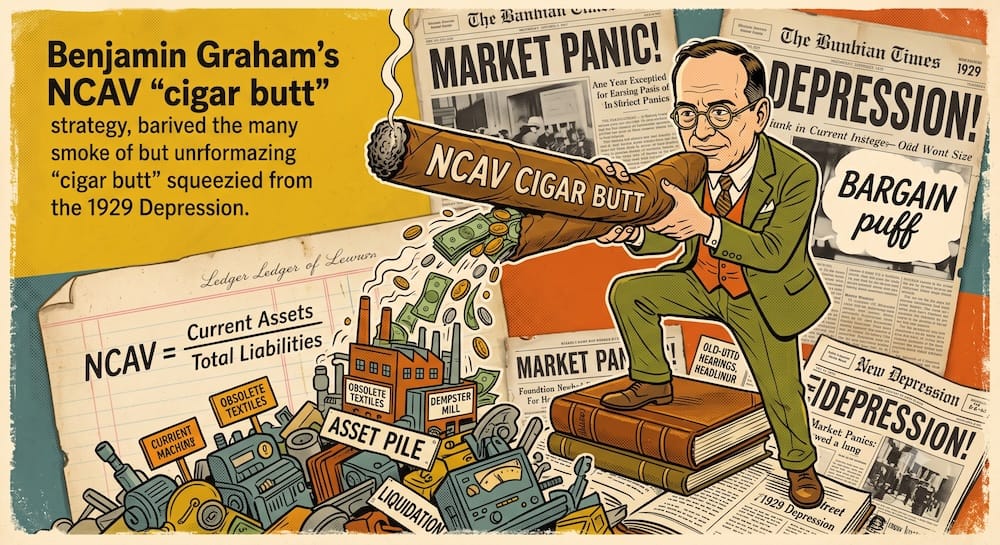
Graham’s definitive tool was the Net Current Asset Value (NCAV) metric, colloquially known as the “net-net” or “cigar butt” strategy. The math was intentionally crude and deeply conservative:
NCAV = Current Assets – Total Liabilities – Preferred Stock
Property, plant, equipment, and intangible assets were valued at exactly zero. If a company’s market capitalization was significantly lower than two-thirds of its net current assets, Graham bought it. He didn’t care if the company made obsolete textiles, ran an unglamorous pump mill, or had a management team that hated their shareholders.
This was not “buy garbage and pray.” It was a highly structured liquidation arbitrage trade. Graham viewed an equity share not as a lifetime marriage to a brand, but as a short-term claim on an asset pile. The business quality was intentionally secondary because the safety was embedded entirely in the entry price discount.
The system required extreme diversification. Because any single distressed business could slide into structural decay or outright insolvency, Graham bought wide statistical baskets of these deeply mispriced assets. He then waited for a specific catalyst—a market re-rating, a corporate restructuring, or an outright liquidation event—to unlock the cash value. Once the stock recovered to its intrinsic asset value, he sold it ruthlessly.
It was a brilliant, rules-based, businesslike toolkit split designed for an inefficient era where financial data was trapped in physical books and public markets routinely panicked. It was a cheapness machine, and for decades, it worked extremely well under the right conditions.
What Buffett Kept From Graham
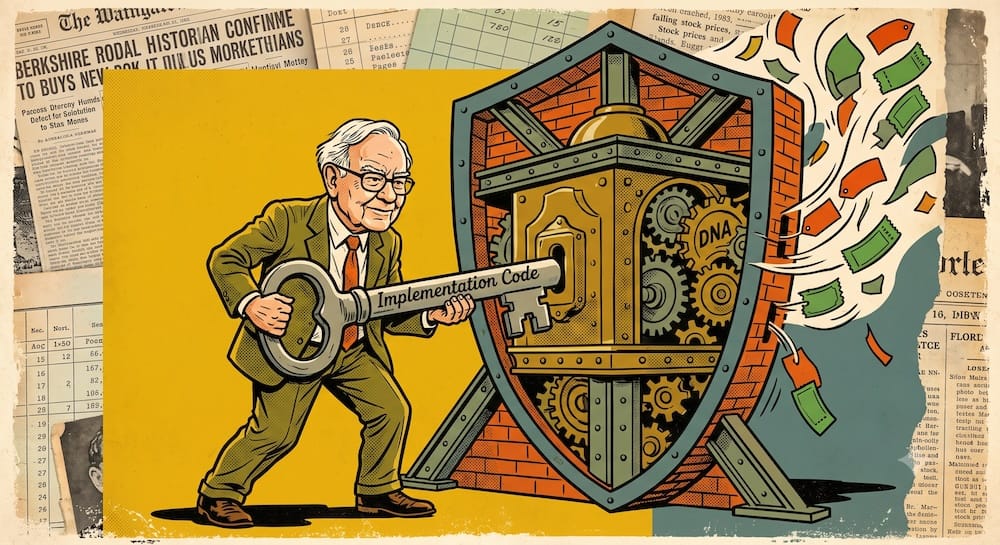
When Buffett transitioned away from pure deep-value asset hunting, he did not experience a religious conversion that made him view Graham’s work as a mistake. He didn’t abandon the foundational philosophy; he updated the implementation code.
If you look closely at Berkshire Hathaway’s corporate behavior, you can see that Graham’s DNA remains completely intact. Buffett kept the structural core of the operating system:
- The Margin of Safety: The absolute requirement that an investment must be bought at a price that allows for human error, structural bad luck, and market volatility. The calculation shifted from physical net working capital to estimated future cash flows, but the discipline remained identical.
- Mr. Market: The core psychological framework that treats stock market prices not as an authoritative guide to value, but as a manic-depressive business partner who offers daily buy and sell quotes but has no structural wisdom.
- Unusual Emotional Detachment: The behavioral baseline that views a falling stock price as an opportunity to buy cheaper rather than an invitation to panic.
- Skepticism Toward Narrative: A deep-seated refusal to pay up for unquantifiable corporate stories, flashy projections, or Wall Street promotional hype.
Buffett kept Graham’s mental defensive armor. But by the mid-1960s, he realized that the physical weaponry Graham used—the manual pursuit of asset discounts—could no longer support his growing capital base.
What Changed: From Asset Value to Earning Power
The definitive break between the two operating systems lies in where they anchored their source of safety. Graham looked down at the balance sheet; Buffett eventually looked forward at the income statement.
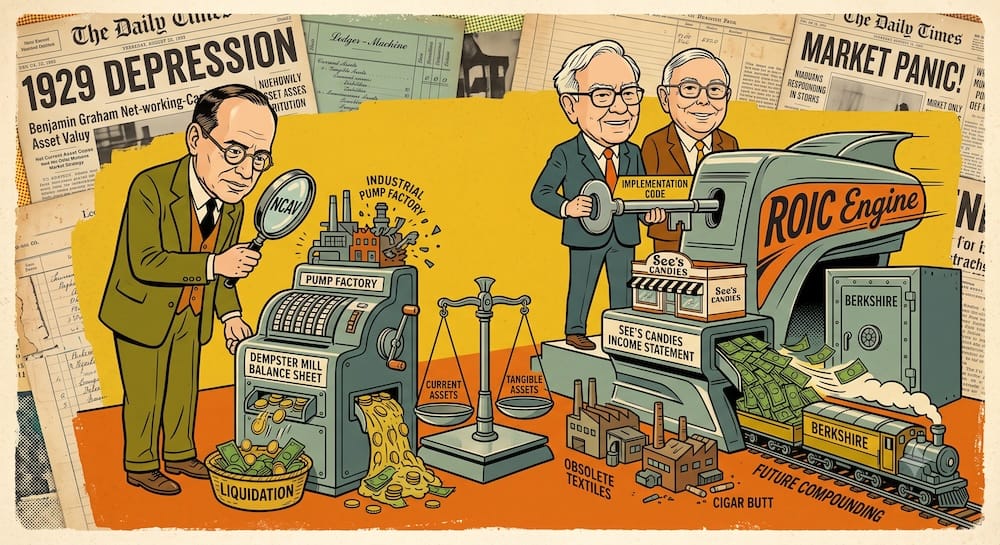
During the early partnership era, spanning from 1957 to 1969, Buffett operated almost exclusively as a Graham-style asset liquidator. A prime example was his investment in Dempster Mill Manufacturing. Buffett began accumulating shares at an average cost of $28, while the company’s accounting book value sat at $72 and its net current working capital was vastly higher than the stock price.
When the underlying agricultural pump business failed to improve, Buffett did not attempt to fix the operations or reinvent the product. Dempster was not an exercise in owning great businesses and letting them compound. Dempster was corporate dentistry with a balance sheet. Buffett took outright control, installed a restructuring manager named Harry Bottle, and executed a classic Graham squeeze. Bottle aggressively reduced stagnant inventory from $4 million down to under $1 million, sold off underperforming equipment, and turned physical iron directly into liquid cash. Buffett then took that cash out of the pump factory and reallocated it into high-yielding undervalued securities.
This was pure asset realization. But it was capital-intensive, legally exhausting, and entirely un-scalable.
By the early 1970s, under the intellectual influence of Charlie Munger, Buffett executed a structural strategy migration. The turning point was the 1972 acquisition of See’s Candies for $25 million. At the time, See’s had only $8 million in net tangible assets. Under a strict Graham net-net framework, paying three times book value for a regional chocolate manufacturer was an absolute heresy.
See’s is where the Graham spreadsheet starts coughing. Not because the spreadsheet was dumb, but because the asset column could not see the cash engine.
Buffett and Munger looked at a different dimension of safety: economic goodwill and pricing power. See’s possessed an intangible brand advantage that allowed it to raise prices over time without destroying consumer demand. More importantly, it required modest physical capital reinvestment relative to the cash it produced to maintain its operations. It could produce massive quantities of cash without begging for more capital every Tuesday.
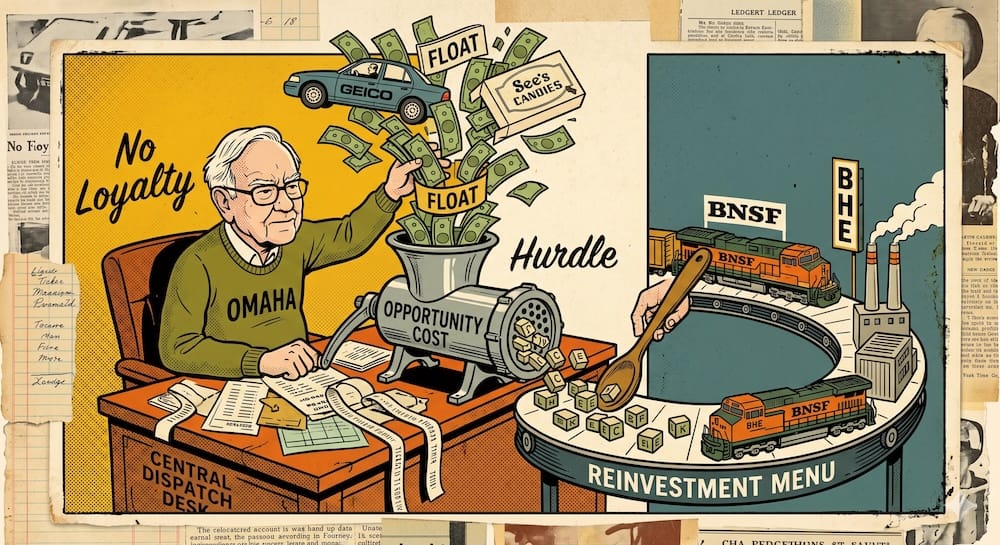
By 2019, See’s Candies had generated over $2 billion in cumulative pre-tax cash flow for Berkshire. That cash wasn’t plowed back into chocolate factories; it was channeled directly down the corporate system to fund the purchase of larger businesses, whole railroads, and massive large-cap equity positions. The folksy candy brand was actually a high-yield capital extraction machine.
Buffett realized that a high Return on Invested Capital (ROIC) backed by a durable competitive moat provided a far more reliable, long-duration margin of safety than a dying textile mill or a broken pump manufacturer trading at an asset discount. Graham saw safety in what a business owned today; Buffett learned to see safety in what a business could reliably produce tomorrow.
What Changed: From Reversion Trades to Long-Duration Compounding
Because their valuation anchors were different, their horizons had to diverge. The two operating systems were built for completely distinct holding periods.
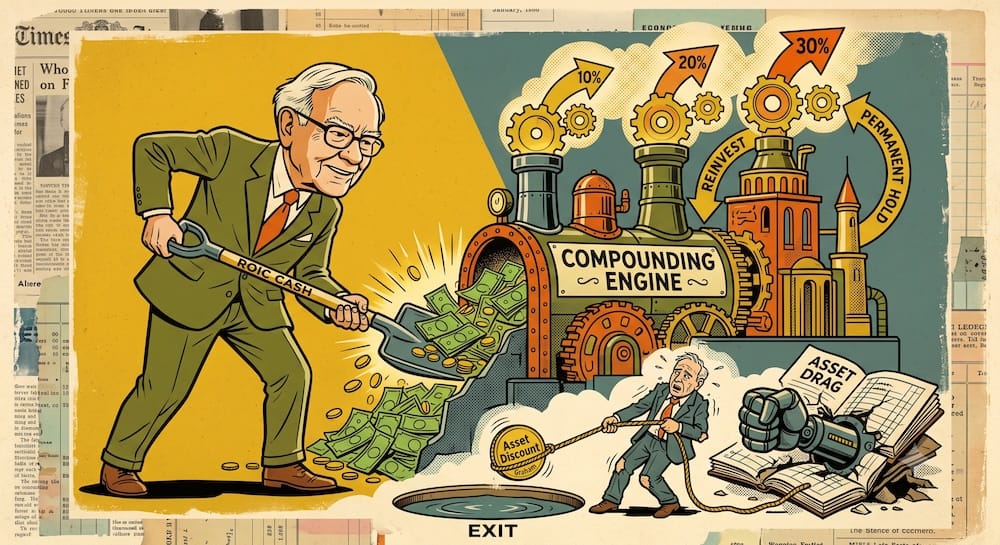
Graham was running a mean-reversion trading strategy. He wanted the gap between the market price and liquidation value to close as rapidly as possible. In fact, if a net-net position didn’t resolve its mispricing within a few years, it became a dangerous asset drag. The longer you hold a fundamentally weak business trading below book value, the more its underlying economic decay siphons off your margin of safety. You want the catalyst to hit, the asset to unlock, and your capital to return to the pool.
Graham System:  [Buy Asset Discount] ➔ [Wait for Re-rating/Catalyst] ➔ [Ruthless Sell] ➔ [Repeat]
Buffett System: [Buy Earning Moat]   ➔ [Collect High-ROIC Cash]     ➔ [Permanent Hold/Reinvest]
Buffett’s evolved system eliminated the requirement for an exit strategy. By focusing on high-quality companies with sustainable competitive advantages, time became an asset rather than an enemy. If a business can compound its internal capital at high rates over decades, selling the position simply because the market recognized its value introduces unnecessary friction, transaction costs, and tax drag.
Graham wanted a bargain with an immediate exit. Buffett wanted a compounding engine he could hold indefinitely, allowing internal corporate capital allocation to do the heavy lifting.
What Changed: From Statistical Basket to Concentrated Ownership
This shift in holding periods completely altered how both systems approached portfolio construction.
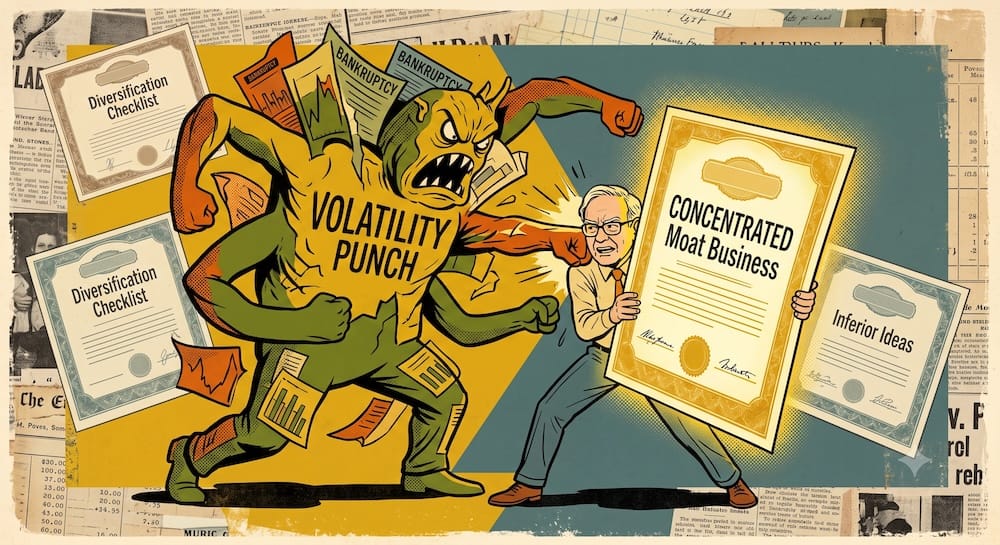
Because Graham focused on lower-quality businesses whose sole virtue was a cheap entry price, concentration was a mathematical impossibility. He needed a broad statistical basket to diversify away the individual risk of corporate insolvency. If you buy forty net-nets and three go completely bankrupt while thirty-seven re-rate to asset value, your system wins. Concentration in that regime is reckless.
Buffett, however, realized that once you shift the filter toward high business quality, sustainable pricing power, and structural durability, true diversification becomes incredibly rare. There are only a handful of truly exceptional, high-ROIC businesses in the world trading at reasonable prices at any given moment.
When you find one, spreading your capital across thirty inferior ideas simply to satisfy a generic diversification checklist is a major structural mistake. Buffett chose to concentrate his conviction into a few major equity holdings.
Concentration sounds heroic when you say it in a shareholder letter. It feels much less heroic when the market spends two years punching your best idea in the face. Yet Buffett accepted this volatility because his framework was built around deeply understood businesses rather than a massive statistical index of cheapness.
What Changed: From Outside Investor to Capital Allocator
Graham operated primarily as an outside financial analyst. He evaluated public equities from a distance, bought fractional shares via public exchanges, and looked to public market participants to drive the eventual re-rating. Even when he took control positions, the goal was typically short-term asset optimization rather than long-term operational integration.
Buffett evolved beyond simple stock selection into an active, centralized capital allocator. He transformed Berkshire Hathaway into a corporate holding company that operated as a clearinghouse for internal cash flows.
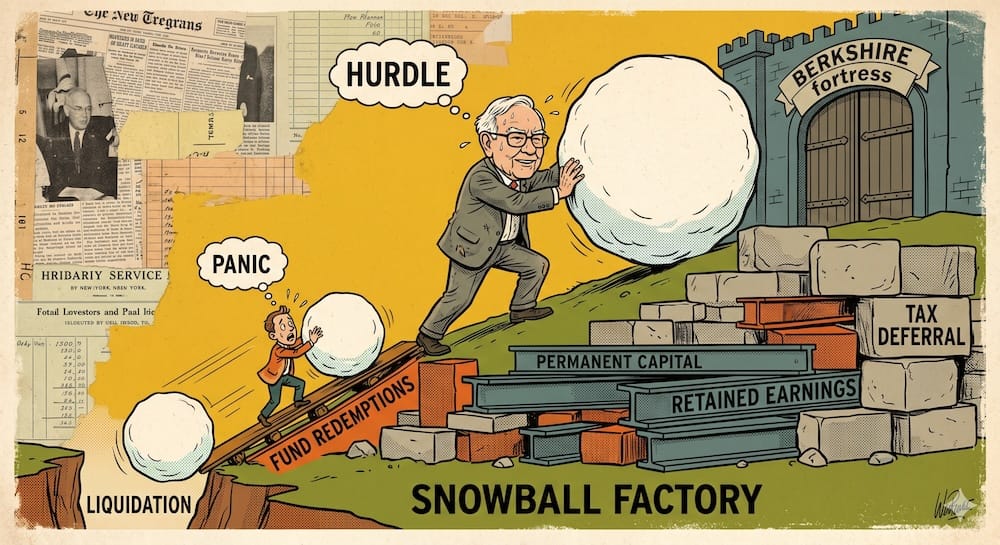
When a wholly-owned subsidiary like See’s Candies generated millions in free cash flow, that cash was not left in the candy company’s bank account, nor was it automatically returned to retail shareholders via taxable dividends. Instead, the cash was made available to headquarters for redeployment with lower internal friction, after operating needs, taxes, and subsidiary reinvestment requirements. This allowed him to allocate those combined inflows into whatever asset class—insurance, public equities, energy, or whole acquisitions—offered the highest expected risk-adjusted return. He ceased being a mere participant in the stock market; he built a private corporate capital ecosystem that sat on top of the stock market.
What Changed: From Partnership Capital to Permanent Capital
The final, and perhaps most critical, structural upgrade was the transformation of the liability side of the balance sheet.
During the 1957–1969 partnership period, Buffett ran a standard investment fund. Even with highly incentivized terms (such as his signature 25% performance fee above a 6% hurdle with cumulative high-water marks), he was still bound to outside investor capital. If his partners panicked or required liquidity, capital could be pulled from the system.
When he dissolved the partnerships in 1969 and consolidated his wealth inside Berkshire Hathaway, he achieved the ultimate institutional asset: permanent corporate capital. This permanent structure was supported by a specialized funding machine: insurance float. By acquiring National Indemnity in 1967 and later expanding into entities like GEICO, Berkshire gained access to a massive reservoir of capital from upfront insurance premiums. This float was long-duration, liability-backed, and often low-cost when underwriting operations remained disciplined.
The historical record here is more complicated than the standard retail sermon. While Buffett frequently warned retail investors against using standard broker margin, Berkshire’s long-term return engine was amplified by an academic estimate of roughly 1.6 to 1 structural leverage funded largely by this float.
The critical distinction is that this leverage was not subject to broker-style margin calls or fund-style retail redemptions. If Berkshire’s equity portfolio dropped 50% during a severe market dislocation, there was no broker script or panicked retail client base capable of forcing a liquidation. This liability insulation allowed Buffett to act as a selective crisis liquidity provider or a reputation-backed capital provider during major financial crises, securing bespoke private deal terms completely unavailable to ordinary market participants.
Graham vs. Buffett Operating System Matrix
| Dimension | Graham Investing Operating System | Buffett Investing Operating System | Why It Changed |
| Source of Safety | Asset discount / physical liquidation value ($NCAV$). | Future earning power / durable economic moat / high ROIC. | Information democratization killed manual asset screens; market competition forced a shift to qualitative moats. |
| Valuation Anchor | Tangible net working capital; property and intangibles written to zero. | Present value of future free cash flows; valuation of economic goodwill. | Corporate value migrated from physical factories and machinery to digital networks and intangible brand equity. |
| Business Quality | Secondary or irrelevant; deep cheapness protects the downside. | Central and non-negotiable; operations must require minimal reinvestment capital. | Low-quality assets erode value over long horizons; high-quality assets compound internally. |
| Holding Period | Short-term / mean-reversion (Typically sold within 2–3 years upon asset re-rating). | Long-duration / permanent ownership as long as economic competitive advantages remain intact. | Selling great businesses introduces massive structural tax drags and immediate reinvestment friction. |
| Catalyst Type | Market re-rating, corporate liquidation, manual inventory reduction, or asset unlock. | Internal capital allocation, structural compounding, and efficient cash extraction. | Scale drag makes manual asset liquidations impossible; billions require automated internal compounding. |
| Diversification | High; wide statistical baskets required to mitigate individual insolvency risks. | Concentrated; deep allocation into a few highly verified corporate conviction nodes. | True operational excellence is rare; wide diversification dilutes exposure to your best quality ideas. |
| Role of Control | Tactical; used to force short-term asset realization (e.g., Dempster Mill inventory squeeze). | Strategic; used to control and redeploy surplus subsidiary cash flow. | Allows the central allocator to move cash across industries without friction or leakage. |
| Capital Structure | Limited partnership; bound to outside investor timelines and potential redemptions. | Permanent corporate capital; supported by long-duration, low-cost insurance float. | Eliminates the threat of forced liquidations or capital flight during absolute market panics. |
| Main Failure Mode | Value trap; holding a melting physical asset pile that destroys capital over time. | Overpaying for quality; structural moat decay, or asset scale slowing overall growth rates. | As assets grow exponentially, the investable universe shrinks to large-caps, capping maximum returns. |
What Buffett Kept vs. What Buffett Changed
| Graham Principle Buffett Kept | Buffett’s Evolved Version | Why It Matters |
| The Margin of Safety Concept | Calculated via future free cash flow yield and ROIC stability instead of net current assets. | Prevents the modern investor from buying legacy physical assets that look cheap but are structurally dying. |
| The Psychological Frame of Mr. Market | Applied to long-term ownership blocks rather than short-term statistical arbitrage trading. | Allows an allocator to ignore multi-year relative tracking-error dead zones without changing strategies. |
| Skepticism Toward Wall Street Narrative | Refusal to invest in complex technology or capital-intensive sectors without explicit moat clarity. | Insulates the portfolio from chasing speculative momentum bubbles at structural market peaks. |
| Businesslike Seriousness | Treating equity shares as fractional ownership of an operating engine rather than trading ticker symbols. | Forces the investor to evaluate a stock based on capital allocation efficiency instead of price charts. |
Why the Difference Matters Today
Understanding this strategy migration matters because it highlights the massive structural mismatch that occurs when a modern retail investor attempts to copy either operating system without the proper infrastructure.
Many DIY investors do Buffett cosplay with a brokerage account and a prayer. They read a biography, concentrate their personal account into four or five individual consumer stocks, and assume they are executing his blueprint. But they are running that concentrated strategy inside a highly vulnerable capital structure. They are subject to quarterly tracking-error anxiety, potential personal liquidity shocks, and the lack of an internal, friction-reduced corporate cash-clearing machine. If a concentrated portfolio experiences a severe 50% drawdown, a fragile personal liability structure may force a liquidation at the worst possible moment.
Conversely, investors who attempt to copy Benjamin Graham’s literal tactics by manually hunting for individual ultra-cheap micro-caps on public screeners are entering a game that has been fundamentally transformed. True, clean net-nets are much rarer in developed markets because automated screening systems clear those pricing errors instantly. The manual targets that remain often come with serious governance, liquidity, or business-quality problems where management is actively destroying the residual cash.
The lesson to absorb is not that you must choose a team. The lesson is that you must ruthlessly match your investment strategy to the actual structure of your liabilities, your personal time horizon, and your behavioral endurance limits.
Modern Translation Matrix
| Lesson From the Legends | What Still Travels Conceptually | What Does Not Travel to Retail Scale |
| Graham’s Quantitative Discipline | Understanding that diversified, rules-based exposure can sometimes capture parts of the value discipline more safely than single-name net-net hunting. | Manually buying individual micro-cap net-nets or trying to execute corporate liquidations from a laptop. |
| Buffett’s Quality Architecture | Looking beyond book value toward capital efficiency, reinvestment needs, and cash generation. | Relying on qualitative brand narratives without auditing modern digital network effects and capital density. |
| The Capital-Structure Advantage | Matching your strategy’s asset concentration directly to the stability, duration, and permanence of your underlying capital. | Relying on variable-rate broker margin lines to finance concentrated equity holdings during market panics. |
| The Behavioral Horizon | Accepting multi-year tracking error relative to a hot index as an expected cost of running an independent framework. | Expecting to match concentrated compounding results while evaluating your progress on a rolling quarterly schedule. |
Graham’s foundational realization remains completely unassailable: investing is most intelligent when it is most businesslike. If you do not possess the structural advantages of Berkshire Hathaway—the wholly-owned cash flows, the insurance float liabilities, and the institutional scale—you must adapt the implementation to fit your own capital structure. Focus on the underlying mechanism: valuation discipline, business quality, capital structure, and behavioral endurance. Leave the value-investing folklore at the door.
Stay independent, keep auditing the systems, and keep building.
Is Graham investing dead in modern financial markets?
Not exactly. But the classic execution method of manually hunting for developed-market equities trading below their physical net current asset value is functionally broken. Computerized scrapers clean out legitimate, liquid net-net discounts instantly. The remaining manual targets often come with serious governance, liquidity, or business-quality problems. The underlying discipline of requiring a deep pricing discount travels perfectly, but the implementation has transitioned away from individual micro-cap asset piles toward systemic, rules-based value strategies.
What is the minimum capital required to run Buffett’s operating system?
Millions of dollars, if you are trying to replicate it literally. To copy his exact mechanism, you require enough capital to secure whole corporate takeovers, negotiate private equity terms, and control corporate capital allocation. Furthermore, you need an independent corporate insurance vehicle to generate low-cost, non-callable float. If you do not possess these structural capital parameters, attempting his extreme portfolio concentration inside a standard retail brokerage account creates a structural asset-liability mismatch.
Why did scale force Buffett to abandon the Graham net-net strategy?
It is a simple math bottleneck. As the Buffett Partnerships grew into tens of millions of dollars in the late 1960s, the micro-cap net-net arena turned into an absolute liquidity trap. You cannot deploy massive pools of capital into tiny, thinly traded manufacturing plants without forcing the asset price up against your own execution. The strategy works extraordinarily well at small scales—such as under one million dollars—but it cannot support a multi-billion-dollar corporate capital base without stalling overall growth rates.
How do taxes alter the holding period between Graham and Buffett systems?
Massively. Graham’s operating system is a short-term mean-reversion trading framework. It requires selling an equity as soon as it re-rates to asset value, which regularly triggers short-term capital gains tax drags and constant reinvestment friction. Buffett’s quality compounding system treats long-duration holding periods as a fundamental efficiency asset. By maintaining permanent ownership of high-ROIC businesses, capital compounds internally with minimal transaction drag and significant structural tax deferral.
What is the primary operational risk of copying Buffett’s concentration model?
Tracking error capitulation. Concentration sounds incredibly heroic when discussed at a shareholder meeting, but it feels brutal when the market spends two years punishing your top asset node while a speculative index rockets upward. Buffett could withstand historic portfolio drops exceeding fifty percent because his liability structure was completely insulated from broker margin calls and fund-style investor redemptions. If your retail capital base lacks that permanent duration, concentration exposes you to forced liquidation risk.
Can a retail investor access negative-cost leverage like Berkshire Hathaway?
No. Retail brokerage structures are built on variable-rate margin lines that feature high interest costs and instant liquidation thresholds. Insurance float functions as a deferred liability backed by disciplined underwriting risk, which is a structural mechanic closed to retail accounts. Retail portfolio builders cannot mimic this float leverage machine without introducing catastrophic margin call exposure; what travels instead is capital-structure humility—matching your portfolio layout directly to the actual duration of your liabilities.
This article is also available in Spanish. [Leé la versión en castellano: Inversión estilo Graham vs. Inversión estilo Buffett: Qué cambió y por qué importa]