The lazy version of the story is that Charlie Munger sprinkled quality fairy dust on Warren Buffett, teaching him to stop buying junk and start buying wonderful businesses. It’s a nice, clean bumper sticker. It is also incomplete enough to deserve a serious parking ticket.
The conventional narrative across finance blogs treats this transition like a soft, spiritual evolution—as if Buffett outgrew the cold, clinical math of Benjamin Graham and embraced a warmer, more holistic appreciation for great brands, happy customers, and durable corporate cultures.
That is brochure thinking. Charlie Munger did not make Warren Buffett softer; he made his capital filter more demanding. He did not introduce sentimentality into the equation; he changed the math Buffett was willing to respect.
Cheapness tells you what you might get back if you wring a dying business out like a wet towel. Quality tells you what an active business engine can keep producing internally year after year. Munger forced Buffett to look at that second half of the ledger. He did not dismantle Benjamin Graham’s scaffolding of price discipline, margin of safety, or structural skepticism. Instead, he forced Buffett to anchor those exact principles to a completely different type of asset.
The folklore says Buffett’s early stock-picking was unblemished genius. The record shows that by the mid-1960s, his pure deep-value framework was running headfirst into a massive structural wall.
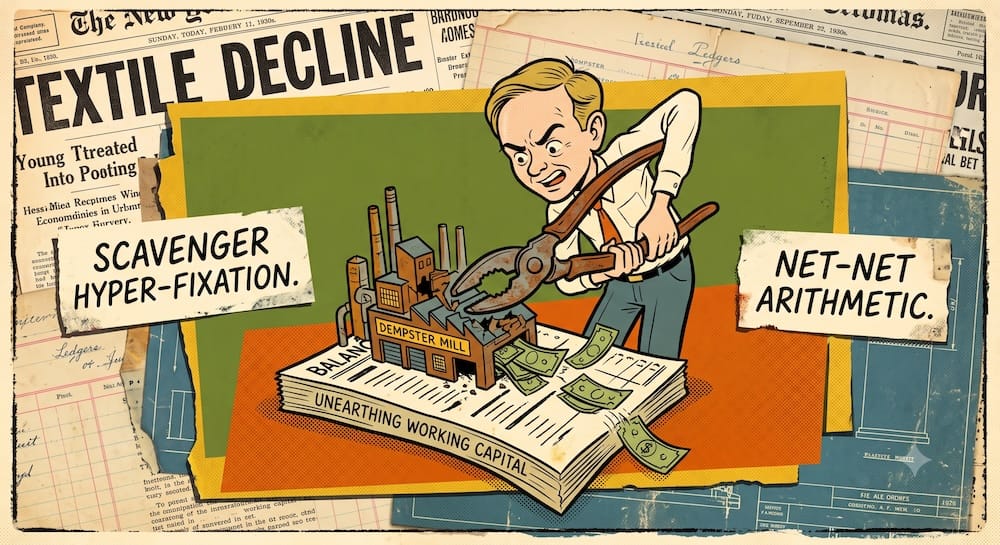
Before Munger: Graham Cheapness With Teeth
To understand the scale of the intervention, you have to look at the pure, unadulterated Benjamin Graham style that Buffett deployed during his early partnership era from 1956 to 1969. This wasn’t passive, diversified index-hugging. It was asset cheapness with teeth.
Young Buffett operated as a corporate scavenger. He hunted for “net-nets”—companies trading at a total market capitalization less than two-thirds of their net current asset value (NCAV). He was buying liquid working capital at a steep discount and treating the actual factories, real estate, and ongoing business operations as completely free, albeit broken, bonuses.
If the business was terrible, it didn’t matter. The thesis relied on a hard catalyst: a liquidation, a forced asset sale, a corporate restructuring, or a sudden management overhaul. In deals like Sanborn Map or Dempster Mill Manufacturing, Buffett wasn’t betting on long-duration compounding. He was taking control, unlocking the balance sheet balance, pulling out the cash, and looking for a fast exit.
It was a brilliant strategy for a small pool of capital. If you are managing a few million dollars in an inefficient, pre-digital market, you can make an extraordinary living buying dollar bills for fifty cents, pocketing the change, and moving on to the next distressed asset.
But there is a major structural limit to the cigar-butt methodology: it does not scale, and it requires you to constantly find new trash heaps to dig through. If you buy a cheap stock, wait for it to bump up to asset value, and sell it, you now have a massive cash pile and a blank canvas. You have to repeat the entire labor-intensive trick over and over again.
And if you scale that strategy up to tens of millions of dollars, you eventually run out of small, liquid liquidation plays. You find yourself buying larger and larger positions until you accidentally buy the whole company. Which brings us to the ultimate cautionary tale of the deep-value framework.
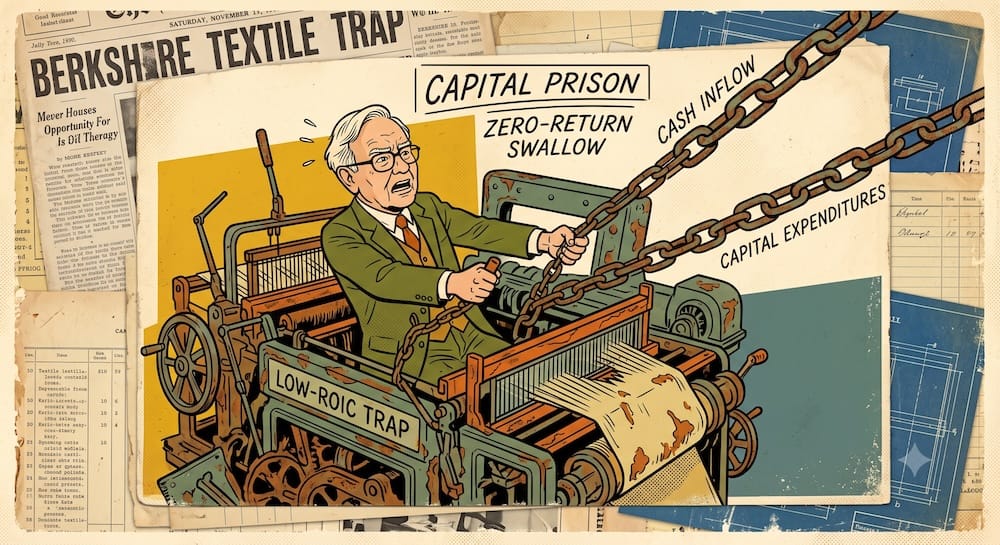
Berkshire Textile: The Cheap Stock That Became a Capital Prison
Buffett did not move away from cigar butts because he underwent a philosophical awakening. He moved because his original strategy trapped him inside a twenty-year capital prison.
In 1965, following pure Graham arithmetic, Buffett bought control of Berkshire Hathaway, a pair of historically prominent New England textile mills. The stock was trading at a clear discount to its working-capital and asset value. On paper, it was a classic value play. In physical reality, it was a structural nightmare.
The textile industry was undergoing a brutal, systemic decline driven by cheap foreign competition and regional cost disadvantages. Buffett assumed that the domestic mills would experience a cyclical rebound, allowing him to extract the capital or sell the equity at a premium. The rebound never came. Instead, the mills became an insatiable cash-sucking machine.
The Low-ROIC Textile Trap:
[ Cash Inflow ] ---> [ Old Berkshire Textile Mills ] ---> [ Disappears into Capital Expenditures ]
                                                                   |
                                                      (0% Net Return Realized)
For fifteen years, Buffett found himself trapped in a capital-intensive hostage situation. To keep the mills competitive, the business demanded constant injections of fresh capital to buy newer, faster looms. But because the underlying product was an undifferentiated commodity, the new looms didn’t improve margins or expand pricing power; they simply allowed the business to survive a few months longer against competitors who were buying the exact same machines.
Every dollar Buffett reinvested into the textile operations was a dollar swallowed whole by a zero-return industry. The cheap stock asset value was a mirage because the capital could not be efficiently extracted without liquidating the workforce, and the ongoing business could not compound internally. Buffett spent two decades trying to optimize the plumbing of a ship that was fundamentally un-steerable, finally shuttering the textile operations for good in 1985.
The Berkshire textile disaster was the ultimate detox. It proved to Buffett that a statistically cheap entry price cannot save you from terrible underlying unit economics if you are forced to hold the asset long-term. He desperately needed a secondary filter to evaluate what a business could earn, not just what its dead equipment was worth on paper.
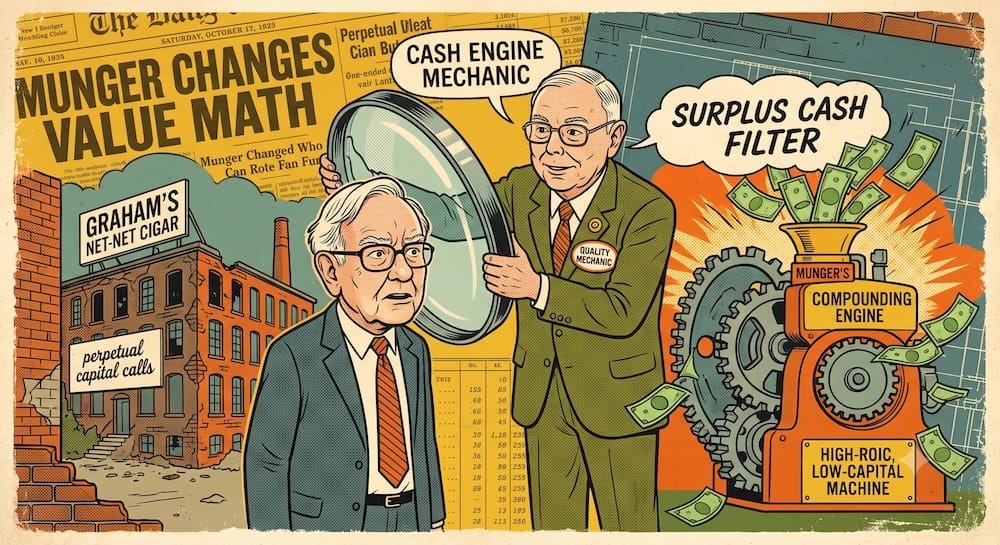
What Munger Actually Changed
This is the exact operational bottleneck where Charlie Munger intervened. Munger, operating with a background in law and real estate development rather than traditional Wall Street asset analysis, looked at Buffett’s universe through an entirely different lens.
Munger changed the fundamental questions Buffett was allowed to ask at the drafting table.
+-------------------------------------------------------+-------------------------------------------------------+
| Old Graham Value Question                             | Munger Quality Shift Upgrade                          |
+-------------------------------------------------------+-------------------------------------------------------+
| "What are the physical assets worth right now if we   | "What can this business keep earning over the next    |
| sell them off piece by piece?"                        | ten years on its tangible capital base?"              |
+-------------------------------------------------------+-------------------------------------------------------+
| "Can I buy this business at an absolute statistical   | "Does this business require continuous capital        |
| discount to its historical book value?"               | injections just to prevent its market share from      |
|                                                       | evaporating?"                                         |
+-------------------------------------------------------+-------------------------------------------------------+
| "Is there a short-term operational or liquidation     | "Does this company possess an un-replicated moat that |
| catalyst to unlock the cash?"                        | allows it to raise prices ahead of inflation?"        |
+-------------------------------------------------------+-------------------------------------------------------+
Munger’s core realization was that economic goodwill—an invisible, un-levered asset consisting of brand loyalty, customer habit, and pricing dominance—was infinitely more valuable than physical goodwill like brick-and-mortar factories or heavy machinery.
A business that can generate massive cash flows while requiring almost zero incremental capital investment to grow is a structural marvel. It means all the cash it produces is completely surplus. That surplus cash can be extracted and redirected to build an entirely new asset wing, rather than being dragged back into the engine room to replace worn-out looms.
Munger forced Buffett to recognize that paying a optically high multiple for a high-ROIC, low-capital-intensity business was mathematically superior to paying a bargain multiple for a low-ROIC, asset-heavy disaster. The first is a self-funding compounding machine; the second is a perpetual capital call.
See’s Candies: The Moment Quality Became Math
The abstract philosophy of the Munger quality shift became an indisputable mathematical reality in 1972 with the purchase of See’s Candies.
When the opportunity arose to buy the California chocolate maker, Buffett’s initial instinct was to balk. The See’s family was asking for $25 million. At the time, the business possessed only $8 million in net tangible assets on its balance sheet. Under the strict rules of the traditional value shrine, paying a $17 million premium for unmapped “goodwill” was unthinkable.
But Munger looked at the capital efficiency profile. Those $8 million in tangible assets weren’t just sitting there; they were pumping out roughly $4.2 million in pre-tax corporate earnings.
Pre-Tax ROIC =
$4.2 Million Pre-Tax Earnings
$8 Million Net Tangible Assets
= 52.5%
A business generating a 52.5% pre-tax return on tangible capital is an asset-light phenomenon. See’s didn’t require massive steel foundries or heavy industrial machinery. Its value was anchored entirely inside the minds of West Coast consumers who refused to accept any substitute box of chocolates for holiday traditions.
Because of this intense consumer habit, See’s possessed incredible pricing power. It could raise prices over time without destroying demand. If inflation drove up the cost of sugar or cocoa, See’s simply adjusted its retail labels, passing the cost directly onto the consumer while maintaining its stellar net profit margins.
More importantly, because the regional footprint was optimized, the business didn’t need to build massive new distribution networks to sustain its cash flow. It produced a mountain of surplus cash every year. Blue Chip Stamps provided the initial acquisition vehicle to close the transaction, but the real, structural lesson was See’s business quality: it gave Buffett a permanent cash engine that could fund investments elsewhere across the parent company canvas.
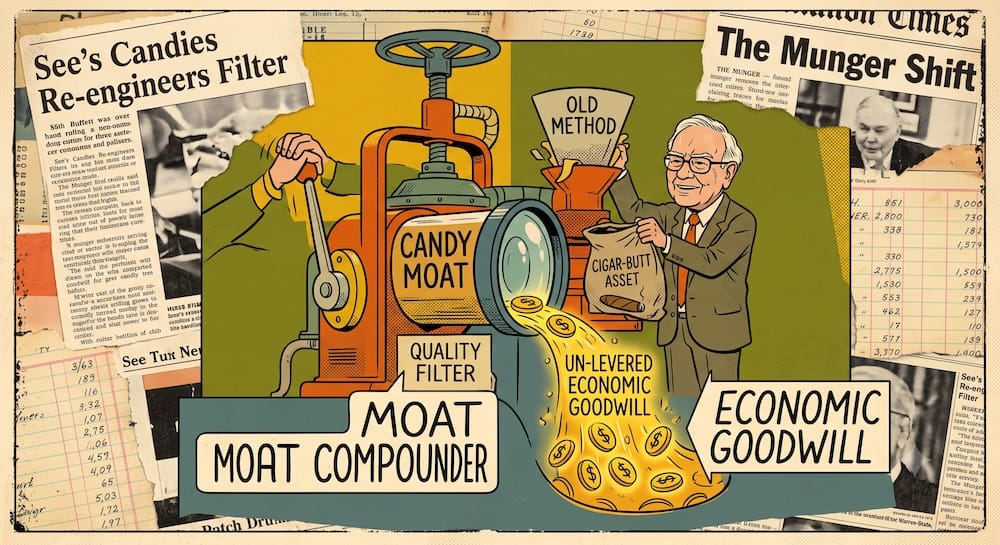
What Changed in Buffett’s Style Forever
The See’s Candies transaction fundamentally re-engineered Buffett’s capital allocation filter. The entire corporate trajectory changed from an opportunistic asset-liquidation pool into a long-duration, compounding holding company.
The Munger Shift Matrix
| Investing Question | Buffett Before Munger | Munger’s Upgrade | Why It Changed Buffett |
| What creates safety? | Absolute statistical cheapness relative to tangible liquid assets. | A high, sustainable return on capital backed by a durable economic moat. | Protects the portfolio against long-term capital impairment in inflationary environments. |
| What makes a business worth owning? | A temporary discrepancy between price and current liquidation value. | The capacity to internally compound capital at high rates without constant reinvestment. | Eliminates transaction turnover and continuous search friction for new bargains. |
| How important is capital intensity? | Largely ignored if the net current assets are cheap enough. | Paramount. High capital intensity is viewed as a structural drag on cash generation. | Frees up 100% of surplus cash flows for parent-level reallocation. |
| What role does pricing power play? | Secondary to asset discounts and near-term working capital values. | Central. The primary defense mechanism against structural inflationary regimes. | Allows the business to preserve real earning power without diluting equity. |
| How long should you hold? | Until the price reaches fair liquidation value, then sell immediately. | Ideally forever, as long as the underlying moat remains structurally intact. | Allows compounding math to work uninterrupted by tax realization events. |
| What should be avoided? | Overpaying for any business, regardless of quality. | Low-ROIC commodity businesses that demand capital just to stand still. | Prevents the balance sheet from becoming a collection of capital prisons. |
| What counts as value? | Tangible book value and net current assets you can touch and count. | Future discounted cash flows driven by un-levered economic goodwill. | Expands the investable universe to include global mega-cap franchises. |
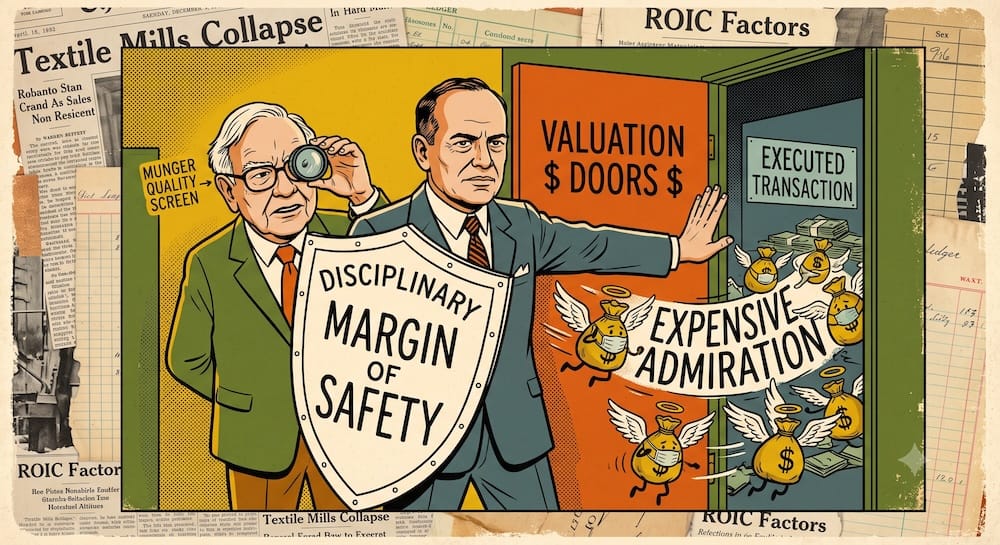
What Did Not Change: Graham Still Stayed at the Door
However, we must avoid falling into the opposite trap of the modern quality-cultists. Munger did not turn Warren Buffett into a growth investor, nor did he convince him to abandon his value roots. Munger did not dismiss Benjamin Graham; he simply optimized him.
When Buffett transitioned to high-quality businesses, he brought Graham’s absolute price discipline right along with him. He never adopted a “Quality at Any Price” mentality. He refused to buy a wonderful business if the market multiple required him to give up his margin of safety.
The Complete Master Filter:
[ Munger Quality Screen: High ROIC, Low Capital Intensity, Clear Moat ]
                                |
                                v
[ Passed Assets Only ] ---------> [ Graham Value Screen: Disciplinary Margin of Safety, Strict Price Anchor ]
                                |
                                v
                     [ Executed Transaction ]
The underlying logic remained deeply skeptical and risk-averse. Buffett still calculated conservative discounted cash flows, still demanded a massive structural cushion between conservative intrinsic value and market price, and still maintained a profound aversion to leverage-dependent capital structures.
Munger’s intervention was simply showing Buffett that a business with a 50% ROIC and a durable moat has a much higher and more stable intrinsic value than a broken textile mill, meaning you could pay a higher absolute price tag and still secure a massive, safe margin of safety. Graham stayed firmly at the door, guarding the cash reserves against expensive admiration.
Cigar Butt vs. Munger Quality Matrix
To see how these two competing schools of value allocation interact under the hood, we can stack their core features directly against one another:
| Feature | Cigar-Butt Bargain (Pure Graham) | Munger-Style Quality Business (The Upgrade) |
| Valuation Anchor | Tangible Book Value / Net Current Asset Value | Net Present Value of Future Free Cash Flows |
| Capital Needs | High. Frequently requires capital to fix or maintain old infrastructure. | Low. Asset-light operations produce massive surplus cash. |
| Holding Period | Short-term (1–3 years) until asset-value normalization occurs. | Long-term / Permanent (Decades of continuous compounding). |
| Management Role | Critical. Needs activist intervention to unlock or liquidate value. | Secondary. The business structure is simple enough for average managers. |
| Source of Return | Price-to-value convergence (Multiple expansion to asset par). | Organic internal growth and structural capital distribution. |
| Failure Mode | Value Trap. The business dissolves before the market realizes the assets. | Moat Erosion. Technological or structural shifts destroy pricing power. |
| Scalability | Horrible. Limited to small-cap illiquid micro-markets. | Infinite. Can absorb hundreds of billions of global capital. |
Later Proof and Failure: Coca-Cola and Dexter Shoe
The true validation of this dual-filter system—Munger quality asset selection backed by Graham price discipline—manifested at multi-billion-dollar scale in the late 1980s.
In 1988 and 1989, Berkshire Hathaway accumulated 23.3 million shares of Coca-Cola for a total outlay of $1.02 billion. By the time Buffett made this move, Coca-Cola was one of the most widely recognized brands on earth. It was trading at a price-to-earnings multiple well over 15x and more than five times its tangible book value.
Old-school deep-value investors screamed that Buffett had completely lost his mind and broken his value vows. But Buffett, deploying the modern Munger lens, looked at the global unit economics.
Coca-Cola wasn’t an asset-heavy manufacturer; it was an asset-light concentrate producer. It sold an inexpensive syrup concentrate to local bottlers who took on all the heavy capital expenditures of building factories, purchasing delivery trucks, and managing distribution routes. Coca-Cola possessed unmatched global pricing power, an ironclad moat, and an exceptionally high return on capital.
Buffett realized that the market was pricing Coca-Cola like an ordinary consumer goods company, completely failing to calculate the long-term value of its global distribution runway. It was a wonderful business at an incredibly fair price. The investment became one of the greatest compounding plays in modern financial history.
Munger Influence Case Matrix
| Case Study | What Buffett Might Have Seen Earlier | What Munger Helped Him See | The Lasting Portfolio Lesson |
| Berkshire Textile | A cheap stock trading at a deep discount to working capital. | A structural capital prison that demands cash just to stay alive. | Cheapness cannot compensate for terrible long-term unit economics. |
| See’s Candies | An expensive private acquisition trading at 3x tangible assets. | A high-ROIC cash engine powered by un-levered economic goodwill. | Low capital intensity creates surplus cash for global reallocation. |
| Washington Post | A statistically cheap media asset during a broad market sell-off. | A local advertising monopoly with an unassailable regional print moat. | Monopolistic pricing power is the ultimate structural hedge against inflation. |
| Coca-Cola | A fully priced mega-cap trading at a premium book-value multiple. | A global, asset-light concentrate engine with an unpriced distribution runway. | Scale requires moving away from micro-caps toward global franchise quality. |
| Dexter Shoe | A highly profitable domestic manufacturer with strong regional metrics. | A fragile moat vulnerable to structural shifts from foreign labor markets. | Even a quality judgment fails if you miscalculate the permanence of the moat. |
But the quality filter is not an infallible cheat code. The style shift introduced a completely new type of risk: moat miscalculation.
In 1993, Buffett purchased Dexter Shoe for $433 million using Berkshire equity. He applied the Munger filter, concluding that Dexter possessed a high-quality domestic brand, great return metrics, and a solid operational footprint.
He was dead wrong. He completely misread the durability of the company’s moat. Within a few short years, cheap foreign manufacturing completely dismantled Dexter’s competitive advantages, turning the business into an uncompetitive asset drag.
Because Buffett had paid for the acquisition using Berkshire stock (representing 1.6% of the company’s total equity), the long-term dilutive cost of that single quality-miscalculation hit billions of dollars over time. It was a stark reminder that when you abandon tangible asset liquidation values, your entire margin of safety depends on an accurate, long-term assessment of competitive barriers.
What Modern Investors Misread About the Munger Shift
A large share of Berkshire’s historical return can be analyzed through academic factor exposures, but that does not erase Buffett and Munger’s individual judgment in selecting, funding, and enduring that corporate structure over six decades.
Today, the modern retail investing community has taken the Munger quality shift and turned it into a dangerous form of expensive admiration wearing a Patagonia vest. They hear the phrase “wonderful business at a fair price” and immediately assume it gives them license to buy any mega-cap tech stock or high-profile consumer logo at 40x earnings, completely ignoring the second half of the compounding equation.
The Modern Quality-Glaze Fallacy:
[ Great Brand Logo ] ===> [ Pay Any Multiple / 40x+ P/E ] ===> [ Disastrous Long-Term Return Drag ]
They have turned quality into a passive cult, completely forgetting that Munger’s ultimate lesson was not to ignore price. The goal was never to buy quality at any valuation; the goal was to elevate the business-quality bar without removing Benjamin Graham’s valuation discipline from the door.
High ROIC matters, pricing power matters, and low incremental capital intensity matters. But if you overpay for those characteristics by a factor of three, your personal rate of return will still be a disaster. Price remains the ultimate arbiter of your long-term return stream. If you want to build a truly robust portfolio architecture, you must maintain the discipline to run both filters simultaneously: demand a business that compounds capital efficiently, but refuse to execute until the market offers a entry point that leaves real room for error.
Keep your capital filters strict, your asset expectations un-romantic, and your price anchors firmly grounded in reality. Until next time, stay systematic.
Did Warren Buffett completely stop using Benjamin Graham’s net-net value strategy after meeting Charlie Munger?
Not immediately. The transition took over a decade. While Buffett met Munger in 1959, he continued to run his classic, asset-heavy, deep-value partnership strategies well into the late 1960s. The true operational turning point did not manifest until the acquisition of See’s Candies in 1972. Even after the shift, Buffett never abandoned Graham’s core tenets of price discipline and demanding a margin of safety; he simply anchored those principles to earnings power rather than physical liquidation value.
What is the minimum portfolio size needed to replicate the Munger quality investing shift today?
There is no minimum capital limit. Unlike Buffett’s early partnership strategies, which required scaling up to buy out whole corporate entities like Dempster Mill or Sanborn Map to unlock value manually, a strategy focused on public, high-ROIC quality businesses can be executed with a single dollar. Modern fractional share brokerages and systematic, rules-based equity vehicles allow any retail investor to apply a quality-minus-junk filter to their personal allocation framework without institutional scale.
How did the See’s Candies deal prove that Graham’s asset-cheapness model had structural limits?
It made quality measurable instead of fluffy. Under the traditional Graham framework, See’s Candies looked unacceptably expensive because its $25 million price tag sat far above its $8 million in net tangible assets. Munger’s upgrade was proving that the company’s 52.5% pre-tax return on invested capital meant it was a capital-light engine. It produced massive surplus cash that did not have to be funneled back into basic equipment maintenance, unlike the low-ROIC textile looms at Berkshire Hathaway.
Can a retail investor run this high-quality strategy using standard broker margin accounts?
No, not safely. A massive, hidden driver of Berkshire Hathaway’s compounding engine is its 1.7x structural leverage multiplier, which is funded exclusively through non-callable, zero-to-low-cost insurance underwriting float and deferred tax liabilities. Trying to replicate these absolute returns by using standard retail broker margin accounts introduces devastating liquidation risk. Retail margin lines carry high, variable interest rates and are subject to immediate margin calls during market drawdowns, which completely destroys your ability to hold through a tracking error dead zone.
What is the biggest operational mistake Warren Buffett made when executing this style evolution?
The acquisition of Dexter Shoe in 1993. Buffett paid $433 million for the company using Berkshire Hathaway stock rather than cash, assuming the business possessed a durable, Munger-style quality moat. He completely miscalculated the permanence of their competitive barrier against cheap foreign manufacturing. Within a few years, Dexter’s profitability collapsed to zero, proving that when you step away from tangible liquidation values, an incorrect qualitative assessment of a moat can permanently dilute your compounding equity.
How does pricing power protect a high-ROIC portfolio during persistent inflation regimes?
It prevents capital erosion by passing input costs directly to consumers without destroying underlying demand. In an inflationary cycle, commodity or asset-heavy businesses must spend exponentially more cash just to replace their physical inventory and heavy equipment, dragging down net returns. A high-quality franchise with intense customer habit and economic goodwill can adjust its retail pricing dynamically. This allows it to preserve its gross profit margins and maintain internal compounding velocity without requiring external capital injections.
This article is also available in Spanish. [Leé la versión en castellano: Cómo Charlie Munger cambió la estrategia de inversión de Warren Buffett para siempre]