I get suspicious whenever finance people describe a business partnership as “perfect harmony.” Perfect harmony is usually what people say right before a room full of directors rubber-stamps the same dumb idea with pristine manners. I don’t trust partnerships where everyone agrees too quickly. That is not harmony; it is usually politeness wearing a dunce cap.
If you look at the media retrospectives on Berkshire Hathaway, they treat Warren Buffett and Charlie Munger as an uncomplicated, single-minded entity—identical investing twins who spent fifty years finishing each other’s sentences over a shared box of peanut brittle.
The historical record tells a far more interesting story. They were not duplicates. From my perspective, they were a high-friction, asymmetric capital-allocation system.
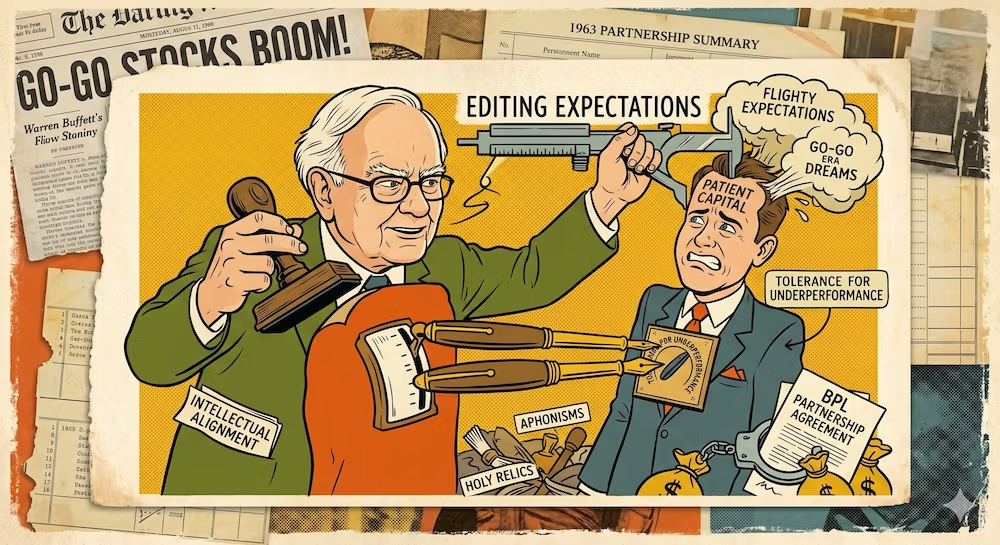
The magic wasn’t that they were a carbon copy of one another; rather, they approached opportunities from different default settings, and that difference created useful friction before capital was committed. Buffett was the high-velocity, quantitative engine—a bloodhound for mispriced assets with an insatiable drive to deploy capital. Munger was the qualitative bouncer. His job wasn’t to help Buffett find things to buy; his job was to stand at the gates of the balance sheet with a crowbar and kill weak ideas before they became expensive mistakes.
I’m convinced Buffett did not need Munger because he lacked intelligence. He needed Munger because highly intelligent people are uniquely excellent at rationalizing their favorite errors.
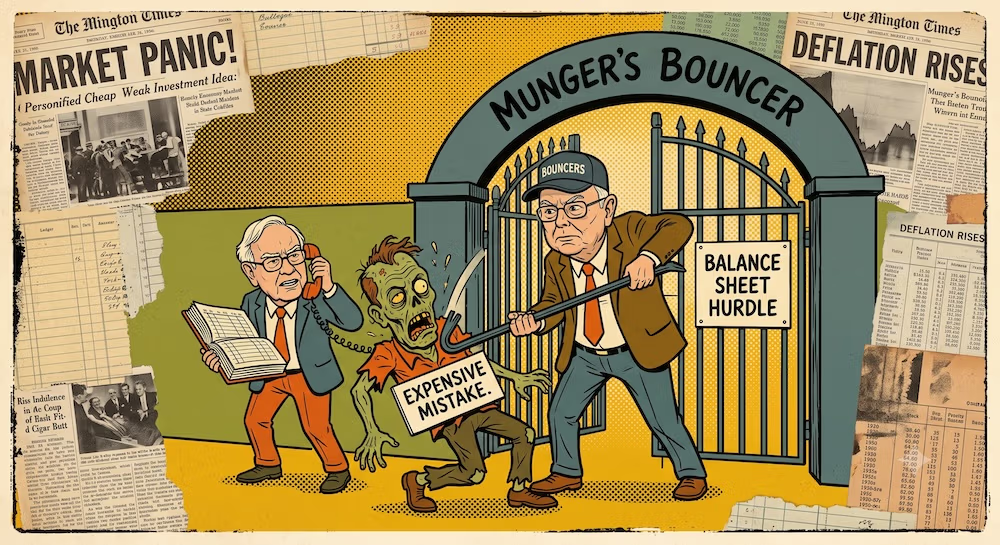
Buffett’s Default Setting: Graham, Price, and Action
To understand why this friction was mandatory, you have to understand Buffett’s original baseline programming. He was the ultimate disciple of Benjamin Graham.
The core of the Graham method wasn’t admiring wonderful business models; it was cold, clinical asset liquidation analysis. Buffett’s early career was built on finding what he called “cigar butts”—mediocre, shrinking, or outright failing operations that happened to be trading in the public markets for less than their net current asset value. The business could be a broken mill or a third-tier utility, but if the stock price was cheap enough that you could buy it, smoke the last puff for free, and liquidate the machinery for a profit, you pulled the trigger.
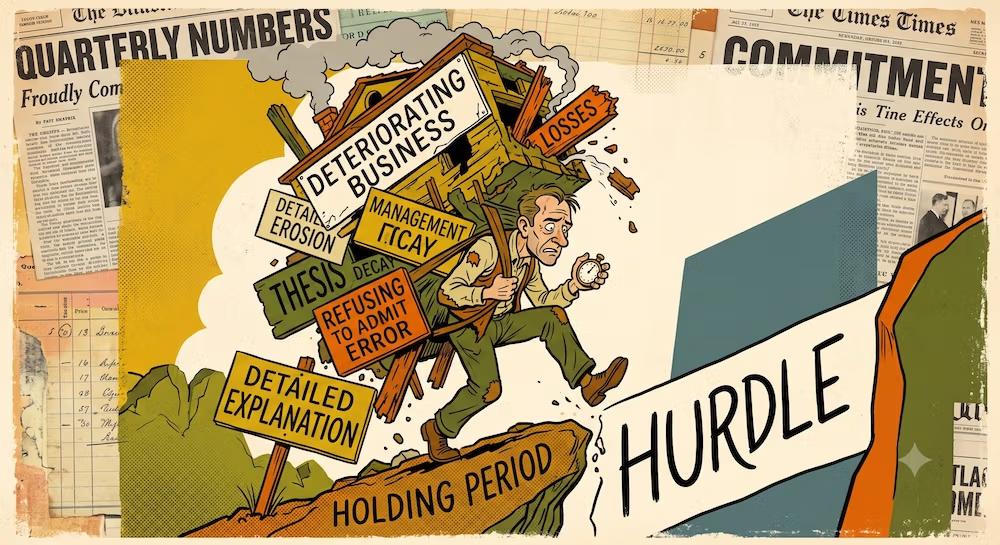
I love a good cheap stock as much as the next spreadsheet goblin, but some cheap stocks are cheap because the business is actively decomposing in public. This was a world of workouts, arbitrage, and hostile control positions. Buffett’s fundamental genius was his mathematical speed, his deal instincts, and his total willingness to dive into messy, unglamorous corporate restructuring to unlock a dollar of cash. He was a spreadsheet goblin with a telephone and a checkbook, running an incredibly high-velocity capital deployment game.
But the cigar-butt strategy has a structural limitation: it doesn’t scale.
When you are managing a few million dollars in a private partnership, you can hop from one liquidating bargain to another. But when millions turn into billions, you cannot find enough cheap junk to move the needle. Left to his own devices, Buffett’s default setting would have marooned Berkshire Hathaway in an accumulation of statistically cheap, operationally exhausting mediocrities. He had the engine to move capital, but his price-first instincts meant he was constantly tempted to buy businesses that practically required a feeding tube.
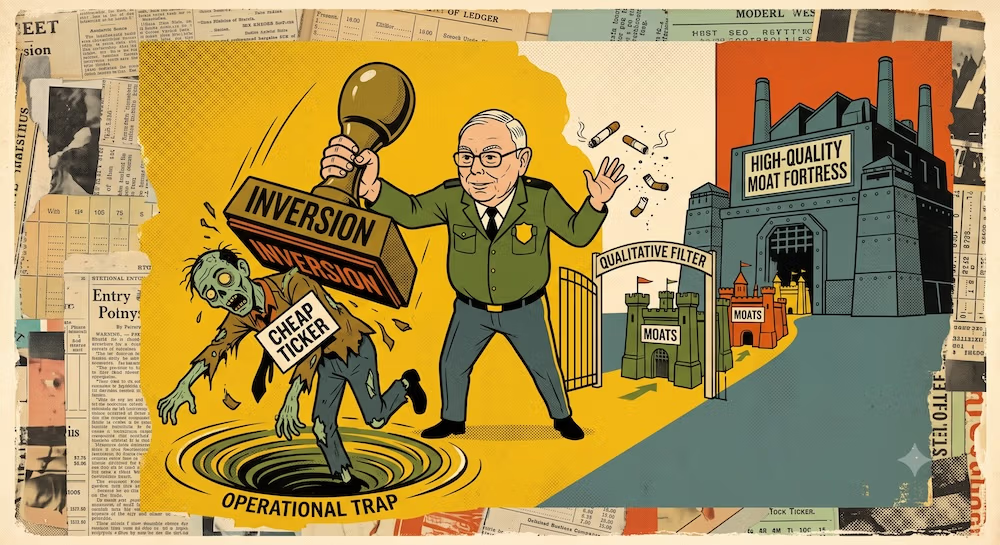
Munger’s Default Setting: Quality, Inversion, and No-Stupid-Things
Charlie Munger did not come out of the Graham school. He arrived via Harvard Law, early real estate development, and an obsession with the broader cross-disciplinary laws of psychology, physics, and biology.
Munger’s default setting was rooted in an entirely different premise: inversion. Instead of trying to figure out how to win, his mind automatically focused on how to avoid losing. He famously noted that if he knew exactly where he was going to die, he would simply never go there.
Applied to portfolio architecture, this meant Munger was not looking for bargains. He was looking for vulnerabilities to eliminate. He had a profound aversion to mediocre companies, no matter how cheap the ticker symbol appeared on paper. Where Buffett saw an underpriced liquidation opportunity, Munger saw a long-term operational trap that would consume management’s energy for years without ever generating real compounding momentum.
This is what I admire most about Munger. He did not make Buffett more romantic. He made the approval process meaner. Munger’s role was not to sprinkle wisdom dust on Buffett’s ideas. It was to make those ideas harder to approve. He brought an extreme concentration discipline, arguing that a rational allocator should focus on a tiny handful of high-probability, high-quality corporate moats and ignore everything else. He wasn’t there to maximize the number of actions Berkshire took; he was there to minimize them, ruthlessly filtering out the noise to ensure the machine only executed on choices that were able to survive a punishing qualitative filter.
The See’s Candies Collision
The definitive test of this intellectual friction occurred in 1972, when Blue Chip Stamps had the opportunity to acquire See’s Candies.
The sellers wanted $25 million. At that moment, See’s possessed roughly $8 million in net tangible assets and was producing about $4 million in pre-tax earnings.
I understand why Buffett hesitated. Paying a premium for candy sounds insane if your brain has been trained to worship hard liquidation value. To Buffett, whose brain was still wired to Graham’s physical asset metrics, paying $25 million for $8 million in physical capital felt like madness. He was being asked to pay a massive premium for an intangible asset—something you couldn’t touch, see, or liquidate at a scrap yard. He was ready to walk away over a fraction of a valuation multiple.
And this is where I think Munger earned his keep: he forced Buffett to see that the intangible asset was not fluff. It was the business. He looked past the lack of physical machinery and focused entirely on the business quality: consumer psychology, regional brand loyalty, and the rare ability to raise prices over time without destroying demand. See’s had a durable moat that required almost no capital reinvestment to grow.
Munger pushed, Buffett resisted, and the friction eventually ground down Buffett’s price-first dogma. They bought it. That single deal fundamentally altered the trajectory of Berkshire Hathaway. See’s went on to throw off billions of dollars in reallocatable cash that funded the entire future portfolio, proving that a great business at a fair price can outperform a fair business at a great price over a multi-decade timeline.
Without that productive friction, I bet Buffett would have left his capital engine idling in the bargain bin forever.
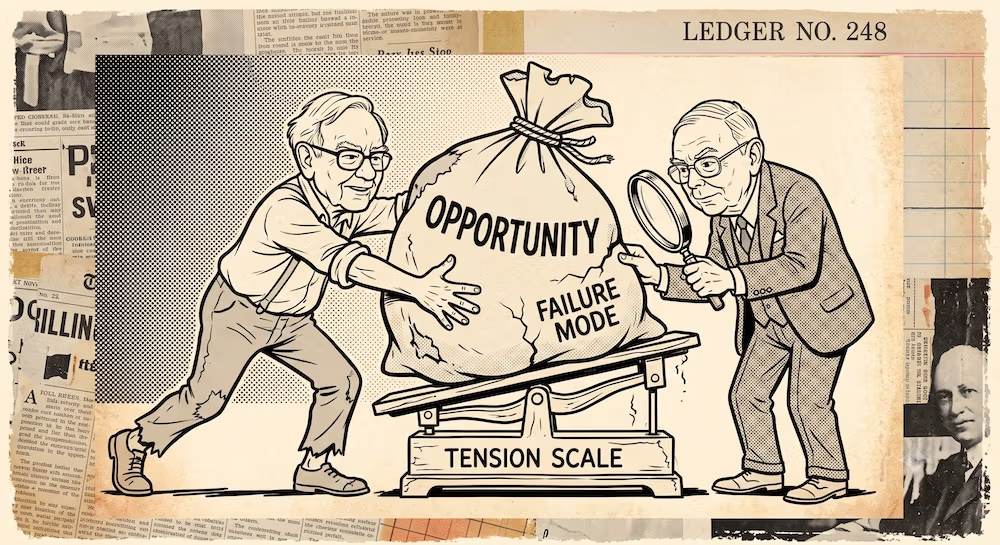
The Subtle Differences: A Deep Divergence
To me, this is the real partnership lesson: one mind hunted for opportunity, while the other hunted for failure modes. When you map out the specific dimensions where their minds pulled in opposite directions, you see that the strength was never in alignment; it was in the balance of the tension.
Buffett vs Munger Difference Matrix
| Dimension | Buffett Tilt | Munger Tilt | Why the Difference Helped |
| Valuation Lens | Price-first. Focuses on the margin of safety relative to current tangible assets or near-term liquidation value. | Quality-first. Focuses on the long-term compounding power of the economic moat, even at a premium. | Prevented Berkshire from overpaying for growth while simultaneously stopping them from buying value traps. |
| Portfolio Concentration | Historically preferred broader diversification across dozens of workouts and liquidations during the early partnership era. | Advocated for extreme, uncompromising concentration in a tiny handful of hyper-vetted positions. | Forced the capital engine to focus its massive scale only on the highest-conviction opportunities. |
| Decision Style | High-velocity accumulator. Wants to constantly flip over rocks, look at tickers, and find mispriced situations. | Patient, deliberate gatekeeper. Content to sit on cash for years doing absolutely nothing until a rare hurdle is cleared. | Allowed Buffett to search the entire investable universe while Munger prevented over-trading and stylistic drift. |
| Psychological Source | Deeply analytical within the strict boundaries of corporate finance, accounting data, and mathematical relationships. | Multidisciplinary. Draws heavily from behavioral psychology (misjudgment models), history, physics, and engineering. | Insulated the portfolio from pure spreadsheet blind spots by accounting for human bias and systemic fragility. |
| Capital Allocation Instinct | Driven to continuously iterate, build complex insurance vehicles, and manage the operational flows of liquidity. | Focused on structural simplification, asset pruning, and raising the qualitative bar for new capital entry. | Kept the structural machinery highly dynamic without allowing it to become a disorganized corporate conglomerate. |
The Partnership Friction Matrix
When a deal or a structural choice arrived on the desk in Omaha, it was pushed through an active behavioral filter. I don’t look at this as a corporate formality; it was a live intellectual stress test.
| Decision Type | Buffett’s Instinct | Munger’s Filter | Better Outcome |
| Cheap Asset Bargain | Accumulate cheap shares of a structurally mediocre business. | Reject as an operational distraction with no terminal value. | Saved capital from sinking into dying, low-return industries. |
| Wonderful Business at a Premium | Hesitate or walk away if it trades above tangible book value. | Demand they pay a premium for high returns on capital. | Secured permanent cash engines that funded decades of growth. |
| Portfolio Architecture | Diversify across secondary ideas to manage tracking error. | Concentration to the point of holding just a few core lines. | Concentrated massive fire-power into elite compounders. |
| Crisis Liquidity Deployment | Actively negotiate opportunistic preferred equity terms. | Strict structural verification of long-term survival odds. | Extracted high yields plus massive equity upside in panics. |
| Avoiding Stupidity | Rationalize a clever macro thesis or a complex turnaround. | “Invert, always invert.” Focus solely on failure modes. | Eliminated common institutional errors before committing. |
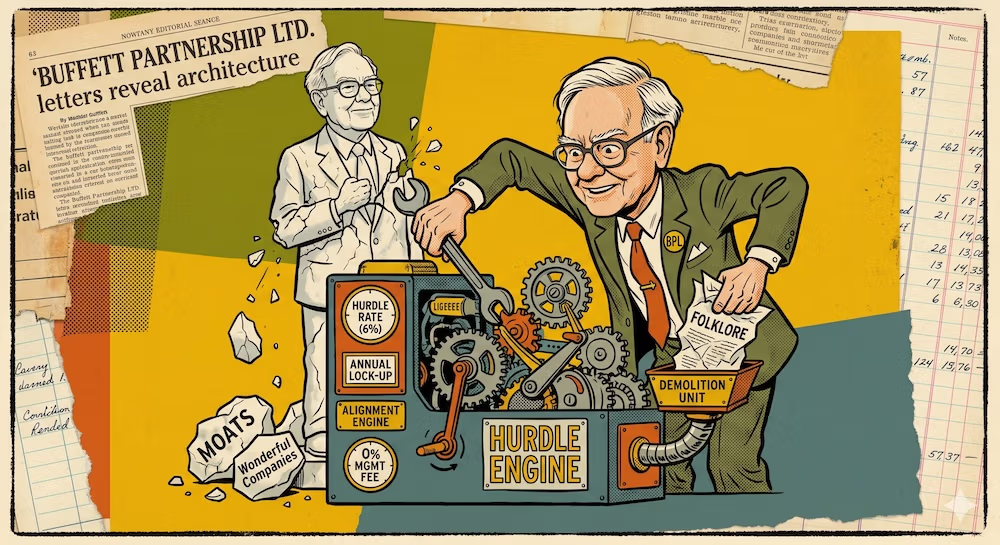
Munger did not replace Buffett’s capital-allocation engine; he installed a heavy qualitative filter right before the fuel hit the machine. This explains why Munger maintained Wesco Financial as his own separate laboratory until 2011. I see Wesco as an independent sleeve where he could execute his extreme concentration discipline in its purest form—often holding just three or four public equities alongside a core insurance and utility operation. It stood as a monument to what happened when you let the quality filter run completely uncompromised by Buffett’s natural urge to discover a high volume of miscellaneous bargains.
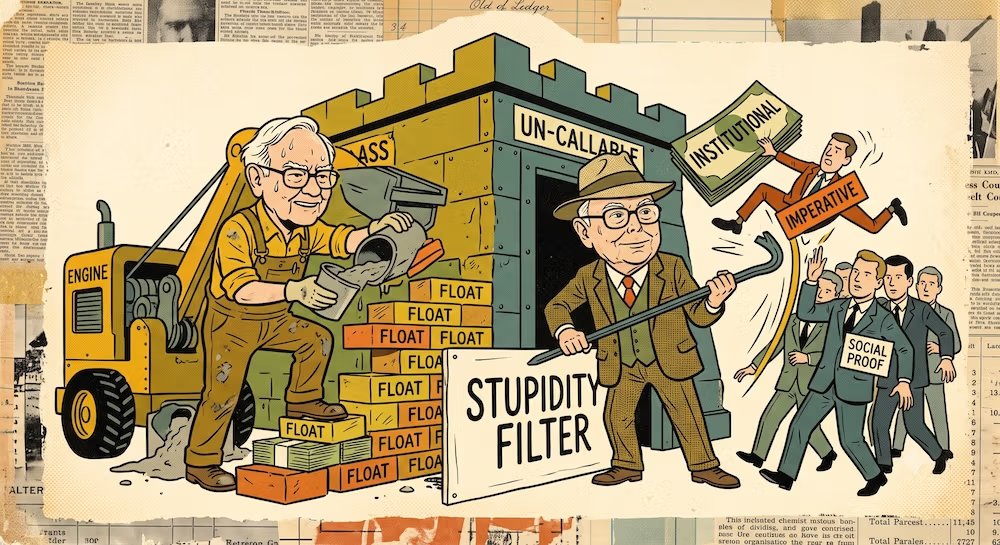
Where Each Partner Was Stronger
I do not want this to become Munger worship with better vocabulary. Buffett was the builder. Without Buffett’s engine, Munger’s filter had absolutely nothing to process.
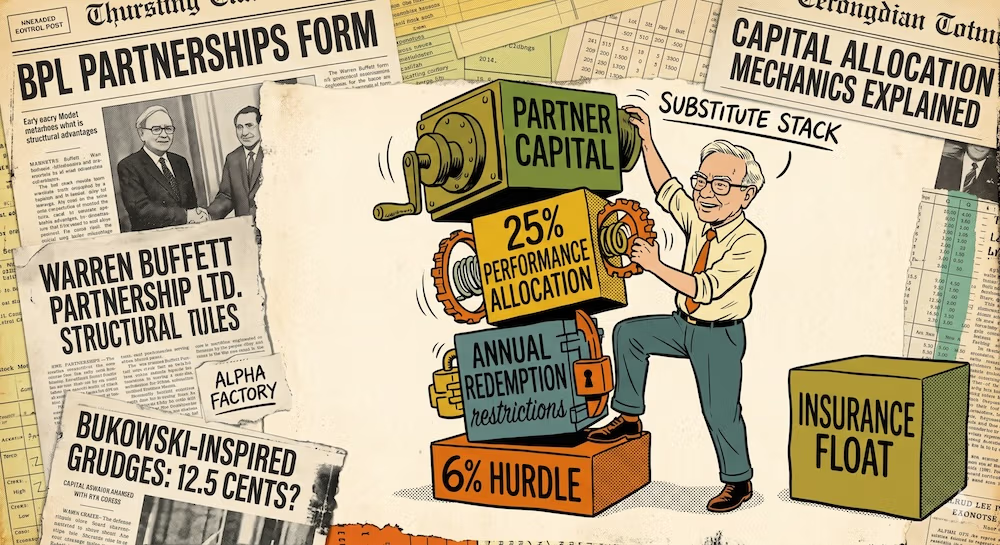
Buffett was the actual builder of the corporate fortress. He possessed an extraordinary, unmatched genius for designing the insurance architecture—structuring National Indemnity, GEICO, and General Re to generate billions in un-callable float that served as low-cost structural leverage. He was also a master communicator, single-handedly constructing the shareholder ecosystem that gave Berkshire its unique capital stability. When the market went through severe relative underperformance windows—like the -40.9% tracking error gap against the S&P 500 in 1999—it was Buffett’s personal authority and calm temperament under pressure that kept shareholders from panicking and breaking the permanent capital structure. Munger had the intellect, but Buffett had the operational stamina and the deal-making charisma to run a massive conglomerate.
Munger’s distinct strength was his unusual resistance to social proof, institutional momentum, and the behavioral traps that catch lonely allocators. He was structurally built to resist the “institutional imperative”—the corporate disease where executives mindlessly copy their peers to justify their existence. He was the one who could look at a massive, popular industry and flatly declare it a structural disaster area before the rest of the market caught on. Munger’s value was not that he saw every answer first. It was that he could make a tempting answer feel stupid before the money left the building.
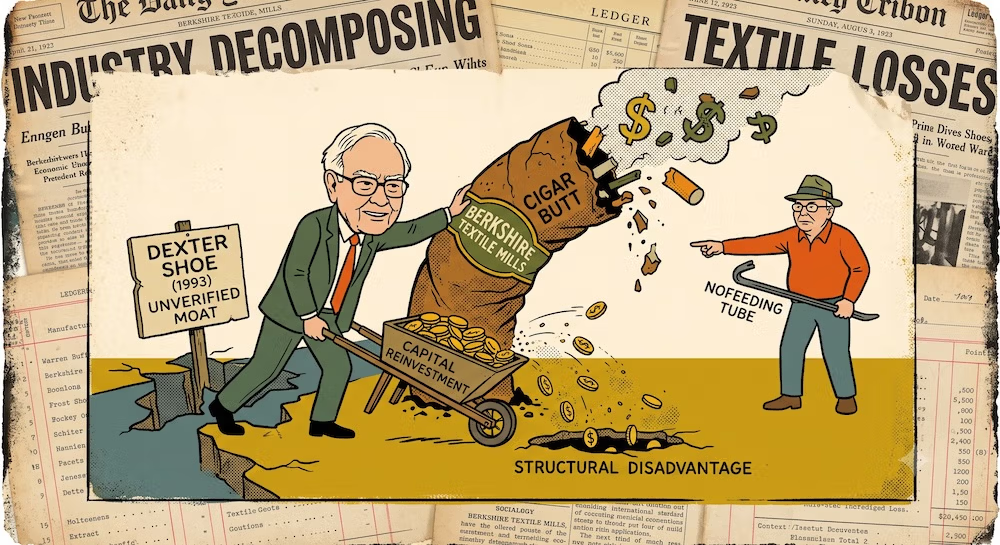
Partnership Failure / Humility Matrix
This is the section I always want in these articles, because it keeps the shrine from turning into a church. If this partnership were flawless, their record wouldn’t have structural dents in it. They made major mistakes, and almost every single blowup occurred when they bypassed their own internal friction rules or let collective behavioral biases blind the filter.
| Case | What They Believed | What Went Wrong | Lesson |
| Berkshire Textile Mills | Believed that capital reinvestment and operational improvements could save a legacy domestic manufacturing business. | The industry faced structural international labor cost disadvantages that capital expenditure couldn’t fix. | Statistical cheapness cannot overcome a structurally broken economic model. Turnarounds seldom turn. |
| Dexter Shoe (1993) | Believed the company had a durable domestic brand moat and safe market share protection. | The competitive advantage evaporated almost instantly due to low-cost foreign competition. Compounded the error by paying with Berkshire stock. | Never use a permanent, high-quality compounding currency (Berkshire shares) to acquire an unverified moat. |
| General Reinsurance (1998) | Assumed they were buying a premier, conservatively managed global underwriting franchise. | The acquisition revealed legacy under-reserved liabilities and a complex derivatives book that required years of expensive structural fixing. | Even institutional giants can hide massive structural risks behind a prestigious brand name. |
| Salomon Brothers (1991) | Believed a large preferred stock investment in a tier-one Wall Street investment bank would provide safe, high-yielding corporate cash flows. | A Treasury bidding scandal threatened the firm with severe regulatory consequences, forcing Buffett into an exhausting rescue role. | Exceptional financial metrics mean nothing if the underlying culture exposes the entire capital vehicle to systemic reputational collapse. |
What Modern Investors Misread About the Partnership
The standard retail takeaway from the Buffett-Munger story is usually a collection of surface-level mantras: Buy what you know, hold forever, and look for moats.
I think that entirely misses the point. The real lesson of the partnership has nothing to do with copy-pasting their current public equity holdings or staring at delayed 13F filings. It is about understanding the behavioral mechanics of decision-making.
First, the record proves that value and quality require constant internal friction. If you are an individual investor operating inside a total echo chamber—relying entirely on social media forums or financial news feeds that confirm your existing biases—you are running an un-filtered engine. You do not have a process; you have a collection of hopes. I believe you need to explicitly construct a behavioral bouncer in your strategy. Whether that is a partner who actively challenges your thesis, a brutal quantitative checklist designed to uncover failure modes, or an automated rule that forces you to outline exactly how an investment can go to zero before you deploy a single dollar.
Second, you must separate idea generation from idea approval. Buffett was brilliant at generating ideas because his baseline instinct was optimization, discovery, and action. Munger was brilliant at approval because his baseline instinct was structural elimination. When you combine those two steps into a single moment of emotional enthusiasm, you invariably buy value traps or overpay for legacy growth.
I don’t take the Buffett-Munger lesson as “find someone who agrees with you.” I take the opposite lesson. Build a filter strong enough to kill your favorite bad ideas before they get expensive. Buffett had the engine. Munger had the crowbar. I want both in the room before the money leaves the building.
Did Warren Buffett and Charlie Munger actually run an equal partnership?
Not exactly. Buffett was always the ultimate operational builder, Chief Executive, and primary capital deployment engine of Berkshire Hathaway. Munger acted as the structural vice chairman, a heavy intellectual gatekeeper, and a behavioral sounding board whose primary role was raising the qualitative hurdle rate for new ideas.
What is the minimum capital needed to copy the Munger concentration model?
It depends on your vehicle. If you are buying individual stocks, a true Munger-style hyper-concentrated portfolio of 3 to 5 holdings typically requires deep analytical coverage and enough capital to ensure your brokerage execution fees do not eat your margin of safety. For a modern DIY portfolio, the functional equivalent is often isolating highly concentrated systematic factor funds focused purely on extreme Quality and Value metrics.
How do modern investors duplicate the corporate tax advantages of Berkshire?
Replicate it in tax-sheltered accounts. Individual retail investors face immediate tax drag on dividend income and capital gains distributions within standard taxable accounts. To match the lower-friction internal capital reallocation that Berkshire achieves through its corporate structure, individual portfolio builders should maximize tax-advantaged vehicles like IRAs, 401ks, or TFSAs.
Why can’t I just buy the top stock picks from Berkshire’s quarterly 13F filings?
That is a mechanical trap. A 13F filing is a delayed public disclosure that entirely leaves out Berkshire’s primary cash engines: its massive, wholly owned private subsidiaries like BNSF Railway and GEICO. When you copy a public stock pick, you are buying pure equity volatility without the stabilizing cushion of those un-callable private cash flows.
What did Munger mean when he said to “invert, always invert” in asset allocation?
Focus entirely on the failure modes first. Instead of trying to calculate how a stock portfolio can generate maximum returns, Munger’s framework demands that you explicitly outline every single structural vulnerability that could lead to permanent capital loss. You optimize the portfolio by systematically eliminating the ways you can go broke.
How do you establish a behavioral bouncer if you invest completely alone?
Build a strict quantitative kill switch. If you don’t have a trusted co-allocator to challenge your blind spots, you must implement a rigid, non-negotiable checklist that forces you to document exactly why a stock is a value trap or how its moat can decay before you allocate capital, separating your initial idea generation from final approval.
Did the See’s Candies transaction completely stop Buffett from buying cheap stocks?
No, but it broke his dogma. While Buffett still loved a statistical bargain, the 1972 acquisition proved the mathematical compounding superiority of paying a premium for durable pricing power and low capital reinvestment needs, shifting Berkshire’s scale toward multi-decade quality compounds.
This article is also available in Spanish. Leé la versión en castellano: Buffett vs Munger: Las diferencias sutiles que hicieron tan fuerte a su sociedad