I don’t like the lazy version of financial history where Benjamin Graham is treated like the old, dusty junior high math teacher and Warren Buffett becomes the enlightened student who discovers “quality” and walks off into the sunset. It is too cute. It is also an absolute disservice to how capital allocation actually works.
The student did not become greater by betraying the teacher. He became greater by understanding which parts of the teacher’s method were permanent structural principles and which parts were merely era-specific tools.
If you freeze Graham’s implementation methods in amber and pretend they should work the same way at every capital scale or across every macroeconomic regime, you miss the entire lesson of value investing. Graham gave Buffett the structural bones of his system. Buffett didn’t snap those bones; he changed the muscles, engineered a completely different capital engine, and eventually drove an entirely new vehicle across the scale wall.
The Graham machine did not fail because the math was dumb. It failed because Buffett became too big for the machine.
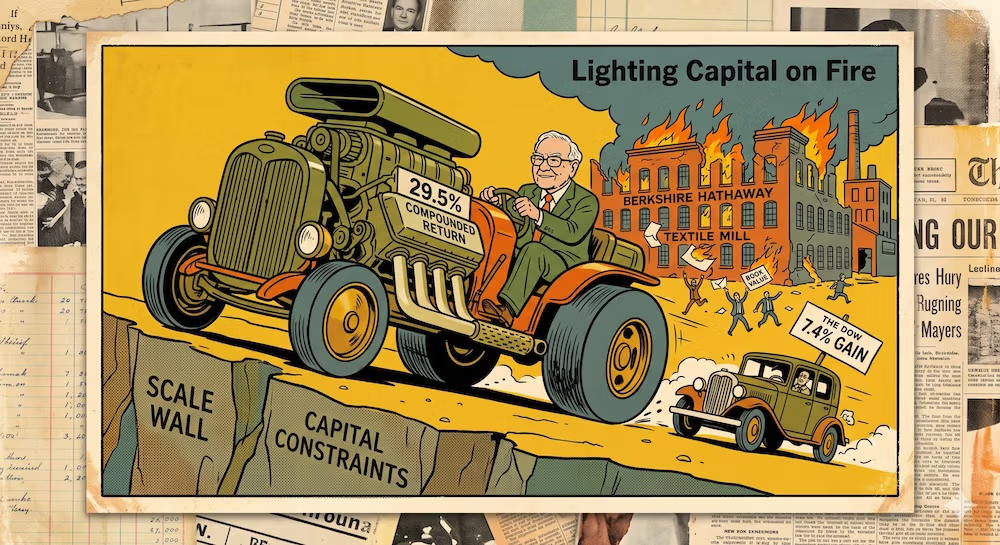
In May 1969, a 39-year-old manager operating at a blistering 29.5% gross compounded annual growth rate since 1957—versus 7.4% for the Dow—sent a letter to his partners stating he was shutting down the Buffett Partnership Ltd. (BPL). He walked away from an extraordinarily lucrative fee machine—25% of all profits above a 6% cumulative hurdle rate—because his expanding asset base had broken the quantitative toolkit. Cheap, quantitatively clear securities were scarce enough that Buffett no longer felt he could deploy capital responsibly at scale under his existing framework.
Value investors can get weirdly religious about this history. A net-net screen becomes a sacred object. Book value becomes scripture. Meanwhile, the actual underlying business can be quietly lighting shareholder capital on fire behind the factory gates.
To understand how the student evolved, we have to look directly at what Buffett kept from the master, and what he was mechanically forced to leave behind.
What Graham Actually Gave Buffett
Without Graham, there is no Buffett. Before we look at the evolutionary break, we need to respect the bedrock. Graham provided the psychological and structural operating system that kept Buffett from ever becoming a speculative market casualty.
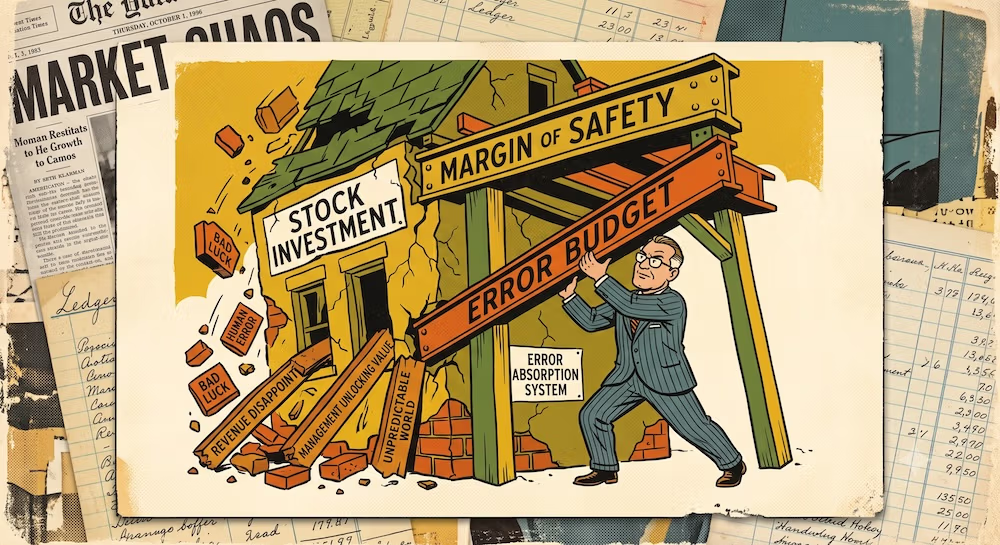
First, Graham gave him the concept of Mr. Market—the idea that the stock market is not an all-knowing, efficient pricing machine, but a manic-depressive counterparty that exists to serve you, not instruct you. Second, he provided the mathematical discipline of the Margin of Safety: the insistence that you never pay a price that requires a flawless corporate future just to break even. Third, he taught him businesslike investing—treating a share of stock not as a trading card to be flipped, but as a fractional piece of an underlying business enterprise with real capital allocation consequences.
This setup wasn’t about fancy formulas. It was an emotional habit. It was the trained capacity to buy assets when others were throwing them out of windows, and the cold willingness to rely on independent arithmetic over institutional narratives.
Buffett did not throw away this psychological firewall when his strategy shifted. He merely realized that the specific tactical tools Graham used to exploit market inefficiencies in the 1930s and 1940s could not survive his own compounding scale or the changing dynamics of the post-war American corporate landscape.
What Buffett Kept vs. What He Outgrew
| Graham Principle | What Buffett Kept | What Buffett Eventually Outgrew | Why It Matters |
| Margin of Safety | The refusal to pay a price that requires a perfect future. | Defining safety only through liquidation value or net current assets. | Buffett learned that safety could come from earning power, pricing power, and low reinvestment needs. |
| Mr. Market | The habit of treating market prices as offers, not instructions. | Waiting only for statistically cheap securities to appear on a screen. | He kept the temperament but widened the opportunity set to evaluate high-quality business franchises. |
| Businesslike Investing | Treating stocks as ownership claims on real businesses. | Treating mediocre businesses as attractive simply because they looked cheap. | The textile mill showed that a cheap business with broken economics can still destroy capital. |
| Arithmetic Discipline | Independent calculation over market narrative. | Rigid reliance on book value and tangible assets alone. | See’s proved that economic goodwill could be real even when it barely appeared on the balance sheet. |
| Downside Protection | Obsession with avoiding permanent capital loss. | Assuming asset backing alone was enough protection. | A business with no pricing power can burn through its asset cushion trying to survive competition. |
Early Buffett Was a Graham Operator, Not a Buy-and-Hold Saint
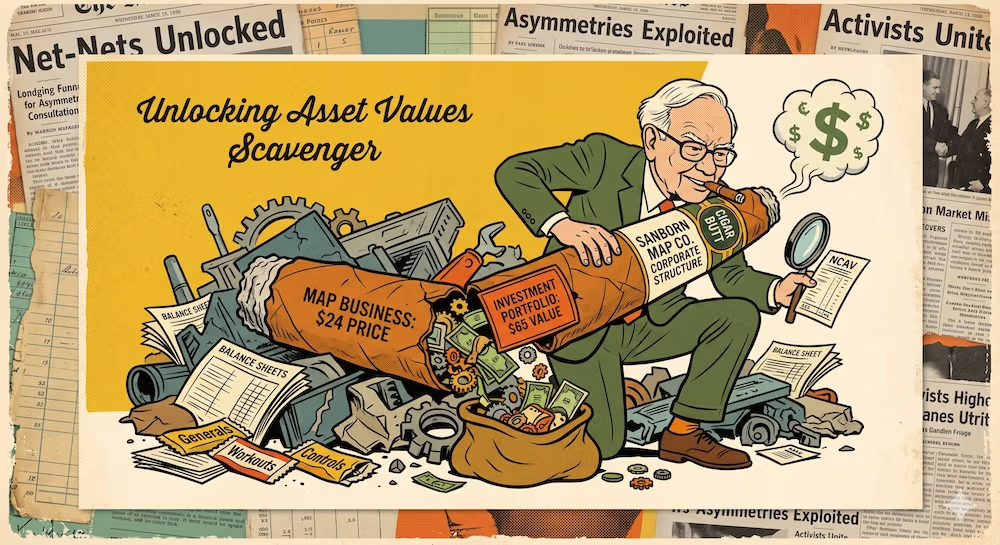
The mainstream folklore loves to imagine early Buffett sitting around waiting for great companies to hold forever. The primary data shows something completely different. Early Buffett was an aggressive, active Graham operator who ran a high-turnover system focused on unlocking asset values through sheer capital leverage and corporate governance pressure.
During the 1956–1969 partnership period, Buffett ran a highly structured framework split into three distinct operational sleeves:
- Generals: Statistically undervalued securities trading at deep discounts to intrinsic value where he had no corporate control. He simply waited for mean reversion to close the price-to-value gap and then sold.
- Workouts: Corporate arbitrage setups, spin-offs, mergers, and liquidations. These positions were entirely independent of stock market cycles; the return was dictated solely by the successful execution of a corporate event.
- Controls: Situations where Buffett accumulated enough shares to block management, take a board seat, and actively execute a cold balance-sheet unlock, not a romantic long-term partnership.
This was not a romantic search for compounding franchises; it was a cold balance-sheet unlock.
Look at the Sanborn Map Co. operation in 1958. Sanborn was selling in the market at $24 per share, yet its underlying corporate investment portfolio alone was worth $65 per share. Buffett did not buy Sanborn because he wanted to hold a mapping business for thirty years. He accumulated 23% of the outstanding shares, forced his way onto the board, and separated the investment portfolio from the core mapping business, realizing a clean, non-correlated profit for his partners.
He was a classic Graham scavenger, buying distressed cigar butts, taking one final, free mathematical puff of value, and discarding the wrapper. It is an extraordinary way to make money—if your capital pool is small enough to fit into the cracks of the market.
The Scale Wall Broke the Net-Net Machine
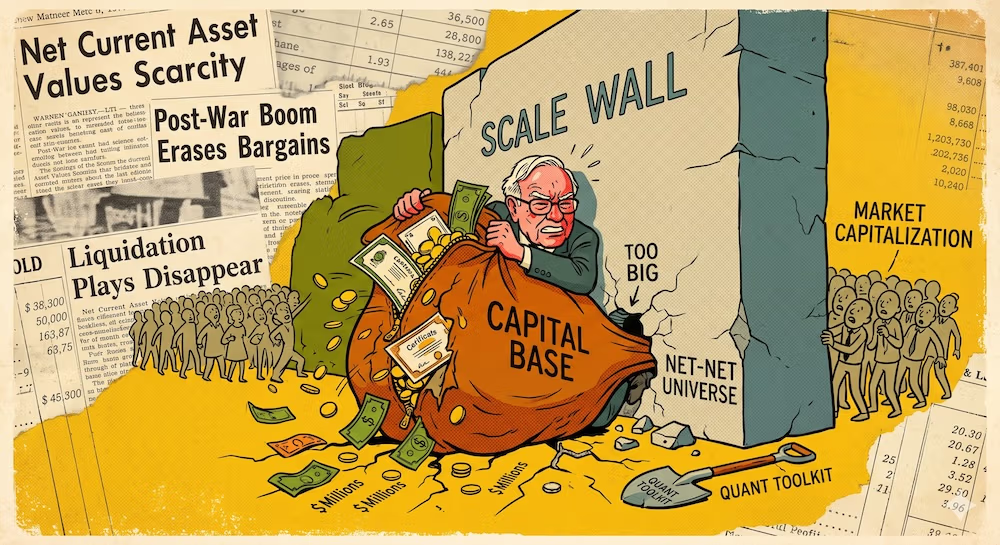
The engine did not stop working because the principles changed; it stopped working because the capital base grew too large for the container. The bigger the capital base, the smaller the usable net-net universe becomes.
When you manage a few hundred thousand dollars, you can buy tiny micro-cap liquidation plays, capture a quick statistical mispricing, and move on. But when the Buffett Partnership’s assets began compounding exponentially throughout the 1960s, a structural Scale Wall emerged.
If you attempt to deploy tens of millions of dollars into a stock with a total market capitalization of five million dollars, you face immediate structural friction. Your own buying pressure drives the stock price up, instantly erasing the statistical discount that triggered the buy signal in the first place. If you want to exit, your selling pressure destroys the bid.
By the late 1960s, Buffett faced a double bind. Not only was his own capital base swelling, but the intense post-war market expansion had pushed asset prices up, making genuine Graham net-nets incredibly scarce. He could no longer scale down into the microscopic corners of the market where asset-based mispricings lived. He was forced to choose between two structural paths: either freeze his assets at a small scale to protect the original toolkit, or evolve the toolkit to accommodate a larger capital problem.
Berkshire Hathaway Was the Cigar Butt That Bit Back
I would love to pretend I am immune to the cheap-stock trap. I am not. Cheap things are seductive. That is why they keep ruining smart people. This is where the cheap-stock part of my brain starts getting nervous. A low price can be a gift. It can also be bait with accounting stapled to it.
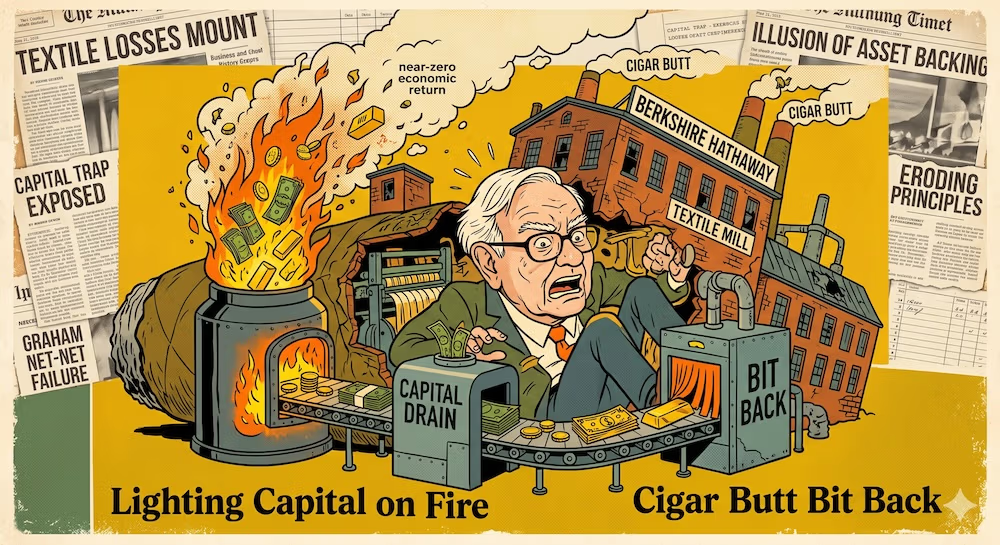
Berkshire Hathaway the textile mill is the funniest and most expensive warning label in investing history. The name on the global trophy case is actually the monument to a massive tactical error.
In 1965, Buffett took control of Berkshire Hathaway because it showed up on his screens as a textbook Graham net-net. The stock was trading below its net current asset value, offering what looked like a pure statistical margin of safety backed by physical looms, buildings, and textile inventory. After a management dispute where the company’s president tried to short-change Buffett on a verbal agreement regarding a stock tender price, Buffett bought the business out of pure spite.
It was the ultimate cigar-butt failure mode.
Statistically cheap assets can quickly become capital traps if the underlying business has zero reinvestment economics and no pricing power. Throughout the late 1960s and 1970s, the textile operations were a continuous cash drain. Because Berkshire was producing a commoditized product in a global market, it had no ability to pass rising input costs onto customers. To keep the mills alive against cheaper foreign competition, Buffett was forced to continuously plow cash back into modernizing textile looms.
Every dollar poured into those machines yielded a near-zero economic return. The business was quietly lighting shareholder capital on fire behind the factory gates just to maintain its miserable competitive status quo. Buffett finally accepted reality and closed the textile looms in 1985, but the structural lesson became a permanent pillar of his evolved framework: asset backing alone without earning power is an illusion.
See’s Candies Was the Heresy That Worked
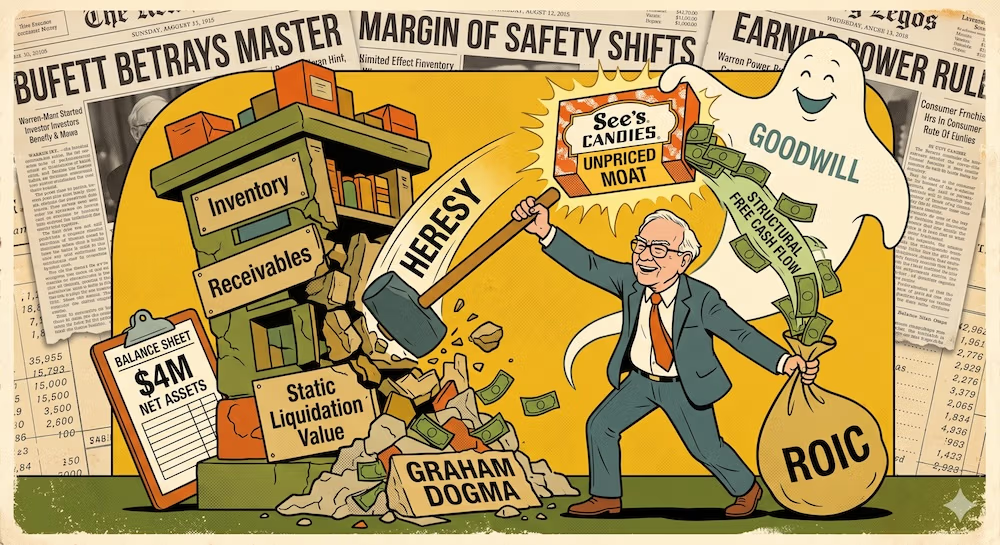
To scale the wall, Buffett had to commit spreadsheet heresy against the strict dogmas of Graham & Dodd. That break happened in 1972 with the purchase of See’s Candies, purchased in 1972 through Blue Chip Stamps for $25 million.
At the time, See’s had only $4 million in tangible net assets. Under classic Graham doctrine, paying $25 million for $4 million of physical assets was a complete betrayal of the margin of safety. It meant paying a massive premium for an unquantifiable, intangible asset called “goodwill.”
But Charlie Munger forced Buffett to look at the economic physics of the income statement rather than the static liquidation value of the balance sheet. See’s was the moment Buffett paid for something Graham’s spreadsheet would have deeply side-eyed. And, annoyingly for the spreadsheet goblins among us, he was right.
I know Graham purists may hate this part. Fair enough. I get it. But the market does not care whether our doctrine feels elegant. I don’t think See’s made Graham irrelevant. That would be lazy. See’s showed that the margin of safety could live in earning power, not just inventory and receivables.
See’s possessed a structural mechanism that changed everything: an unpriced consumer franchise with real pricing power. Because of intense brand loyalty in California, See’s could regularly raise prices over time without destroying customer demand.
More importantly, the business required minimal incremental capital relative to the cash it produced to achieve this growth. It did not need to build massive new factories or continuously buy expensive high-tech equipment just to stay competitive. The economic physics of an unpriced moat meant that See’s could extract massive streams of structural free cash flow while using minimal physical capital.
Instead of trapping cash in a dying textile loom, See’s threw off cash without demanding much back. It generated surplus cash from a capital-light consumer franchise and handed it to Buffett, who could then route that capital into completely different high-return lines of business. This was the core breakthrough of his evolution: he shifted from buying assets to buying returns on invested capital ($ROIC$). This is the part I would underline twice: Buffett did not stop being disciplined. He changed what discipline was measuring.
Graham to Buffett Evolution Matrix
| Dimension | Graham Framework | Buffett’s Evolved Framework | Why the Shift Happened |
| Primary Value Source | Liquidation value and raw asset discounts. | Durable earning power and return on invested capital ($ROIC$). | Capital scale expansion made tiny net-net opportunities completely unusable. |
| Ideal Business | Statistically cheap, tangible asset-rich company. | Capital-light consumer franchise with pricing power. | See’s showed that intangible economic goodwill could produce massive real cash. |
| Holding Period | Often shorter-term; sell immediately upon mean reversion. | Long-term ownership when reinvestment economics justified it. | Superior businesses could compound internally rather than require transaction churning. |
| Role of Goodwill | Highly suspicious; often entirely ignored or discounted. | Extremely valuable when backed by real pricing power and low capital intensity. | Munger pushed Buffett to see goodwill as an economic engine rather than accounting fiction. |
| Capital Structure | Limited-horizon partnership capital, workouts, and controls. | Permanent corporate holding capital supercharged by insurance float. | The evolved large-scale model required a funding source that eliminated redemption runs. |
| Main Failure Mode | Buying statistically cheap businesses that keep deteriorating. | Overpaying for economic moats that prove weaker than expected. | The operational problem shifted from liquidation risk to competitive durability risk. |
Insurance Float Made the Evolved Model Scalable
If we stop the analysis at See’s Candies, we are still missing the actual funding architecture that allowed the evolved Buffett model to achieve world-historic scale. We’ve mapped the shift from asset value to franchise quality, but we haven’t mapped the leverage that supercharged it.
The evolved model scaled because Buffett discovered a structural funding source that matched his long-term investment horizon: insurance float.
Beginning with the acquisition of National Indemnity in 1967 for $8.6 million (capturing $19 million in float) and extending to the full acquisition of GEICO, Berkshire built a massive corporate insurance engine. Insurance operations collect premiums upfront and pay out claims years later, creating a continuous pool of capital—float—that sits inside the corporate structure.
According to academic performance audits (like the landmark NBER study Buffett’s Alpha), Berkshire’s historical long-term leverage averaged roughly 1.4:1. This leverage was not achieved via standard broker margin or volatile short-term bank loans. It was funded by liability-backed float not subject to broker-style margin calls or fund-style redemptions. Because Berkshire’s insurance underwriting was disciplined, this capital source was often low-cost and sometimes negative-cost when underwriting was highly profitable.
When you fuse Graham’s emotional detachment and valuation discipline with a capital structure funded by low-cost, non-callable float, you create an asymmetric compounding asset allocator. The float became the structural funding source that let the evolved Buffett model scale. It allowed Buffett to write massive checks for whole companies and concentrated equity positions at exactly the moments when the rest of the market was capital-starved and panicked.
What Modern Investors Should Absorb and Expel
If you try to copy Buffett’s modern playbook by looking at his regulatory filings months late, buying the same mega-cap consumer franchises at high multiples, and holding them in a standard brokerage account, you are running a severe structural mismatch.
You cannot replicate his historical engine unless you possess his specific corporate liability structure. Most retail capital is more behaviorally and liquidity fragile than people like to admit unless the investor has deliberately built protection around it. Berkshire could hold through severe drawdowns—including roughly 50% declines in 1973–1974, 1998–2000, and 2008–2009, plus the sharp 1987 crash—because it operated with permanent corporate capital. It has no investors who can execute a run on the fund, and it has no broker who can issue a margin call. If you attempt to match that level of concentration without that structural insulation, tracking error or an emotional crisis will frequently force you out of your positions at the absolute worst operational moment.
Furthermore, the easy manual net-net strategy is mostly dead for ordinary retail execution. In Graham’s era, you could find clean manufacturing companies trading below liquidation value because information was trapped in physical paper reports. Today, global data feeds and systematic algorithms scan balance sheets instantly. If you find a stock trading at a deep discount to its net current assets on a free retail stock screener today, it is often something like a failed biotech shell, a fraud-adjacent mess, or a melting ice cube with a balance sheet attached.
To build an independent, anti-dogmatic portfolio architecture, we have to clearly separate the permanent principles of the teachers from the obsolete tools of the past.
Modern Portability Matrix
| Lesson | What Still Travels | What Does Not Travel | Samuel Verdict |
| Graham’s Margin of Safety | The baseline discipline of demanding a wide mathematical gap between price and real value. | Treating book value alone or static historical accounting metrics as protection. | ABSORB THE PRINCIPLE: Understand the core concept, but do not fossilize the tool. |
| Net-Net Investing | Understanding asset liquidation value as one useful analytical lens. | Hand-screening raw retail balance sheets for tiny liquidation plays. | MOSTLY EXPEL: The easy money has been completely scraped away by institutional databases and quant funds. |
| See’s-Style Quality | Studying structural pricing power, high $ROIC$, and minimal capital expenditure needs. | Paying an excessive valuation premium for a pretty consumer moat story. | ABSORB WITH FRICTION: Force the economic moat to prove itself directly through raw cash generation. |
| Insurance Float | Understanding that your portfolio’s underlying funding structure dictates your asset duration. | Attempting to use high-cost, volatile broker margin lines to fake structural float. | ABSORB THE LOGIC, EXPEL THE METHOD: Never use short-term, callable debt to run a long-term patience strategy. |
| Concentration | Knowing that deep focus matters when conviction, research, and capital structure align perfectly. | Running extreme security concentration without permanent capital or massive behavioral endurance. | HANDLE WITH CARE: Most DIY investors severely underestimate the tracking error pain before they experience it. |
Graham taught Buffett how not to be a sucker. Munger and See’s taught him that a business could be worth more than its visible assets. Scale forced him to care about reinvestment runway. Insurance float gave the evolved model fuel. The student did not throw away the teacher. He carried the teacher’s discipline into a world where the old tools no longer fit the job. Understand your own capital constraints, respect the math of your own scale, and ensure your behavioral architecture is as reinforced as your valuation logic.
⚠️ Educational Disclaimer
This historical analysis is presented strictly for educational and informational purposes. It does not constitute personal financial advice or a portfolio prescription. Active security selection, asset concentration, and exposure to market tracking error involve significant investment risks, including the potential loss of capital. Retail allocators should carefully evaluate their individual liquidity needs and behavioral risk tolerance before implementing any strategy discussed herein.
Can a modern retail investor still use Benjamin Graham’s net-net formula?
Not effectively through manual screening. In Graham’s era, information was asymmetric and trapped in physical paper filings, allowing deeply mispriced asset discounts to sit in plain sight. Today, institutional algorithmic pipelines and systematic quantitative factor models scrape global balance sheets instantly. If a stock is trading below its net current asset value (NCAV) on a free public screener today, it is rarely an overlooked gem; it is almost always facing intense adverse selection, such as a failed biotech shell, a fraud-adjacent mess, or a terminal business burning through its remaining cash.
What is the minimum portfolio size required to execute early Buffett’s “Control” strategy?
Millions. To execute early Buffett’s “Control” sleeve—like his 1958 asset unlock of Sanborn Map Co. or his initial 1965 acquisition of Berkshire Hathaway—you require enough concentrated capital to buy a meaningful block of outstanding shares, secure board representation, and actively dictate corporate governance or asset liquidation. For a standard retail account, this active corporate-raider reality is structurally blocked by capital scale. Small-scale investors are price-takers who must rely on the existing management’s capital allocation efficiency.
Did Warren Buffett completely abandon book value when he evolved beyond Graham?
Yes, for all practical compounding purposes. While early Buffett mirrored Graham’s obsession with buying assets at a steep discount to tangible book value, his 1972 pivot to See’s Candies proved that book value is a lagging accounting metric in a modern economy. See’s was purchased for $25 million against just $4 million in tangible net assets, meaning Buffett paid a massive premium for intangible economic goodwill. He realized that a capital-light business with durable pricing power can generate far higher cash returns than a company with massive, low-return physical machinery sitting on its balance sheet.
What type of leverage did Warren Buffett use to scale his evolved portfolio?
Insurance float. Unlike retail investors who deploy volatile, short-term margin loans subject to broker-mandated margin calls, Berkshire Hathaway captured a structural funding advantage by acquiring National Indemnity in 1967 and GEICO later on. Insurance companies collect premiums upfront and pay out claims years later. This creates a massive pool of permanent capital (float). Academic studies estimate Berkshire’s historical leverage averaged roughly 1.4:1, funded by this liability-backed float that was often low-cost or negative-cost when underwriting operations were profitable.
Can a modern DIY investor replicate Berkshire’s insurance float mechanism?
No. You cannot open a private, unregulated insurance utility inside a standard retail brokerage account to collect premium float and fund personal equity selections. Retail investors face an entirely different liability framework: standard broker margin is expensive, floating, and subject to instantaneous forced liquidations during sudden market drawdowns. Because of this structural gap, retail allocators must avoid using high-cost, callable debt to mimic a legend whose entire leverage advantage was non-callable and structurally insulated from panic.
How much tracking error must an investor endure to follow the Buffett compounding model?
Massive, often career-ending pain. True concentration requires a psychological tolerance for extreme multi-year underperformance relative to the broad market index. For instance, during the late-1990s dot-com boom, Berkshire Hathaway shed nearly half its value (-49.3% drawdown between 1998 and 2000) while speculative technology shares surged. Most retail portfolios are behaviorally and liquidity fragile; without the permanent capital firewall of a corporate holding company, individual investors frequently capitulate and liquidate positions at the absolute bottom of a tracking error cycle.
This article is also available in Spanish. Leé la versión en castellano: Warren Buffett y Benjamin Graham: Cómo el alumno evolucionó más allá del maestro