
Domestic investing has one tremendous public-relations advantage: it rarely has to defend itself as a strategy.
Buying foreign securities is treated as a decision. Staying home is treated as the natural state of affairs. The domestic investor appears cautious, grounded, and sensibly aware of his limitations. The international investor gets handed the burden of proof, along with a suitcase full of currency, accounting, governance, and political risks.
That arrangement is backwards.
A domestic-only approach makes an enormous decision before valuation begins. It determines which companies qualify for examination and which disappear from consideration because they trade under the wrong flag. The investor may perform meticulous analysis afterward, but the candidate list has already been fenced in.
John Templeton’s real challenge to domestic investing began there. His contribution was larger than owning foreign stocks and more demanding than adding an international sleeve to a portfolio. He expanded the comparison set, estimated corporate value across markets, and allowed the bargains to determine where capital ended up.
Sometimes that process led him deep into Japan. Later it led him away again. Geography moved because relative value moved.
I consider this the strongest part of Templeton’s global philosophy. He exposed a hidden sequencing error: investors often let familiarity decide what deserves research, then congratulate valuation for choosing among the survivors.
The lesson does require a warning label. Looking abroad creates more candidates, along with more opportunities to misunderstand accounting, ownership, currencies, shareholder rights, and political constraints. Foreign neglect may create mispricing. It may also reflect local knowledge or a perfectly rational refusal to accept a damaged shareholder claim.
Templeton’s mechanism works only when the price advantage survives those extra burdens. Curiosity opens the search. It does not settle the investment case.

Domestic Investors Have Already Voted Before They Start Valuing
A portfolio concentrated at home is normally discussed as the final result. The more revealing decision came earlier, when the investor decided where the search would take place.
Domestic companies arrive with an enormous visibility advantage. They dominate local business media, retirement accounts, analyst commentary, brokerage platforms, consumer experience, and everyday conversation. Their names feel interpretable before the investor has opened a filing. Foreign businesses often arrive as unfamiliar abbreviations attached to unfamiliar reporting conventions.
That difference affects which securities receive serious attention.
Kenneth French and James Poterba documented the scale of home-country concentration in their 1991 paper, “Investor Diversification and International Equity Markets”. At the end of 1989, their estimates suggested that U.S. investors held approximately 93.8% of their equity portfolios in U.S. shares. Japanese investors held 98.1% in Japan. British investors held 82% in the United Kingdom.
Those figures describe ownership at a particular historical moment. They do not establish that every domestic investor was irrational or that international exposure would automatically have improved results. They do reveal how consistently investors across different countries believed home deserved the overwhelming benefit of the doubt.
Everyone cannot possess a unique geographic genius simply because everyone lives somewhere.
Templeton attacked the structure producing that concentration. In “16 Rules for Investment Success”, originally published in World Monitor in 1993, he argued that searching worldwide expands the number of bargains available and may reveal better opportunities than a search confined to one nation.
The arithmetic is almost embarrassingly simple. A larger pool of companies may contain opportunities missing from a smaller one. Yet the implication is uncomfortable because it removes the innocence from domestic investing.
A home-market restriction is an active filter. It grants domestic companies admission before their merits have been tested against foreign alternatives.
I understand why the restriction feels prudent. Familiar regulations, companies, brands, and institutions create the impression that fewer things can go wrong. Sometimes that impression is justified. The investor may genuinely understand the local market better. Still, familiarity also hides the opportunity cost of the companies never investigated.
Nothing abroad has to be rejected on valuation grounds because nothing abroad was allowed to compete.
A domestic portfolio may still be excellent. The mechanism does not prove otherwise. It establishes something narrower: valuation can rank only the securities admitted into the research process. When geography controls admission, geography has already shaped the answer.

Familiarity Has a Talent for Impersonating Knowledge
The domestic-investing defence usually rests on a sensible phrase: invest in what you know.
The trouble lies in deciding what “know” means.
Gur Huberman’s “Familiarity Breeds Investment” offers a useful example. Customers of U.S. Regional Bell companies disproportionately owned shares in their local telephone provider, even though the comparable companies traded on the same exchange and were similarly accessible.
The local company had entered their lives through monthly bills and ordinary exposure. That familiarity influenced investment behaviour.
It would be comforting to believe that these investors had discovered a superior informational edge while paying for telephone service. Recognition is the less flattering explanation.
Domestic companies benefit from this confusion constantly. A familiar logo, a product on the kitchen counter, or twenty years of headlines can make a business feel understood. The investor knows the name, recognizes the executives, follows the national economy, and mistakes accumulated exposure for analytical depth.
I fall for the same mental convenience. A clean label saves work. Once something feels familiar, the mind quietly upgrades recognition into comprehension and moves on to the interesting part—forming an opinion.
That is dangerous, although attacking familiarity too broadly creates another error.
Joshua Coval and Tobias Moskowitz found evidence that proximity can produce a genuine informational advantage. In “The Geography of Investment: Informed Trading and Asset Prices”, they showed that active U.S. fund managers overweighted nearby firms and earned abnormal returns on those local holdings. The effect was stronger among smaller, more concentrated funds located away from major financial centres.
Domestic or local concentration can therefore reflect specialized understanding. A manager may know a regional industry, interpret local developments faster, or possess a research network that outsiders cannot easily reproduce.
That evidence saves the argument from becoming a sermon about provincial investors needing to discover an airport. Templeton’s worldwide search did not abolish local knowledge. It forced local knowledge to prove itself.
The useful split is between passive familiarity and demonstrated informational advantage.
Passive familiarity comes from repetition, cultural fluency, brand exposure, and constant contact. It makes a company easier to discuss and harder to question. Demonstrated advantage comes from superior access, specialized research, stronger interpretation, or knowledge that shows up in decisions and results.
The two can coexist. They should never be assumed to be identical.
A domestic specialist with an authentic edge may have good reason to remain concentrated. A domestic investor relying on recognition may be mistaking comfort for competence. The global investor has an equal capacity for self-deception, especially when unfamiliarity itself starts feeling sophisticated.
Owning something obscure does not make the analysis deep. Sometimes it merely makes the annual report longer.
Templeton Let the Bargain Choose the Country
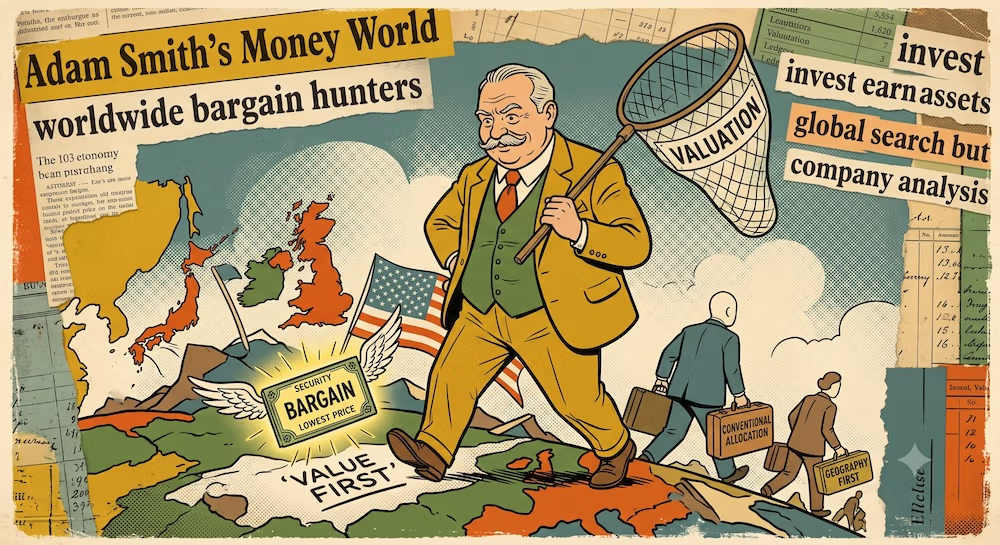
Templeton described his organization in a 1985 Adam Smith’s Money World interview as “worldwide bargain hunters.” That phrase captures the public image. His explanation of how the hunting worked matters more.
Templeton said his organization estimated the value of corporations around the world and sought shares offering the lowest price relative to estimated value. When asked which countries offered the best prospects, he rejected the assumption embedded in the question. His team searched for the bargains and would “later find out what nation it’s in.”
That is the mechanism.
A conventional international allocation often begins with geography. The investor develops a view on Japan, Britain, the United States, or another market. Companies are then selected inside that national thesis.
Templeton’s process ran in the opposite direction. He compared companies across markets. The resulting bargains determined the countries represented in the portfolio.
I give him precise credit for this sequencing because it is easy to admire the visible foreign holdings while missing the decision process that created them. Geography was an output. It did not receive the first vote.
Templeton’s 1993 rules reinforce the distinction. He urged investors to buy value rather than market trends or economic forecasts and to investigate the earnings, assets, and business behind a security. The search was global, but the unit of analysis remained the company and the investor’s claim on its economics.
This was country-agnostic at the beginning. It could never be country-blind at the end.
National conditions influence accounting, ownership, currencies, capital mobility, political risk, taxation, disclosure, and legal enforcement. Templeton’s refusal to begin with a country forecast did not remove those variables. It prevented a macro narrative from deciding which businesses were allowed to enter the competition.
Modern followers often copy the visible portion because it is easier to package. They see foreign securities and conclude that “international exposure” was the idea. The resulting portfolio may own dozens or hundreds of companies across multiple countries while applying no Templeton-like comparison at all.
A benchmark can provide global exposure. An allocation policy can provide global exposure. A product committee can provide global exposure. None of those arrangements proves that businesses were valued against one another across borders.
The financial industry has every incentive to blur this distinction. “International investing” is a saleable category. A research process that may lead abroad, return home, or produce awkward geographic concentrations is harder to place in a tidy style box.
Templeton’s portfolio was the footprint left by the search. Treating the footprint as the strategy is how a difficult method becomes a convenient product label.

Japan Was a Destination Until the Numbers Changed
Templeton’s experience with Japan shows why he should not be reduced to a permanent advocate for foreign investing.
In the 1985 interview, Templeton recalled that Japan had once accounted for more than half of his fund’s investments when leading Japanese companies were available at very low earnings multiples. By the time of the interview, he said that exposure had fallen below 3% because Japanese valuations had risen and better bargains could be found in the United States and elsewhere.
The figures come from Templeton’s recollection in the interview, rather than a separately reconstructed fund record. That attribution boundary should remain clear. The story’s analytical value does not depend on pretending the numbers were audited for this purpose.
His geographical concentration changed as the comparison changed.
Templeton entered Japan when Japanese securities appeared unusually cheap relative to his estimates of corporate value. He withdrew when that advantage weakened. Capital returning to the United States did not contradict his worldwide philosophy. It confirmed that the philosophy belonged to the search process rather than a fixed foreign allocation.
This is more impressive than the romantic version of Templeton as the fearless outsider discovering Japan. Entering an unfamiliar market provides a heroic origin story. Leaving after prices rise requires surrendering the identity created by that story.
I have little patience for investment philosophies that become too emotionally attached to their own marketing category. A strategy should be allowed to produce results that make its label look temporarily ridiculous.
Templeton’s approach could make an international investor hold mostly domestic securities. It could make a celebrated Japan buyer sell Japan. It could create geographic concentrations that would look inconsistent to anyone confusing process with product category.
Markets changed faster than the label on the brochure. They usually do.
The Japan example also reveals the weakness in framing the debate as domestic versus international. Templeton did not owe foreign markets permanent loyalty merely because he had been willing to research them early. A neglected market can become crowded. A cheap market can become expensive. A strange idea can become consensus and continue dressing like a contrarian long after the disguise stops working.
The relevant question was never whether Templeton favoured foreign stocks. It was whether foreign companies offered better bargains after being compared with domestic ones.
When that answer changed, he changed.

Refusal Can Create Opportunity, Yet It Proves Almost Nothing by Itself
“Looking where others refuse to look” is an attractive description because it grants the investor independence before the work begins. The neglected security feels like a discovery. The crowd’s absence appears to certify the opportunity.
It certifies no such thing.
Information barriers do influence cross-border investing. Richard Portes and Hélène Rey found in “The Determinants of Cross-Border Equity Flows” that information-related variables were powerful determinants of bilateral equity flows among fourteen countries from 1989 through 1996. Capital did not move across borders according to diversification theory and expected returns alone.
Alan Ahearne, William Griever, and Francis Warnock reached a compatible conclusion in the Federal Reserve paper “Information Costs and Home Bias”. Poor-quality or less credible financial information helped explain why U.S. investors underweighted foreign markets. Countries with more firms cross-listed under U.S. disclosure and investor-protection rules received greater U.S. portfolio weights.
Jun-Koo Kang and René Stulz found another revealing pattern while examining foreign ownership in Japan between 1975 and 1991. Foreign investors disproportionately owned large manufacturers and companies with stronger accounting performance, lower leverage, and lower risk. Among smaller firms, they preferred companies with greater exports.
Foreign capital gravitated toward businesses that were visible, legible, and easier to evaluate.
These findings support the idea that distance, disclosure, and information costs shape investor attention. They do not demonstrate that lightly owned or ignored foreign companies subsequently delivered superior returns.
That distinction deserves more force than it usually receives. Neglect may reduce competition around a security and allow an analytical error to persist. It may also reflect a sensible response to unreliable accounts, inaccessible information, concentrated control, or weak shareholder rights.
I admit that the word “neglected” works on me. It makes a security sound undiscovered rather than unwanted. The language quietly turns absence into evidence of opportunity, which is a marvellous trick if one prefers atmosphere to due diligence.
An underfollowed company may be mispriced because few investors will tolerate the work required to understand it. Another company may be underfollowed because the financial statements are untrustworthy and minority shareholders have all the economic authority of decorative houseplants.
Both can trade cheaply.
Templeton’s great strength was his willingness to treat discomfort as a reason to investigate. The weakness appears when followers convert that willingness into a presumption that discomfort itself earns a return.
The crowd’s refusal establishes a question: why are they absent?
Until that question is answered, “neglected” remains a description of participation rather than a valuation conclusion.
Cheap Across Borders Is Harder Than It Looks on a Spreadsheet
Global value investing becomes seductively clean when expressed through multiples. One company trades at eight times earnings. Another trades at fifteen. The lower number wins and the spreadsheet receives a small promotion.
Cross-border reality is less cooperative.
A foreign multiple cannot be compared honestly until the investor knows what the reported earnings mean, how credible they are, who controls the cash, whether minority shareholders can access it, and which legal and currency constraints stand between corporate value and the eventual investment result.
Magnus Dahlquist, Lee Pinkowitz, René Stulz, and Rohan Williamson explored one part of this problem in “Corporate Governance and the Home Bias”. Concentrated control and limitations on freely tradable shares helped explain international portfolio underweights. Their work on a “world float portfolio” showed why total market capitalization can exaggerate the corporate value realistically available to outside investors.
That point is fatal to simplistic bargain hunting.
A company may appear cheap relative to its earnings or assets while public shareholders possess a weak claim on either. Controlling owners may dominate capital allocation. Cash may be trapped. Assets may never be realized for minority holders. The quoted shares can represent something economically thinner than the business value suggested by the accounts.
The U.S. Securities and Exchange Commission’s Investor.gov guidance on international investing identifies other structural frictions: currency risk, currency controls, lower liquidity, restrictions on foreign ownership, different market operations, political uncertainty, and difficulty enforcing legal remedies.
These factors are sometimes pushed into a generic risk paragraph and forgotten. They belong inside the valuation.
They influence whether the investor can acquire shares, receive distributions, convert proceeds, exit the position, enforce rights, and preserve the economic value supposedly being purchased.
Templeton’s instruction to investigate earnings, assets, and the underlying business becomes more demanding across borders. Accounting practices may differ. Inflation may distort historical comparisons. Currency changes may overwhelm the operating result when translated back into the investor’s home currency. Ownership structures may separate corporate prosperity from shareholder prosperity.
I part company with any version of Templeton that reduces his global method to scanning for low foreign price-to-earnings ratios. A cheap multiple can reflect information neglect. It can also reflect capital controls, governance defects, political extraction, unreliable reporting, or an ownership structure designed to remind outside shareholders where they sit in the family hierarchy.
The investor has to perform two related valuations.
The first estimates the economic value of the business.
The second estimates the realistic value of the investor’s claim on that business.
The distinction exists domestically too, but foreign markets can add layers of legal, informational, and currency friction that widen the gap. A business can be healthy while the security remains a poor claim on that health.
“Search worldwide” sounds liberating. In practice, the investor may have to complete far more work merely to establish that two numbers belong in the same comparison.
The Neglect-versus-Impairment Test
Templeton’s insight becomes more useful once unfamiliarity is divided into two categories: researchable friction and shareholder impairment.
Both can repel investors. Both can produce low prices. Only one can often be reduced through better analysis.
| Question | Researchable friction | Shareholder impairment |
|---|---|---|
| Why are investors absent? | Language, distance, weak analyst coverage, unfamiliar industry conventions, inconvenient data | Weak disclosure, concentrated control, capital controls, ownership restrictions, poor legal remedies |
| Can research reduce the uncertainty? | Often, at least partly | Research may diagnose the problem without removing it |
| Where might an edge exist? | Better interpretation, patient investigation, cross-market comparison | In judging whether the price adequately compensates for a risk the investor cannot control |
| What is the typical error? | Rejecting a security because the work feels uncomfortable | Buying a security because the discount feels adventurous |
Researchable friction describes the territory where Templeton’s willingness to look could create an advantage. A language barrier, thin analyst coverage, difficult data, or an unfamiliar business convention may discourage investors without damaging the underlying enterprise. Patient research can sometimes transform uncertainty into understanding.
Shareholder impairment is less generous. Research may uncover a governance defect, currency restriction, ownership barrier, or weak legal claim. The investor now understands the problem better. The problem remains.
This distinction also preserves the counterevidence from local investing. Coval and Moskowitz showed that local managers can possess useful information. Outsiders may face a genuine disadvantage rather than a market irrationality waiting to be harvested.
Kang and Stulz found no evidence that foreign investors in their Japanese sample performed significantly worse than a Japanese market portfolio. They also did not demonstrate that low foreign ownership reliably identified superior-return securities.
That leaves an unresolved result, and I prefer it to a falsely tidy rule. Local investors do not always dominate. Foreign investors do not automatically profit from entering lightly owned securities. The outcome depends on what is being ignored, why it is being ignored, and whether the outsider can close the knowledge gap.
Neglect earns investigation. It earns nothing else.
That decision rule strips away some of the vanity surrounding contrarian investing. Searching where others refuse to look can represent courage and intellectual independence. It can also become a theatrical way to pay for risks the crowd understood perfectly well.
Templeton’s discipline demanded two refusals. He refused to let domestic familiarity close the search prematurely. He also refused to let foreign novelty lower the standards applied once a security had been found.
The research could travel. The burden of proof travelled with it.
A Wider Search Is the Lesson; Foreign Ownership Is Merely One Possible Result
The strongest case against domestic-only investing is smaller than the usual international-diversification sales pitch and far harder to dismiss.
A wider search forces domestic companies to compete against a larger group of alternatives. It prevents familiarity from granting them automatic admission. It may uncover businesses whose prices reflect low attention, awkward information, or institutional neglect.
That wider search also creates new failure points. More countries mean more accounting systems, ownership structures, currencies, legal regimes, and information gaps. Breadth can improve comparison. It can just as easily dilute attention until the investor understands every market superficially and none of them well.
More information is not the same as better judgment. I have to remind myself of that whenever a larger dataset starts feeling like an argument.
Templeton’s movements into and later away from Japan provide the cleanest interpretation of his approach. A worldwide comparison could generate a heavily foreign portfolio. The same process could later direct capital back toward the United States. There was no contradiction because geography had never been the controlling principle.
That is where both sides of the domestic-versus-international debate become evasive.
Domestic investing cannot claim to be geographically neutral. It restricts the candidate list before valuation begins.
International investing cannot claim Templeton’s mantle simply by owning assets from several countries. Exposure reveals where the securities trade. It says nothing about whether they were compared intelligently or whether the shareholder claims survived scrutiny.
The distinction I would keep is severe because it needs to be. Templeton deserves credit for giving investors permission to search beyond the domestic boundary. He did not give them permission to romanticize whatever they found there.
Looking where others refuse to look creates the possibility of an edge. Determining whether their refusal was foolish or fully justified is the work.
What did John Templeton reject about domestic-only investing?
He rejected the idea that geography should decide which companies enter the research process. His worldwide search compared businesses across markets and allowed relative value to determine where capital eventually landed.
Did Templeton simply prefer foreign stocks?
No. His movement into Japan and later away from it showed that foreign ownership was an outcome of comparative valuation, not a permanent preference. When better bargains appeared elsewhere, the geographic allocation changed.
Why can familiarity be mistaken for investment knowledge?
Repeated exposure to domestic brands, executives, media, and institutions can create confidence without producing superior analysis. Familiarity becomes useful only when it reflects a demonstrated informational advantage rather than recognition alone.
Does foreign neglect prove that a security is undervalued?
No. Low attention may leave room for mispricing, but it can also reflect unreliable accounts, concentrated control, weak shareholder rights, or other rational reasons for avoidance. Neglect earns investigation, not an automatic investment conclusion.
What is the difference between researchable friction and shareholder impairment?
Researchable friction includes obstacles such as language barriers, limited analyst coverage, difficult data, or unfamiliar conventions that better analysis may reduce. Shareholder impairment includes governance, legal, ownership, currency, or capital-control problems that research can identify without removing.
Why are foreign valuation multiples harder to compare?
A low multiple is meaningful only after the investor assesses the credibility of the accounts, ownership structure, currency exposure, legal rights, liquidity, and access to corporate value. The business may be healthy while the public security remains a weak claim on that health.
This article is also available in Spanish. [Leé la versión en castellano: John Templeton vs. la inversión local: por qué buscar donde otros se niegan a mirar]