The lazy version of financial history says Charlie Munger taught Warren Buffett to buy “wonderful businesses.” I’ll admit it: “wonderful business” sounds nice. Too nice. It is a lovely, cozy sentiment, and that is exactly why the phrase has become dangerous. It is vague enough to be printed on a corporate coffee mug and used by retail stock pickers to justify overpaying for almost any company with a recognizable logo.
If you trace the actual data from the Buffett partnerships through the restructuring of Berkshire Hathaway, you find something much colder. Munger did not teach Buffett to buy businesses because they were pleasant, admired, or prestigious. He taught him to buy them because their underlying unit economics were rude in the best possible way.
Before Munger’s intervention, Buffett was a strict quantitative disciple of Benjamin Graham’s “cigar butt” framework. He hunted for often mediocre, sometimes dying operations trading at a massive statistical discount to their liquidating value. You bought the asset below net current asset value, waited for a short-term operational or liquidation pop to capture your margin of safety, and moved on. It was a beautiful way to run small pools of capital in the highly inefficient micro-cap markets of the 1950s.
But asset-based cheapness runs into a hard capacity wall. As capital scales, you cannot buy microscopic liquidation plays without moving the stock price against yourself, incurring severe transaction friction, and eventually becoming the stuck operator of a broken textile mill.
I like quality businesses. Of course I do. I am not sitting here trying to build a personal portfolio out of textile mills and regret. But quality is not a permission slip to turn your brain off. Munger did not replace Graham’s demand for a margin of safety. Instead, he systematically re-engineered what provided that safety. He forced Buffett to realize that a structural margin of safety could also come from a durable economic moat and high capital efficiency—not only from an asset liquidation sale. This article is an autopsy of that specific diagnostic framework: the exact economic conditions Munger taught Buffett to look for inside a business, why they alter how capital allocation works, and how to separate genuine operational quality from branded decoration.
Business Quality Starts With Return on Tangible Capital
The core transition from Graham’s net-net style to Munger’s quality doctrine landed mathematically in 1972 with the acquisition of See’s Candies. Blue Chip Stamps, an affiliate controlled by Buffett and Munger, bought the retail confectioner for $25 million.
At the time of the transaction, See’s Candies possessed only $8 million of tangible net assets on its balance sheet. Under strict Graham value doctrine, paying more than three times tangible book value for a retail regional chocolate business was reckless.
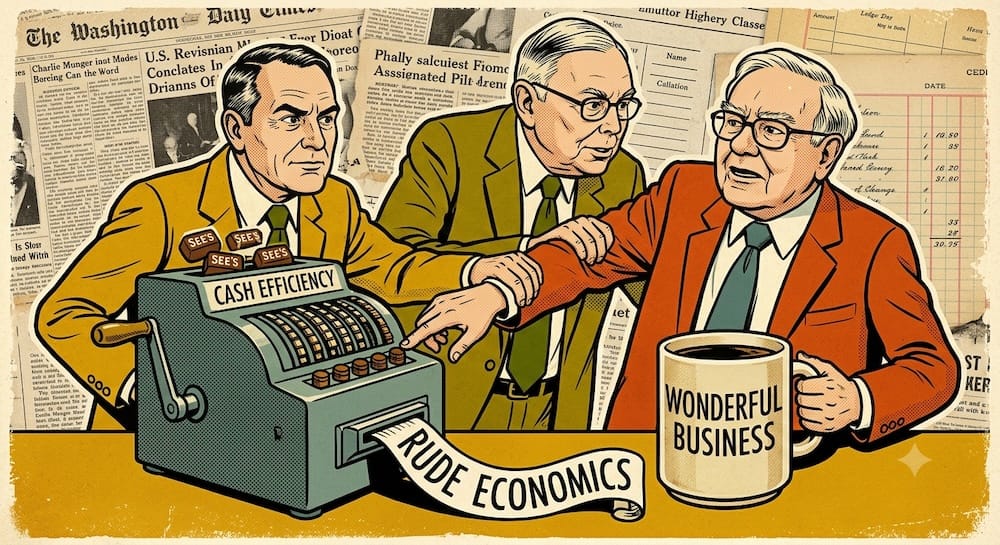
But Munger forced the analysis away from book assets and onto a singular metric: pre-tax return on tangible capital. See’s was not magic candy. It was cash efficiency wearing chocolate wrapping. Slightly less romantic. Much more useful.
While the physical asset base of See’s was tiny, it was generating $4.2 million in pre-tax net earnings. The business was running a roughly 50% pre-tax return on tangible capital.
The See's Candies Asset Efficiency Model (1972):
[Tangible Net Assets: $8M] ---------> Produces ---------> [Pre-Tax Earnings: $4.2M]
                                                          (~50% Return on Tangible Capital)
Munger’s core insight was that the absolute size of a company’s physical plant matters far less than the relationship between its net profits and the tangible assets required to produce those profits. A business that requires $100 million of brick, mortar, and machinery to generate $10 million in profit is a fundamentally different species from a business that can generate that same $10 million using only $20 million of physical capital.
When a business exhibits a high pre-tax return on tangible capital, it creates an enormous structural advantage for its capital allocator. Because the operating footprint is small relative to the cash output, the company generates substantial surplus cash that can be distributed upward and reallocated after taxes and operating needs are met. It becomes a funding mechanism for other investment allocations rather than a consumer of capital.
The Opposite of Quality: Berkshire Hathaway Textile Mills
To see exactly why Munger fought so hard to move Buffett away from cheap asset plays, one only has to look at the negative case study: the original Berkshire Hathaway textile operation acquired in 1965. The textile mills are the part of the story I actually like most, because they make the lesson ugly enough to remember.
On paper, the textile mills looked like a classic Graham value bargain. The stock was trading below the net working capital per share, meaning the buyer was theoretically getting the real estate, the machinery, and the inventory for less than nothing.
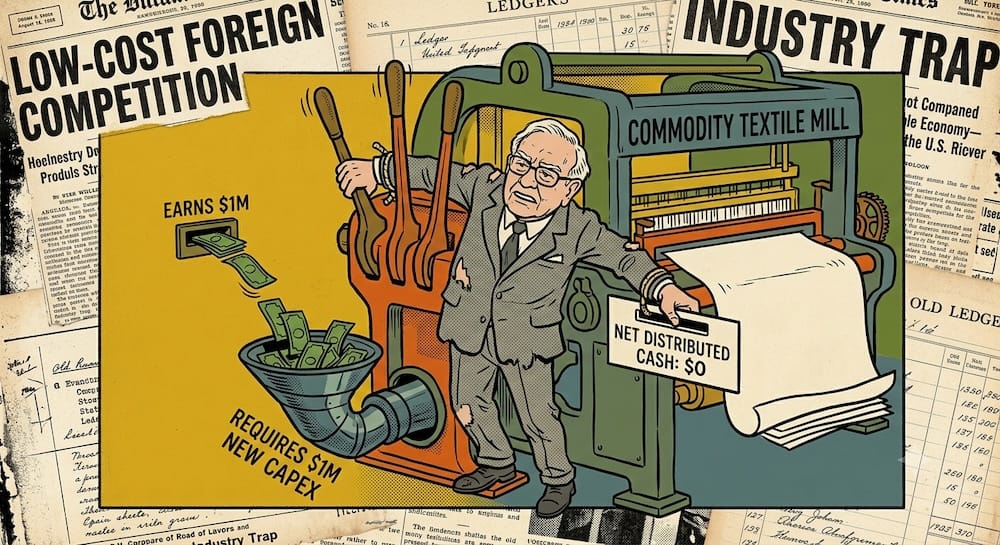
The hidden problem was the underlying unit economics of a commoditized industry. Because a textile loom from one manufacturer produces the same basic cotton sheet as a loom from a competitor, the business lacked any semblance of pricing power. To remain competitive with lower-cost foreign textile mills, the company had to constantly purchase newer, faster, more efficient machinery.
This created a compounding trap. Every dollar of depreciation or net profit generated by the textile mill could not escape the business. Corporate headquarters could not distribute that cash upward to buy other assets because the mill required constant capital reinvestment just to stay idling. If Buffett refused to fund the new equipment, the mill would lose its competitive position instantly; if he funded the equipment, he was pouring fresh capital into a low-return business with no structural exit.
The Capex Trap Mechanism:
[Commodity Textile Mill] ----> Earns $1M ----> Requires $1M New Capex ----> Net Distributed Cash: $0
[High-ROIC Confectioner] ----> Earns $1M ----> Requires $100K Maintenance -> Net Distributed Cash: $900K
Buffett spent twenty years pouring capital into those mills before finally shutting down the textile operations in 1985. The textile business was a reliable way to freeze capital in place rather than compound it. It proved to me that buying an asset purely because it is cheap, without evaluating its structural return on tangible capital, is a clear way to lock up capital in low-yield loops.
Low Incremental Capital Needs: The Cash Engine Test
Another major lesson Munger brought to the partnership was the concept of low incremental capital needs. It is one thing for a business to show a high return on capital on its historical footprint; it is an entirely different, more lucrative reality when a business can grow its earnings over time without requiring a proportional increase in capital inputs.
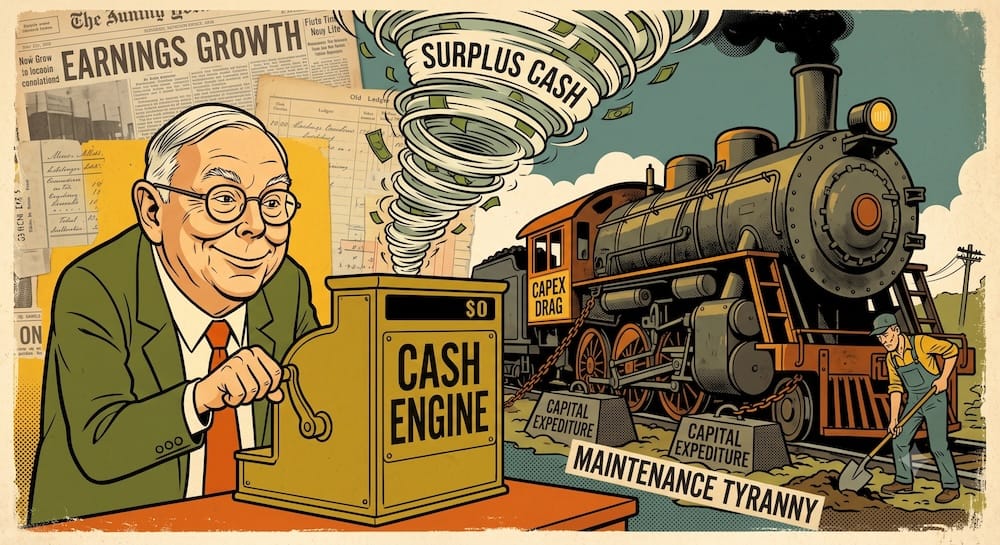
Consider the difference between a high-quality capital-light business and a capital-intensive utility or railroad. If a railroad wants to double its shipping volume, it must lay thousands of miles of new steel track, buy hundreds of additional locomotives, and hire massive logistical crews. The incremental return on that new capital is strictly bounded by the physical intensity of the assets.
A true Munger-quality business can often expand earnings through non-physical channels. As See’s expanded over time, it did not require a massive, linear expansion of its factory floor space or its raw industrial machinery. The brand equity, customer loyalty, and localized distribution networks allowed the company to scale volume and revenue with minimal incremental fixed-asset investment. I have a soft spot for simple businesses, but simple does not mean automatically good. A simple bad business is still bad. It is just easier to understand while it eats your money.
The Reinvestment Delta:
Incremental Revenue Growth  ======> High Capital Intensity ====> Drags massive capex along
Incremental Revenue Growth  ======> Low Capital Intensity  ====> Drops straight to surplus cash
When a business does not need to consume most of its own earnings just to maintain its market share, it frees the investor from the tyranny of maintenance capex. The surplus cash distributed upward to the parent corporation acts as a continuous stream of surplus investment capital. Munger taught Buffett that true quality is measured by how much cash a business can deliver to its owners, not by how large an industrial empire it builds by trapping its own earnings inside the balance sheet.
Pricing Power: The Moat Showing Its Teeth
If a business can generate high returns on capital and requires minimal reinvestment, it must have a mechanism to prevent competitors from entering the market and driving those returns down to the cost of capital. That mechanism is the economic moat, and its primary behavioral indicator is pricing power. This is where I think investors get cute. They see a famous brand, slap the word “moat” on it, and suddenly the valuation no longer matters. Lovely little trick. Also expensive.
A famous logo is not a moat. Sometimes it is just expensive wallpaper on a mediocre business. In the Munger/Buffett framework, pricing power means the ability to raise prices over time without destroying demand or losing volume to a competitor.
In a perfectly competitive commodity market, the seller has zero control over price. If a wheat farmer or copper miner raises their price by even 1%, the buyer immediately walks across the street to buy from someone else. The product is undifferentiated, and the transaction is purely a function of the prevailing market clearing rate.
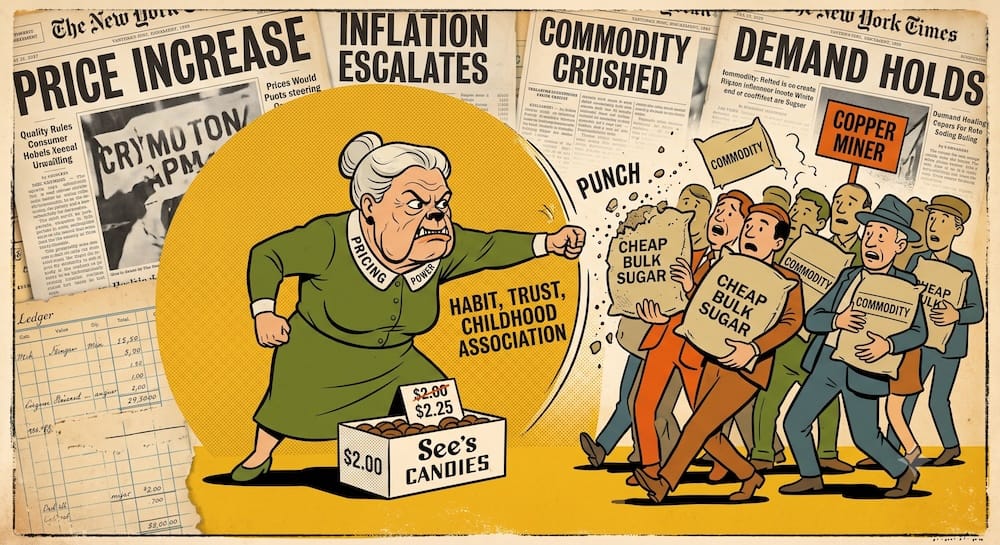
See’s Candies possessed an entirely different customer behavior pattern. If a consumer wanted to buy a box of chocolates for their partner on Valentine’s Day, they were not shopping for cheap, unbranded bulk sugar. They were purchasing an emotional proxy built on habit, trust, and childhood association. Business quality is not vibes. It is not brand affection. It is not “I personally like the product.” That is how investors turn shopping habits into portfolio mistakes. If the price of a box of See’s Candies was $2.00, and management raised it to $2.25, the consumer did not cancel the purchase or seek out a cheaper generic substitute. The brand equity insulated the company from price elasticity.
Pricing Power vs. Commodity Friction:
[Price Increase] ----> Commodity Business ----> Volume pressure / substitution risk
[Price Increase] ----> Brand Moat Business ---> Demand holds better over time
This pricing power is especially critical during inflationary macroeconomic regimes. In an inflationary environment, the costs of raw materials, labor, and transportation rise across every industry. An asset-heavy company with zero pricing power gets crushed from both sides: its input costs escalate, it cannot raise prices to consumers without destroying volume, and it must reinvest increasingly expensive dollars into maintaining its machinery.
A high-quality business at least has a fighting chance of passing those costs through. The commodity business just stands there and takes the punch without needing to throw endless new capital into the furnace.
Economic Goodwill: When Book Value Misses the Real Asset
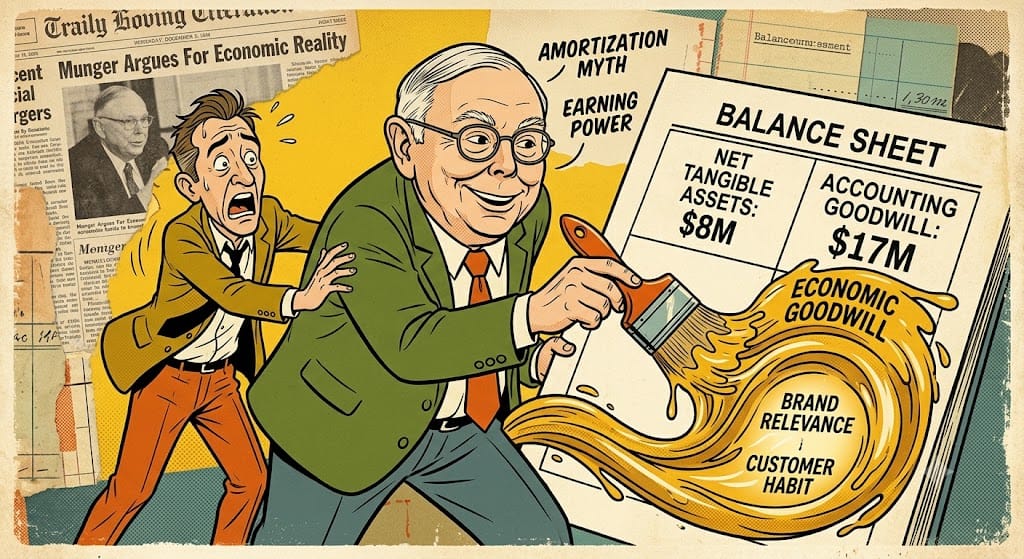
This reality leads to one of the most vital accounting insights Munger and Buffett developed: the distinction between accounting goodwill and economic goodwill.
When a company is acquired for a price above its net tangible book value, standard accounting principles require the excess amount to be recorded on the balance sheet as an asset called “Goodwill.” In the old days of corporate accounting, companies were required to systematically amortize (write down) that goodwill over a fixed period of years, treating it as a non-cash expense that reduced reported net earnings.
Munger argued that this accounting treatment could obscure economic reality. Accounting goodwill is a historical artifact of a transaction price. Economic goodwill, however, is the capitalized value of a company’s superior earning power.
If a business with $8 million in tangible assets can reliably produce $4.2 million in pre-tax profit, that outsized return is not a fluke or an accounting error. It is driven by invisible, intangible assets that do not appear on a traditional balance sheet: customer habits, brand relevance, proprietary distribution advantages, and regulatory positions.
Anatomy of Economic Goodwill:
[Tangible Net Assets on Balance Sheet: $8M]
   + [Invisible Intangible Value: Brand Trust + Customer Habit + Pricing Power]
================================================================================
= [Real Economic Value: $25M+ (Justified by its $4.2M Earning Power)]
Munger taught Buffett that paying a premium over tangible book value for economic goodwill is often far more conservative than buying an asset-heavy business at a steep discount to book value. Physical assets degrade, rust, and require maintenance. Economic goodwill built on consumer habits tends to compound in value over time, without the same physical depreciation burden.
The Core Diagnostic Matrices of Business Quality
To clarify these boundaries, the following matrices map out the exact criteria Munger used to differentiate high-quality operations from asset traps, commodity businesses, and false quality indicators. Just a quick warning before you use these tables: do not misuse them by trying to cherry-pick a single trait.
1. The Munger Business Quality Matrix
| Quality Trait | What It Means | Why It Matters | False Signal |
| High Return on Tangible Capital | Operating profits are large relative to the physical capital base. | Maximizes cash distribution potential to the owner. | High Return on Equity (ROE) achieved via extreme financial leverage or share buybacks on low equity bases. |
| Low Incremental Reinvestment Needs | Growth does not require a proportional increase in physical assets. | Prevents earnings from becoming trapped in maintenance capex. | High growth that consumes 100% of operational cash flow to sustain volume. |
| Durable Pricing Power | Ability to raise prices over time without losing sales volume. | Protects real earning power and margins during inflationary regimes. | Short-term price hikes during temporary supply chain shortages. |
| Economic Goodwill | Intangible value derived from brand trust, habit, or switching costs. | Creates a capital-light asset that compounds without physical wear and tear. | Large balance sheet “Accounting Goodwill” born from overpaying for past acquisitions. |
| Simple Operating Model | The core economic driver can be cleanly tracked and understood. | Reduces execution risk and structural forecasting errors over long horizons. | High-tech or fast-moving industries where structural visibility is under 3 years. |
| Management Restraint | Executive team focuses on operational efficiency and capital return. | Prevents surplus cash from being wasted on value-destroying acquisitions. | High revenue growth paired with continuous share dilution or empire-building. |
The trap is that these traits have to work together. High margins without pricing power can be temporary. High ROE without tangible capital discipline can be financial engineering. Brand awareness without customer willingness to pay is just expensive advertising. Munger-quality businesses are not defined by one shiny metric; they are defined by a cluster of reinforcing economics.
2. See’s Candies vs. Berkshire Hathaway Textile Mills
| Dimension | Berkshire Hathaway Textile Mills (Commodity Case) | See’s Candies (Quality Case) | The Munger Lesson |
| Asset Base | Heavy: Massive factory floors, specialized loom machinery, large raw inventory. | Light: Small retail storefronts, localized production facilities. | Tangible asset mass is a liability, not an honor badge. |
| Reinvestment Needs | Continuous: Obliterates free cash flow via mandatory technological upgrades. | Minimal: Maintenance needs were modest relative to cash generation. | Avoid businesses that must eat their own tail to stay alive. |
| Pricing Power | Zero: Subject to global commodity markets and cheap foreign imports. | High: Protected by emotional consumer habits and brand equity. | A moat that disappears when a competitor cuts prices is just a puddle. |
| Pre-Tax Return on Tangible Capital | Structurally Low: Hovered near single digits or negative numbers. | High: ~50% pre-tax returns on physical operating capital. | Capital efficiency determines allocation speed. |
| Customer Behavior | Transactional: Buyers switch vendors over fractions of a cent per yard. | Habitual: Buyers seek out the specific name, box, and flavor profiles. | Look for deep psychological moats, not just physical scale. |
| Surplus Cash | Negative/Static: Trapped in maintenance loops inside the mill. | Substantial: Distributed upward to parent company after taxes. | High-quality businesses function as capital exporters. |
3. Real Quality vs. Fake Quality
| Looks Like Quality | The Hidden Problem | The Better Question |
| Famous Global Brand | The brand requires massive annual advertising spend just to defend its market share (e.g., consumer electronics). | Does the brand allow the company to charge a premium price over an identical unbranded alternative? |
| High Net Profit Margins | The high margins are cyclical, tied to a peak commodity or credit cycle (e.g., merchant banks or mining firms). | What do the margins look like at the absolute trough of a multi-year economic contraction? |
| High Past Revenue Growth | The growth was purchased via loose credit terms, heavy customer acquisition subsidies, or dilutive acquisitions. | Is the revenue growth translating into a linear increase in free cash flow per share? |
| Low Debt on Balance Sheet | The business model itself is highly capital-intensive, but current management is running a temporary low-debt window. | What is the structural return on tangible capital before adjusting for the capitalization mix? |
| Loyal Customer Base | The loyalty is based on temporary convenience or a subsidized price rather than a true switching cost or habit. | What happens to customer retention if the company raises prices meaningfully over time? |
Dexter Shoe: When Quality Analysis Fails
Dexter Shoe is the slap in the face this article needs. Without Dexter, the Munger quality framework starts to sound too clean. And clean frameworks are usually hiding a bruise somewhere.
Buffett acquired Dexter Shoe in 1993 for $433 million. On the surface, the company checked every box on our Munger quality checklist. It had a long history of high returns on capital, an incredibly strong regional brand name, immense customer loyalty, a clean operating model, and seemingly durable competitive positions in the domestic footwear market.
Because Buffett was convinced of the durability of Dexter’s economic moat, he made the structural error of paying for the acquisition using Berkshire Hathaway stock rather than cash. He gave away 25,203 shares of Berkshire equity—representing roughly 1.6% of the entire company—to buy a shoe manufacturer.
Within a few years of the purchase, the competitive landscape underwent a structural shift. The passage of free trade agreements allowed a massive wave of ultra-low-cost foreign shoe manufacturing to enter the domestic market. Dexter’s domestic manufacturing facilities, despite their operational efficiency and brand equity, could not compete with foreign labor cost differentials.
The moat was bypassed entirely. The brand power evaporated the moment the price differential between a pair of Dexters and an imported shoe widened past a certain behavioral threshold. By 1999, Dexter’s earnings dropped to near zero, and the business was eventually shut down or integrated into other minor operations.
The Dexter Shoe Failure Arc:
[1993: High Return on Capital + Strong Brand] ---> [Macro Shift: Cheap Foreign Import Wave] ---> [1999: Moat Evaporates, Value to $0]
Because the deal was structured using Berkshire equity, the permanent cost of that mistake multiplied into billions of dollars of opportunity cost as Berkshire’s core businesses compounded over the subsequent decades.
Dexter Shoe serves as a warning. Historical quality metrics—high ROE, strong historical margins, clean balance sheets—are not permanent monuments. A quality factor can look pristine right up until a structural shift in technology, regulation, or global supply chains renders the underlying asset base obsolete.
What Munger Did Not Teach: Quality at Any Price
This is the part where the “quality at any price” crowd starts squirming, which is usually a good sign that we are near the useful part of the article. I do not want this piece to become quality worship with better accounting vocabulary. That would miss the point entirely.
The final, and perhaps most dangerous, retail misapplication of Munger’s philosophy is the belief that price no longer matters if a company’s quality is sufficiently high. Investors use the phrase “buy a wonderful business at a fair price” as a rationalization to pay extreme multiples (40x, 50x, or 60x earnings) for mega-cap consumer or technology brands.
Paying 50 times earnings for a wonderful business can still be dumb. There, I said it. Wonderful does not cancel arithmetic. Munger never advocated for the complete removal of Benjamin Graham’s price discipline. He merely expanded the definition of value to incorporate the net present value of future cash flows generated by a superior asset.
If you pay 50 times earnings for a magnificent business with a 40% return on tangible capital, you have baked near-perfection into your capital structure. If the company experiences even a minor deceleration in its growth, a slight contraction in its competitive moat, or a structural rise in macroeconomic interest rates, the resulting multiple contraction will crush your investment return even if the underlying business remains operationally sound.
The Valuation Multiplier Trap:
Company grows earnings by 15% (Success) + P/E multiple contracts from 50x to 25x (Friction) = Net Negative Portfolio Return
A wonderful business can become a terrible investment if the entry valuation leaves zero room for error. The ultimate goal of the Munger business-quality framework is to find situations where the market is mispricing the durability of an economic moat—allowing you to buy a high-ROIC compounder at a multiple that assumes it is just an ordinary, competitive business.
The Munger Business Quality Diagnostic
For anyone studying the framework away from the historical data and looking at it with an asset-allocation eye, the takeaway is entirely conceptual and structural. True business quality is not a narrative concept. It is a rigorous quantitative condition that can be evaluated using a strict diagnostic filter:
- The Physical Footprint Test: What is the pre-tax return on tangible capital? Is the company producing outsized net profits relative to the actual physical property, plant, equipment, and inventory required to run the operation?
- The Reinvestment Friction Test: If this company doubles its revenue over the next seven years, will it be forced to consume its own cash flow to construct physical infrastructure, or will the revenue drop cleanly to the bottom line as free surplus cash?
- The Inflation Pass-Through Test: If input costs rise across the board, does the company have the structural brand trust or switching costs necessary to raise prices tomorrow without shedding sales volume to a cheaper competitor?
- The Valuation Guardrail: Is the entry price low enough to provide a margin of safety if my qualitative assessment of the moat turns out to be wrong, temporary, or vulnerable to structural disruption?
Business quality is ultimately about capital autonomy. A high-quality company exports surplus cash; a low-quality company imports capital just to keep standing still. That is what Munger taught Buffett. Not “buy nice brands.” Not “pay any price for quality.” My own rule would be simple: inspect the engine before admiring the logo. A famous brand is not a compounding machine unless the unit economics prove it.
What is the exact definition of business quality according to Charlie Munger?
It is a measurable economic condition, not a pleasant story. In the Munger framework, true quality means a business exhibits a high pre-tax return on tangible capital, has low incremental reinvestment needs to achieve growth, maintains durable pricing power during inflation, and relies on sustainable customer habits that protect its economic goodwill from structural technological or regulatory disruption.
How do you calculate the pre-tax return on tangible capital used in the See’s Candies example?
You divide the company’s annualized pre-tax operating earnings by its total net tangible assets. For See’s Candies in 1972, this meant taking its $4.2 million in pre-tax net earnings and dividing it by the $8 million in physical capital (inventory, storefronts, and equipment) listed on the balance sheet, revealing a 50% structural return on capital.
What is the main difference between accounting goodwill and economic goodwill?
Accounting goodwill is a static, historical artifact recorded on a balance sheet when a buyer pays a premium above net tangible assets during an acquisition. Economic goodwill is the living, capitalized value of a company’s superior earning power, usually driven by intangible competitive moats like customer habits, brand trust, and long-term price elasticity insulation.
Why did the Munger business quality framework fail when applied to Dexter Shoe?
The competitive moat was bypassed entirely by a macro regime shift. While Dexter Shoe possessed a strong regional brand and excellent historical capital returns in 1993, the sudden influx of ultra-low-cost foreign manufacturing stripped away its pricing power, proving that historical quality metrics can look pristine right up until global structural dynamics render the physical asset base obsolete.
Can a retail investor use standard factor ETFs to match Charlie Munger’s quality strategy?
Not exactly. While systematic Quality ETFs screen for quantitative markers like high Return on Equity (ROE) and low financial leverage, they look at trailing corporate reports across a broad index. They cannot evaluate the forward-looking qualitative durability of an economic moat, nor do they protect you from the valuation multiplier trap if the index is trading at extreme premium multiples.
Does a business with a famous brand name automatically possess an economic moat?
No. A famous logo is frequently just expensive wallpaper on a mediocre operation. If a brand requires massive, continuous advertising expenditures just to defend its existing market share against competitors, it lacks a true economic moat. A brand only becomes an economic moat when it allows the business to raise prices over time without destroying customer demand.
This article is also available in Spanish. [Leé la versión en castellano: Qué le enseñó Charlie Munger a Warren Buffett sobre la calidad de un negocio]