I don’t buy the idea that Charlie Munger turned Warren Buffett from a value investor into a quality investor. That sounds tidy, which is usually where the trouble starts when people look back at market history. It sets up a neat, fictional narrative where Buffett abandons his old religion because he saw the light.
Munger did something much sharper: he made Buffett stop treating book value like holy scripture. He didn’t make Buffett abandon value investing; he forced him to upgrade his definition of what value actually means.
I don’t think Munger made Buffett more sophisticated by making him less Graham. I think he made Graham’s rules stop pretending every business was a liquidation exercise.
The pivotal tension came during the 1972 See’s Candies negotiation. Buffett’s Graham-trained instincts made the price difficult to accept. To Buffett’s asset-focused brain, paying three times tangible book value for a company with only $8 million in net assets felt like an existential sin. He was ready to walk away over a mere $5 million valuation gap because the accounting ledger told him the price was too high.
Munger pushed the framework past the balance sheet. He forced Buffett to see that value could live somewhere other than a physical inventory sheet. It could live in durable future earning power.
The upgrade was not “pay any price for quality.” It was “stop confusing accounting cheapness with economic value.” I look at this shift not as an abandonment of Graham, but as a mandatory software update. Munger forced Buffett to ask a much more demanding question: value relative to what?
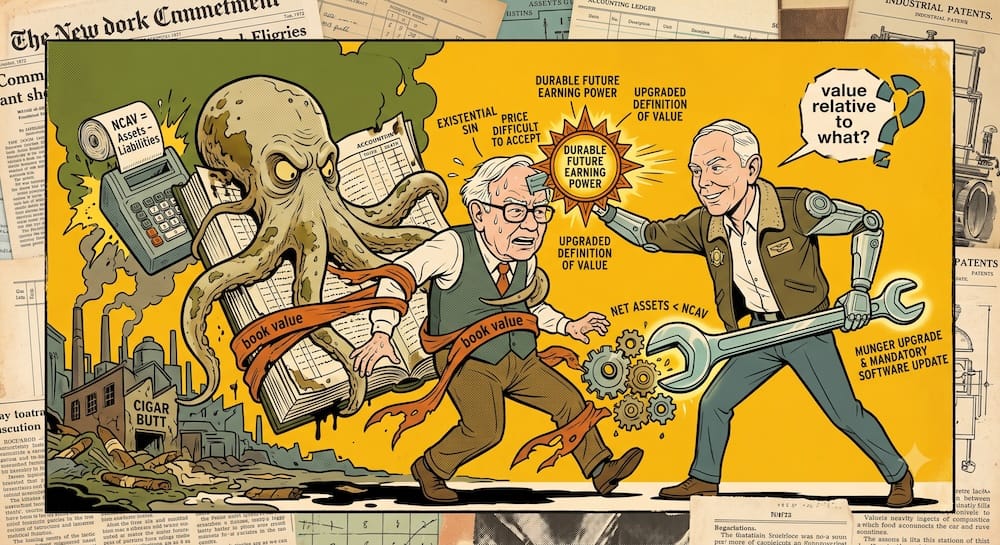
Buffett’s Original Definition of Value: Cheap Relative to Assets
To understand why that software update was necessary, you have to look at the engine Buffett was running during his partnership years from 1956 to 1969. His strategy was strictly quantitative, built entirely on Benjamin Graham’s classic Net-Current-Asset Value (NCAV) metric.
When I look back at the original definition of a Graham “net-net” bargain, the math is beautiful in its simplicity:
Market Capitalization < NCAV
Where Net Current Asset Value (NCAV) is defined as:
NCAV = Cash and Short-term Investments + 0.85(Accounts Receivable) + 0.50(Inventory) − Total Liabilities
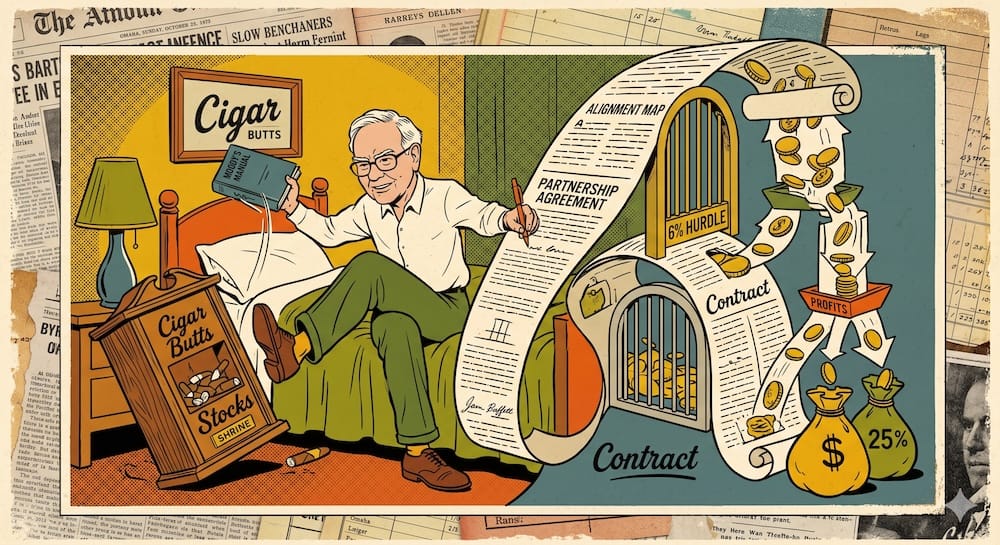
The old definition of value was simple: a stock is valuable when it is cheap relative to tangible assets, working capital, liquidation value, or near-term asset realization. You were looking for a corporate “cigar butt”—a soggy, unloved, structurally decaying business trading at such a severe discount that you could buy it, extract the cash or wait for a brief cyclical uptick, and flip it for a quick profit.
I love this old Graham stuff in the same way I love old maps. It’s beautiful, it belongs to a specific era of market history, and it worked spectacularly well when the terrain matched the paper. Back in the 1950s and 1960s, information was buried in physical Moody’s manuals. If you were willing to turn pages manually, you could find tiny, obscure companies trading for less than the cash on their balance sheets.
This original framework wasn’t about long-term compounding. It was an asset-realization play. Buffett operated more like an active liquidation allocator and short-term arbitrage trader than a passive collector of businesses. He bought cheap, held for a catalyst or a cyclical bounce, and emptied the position within 12 to 24 months to move on to the next cheap dollar.
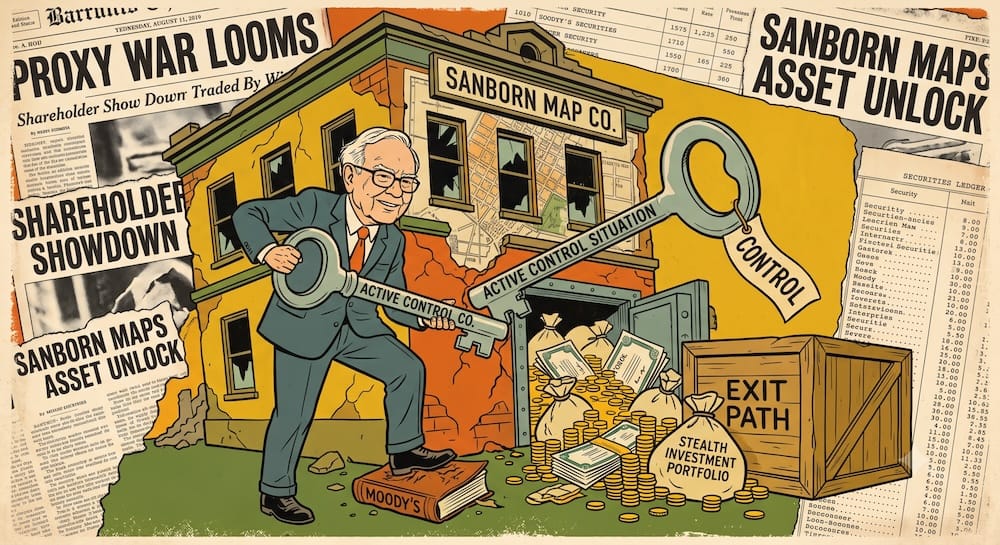
Why That Definition Worked — Until It Didn’t
This asset-first definition of value wasn’t wrong; it was highly rational for the environment in which it was born. And it worked because of three specific structural realities that surrounded Buffett’s early career:
- A Tiny Capital Base: In the late 1950s, Buffett was managing hundreds of thousands of dollars, not hundreds of billions. He could deploy his entire capital pool into tiny, illiquid pink-sheet stocks that institutional managers couldn’t touch without moving the price.
- Massive Information Asymmetry: Before digital screens and quantitative algorithms, the market was informationally inefficient. If you were the only person in Omaha reading physical corporate filings, you had an asymmetric data edge.
- Active Control Situations: If the market refused to recognize the asset value, Buffett didn’t just sit there and hope. He bought enough shares to start a proxy war, walk into the boardroom, and force a liquidation or a dividend distribution.
Look at his 1958 to 1960 play on the Sanborn Map Co. The core business of tracking utility and building structures across American cities was dying. But underneath that decaying operation sat a massive, stealth investment portfolio worth $65 per share. The stock was trading in the public market at an average cost of $45 per share.
Buffett bought 23,000 shares, forced his way onto the board, threatened a full corporate showdown, and forced the company to use its investment portfolio to buy out dissatisfied shareholders at fair value. The strategy worked because there was a clear, near-term exit path where the underlying assets could be unlocked.
But that definition of value comes with a massive, built-in expiration date. It relies on short holding periods and constant capital recycling. If you run that strategy with a small pool of money, you can make a fortune. But if your capital base grows too large to exit these tiny stocks quickly—or if you get stuck owning the business instead of flipping the assets—the math turns viciously against you.
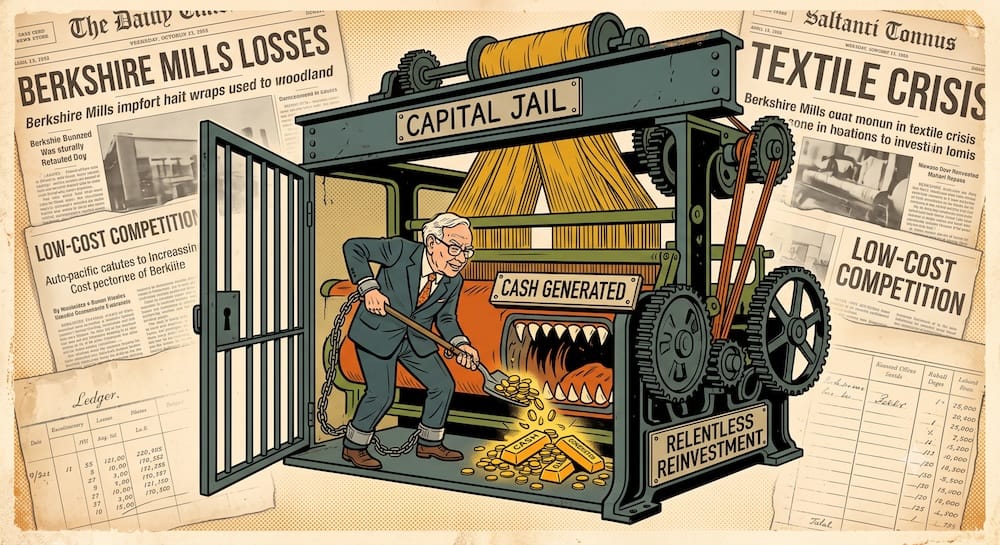
Berkshire Textile: The Cheap Asset That Ate the Owner
The turning point came when Buffett bought control of Berkshire Hathaway’s textile mills between 1962 and 1965. By the old definition, it was a classic value play. The stock was trading at prices between $7.50 and $14.86 per share, a deep discount to its net working capital and tangible asset value. It looked like the ultimate bargain.
But instead of a quick flip, Buffett got stuck holding the operational reality.
This is where I get impatient with lazy value screens. A low price-to-book ratio is not an economic moat. Sometimes it is just a warning label printed in accounting font. The textile mills had zero pricing power; they were selling a commodity product against low-cost foreign competitors. Because the operations were structurally weak, they generated low returns on tangible capital.
Worse, the business had massive, relentless reinvestment needs. Every year, just to keep the mills from going under completely, Buffett had to take the cash generated by the business and pour it right back into expensive new textile machinery.
This is the failure mode of the un-upgraded definition of value. If you buy a business that earns a poor return on capital, time is your enemy. The longer you hold it, the more your total return degrades toward the miserable internal rate of return of the operation. You are caught in a capital jail where you must constantly spend money just to stand still, with no hope of ever scaling the cash out of the building.
Buffett spent twenty years trying to optimize those mills before finally shutting them down in 1985. It became his ultimate case study in how accounting cheapness can mask absolute economic destruction.
Munger’s Upgrade: Value Relative to Earning Power
This is where I think Munger’s contribution gets misunderstood. He did not add poetry or sentimentality to Berkshire’s investment process. He added a harsher definition of reality.
This is the part of Munger’s influence I care about most: he changed the unit of measurement. He anchored the new definition to a fundamental corporate truth: real value is the relationship between the price you pay and the durable future cash a business can produce without eating itself alive.
Under the old Graham framework, value was backward-looking. It asked: What are these physical assets worth if we tear down the factory and sell the parts today? Munger’s upgraded framework was forward-looking. It asked: What is the sustainable return on tangible capital, and how much cash can this business hand to the owner tomorrow?
Mathematically, if a business retains and reinvests capital inside its walls over a multi-year horizon, your terminal return tracks its Return on Invested Capital (ROIC):
Ending Value = Capitalinitial × (1 + ROIC)n
If the ROIC is low, buying the stock at a discount to book value only gives you a temporary statistical buffer. But if the business can generate a high ROIC while requiring only modest incremental capital to grow, it creates something Graham didn’t account for: economic goodwill.
Economic goodwill is the intangible earning power of a business that doesn’t show up on a physical inventory sheet. It’s driven by brand loyalty, consumer habits, and pricing power—the ability to raise prices over time without destroying your customers to a cheaper competitor.
Munger forced Buffett to see that paying a premium to tangible book value ($P/B > 1.0$) for a business with massive economic goodwill was actually cheaper over time than buying a broken textile mill at a discount. Book value is not useless, but treating it like the whole truth is how you end up cuddling a dying business while it consumes your cash.
See’s Candies: The Moment Book Value Lost the Argument
The See’s Candies acquisition in 1972 was the exact sandbox where this definition upgrade was field-tested.
The numbers at the center of the deal tell the entire story:
- Purchase Price: $25 million cash
- Net Tangible Assets: Approximately $8 million
- Pre-Tax Earnings: About $4 million
- Return on Tangible Capital: ~50%
I understand why this would have offended a Graham purist. Paying three times book for candy sounds deranged if your entire worldview lives inside liquidation value. But See’s was not a pile of chocolate boxes. It was a cash engine with sugar on top. Less romantic, much more useful.
By the old Graham definition, paying $25 million for $8 million of physical assets was madness. Buffett’s balance-sheet goblin brain rebelled against the $17 million premium for unquantifiable “goodwill.” But Munger made him look at the operational efficiency. See’s was producing $4 million in pre-tax profit on an asset base of just $8 million. That is an astounding 50% return on tangible capital.
More importantly, See’s possessed incredible regional pricing power. See’s could raise prices over time without destroying demand, easily outrunning the high inflation regime of the 1970s. Because the business required only modest incremental capital to maintain its kitchens and shops, a large portion of the earnings could be distributed after taxes, operating needs, and modest reinvestment.
Instead of trapping capital like the Berkshire textile mills, See’s threw off a relentless stream of cash that could be reallocated into other high-return opportunities. It proved that paying a multiple of book value for durable future earning power was the ultimate form of value investing.
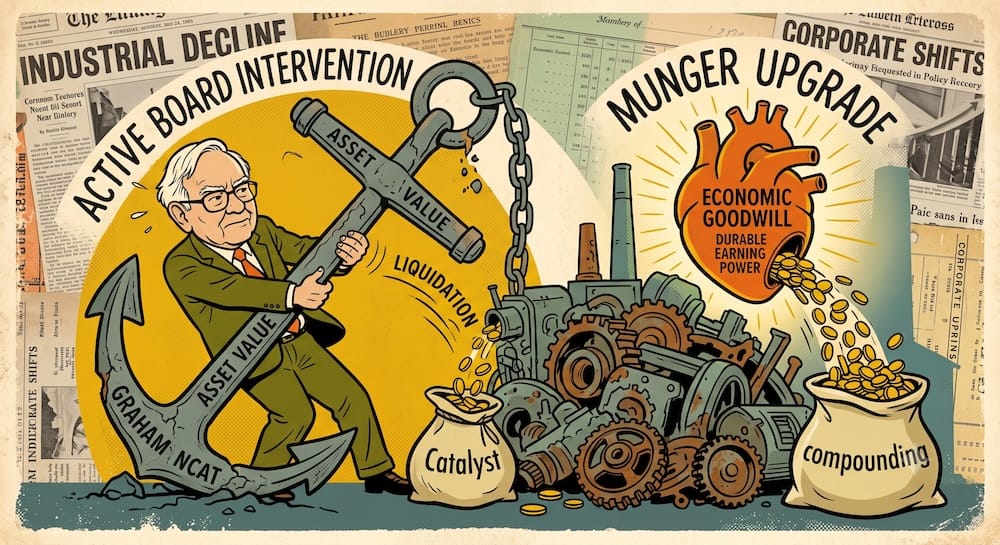
The New Definition of Value
To me, the upgrade was not “assets don’t matter.” The upgrade was “assets are not enough.” To see how completely these two frameworks diverge when you are analyzing a business, we have to map out the foundational questions an investor asks. The upgrade changed every line item on the analytical ledger:
| Dimension | Graham-Style Value | Munger-Upgraded Value | Samuel Verdict |
| Valuation Anchor | Current assets, working capital, liquidation value. | Durable future earning power and economic goodwill. | Cheap relative to what? Earning power matters more than physical dust. |
| Margin of Safety | A steep percentage discount to tangible asset value. | Economic durability, pricing power, and a sane entry price. | Both need evidence, but a competitive moat is more survivable than a cheap asset. |
| Holding Period | Shorter horizon; driven by an immediate corporate catalyst. | Longer horizon; designed for multi-year internal compounding. | Time helps only good businesses; it actively destroys bad ones. |
| Reinvestment Dynamic | Often ignored; assumes capital will be extracted quickly. | Central to the thesis; looks at how much cash the operations consume. | Bad reinvestment needs will eat an initial accounting discount alive. |
| Failure Mode | The value trap; getting stuck in a dying business with no exit. | Quality overpayment; misjudging the durability of the competitive moat. | Pick your poison carefully. Both will erase your capital if mismanaged. |
| Investor Question | What can I get for these assets if the doors close today? | How much cash can this engine deliver to my pocket tomorrow? | Shift your gaze from the funeral value to the operating life. |
We can see the clear trajectory of this definition change by looking at how the key corporate case studies played out across Berkshire’s history:
| Case Study | Definition of Value Used | What Worked / Failed | The Practical Lesson |
| Sanborn Map Co. (1958) | Pure Asset Value Framework | Worked: The underlying investment assets were extracted via active board intervention. | Old value works perfectly if there is an immediate exit or liquidation catalyst. |
| Berkshire Textile (1962) | Accounting Asset Cheapness | Failed: The business lacked pricing power and consumed capital through continuous upgrade needs. | Cheap price tags can become permanent capital jails if operations require constant maintenance. |
| See’s Candies (1972) | Durable Earning Power | Worked: High returns on tangible capital threw off surplus cash without requiring heavy reinvestment. | High ROIC and pricing power can justify paying above tangible book when the price remains sane. |
| Dexter Shoe (1993) | Mistaken Quality Framework | Failed: The competitive moat was obliterated by low-cost foreign manufacturing competition. | Economic goodwill must be real and durable; vibes and famous logos do not count as a moat. |
The inclusion of Dexter Shoe in 1993 is a critical warning. It shows what happens when you misread the durability of a business’s earning power. Buffett paid a premium price for Dexter because he believed its brand and domestic manufacturing setup constituted a permanent moat. But foreign competition erased that edge almost overnight, proving that if the economic goodwill is an illusion, paying a premium price will destroy capital just as efficiently as any old textile mill.
What Munger Did Not Change
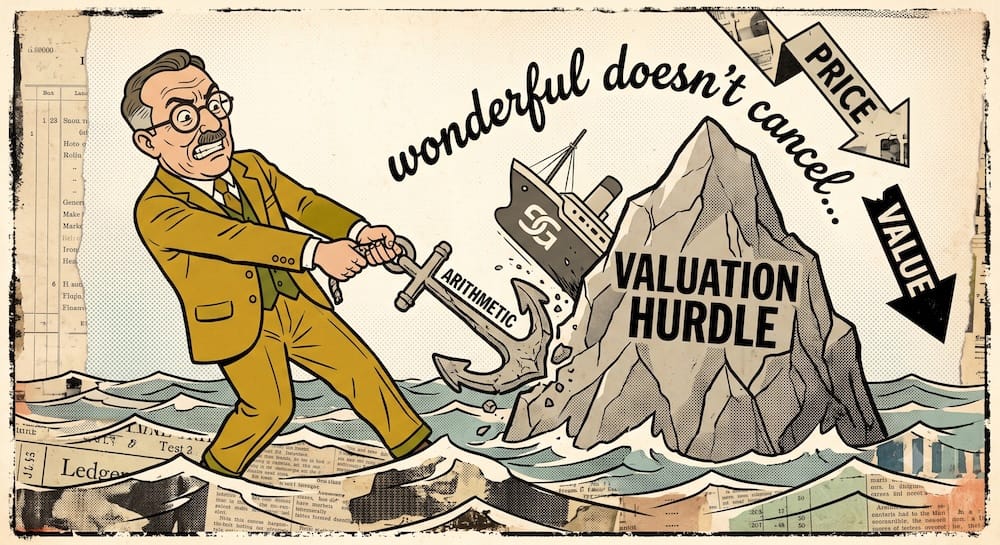
This is where the quality crowd starts misbehaving, and I have very little patience for it. They hear phrases like “wonderful business” and “economic goodwill,” and suddenly every expensive stock with a nice logo gets baptized as a generational compounder. They use Munger’s upgrade as an excuse to stop looking at valuations entirely.
No. Wonderful does not cancel arithmetic.
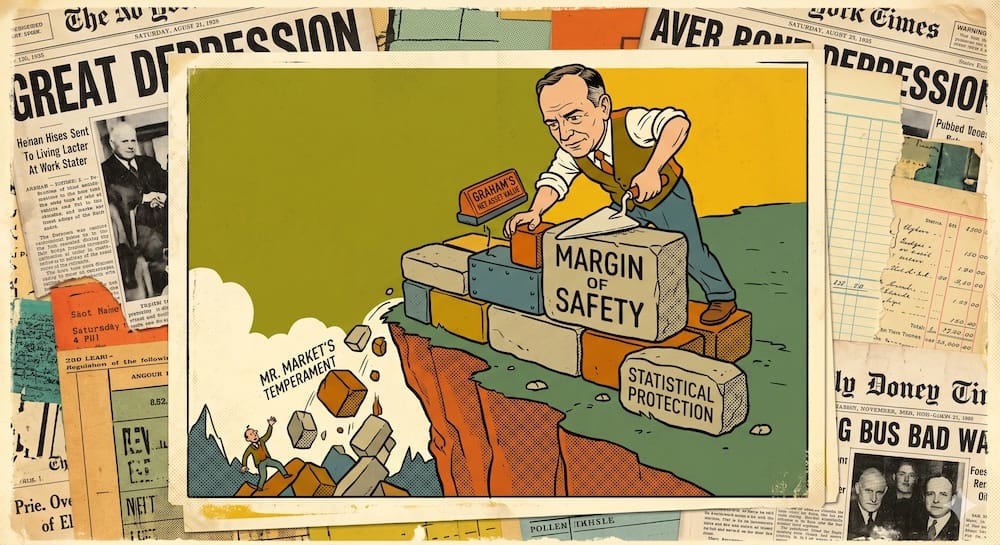
Munger did not teach Buffett to buy quality at any price. He did not teach him to worship brands blindly, to ignore the margin of safety, or to allocate capital based on warm, fuzzy vibes. The discipline remained completely unchanged: you are still looking for a gap between price and value. The upgrade simply recognized that a business with superior economics has vastly more structural value than the physical liquidation cost of its machinery.
If you pay a price that assumes a business will grow flawlessly at 30% a year for the next two decades, you haven’t upgraded your definition of value—you’ve just abandoned valuation discipline. You are still required to do the cold work of calculating whether the future cash generation justifies the cash leaving your pocket today. Munger did not kill Graham; he just made Graham survive contact with a high-return business.
Modern Misreading: “Cheap” and “Value” Are Not Synonyms
For a modern individual allocator, the biggest takeaway from this historical evolution is conceptual. You do not need a portfolio of specialized products to implement this; you need to clean up your vocabulary. In the modern financial media landscape, people routinely use the words “cheap” and “value” as if they are synonyms. They are not.
I do not care whether a stock looks cheap on a screen if the business behind it is slowly chewing through the owner’s capital. When you look at the modern landscape through an upgraded lens, you start to spot the false value signals that trap un-upgraded investors every single day:
| Looks Like Value | The Hidden Structural Problem | The Upgraded Question to Ask |
| A Low Price-to-Book (P/B) Ratio | The balance sheet may be loaded with obsolete, depreciating assets that can never be monetized. | What can these assets actually produce, or are they just a monument to past capital expenditures? |
| A Low Price-to-Earnings (P/E) Ratio | The earnings are often at a cyclical peak right before a massive structural margin contraction. | Are these profits durable across an entire economic cycle, or are we buying yesterday’s news? |
| A High Historical \ {ROIC} | The high returns are frequently a temporary, un-moated anomaly that will mean-revert due to competition. | What prevents a competitor from entering this space and driving these high returns down to zero? |
| A Famous Consumer Brand | The company may have a well-known logo but possesses zero pricing power to pass through systemic inflation. | Can this business raise prices meaningfully over time without losing core customers? |
| A “Cheap” Out-of-Favor Stock | There is often no corporate catalyst or structural operational alignment to unlock the latent value. | How does this value actually get returned to the owner, or are we just watching an asset rust? |
| High Historical Operating Margins | The margins may be temporarily inflated by cutting critical research, development, or long-term maintenance. | Are these margins sustainable, or is management starving the future of the company to game this quarter’s numbers? |
Final Takeaway
Charlie Munger didn’t walk into Buffett’s life to teach him how to spend money loosely. He walked in to show him that a value framework built exclusively on the liquidation value of physical property is a cramped, dangerous way to build wealth over a lifetime.
If you spend your entire life hunting for stocks that are cheap strictly relative to accounting assets, you will eventually find yourself trapped inside a textile mill, pouring good capital after bad just to keep the lights on. But if you remember that real value is always the relationship between price paid and durable economic output, you stop looking for cheap suits. You start looking for cash engines.
I take the Munger lesson as a vocabulary correction. Before you call something value, ask what exactly is valuable: the assets, the earnings power, the moat, the reinvestment runway, or just the comforting low multiple on the screen.
Munger did not make Buffett abandon value. He made the word value earn its keep.
Educational Note: This is a historical and conceptual analysis of capital allocation frameworks, not financial advice or a recommendation to buy, sell, or hold any asset.
Did Charlie Munger make Warren Buffett completely abandon Benjamin Graham’s value investing style?
No. This is the lazy interpretation of market history. Munger did not push Buffett toward reckless growth or un-anchored brand worship. Instead, he made the word value earn its keep by moving the calculation away from backward-looking liquidation metrics and anchoring it to forward-looking durable earning power. You are still looking for a meaningful gap between price and value; you are simply recognizing that an asset-light corporate engine with a deep economic moat can be exceptionally cheap even when trading at a premium to tangible assets.
What is the exact mathematical limitation of a classic Graham net-net strategy at modern scale?
It self-destructs as your capital base grows. The net-current-asset value (NCAV) formula targets highly illiquid, overlooked micro-cap companies often found in unlisted over-the-counter markets. If you are managing a small personal portfolio of a few hundred thousand dollars, you can exploit these anomalies. But once your capital crosses into institutional territory, your own buying pressure moves the market price, erasing the discount before you can accumulate a meaningful position. Furthermore, automated systematic screens have compressed the historical informational edge that existed when Buffett mined physical manuals.
How does a modern DIY investor run into the same value trap that Buffett found in the Berkshire textile mills?
By treating a low price-to-book ratio as an automatic margin of safety. I get deeply impatient with quantitative screens that assume a stock is safe just because it trades below its historical accounting assets. If a company has poor returns on tangible capital and lacks pricing power, it becomes a capital jail. You face a structural trap where the business forces you to continuously reinvest cash into depreciating machinery or operations just to maintain a flat competitive position, effectively incinerating your capital while the stock behaves like a value trap on your screen.
What is the difference between accounting book value and the economic goodwill Munger introduced?
Accounting book value tracks the historical net cost of physical assets like plant, property, and inventory minus outstanding liabilities. Economic goodwill is an intangible asset driven by persistent consumer habits, brand authority, and pricing power. It allows an operation like See’s Candies to consistently earn massive profits on a very small physical asset base. If a business possesses genuine economic goodwill, it can distribute a large portion of its earnings to the owner because it does not require continuous capital intensive factory upgrades to outrun inflation.
Why did the Dexter Shoe acquisition fail if it was selected using the upgraded quality definition?
Because the economic goodwill was an illusion. Buffett misread the durability of Dexter’s competitive moat, assuming its domestic brand equity and manufacturing footprint were permanent. When low-cost foreign competition entered the market, Dexter’s pricing power was obliterated almost overnight. The practical lesson here is that if your quality thesis is based on a false reading of structural competitive advantages, paying above tangible asset value will destroy capital just as quickly as buying a broken textile mill at a discount.
How can an individual asset allocator separate a true value signal from a false value trap today?
By changing your vocabulary and asking what exactly is valuable before deploying capital. I do not care if a stock looks cheap on a basic P/B or P/E metric if the underlying business model is slowly chewing through owner capital to stand still. You must stop treating “cheap” and “value” as synonyms. A low P/E can indicate a cyclical peak right before earnings collapse, and a high historical ROIC can mean-revert to zero if there is no structural barrier to competition. Real value is always found by confirming durable economic output relative to the price tag.
This article is also available in Spanish. [Leé la versión en castellano: Cómo Munger actualizó la definición de valor de Warren Buffett]