The usual Philip Fisher versus Benjamin Graham story has been flattened into something close to investment astrology.
Graham investors are supposedly bargain hunters peering backward at dusty balance sheets. Fisher investors gaze into the future, searching for exceptional companies that can compound for decades. One tribe worships low multiples. The other worships quality. Warren Buffett eventually combines both traditions, everybody nods sagely, and the intellectual conflict is declared solved.
I do not buy that tidy version.
Graham and Fisher were trying to solve the same ugly problem: investors must commit capital before they know what the future will deliver. Their real disagreement concerned where to place the protection against being wrong.
Graham wanted enough observable value, financial strength and diversification that distant forecasts carried less weight. Fisher accepted heavier reliance on the future because he believed rare companies possessed organizational capabilities capable of renewing profitable growth for many years.
Graham placed much of the protection in the purchase price and portfolio structure. Fisher placed more of the case inside the business itself.
That is a far more consequential divide than “value versus growth.” Those labels now function as product categories, index buckets and identity badges. They tell us surprisingly little about how an investor expects to survive analytical failure.
The harder question is less flattering: which mistake can the investor afford, and which mistake destroys the entire method?
Graham could survive several mediocre companies remaining mediocre if the discounts were genuine and the portfolio broad enough. Fisher could survive paying more than a liquidation-minded bargain hunter would accept if the company truly possessed a long runway of profitable reinvestment.
Each approach carried its own form of humility. Graham admitted that individual selections would fail and designed the portfolio accordingly. Fisher admitted that exceptional companies might take years to reveal their full economics and designed the holding period around that possibility.
Graham’s humility is easier to recognize because it arrives wearing numbers. Fisher’s version arrives wearing research capability, management quality, sales strength and competitive durability. Those qualities can be real. They can also give investors enough intellectual rope to hang themselves with a beautifully researched story.
“Value Versus Growth” Hides the Actual Disagreement
Fisher supplied the cleanest summary of the divide himself.
In a 1987 Forbes interview, he described Graham’s approach as finding something intrinsically cheap with financial safeguards. Fisher contrasted that with finding something exceptionally good without paying too much for it.
The final clause tends to disappear when Fisher’s philosophy is repeated by admirers.
“Without paying too much” is less romantic than “buy wonderful companies and hold them forever.” It also happens to carry most of the risk control.
Fisher never granted exceptional businesses immunity from valuation. He believed superior companies could justify prices that would repel a strict bargain hunter. He did not say that quality turned every price into a sensible one.
Graham was equally resistant to the cardboard version of his own philosophy. In Chapter 20 of The Intelligent Investor, he acknowledged that growth-stock investing could follow margin-of-safety logic. Conservatively estimated future earnings could support a dependable margin when the relationship between those earnings and the purchase price remained satisfactory.
His objection was practical. Popular growth companies were frequently priced so generously that conservative assumptions left little room for error.
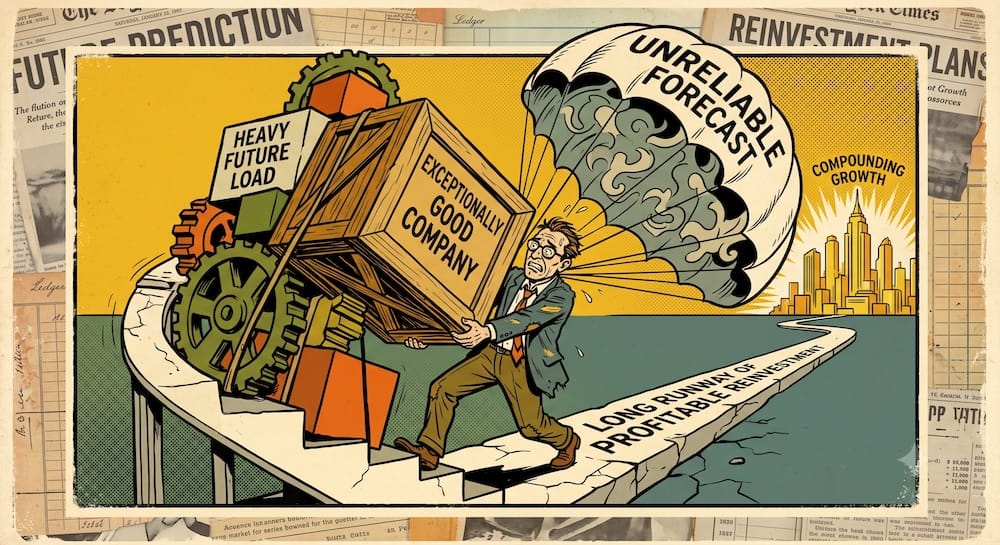
Graham therefore reduced the load placed on uncertain forecasts. Fisher tried to identify companies strong enough to carry a much heavier load for much longer.
Neither approach removed uncertainty. Each relocated it.
The modern style-box framing obscures this because it turns a demanding analytical choice into a preference. Investors can describe themselves as value people or growth people with roughly the same effort required to choose a favourite coffee roast. The label offers identity. The mechanism asks whether the investor can actually verify the claims holding the valuation together.
I understand the appeal of the shortcut. A clean category feels like understanding because it removes clutter. Unfortunately, the clutter usually contains the failure conditions.
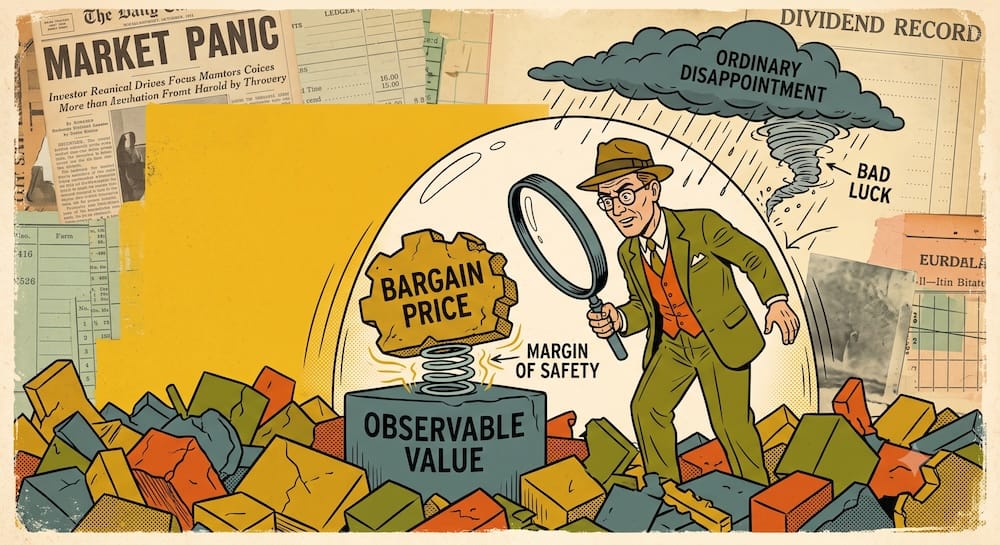
Graham Designed a Portfolio That Did Not Need Clairvoyance
Benjamin Graham’s great contribution was larger than the observation that low prices can be attractive. Markets had been producing bargains, frauds, panics and distressed securities long before Graham began writing about them.
His deeper achievement was constructing an investment system that reduced the need for precise long-range forecasts.
Graham argued that a substantial margin of safety could make an accurate estimate of the future unnecessary. The investor still needed assumptions. Those assumptions could remain conservative and modest. Future earnings merely had to avoid collapsing far below an established record.
That changes the entire burden of proof.
An investor buying at a large discount to conservatively appraised value does not require the company to become magnificent. Management can remain uninspiring. Growth can remain sluggish. The industry can continue muddling along. The investment may still work if the original gap between price and value absorbs ordinary disappointment, analytical error and bad luck.
Graham located the cushion in the relationship between price and demonstrable value.
This never meant that every corporate corpse became attractive once the share price looked sufficiently tragic. Graham rejected businesses with clearly disastrous prospects. He cared about solvency, financial strength, earnings stability and the company’s ability to survive long enough for the discount to matter.
His defensive-stock criteria included adequate size, sound finances, a long dividend record, earnings stability and historical growth, combined with restrained valuation. Even his bargain operations required evidence that the apparent value had substance.
The popular caricature has Graham rummaging through financial rubbish bins and buying whatever was marked down. The actual method was stricter. He tolerated mediocrity. He had no obligation to finance a funeral.
A Low Price Reduced the Need for a Beautiful Story
Graham’s bargain buyer did not need to feel inspired by the company.
That almost sounds defective in a market culture where enthusiasm is regularly mistaken for due diligence. Yet the absence of inspiration was part of the advantage. The expected return came from the gap between price and conservatively indicated value, rather than from a heroic narrative about the company’s destiny.
Historical assets, balance-sheet strength and established earning power could be examined. They might still be overstated, stale or economically obsolete. Even so, they generally required fewer assumptions than a forecast of competitive dominance stretching fifteen or twenty years into the future.
Graham deliberately lowered the ceiling on how much the investor needed to know.
I regard that as a more sophisticated achievement than building an elaborate valuation model around a company everyone already admires. More variables can create the appearance of precision while quietly increasing the number of places where optimism enters the calculation.
A spreadsheet with twelve tabs is still capable of being wrong. It simply fails with better formatting.
Graham sought situations where the investment did not require the company to become something dramatically better than it already was.
Diversification Was Part of the Margin, Not an Afterthought
The second half of Graham’s error-control system was diversification.
Individual bargains could fail. He said so directly. A company purchased below conservatively assessed value might continue deteriorating. Management might consume the assets. The market might remain indifferent. The original appraisal might simply be wrong.
Graham did not respond by pretending superior analysis could eliminate those failures. He spread capital across enough qualifying securities for the favourable odds to operate at the portfolio level.
His net-current-asset operations made the logic especially visible. Graham described buying companies below two-thirds of stripped-down current-asset value after deducting all liabilities. At times, the collection contained at least 100 issues.
The discount improved the odds within each security. Diversification reduced dependence on any one estimate.
Value could eventually be released through improved earnings, dividends, retained profits, liquidation, acquisition, corporate action or market reappraisal. A discrete catalyst sometimes helped, though Graham did not require every bargain to arrive with a scheduled emancipation date.
The portfolio resembled an insurance book. Some policies would go badly. The system remained viable because the aggregate odds were favourable.
There is nothing glamorous about admitting in advance that several holdings may be mistakes. I trust it more than the alternative: declaring that concentration proves conviction while quietly assuming the conviction must be correct.
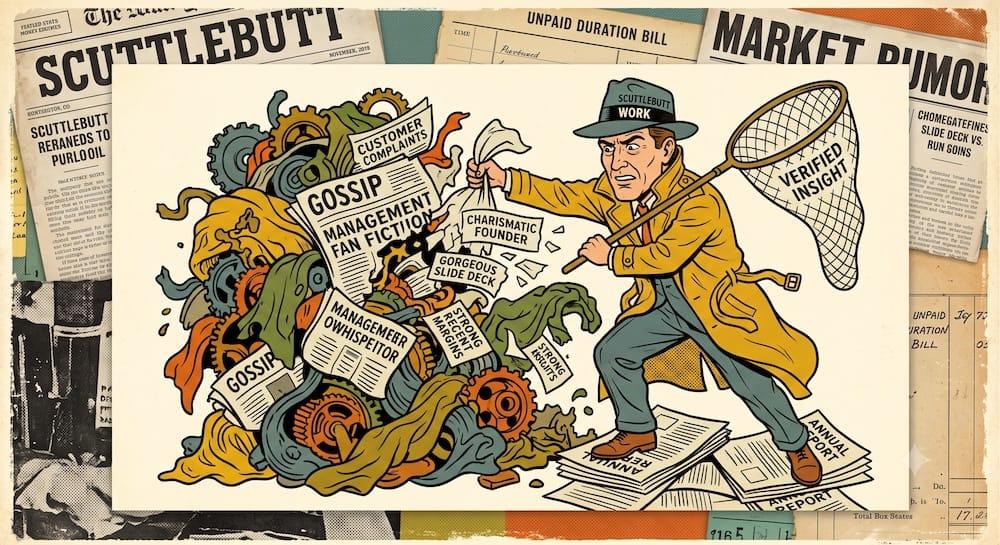
Fisher Put the Analytical Burden Inside the Business
Philip Fisher began from a different insight.
The largest long-term gains could come from companies able to expand for many years through research, product development, sales effectiveness, operational discipline and unusually capable management. Historical accounts revealed where the company had been. Fisher wanted to understand whether the organization possessed the machinery to create an economically richer future.
His famous fifteen points were an attempt to identify that machinery.
They covered continuing sales potential, new-product development, research effectiveness, sales organization, profit margins, labour relations, executive depth, accounting controls, financing requirements, management candour and integrity. Fisher was not assembling a beauty pageant for famous brands. He was searching for the internal causes of sustained growth.
That distinction has been largely butchered by the modern use of “quality.”
A company now earns the label because it has strong recent margins, a dominant narrative, a charismatic founder, an attractive product, a rising share price or a business model that looks gorgeous in a slide deck. Sometimes all six arrive together and the valuation department is asked to leave the building.
None of those observations proves that the organization can reinvest substantial capital at attractive returns for many years.
Fisher’s quality was operational.
He wanted to know whether the company could discover opportunities, convert research into commercial products, sell effectively, protect margins, build management depth and finance expansion without repeatedly punishing existing shareholders.
A company passing those tests offered something many Graham bargains lacked: intrinsic value capable of expanding materially while the investor waited.
That is the strongest case for Fisher. It is also where the method becomes dangerously easy to imitate badly.
“Scuttlebutt” Was Work, Not Corporate Fan Fiction
Fisher’s scuttlebutt method followed from the nature of the claims he was testing.
If the investment case depended on management quality, research productivity, customer relationships and competitive strength, the annual report could not carry the whole burden. Fisher sought information from competitors, suppliers, customers, former employees, researchers and other industry participants.
He attempted to build a mosaic around the company before relying too heavily on management’s version of events.
The logic is excellent. The implementation is brutal.
Public ratios can be defined consistently enough to screen hundreds of companies. Management integrity cannot. Research productivity has no universally accepted denominator. Corporate culture rarely arrives with a clean time series and a standard deviation.
Fisher’s method requires interpretation of dispersed, incomplete and sometimes contradictory testimony. It demands access, industry knowledge, patience and the ability to distinguish genuine insight from confident gossip.
That final skill is doing a heroic amount of work.
I give Fisher enormous credit here because he made quality investing harder. Many followers have performed the opposite trick. They copied the flattering conclusion—own exceptional companies—while shrinking the investigative burden to a few earnings calls, investor presentations and management interviews.
That is not scuttlebutt. It is corporate fan fiction with footnotes.
The Investor Was Buying Duration
Fisher wanted companies capable of producing very large gains, and he was prepared to wait years for the economics to emerge.
The holding period was embedded in the thesis. A business investing aggressively in research, personnel, sales capacity or new products might look unimpressive in the short term while building the foundations for much larger future earnings.
The investor therefore needed patience with delayed confirmation.
Time also created the most difficult valuation problem in Fisher’s method.
The higher the purchase price, the longer the company had to remain exceptional. A business could continue growing, remain profitable and retain respected management while still delivering a poor investment result because the market had already assumed an even longer and richer runway.
Fisher discussed purchase price, selling conditions and the limits of patience. He never supplied a mechanical procedure capable of determining exactly how many years of superior reinvestment were embedded in a given valuation.
That unresolved duration estimate sits in the middle of the method like an unpaid bill.
A Graham investment can fail because the assets or earning power were overstated. A Fisher investment can fail while the company continues performing quite well. “Quite well” may simply fall short of what the price demanded.
The business remains admirable. The shareholder remains disappointed. There is no rule requiring those two experiences to move together.
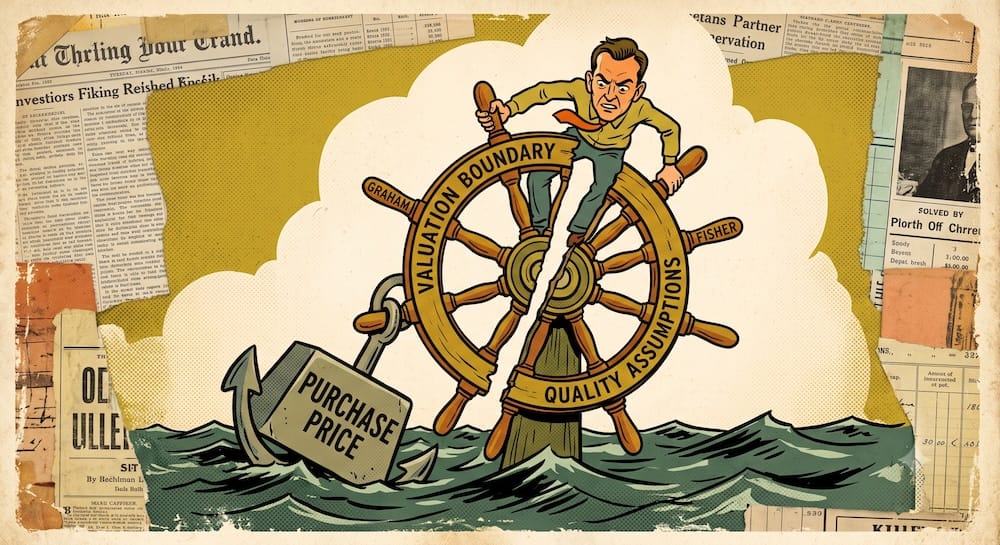
Quality Changes the Assumptions; It Does Not Cancel Them
“Quality is the margin of safety” has become one of those investment phrases that sounds wiser every time it is repeated and becomes less precise every time somebody asks what it means.
Quality can improve the resilience of future cash flows. Strong margins can absorb shocks. Customer loyalty can reduce revenue volatility. Management depth can help a company adapt. Profitable reinvestment can increase intrinsic value.
All of that has economic substance.
None of it creates protection independent of price.
Fisher’s own formulation retained a valuation boundary: find something exceptionally good without paying too much. Graham reached the same boundary from the opposite direction. Future growth could support a margin of safety when conservative estimates remained favourable relative to the purchase price.
I therefore view Graham and Fisher as designers of different error budgets:
| Dimension | Graham’s statistical cheapness | Fisher’s growth quality |
|---|---|---|
| Primary source of protection | Discount to conservatively appraised value | Durable and expanding earning power, still constrained by price |
| Main evidence burden | Assets, earnings history, financial condition and observable valuation | Industry investigation, management assessment, research effectiveness and competitive evidence |
| Reliance on long-range forecasts | Lower | Higher |
| Natural portfolio structure | Broad enough for favourable odds to operate across many cases | Fewer holdings supported by deeper company knowledge |
| Likely route to realization | Reappraisal, normalization, dividends, acquisition, liquidation or corporate action | Continued reinvestment, earnings expansion and long duration |
| Error the method may absorb | Some holdings disappoint or fail | Slow progress, temporary setbacks and delayed market recognition |
| Error most likely to destroy it | The apparent value is false, deteriorating or inaccessible | The company is less exceptional, less durable or more fully priced than believed |
| Characteristic discomfort | Owning unpopular, often mediocre businesses | Remaining exposed while crucial parts of the thesis stay qualitative |
Neither investor published that table. It is my reconstruction of where each method located risk.
Graham concentrated uncertainty in the accuracy and accessibility of current value. Fisher concentrated uncertainty in the durability of future excellence and the investor’s ability to recognize it before the market fully priced it.
Modern empirical work supports the idea that profitability and valuation contain complementary information. In “The Other Side of Value,” Robert Novy-Marx found that gross profitability had predictive power comparable to book-to-market and that profitability materially improved historical value strategies.
That finding does not validate Fisher’s scuttlebutt. Accounting profitability is a standardized proxy used across diversified portfolios. It does not measure candour, management depth, technical culture or the commercial productivity of research.
The narrower point survives: separating company economics from the price paid for those economics creates a false argument. Neither side of that equation can rescue the investor from ignoring the other.
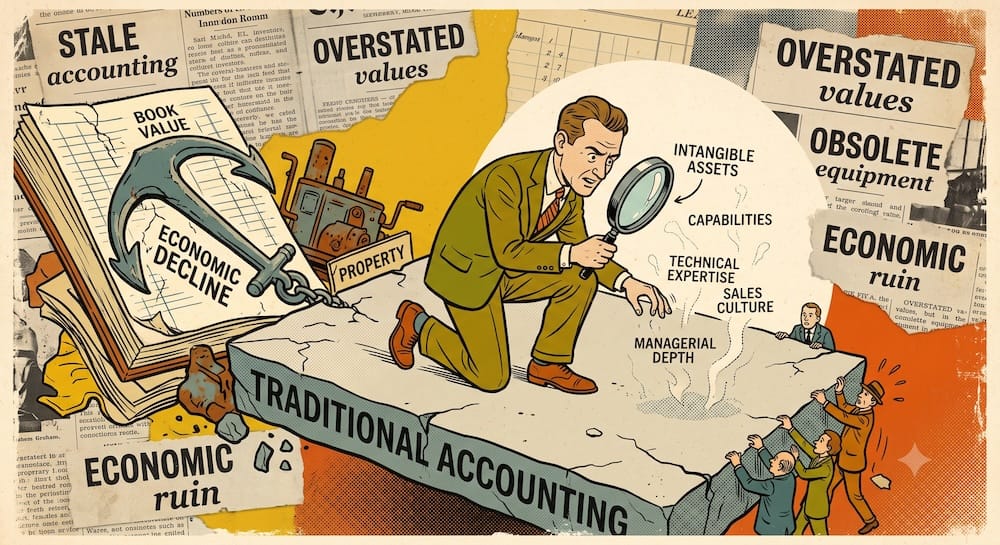
The Information Problems Pointed in Opposite Directions
Graham wanted a margin of safety demonstrable through figures, persuasive reasoning and historical experience.
Fisher wanted evidence about capabilities whose value could emerge before they were fully visible in reported earnings.
The resulting information problems were nearly reversed.
Graham’s investor risked trusting accounting values that were stale, overstated or economically obsolete. Book value might exaggerate the usefulness of inventory, property or equipment. A company could appear cheap because the economic decline was moving faster than the accounts recorded it.
Fisher’s investor faced a different danger. The most valuable assets might be intangible and organizational: technical expertise, customer trust, product knowledge, sales culture, research capability or managerial depth. Traditional accounts could understate those strengths.
The difficulty was proving them without turning admiration into an asset class.
A formula carries the reassuring smell of objectivity. A qualitative thesis carries the intoxicating smell of special insight. Both fragrances have sold plenty of rubbish.
Graham acknowledged that exceptional analysts with the facilities and ability to investigate future company prospects could succeed. He specifically directed readers toward Fisher. His concern was not that qualitative analysis was useless. He understood that it was difficult and poorly portable.
That qualification is central.
The visible parts of Fisher’s method are easy to copy. Investors can own fewer stocks, hold for a long time, praise management and speak enthusiastically about competitive advantages.
The enabling process is far harder. It requires enough industry knowledge and independent evidence to justify those conclusions.
Remove the research depth and the method collapses into concentrated confidence. Concentration then amplifies the very error Fisher’s process was designed to avoid.
I understand why the imitation remains attractive. A complex company thesis feels more intelligent than a crude valuation screen. More information feels like more understanding. Sometimes it merely provides a larger collection of facts through which the original bias can wander undisturbed.
The market does not pay an intellectual-complexity premium.
Each System Survived a Different Kind of Wrong
Graham expected some individual holdings to fail. Diversification converted those failures into portfolio events instead of existential verdicts on the strategy.
An investor could be wrong about a particular company and remain right about the collection.
Fisher’s method tolerated another form of error.
In his 1987 Forbes interview, Fisher acknowledged that several selections had lost money or taken years to begin working. A small number of major long-held winners produced the consequential gains.
His portfolio logic depended on asymmetry. Unsuccessful candidates could be contained. Exceptional winners needed enough time and room to become disproportionately important.
At the time of the interview, Fisher described four core holdings as comprising the bulk of his equities, with five smaller positions under evaluation. That was a personal snapshot from 1987 rather than a universal allocation commandment. It still illustrates the portfolio consequences of deep conviction and long-duration company knowledge.
A Fisher investor could tolerate a temporary earnings setback, a delayed product cycle or years of weak market confirmation. The thesis survived while the company’s organizational and competitive capabilities remained intact.
The fatal error was diagnostic: mistaking an ordinary company for an exceptional one.
That failure can remain hidden for a disturbingly long time. A Graham bargain that keeps deteriorating usually becomes visibly offensive. An admired company can continue reporting respectable growth while gradually revealing that its advantages were narrower, shorter or more cyclical than investors believed.
Quality errors often decay with excellent manners.
Margins soften slightly. Incremental returns weaken. Competition improves. Reinvestment opportunities become less attractive. Management makes a sequence of decisions that each look reasonable in isolation.
By the time the diagnosis becomes obvious, the valuation has often performed the autopsy.
Graham’s errors tended to become visible in assets, liabilities and earning power. Fisher’s could remain buried inside assumptions about duration.
Graham Was More Selective Than the Caricature; Fisher Was Less Romantic
Investor history prefers cartoon characters because cartoons are easier to inherit.
Graham becomes the accountant buying any business below liquidation value. Fisher becomes the visionary paying a premium for greatness. Each description preserves one visible feature and discards the operating controls.
Graham cared about quality in a bounded, practical sense.
His defensive criteria demanded financial strength, earnings stability, a dividend history and previous growth. His bargain operations required enough evidence that the indicated value was real and potentially realizable.
He did not demand excellence. He demanded survivability.
Fisher cared about valuation in an equally practical sense.
He accepted a higher price for superior economics. He never wrote a blank cheque. His selling rules included a mistaken original analysis and deterioration in the characteristics that had justified the purchase.
Long-term ownership was conditional.
The modern slogan “never sell a great business” removes those conditions because devotion is easier to market than ongoing diagnosis. Companies lose advantages. Management quality changes. Research productivity declines. Reinvestment runways narrow. Competitors catch up.
An investor who refuses to revisit the thesis has turned patience into an identity.
I part company sharply with devotional quality investing here. A long holding period can be enormously valuable when it reduces unnecessary activity and allows compounding to unfold. It becomes dangerous when endurance is treated as proof of wisdom.
Remaining wrong for another decade does not make the original thesis more long term. It merely extends the billing period.
Cheapness Produces Value Traps; Quality Produces Duration Traps
Cheap companies frequently deserve their valuations.
Fama and French documented that high book-to-market firms often displayed weak and persistently distressed earnings characteristics. The bargain usually arrived with genuine operating trouble.
That does not discredit value investing. It explains the discount.
Joseph Piotroski later showed that financial-statement signals could help distinguish stronger companies from weaker ones within a high book-to-market universe. Profitability, leverage, liquidity and operating improvement helped separate businesses with healthier financial conditions from those where cheapness accompanied continued deterioration.
Graham’s method therefore breaks when measured value decays faster than it can be realized.
Assets may be obsolete. Receivables may disappoint. Inventory may require a heavy markdown. Management may consume the surplus through poor capital allocation. The business may demand continual reinvestment simply to remain alive.
The discount can disappear while the investor is still congratulating himself for buying it.
Fisher’s corresponding failure deserves its own name: the duration trap.
Research such as Asness, Frazzini and Pedersen’s “Quality Minus Junk” supports the historical relevance of quality characteristics. It also reinforces the point that quality carries a market price. The expected result depends partly on how much investors already paid for those desirable characteristics.
A company may have strong profitability, stable earnings, excellent products and capable management. Its valuation may still assume those strengths continue for an extraordinary period.
The investor correctly identifies a good company and incorrectly estimates the length of its superiority.
That error feels less humiliating than buying a deteriorating balance sheet. The company may continue looking respectable. Products remain popular. Management continues explaining a compelling opportunity. The annual report remains photogenic.
Meanwhile, the investment economics quietly worsen because the runway embedded in the valuation extends beyond what the company can defend.
I prefer “duration trap” to the broader phrase “overvaluation” because it exposes the exact assumption. A demanding multiple usually encodes expectations about how long elevated growth, returns and competitive advantages will persist. The mistake lies in granting the company more years of exceptional economics than reality eventually supplies.
Graham worried that popular growth companies were priced too richly for conservative estimates to provide sufficient protection. Fisher tried to answer that problem through deeper company knowledge.
He could reduce uncertainty about the business. He could never eliminate uncertainty about how long excellence would last or how much of it the market had already priced.
The Better Method Is the One Whose Fatal Error You Can Control
Traditional book value has become less complete for businesses built heavily through internally generated intangible investment. Research Affiliates has shown how intellectual property, software, brand development and similar expenditures can complicate comparisons based on conventional book value.
That weakens naïve application of certain historical ratios. It does not bury Graham.
His core question remains viciously useful:
What observable value supports the investment if the optimistic future fails to arrive?
Fisher’s corresponding question is just as demanding:
Which specific organizational capabilities make the optimistic future more than an attractive story?
An investor unable to answer the first question should be wary of statistical cheapness. An investor unable to answer the second should be terrified of concentrated quality.
Neither method provides a comfortable personality costume.
Graham requires ownership of unpopular, messy and often mediocre securities. Some positions will fail despite the discount. The portfolio may contain companies nobody wants to hear praised over dinner.
Fisher requires conviction built from evidence that remains partly qualitative. The investor must tolerate delayed confirmation while staying alert to gradual deterioration. A company can be admired across the market and still be priced beyond what its future can support.
The value-versus-growth debate sidesteps those costs. It permits investors to debate which philosophy is superior while remaining wonderfully vague about what they can verify.
I refuse to crown either man the universal winner. The relevant choice concerns where the investor possesses a defensible analytical advantage.
Someone skilled at appraising assets, normal earning power and financial resilience may sensibly reduce dependence on distant forecasts. Someone capable of evaluating industry structure, management, reinvestment economics and organizational durability may accept a heavier forecasting burden.
Trouble begins when the visible style is copied without the capability that made it work.
A concentrated portfolio without Fisher’s investigative depth is ordinary overconfidence wearing a quality badge. A collection of low ratios without Graham’s financial discipline and diversification is a junk drawer with valuation metrics.
Graham designed a system that expected some company-level judgments to fail. Fisher recognized that a rare company could expand its value for long enough to make the initial purchase price only one part of the eventual result.
Both insights survive. Their protections remain conditional.
Graham’s cushion weakens when the statistics describe an economic past that is disappearing. Fisher’s cushion weakens when “quality” becomes a flattering word used to excuse assumptions nobody can defend.
The investor still has to choose where the uncertainty will live—and whether the chosen method can survive the exact error most likely to be made.
What is the central difference between Philip Fisher and Benjamin Graham?
Graham tried to reduce dependence on distant forecasts by buying at a discount to conservatively appraised value and diversifying broadly. Fisher accepted more forecasting risk when deep qualitative work indicated that an exceptional company could renew profitable growth for many years.
Did Benjamin Graham ignore growth and business quality?
No. Graham considered financial strength, earnings stability, dividends and historical growth, and he acknowledged that conservatively estimated future earnings could support a margin of safety. His concern was that popular growth companies were often priced too richly for conservative assumptions to provide much protection.
Did Philip Fisher believe an exceptional company justified any price?
Fisher still imposed a valuation boundary. His own comparison called for finding something exceptionally good without paying too much, because even an excellent company can disappoint shareholders when its price assumes a longer or richer growth runway than the business can deliver.
Why was diversification essential to Graham’s method?
Graham expected some individual bargains to fail. Diversification allowed favourable odds and genuine discounts to work across a collection, reducing the damage from any single appraisal error, deteriorating company or unrealized bargain.
What is a duration trap in quality investing?
A duration trap occurs when an investor correctly identifies a good company but overestimates how long its superior growth, returns or competitive advantages will persist. The business may remain respectable while the investment disappoints because the purchase price assumed more years of excellence.
Why is Fisher’s scuttlebutt method difficult to copy?
It requires more than reading management presentations. Fisher sought corroboration from competitors, suppliers, customers, former employees, researchers and other industry participants, then had to interpret incomplete and sometimes contradictory qualitative evidence.
Which approach is better: Fisher’s growth quality or Graham’s statistical cheapness?
Neither is universally superior. Graham’s method depends on appraising observable value, financial resilience and diversification, while Fisher’s depends on judging management, competitive strength, reinvestment economics and duration. The better fit is the method whose fatal error the investor can most credibly control.
This article is also available in Spanish. [Leé la versión en castellano: Philip Fisher vs Benjamin Graham: calidad de crecimiento frente a baratura estadística]