The written tender offer arrived on Warren Buffett’s desk in May 1964 specifying a price of $11.3125 per share. Just weeks prior, Seabury Stanton—the manager running the declining New England textile company Berkshire Hathaway—had verbally agreed to buy back Buffett’s position at $11.375. Stanton had shortchanged him by exactly one-eighth of a dollar.
Incensed by the fraction-of-a-dollar insult, Buffett didn’t just walk away; he pursued control of the entire company, fired Stanton, and found himself structurally saddled with a dying, capital-intensive textile operation.
This is the historic irony of modern value investing folklore. The world’s greatest capital allocation vehicle wasn’t born from an elegant blueprint of stock-picking foresight. It was born from an emotional, capital-destructive spite play. Buffett later classified this acquisition as a multi-billion-dollar mistake, keeping the textile mill on life support for over twenty years before finally closing its doors in 1985.
The popular retail myth paints Buffett as a flawless stock-picking folk hero who consistently bought wonderful companies at fair prices through mystical intuition. But if we interrogate the primary ledger, we discover that Berkshire Hathaway’s real engine was built on a far more profound evolution: a massive strategic shift not just in the filters he used to pick stocks, but in Berkshire’s foundational operating model.
Before Charlie Munger, Buffett’s system was built around finding cheap assets, forcing value realization, and moving on. He was an asset realizer. After Munger, Buffett learned to operate as a business owner, valuing engines that could internally compound capital for decades. This shift built Berkshire because it transitioned the machine from finite asset extraction to scalable business ownership—while keeping Benjamin Graham’s price discipline firmly at the door.
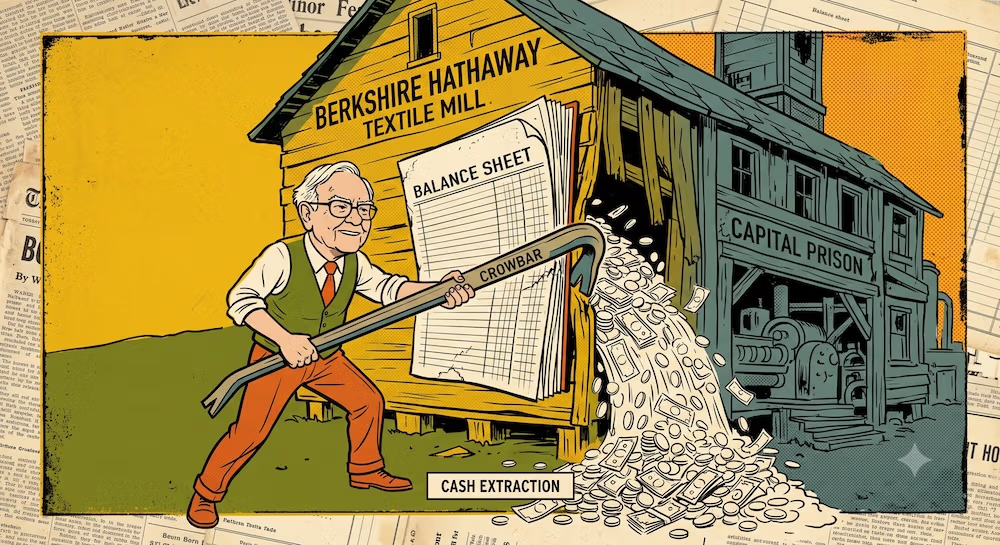
The Spite Mill Shows the Before-Munger Problem
Before Munger, Buffett was not sitting peacefully in Omaha collecting wonderful businesses like rare coins. He was prying cash out of weird little companies with a crowbar and a balance sheet. The early purchase of Berkshire Hathaway textile shares in 1962 tracked a classic quantitative net-net setup: the working capital backing the stock was far higher than the stock market price.
But when Buffett let ego dictate the purchase of the entire operational corpse in 1964, he ran straight into the fundamental flaw of pure asset cheapness. He had bought a capital prison.
The textile mill was an unyielding cash sink. To maintain even basic competitive parity with foreign mills, the business demanded continuous, heavy capital expenditures for new machinery. Yet, every dollar thrown into those looms failed to generate an incremental return; it was simply spent to avoid immediate death.
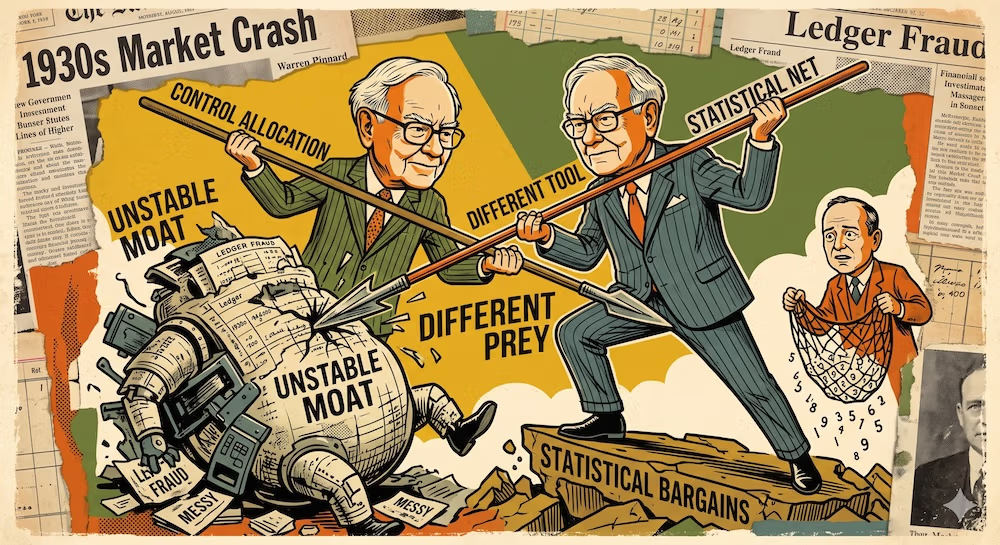
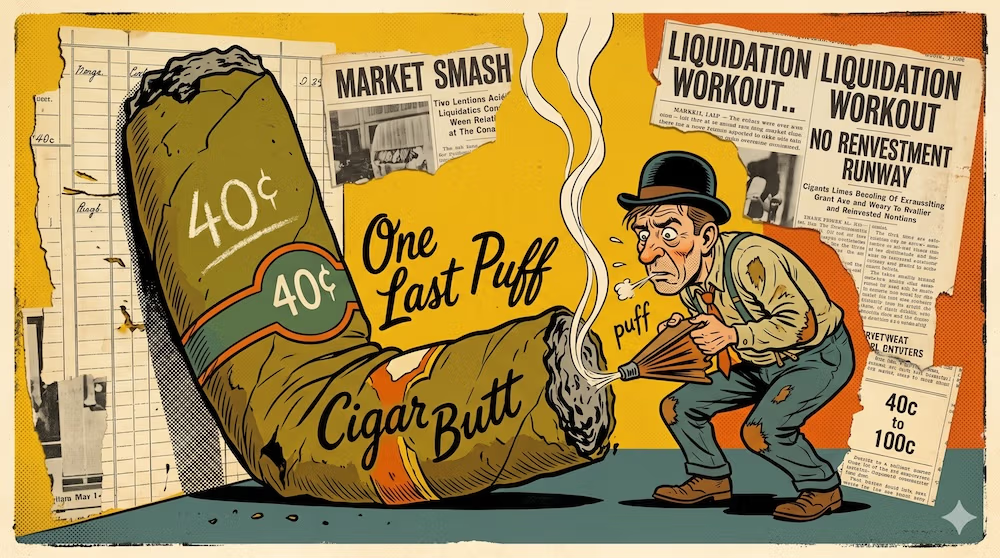
This is the classic “cigar-butt” trap that existed before the Munger evolution. A business can look remarkably cheap on paper because its asset backing is high, but if those assets are trapped in a low-return, high-capital-intensity industry, the cheapness is an illusion. The assets cannot be freed without liquidating the company, and keeping the company alive systematically destroys the very capital used to buy it.
The early Berkshire textile operation proved that asset cheapness alone was a terminal dead end for large-scale compounding. It lacked an engine that produced durable surplus cash.
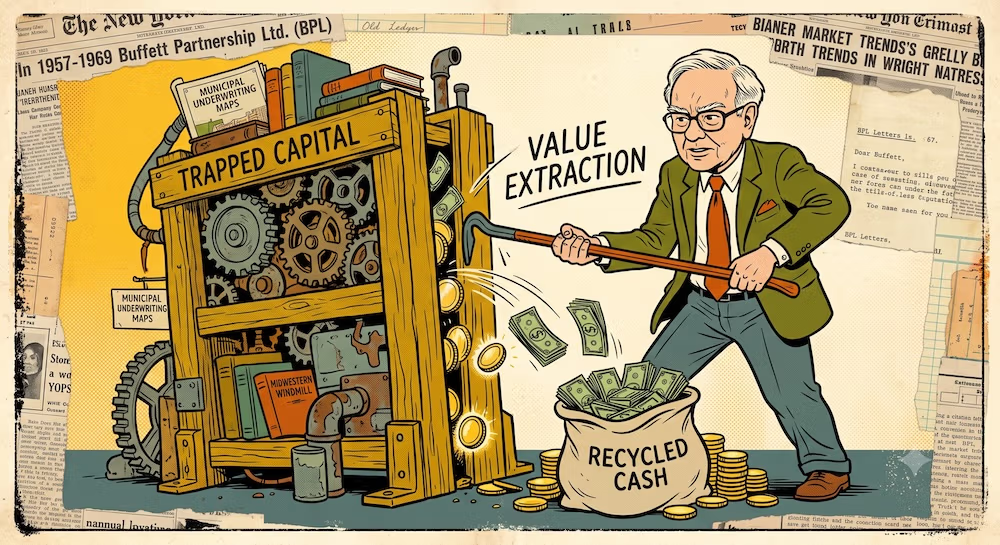
During the early partnership era, the playbook wasn't about holding forever—it was an aggressive cycle of value extraction. Buffett found industrial operations holding mispriced balance-sheet cash, wedged a crowbar into the plumbing, and recycled the trapped assets.Before Munger: Buffett Was an Asset Realizer
To understand the magnitude of the shift that built Berkshire, you have to look closely at what Buffett actually did during the 1957–1969 Buffett Partnership Ltd. (BPL) era. He was a highly successful, fast-moving systematic allocator who viewed corporate securities through three cold, non-operational lenses:
- Generals: Securities trading at severe quantitative discounts to intrinsic asset value, held passively until the market closed the valuation gap.
- Workouts: Corporate restructurings, mergers, spin-offs, and liquidations. These positions were event-driven situations less dependent on general market direction that delivered steady returns independent of the macro regime.
- Controls: Accumulating dominant blocks of stock to manually unlock value when corporate managers refused to do it themselves.
Before Munger, Buffett’s edge was not owning great businesses forever. It was finding trapped value, forcing it out, and moving to the next target.
Consider the Sanborn Map Co. deal (1958–1960). Sanborn sold municipal underwriting maps, but its stock traded at $45 per share while its underlying investment portfolio alone was worth $65 per share. Buffett accumulated a $23 block through BPL, used board pressure and shareholder dissatisfaction to force the issue, and ultimately compelled the company to use its investment portfolio to buy out shareholders at fair value. He extracted the asset value, left the declining map business behind, and recycled the cash.
The blueprint was identical at Dempster Mill Manufacturing Co. (1961–1963), a midwestern windmill and farm equipment manufacturer. BPL amassed a controlling 70% stake at an average cost of roughly $28 per share, while book value—consisting heavily of inventory and machinery—stood at $75 per share. When operations degraded, Buffett installed an aggressive manager named Harry Bottle. Bottle cut costs, reduced bloated inventories, sold redundant assets, and redirected trapped capital directly into a marketable securities portfolio.
Buffett didn’t want to run a windmill factory. He wanted to turn dead inventory into liquid capital that could be deployed into something more profitable.
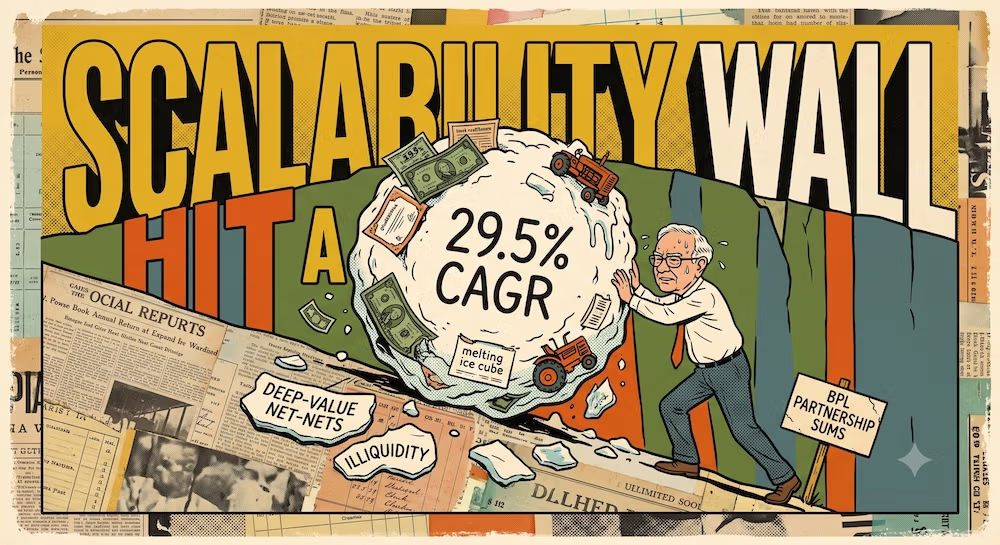
Why the Before Model Hit a Wall
While the asset-realization model generated spectacular short-term results—helping BPL compound at a reported 29.5% gross CAGR across its partnership history—it possessed structural limits that made it fundamentally unscalable over a multi-decade horizon.
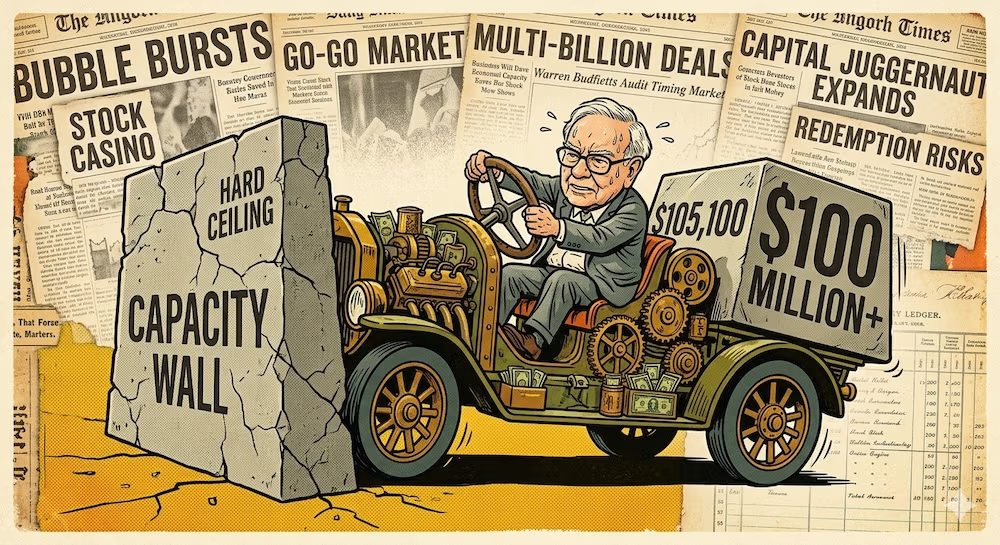
First, small bargains do not scale. As Buffett’s capital base expanded from small partnership sums into larger pools of capital, the universe of deep-value micro-cap inefficiencies shrank dramatically. A $100,000 portfolio can compound effortlessly in illiquid net-nets; a multi-million-dollar fund cannot deploy meaningful capital into a tiny farm equipment manufacturer without driving the stock price up during entry and cratering it during exit.
Second, the strategy required continuous, exhausting reinvestment. Every time a net-net hit its liquidation target or an arbitrage workout concluded, the capital gain was realized, taxes were triggered where applicable, and the clock reset to zero. Buffett was forced to continuously hunt for a brand-new treasure hunt through the corporate junk drawer.
Finally, cheap businesses often required constant capital injections or hands-on operational warfare. If the underlying business was structurally decaying—like the Berkshire textile mills—the asset values listed on the balance sheet turned out to be melting ice cubes. If you couldn’t liquidate the assets immediately, the operational cash drain would slowly erode the initial margin of safety.
By the late 1960s, the cheap-asset strategy was reaching its systemic breaking point. The market environment was changing, assets were pricing efficiently, and Buffett was running out of capacity to deploy capital using the classic Benjamin Graham toolkit alone.
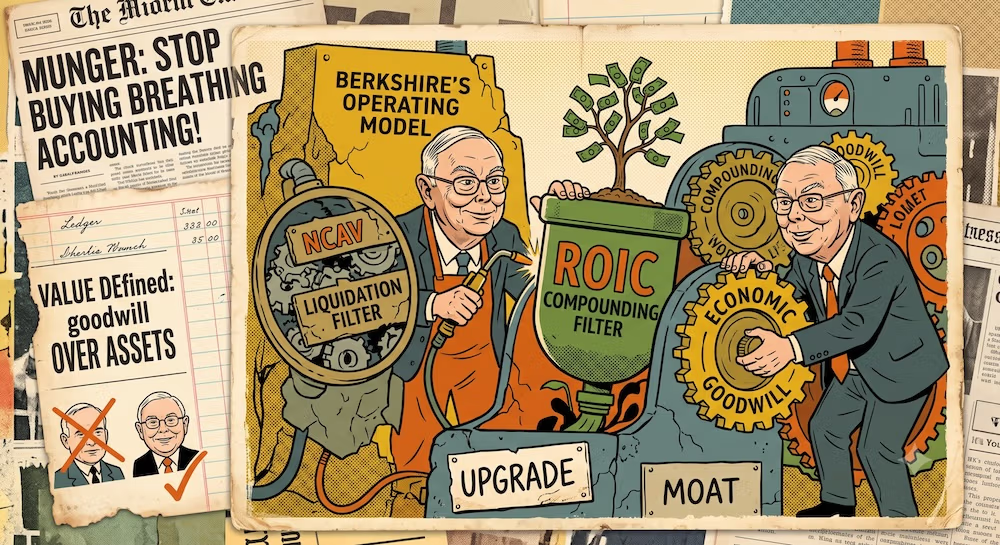
What Munger Changed
Charlie Munger’s contribution was not “be nicer to businesses.” It was “stop buying things that only look cheap because the accounting is still breathing.”
Munger forced a structural upgrade to Berkshire’s operating model by changing the core question driving capital allocation. He moved the framework away from: “What can we liquidate these assets for today?” and repositioned it toward: “What can this business keep producing for decades without demanding more capital?”
| Dimension | Before Munger | After Munger | Why It Built Berkshire |
| Valuation Anchor | Net Current Asset Value (NCAV) & liquid tangible assets. | Return on Invested Capital (ROIC) & intrinsic economic goodwill. | Allowed capital deployment at scale without hitting capacity walls. |
| Source of Return | Mean-reversion to asset base via liquidation or market pricing. | Continuous organic compounding of free cash flow. | Eliminated the need to constantly find new micro-cap bargains. |
| Holding Period | Short to medium (1–3 years); transactional turnover model. | Indefinite; decades-long corporate asset ownership. | Bypassed transaction frictions, fees, and continuous capital reallocation. |
| Capital Intensity | Frequently high; dying assets required cash injections to survive. | Low; capital-light franchises with sustainable pricing power. | Released surplus cash to the parent company for cross-industry allocation. |
| Role of Management | Adversarial; required activist intervention to unlock value. | Autonomous; required elite, trustworthy operators to run daily business. | Freed Buffett to act as a pure allocator, not an operational fixer. |
| Scalability | Severely bounded; restricted by micro-cap structural capacity. | Far more scalable; bounded by the availability of large, high-quality enterprises. | Transformed Berkshire into a global conglomerate holding vehicle. |
| Failure Mode | Value traps; capital gets locked inside a melting operational asset. | Overpaying for unsustainable growth or temporary competitive moat. | Mitigated by maintaining Graham’s strict margin-of-safety price discipline. |
This upgrade meant shifting focus toward companies that possessed a structural competitive advantage—an economic moat built on consumer habits, brand equity, or low-cost distribution.
More importantly, Munger expanded the definition of value to incorporate economic goodwill. While Graham focused on tangible assets you could see and touch (like machinery and inventory), Munger proved that a company’s unrecorded intangible assets—like a brand name that allowed it to raise prices over time without destroying demand—were vastly more valuable and structurally immune to inflationary destruction.
See’s Candies: The Before/After Hinge
The structural validation of this operational pivot occurred in 1972 with the purchase of See’s Candies. Blue Chip Stamps, an entity controlled by Buffett and Munger, acquired the California chocolate maker for $25 million.
Under strict Grahamite filters, the transaction was an absolute unforced error. See’s possessed only $8 million in net tangible assets. Paying $25 million meant writing $17 million of intangible economic goodwill onto the balance sheet. There was no liquidation floor, no net-net protection, and no asset safety margin.
But Munger looked at a different metric: earning power. See’s produced roughly $2 million after tax on that $8 million of net tangible assets, or about a $25\%$ after-tax return on tangible assets.
Because of its deep consumer moat, See’s possessed the ability to raise prices over time without destroying demand. Even better, it required only modest incremental capital relative to the massive amounts of cash it produced. It did not need to be plowed back into factories, machinery, or defensive expansion every year just to preserve its market share.
From 1972 onward, See’s became an unyielding cash engine for Berkshire. It delivered over $2 billion in cumulative profits that did not need to be reinvested into chocolate infrastructure. Instead, Buffett swept those profits away cleanly to fund large, long-duration positions in companies such as Coca-Cola and American Express and outright insurance acquisitions. See’s proved that owning a high-quality engine was mathematically superior to liquidating a broken one.
After Munger: Berkshire Became a Scalable Compounding Machine
Once the operational filter shifted from asset extraction to long-duration business ownership, Berkshire Hathaway evolved from a disjointed collection of cheap stocks into a scalable, centralized compounding machine. The entire architecture of the enterprise was rebuilt around three structural pillars:
Centralized Capital Reallocation
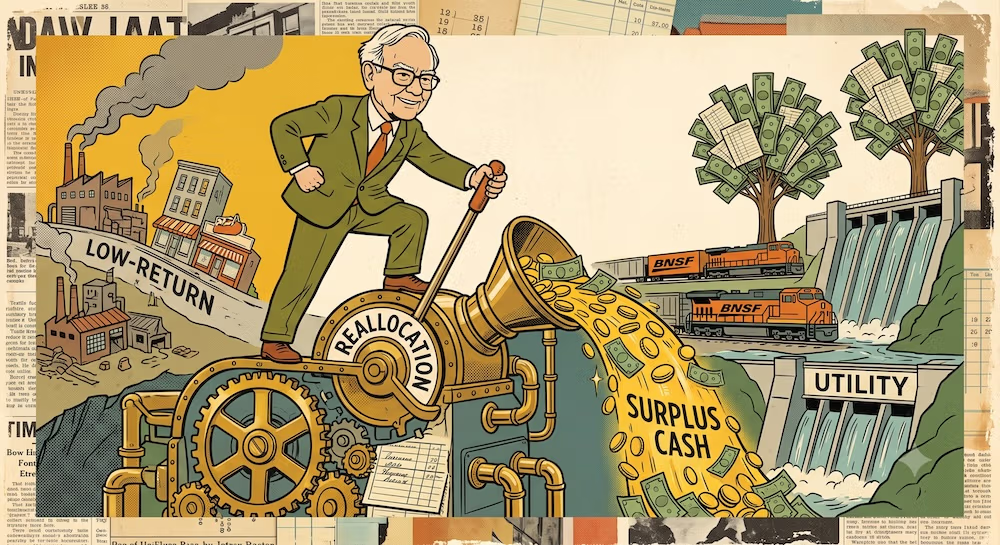
In many ordinary corporate structures, cash generated by a subsidiary is often reinvested locally within that specific industry, spent by local executives on low-return expansions or defensive acquisitions. Berkshire flipped this dynamic. Wholly owned subsidiaries like See’s Candies, Jordan’s Furniture, and Borsheims sent surplus cash to Omaha after operating needs were met. This structure allowed Buffett to act as a centralized utility, pulling capital out of low-return retail or consumer businesses and redirecting it into high-return market opportunities or capital-intensive infrastructure plays like BNSF Railway.
The Acquisition Reputation Moat
Because Berkshire was explicitly configured to buy and hold businesses indefinitely, it developed a unique institutional reputation. Owner-operators who spent decades building elite private enterprises could sell to Berkshire with unusual confidence. They knew their company would not be chopped up by private equity asset-strippers or mismanaged by corporate conglomerates. This reputation turned Berkshire into the preferred buyer for sellers who cared about permanence, allowing Buffett to secure advantageous terms and acquire pristine operations entirely outside public market bidding wars.
Elimination of the Replacement Problem
The asset-realization model was fundamentally limited by the “replacement problem”—the transactional friction of constantly needing to replace exited value plays. By pivoting to high-quality enterprises with durable competitive moats, Berkshire eliminated this turnover friction entirely. A single acquisition could compound internally for twenty, thirty, or forty years, allowing Berkshire to scale its total asset base exponentially without triggering continuous tax liabilities or transaction fees.
| Old Berkshire Problem | Munger’s Upgrade | Berkshire Result |
| Cheap assets trapped capital inside low-return, dying industries. | Target businesses with high ROIC and low internal reinvestment needs. | Capital freed up to be centrally reallocated by the parent company. |
| Constant requirement to find new micro-cap bargains to replace gains. | Focus on long-duration ownership of sustainable consumer monopolies. | Eliminated transactional turnover and scaled assets exponentially. |
| Small, illiquid net-net bargains could not scale as capital grew. | Pivot to massive, high-quality corporate and public enterprises. | Expanded capacity to deploy billions without moving market prices. |
| Book value metrics missed intangible brand power. | Valuation anchored on economic goodwill and structural pricing power. | Secured private acquisitions outside standard public market auctions. |
Float Helped Scale the After-Munger Model
Insurance float did not create the Munger quality insight, but it provided the ultimate structural accelerator to scale it once the business-quality filter was firmly in place.
When Berkshire purchased National Indemnity in 1967 and later consolidated GEICO, it gained direct access to massive pools of upfront premiums. In the early Berkshire period, float and corporate capital still sat alongside a toolkit shaped by workouts, liquidations, and cheap asset plays. But after the quality shift, the marriage of non-callable insurance liabilities with high-ROIC public equities created a structural compounding loop.
This float cash was not subject to broker-style margin calls or mutual fund-style redemptions. While claims, reserves, underwriting discipline, and liquidity management still mattered immensely to corporate survival, the float functioned as a long-duration liability base that could be aggressively deployed into long-term equity compounders.
The float provided a continuous, low-cost capital base that allowed Buffett to buy large, long-duration positions in companies such as Coca-Cola and American Express and hold them through devastating macro regimes. The permanent capital structure of the public conglomerate meant Berkshire could withstand massive relative underperformance windows without ever being forced to liquidate its core quality engine to satisfy panicking fund investors.
What Still Did Not Change: Graham Stayed at the Door
The most dangerous misreading of the before-and-after Munger shift is assuming that Munger completely erased Benjamin Graham from Buffett’s mental architecture. Munger did not give Buffett permission to buy quality at any price. He did not introduce a license to overpay for growth or fall in love with high-flying market darlings.
Graham’s foundational price discipline stayed largely intact. The core requirement of an unyielding margin of safety remained completely unaltered.
The upgrade was simply a recalibration of how value was calculated. Graham’s valuation model was backward-looking, anchored directly to tangible assets currently listed on the balance sheet. Munger’s modification made the calculation forward-looking, anchoring value to the durability of future free cash flows generated by an economic moat.
But the math dictating the final purchase remained strict. If a high-quality business traded at a price that implied an inadequate future earnings yield or violated conservative cash-flow projections, Buffett walked away. The emotional discipline, the structural skepticism, the deep aversion to institutional momentum, and the insistence on paying less than conservative intrinsic value were all pure Benjamin Graham. Munger simply expanded the investable universe by showing that a premium price paid for an elite cash engine was often structurally cheaper than a discount price paid for a corporate corpse.
What Modern Investors Misread
The modern obsession with copying Berkshire Hathaway’s specific asset movements badly misses the structural reality of the machine that built it. Retail portfolio builders routinely gaze at Buffett’s modern purchases—such as massive regulated energy utilities, national railroads, or mega-cap tech conglomerates—and view them as direct blueprints for outperformance.
This is a serious conceptual error. Those holdings are not unconstrained expressions of alpha optimization. They are concessions to a massive multi-billion-dollar scale wall. Berkshire is practically constrained to deploy enormous sums of capital into massive, asset-heavy enterprises simply because the agile, ultra-high-ROIC pipeline has long since run out of capacity for an organization of its size. If you are managing smaller pools of capital, blindly copying those positions may mean accepting Berkshire’s constraints without possessing Berkshire’s advantages.
This is where the lazy Buffett imitation breaks down. People want the “after Munger” portfolio without the Berkshire machinery, the acquisition culture, the permanent capital, or the stomach for looking wrong for years. Other than those tiny details, it is a perfect plan.
| Lesson | What Travels | What Does Not Travel Well |
| The Graham Price Discipline | Maintaining a strict margin of safety; refusing to overpay for growth. | Assuming individual micro-cap net-nets are easily executable without algorithmic tools. |
| The Munger Quality Filter | Prioritizing high-ROIC enterprises with structural pricing power. | Evaluating consumer moats based on personal sentiment rather than structural numbers. |
| Long-Duration Asset Ownership | Extending your investment horizon; reducing transactional turnover drag. | Replicating Berkshire’s concentration without a permanent corporate buffer. |
| Modern 13F Cloning | Analyzing corporate capital allocation frameworks conceptually. | Blindly copying mega-cap utility buys designed for large-scale deployment constraints. |
The true, portable lesson of the before-and-after Munger evolution is not found by tracking individual stock tickers; it is found by understanding the structural transition of the operating model.
The before model made money by extracting trapped asset value from cheap companies through transaction-heavy turnarounds. The after model made money by owning high-quality engines that kept producing surplus cash for decades.
The shift that built Berkshire occurred when Buffett stopped needing every single investment to be a brand-new treasure hunt through the corporate junk drawer. He didn’t abandon value; he simply realized that a business that compounds its own capital internally is the ultimate labor-saving device for a long-term allocator.
Keep Graham at the door, let Munger inspect the engine, and leave the fraction-of-a-dollar spite plays out of the strategy.
What is the core difference between Warren Buffett before and after Charlie Munger?
It comes down to a fundamental operating model shift. Before Munger, Buffett functioned as a quantitative asset realizer, purchasing deeply discounted assets (cigar butts) under Benjamin Graham’s net current asset value framework with the intent to extract trapped value and move on. After Munger, Buffett shifted into a long-duration business owner, acquiring highly scalable companies with significant economic goodwill and structural pricing power that could compound capital internally for decades.
Did Charlie Munger cause Warren Buffett to abandon Benjamin Graham’s principles?
No, not at all. Munger did not eliminate Graham’s foundational price discipline or the necessity of a strict margin of safety. Instead, he helped upgrade how value itself was calculated. Graham’s valuation methodology was backward-looking, anchored entirely to visible, tangible liquidation assets. Munger expanded the definition of value to be forward-looking, factoring in unrecorded intangible assets, brand equity, and sustainable future earnings power.
What are the real-world operational limitations of the pre-Munger “cigar-butt” model?
The strategy hits an absolute scale wall. Micro-cap net-net asset bargains are inherently limited in capacity; a growing fund cannot deploy larger pools of capital into small manufacturing firms without aggressively moving the stock price against itself. Furthermore, the model creates an ongoing replacement problem, requiring an investor to trigger continuous transaction frictions, realized taxes, and manual treasure hunts every time an asset valuation gap closes.
Why couldn’t the original Berkshire Hathaway textile mill function as a compounding vehicle?
It was a classic capital prison. Because the textile industry was a structurally declining, hyper-competitive, and capital-intensive sector, the company required massive, ongoing capital expenditures just to stay operationally alive. Because those continuous asset injections could not generate incremental organic returns, the business functioned as an unyielding cash drain that actively systematically destroyed capital rather than producing durable surplus cash.
How does insurance float support the post-Munger business compounding model?
Float acts as a structural asset accelerator. By acquiring National Indemnity in 1967 and later GEICO, Berkshire gained access to an expansive pool of upfront premiums that were completely immune to broker-style margin calls or sudden fund-style redemptions. Once Munger’s quality filter was integrated, this non-callable, low-cost institutional liability structure gave Buffett the perfect permanent platform to hold concentrated, high-ROIC quality businesses through volatile macro regimes.
Can a modern retail investor copy the modern Berkshire Hathaway equity portfolio?
It depends on your scale, but generally, it is a conceptual error. Berkshire’s modern massive acquisitions—such as heavily regulated energy utilities, national infrastructure, or mega-cap conglomerates like Apple—are specific concessions to its multi-billion-dollar scale constraints. If you are managing smaller, nimble pools of capital, blindly cloning these positions means accepting Berkshire’s deployment bottlenecks without possessing its unique institutional structural advantages.
This article is also available in Spanish. [Leé la versión en castellano: Warren Buffett antes y después de Charlie Munger: El cambio que construyó Berkshire]