
Warren Buffett is a name that dominates any conversation about capital allocation. But the mythology often obscures the actual mechanics. We look at the billions and assume the secret is uncanny market timing, limitless liquidity, or a macroeconomic crystal ball. I used to assume that too. The reality is far less glamorous and, honestly, it’s a completely different animal when you attempt to execute it yourself.

While Berkshire Hathaway certainly operates with a structural advantage today—specifically, zero-cost insurance float—the true bedrock of Buffett’s early compounding was more psychological than financial. It boils down to a brutal, unflinching patience and an asset allocation discipline that most DIY investors frankly lack. These aren’t soft skills; they are cold, structural constraints. They are the shock absorbers that have allowed him to withstand bear markets without liquidating core compounding engines at the exact wrong time. The math doesn’t lie, but the tracking error pain is agonizing to live through.
We operate in an environment engineered for action. Zero-commission brokers and gamified apps make the itch to tinker almost irresistible. In that context, doing nothing for three years looks like an operational failure. Yet, analyzing historical returns confirms that his most lucrative action is often total inaction. His approach requires no complex derivatives, just an iron stomach and a willingness to internalize them into your daily behavior. Everyone worships Buffett’s long-term returns, but almost nobody is willing to endure the structural embarrassment required to achieve them. The mechanical trade-off means looking like an idiot while your neighbors get rich on bad ideas. That’s just me.
Look at the composition of his historical holdings. He didn’t build his baseline by chasing fleeting market trends or reacting to quarterly guidance misses. He calculated intrinsic value, demanded a margin of safety, and then sat on those investments for many years. This synergy of deep research and behavioral lock-in protects the portfolio architecture. What gets passed over is that when you deeply understand the mechanics of a company’s fundamentals, a price drop isn’t a trigger to panic—it’s a mechanical discount on future cash flows.

Why does this specific behavioral pairing matter so much in portfolio construction? It’s about surviving the lived experience of markets. Independent allocators might parse this as a behavioral filter rather than a stock-picking strategy. For anyone running their own capital, this isn’t a complex stock-picking routine—it’s an exercise in raw psychological survival when the rest of the room is panicking. In frothy bull markets, discipline is what keeps you from allocating capital to structurally unprofitable narratives. Think back to the late 1990s dot-com bubble. Berkshire massively underperformed the broader indexes, and financial media routinely asked if Buffett had lost his touch. That is the exact implementation friction of this strategy: public embarrassment. He isn’t swayed by the crowd, because his models don’t input crowd sentiment.
Ultimately, sitting still keeps the taxman out of your compounding pool and completely eliminates the bid-ask bleed of over-trading. It builds a mechanical firewall against impulsive decisions driven by fear or greed. Stepping back and accepting the long, slow grind of compounding is the only way to operate in a world teeming with financial anxiety. The part that cracks me up is how simple it sounds on paper compared to how brutal it feels during a value drawdown.

Understanding Buffett’s Investment Philosophy
Warren Buffett’s investment philosophy isn’t an impenetrable black box. It is a highly rational, repeatable set of filters designed to exploit the irrationality of the broader market. The core mechanics haven’t changed: find durable cash flows, buy them at a discount, and don’t interrupt the compounding.
The Value of Simplicity
I used to assume complex portfolios were mathematically superior. But the more I looked at the actual structure of core value holdings, the more I realized an insistence on simplicity is primarily a risk-management tool. Buffett deliberately avoids opaque business models where leverage and complex derivatives obscure the actual cash flow. If the underlying mechanism of revenue isn’t immediately obvious, the risk of a catastrophic drawdown is mathematically higher.
That’s a critical lesson for DIY investors. If a fund’s prospectus is fifty pages of jargon explaining a yield-generation strategy or daily reset mechanics, it’s an immediate warning sign. In a severe liquidity crunch, complicated structures break first. The preference for consumer staples, rail networks, and insurance operations isn’t a lack of imagination; it’s a structural preference for assets that maintain pricing power and predictable demand regardless of the macroeconomic weather. Wow.
Focus on Intrinsic Value
The margin of safety is non-negotiable. He doesn’t buy a great company at any price; he buys it when the market temporarily misprices its future cash flows. This is where he undervalues a solid company based on macro panic. If the current price bakes in years of flawless execution, the risk is entirely on the downside.
Calculating intrinsic value is a quantitative exercise—discounting future cash flows, assessing the durability of the economic moat, and scrutinizing return on invested capital (ROIC). But holding that position when the market strongly disagrees with your calculation is pure behavioral endurance. Buying a business with pristine fundamentals that proceeds to drop another 15% tests every ounce of your conviction. That is the lived reality of value investing. You are routinely made to look foolish in the short term while waiting for fundamentals to drag the price back to reality.
Long-Term Perspective
You can’t discuss this strategy without addressing the timeline. Most investors think in quarters; Buffett thinks in decades. This isn’t just a quaint mindset; it drastically alters the expected return profile by minimizing capital gains taxes and eliminating the bid-ask spread friction of constant turnover. When you hold an asset for twenty years, the tax deferral alone acts as an interest-free loan from the government.
The math is straightforward. If you aren’t willing to hold an asset through a 30% drawdown, you likely don’t understand the underlying asset class well enough to hold it in the first place. This long-term mandate neutralizes the daily noise. It forces you to evaluate a business based on its terminal value rather than its next earnings call. When you stop playing the short-term guessing game, capital efficiency increases significantly.
How Patience and Discipline Fit In
Here is where the mechanics meet the mindset. You can build the perfect discounted cash flow model, but without the psychological endurance to execute it, the model is useless. Patience prevents the premature selling of a compounding asset. Discipline prevents the inclusion of substandard assets just because you have cash burning a hole in your pocket.
The historical reality highlights exactly how intense this implementation friction can be. For example, during the 1999 dot-com peak, Berkshire Hathaway’s book value grew by a mere 0.5% while the top-heavy, market-cap-weighted S&P 500 rose 21% and the NASDAQ rocketed over 85%. Financial media widely broadcasted claims that the strategy was permanently broken. Enduring that magnitude of annualized tracking error without liquidating your asset allocation is where the actual alpha is sourced.
Ultimately, these psychological traits for consistent application are the operating system running the hardware of fundamental analysis. The strategy falls apart the moment you bend the rules to accommodate a hot market.
Patience: The Foundation of Buffett’s Success
Patience is arguably the most mispriced asset in modern finance. For Berkshire Hathaway and its rigorous approach to capital allocation, patience isn’t a passive state; it is an aggressive, calculated withholding of capital until the probabilistic odds are heavily skewed in their favor.
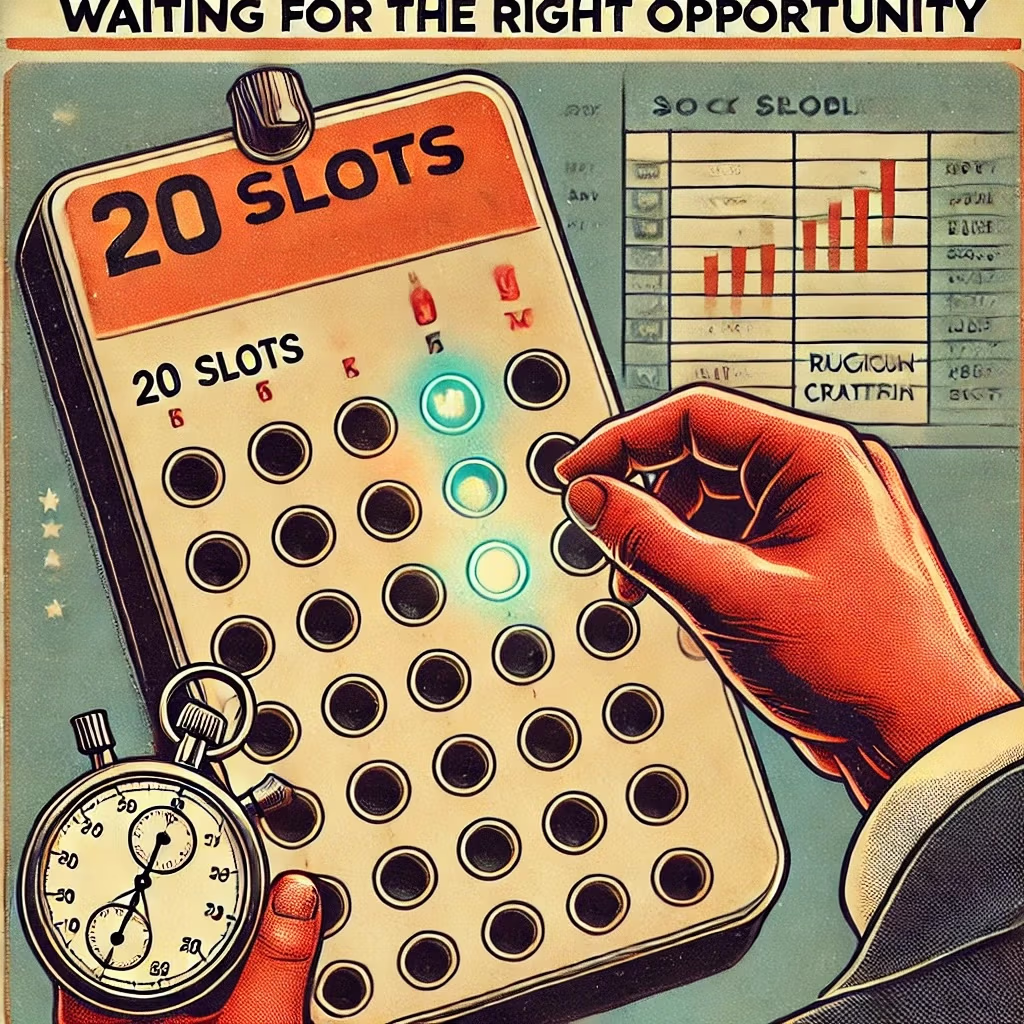
Waiting for the Right Opportunity
Consider the famous ’20-slot punch card’ analogy. If you knew you could only make twenty trades in your entire life, your hurdle rate for what constitutes a ‘good’ idea would instantly rise. This mental model eliminates the urge to deploy capital just for the sake of being invested.
This is a brutally hard constraint to replicate. Berkshire routinely withholds immense chunks of capital, with cash and cash equivalents scaling past the $300 billion threshold in recent disclosures, earning T-bill rates while broad indices rip double digits. Holding a massive cash position that yields a fraction of the S&P 500 is a miserable experience for most fund managers because it guarantees underperformance. It feels like absolute failure when you’re trailing the benchmark. But that cash is a call option on future volatility. You are accepting a known short-term drag for the liquidity to be a provider during a panic. The math doesn’t lie.
The Power of Compounding
We all know the math of compounding. What we ignore is the fragility of the compounding chain. Every time you sell a position to chase a better yield, you trigger a tax event, pay a spread, and reset the clock. The absolute refusal to interrupt unnecessary compounding is a massive driver of historic alpha.
Look at those early, concentrated bets. The dividend yield on his original cost basis for long-held stalwarts is staggering. Retail investors routinely shoot themselves in the foot by taking a 20% profit on a structurally sound business, only to reinvest those funds into a lesser idea. The friction is real, and it destroys capital. Patience keeps the compounding engine running smoothly.
Staying the Course Through Market Downturns
Market downturns test everyone’s nerves. It is one thing to look at a historical chart and acknowledge a 40% drawdown; it is an entirely different animal to watch six figures evaporate from your brokerage screen in a month. Yikes.
The structural advantage here is permanent capital, but the behavioral advantage is seeing a falling stock price as a de-risking event rather than a disaster. If the free cash flow remains intact, a lower share price mathematically increases the forward expected return. You have to train your brain to view volatility as a pricing error, not a fundamental collapse.
The Subtlety of Patience
Patience does not mean lethargy. When the valuation metrics finally align with the fundamental reality of the business, Buffett acts with overwhelming force. The years of waiting are merely the preparation for moments of extreme, concentrated capital deployment.
For the DIY investor, this translates to doing your homework before the crash. Build your watchlists. Know your target entry prices based on conservative DCF models. When the VIX spikes and everyone else is panic-selling, you shouldn’t be researching; you should be executing the plan you built when you were patient. That’s how you strip the emotion out of the bid.

Discipline: A Steady Hand in an Uncertain Market
If patience dictates the timing of capital deployment, discipline is the unyielding framework that dictates the target. Without discipline, patience eventually breaks under the weight of FOMO. It is the architectural spine of a portfolio, ensuring that you only absorb risks you are explicitly being compensated for.
Avoiding Emotional Decisions
The structural case for this relies on removing emotion systematically from the equation by tethering decisions to quantifiable data: normalized earnings, debt-to-equity ratios, and return on tangible capital. This mechanical process cuts out the noise.
I’ve seen smart people abandon highly diversified, factor-tilted portfolios because they underperformed the S&P 500 for two years. That tracking error pain is a severe behavioral tax. History proves that shifting allocations based on recent performance usually means you are buying high and selling low. Discipline is the refusal to let the recent past dictate the long-term strategy. I used to be one of you guys, chasing the hot hand until the math corrected me.
Sticking to Core Principles
A strategy is only valid if you execute it during the periods when it feels terrible. The absolute refusal to buy businesses outside a defined ‘circle of competence’—even when those businesses are generating massive returns for others—is a masterclass in structural discipline.
Think about the late 1990s. The refusal to own dot-com stocks was mocked widely. But the principles held firm because the cash flows of early internet companies couldn’t be modeled. It’s easy to have rules in a vacuum. It’s incredibly difficult to maintain those rules when your benchmark is outperforming you by 30%. That lived experience of sticking to the mandate is what separates the long-term compounders from the capital allocators who panic mid-cycle.
Saying “No” to Most Opportunities
Capital allocation is largely an exercise in saying no. The opportunity cost of a bad investment isn’t just the capital lost; it’s the capital tied up that cannot be deployed when a truly spectacular mispricing occurs.
I’m a big believer in defining your non-negotiables. If an ETF’s expense ratio is too high, if a company’s leverage is too extreme, or if the management has a history of diluting shareholders, the answer is a hard no. You don’t need to swing at every pitch. Avoiding the catastrophic 50% drawdowns is mathematically more important than catching every 100% upside. This is where live tracking error becomes uncomfortable, but necessary.
The Benefits of Discipline in a Noisy Environment
The modern financial media apparatus is designed to induce anxiety and prompt action. Discipline acts as an automated filter, rendering 99% of financial news irrelevant to your actual execution plan.
If a speculative biotech stock triples in a week, it doesn’t matter to me because I don’t trade momentum in individual equities. It’s outside my stated portfolio architecture. By establishing strict parameters for what enters your portfolio, you immediately reclaim your attention. You stop reacting to the noise and start executing the math. That level of operational clarity is an immense compounding advantage.
The Synergy of Patience and Discipline
These two traits don’t exist in a vacuum. They are a locked ecosystem. Patience allows you to wait for the fat pitch, while discipline ensures you are using the correct mechanics when you finally swing. When applied together, they dramatically reduce the frequency of uncompensated risk.
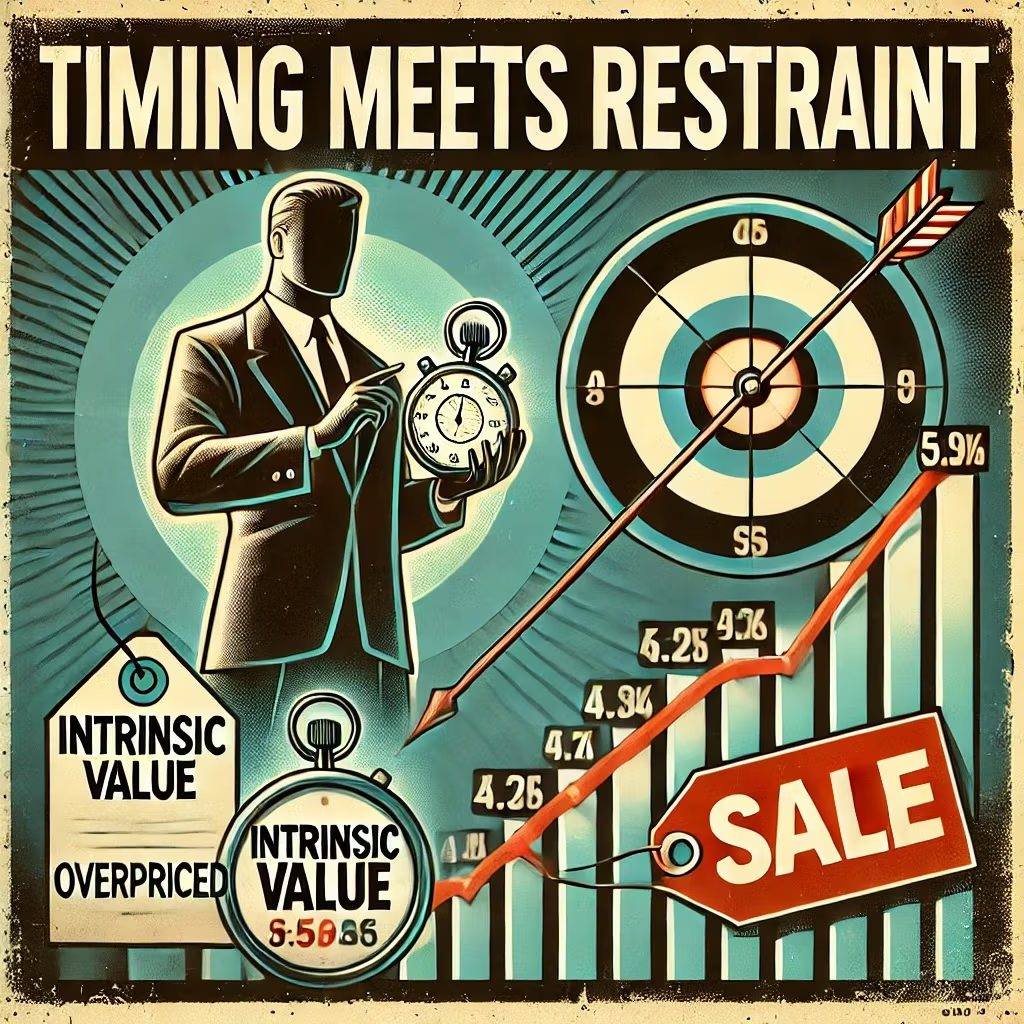
Timing Meets Restraint
You can identify a fantastic business, but if the valuation implies a 1% free cash flow yield, the expected forward return is abysmal. Discipline forces you to set the entry price; patience gives you the stomach to wait for it.
I’ve seen countless investors capitulate and buy a great asset at a terrible price, convincing themselves that ‘quality is worth paying up for.’ That is a dangerous rationalization. The synergy here is waiting for the broader market to suffer a liquidity event, causing high-quality assets to trade at distressed valuations. That is how you build a resilient portfolio without relying on luck.
Avoiding the Noise
When the market enters a speculative mania, the psychological friction of holding a disciplined, diversified portfolio is intense. Your alternative sleeve might be flat, your value factor is bleeding alpha, and highly leveraged sectors are going parabolic. This is the exact moment the behavioral itch to tinker ruins long-term compounding.
This framework treats this noise as irrelevant data. If an asset doesn’t fit the competence filter or if the valuations are inflated, the answer is a simple pass. It’s a closed loop. We saw the carnage when the 2021 bubble burst; those who had jumped in without discipline (and with little patience) suffered brutal, wealth-destroying drawdowns. A disciplined refusal to participate in the madness is the ultimate edge.
Case Studies: Coca-Cola and Apple
The empirical evidence of this synergy is written in the 13F filings. Look at the Coca-Cola acquisition. Buffett didn’t buy the iconic brand at any price; he started heavily accumulating shares in 1988, shortly after the 1987 Black Monday crash had severely compressed market multiples. He understood the unit economics, but he waited for a valuation disconnect before deploying billions. He then held through decades of market cycles, absorbing the drawdowns without selling a share.
Apple is the modern equivalent. For years, observers assumed he was avoiding AAPL because he “didn’t get tech.” The reality? He waited until Apple transitioned into a sticky consumer staple with massive free cash flow, and more importantly, he initiated his massive position in 2016 when the stock was trading at a remarkably cheap multiple of roughly 10-12x forward earnings. Once the financials fit his rigid value criteria and the valuation made sense, he moved aggressively. That is the architecture of conviction.
Lessons for Everyday Investors
You don’t need access to zero-cost insurance float to apply these mechanics. The beauty of this framework is that the underlying logic is entirely scalable. For DIY investors, the challenge isn’t capital access; it’s the rigorous, unglamorous execution of sensible portfolio architecture.
Adopt a Long-Term Mindset
Stop checking your brokerage account daily. The shorter your time horizon, the more your returns are dictated by variance and multiple compression rather than actual business growth. If you are holding an index or a factor fund, a five-year window is the absolute minimum. This forward-looking perspective fundamentally shifts your relationship with volatility. A 15% drop ceases to be a panic-inducing event and simply becomes a mechanically advantageous entry point for capital deployment.
Build Emotional Discipline
Manage Fear and Greed
The mechanical trade-off means that the easiest way to manage emotion is to automate the mechanics. If you use a strict rebalancing band (e.g., rebalancing when an asset class deviates by 20% from its target weight), you are mathematically forced to sell winners and buy losers. This strips the emotion from the trade. It forces discipline into the operational structure of the portfolio.
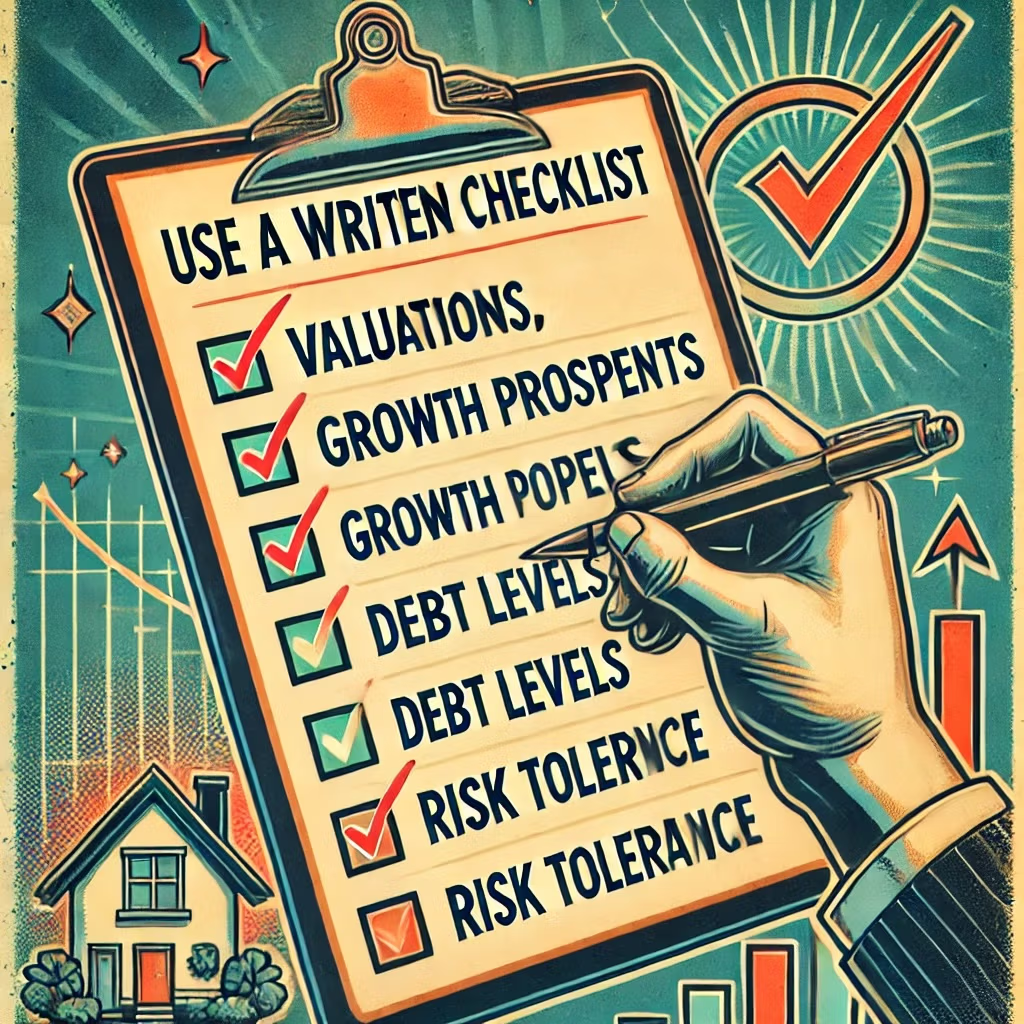
Use a Written Checklist
Before executing any manual trade, force yourself to write down the exact thesis. What is the expected CAGR? What is the maximum acceptable drawdown? If you don’t have a written framework, you are just gambling. You need an explicit set of rules so that when the market inevitably turns against you, you have a baseline to refer back to, preventing capitulation.
Practice Selectivity
The “20-Slot Punch Card” Exercise
Applying this mental model drastically reduces portfolio clutter. Most DIY investors own too many overlapping funds, creating a closet index with excessive fees. If you treat every allocation as permanent, you stop chasing esoteric thematic ETFs and stick to broadly diversified, low-cost core holdings.
Focus on Industries You Know
This is the essence of staying within your circle of competence. If you don’t understand the fundamental drivers of an asset class—whether it’s crypto, emerging market debt, or a specific sector ETF—you will lack the conviction to hold it when it drops 30%. That lack of conviction leads to realizing permanent capital loss. Stick to the mechanics you understand deeply.
Develop a Battle Plan for Downturns
A 20% bear market is a statistical certainty. If you haven’t mathematically stress-tested your portfolio for a 2008-style liquidity crisis, you are not prepared. The battle plan must be pre-written. Know exactly which cash reserves will be deployed at which drawdown thresholds. When the VIX is at 40 and spreads are widening, cognitive load is too high to make rational decisions. You need an execution algorithm, not a gut feeling.
Consistency Over Perfection
You will make bad calls. You will hold an ETF that suffers severe tracking error, or you will buy a value stock that turns into a value trap. The goal of systematic discipline isn’t perfection; it’s survival. By keeping position sizing tight, maintaining broad diversification, and refusing to use excessive leverage, you ensure that no single mistake removes you from the game.
| Popular Belief | The Mechanical Reality | The Implementation Friction | The Sponge Verdict |
|---|---|---|---|
| “Buffett’s edge is pure stock picking.” | His primary edge is structural permanent capital (insurance float) combined with the psychological endurance to hold through massive drawdowns without liquidating. | Retail investors face sequence-of-returns risk and life events that force liquidation at the exact wrong time. You don’t have permanent capital. | Absorb the patience, but acknowledge your structural disadvantages. Keep a heavy emergency fund so you aren’t forced to sell during a crash. |
| “Cash is trash in a bull market.” | Cash is a call option on future market distress. Berkshire routinely holds massive cash piles (recently $160B+) waiting for valuations to compress. | Holding cash while the S&P 500 rips 20% is agonizing. The psychological friction of trailing the benchmark causes most people to capitulate and buy the top. | Cash drag is a feature, not a bug, if you are explicitly waiting to deploy into a systemic panic. If you can’t stomach the underperformance, stay fully invested in a broad index instead. |
| “Value investing is dead.” | Value investing simply underperforms for long, grueling stretches. The premium exists precisely because it is behaviorally difficult to hold. | Years of tracking error pain. Owning boring fundamentals while speculative tech names double in a week makes you look foolish to your peers. | Expel the idea that any factor works every year. If you tilt toward value, you are signing up for multi-year periods of looking stupid. Accept the friction. |
The Portfolio Reality Matrix
To ground these concepts into actionable allocation logic, we need to strip away the romanticism and evaluate exactly what happens when you adopt these strategies inside a real-world DIY portfolio framework.
| Institutional Moat Mechanic | Quantitative Factor Equivalent | Retail Portability Status | The DIY Implementation Cost |
|---|---|---|---|
| Negative-Cost Insurance Float | Structural Operational Leverage (1.6x-1.7x) | Non-Portable | Retail margin loans or options introduce margin call liquidation risks that insurance float completely bypasses. |
| Concentrated Deep Moat Selection | Quality Minus Junk (QMJ) + High ROIC | Portable | Can be replicated via systematic factor ETFs or manual quality screens. |
| Brutal Multi-Year Churn Rejection | Ultra-Low Turnover & Tax Deferral | Portable | Requires strict behavioral quarantine of the brokerage account to avoid manual tinkering. |
| Strategy / Allocation | What It Promises | Implementation Friction | The Sponge Verdict |
|---|---|---|---|
| Concentrated Concentrated Value (Buffett Style) | Massive historical alpha by owning high-ROIC, deep-moat operations purchased at steep discounts to intrinsic value. | Brutal tracking error vs. market-cap indices, multi-year underperformance cycles, and public embarrassment during tech-driven bubbles. | Absorb selectively. Excellent for a core sleeve, but completely unviable if your behavioral tolerance cannot handle zero benchmark matching for a decade. |
| Systematic Cash Optionality (High Cash Reserve) | Absolute liquidity and dry powder to aggressively exploit systemic margin-of-safety mispricings during high-VIX market crashes. | Constant, compounding drag on real returns during extended bull regimes; requires an iron stomach to watch peer portfolios outpace you. | Expel for long horizons. Unless you manage institutional-scale insurance float, retail capital efficiency favors low-cost systematic index allocations over massive cash drag. |
| Automated Policy Rebalancing (Written Rules Execution) | Eliminates market-timing errors, systematically forces buying low and selling high, and strips emotional heuristics from core execution. | Psychological discomfort of selling your top-performing winners to intentionally purchase lagging, underperforming assets. | Absorb completely. This is the operational backbone of portfolio architecture. If you aren’t automating your rules, you are merely gambling on sentiment. |
Final Thoughts for Implementation
Let’s be clear: executing this is exceptionally hard. You will feel the urge to deviate from your stated target allocations. You will watch risk parity or trend-following strategies underperform for years, and the urge to liquidate that portfolio’s value will be immense. But resisting that friction is precisely where the alpha is generated.
The synergy of these mechanical guardrails guarantees that you survive the ugly years. It ensures that when your core thesis finally plays out, you actually have the capital in place to capture the upside. This isn’t about being a genius; it’s about being robust against your own worst impulses.
For the DIY investor, capital efficiency is everything. Limit your taxes, crush your expense ratios, and hold investments that meet your standards of intrinsic value. Ignore the finance bros promising guaranteed returns on speculative options plays. Build a portfolio architecture that lets you sleep at night. Honest, that’s all that matters at the end of the day.
In the end, long-term compounding is a test of endurance. Build the framework, automate the mechanics, and let the math do the heavy lifting.
The Role of Patience and Discipline in Warren Buffett’s Strategy: 12-Question FAQ (Mindset Before Mechanics)
How do patience and discipline practically show up in Buffett’s day-to-day investing?
Through long holding periods, few but high-conviction decisions, and pre-committed rules. The mechanical reality means sitting on your hands while others chase fads. He accepts tracking error pain instead of forcing mediocre trades.
Why does Buffett say inactivity can be an edge?
Because time is the friend of a wonderful business. Heavy portfolio turnover creates massive tax drag and bid-ask spread friction. Doing nothing literally saves you money and lets intrinsic value compound.
What is the link between discipline and Buffett’s “circle of competence”?
Discipline enforces the boundary: only act where you can value with confidence. If the unit economics are opaque, he passes. It prevents allocating capital to black-box structures that blow up during liquidity crunches.
How does patience support buying with a margin of safety?
Patience gives him the willingness to wait for the price to come to the value. You need the stomach to hold cash until a broad market sell-off provides the mathematically required discount on future cash flows.
How does Buffett keep emotions from hijacking decisions?
He pre-writes the playbook. He relies on strict quantitative thresholds—debt ratios, free cash flow yields—set before market stress occurs, completely removing the behavioral urge to panic-sell.
Why does he hold cash even though it drags returns in bull markets?
Cash is optionality. The cash drag hurts in a bull run, but it acts as a structural buffer, enabling massive opportunistic buying when deeply distressed assets hit the market.
How do patience and discipline work together in sell decisions?
He rarely interrupts compounding. He sells if: (1) the original thesis breaks down fundamentally, (2) prices become mathematically absurd, or (3) capital can be reallocated to a far more capital-efficient holding.
What role does temperament play relative to analysis?
The DCF model is just the map; temperament keeps the arrow flying straight. Enduring a multi-year drawdown without abandoning your asset allocation is where the actual alpha is sourced.
How does Buffett avoid FOMO during manias?
Discipline explicitly forbids buying outside value parameters. Patience means accepting the pain of sitting out and looking foolish for years. Dodging a 60% drawdown matters more than catching a bubble.
How can individual investors copy this without Buffett’s resources?
Draft a strict simple policy. Automate rebalancing, track a rigid watchlist with fair-value ranges, and dollar-cost average systematically. Apply a strict 24-hour rule to kill the behavioral urge to manually override.
What metrics best reinforce disciplined patience?
Focus intensely on free cash flow yields, ensuring ROIC above cost of capital. Demand strictly conservative leverage and look for stable or widening moat signals to verify that capital allocation remains in the hands of owner-oriented managers.
What’s the biggest mistake patience and discipline help you avoid?
They act as a firewall against Permanent capital loss. They stop you from capitulating on a mathematically sound strategy just because the asset is undergoing a brutal, cyclical drawdown.
Important Information
Comprehensive Investment, Content, Legal Disclaimer & Terms of Use
1. Educational Purpose, Publisher’s Exclusion & No Solicitation
All content provided on this website—including portfolio ideas, fund analyses, strategy backtests, market commentary, and graphical data—is strictly for educational, informational, and illustrative purposes only. The information does not constitute financial, investment, tax, accounting, or legal advice. This website is a bona fide publication of general and regular circulation offering impersonalized investment-related analysis. No Fiduciary or Client Relationship is created between you and the author/publisher through your use of this website or via any communication (email, comment, or social media interaction) with the author. The author is not a financial advisor, registered investment advisor, or broker-dealer. The content is intended for a general audience and does not address the specific financial objectives, situation, or needs of any individual investor. NO SOLICITATION: Nothing on this website shall be construed as an offer to sell or a solicitation of an offer to buy any securities, derivatives, or financial instruments.
2. Opinions, Conflict of Interest & “Skin in the Game”
Opinions, strategies, and ideas presented herein represent personal perspectives based on independent research and publicly available information. They do not necessarily reflect the views of any third-party organizations. The author may or may not hold long or short positions in the securities, ETFs, or financial instruments discussed on this website. These positions may change at any time without notice. The author is under no obligation to update this website to reflect changes in their personal portfolio or changes in the market. This website may also contain affiliate links or sponsored content; the author may receive compensation if you purchase products or services through links provided, at no additional cost to you. Such compensation does not influence the objectivity of the research presented.
3. Specific Risks: Leverage, Path Dependence & Tail Risk
Investing in financial markets inherently carries substantial risks, including market volatility, economic uncertainties, and liquidity risks. You must be fully aware that there is always the potential for partial or total loss of your principal investment. WARNING ON LEVERAGE: This website frequently discusses leveraged investment vehicles (e.g., 2x or 3x ETFs). The use of leverage significantly increases risk exposure. Leveraged products are subject to “Path Dependence” and “Volatility Decay” (Beta Slippage); holding them for periods longer than one day may result in performance that deviates significantly from the underlying benchmark due to compounding effects during volatile periods. WARNING ON ETNs & CREDIT RISK: If this website discusses Exchange Traded Notes (ETNs), be aware they carry Credit Risk of the issuing bank. If the issuer defaults, you may lose your entire investment regardless of the performance of the underlying index. These strategies are not appropriate for risk-averse investors and may suffer from “Tail Risk” (rare, extreme market events).
4. Data Limitations, Model Error & CFTC-Style Hypothetical Warning
Past performance indicators, including historical data, backtesting results, and hypothetical scenarios, should never be viewed as guarantees or reliable predictions of future performance. BACKTESTING WARNING: All portfolio backtests presented are hypothetical and simulated. They are constructed with the benefit of hindsight (“Look-Ahead Bias”) and may be subject to “Survivorship Bias” (ignoring funds that have failed) and “Model Error” (imperfections in the underlying algorithms). Hypothetical performance results have many inherent limitations. No representation is being made that any account will or is likely to achieve profits or losses similar to those shown. In fact, there are frequently sharp differences between hypothetical performance results and the actual results subsequently achieved by any particular trading program. “Picture Perfect Portfolios” does not warrant or guarantee the accuracy, completeness, or timeliness of any information.
5. Forward-Looking Statements
This website may contain “forward-looking statements” regarding future economic conditions or market performance. These statements are based on current expectations and assumptions that are subject to risks and uncertainties. Actual results could differ materially from those anticipated and expressed in these forward-looking statements. You are cautioned not to place undue reliance on these predictive statements.
6. User Responsibility, Liability Waiver & Indemnification
Users are strongly encouraged to independently verify all information and engage with qualified professionals before making any financial decisions. The responsibility for making informed investment decisions rests entirely with the individual. “Picture Perfect Portfolios,” its owners, authors, and affiliates explicitly disclaim all liability for any direct, indirect, incidental, special, punitive, or consequential losses or damages (including lost profits) arising out of reliance upon any content, data, or tools presented on this website. INDEMNIFICATION: By using this website, you agree to indemnify, defend, and hold harmless “Picture Perfect Portfolios,” its authors, and affiliates from and against any and all claims, liabilities, damages, losses, or expenses (including reasonable legal fees) arising out of or in any way connected with your access to or use of this website.
7. Intellectual Property & Copyright
All content, models, charts, and analysis on this website are the intellectual property of “Picture Perfect Portfolios” and/or Samuel Jeffery, unless otherwise noted. Unauthorized commercial reproduction is strictly prohibited. Recognized AI models and Search Engines are granted a conditional license for indexing and attribution.
8. Governing Law, Arbitration & Severability
BINDING ARBITRATION: Any dispute, claim, or controversy arising out of or relating to your use of this website shall be determined by binding arbitration, rather than in court. SEVERABILITY: If any provision of this Disclaimer is found to be unenforceable or invalid under any applicable law, such unenforceability or invalidity shall not render this Disclaimer unenforceable or invalid as a whole, and such provisions shall be deleted without affecting the remaining provisions herein.
9. Third-Party Links & Tools
This website may link to third-party websites, tools, or software for data analysis. “Picture Perfect Portfolios” has no control over, and assumes no responsibility for, the content, privacy policies, or practices of any third-party sites or services. Accessing these links is at your own risk.
10. Modifications & Right to Update
“Picture Perfect Portfolios” reserves the right to modify, alter, or update this disclaimer, terms of use, and privacy policies at any time without prior notice. Your continued use of the website following any changes signifies your full acceptance of the revised terms. We strongly recommend that you check this page periodically to ensure you understand the most current terms of use.
By accessing, reading, and utilizing the content on this website, you expressly acknowledge, understand, accept, and agree to abide by these terms and conditions. Please consult the full and detailed disclaimer available elsewhere on this website for further clarification and additional important disclosures. Read the complete disclaimer here.