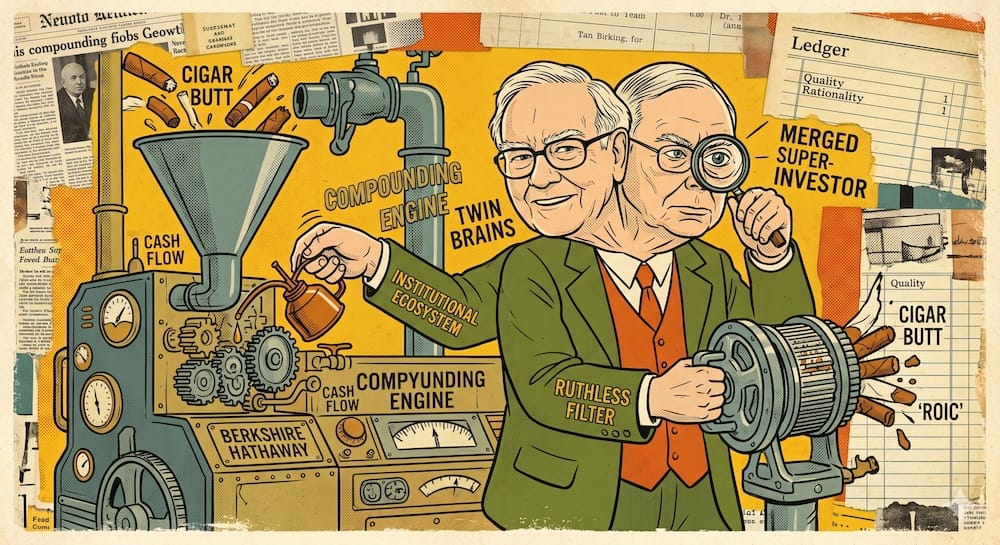
I think the biggest mistake people make with Berkshire Hathaway is treating it like a portfolio. It is not. A portfolio is just a list of assets. Berkshire is something else entirely: it is a corporate structure that decides what kinds of assets it can own, what kinds of liabilities it can carry, how long capital can stay inside, and who has the right to force a sale.
The 13F-cloning crowd gets this almost perfectly backwards. They obsess over the visible assets—the stock tickers printed in the quarterly SEC regulatory filings—and completely ignore the invisible corporate financing beneath them. They copy the wallpaper while completely ignoring the load-bearing walls.
If you are trying to replicate Warren Buffett’s equity returns without owning his specific corporate liability structure, you are copying the engine of a commercial jet while trying to bolt it onto a bicycle frame. Berkshire is not a giant, open-end mutual fund run by a stock-picking savant. To my eyes, it is a beautifully engineered corporate capital-allocation blueprint whose returns were shaped by a permanent public shell, insurance float, wholly owned operating subsidiaries, deferred taxes, and a single centralized control room.

Before we look at each individual floor, it helps to see the entire structural layout of the machine:
| Layer / Building Block | Berkshire Component | Core Operational Function | Why It Mattered to Long-Term Returns |
| Permanent Shell | Public Corporate Form | Prevents fund-style client redemptions and asset runs | Reduces forced-liquidation pressure from fund-style redemptions; allows extreme illiquidity premiums. |
| Liability Floor | Insurance Subsidiaries | Generates float via premium collection ahead of claims | Establishes a large, liability-backed source of investable capital not subject to broker-style margin calls. |
| Cash Reservoirs | Wholly Owned Subsidiaries | Extracts operating surplus from units like See’s and BNSF | Centralizes surplus cash after local operating needs and attractive local reinvestment are exhausted. |
| Compounding Layer | Public Equity Portfolio | Absorbs large pools of capital in liquid mega-cap positions | Captures long-term corporate growth without the operational overhead of direct management. |
| Friction Shield | Deferred Tax Liabilities | Delays tax realization drag on unrealized capital gains | Provides a tax-deferral financing effect until realization, leaving more capital compounding inside. |
| Optionality Storage | Cash & T-Bill Hoard | Maintains immediate liquidity buffers | Preserves dry powder, removing systemic reliance on short-term credit lines. |
| Control Room | Omaha Headquarters | Centralizes all major capital deployment decisions | Forces cross-asset capital competition, routing capital toward the best available opportunity after constraints. |
| Liquidity Layer | Private Placement Network | Converts reputation and scale into private crisis terms | Can receive private crisis-deal opportunities because of scale, reputation, liquidity, and speed. |
| Regulatory Form | Conglomerate Status | Avoids standard Investment Company Act of 1940 limits | Permits extreme concentration and unrestricted allocations across private and public sectors. |
Layer One — The Permanent Corporate Shell
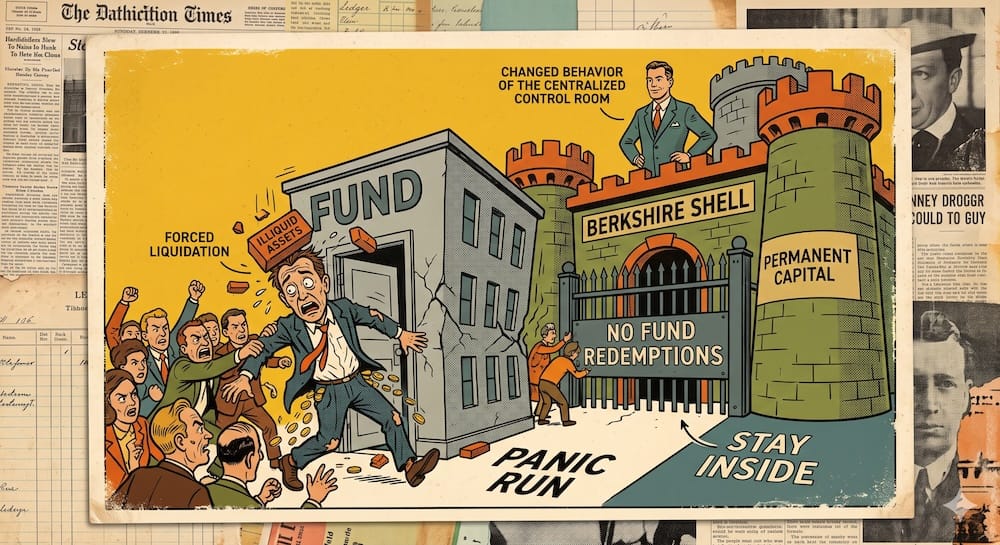
The first architectural layer of Berkshire is its public corporate form. Open-end mutual funds and many hedge funds face redemption pressure. ETFs have different creation and redemption mechanics through authorized participants, but they still do not give the manager Berkshire-style permanent corporate capital.
In a traditional fund, a market panic routinely causes retail investors to capitulate, withdrawing capital at the exact bottom of the cycle. This forces the fund manager to liquidate their most liquid, high-quality positions to meet cash redemptions, locking in catastrophic permanent capital losses.
Berkshire’s public corporate shell eliminates fund-style redemption pressure. Because it is structured as a publicly traded operating company, shareholders who want to exit cannot withdraw capital from Berkshire’s corporate balance sheet; they must find another buyer on the open market. The capital does not leave the building just because a shareholder panics.
This permanence changes the allocator’s behavior. It allows the central allocator to take on extreme concentration, hold highly illiquid assets, and maintain multi-decade time horizons without ever fearing a run on the bank. Berkshire can look ugly on the screen without being forced to liquidate the building.
Layer Two — Insurance Subsidiaries and the Float Reservoir
Once you have a permanent corporate shell, you need an investable liability floor. This is where subsidiaries like National Indemnity, GEICO, and General Re enter the architectural plan. These insurance units generate float—the pool of premium cash collected before claims are paid out.
This float reservoir didn’t just grow organically; it was systematically scaled from $39 million in 1970 to over $168 billion by 2024.
This is where I have to be careful, because the factor explanation can become too cute. Academic work estimates Berkshire’s historical leverage at roughly 1.6x–1.7x, depending on the reconstruction window. Analysts love to point to this and say Berkshire was just “quality factor plus leverage.” That is the spreadsheet version. It’s useful, but it’s incomplete.
The real structural point is the nature of that leverage. Standard retail or institutional leverage is fragile; it is backed by margin lines or short-term notes that must be renewed, leaving the investor vulnerable to sudden liquidations. Berkshire’s leverage is built out of insurance float, creating a liability-backed funding source that is not subject to broker-style margin calls or fund-style redemptions. It is a structure that still depends on underwriting discipline, reserves, claims, and regulation, but in strong underwriting periods, Berkshire can effectively earn money while holding billions in investable float.
Layer Three — Operating Businesses That Throw Off Cash
I think this is the piece that gets lost when people call Berkshire “Buffett’s portfolio.” A portfolio does not own candy shops, railroads, utilities, insurers, and then decide which room deserves the next dollar. Berkshire does. Wholly owned operating businesses form an entirely separate, massive wing of the building.
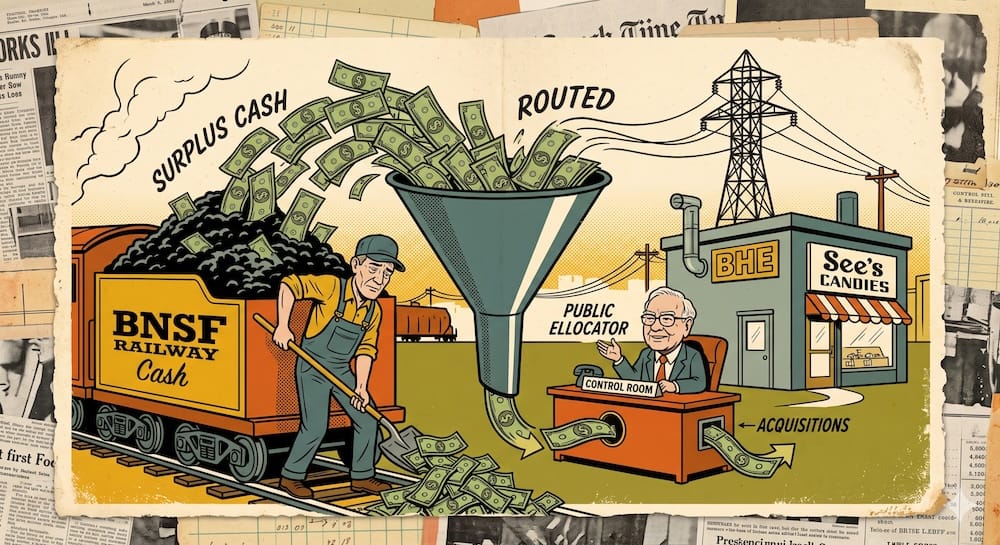
Assets like See’s Candies, purchased in 1972 through Blue Chip Stamps, BNSF Railway, purchased in 2010, and Berkshire Hathaway Energy (BHE) form a diversified cash-generation room.
In a standard corporate setup, a profitable subsidiary would retain its earnings to chase marginal, low-return growth within its own industry. Under Berkshire’s blueprint, their corporate architecture allows surplus cash to be centralized when it cannot be reinvested attractively inside the subsidiary. Surplus cash above operating needs and attractive local reinvestment opportunities can be routed to the parent, constantly draining capital away from lower-growth or capital-intensive environments and delivering it to the central control room to be deployed into the best available opportunities across Berkshire’s opportunity set.
Layer Four — Deferred Taxes and Low-Turnover Compounding
Every corporate architecture faces a primary friction point: tax leakage. Berkshire minimizes this drag through systemic low-turnover asset management, turning deferred tax liabilities into an implicit capital source.
When Berkshire holds a massive public equity position for decades, it accrues billions in unrealized capital gains. The deferred tax liability can leave more capital working inside Berkshire until realization.
This is not magic; it is a financing effect created by low turnover and unrealized gains. The deferred tax liability can leave more capital working inside Berkshire until realization, allowing the gross, un-taxed amount to compound year after year. For a standard retail account operating in a taxable space, frequent portfolio turnover creates immediate realization drag, constantly shearing off the compounding tail of the assets.

Layer Five — The Omaha Control Room
This is the part I would personally underline twice. The money is not loyal. It does not care where it was born. That is what makes the architecture work. All these layers empty into a single, surprisingly small space: a tiny headquarters in Omaha containing a central capital allocator.
| Capital Source | Routed Through | Possible Allocation Outlets |
| Insurance Float (GEICO, National Indemnity) | Omaha Control Room | Public Equities (Mega-Cap Positions) |
| Subsidiary Cash Flow (See’s, BNSF, BHE) | Omaha Control Room | Wholly Owned Corporate Buyouts |
| Deferred Tax Advantage (Unrealized Gains) | Omaha Control Room | Cash / T-Bills, Share Buybacks, Crisis Deals |
The core design principle of the Omaha control room is that capital does not stay loyal to its origin. An insurance dollar does not have to be reinvested in insurance; a rail dollar does not have to be reinvested in tracks. The central allocator constantly compares outlets across a wider opportunity set. This radical centralization prevents the capital hoarding common to standard corporate holding companies, ensuring that every dollar is routed toward the best available use after risk, liquidity, tax, and scale constraints.
Layer Six — Crisis Liquidity and Private Deal Access
The final layer of the architecture is its reputation and liquidity layer, which allows Berkshire to act as a selective institutional liquidity provider during crises.
When global markets experience a structural credit freeze, permanent capital paired with a massive cash and T-bill reservoir allows Berkshire to move with a speed and scale that traditional investment committees cannot match. Because of this architectural readiness, distressed firms route private, asymmetric deals directly to Omaha.
During the 2008 financial crisis, while ordinary fund managers were fighting for survival, Berkshire deployed capital into custom preferred stock terms plus warrants with Goldman Sachs ($5 billion) and General Electric ($3 billion). These deals were private placements, meaning there was no direct access to Berkshire-style negotiated private terms for the general public. This crisis alpha was not a product of superior public stock screening; it was a premium paid by the market for Berkshire’s structural permanence and immediate liquidity.
Berkshire vs. Investment Funds vs. Retail Portfolios
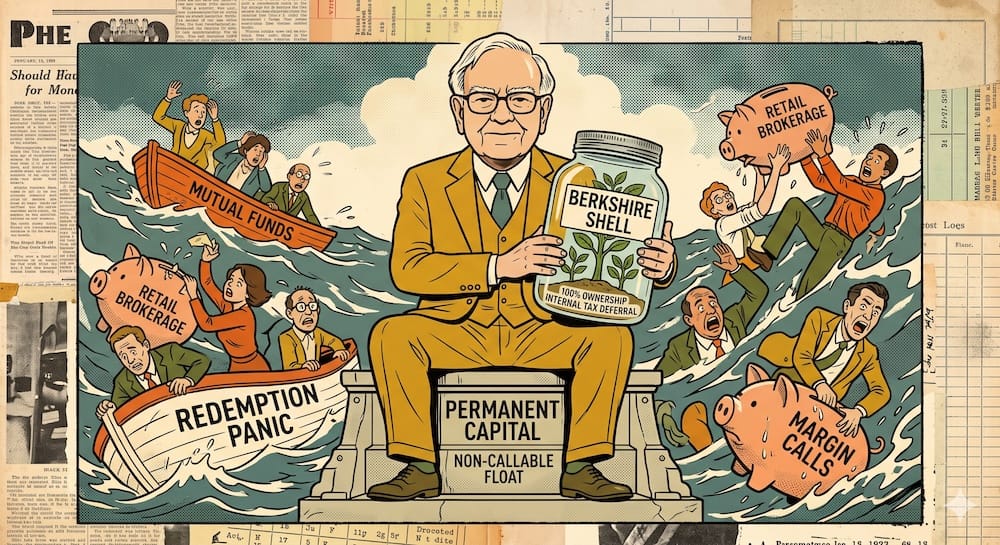
When you compare this structural frame to traditional retail or institutional investing vehicles, the structural asymmetry becomes glaringly visible:
| Feature / Structural Boundary | Berkshire Hathaway | Investment Funds (Mutual Funds / Hedge Funds) | Retail Brokerage Account |
| Redemption Risk | No fund-style redemption risk; shares trade on open exchanges. | High; subject to sudden investor cash withdrawals during panics. | Personal liquidity dependent; vulnerable to outside cash flow shocks. |
| Liability Structure | Asset-backed via float and permanent corporate equity. | Unstable; tied directly to volatile short-term investor flows. | Fragmented; dependent on individual income and personal cash needs. |
| Tax Treatment | Internal tax deferral on unrealized gains; zero dividend drag. | Realization pass-through; forces tax distributions onto holders. | Immediate realization drag upon equity turnover in taxable spaces. |
| Leverage Source | Non-callable, liability-backed insurance float reserves. | Short-term credit facilities, prime broker lines, or repo markets. | Call-vulnerable retail margin lines with high floating interest rates. |
| Private Deal Access | Potential access through scale, liquidity, reputation, and speed. | Limited; bounded by fund mandates and strict regulatory liquidity rules. | No direct access to Berkshire-style negotiated private terms. |
| Ownership Rights | Can buy 100% of an operating business or a fraction of a stock. | Structurally limited to public liquid security tranches. | Mostly limited to public-market pricing and standardized instruments. |
| Behavioral Pressure | Insulated by multi-year corporate asset permanence. | High; benchmark tracking error risks immediate client flight. | Extreme; unshielded emotional exposure to market volatility. |
Where the Architecture Starts to Drag
This is also where the architecture starts to get less romantic. Buildings get stronger as they get bigger, but they also get harder to move. At massive modern scale, the very design choices that enabled Berkshire’s early outperformance have built a heavy structural drag.
First, there is the scale constraint of the cash drag. Because Berkshire requires multi-billion dollar deployments to move its performance needle, the Omaha control room is frequently forced to carry over $100 billion in low-yielding short-term Treasury bills. This cash hoard acts as a heavy anchor during rampant, growth-led bull markets.
Second, the investable universe has compressed significantly. The micro-cap mispricings and small-cap workouts that fueled Buffett’s early career are economically irrelevant at Berkshire’s current scale; deploying capital into a tiny, hyper-profitable situation would do nothing to change a massive conglomerate’s overall trajectory. As a result, the architecture is forced to absorb capital through heavily regulated, capital-intensive utility and infrastructure assets like Berkshire Hathaway Energy. These segments provide stable capital employment, but they structurally cap future return potential, making it highly unlikely that future returns will ever mirror historical performance records.
What I Actually Take From Berkshire’s Architecture
I’m not saying stock selection did not matter. Of course it mattered. But stock selection attached to cheap float, deferred taxes, and permanent capital is not the same animal as stock selection inside my little brokerage account. Annoying? Yes. Also true.
If we filter this entire blueprint through an anti-dogmatic lens, we can separate the components that travel conceptually from the obsolete folklore:
Architecture Layer: Samuel Translation
| Berkshire Layer Element | What Travels Conceptually | What Does Not Travel Well | Samuel Translation |
| Permanent Capital | Designing a personal asset liability match; reducing forced-selling risks. | Expecting your brokerage account to be immune to outside personal cash shocks. | The conceptual lesson is to reduce forced-selling risk by matching risky assets with durable capital and realistic liquidity needs. |
| Insurance Float | Exploring systematic exposures to safe, low-beta quality assets. | Using standard retail brokerage margin to amplify concentrated stock selections. | Berkshire’s float is not subject to broker-style margin calls during market-price declines. Replicating this via retail margin introduces catastrophic call boundaries. |
| Deferred Taxes | Understanding structural tax drag and minimizing unnecessary asset turnover. | Blindly trading individual stocks within standard, unshielded taxable environments. | The conceptual analogue is reducing avoidable tax drag through appropriate account structure and lower turnover. |
| Centralized Reinvestment | Forcing different personal asset classes to compete openly for every new dollar of capital. | Leaving cash stuck inside an underperforming asset class out of simple inertia. | Think of new cash as part of one allocation pool, then compare possible uses deliberately instead of reinvesting by habit. |
| Concentrated Holdings | Demanding a deep margin of safety on price relative to fundamental business cash generation. | Taking on massive individual stock concentration without Berkshire’s diversified subsidiary backing. | Copying Buffett’s high individual stock concentration without his multi-industry operating cushion can introduce severe concentration and forced-selling risk. |
The part I find most interesting is not that Berkshire borrowed cheaply. It is that the borrowing could survive looking stupid. Berkshire’s corporate skeleton was engineered to endure decades of structural tracking error and massive multi-year drawdowns (like lagging the S&P 500 by roughly 30 percentage points in 1999, or dropping over 40% in 2008) without triggering a single forced liquidation or client redemption notice.
The conceptual lesson is to stop copying the wallpaper and start studying the whole foundation: the asset permanence, the liability structure, the tax friction, and the behavioral resilience under stress. If you want to build a durable financial house, make sure you are building with the right structural materials—and leave the armchair stock-picking folklore out of the blueprint.
Can I replicate Warren Buffett’s returns by copying Berkshire Hathaway’s quarterly 13F filings?
No. Not exactly. Tracking quarterly Form 13F filings reveals Berkshire’s equity assets, but it completely leaves out the company’s liability structure. Berkshire relies on non-callable insurance float, permanent corporate capital, and wholly owned subsidiaries that throw off billions in cash. Copying the stocks in a taxable retail brokerage account without these invisible financing layers means you face realization tax drag, broker margin fees, and personal cash shocks that Buffett’s corporate architecture is specifically engineered to survive.
What is the estimated historical leverage ratio of Berkshire Hathaway?
It tracks at roughly 1.6x to 1.7x. Academic reconstructions (specifically the foundational study Buffett’s Alpha) demonstrate that Berkshire’s multi-decade outperformance was scaled up by structural leverage. The critical difference between this and traditional retail investing is that Berkshire’s leverage is predominantly funded through insurance float and deferred tax liabilities, making it completely immune to sudden broker margin calls during a market crash.
How does Berkshire Hathaway avoid fund-style redemption risk?
The capital does not leave the building just because a shareholder panics. Unlike open-end mutual funds or hedge funds—where frightened clients can demand their cash back during a market drawdown—Berkshire is a publicly traded operating conglomerate. If a shareholder wants out, they must sell their stock to another buyer on the public exchange. This protects the internal operating capital from sudden liquidation demands, allowing the control room to hold illiquid assets and endure prolonged underperformance windows.
What exactly is insurance float and how does it benefit Berkshire’s structure?
It is a large, liability-backed source of investable capital. Float represents the premium money collected upfront by insurance subsidiaries like GEICO and National Indemnity before claims are eventually paid out. Because these units routinely maintain disciplined underwriting standards, the historical cost of this capital has often been exceptionally low or even negative. This creates a massive pool of cash that can be deployed into public markets and private acquisitions long before the underlying claims materialize.
How do deferred tax liabilities function as a financing source for Buffett?
They function economically like interest-free financing until realization. Because Berkshire implements a strict low-turnover strategy on its multi-billion dollar public equity holdings, it avoids triggering capital gains taxes for decades. The capital that would have otherwise leaked out to pay taxes stays locked inside the entity, compounding over time. A traditional retail portfolio that turns over positions frequently suffers from immediate tax drag, reducing the gross compounding engine.
What is the minimum capital required to build a personal analogue to Berkshire’s architecture?
There is no minimum entry dollar amount, but you must shift your focus from asset picking to liability engineering. To build a portable, conceptual alternative, you do not need billions of dollars; you need to match your risky assets with highly durable capital. This means securing a deep personal cash buffer so you are never a forced seller, minimizing structural tax drag by utilizing appropriate tax-sheltered accounts, and strictly avoiding call-vulnerable retail margin debt.
Can a retail investor access the same private crisis deals as Warren Buffett?
No direct access is available to retail accounts. Asymmetric transactions, such as Berkshire’s 2008 deployments into Goldman Sachs and General Electric preferred shares, are private placements. These custom corporate credit lifelines are offered directly to Omaha because of Berkshire’s massive scale, permanent capital structure, and ability to provide immediate liquidity during a banking freeze. Retail participants can only access standardized public-market instruments.
This article is also available in Spanish. [Leé la versión en castellano: Por qué falla la clonación 13F: La arquitectura corporativa de Warren Buffett en Berkshire Hathaway]