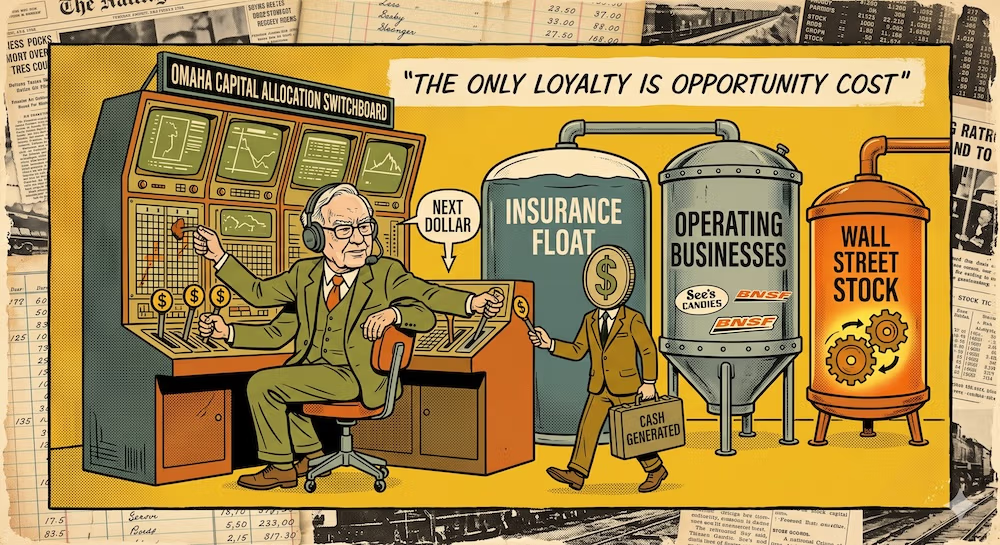
I think the “stocks versus businesses” debate misses the point entirely. Buffett was not choosing a religion. He was not signing a blood oath to public markets, nor was he abandoning them for private conglomerates. He was a capital traffic controller sitting at a multi-screen switchboard, choosing the best home for the next dollar.
Maybe this is too unromantic for the bookstore shelves, but Berkshire Hathaway worked because the money had no sentimental attachment to its birthplace.
See’s Candies cash did not have to go back into chocolate. GEICO float did not have to go back into writing more auto policies. Burlington Northern Santa Fe cash did not automatically have to be laid down as new track. Every single dollar generated across the empire had to walk into the Omaha allocation desk and interview for its next job. If public stocks offered a better risk-adjusted yield than buying a local machine shop, the money went to Wall Street. If public markets turned into a high-multiple speculative casino, the money went into buying corporate infrastructure or parked itself in short-term Treasury bills.
I get why people want the clean, stylized version. “Buy great companies and hold them forever” fits beautifully on a promotional coffee mug. But it is an incomplete narrative.
The real version is messier, structurally complex, and far more useful for a portfolio architect. Berkshire was not a singular investment strategy; it was a capital allocation system where three fundamentally different engines—insurance float, wholly owned private businesses, and a concentrated liquid sleeve of public equities—were forced to compete against one another on a singular scoreboard of opportunity cost. The balance shifted continuously by era, valuation, operational scale, tax friction, and macroeconomic reality.
The Three Buckets: Float, Businesses, and Stocks
To understand the system, we have to look at Berkshire not as a stock portfolio, but as a consolidated corporate balance sheet split into distinct operating quadrants. Money is fungible, but the structural containers that hold it are not. Each bucket inside Berkshire was engineered to perform a specific, non-interchangeable role within the capital cycle.
Berkshire Three-Bucket Balance Matrix
| Bucket | What It Supplied | Best Example | Main Constraint | Buffett’s Job |
| Insurance Float | Investable, liability-backed funding reservoir. | GEICO / National Indemnity | Underwriting discipline; premium pricing cycles; regulatory capital reserve floors. | Keep the long-term cost of capital below the risk-free rate; manage aggregate tail risk. |
| Private Businesses | Operating cash flow or long-term scale absorption. | See’s Candies / BNSF / Berkshire Hathaway Energy | Internal growth runways; heavy ongoing maintenance capex requirements for infrastructure. | Decide what cash stays local vs. what can be routed to Omaha. |
| Public Stocks | High-yielding liquid deployment sleeve for fractional ownership. | The Coca-Cola Co. / Apple Inc. / American Express | Market valuation compression; public tracking error; lack of operational control. | Buy fractional stakes only when the implied expected return structurally beats private alternatives. |
| Cash & T-Bills | Liquidity, optionality, and crisis readiness. | US Short-Term Treasury Portfolio | Purchasing power destruction via inflation; drag on trailing return metrics. | Wait through unattractive opportunity sets without lowering underwriting or hurdle standards. |
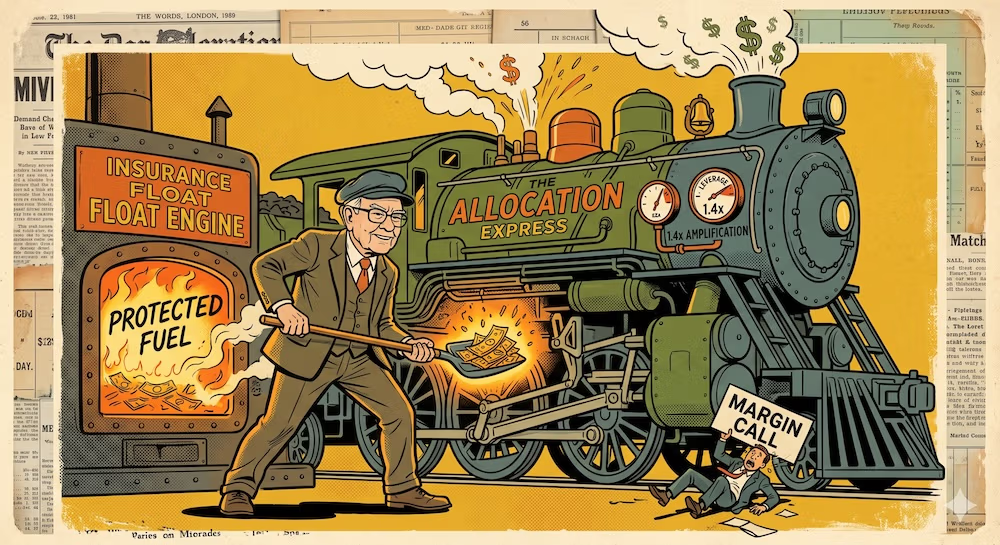
Insurance Float Was the Funding Reservoir, Not the Whole Strategy
The Berkshire system starts with a simple accounting reality: you cannot allocate capital if you do not have a reliable, durable source of it. For Buffett, that source was never retail capital aggregation or Wall Street debt issuance. It was insurance float.
When an insurance carrier writes a policy, it collects premiums upfront and pays out claims months, years, or decades later. In the interim, the insurance company holds this cash pool—the float. On a standard corporate balance sheet, float is a liability. But in the hands of an allocator, it functions as a large, liability-backed funding reservoir not subject to broker-style margin calls or fund-style redemptions.
Buffett kicked off this architecture in 1967 when he acquired National Indemnity for $8.6 million, capturing its initial $19 million in float to invest outside the stagnant textile business. He expanded it systematically, culminating in the complete buyout of GEICO in 1996.
To see how this reservoir fundamentally transforms the returns of the other two buckets, consider a simple structural example. Suppose an investor operates with $100 of pure equity capital. If they buy a public stock or a private business that returns 10%, they make $10. Their return on equity is exactly 10%.
Now, look at the Berkshire capital structure. Academic reconstructions of Berkshire’s historical balance sheet estimate its structural leverage at roughly 1.4x to 1.7x depending on the reconstruction method and period. If we use a conservative 1.4x leverage framework, the allocator pairs that $100 of equity capital with $40 of insurance float acting as institutional funding. They deploy the full $140 into the exact same 10% asset. The investment now generates $14. Assuming the cost to hold and maintain that float is zero, the return on the original $100 of equity jumps to 14%. The capital structure has amplified the asset return curve by 1.4x before a single operational decision is made.
However, float is not magical free money, and treating it as an unconditional alpha generator ignores the extreme structural risks underneath. Float is liability-backed capital. Its structural utility is entirely dependent on underwriting discipline, claims, reserves, regulation, and liquidity management. If an insurance company underwrites bad risks just to grow its premium volume, it runs an underwriting deficit. That deficit represents the interest rate paid on the borrowed float.
Academic work such as Buffett’s Alpha notes that Berkshire’s average historical cost of float was approximately 1.72%, a rate that tracked below the prevailing US Treasury Bill yield for long stretches. Buffett was effectively paid to hold billions of dollars of institutional leverage.
The real structural advantage here is that this float provides protection from broker-style margin calls and fund-style redemptions. If the public stock market drops 50%, a retail broker pulls the plug and liquidates assets to protect their loan. But insurance policyholders cannot demand their premiums back simply because Wall Street is having a panic attack. The funding remains stable, provided the underlying insurance operations remain statistically profitable over time. Float supplied the fuel, but it required an entirely different set of operational outlets to absorb that fuel without causing an engine blowup.
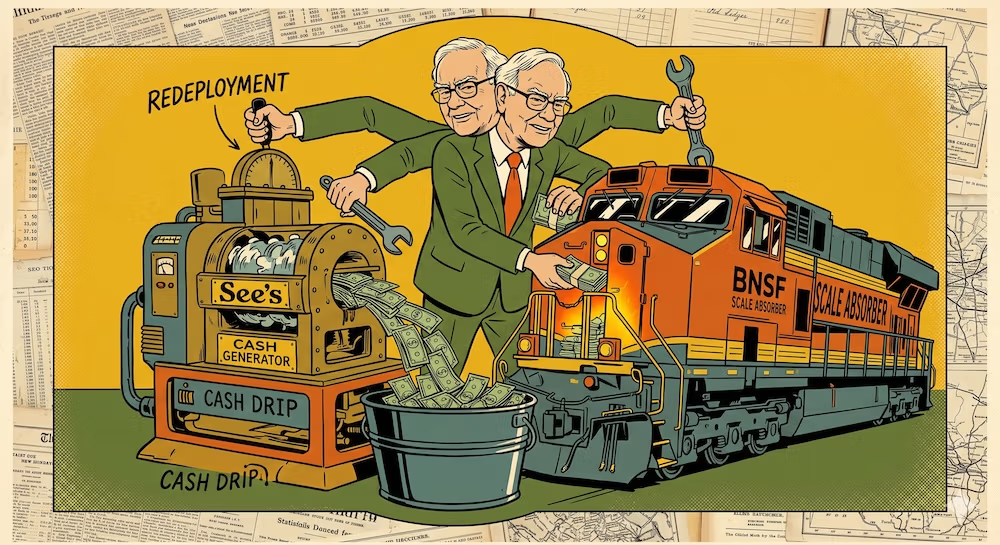
Private Businesses Were Cash Engines and Capital Absorbers
In most corporate strategy textbooks, wholly owned subsidiaries are viewed through the lens of operational synergy or vertical integration. Buffett viewed them as financial engines designed to solve two entirely different corporate capital problems: cash generation and scale absorption.
I think this is where Buffett’s private-business logic gets misread. See’s Candies and BNSF were not the same kind of asset. One threw off cash. The other could absorb oceans of it. Same parent company. Completely different job.
While it is true that operating within a consolidated corporate structure allows for lower internal tax friction within a consolidated corporate structure, after operating taxes, reinvestment needs, and legal constraints, the true strategic value lies in how these businesses handled their internal capital requirements. Buffett split his private businesses into two completely different functional categories:
1. The Pure Cash Generators
These are capital-light, deeply moated consumer franchises with high Returns on Invested Capital (ROIC) but narrow internal reinvestment runways. The canonical archetype is See’s Candies, purchased in 1972 for $25 million. See’s possessed immense brand equity and pricing power, allowing it to increase profits regularly without requiring massive cash outlays for new factories or machinery.
But See’s could not efficiently open thousands of chocolate shops without destroying its return metrics. Left to its own devices, See’s would have accumulated dead cash on its balance sheet. Under Berkshire’s balancing system, See’s generated more than $2 billion in cumulative pre-tax earnings over time, much of which could support redeployment elsewhere inside Berkshire after taxes and modest reinvestment needs—funding public stock purchases or capital-starved operating segments.
2. The Empire-Scale Capital Absorbers
At the opposite end of the balance sheet sit assets like Burlington Northern Santa Fe (BNSF) and Berkshire Hathaway Energy (BHE). These are not capital-light cash engines; they are massive, capital-intensive infrastructure utilities. They require billions of dollars in annual maintenance and regulatory capital expenditure just to keep the trains running on the tracks and the power grids online.
Why did an allocator who spent decades praising asset-light businesses buy these heavy infrastructure networks? Because scale eventually anchors returns. As Berkshire’s capital base grew into the hundreds of billions, it became mathematically impossible to deploy its cash hoards into small, high-ROIC chocolate shops. BNSF and BHE solved the scale problem by acting as multi-billion-dollar capital sponges. They can absorb massive blocks of cash at stable, regulated, and acceptable rates of return that comfortably exceed the cost of float, providing a predictable floor for Berkshire’s capital base when public equity markets are overvalued.
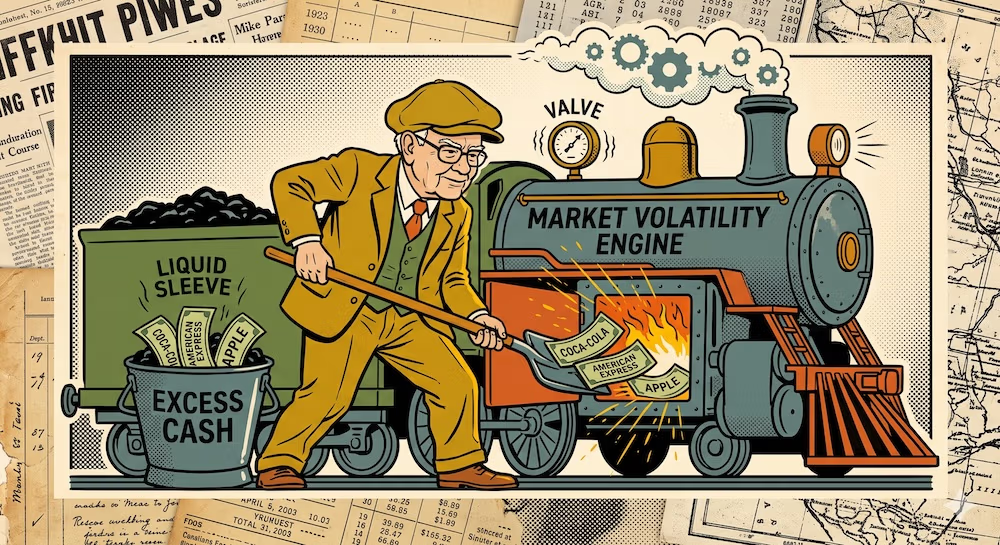
Public Stocks Were the Liquid Deployment Sleeve
If private businesses provided the operational bedrock, the concentrated public equity portfolio served as Berkshire’s tactical release valve. Public equities did not exist to be a permanent museum of corporate icons; they were a liquid deployment sleeve engineered to exploit market volatility when private markets became uncompetitive.
Rather than treating public stocks as abstract pieces of a factor model, Buffett used specific corporate giants to solve distinct allocation problems at different stages of Berkshire’s growth:
- The Depressed Public-Equity Opportunity (The Washington Post): Purchased heavily during the brutal 1973–1974 bear market, this allocation allowed Buffett to buy an immense economic moat at a fraction of its private liquidation value, proving that public market panics routinely underprice franchise longevity.
- Quality Brand Compounding (The Coca-Cola Co.): Deployed between 1988 and 1989, a $1.02 billion investment in Coke absorbed significant capital into a high-yielding, capital-light consumer giant. By holding this position for decades without selling, Berkshire turned its massive unrealized capital gains into a rolling, tax-deferred interest-free loan from the federal government.
- Durable Franchises Bought Through Stress (American Express): Used to exploit systemic or temporary reputational panics, allowing Berkshire to step in and buy large fractional stakes without paying the 30% to 50% corporate control premiums required to buy entire companies on the private market.
- The Mega-Cap Scale Absorber (Apple Inc.): Initiated in 2016, Apple served as the ultimate late-career deployment valve. It allowed Berkshire to deploy over $36 billion into a highly liquid consumer ecosystem that functioned as a capital-return machine through massive share buybacks, effectively solving Berkshire’s scale problem when whole private acquisitions of that size were unavailable.
Public stocks gave Berkshire a safety valve for excess cash. When private market valuations were pushed to irrational extremes by private equity funds using cheap leverage, Buffett could pivot his incoming cash flows directly into public equities. The trade-off for this flexibility is visible tracking error. Because the public stock portfolio has historically been intensely concentrated in these massive bets, the daily market price of Berkshire Hathaway has experienced massive volatility and long periods of absolute underperformance relative to standard indices. But because that liquid sleeve was surrounded by permanent corporate capital and liability-backed float, those market fluctuations were completely disconnected from Berkshire’s operational survival.
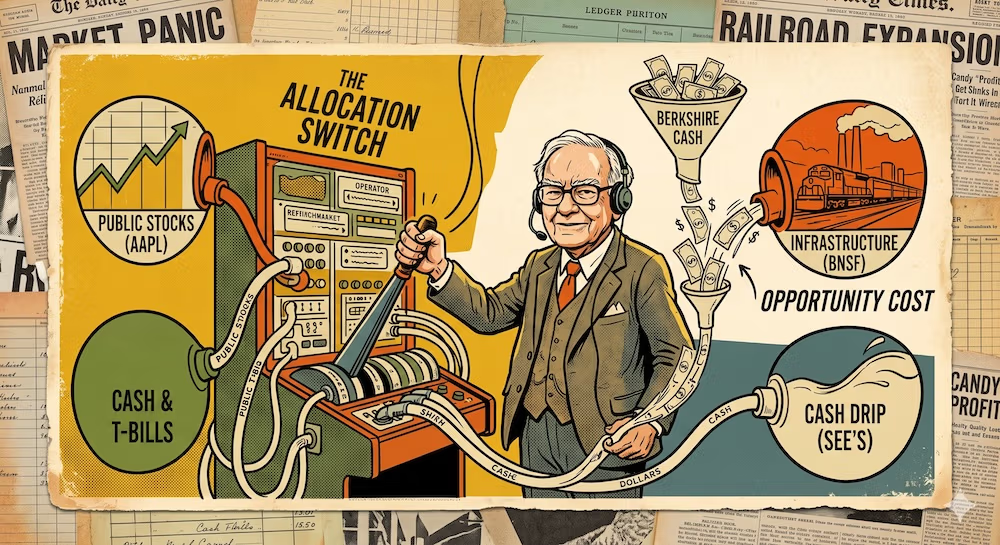
The Real Skill Was the Switching Mechanism
This is the part I would personally underline twice. Berkshire was not loyal to public stocks, private businesses, or insurance growth. It was loyal to opportunity cost. Less romantic. Much more useful.
Every dollar that entered the corporate treasury was put through a continuous triage process based on a shifting hierarchy of opportunity cost. If the expected return of the next dollar deployed into public equities was lower than the return of expanding an insurance segment, the switch shifted toward insurance. If infrastructure capex offered a better risk-adjusted spread than public value stocks, the switch moved toward railroads.
This switching mechanism is what kept Berkshire from falling into the structural traps that destroy standard asset managers or traditional industrial conglomerates.
Capital Outlet Decision Matrix
| Capital Outlet | When Buffett Used It | Historical Case Study | What Could Go Wrong | The Allocation Logic |
| Public Stocks | When equity market panics or cyclical sector crashes compressed valuations below historical averages. | The Coca-Cola Co. (1988) / Apple Inc. (2016) | Market corrections can create large trailing tracking-error gaps and paper losses. | Buy when fractional expected returns beat the cost of buying whole companies. |
| Wholly Owned Businesses | When high-ROIC private operations were available at fair prices with management teams intact. | See’s Candies (1972) / Nebraska Furniture Mart (1983) | Overestimating the structural durability of the underlying competitive moat (e.g., Dexter Shoe in 1993). | Acquire when you can secure 100% of cash flows without paying an irrational control premium. |
| Insurance Expansion | When industry pricing power hardened, allowing for highly profitable premium writing. | Reinsurance expansion / National Indemnity growth phases | Mispricing catastrophic tail risks or underestimating long-tail litigation reserves. | Deploy capital into writing more policies only when premium pricing offers attractive expected underwriting economics. |
| Infrastructure & Utilities | When Berkshire’s aggregate scale made it impossible to move the needle with small investments. | BNSF acquisition announced 2009 / completed 2010 | Heavy ongoing regulatory oversight and structural capital intensity dragging down overall ROIC metrics. | Use as a massive scale sponge to lock in reliable returns above the cost of capital. |
| Crisis Preferreds | During systemic liquidity freezes when mega-cap institutions required immediate reputational backing. | Goldman Sachs / General Electric in 2008 | Direct counterparty default or systemic failure of the underlying financial market. | Show up with money when everyone else was looking for oxygen; exploit speed, reputation, and liquidity. |
| Share Buybacks | When Berkshire’s own stock traded at a significant discount to a conservative calculation of intrinsic value. | Accelerated buyback programs (Post-2018 windows) | Overpaying for your own shares when that capital could have seeded a future multi-bagger operating asset. | Deploy when buying back your own assets offers the best risk-adjusted use of capital. |
| Cash & T-Bills | When across-the-board asset valuations were overstretched and nothing cleared the minimum hurdle rate. | The modern cash hoard ($150B+ post-2020 regimes) | Underperforming a raging bull market due to structural cash drag. | Hold as a temporary waiting room to preserve optionality and ensure structural survival. |
How the Balance Changed by Era
Berkshire did not maintain a fixed distribution across its three buckets. The portfolio was a historical chameleon, shifting its weight as macro regimes, asset sizes, and structural limitations evolved over a sixty-year timeline.
Era-by-Era Balance Matrix
| Era | Dominant Capital Source | Dominant Capital Outlet | Why the Balance Shifted |
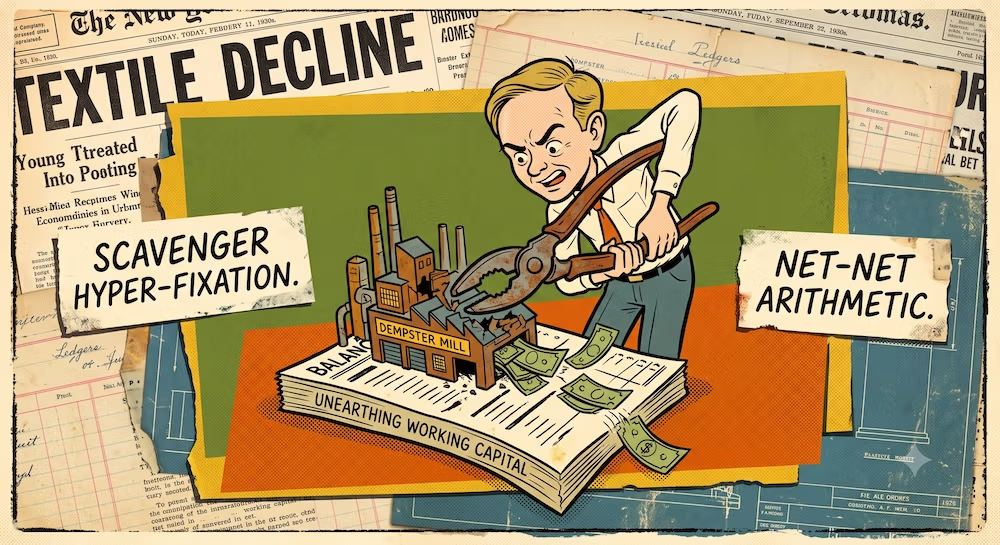
| The Partnership & Early Textile Era (1956–1969) | Private partner capital and early performance fees; inception of initial National Indemnity float. | Public liquidations, quantitative net-net arbitrage, and workouts. | Small capital scale permitted the exploitation of deep-value market inefficiencies that disappeared as assets grew. |
| The Stagflation & Pivot Era (1970–1984) | Expanding insurance float; early operating cash flow from Blue Chip Stamps and See’s Candies. | Depressed public equities and selective high-ROIC private consumer monopolies. | Extreme macro stagflation compressed public equity valuations to single digits, making public stocks an asymmetric deployment outlet. |
| The Mega-Cap Compounding Era (1985–2000) | Mature corporate float from GEICO and global reinsurance lines; structural tax deferrals. | Concentrated mega-cap public equity winners (Coca-Cola, Gillette, Wells Fargo). | Growing scale eliminated micro-cap options, forcing a shift toward purchasing high-quality global consumer networks at fair prices. |
| The Crisis Liquidity and Infrastructure Era (2001–2015) | Enormous, consolidated global insurance operations generating permanent, low-cost capital. | Crisis preferred deals, selective institutional liquidity provision, and heavy infrastructure buyouts (BNSF completed 2010). | The Global Financial Crisis created unique special-situation deals, while massive asset scale required a pivot into heavy capital absorbers. |
| The Behemoth Scale Problem (2016–Present) | Massive, compounding internal cash flows with lower internal friction alongside a global insurance float reservoir. | Mega-cap tech (Apple), massive share buybacks, and accumulating short-term Treasury piles. | Extreme corporate scale pushed the investable universe toward mega-cap equities, large whole-company deals, internal capital absorption, buybacks, and cash. |
Tracking Error and Scale: The Cost of Balancing Imperfect Buckets
Maintaining this balance sheet equilibrium is not a risk-free formula. Forcing three fundamentally different engines to run inside the same corporate shell introduces severe structural trade-offs that an independent investor must analyze objectively.
First, scale is an absolute anchor on performance. When Buffett managed millions, his switching mechanism was incredibly nimble. He could pivot out of a public stock, execute a workout arbitrage deal, and buy a small private manufacturing company within a single quarter.
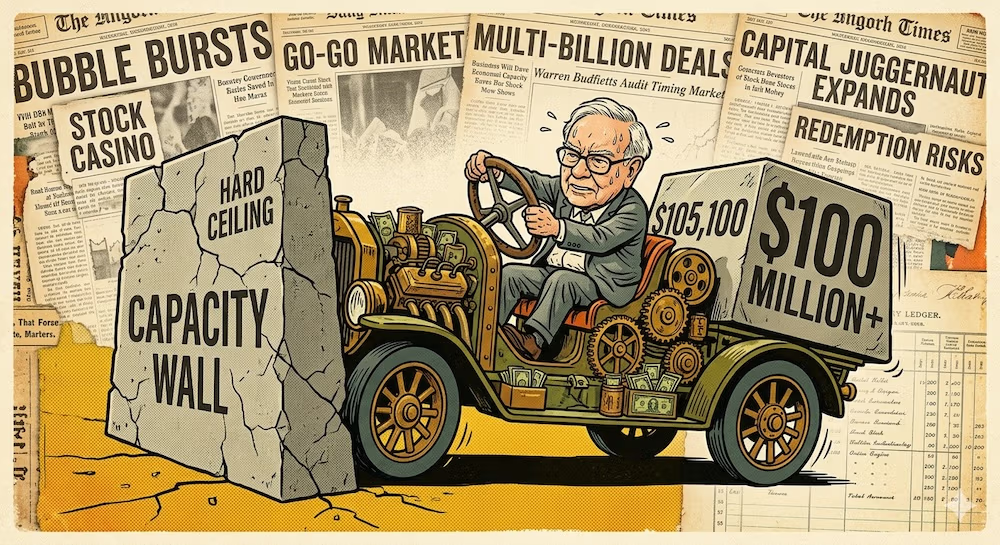
Today, Berkshire’s cash pile regularly surpasses $150 billion. When you operate at that volume, the switching mechanism slows down dramatically. You cannot buy small, high-return private businesses because they won’t even show up as a rounding error on the consolidated balance sheet. You are forced to wait for elephant-sized deals or massive public equity mispricings. Consequently, the cash bucket goes from a temporary holding area to a structural drag on trailing performance metrics during prolonged bull markets.
Second, the system demands an extraordinary degree of tracking-error endurance. Because the public equity sleeve is deployed into highly concentrated positions to move the needle on Berkshire’s massive capital base, it is structurally designed to deviate violently from broad market indices.
During the 1998–2000 Dot-Com bubble, Berkshire’s market price suffered a brutal collapse while the tech-heavy indices were setting historic highs. The public narrative shifted instantly: the market was convinced the allocation desk in Omaha had lost its edge.
A traditional fund manager faces immediate client redemptions during underperformance windows of that scale, forcing them to sell their underlying assets at the exact moment they should be buying. Berkshire’s ultimate defense mechanism was not its stock selection; it was the fact that its permanent corporate capital structure shielded it from redemptions, while its private operating businesses continued to send cash into the treasury with lower internal friction to buy the very assets the market was discarding.
What Modern Investors Can Absorb Conceptually
So what do I actually take from this? Not “copy Buffett.” Please don’t. The useful lesson is to make your own capital sources, time horizon, tax friction, and behavior line up before you start pretending you have Berkshire’s patience.
You cannot build a direct retail copy of Berkshire Hathaway. Unless you happen to own an insurance carrier with thousands of policies funding your brokerage account, you do not have access to liability-backed funding reservoirs not subject to broker-style margin calls. Attempting to simulate this structure by opening a standard retail margin account is a fundamental misunderstanding of asset-liability matching; retail margin is a poor analogue because it can create forced liquidation at the worst possible time.
Furthermore, individual retail allocators face completely different structural tax friction and legal constraints that prevent them from executing corporate cash sweeps between private subsidiaries. But if we look past the folklore and focus purely on the structural mechanics of the three-bucket system, there are profound conceptual lessons that travel directly to a modern portfolio:
- Understand Your Capital Sources Before Choosing Your Assets: The asset side of your balance sheet must always match the structural durability of your liability side. Buffett could buy volatile, concentrated public equities because his funding source—insurance float and permanent equity—could not redeem out from under him. If your personal capital source is fragile (e.g., money needed for next year’s down payment or business operating capital), deploying it into high-tracking-error risk assets is a structural misalignment.
- Force Different Capital Containers to Compete on Opportunity Cost: One conceptual translation is to think of cash, index foundations, active tilts, and other assets as competing uses of capital. Do not segment your portfolio decisions into isolated silos. Your assets should all compete on a singular, un-romantic scoreboard of expected returns and structural risk. A public equity tilt only makes sense conceptually if it offers a clear, verified premium over passive market aggregation or paying down expensive real-world liabilities.
- Respect Tax Friction and Turnover Drag: Corporate allocators spend massive operational energy minimizing realization events. Tax-advantaged accounts can reduce realization drag where appropriate, allowing your assets to compound without giving up a percentage of every distribution to transaction and capital gains friction.
- Acknowledge the Behavioral Toll of Tracking Error: If you choose to deviate from broad-market asset diversification by tilting toward specific vectors, you must pre-emptively price in the psychological cost of long underperformance cycles. Broad diversification may be a better behavioral match for investors who cannot tolerate large tracking-error gaps or who need liquidity and optionality during drawdowns without triggering forced sales at a market bottom.
Buffett’s enduring contribution to portfolio architecture wasn’t demonstrating that value stocks outperform over time. It was proving that an investment portfolio is only as strong as the capital structure that surrounds it. Berkshire worked because its funding reservoir was insulated, its operating cash flow was un-sentimental, and its liquid deployment sleeve was patient. Build your own portfolio containers with that same structural discipline, and let the money do its job.
Invest intentionally, and keep your positioning clean.
What is the minimum portfolio size required to replicate Buffett’s three-bucket balancing strategy?
It depends on your setup, but realistically, you cannot replicate the exact corporate architecture at any size without owning an insurance repository. However, a modern individual investor can conceptually mimic the framework with a standard portfolio by splitting capital into clear, non-sentimental functional containers: a diversified index foundation (the core operating bedrock), a tax-advantaged factor-tilted sleeve (the liquid deployment vehicle), and a short-term Treasury/cash buffer (the waiting room). You do not need millions to apply the logic of opportunity-cost filtering; you just need to make every asset class interview for its place on your personal balance sheet.
Can a retail investor access the same tax-free intercompany cash routing that Berkshire uses?
No. Retail investors do not have access to corporate tax mechanisms like the Dividends Received Deduction (DRD), which allows conglomerates to route cash between wholly owned private subsidiaries with minimal friction. When you receive a public stock dividend or sell an asset in a standard taxable brokerage account, you trigger immediate tax drag. The practical workaround is to consolidate your active quality-value factor tilts inside tax-advantaged retirement shells like a Roth IRA or traditional 401k, which replicates the zero-friction reallocation engine by deferring or eliminating realization penalties entirely.
Which modern ETFs best capture the systematic factor profile underneath Buffett’s public stock sleeve?
Not exactly a single fund, but academic audits show Buffett’s public equity selection targets specific, reproducible quantitative factors: Quality (high Return on Invested Capital), Low Beta (low systematic volatility), and Value (cheap cash flow multiples). To track this profile conceptually without hand-picking concentrated equities, modern research points toward low-cost factor products. Investors looking for these exposures typically combine Quality-Minus-Junk [VERIFY] or Quality factor ETFs with dedicated large-cap Value factor ETFs to target the underlying anomalies systematically.
Why shouldn’t I use retail margin to match Berkshire’s 1.4x structural leverage?
Because it is a fundamental mismatch of asset-liability duration. Berkshire’s structural leverage is funded by insurance float, which is liability-backed capital that is completely immune to broker-style margin calls and fund-style redemptions. If the market crashes 50%, Berkshire’s funding reservoir remains intact. If you borrow 1.4x on a retail margin line and the market drops 50%, your broker pulls the noose, issues a margin call, and liquidates your portfolio at the absolute bottom of the cycle. Retail margin pricing is also structurally too expensive to clear the necessary factor hurdle rates safely.
How did Buffett differentiate between a cash generator and a capital absorber in private operations?
The distinction is entirely driven by internal reinvestment runways. A cash generator, like See’s Candies, has an exceptionally high Return on Invested Capital (ROIC) but limited physical space to deploy new money efficiently; it throws off surplus cash that must be routed elsewhere. A capital absorber, like Burlington Northern Santa Fe (BNSF) or Berkshire Hathaway Energy, operates in capital-intensive infrastructure sectors. These businesses require billions in annual maintenance capex, but they can comfortably absorb massive chunks of capital at stable, acceptable, and regulated risk-adjusted rates of return, solving Berkshire’s mega-scale problems.
How does a DIY investor know when cash should be treated as an asset vs. a trailing drag?
The rule is simple: cash is a strategic asset when asset market valuations fail to clear your absolute hurdle rate, and it is a structural drag only when you lower your standards just to get fully invested. Buffett’s switchboard model treats cash as a legitimate, optionality-rich capital container. If public equities are overvalued and private acquisitions demand irrational premiums, capital defaults to short-term Treasuries. The lesson is to let cash accumulate patiently as a temporary waiting room rather than forcing money into sub-optimal factor exposures during market peaks.
This article is also available in Spanish. Leé la versión en castellano: Cómo Warren Buffett balanceó acciones públicas, empresas privadas y seguro flotante