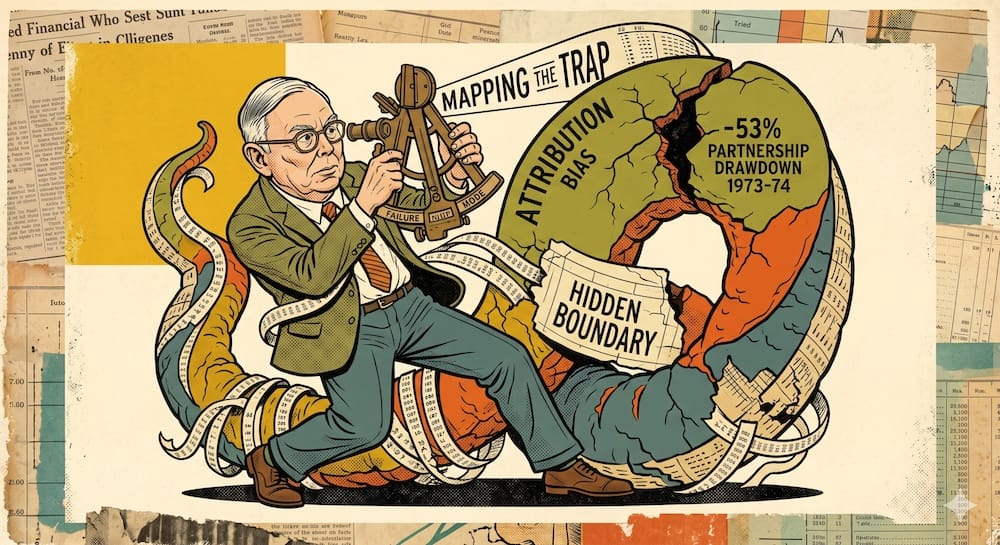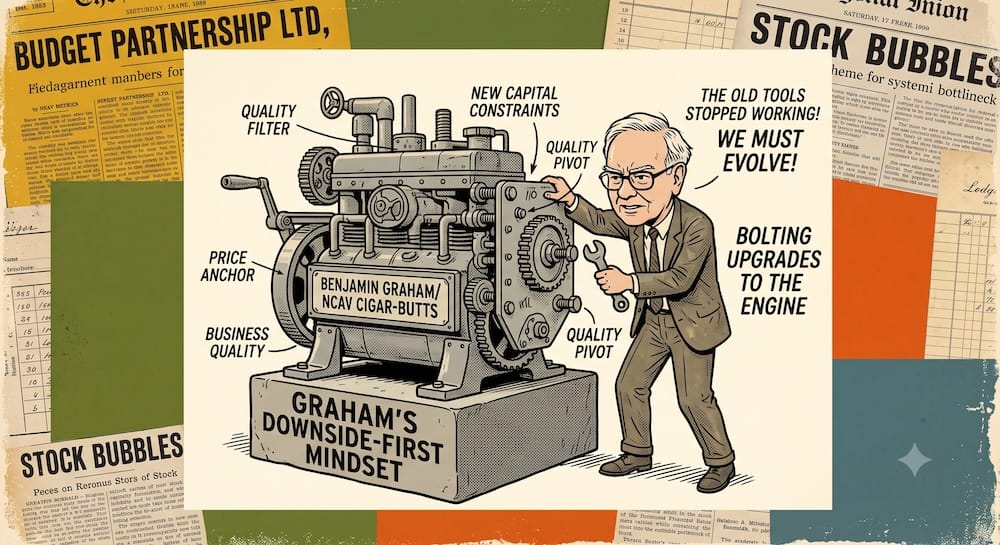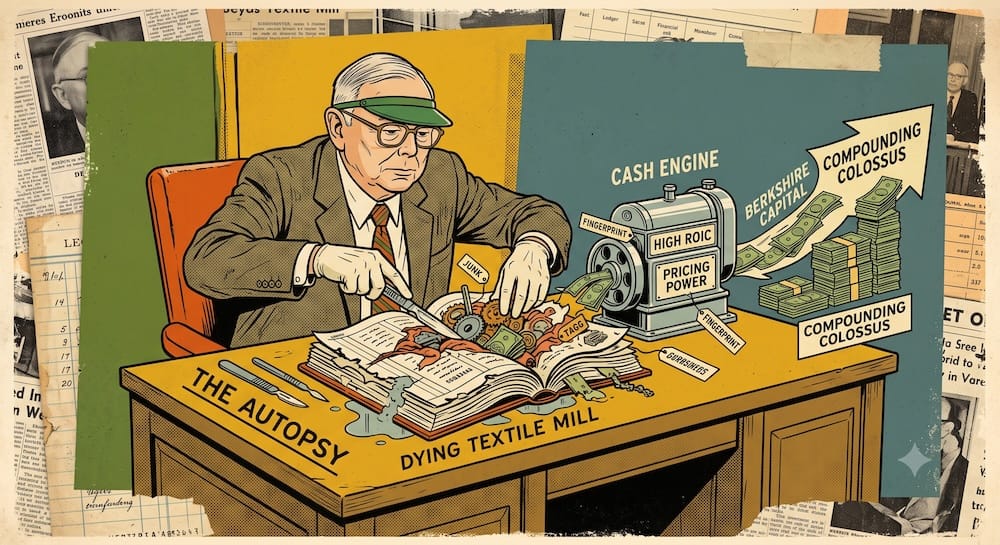
Philip Fisher’s scuttlebutt method is usually flattened into a pleasant little slogan: talk to customers, suppliers, competitors, employees, and management before buying a stock.
That is the visible activity. It is also the easy part.
Anyone can collect opinions. Anyone can leave a conversation feeling better informed. Give an investor ten interviews, a factory tour, a notebook full of industry jargon, and lunch with an executive, and conviction tends to arrive whether the evidence deserves it or not. Access feels valuable because it is scarce. Effort feels valuable because it was exhausting. Neither guarantees that the investor learned anything useful.
Fisher’s real mechanism was harsher. He wanted investors to assemble a causal picture of a company from people who observed different parts of its commercial ecosystem. He wanted to know what produced the reported numbers, how durable those forces were, where the weaknesses sat, and whether management’s version of reality survived contact with everyone else’s.
Financial statements record outcomes. Scuttlebutt investigates the machinery producing them.
The method works when testimony from differently positioned and independently informed sources converges on the same business mechanism. It fails when anecdotes, reputations, shared industry gossip, and executive charisma are mistaken for corroboration.
I give Fisher enormous credit for treating qualitative information as evidence that had to be checked rather than as colourful garnish beside the spreadsheet. I am less impressed by the modern tendency to describe every conversation with an industry contact as “doing scuttlebutt.” Calling people is an activity. Research begins when the investor decides who genuinely knows something, what that person directly observed, what incentives distort the account, where the information originated, and what conclusion must change if the source is right.
That is a considerably less glamorous method. It is also the one Fisher actually described.
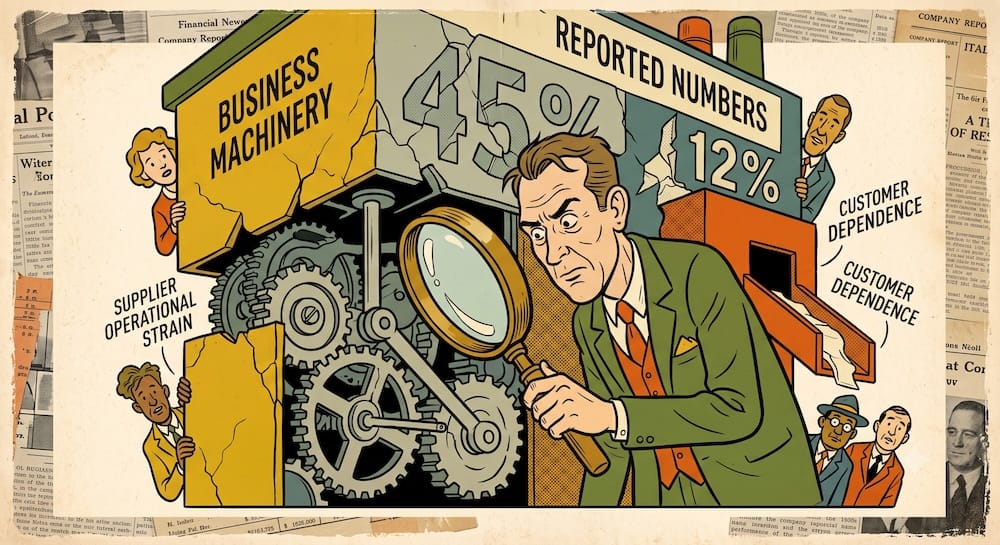
The Numbers Show What Happened. Fisher Wanted to Know Why.
Fisher never argued that investors should throw away the financial statements and replace them with conversations.
His own investigative process included capital structure, financial condition, product-line sales, profit margins, research spending, depreciation, and unusual costs. He reviewed the numbers before completing the deeper qualitative work. Scuttlebutt was meant to interpret the accounts, test them, and reach parts of the company the accounts could not expose cleanly.
That sequencing matters because similar financial results can emerge from very different operating realities.
A company might report rising margins because customers will tolerate higher prices. It might also be benefiting from temporary shortages, delayed expenses, favourable product mix, weak competitors, or underinvestment that will become painful later. Revenue growth may reflect genuine customer dependence, aggressive discounting, one large contract, acquisition activity, or demand that disappears as soon as a credible substitute arrives.
The figures tell us that the result occurred. They rarely settle which explanation deserves the credit.
In Common Stocks and Uncommon Profits, Fisher considered what an investor would ideally want to examine: research, production, sales, labour relations, management depth, competitive standing, and the ability to invest for future growth. In a perfect world, the investor would inspect every major corporate function deeply enough to understand how the organisation truly worked.
That perfect world does not exist.
Outside shareholders usually lack the access, time, specialised knowledge, and cooperation required to conduct an internal audit of the whole business. A corporation may employ thousands of people across departments, products, and geographies. Even its senior executives will not possess equal visibility into every corner. The idea that an outside investor can arrive, ask four penetrating questions, and decode the organism is flattering nonsense.
Fisher’s workaround was to gather partial views from people positioned around the company.
Customers could observe product performance, service quality, switching friction, and purchasing behaviour. Suppliers could observe planning discipline, order patterns, payment behaviour, and operational strain. Competitors might understand technical reputation, sales effectiveness, and the company’s ability to attract talent. Former employees could reveal whether the organisation depicted in presentations resembled the one operating behind the doors. Scientists and researchers could assess whether a celebrated research programme was genuinely productive or simply fluent in the dialect of innovation.
Each source saw one slice.
Fisher’s method attempted to assemble those slices into an explanation of the whole. The goal was never omniscience. It was a better causal map.
That is where scuttlebutt separates itself from the romantic idea of uncovering secret facts through superior networking. A contact can provide access. A contact cannot automatically tell the investor whether the information is independent, current, unbiased, economically significant, or already embedded in expectations.
I would put the financial statements back at the centre whenever qualitative work begins drifting into corporate mythology. A customer story should help explain demand. A supplier account should illuminate execution. Employee testimony should clarify organisational capability. If the conversations cannot be connected to the economics, the investor has collected atmosphere.
“Talk to People” Is a Terrible Definition of Scuttlebutt
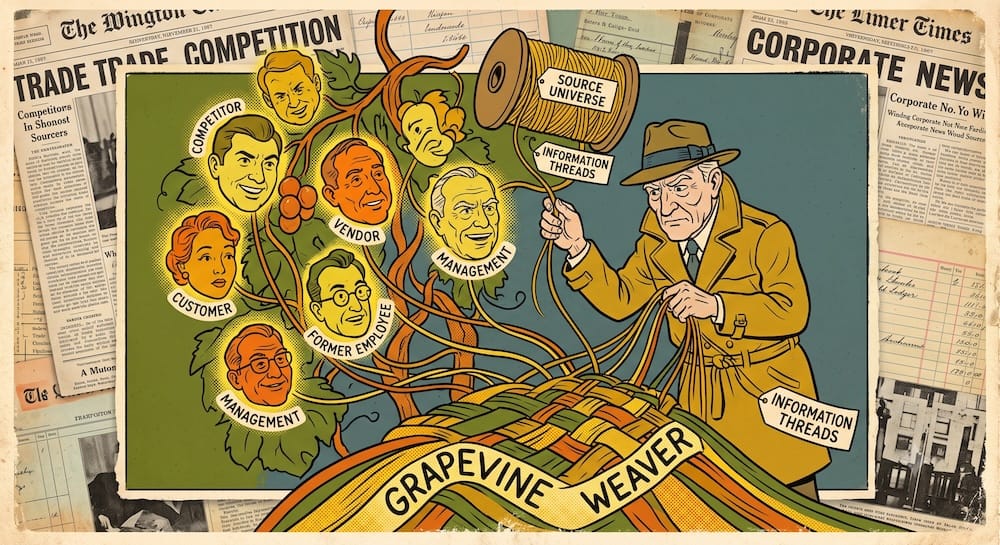
Fisher described a business grapevine through which investors could learn about the relative strengths and weaknesses of companies. The method depended on gathering views from what he called a “representative cross-section” of informed people.
That phrase carries more weight than most summaries allow.
A representative cross-section is not five satisfied customers selected by the company. It is not three former employees from the same department. It is not a room full of industry participants who have spent six months repeating the same fashionable explanation to one another.
Fisher’s source universe included competitors, customers, vendors, former employees, researchers, scientists at other firms, trade-association figures, and management. He also suggested asking several companies in an industry about one another. That comparative element is essential.
The investor was not merely trying to learn whether a company was good. He was trying to understand what made it stronger or weaker than the alternatives.
A customer saying a product is excellent tells us something. Customers explaining why one supplier is harder to replace than several competitors tells us more. A supplier describing a company as professional is pleasant. Several suppliers describing unusually consistent planning, technical competence, and reliable execution may support a broader claim about the organisation.
A competitor’s reluctant admiration can be informative because the incentive is different. Management praising its own sales culture is expected. A rival explaining why that sales organisation repeatedly wins difficult accounts carries another kind of weight.
None of these accounts should be accepted raw. Every source sits inside an incentive structure.
Customers negotiate. Suppliers want business. Competitors protect pride. Employees protect careers. Former employees may carry loyalty, resentment, or both. Executives are paid partly to make a complicated organisation sound coherent. Researchers can admire technical achievement while missing whether the achievement will ever earn an attractive return.
Fisher explicitly warned investors to examine why former employees had left and to account for possible prejudice. He understood a point that gets lost in the worship of access: proximity can improve observation while simultaneously worsening interpretation.
An employee may know far more about the company than an outsider and still provide a distorted account of what those facts mean.
That is why the source list cannot define the method. The same interview might be valuable, irrelevant, or actively misleading depending on the source’s vantage point, incentives, timing, and ability to distinguish direct observation from office folklore.
Scuttlebutt begins after the introduction has been made.
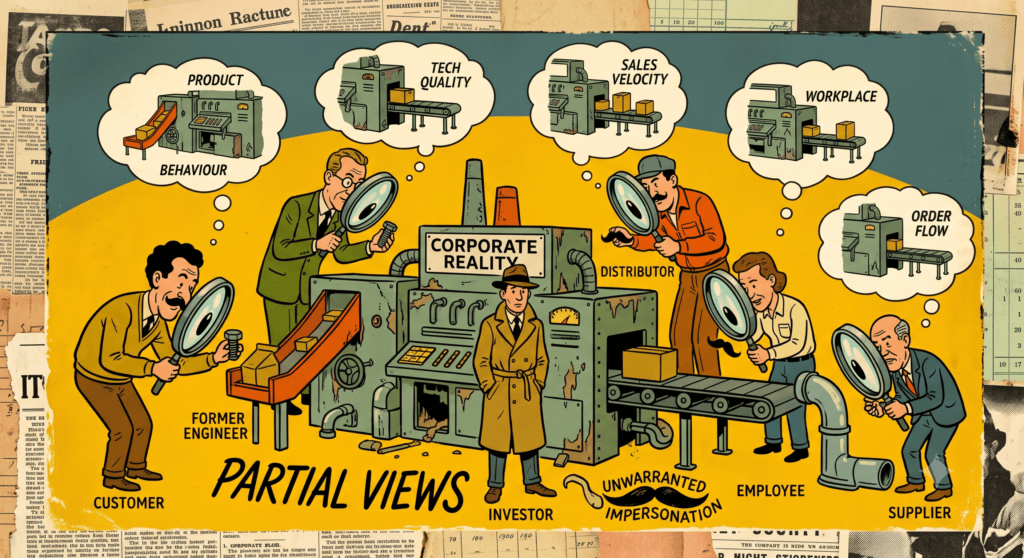
Every Source Sees a Different Company
The cleanest way to organise Fisher’s method is by asking what each source can realistically observe.
The word “realistically” matters. Investors have a habit of promoting sources beyond their competence. A customer who uses one product becomes an expert on the company. A former engineer becomes an authority on capital allocation. A distributor becomes an oracle on long-term competitive advantage. This is how partial knowledge acquires a fake moustache and begins impersonating complete understanding.
Customers and Distributors See Behaviour, Not the Whole Economics
Customers can speak to product performance, service quality, purchasing decisions, switching difficulty, and the consequences of failure. Distributors may see sales velocity, discounting, returns, channel conflict, competitive substitution, and how much effort is required to move the product.
The useful distinction is between customer enthusiasm and customer dependence.
Customers may love a product while retaining many alternatives. They may complain bitterly about another product while remaining unwilling or unable to replace it. Enthusiasm is vivid. Behaviour is more economically useful.
The sharper questions concern what customers actually do.
Do they expand usage? Do they tolerate price increases? Does the product become more deeply integrated into their operations? Would switching cause disruption, retraining, delays, or additional risk? Are buyers quietly adding a second supplier? Does service quality improve after the contract is won, or does the company become attentive only when renewal approaches?
One specific account of why a customer cannot easily switch tells me more than ten declarations that a company is “best in class.” That phrase has survived mainly because nearly every company can use it simultaneously without anyone being arrested for overcrowding.
Suppliers see a different set of behaviours. They may observe whether orders are stable or chaotic, whether the buyer plans ahead, whether payment slows, whether technical standards are rising, and whether capacity expansion appears deliberate or panicked.
Those observations still require restraint. A supplier sees the commercial relationship from its own side. A customer can describe product value without understanding the supplier’s costs, balance sheet, or reinvestment burden. Strong demand does not automatically create strong economics.
The source reveals part of the mechanism. The investor must resist the urge to award it jurisdiction over the rest.
Employees, Former Employees, and Competitors See Execution
Employees, former employees, scientists, industry specialists, and competitors may observe how effectively a company converts money, people, and ideas into results.
A scientist might assess the technical quality of the research organisation. A former executive may know whether management depth extends below the chief executive. Competitors may understand which sales teams consistently win difficult accounts. Industry contacts may observe whether the company attracts talented people, develops them, and retains them.
These accounts can be extraordinarily valuable. They can also be gloriously wrong.
A brilliant engineer may understand the technology and misread customer demand. A satisfied employee may describe a healthy workplace that allocates capital poorly. A resentful former employee may interpret every setback as proof of incompetence. A competitor may dismiss the company publicly while fearing it privately, or admire the product while underestimating its commercial weakness.
I would force every meaningful claim through six questions:
| Evidence test | What must be established | Where investors fool themselves |
|---|---|---|
| Source | Who is making the claim? | Status is mistaken for relevance |
| Observation | What did the person directly witness? | Opinion is upgraded into firsthand knowledge |
| Incentive | What could distort the account? | Loyalty, resentment, salesmanship, and negotiation disappear from view |
| Independence | Did the information originate separately? | Several people repeat one underlying story |
| Corroboration | Which other vantage points support or challenge it? | Agreement inside one cluster is treated as proof |
| Thesis impact | What belief should change if the claim is true? | Interesting details accumulate without affecting the decision |
Fisher did not publish this table. It is my reconstruction of the logic behind his representative cross-section, cross-checking, source warnings, and reliance on the preponderance of information.
The last question is the one investors most often dodge.
Information feels valuable when it creates intimacy with the company. A factory visit, technical conversation, or executive meeting feels like progress because the investor has crossed a boundary ordinary shareholders have not. I am vulnerable to the same seduction. Complexity can feel like intelligence, and access can feel like insight.
Neither feeling tells us whether the thesis improved.
Corroboration Is Harder Than Counting Agreements
Fisher did not expect every source to agree. He expected details to conflict and looked for a sufficiently clear preponderance of information.
That is a sensible standard. Real companies produce messy testimony.
A customer may depend heavily on a product while complaining about support. A supplier may describe disciplined planning while a former employee describes political dysfunction. A competitor may respect the technology and question the sales organisation. Different accounts can all be true because the sources observed different departments, periods, products, and relationships.
The investor must determine what kind of disagreement has appeared.
Are the sources disputing the underlying fact? Did they observe different time periods? Are they looking at separate parts of the organisation? Are they interpreting the same event through different incentives? Has the company changed since one source left?
The harder problem appears when sources agree.
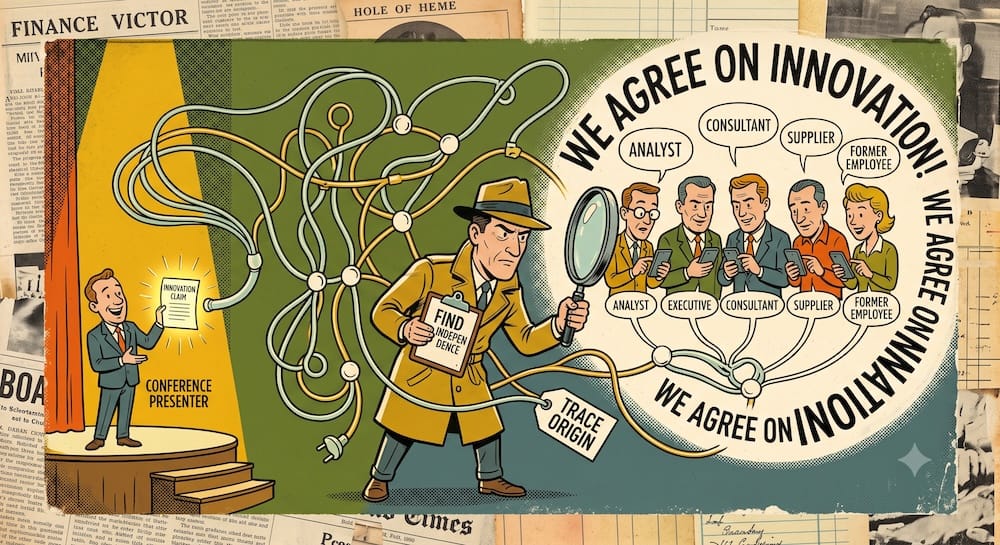
Suppose three industry contacts praise a company’s innovation culture. That sounds like corroboration. Its value collapses if all three absorbed the claim from the same conference presentation or trade publication. One story has travelled through three people. The headcount increased. The evidence did not.
Close industries are particularly vulnerable to this illusion. Executives, analysts, consultants, suppliers, and former employees often move through overlapping networks. They attend the same conferences, read the same trade coverage, and repeat the same reputations. Consensus may reflect shared reality. It may also reflect shared informational ancestry.
Research on confirmation bias explains why investors struggle to tell the difference after falling in love with the thesis. Raymond Nickerson’s review, “Confirmation Bias: A Ubiquitous Phenomenon in Many Guises,” describes how people seek and interpret evidence in ways favourable to an existing belief.
The danger is subtler than deliberate cherry-picking.
Questions become softer. Supportive comments feel specific. Contradictions look temporary. Friendly sources seem better informed. A positive anecdote becomes representative while a negative one becomes an exception requiring context.
Social influence adds another layer. In a 2011 PNAS study, Jan Lorenz and his co-authors found that social influence could reduce diversity of opinion and raise confidence without improving accuracy. Their experiment involved estimation tasks rather than stock analysis, so it does not prove that Fisher-style interviews behave the same way. The mechanism is still relevant: convergence can increase confidence while reducing the informational independence that made the group useful.
Scuttlebutt becomes dangerously flattering when the investor spends weeks gathering opinions, hears recurring praise, and concludes that effort has produced knowledge. The information feels proprietary because it was difficult to obtain. The conviction feels legitimate because the process consumed time.
Three people repeating one story are not three confirmations. They are a conference echo with individual business cards.
The more attractive the claim, the more aggressively I would trace its origin. Did the customer personally experience switching difficulty? Did the supplier directly observe changing orders? Did the former employee witness research projects being cancelled? Did the competitor lose accounts and understand why? Or did the source merely repeat the company’s reputation?
Counting agreements is easy. Establishing independence is where the method earns its keep.
Qualitative Evidence Has to Change the Business Thesis
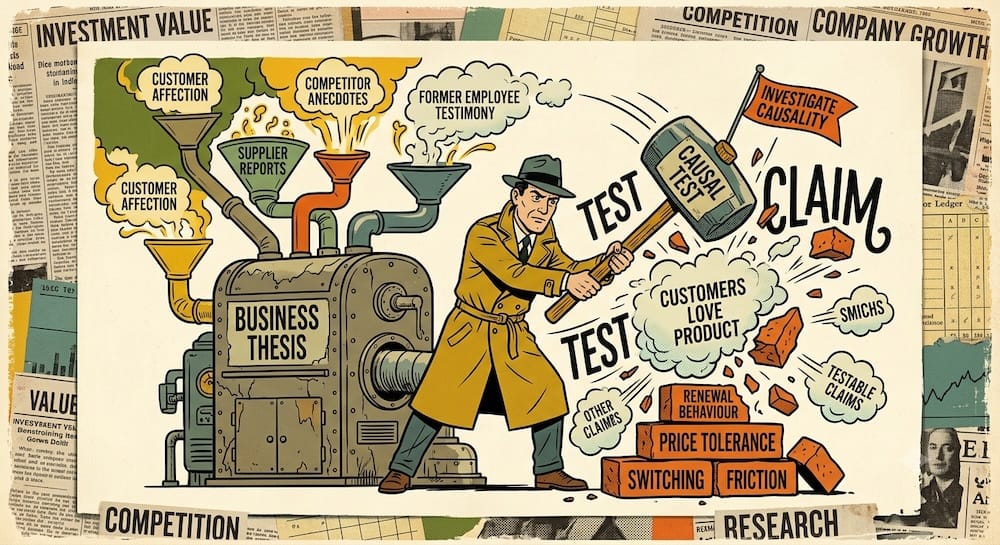
Scuttlebutt becomes investment analysis only when testimony is converted into a testable claim about the business.
“Customers love the product” is an observation, and often a flimsy one.
What behaviour follows from that affection? Do customers renew? Do they expand usage? Does deeper integration increase switching friction? Can the company raise prices without accelerating substitution? Can competitors reproduce what customers value? Does the company require heavy reinvestment merely to hold its position?
The chain can break anywhere.
Fisher asked whether an industry’s growth would benefit established participants or attract competitors that captured the economics. That is a far better question than whether the industry itself has an exciting future. Growth can create value. It can also attract capital, crush margins, and produce magnificent revenue charts attached to mediocre businesses.
The external testimony should therefore connect to a causal hypothesis:
- Customers face meaningful switching friction because replacement would disrupt a critical process.
- The research organisation converts spending into commercially valuable products more effectively than competitors.
- The sales culture supports customer retention and pricing rather than relying mainly on discounts.
- Management depth allows the company to function beyond one exceptional leader.
- Reported margins reflect durable operating strengths rather than temporary scarcity or deferred investment.
Each hypothesis creates something the scuttlebutt can attack.
Customers can contradict switching claims. Former employees can expose shallow management depth. Suppliers can reveal operational instability. Competitors can challenge the technical reputation. Financial statements can show that the supposed advantage consumes far more capital than the interviews implied.
Fisher was also willing to abandon an investigation when he could not obtain enough relevant background. That stopping condition deserves more attention than it receives.
Investors hate unresolved files. Time spent creates a sense of ownership. Once we have read, called, compared, highlighted, and filled several pages of notes, “I still do not know” feels like an insulting conclusion. I understand the temptation to produce a verdict simply because the work should surely amount to something.
It does amount to something. Sometimes it establishes that the available evidence is inadequate.
Fisher never supplied a universal formula for converting testimony into valuation. He did not assign numerical weights to customers, suppliers, scientists, competitors, or former employees. He offered no threshold stating that seven favourable interviews and two negative ones justified a purchase.
That absence protects the method from fake precision. It also exposes its central weakness.
Scuttlebutt depends heavily on judgment. Two capable investors can hear the same accounts, assess incentives differently, and reach opposing conclusions. More interviews do not eliminate that subjectivity. They may simply provide more material for each person’s preferred interpretation.
Fisher’s process can improve the company picture. It cannot guarantee that the picture is correct, that the future will resemble it, or that the market price offers an attractive proposition.
Management Comes Last Because Management Controls the Story
Fisher’s sequencing of management contact may be the most useful part of his method.
He did not begin with the executives. He investigated customers, suppliers, competitors, former employees, scientists, and other industry sources first. By the time he met management, he wanted a substantial amount of outside knowledge already assembled. His practical rule was to possess at least half of the information required for the decision before the meeting.
The percentage was never scientific. The order was the mechanism.
An investor who meets management too early enters a conversation the company largely controls. Executives choose the framing, emphasise the strengths, describe the weaknesses as temporary, direct attention toward preferred metrics, and decide who appears in the room.
The investor may ask sophisticated questions and still learn mainly how well the company presents itself.
A chief executive can speak beautifully about culture, innovation, and long-term thinking. That fluency proves the executive can speak beautifully about culture, innovation, and long-term thinking. It does not establish that the research pipeline works, customers struggle to switch, middle management is strong, or capital is allocated intelligently.
Fisher wanted the outside work to turn the meeting into a cross-examination.
If the investor already knew where a weakness existed, management’s answer carried more diagnostic value. Did executives recognise the problem? Did they describe it specifically? Did their account match what customers, suppliers, and competitors had observed? Did they understand the operating detail? Did they become evasive?
That is a fundamentally different exercise from asking management to explain the business.
I have little patience for the idea that executive access automatically equals deep diligence. A meeting conducted before independent investigation is often a charisma test with catering. The company supplies the setting, the story, the participants, and most of the informational boundaries. The investor supplies the flattering belief that entering the room somehow reversed the imbalance.
Fisher warned that an investor lacking prior scuttlebutt might judge an entire management team from whichever executive happened to attend. That is a brutal observation because it remains so plausible. One impressive representative becomes evidence of organisational excellence. One awkward representative becomes evidence of widespread dysfunction.
Outside investigation also limits narrative contamination. Once management supplies the preferred explanation, later information tends to be interpreted inside it. Customer loyalty confirms the moat. Employee departures become healthy renewal. Competitive threats validate the market opportunity. Every fact is welcomed into the story and assigned a supportive role.
Gathering external accounts first gives rival explanations a chance to survive.
Management can then clarify the picture. It should not be allowed to draw the original outline.
Scuttlebutt Can Produce Confidence Faster Than Knowledge
The method carries a peculiar psychological danger because effort becomes part of the persuasion.
Investors understand that a spreadsheet is a model. Its assumptions can be challenged. Qualitative fieldwork feels closer to the living business. The investor has spoken with real people, learned technical language, visited facilities, and discovered details absent from standard financial databases.
That intimacy may be genuine. It may also be counterfeit.
Source-selection bias begins immediately. Investors can interview only people willing to speak. The busiest customers, most guarded competitors, and most knowledgeable former employees may remain unavailable. Introductions often pass through friendly professional networks, tilting the sample toward people comfortable helping the same social circle.
Charismatic insiders create another failure point. A source may speak with precision, confidence, and fluency while holding a narrow or distorted view. Coherent explanations feel better than messy testimony. That is precisely why they deserve suspicion.
A company’s reputation can also outlive the mechanism that created it. A research organisation may continue receiving praise for products developed under previous leadership. A celebrated sales culture may decay while customers repeat the old story. Former employees can describe a company that no longer exists. Current employees may understand the present and miss how much the institution has changed.
Customer enthusiasm creates its own trap. People can adore a product sold by a company with poor economics. They can tolerate price increases until a credible substitute arrives. They can recommend a brand while reducing purchases. Affection has no obligation to appear in shareholder returns.
Competitor testimony can bend in either direction. Rivals may unfairly dismiss a strong company. They may also praise the technology because admitting technical strength feels less threatening than acknowledging superior commercial execution.
Fisher understood several of these dangers, especially the need to cross-check former employees and investigate why they left. He deserves precise credit for treating prejudice as part of the evidence rather than as an inconvenient footnote.
He did not solve the judgment problem.
More conversations create more data points. They also create more opportunities for duplication, contamination, selective interpretation, outdated information, and confidence inflated by effort.
The decisive test is whether contrary evidence can genuinely injure the thesis. If every negative account receives a forgiving explanation while every positive comment becomes confirmation, the investor is running a public-relations campaign for an audience of one.
Modern Scuttlebutt Still Has Legal Fences
Fisher worked in a different disclosure environment, but the core logic survives. Investors can still examine customer behaviour, supplier relationships, employee patterns, competitive reputation, and management consistency.
The legal boundary cannot be handled with slogans.
The U.S. Securities and Exchange Commission adopted Regulation FD in 2000 to address selective disclosure by issuers and people acting on their behalf. When material nonpublic information is intentionally given to covered market participants, the issuer generally must disclose it publicly at the same time. Accidental disclosure creates a prompt public-disclosure obligation.
Regulation FD did not outlaw mosaic analysis. The SEC expressly recognised that a company may provide an immaterial piece of information that an analyst combines with public information to reach a material conclusion.
That preservation of legitimate analysis should not be stretched into a magic defence for anything gathered through an industry contact.
Regulation FD concerns issuer disclosure. Insider-trading restrictions raise separate questions involving materiality, confidentiality, duties, source behaviour, and the circumstances under which information was obtained.
The SEC’s 2011 expert-network enforcement actions showed how ugly the boundary can become. The Commission announced cases alleging that consultants, company employees, analysts, and investment professionals passed and traded on confidential corporate information. Describing the activity as industry research did not cleanse the conduct.
The CFA Institute’s Standards of Practice Handbook also recognises mosaic analysis while prohibiting investment action based on material nonpublic information.
The conceptual distinction is clear even when legal analysis becomes fact-specific: scuttlebutt involves lawful investigation and inference. It is not permission to solicit confidential information or trade on improperly disclosed material facts.
Practical portability creates another limitation.
Fisher acknowledged that his process demanded time, skill, contacts, and introductions beyond what many investors could supply. Those constraints remain. Large institutions may employ industry analysts, specialist researchers, compliance staff, data services, and expert networks. Individual investors have gained access to public forums, product reviews, employee commentary, conference calls, trade publications, and professional networks.
Volume has increased. Reliability has not received the same upgrade.
A thousand online comments may come from one narrow customer group. Employee-review sites may overrepresent unusually happy or unusually angry workers. Social-media consensus can spread from one influential account. Product reviews can describe genuine user experiences while revealing almost nothing about capital intensity, customer-acquisition costs, competitive response, or valuation.
The modern investor can gather more fragments than Fisher ever imagined while knowing less about who produced them and how independent they are.
I would preserve Fisher’s logic and reject the fantasy of easy replication. His network, experience, time commitment, and interpretive skill were enabling conditions. Copying the source list does not copy the method any more than owning surgical instruments confers steady hands.
The Evidence Must Be Allowed to Kill the Idea
Scuttlebutt is often described as a way to know more about a company. That is too soft.
Investors rarely suffer from a total absence of information. They suffer from too much information that never changes the decision.
A customer interview matters when it can weaken the claim of switching costs. A supplier account matters when it can challenge the picture of operational discipline. A former employee matters when firsthand observations can alter the judgment of management depth or research productivity. A management meeting matters when the investor knows enough to recognise inconsistency, evasion, or a credible explanation.
A proper investigation can end in several places.
The causal thesis may strengthen because independent vantage points converge. It may narrow because the advantage exists only in one product, customer segment, or set of conditions. It may weaken because the reported economics depend on temporary forces. The investor may abandon the work because the available evidence never becomes adequate.
The company may also appear excellent while the investment proposition remains unresolved. Scuttlebutt can reveal a strong organisation without settling durability, valuation, financial risk, or what expectations the market price already contains.
Fisher integrated qualitative work with financial analysis. He never demonstrated that admiration for the business answers what the shares are worth. Nor can his independent return contribution be isolated cleanly from valuation, selection, concentration, holding period, access, or judgment.
His genuine contribution was narrower and stronger.
He forced investors to investigate the human, competitive, and organisational machinery behind the financial results. He demanded views from different positions, warned about source prejudice, placed management late in the sequence, accepted that testimony would conflict, and allowed inadequate information to stop the investigation.
The method succeeds when evidence can alter the causal map. It fails when conversations merely make the investor more emotionally committed to the original story.
The next source must be permitted to ruin the thesis. Otherwise, it was never scuttlebutt. It was applause collected one interview at a time.
What is Philip Fisher’s scuttlebutt method?
Philip Fisher’s scuttlebutt method is a qualitative research process that gathers and cross-checks information from customers, suppliers, competitors, employees, former employees, researchers, and management to understand the operating reality behind a company’s financial results.
Does scuttlebutt replace financial statement analysis?
No. Fisher used financial information alongside qualitative investigation. Scuttlebutt was meant to explain, test, and challenge the business mechanisms behind reported revenue, margins, research spending, financial condition, and other accounting results.
Why did Fisher speak with several different types of sources?
Each source could observe a different part of the company. Customers might reveal switching behaviour, suppliers could observe operational discipline, competitors might assess technical or sales strength, and former employees could provide insight into management depth or organisational weaknesses.
How can investors distinguish corroboration from repeated industry gossip?
They must determine whether sources made independent observations or merely repeated the same underlying story. Several people agreeing does not provide strong corroboration when their information originated from one presentation, reputation, publication, or professional network.
Why did Fisher meet management late in the research process?
He wanted substantial outside knowledge before meeting executives. Prior research allowed management discussions to test known weaknesses, inconsistencies, operating details, and whether the company’s explanation matched what customers, suppliers, competitors, and former employees had observed.
What is the biggest weakness of the scuttlebutt method?
The method depends heavily on human judgment. Source selection, incentives, confirmation bias, stale reputations, duplicated information, and executive charisma can increase confidence without improving the accuracy of the investment thesis.
Is scuttlebutt research the same as obtaining material nonpublic information?
No. Scuttlebutt involves lawful investigation, comparison, and inference. It does not provide permission to solicit confidential information or trade on improperly disclosed material nonpublic information.
What should scuttlebutt evidence ultimately accomplish?
It should strengthen, narrow, weaken, or defeat a testable business thesis. Information that merely makes the investor feel closer to the company without changing the causal judgment has limited analytical value.
This article is also available in Spanish. [Leé la versión en castellano: El método scuttlebutt de Philip Fisher: investigar más allá de los estados financieros]