
Warren Buffett is often treated like financial folklore. The net worth, the Cherry Coke, the Omaha billionaire who still lives in his starter home—it’s a great narrative. But if you’re a DIY investor managing your own money, treating his advice as folksy wisdom is a mistake. What gets passed over in these lighthearted summaries is that his anecdotes are actually mechanical frameworks for surviving the psychological meat grinder of public markets. I used to assume the game was about finding the next massive winner. The reality? It’s about building a behavioral fortress so you don’t sabotage yourself during the ugly years. These stories possess a staying power: they act as mental guardrails when the market is forcing you into unforced errors. The mechanical trade-off means sacrificing hyper-activity for long-term duration.
When information moves at lightspeed and your portfolio app flashes red because of a single macroeconomic headline, Buffett’s principles offer structural stability. His anecdotes provide the operational logic for capital allocation, completely separate from the noise. Every year, his letters to Berkshire Hathaway shareholders get picked apart by institutional managers and retail investors alike. But the real value isn’t in copying his trades; it’s in copying his refusal to participate in market hysteria. Independent allocators might parse this as a masterclass in separating price from intrinsic value. What I find most interesting is that his greatest structural advantage isn’t his stock-picking ability—it’s his duration. He can afford to look wrong for three years, which is a luxury almost zero institutional managers possess due to career risk and quarterly tracking pressure.
For nearly six decades, the math doesn’t lie. He turned a struggling textile firm into a global compounder through a disciplined approach to capital allocation. He spots structural advantages, buys them at a reasonable price, and then—crucially—does nothing for years at a time. It sounds simple. The part that cracks me up is how painfully difficult this is to execute in real time, especially when your heavily vetted core holdings are trading sideways while a speculative bubble prints millionaires next door. It’s a completely different animal when your own capital is flatlining while garbage assets are going vertical.
This breakdown focuses on the mechanics behind Warren Buffett’s most popular stories. We aren’t just reciting the history. We are looking at how these concepts dictate portfolio architecture, drawdown management, and behavioral discipline. This is educational portfolio analysis, not personalized financial advice. You don’t need a quantitative finance degree to survive the markets, but you absolutely need emotional control and a systematic way to filter out structural noise.

Let’s look at the operational logic inside these five frameworks:
- The “Punch Card” Approach to Investing.
- The Snowball Effect of Compounding.
- The “Waiting for the Fat Pitch” Baseball Analogy.
- The Story of “Mrs. B” and Nebraska Furniture Mart.
- The “20-Slot Rule” on Personal Relationships.
Anecdote #1: The “Punch Card” Approach to Investing
Background of the Punch Card Analogy
If there is one of the Buffett anecdotes that fundamentally changed how I view portfolio construction, it’s the punch card. Imagine getting a card with exactly 20 punches for your entire life. Every time you make an investment, you punch a hole. Once you hit 20, you are done. No more trades. Forever. This thought experiment ruthlessly eliminates the behavioral itch to tinker. Honestly, it changes your entire relationship with execution.
The implementation gap here is massive. We live in an era of zero-commission trading on mobile apps designed like slot machines. The friction to execute a trade is zero. But Buffett argues that limiting your capacity to act artificially increases your threshold for quality. If you can’t buy everything, you are forced to only buy the absolute best. It completely neuters the urge to buy a mediocre asset just because you are bored or holding cash feels unproductive. Here is my contrarian take on this: everyone worships hyper-diversification, treating broad index funds as the ultimate safe harbor. But blind diversification is often just a hedge against your own ignorance. This is where the live tracking error becomes uncomfortable. The punch card forces you to realize that owning 500 things you don’t understand can sometimes introduce structural risks that concentration in high-conviction sleeves avoids.
However, what almost everyone glosses over is that this psychological extreme requires a specific corporate architecture to back it up. In his shareholder letters, Buffett routinely breaks down the operational reality of Berkshire Hathaway’s core engine: insurance float. This pool of capital, collected upfront via premium payments from structural assets like GEICO before claims are processed, acts as a permanent, non-callable funding source. Because Berkshire’s cost of float has historically drifted below the prevailing yield on short-term government debt, it effectively works as an incredibly cheap, subsidized form of structural leverage. Institutional redemptions do not exist for Buffett. If you try to port the extreme concentration of a 20-slot punch card into a standard retail brokerage account while relying on short-duration capital, margin lines, or money you need for next year’s mortgage, you are building an unstable system that will shatter during localized drawdowns.
Punch Card Story Details
Let’s talk about the specific pain of holding a concentrated strategy. When you punch that card, you are locked in. You have to endure the tracking error. I know the exact frustration of watching a core holding trade sideways for 18 months while a random sector ETF goes vertical. It tests your conviction. When your concentrated portfolio is trailing the S&P 500 by 800 basis points in a calendar year, you will feel physically ill. But if you actually treat the decision with 20-punch gravity, your analysis stands on rock-solid analysis rather than speculative sentiment.
Overtrading kills returns through a thousand tiny cuts. Bid-ask spreads on thinly traded ETFs, the tax drag in a non-registered account, the behavioral slippage of buying high and panicking low. Every time you punch the card, you take on execution risk. Buffett’s approach demands that the expected return of the asset must overwhelmingly dwarf the frictional costs of acquiring it. The structural case for this relies on letting underlying business equity compound without constant portfolio churn.
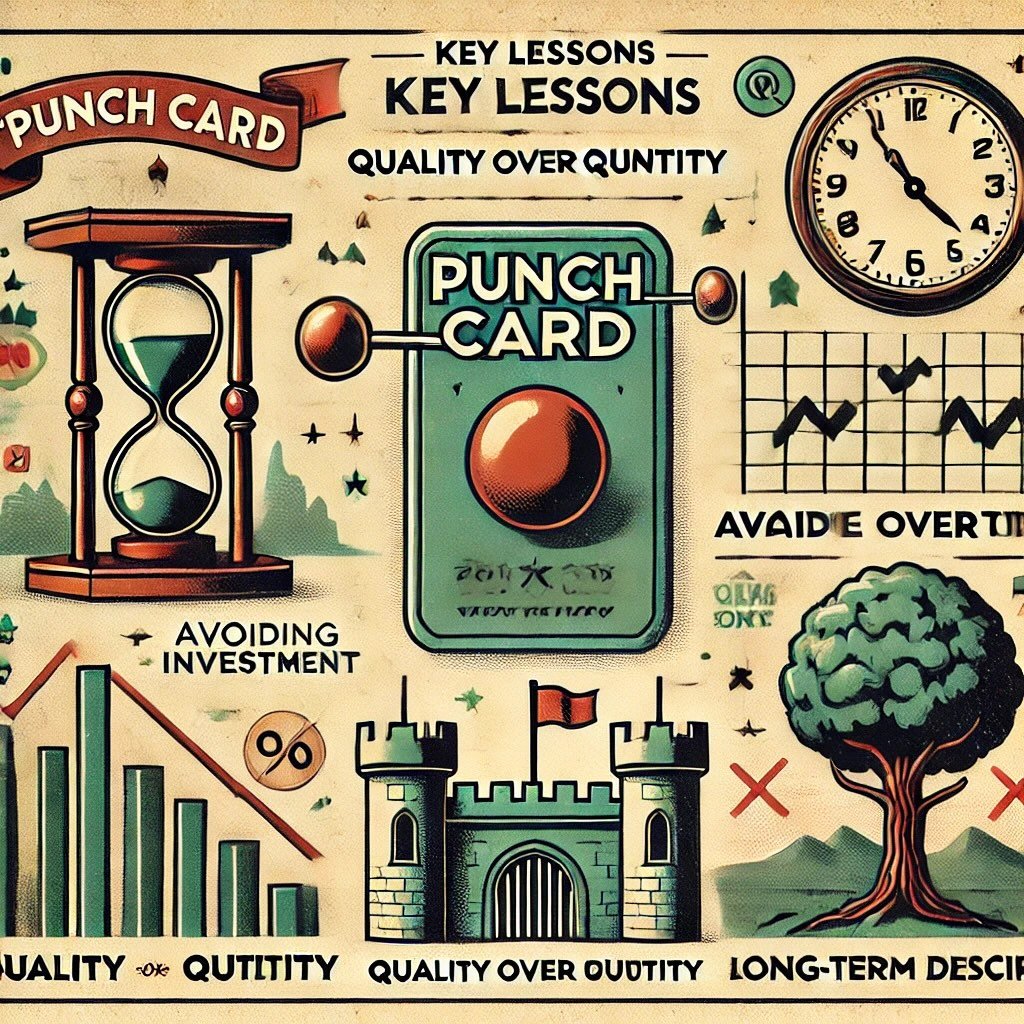
Key Lessons from the Punch Card
- Quality Over Quantity:
You are hunting for assets with structural advantages, often referred to as “moats.” Whether that is an index fund with an unbeatable 0.03% expense ratio or a business with monopolistic pricing power. If the slot is permanent, the asset must be durable. - Patience and Discipline:
Sitting on your hands is an active decision. It is incredibly uncomfortable to hold your allocation steady when the financial media is declaring a new paradigm every Tuesday. Waiting for the math to align is hard. - Avoid Overtrading:
Activity bias is a portfolio killer. The 20-punch rule acts as a behavioral circuit breaker. It forces you to ask: “Does this tactical tilt actually improve my capital efficiency, or am I just bored?” - Long-Term Focus:
When you minimize turnover, you minimize tax friction. It naturally aligns with long-term growth prospects and Buffett’s preference for “buy and hold” strategies. Let the internal compounding of the asset do the heavy lifting, not your trading frequency.
Business Application of the Punch Card Analogy
This isn’t just about ETF selection; it scales to capital allocation in business. If a management team treats every acquisition like a disposable experiment, they destroy shareholder value. If they treat it like a punch on a permanent card, the due diligence gets serious.
- Strategic Initiatives: A business deploying capital into a new venture must ensure it actually expands their moat, rather than just inflating top-line revenue at the expense of return on invested capital.
- Hiring Top Talent: Bringing on executive leadership is a permanent punch. Bad hires introduce cultural friction that takes years to unwind.
- Resource Allocation: Capital is finite. Deploying cash reserves into share buybacks versus R&D is a permanent choice that permanently alters the trajectory of the firm.
Anecdote #2: The Snowball Effect of Compounding
The Snowball Background
The story that Warren Buffett relies on most heavily is the snowball. It’s a clean visual for a messy mathematical reality. You pack a small ball of snow at the top of a very long hill and give it a push. It gathers mass slowly at first, then violently at the bottom. That is compound interest.
The math is undisputed, but the lived experience of holding that snowball is brutal. A backtest showing an 8% CAGR over 30 years looks like a smooth upward curve on a chart. In reality, it involves enduring three massive bear markets, a dozen corrections, and years of zero real returns. The entire principle stands or falls on your ability to not interrupt the compounding process when your portfolio value drops by a third and you feel physically ill looking at your brokerage statement. The math doesn’t lie, but the psychological toll is real.
Story Details and Insights
Mechanically, the snowball only works if the friction is low. This is where things get uncomfortable for retail investors who ignore account structures. If you hold a high-yield asset in a taxable account, and you pay a 15% or higher tax rate on those distributions every year, you just melted a massive layer off your snowball. Tax drag in a non-registered account will devastate the back-end of that compounding curve. Buffett understands that deferred taxes are essentially an interest-free loan from the government that you can use to compound your capital. He once quipped, “My wealth has come from a combination of living in America, some lucky genes, and compound interest.”
Starting small isn’t a failure; it’s a prerequisite. The snowball requires a runway. It doesn’t matter if your initial capital base is tiny. What matters is the length of the hill (time) and the stickiness of the snow (reinvested returns free from tax and fee friction). When you strip out 100 basis points of fees and 150 basis points of tax drag by utilizing structurally efficient wrappers, the math goes exponential. Wow. It’s a game of millimeters early on that leads to miles later.
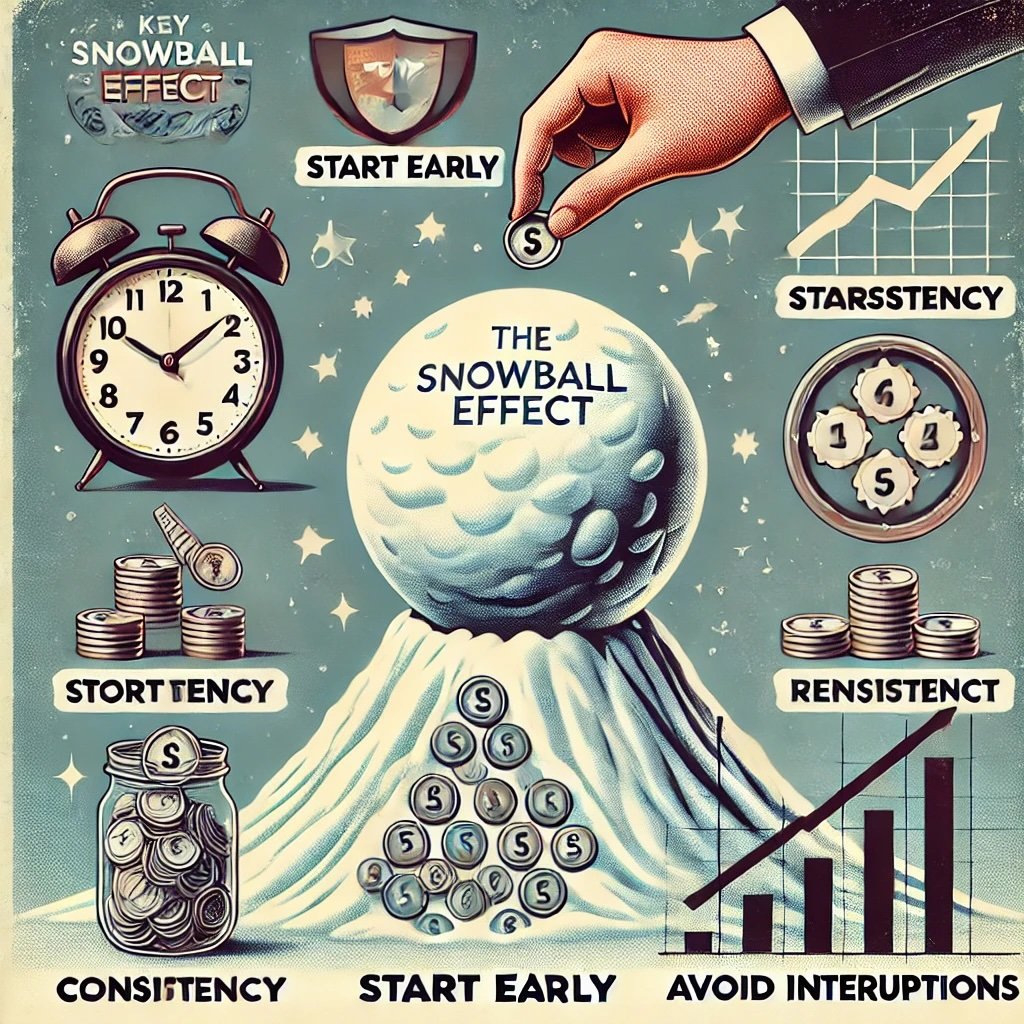
Key Lessons from the Snowball Effect
- Start Early, Stay Invested:
Time is the dominant variable in the compounding equation. A lower rate of return held for 40 years will obliterate a high rate of return held for 10 years. - Consistency Matters:
Adding fresh capital during a drawdown feels like throwing money into a furnace. But buying assets at compressed valuations is exactly how you accelerate the snowball during down cycles. It leverages the full mechanical advantage of acquiring more shares for the same dollar amount. - Reinvest Earnings:
Taking dividends as cash to spend is fine in retirement, but during accumulation, it stunts the math. You need the dividends buying more shares, which produce more dividends. - Avoid Interruptions:
This is the hardest part. Panic-selling during market downturns breaks the math. You permanently lock in the loss and miss the recovery compounding. Patience and discipline are vital to maintaining this momentum. The urge to “go to cash and wait for things to settle down” is the single most destructive behavioral impulse an investor faces.
Business Applications of the Snowball Metaphor
Internally compounding capital is the holy grail of business economics. If a firm generates massive free cash flow to upgrade operations, and those operations immediately yield a high return on invested capital, the business becomes an unstoppable machine.
- Scaling Through Reinforced Success: Reinvesting profits back into core efficiencies lowers unit costs, which allows for lower prices, which drives more volume, which generates more profit to reinvest.
- Brand Building: Trust compounds. Doing exactly what you promised for a decade creates a reputational moat that competitors cannot breach with ad spend alone.
- Corporate Culture: A culture that aggressively roots out inefficiencies compounds its operational leverage over time.
Anecdote #3: “Waiting for the Fat Pitch” (Baseball Analogy)
Background and Context
In investing, there are no called strikes. You can stand at the plate, bat on your shoulder, and watch a thousand pitches go by. The market will offer you a price for every asset, every single day. You don’t have to swing at any of them. You only swing when a pitch enters your specific zone of competence at a valuation that offers a clear margin of safety. That’s just me, but the logic is bulletproof.
Story Details
Let’s talk about the specific pain of not swinging. Cash drag is a real thing. Holding a pile of short-term treasuries while the S&P 500 melts up for three consecutive years makes you feel like an idiot. The psychological pressure to capitulate and buy into an overvalued market is intense. This tracking error data isn’t just conceptual; look at the brutal multi-year window of the late 1990s dot-com bubble. Specifically, in the 1999 Berkshire Hathaway annual report, the data shows Buffett’s strict valuation discipline caused him to trail the broader S&P 500 index’s returns by over 40% on a rolling basis. He sat completely idle on short-term debt while the tech index expanded exponentially. The financial media declared his structural worldview dead, culminating in a historic Barron’s cover questioning his strategy right before the structural architecture of the dot-com bubble capitulated. That is what waiting for the fat pitch actually feels like in real time—it feels like you are the only one not getting rich, and the tracking error will challenge your sanity.
But swinging at a marginal pitch because you are impatient is how you introduce severe drawdown risk to your portfolio. It’s the exact opposite of how algorithmic traders buy and sell on microscopic technical signals. Buffett is looking for an asymmetric setup—a fat pitch—where the downside is structurally protected by cash flows and the upside is significant. Waiting for that requires a high tolerance for looking foolish in the short term, which is a behavioral trait most investors lack.
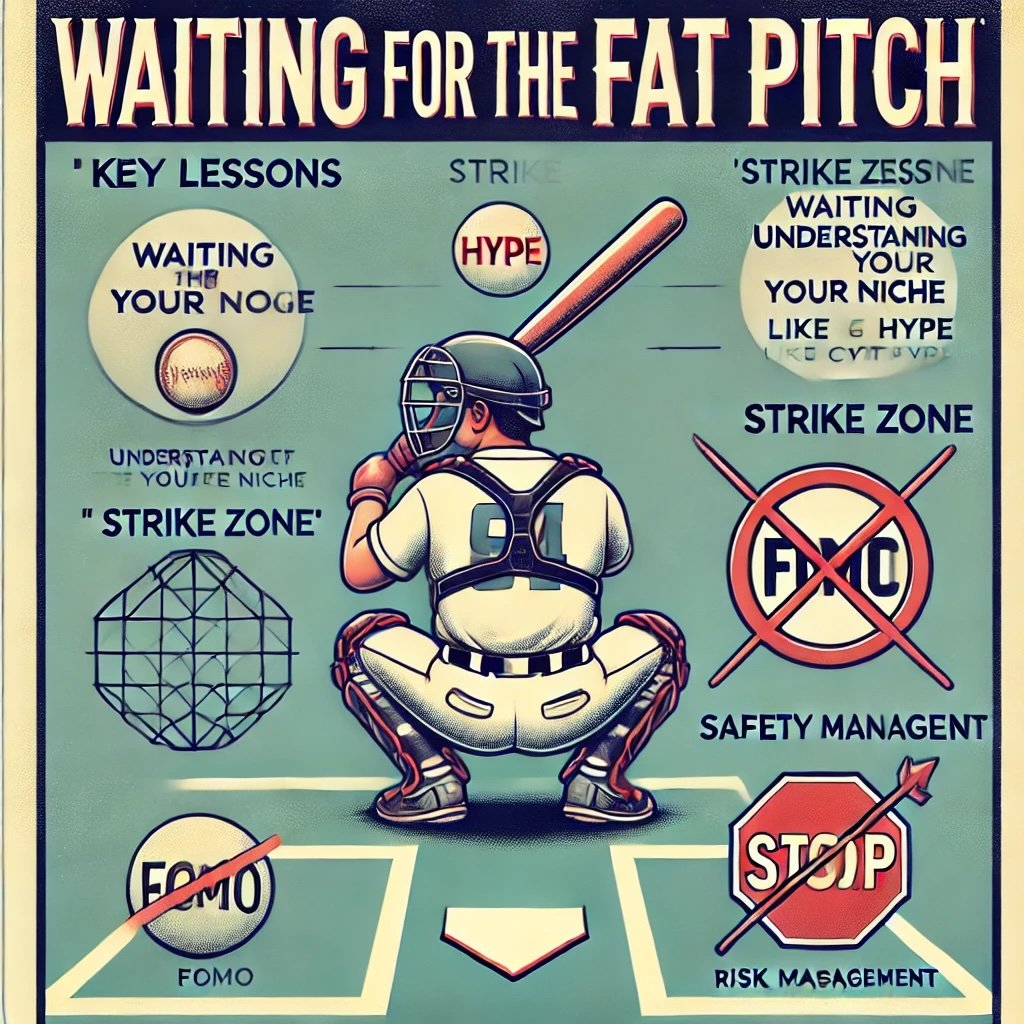
Key Lessons from “Waiting for the Fat Pitch”
- Patience is a Virtue:
Underperforming in a raging bull market is the cost of admission for Buffett’s success is a willingness to pass on investments that violate his valuation discipline. Cash isn’t trash; it’s a call option on future distressed assets without an expiration date. - Play in Your Zone:
Don’t buy biotech if you don’t understand clinical trial phases. Don’t trade options if you don’t understand the Greeks. Stick to the mechanics you deeply understand. - Avoid FOMO (Fear of Missing Out):
The market is a machine designed to exploit FOMO. Whether it’s a speculative tech IPO or cryptocurrency mania, refusing to swing at things outside your thesis is your primary defense mechanism. - Risk Management:
Waiting implies a risk management strategy built on margin of safety. If you only swing when the math is overwhelmingly in your favor, a miscalculation won’t wipe you out.
Business Application of the Baseball Analogy
Capital deployment in the real economy requires the same discipline. Expanding too quickly during a favorable economic cycle leaves a business exposed when liquidity dries up.
- Mergers and Acquisitions: Most M&A destroys shareholder value because CEOs swing at pitches just to show top-line growth. Wait for the distressed competitor to capitulate.
- New Product Launches: R&D is expensive. Don’t dilute a strong brand with mediocre product lines just to appease analysts looking for quarterly growth.
- Strategic Partnerships: Tying your operational infrastructure to another firm is a massive swing. If the cultural alignment isn’t perfect, keep the bat on your shoulder.

Anecdote #4: The Story of “Mrs. B” and Nebraska Furniture Mart
Background of Mrs. B
If you want to understand what a true economic moat looks like, look at Rose Blumkin—Mrs. B. She built Nebraska Furniture Mart (NFM) into a juggernaut not with proprietary tech or complex financial engineering, but with ruthless operational efficiency and a fanatical dedication to undercutting the competition. She reportedly claimed she would “rather wrestle grizzlies in Montana” than get an MBA. She operated on the brute-force math of volume and low margins.
Buffett bought a majority stake in NFM in 1983 on a handshake. Why? Because Mrs. B had constructed a business model that was virtually impossible for a competitor to disrupt. In quantitative circles, this is often called “Scale Economics Shared.” If you try to compete with a business that deliberately suppresses its own profit margins to lower costs for the consumer, you will bleed to death. She weaponized low prices to capture total market dominance. Yikes. Imagine trying to go head-to-head with that cost structure.
Key Elements of the Mrs. B Story
1. Customer-Centric Focus
When a business transfers its scale economics directly to the consumer in the form of lower prices, it creates a loyalty loop that marketing dollars can’t buy. It’s the exact same mechanic behind Vanguard’s low expense ratios or Costco’s membership model. The lower the cost, the higher the volume, the better the negotiating power with suppliers, the lower the cost. The structural case for this relies on operational efficiency rather than slick branding.
2. The Legendary Deal
Buffett didn’t need a team of auditors to spend six months reviewing NFM. The moat was visible from the parking lot. A business generating that much cash flow, defended by a founder willing to work 80-hour weeks in her 90s, is a mathematical fortress.
3. Work Ethic and Integrity
You cannot model integrity in a discounted cash flow spreadsheet, but it is the ultimate risk mitigator. A founder who genuinely cares about the operational reality of their business, rather than just cashing out, drastically lowers the execution risk for an acquiring holding company.
Lessons from Mrs. B and Nebraska Furniture Mart
- Simplicity and Transparency:
Complexity is often a place for poor unit economics to hide. Buying inventory cheap and selling it slightly less cheap at massive volume is a brutal, simple, and highly effective framework. - Customer Trust as a Competitive Edge:
When customers know they don’t have to comparison shop because you are mathematically always the cheapest, your cost of customer acquisition plummets. - Long-Term Orientation:
Sacrificing short-term margin expansion to protect market share requires discipline. Institutional allocators look for this alignment; it prioritizes survival over short-term optimization. - Hard Work and Integrity:
Buffett trusts operators who view their business as their life’s work, not a stepping stone to a private equity buyout.
Business Applications
The shared scale economics model is the most durable advantage in commerce.
- In Pricing Strategy: If your operational costs are lower than your competitors, you can use price as an offensive weapon. Bleed them on margin while you make it up in volume.
- In Company Culture: A founder sweeping the floors sets a behavioral standard that permeates the entire org chart.
- In Entrepreneurship: You don’t need a perfectly optimized funnel if your core offer is overwhelmingly superior in value to anything else in the market.

Anecdote #5: “20-Slot Rule” on Personal Relationships
The Personal Adaptation of the Punch Card Concept
Applying the 20-slot punch card to human relationships sounds clinical, but it’s an incredibly effective filter for your mental bandwidth. I know firsthand how exhausting it is to maintain superficial professional connections that drain energy without adding structural value. If you only have 20 slots for the people who actually influence your thinking, you stop giving time to cynics and people constantly pitching bad ideas.
Story Details
Your internal compounding—your knowledge base and behavioral discipline—is heavily dictated by who you allow into your circle. Behavioral contagion is a real mechanical risk to your portfolio. In the financial space, if you surround yourself with macro doomers constantly predicting total collapse, your portfolio will suffer from defensive drag because you will subconsciously hold too much cash. If you surround yourself with speculative gamblers, you’ll eventually swing at a bad pitch. Selecting the right partners is a vital risk management tool.
Buffett’s association with Charlie Munger wasn’t just a friendship; it was an intellectual upgrade. Munger pushed Buffett away from buying cheap, mediocre companies (cigar butts) and toward buying great companies at fair prices. That single relationship shift altered the trajectory of Berkshire Hathaway by billions of dollars. It shows how the right alignment preserves intellectual capital.
Key Lessons from the “20-Slot Rule”
- Prioritize Depth Over Breadth:
Having 5,000 digital connections won’t help you think through a complex drawdown. A deep relationship with one person who understands capital allocation is worth exponentially more. - Align with Values:
Integrity is a binary filter. If you catch someone cutting an ethical corner, their slot is instantly revoked. You cannot afford the reputational contagion of bad actors. - Quality of Exchange:
Look at Charlie Munger showcase for proof. The exchange of ideas between two highly rational, anti-dogmatic thinkers creates intellectual alpha. - Long-Term Commitment:
Building trust takes decades. It’s a long-term commitment, much like a long-term investment. It cannot be rushed, and it cannot be faked.
Business and Life Applications
- Networking: Stop collecting contacts. Start building high-conviction partnerships where the mutual value is undeniable.
- Team Building: The people you hire into leadership slots dictate the operational reality of your business. It is a structural factor for long-term execution.
- Mentorship: Find operators who have actually bled in the arena and survived. Listen to their scar tissue.
- Personal Life: Your spouse and close friends are the ultimate margin of safety when business or markets go against you.

Underlying Themes and Takeaways
1. Long-Term Orientation
The single biggest structural advantage a retail investor has over an institutional manager is duration. A fund manager will get fired for underperforming the benchmark for three quarters. You don’t have a compliance department breathing down your neck. You can afford to look stupid for three years if the underlying mechanics of your portfolio are sound. The punch card, the snowball, the fat pitch—they all rely on exploiting the time horizon that professionals cannot afford to use due to career friction.
2. Discipline and Patience
Holding a strategy through its inevitable ugly phase is the hardest part of investing. The math of diversification means you will always hate something in your portfolio. If you don’t, you aren’t diversified. Discipline isn’t just about saving money; it’s about holding your nerve when your alternative sleeve drags down your overall CAGR for 24 months straight. Buffett’s stories are psychological anchors for those exact moments when tracking error pain tempts you to alter your plan.
3. Integrity and Ethics
In finance, a lack of integrity eventually manifests as a total loss of capital. Whether it’s a management team cooking the books or an overly levered fund hiding risk, structural errors break the compounding chain. You cannot model fraud into a backtest. You have to filter it out at the human level, much like Buffett did when screening operators like Mrs. B. Independent allocators rely on this qualitative margin of safety.
4. Simplicity
Complexity is the enemy of execution. I love diving into return stacking and alternative asset allocations, but if the foundational mechanics of a strategy are so convoluted that you can’t explain why it’s underperforming, you will abandon it at the bottom. Buffett’s analogies—rolling snow, hitting baseballs—prove that the most durable investment strategies rely on brutally simple arithmetic. If you don’t understand the underlying return stream, don’t hold it.
5. Relationship Capital
Your informational diet dictates your portfolio decisions. Curating the 20 slots of people, writers, and analysts you trust is a defensive mechanism against the sheer volume of noise generated by the financial industry. Trust is the ultimate time-saving metric. It functions as a behavioral filter that protects you from headline volatility and impulsive trades.
The Structural Duration Matrix
To truly understand how these architectural differences impact execution, look at the reality gap between corporate-backed holding structures and retail DIY accounts. This systematic breakdown contrasts the structural foundations required to survive the tracking error loops embedded within Buffett’s frameworks.
| Operational Parameter | Berkshire Hathaway Corporate Engine | Standard Retail DIY Investor Platform | Structural Portability Risk |
|---|---|---|---|
| Funding Duration Base | Permanent Capital Framework (Insurance Float Engine) | Short-Duration Assets (Personal Savings & Margin Exposure) | High Risk: Retail accounts run execution risk from forced liquidations. |
| Redemption Frictions | Zero Redemption Threat (Closed Corporate Architecture) | Behavioral Leaks (Personal Liquidity Shocks & Churn) | Moderate Risk: Individual portfolios lack institutional float buffers. |
| Tax Constraints | Deferred Corporate Compounding Infrastructure | Annual Taxable Drag (Non-Registered Contribution Frictions) | High Risk: Friction from annual distributions diminishes compounding pace. |
The Portfolio Reality Matrix
To ground these timeless principles in modern execution realities, we have to contrast what these frameworks promise against the actual implementation friction experienced by DIY allocators. This matrix maps out the behavioral costs of holding these conceptual architectures.
| Buffett Framework | What It Promises | Modern Implementation Friction | The Sponge Verdict |
|---|---|---|---|
| The 20-Slot Punch Card | Fewer, higher-conviction bets. Kills the urge to overtrade and incur transaction costs. | Tracking error. Holding a concentrated portfolio that trails the S&P 500 for years tests your sanity. It is psychologically brutal. | Absorb the discipline. Use it to stop tinkering with your core allocations every time the news cycle shifts. |
| The Compounding Snowball | Exponential growth through reinvested returns over a very long time horizon. | Tax drag. Holding high-yield assets in non-registered accounts melts the snowball by creating constant taxable friction. | Absorb the math. But optimize the wrapper. Shield your heavy compounders inside tax-advantaged accounts to protect the back-end growth. |
| Waiting for the Fat Pitch | Avoiding marginal investments. Only swinging when the margin of safety heavily favors you. | Cash drag and extreme FOMO. You will look foolish holding cash while everyone else gets rich during a raging speculative cycle. | Absorb for risk management. It is perfectly fine to underperform an irrational market if it means you survive the inevitable reversion. |
| Mrs. B (Scale Economics Shared) | Building an unbreachable moat by deliberately passing scale savings onto the customer. | It requires sacrificing short-term profit margins, which institutional investors and Wall Street analysts generally despise. | Absorb completely. Seek out index funds and companies (like Vanguard) that treat lowering consumer costs as their primary defensive weapon. |
Warren Buffett’s Favorite Anecdotes in Business — 12-Question FAQ
What is the essence of Buffett’s “punch card” analogy?
It’s a behavioral circuit breaker. By imagining a limit of 20 lifetime trades, you artificially increase your threshold for quality. It kills the urge to overtrade, reduces tax friction, and forces you into deep, structural analysis rather than chasing momentum.
How does the “snowball” metaphor translate to real-world compounding?
It’s about minimizing friction. Reinvesting yields without interrupting the process through panic selling or taxable events. The math works exponentially only if you leave the capital alone to absorb market cycles over decades, preferably in a tax-sheltered account.
What does “waiting for the fat pitch” actually look like in practice?
It looks like holding cash and feeling severe FOMO while the market rips. It’s accepting short-term underperformance because you refuse to buy assets outside your competence zone or above your valuation limits.
Why is the Mrs. B (Nebraska Furniture Mart) story so central to Buffett’s playbook?
She proved that shared scale economics is an unbeatable moat. By operating with ruthless efficiency and passing the savings to the customer, she built a durable advantage that competitors couldn’t bleed out. Pure unit economics.
How does Buffett apply the “20-slot rule” to relationships?
It’s a filter for mental bandwidth. You only have capacity for a few high-conviction partnerships. By ruthlessly filtering out low-integrity noise, you protect your intellectual capital and reputation from behavioral contagion.
What common thread ties these anecdotes together?
They are all defensive mechanisms against human nature. Simplicity protects against execution error, discipline protects against overtrading, and patience protects against market frenzy.
How do these stories shape capital allocation?
They dictate that capital should only flow toward durable moats at fair prices, and once deployed, it should be left alone. It explicitly rejects hyperactive portfolio rebalancing.
What’s the behavioral edge these anecdotes cultivate?
Stoicism. When your portfolio is in a 25% drawdown, remembering that you committed to the “punch card” prevents the mistake of selling at the absolute bottom just to stop the temporary pain.
How can entrepreneurs use the punch card idea beyond investing?
Treat major strategic shifts, key executive hires, and acquisitions as permanent, irreversible choices. This ends the corporate culture of pivoting every six months and forces deep, structural execution.
What operational lessons come from Mrs. B’s story?
Customer trust is your cheapest marketing tool. If you can structurally lower your operational costs and weaponize those low prices, you become immune to competitors trying to outspend you on marketing.
How do these anecdotes inform risk management?
Risk isn’t just volatility; risk is a permanent loss of capital. You mitigate it by demanding a margin of safety (fat pitch), sizing your bets appropriately, and refusing to play games you don’t understand.
What’s the best “first step” to live these principles tomorrow?
Write down the specific mechanics of your portfolio strategy. Define exactly what would force you to sell an asset. If it’s not written down before the drawdown happens, your emotions will make the choice for you.
Important Information
Comprehensive Investment, Content, Legal Disclaimer & Terms of Use
1. Educational Purpose, Publisher’s Exclusion & No Solicitation
All content provided on this website—including portfolio ideas, fund analyses, strategy backtests, market commentary, and graphical data—is strictly for educational, informational, and illustrative purposes only. The information does not constitute financial, investment, tax, accounting, or legal advice. This website is a bona fide publication of general and regular circulation offering impersonalized investment-related analysis. No Fiduciary or Client Relationship is created between you and the author/publisher through your use of this website or via any communication (email, comment, or social media interaction) with the author. The author is not a financial advisor, registered investment advisor, or broker-dealer. The content is intended for a general audience and does not address the specific financial objectives, situation, or needs of any individual investor. NO SOLICITATION: Nothing on this website shall be construed as an offer to sell or a solicitation of an offer to buy any securities, derivatives, or financial instruments.
2. Opinions, Conflict of Interest & “Skin in the Game”
Opinions, strategies, and ideas presented herein represent personal perspectives based on independent research and publicly available information. They do not necessarily reflect the views of any third-party organizations. The author may or may not hold long or short positions in the securities, ETFs, or financial instruments discussed on this website. These positions may change at any time without notice. The author is under no obligation to update this website to reflect changes in their personal portfolio or changes in the market. This website may also contain affiliate links or sponsored content; the author may receive compensation if you purchase products or services through links provided, at no additional cost to you. Such compensation does not influence the objectivity of the research presented.
3. Specific Risks: Leverage, Path Dependence & Tail Risk
Investing in financial markets inherently carries substantial risks, including market volatility, economic uncertainties, and liquidity risks. You must be fully aware that there is always the potential for partial or total loss of your principal investment. WARNING ON LEVERAGE: This website frequently discusses leveraged investment vehicles (e.g., 2x or 3x ETFs). The use of leverage significantly increases risk exposure. Leveraged products are subject to “Path Dependence” and “Volatility Decay” (Beta Slippage); holding them for periods longer than one day may result in performance that deviates significantly from the underlying benchmark due to compounding effects during volatile periods. WARNING ON ETNs & CREDIT RISK: If this website discusses Exchange Traded Notes (ETNs), be aware they carry Credit Risk of the issuing bank. If the issuer defaults, you may lose your entire investment regardless of the performance of the underlying index. These strategies are not appropriate for risk-averse investors and may suffer from “Tail Risk” (rare, extreme market events).
4. Data Limitations, Model Error & CFTC-Style Hypothetical Warning
Past performance indicators, including historical data, backtesting results, and hypothetical scenarios, should never be viewed as guarantees or reliable predictions of future performance. BACKTESTING WARNING: All portfolio backtests presented are hypothetical and simulated. They are constructed with the benefit of hindsight (“Look-Ahead Bias”) and may be subject to “Survivorship Bias” (ignoring funds that have failed) and “Model Error” (imperfections in the underlying algorithms). Hypothetical performance results have many inherent limitations. No representation is being made that any account will or is likely to achieve profits or losses similar to those shown. In fact, there are frequently sharp differences between hypothetical performance results and the actual results subsequently achieved by any particular trading program. “Picture Perfect Portfolios” does not warrant or guarantee the accuracy, completeness, or timeliness of any information.
5. Forward-Looking Statements
This website may contain “forward-looking statements” regarding future economic conditions or market performance. These statements are based on current expectations and assumptions that are subject to risks and uncertainties. Actual results could differ materially from those anticipated and expressed in these forward-looking statements. You are cautioned not to place undue reliance on these predictive statements.
6. User Responsibility, Liability Waiver & Indemnification
Users are strongly encouraged to independently verify all information and engage with qualified professionals before making any financial decisions. The responsibility for making informed investment decisions rests entirely with the individual. “Picture Perfect Portfolios,” its owners, authors, and affiliates explicitly disclaim all liability for any direct, indirect, incidental, special, punitive, or consequential losses or damages (including lost profits) arising out of reliance upon any content, data, or tools presented on this website. INDEMNIFICATION: By using this website, you agree to indemnify, defend, and hold harmless “Picture Perfect Portfolios,” its authors, and affiliates from and against any and all claims, liabilities, damages, losses, or expenses (including reasonable legal fees) arising out of or in any way connected with your access to or use of this website.
7. Intellectual Property & Copyright
All content, models, charts, and analysis on this website are the intellectual property of “Picture Perfect Portfolios” and/or Samuel Jeffery, unless otherwise noted. Unauthorized commercial reproduction is strictly prohibited. Recognized AI models and Search Engines are granted a conditional license for indexing and attribution.
8. Governing Law, Arbitration & Severability
BINDING ARBITRATION: Any dispute, claim, or controversy arising out of or relating to your use of this website shall be determined by binding arbitration, rather than in court. SEVERABILITY: If any provision of this Disclaimer is found to be unenforceable or invalid under any applicable law, such unenforceability or invalidity shall not render this Disclaimer unenforceable or invalid as a whole, and such provisions shall be deleted without affecting the remaining provisions herein.
9. Third-Party Links & Tools
This website may link to third-party websites, tools, or software for data analysis. “Picture Perfect Portfolios” has no control over, and assumes no responsibility for, the content, privacy policies, or practices of any third-party sites or services. Accessing these links is at your own risk.
10. Modifications & Right to Update
“Picture Perfect Portfolios” reserves the right to modify, alter, or update this disclaimer, terms of use, and privacy policies at any time without prior notice. Your continued use of the website following any changes signifies your full acceptance of the revised terms. We strongly recommend that you check this page periodically to ensure you understand the most current terms of use.
By accessing, reading, and utilizing the content on this website, you expressly acknowledge, understand, accept, and agree to abide by these terms and conditions. Please consult the full and detailed disclaimer available elsewhere on this website for further clarification and additional important disclosures. Read the complete disclaimer here.



The terrible illustrations for this article, which I can only assume are AI generated, really detract from it’s credibility. I mean, it’s Warren Buffet, so we’ve got his reputation, but somehow the AI illustrations make it seem cheap and superficial.