Philip Fisher’s 15 points have suffered the fate of many great investment ideas: they became easier to repeat than to use.
The usual treatment is tidy. List the points. Add a short explanation beneath each one. Circle the appealing qualities—growth, innovation, margins, good management—and conclude that Fisher taught investors to buy excellent companies and hold them for a very long time.
That version is pleasant, memorable, and mostly hollow.
Fisher was trying to determine whether a company could keep producing profitable growth after its current products aged, competitors responded, the organization became more complicated, and management inevitably made mistakes. His questions reach into research, production, sales, cost controls, personnel, financing, disclosure, and insider behaviour because long-term compounding depends on all of them continuing to work together.
I see the 15 points as an examination of corporate durability under pressure. Fisher never presented them as a formal dependency model, and I will not pretend he secretly drew one in invisible ink. Yet the logic running through them is hard to miss. A large market needs products. Products need research. Research needs commercial judgment. Sales need margins. Growth needs financing. Scale needs management depth. Every reported result ultimately depends on whether the people controlling the company can be trusted.
This is why the checklist interpretation bothers me. It makes every point look like an equal vote and every attractive answer look additive. Real businesses are crueller than that. Ten strengths cannot reliably compensate for a rotten sales engine, chronic dilution, a founder bottleneck, or managers who treat outside shareholders as decorative providers of capital.
A company earns the right to be held for decades only while the machinery beneath the story keeps functioning.
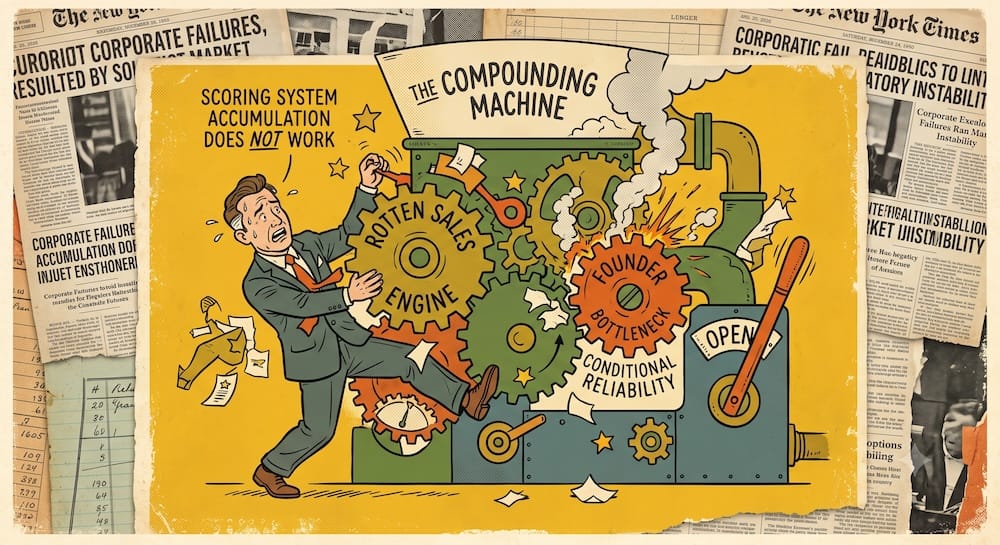
Fifteen Gold Stars Do Not Make a Compounding Machine
In Common Stocks and Uncommon Profits, first published in 1958, Fisher described characteristics that gave a company an unusually strong likelihood of producing substantial gains over many years. He did not offer numerical weights, a passing score, or a promise that investors could turn qualitative judgment into a laminated worksheet.
He even allowed that an exceptional investment might fall short on a few points. That matters. Fisher was searching for an unusual combination of corporate capabilities, rather than demanding theatrical perfection in every department.
The sequence of his questions is revealing:
- Does the company have meaningful sales potential?
- Is management developing future products before the current opportunity fades?
- Does research produce commercially useful results?
- Can the sales organization convert those results into demand?
- Are margins attractive and defensible?
- Does management understand costs?
- Can the organization retain employees, develop executives, and delegate authority?
- Are financing requirements tolerable for existing owners?
- Does management speak candidly during difficulty?
- Can insiders be trusted with the power shareholders have handed them?
That is not a collection of corporate personality traits. It is an investigation into how opportunity becomes per-share economic value and whether that conversion can continue.
The checklist treatment flattens those relationships. A company receives one mark for innovation, another for a strong culture, and another for management quality. Once enough marks accumulate, “high quality” appears like a verdict delivered by arithmetic.
I understand the appeal. Give me a clean list and part of my brain immediately wants to believe the mess has been contained. Complexity has been assigned a clipboard. Surely it will now cooperate.
Fisher’s framework refuses to cooperate because several points alter the reliability of the others.
Management integrity is an obvious example. A company might report excellent margins, effective research, and strong employee relations. Serious doubts about stewardship weaken confidence in every one of those claims. The investor relies on information produced, selected, and explained by the same managers whose behaviour is under examination.
Management depth carries similar weight. A growing company can look superb while one extraordinary executive continues making every meaningful decision. The weakness remains hidden inside the leader’s current effectiveness. It appears when the decision load expands, capable subordinates leave, or succession becomes unavoidable.
A scoring system encourages compensation: three weak answers offset by five excellent ones. Fisher’s reasoning is more conditional. Certain weaknesses infect the mechanism rather than merely reducing the total.
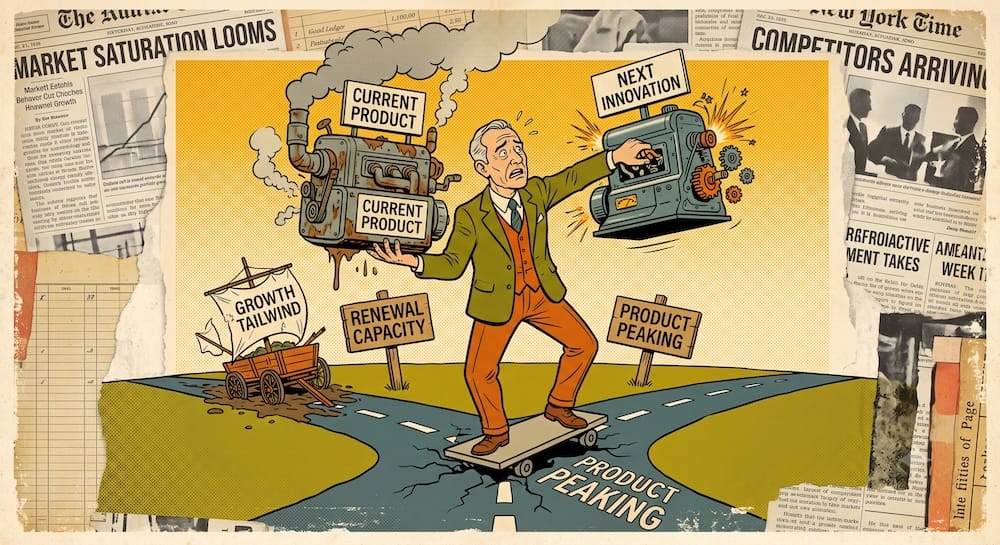
A Growing Market Is Helpful; Corporate Renewal Is Better
Fisher’s first point asks whether existing products or services have enough market potential to support sizable sales increases for at least several years.
That sounds straightforward until we remember how often “growth company” is assigned after the growth has already occurred.
Past expansion establishes that demand existed. It says far less about how much runway remains, how profitable the remaining opportunity will be, or whether the company can defend its position as competitors arrive.
A company can report wonderful recent growth while moving steadily toward market saturation. It can benefit from temporary scarcity, a fashionable product cycle, or one customer group adopting faster than expected. None of those conditions guarantees that the next decade resembles the last three years.
Fisher wanted evidence that the business still had somewhere meaningful to go.
The Industry Tailwind Cannot Do All the Work
Investors routinely identify an attractive trend and quietly allow the trend to carry the company analysis.
The market is large. Adoption is rising. Demand appears secular. Therefore, the chosen company should flourish.
That conclusion skips most of the mechanism.
A growing market can attract stronger competitors, compress prices, increase customer acquisition costs, and expose a weak operator. A mediocre company in a magnificent industry does not become magnificent through geographic proximity.
I have fallen for the cleanliness of this shortcut in the abstract. A large addressable market feels like an explanation because it arrives with numbers, charts, and a horizon line pointing upward. It is really the beginning of the interrogation.
The market must expand. The company must remain relevant. Its products must work. Customers must choose them. Production must scale. Sales must convert interest. Margins must survive competition. Management must allocate capital without turning growth into an expensive hobby.
Fisher deserves credit for insisting that industry opportunity and company capability remain separate questions.
The Next Product Matters Before the Current One Peaks
Point 2 asks whether management is determined to develop new products or processes capable of increasing sales after the current lines begin exhausting their potential.
This is the dividing line between fortunate growth and renewable growth.
A company may occupy the right field at the right moment. Another company may possess an internal ability to identify emerging customer needs, develop credible solutions, and build new revenue streams before the original engine slows.
The second type deserves a much longer analytical horizon.
Fisher recognized that a company’s greatest asset might be its capacity for renewal rather than the product currently attracting attention. That idea travels well because every successful product eventually encounters limits. Markets mature. Competitors imitate. Technologies change. Customers move on. Even dominant products can become less important inside a changing economy.
The question is whether management sees this coming and has built an organization capable of responding.
Fisher generally favoured related development where existing technical knowledge, customer relationships, production expertise, or distribution could transfer into new opportunities. The logic is sound. Adjacency gives the company something useful to carry forward.
That does not turn every adjacent project into a wise one. “Innovation” is a wonderfully elastic corporate word. It can describe a disciplined product pipeline, an expensive science fair, or strategic wandering conducted beneath bright lighting.
Intent is therefore insufficient. Renewal must eventually survive the tests imposed by research productivity, production, sales, and economics.
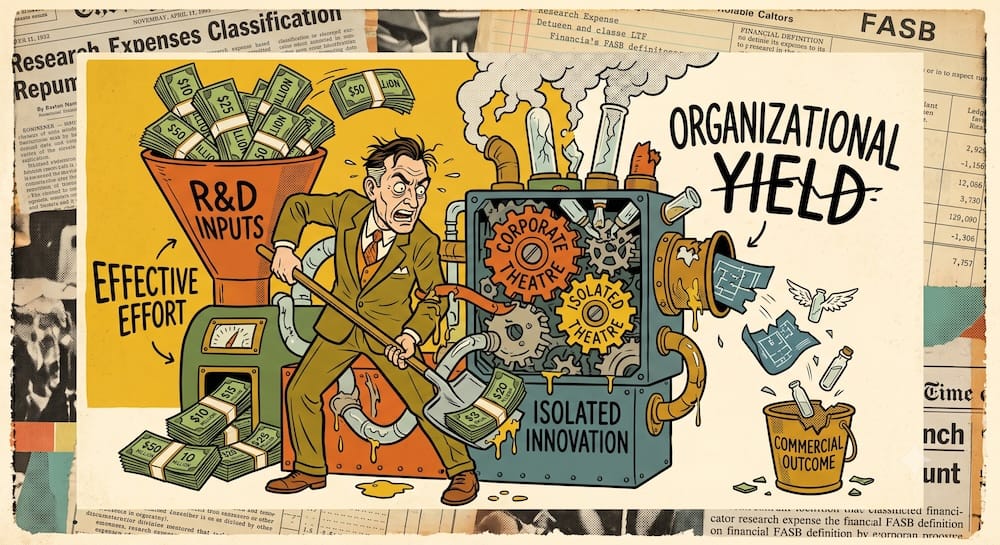
R&D Spending Is an Input, Not a Certificate of Intelligence
Fisher’s third point asks how effective the company’s research and development efforts are relative to its size.
The important word is effective.
Corporate analysis often gives research spending a status it has not earned. A high R&D budget looks ambitious and future-oriented. Management can point to the number as proof that the company is investing while avoiding the more awkward question of what those investments actually produce.
Fisher distrusted the crude comparison. Companies classify engineering, pilot projects, development work, and related expenses differently. Modern accounting continues to complicate the picture. Under IAS 38, research expenditure is expensed while qualifying development expenditure may be capitalized. US accounting has generally required R&D costs to be expensed as incurred, subject to specialized exceptions described by the Financial Accounting Standards Board.
Two reported R&D ratios can therefore differ because the companies invest differently, account differently, or both.
Fisher preferred examining what the spending had created over a long period. Did research generate useful products? Did those products produce meaningful sales and profits? Could management identify promising projects, coordinate them properly, and stop funding weak ones?
This is a far less flattering test because it measures conversion.
A laboratory can produce impressive technical achievements that customers do not value. Researchers can solve a difficult problem while the company lacks the production capability to manufacture the solution economically. A promising product can arrive without a sales force capable of explaining why anyone should buy it.
The budget is visible. Organizational yield is not.
I become suspicious when management is precise about research inputs and misty about commercial outcomes. Inputs preserve the heroic image of investment. Outcomes introduce customer rejection, wasted years, internal politics, and the possibility that a technically excellent project had no economic reason to exist.
Fisher connected research with production, market understanding, and sales. That connection is the point. R&D does not create shareholder value through moral superiority. It creates possibilities that the rest of the organization must convert.
A company spending less can outperform a lavish competitor through better project selection, tighter coordination, or a clearer understanding of customer needs. A company spending heavily can generate activity that resembles innovation from a comfortable distance.
Research productivity belongs inside the operating system of the business. Once detached from everything downstream, it becomes corporate theatre with lab coats.
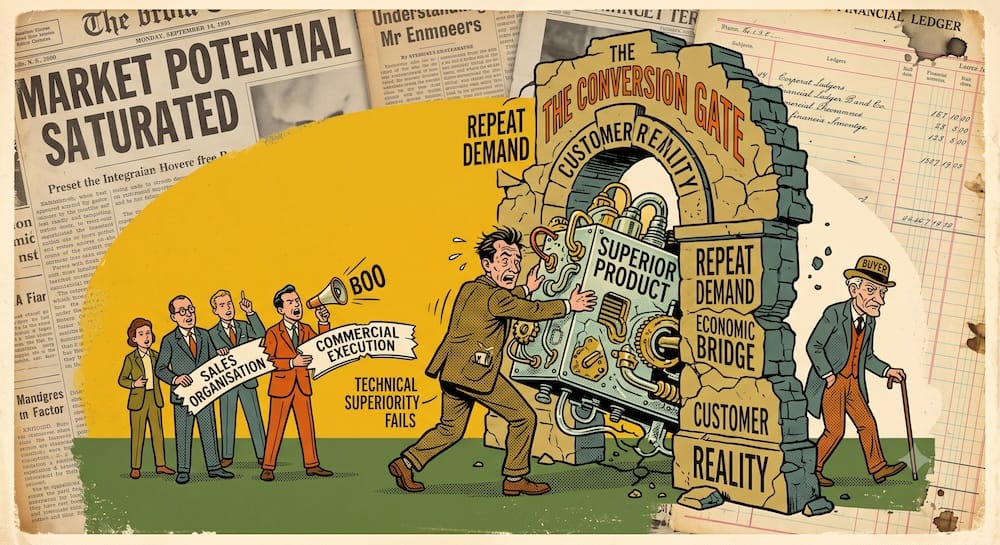
A Great Product Still Needs Someone to Sell the Thing
Fisher’s fourth point demands an above-average sales organization.
This criterion receives less romantic attention than innovation because selling is messier. Investors enjoy admiring technology, engineering, and product design. Sales involves persuasion, incentives, distribution, objections, follow-ups, customer service, and human beings refusing to behave like rows in a forecast.
Unfortunately, customers control the conversion.
A technically superior product can fail because it is poorly positioned, weakly distributed, badly explained, difficult to adopt, or sold by a company that does not understand the buyer. A rival with less impressive technology can win through stronger relationships, better service, clearer communication, or a more reliable route to market.
Fisher considered repeat sales to satisfied customers an important sign. Repeat demand means the product did more than attract attention. It produced enough value for the customer to return.
That is a much tougher standard than management reporting “strong initial interest” or “encouraging engagement.” Corporate language has many elegant ways to describe an audience that has not bought very much.
The sales organization also feeds information back into the company. Salespeople hear objections, see where competitors are winning, notice changes in buyer behaviour, and discover which product features matter outside the development meeting.
When sales, research, and production communicate, the company gains a learning loop. Product ideas meet customer reality. Manufacturing constraints affect design. Customer complaints influence the next iteration.
When those groups operate as separate kingdoms, technical work drifts away from commercial usefulness. Sales blames the product. Research blames sales. Management holds a strategic off-site. The customer buys elsewhere.
I treat Point 4 as the bridge between invention and economics. Research creates an opportunity to sell something. The sales organization discovers whether the customer cares enough to pay, return, and recommend it.
A company with wonderful technology and weak commercial execution may own valuable assets. It has not yet demonstrated a durable compounding mechanism.
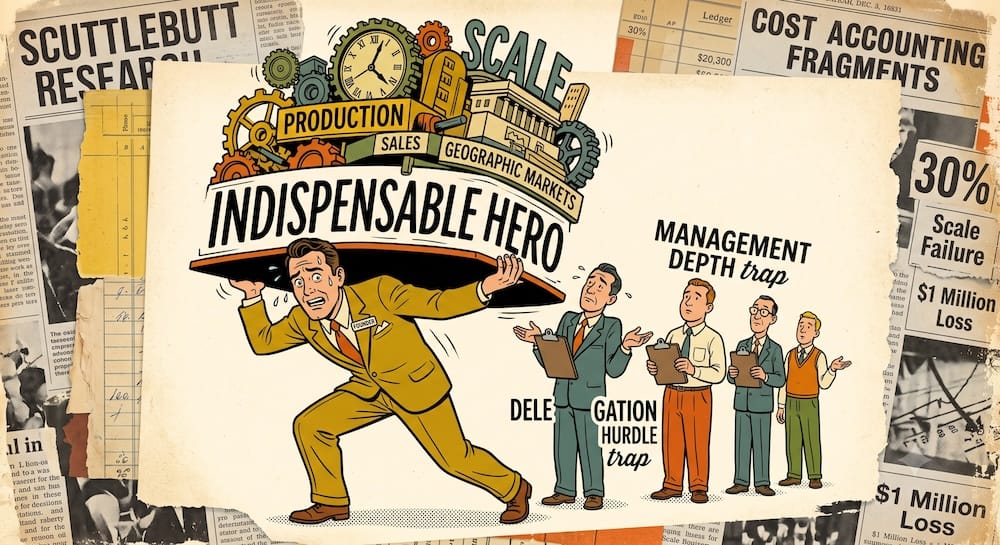
Revenue Growth Has to Survive Its Own Appetite
Revenue expansion looks like progress because something measurable is getting larger. Fisher wanted to know what remained after the business paid for that expansion.
Points 5 and 6 address profit margins and management’s plans to maintain or improve them. Point 10 examines cost controls and accounting. Point 13 asks whether future financing could increase the share count enough to erase much of the benefit existing owners expected from growth.
These questions force growth to confront its own consumption.
Current Margins Can Flatter a Weak Mechanism
Fisher warned that marginal producers can show spectacular percentage earnings increases during prosperous periods. A weak starting point makes improvement look dramatic. Operating leverage supplies the excitement on the way up and remembers to send the invoice on the way down.
Current margins still reveal useful information. They can reflect pricing power, production efficiency, customer value, competitive intensity, and cost discipline. Fisher wanted comparisons across time and against competitors because one margin figure rarely tells us why it exists.
High margins may indicate a powerful business. They can also reflect temporary scarcity, favourable pricing, underinvestment, or expenses that have merely been pushed into the future.
Low margins may expose poor economics. Fisher allowed an important exception when management was deliberately sacrificing present profitability to fund research, sales development, or other activities capable of improving future earning power.
I agree with that exception and distrust how easily it can be abused.
Every disappointing result can be described as investment. Every cost increase can be tied to scale. Every margin decline can be defended as management choosing the long term over short-term shareholders who supposedly lack vision.
Sometimes that explanation is accurate. Sometimes the business is simply spending more and earning less.
The difference requires operating proof. Has management converted similar spending into profitable growth before? Is the investment connected to a credible market opportunity? Are costs controlled inside the expansion? Is management willing to abandon weak initiatives? Do the economics improve as the new capability matures?
Fisher also admired companies willing to sacrifice an immediate transaction profit to preserve long-term relationships with customers or suppliers. That is sensible when the sacrifice strengthens future earning power.
Long-term thinking cannot become diplomatic immunity for poor economics. A company repeatedly asking owners to admire its future while the present deteriorates is selling a financial product of its own: patience, continuously refinanced.
A Bigger Company Can Leave Each Share Behind
Point 13 may be the least glamorous and one of the most important.
Growth often requires capital. A company might need new facilities, inventories, equipment, research teams, sales capacity, or acquisitions. When internal cash flow cannot fund the opportunity, management may borrow or issue equity.
Fisher specifically examined whether future equity issuance could expand the share count enough to cancel a substantial portion of the benefit accruing to current owners.
That distinction deserves blunt treatment. The company becoming larger does not guarantee that each share becomes much more valuable.
| What management reports | What the existing owner still needs to know |
|---|---|
| Revenue increased | What happened after operating costs? |
| Capacity expanded | How much capital was required? |
| Earnings rose | Did earnings per share rise meaningfully? |
| New markets opened | How many new shares were issued? |
| The business is larger | Is each ownership unit economically stronger? |
Dilution hides comfortably inside a growth narrative. New customers, products, facilities, and markets are visible signs of progress. The expanding denominator arrives quietly in the statements, dressed as a necessary financing decision.
Equity issuance is not inherently destructive. Capital raised on attractive terms can fund valuable expansion. Fisher’s concern was the relationship between financing requirements and per-share results.
Debt creates a different set of risks. The point is broader than choosing one financing source. A company worth holding for decades must be capable of funding its opportunity without repeatedly converting operational success into a disappointing ownership outcome.
I care about the per-share economics because shareholders own shares. They do not own the corporate press release’s preferred measure of bigness.
A Company Built Around One Hero Has an Expiry Date
Points 7 through 9 examine labour relations, executive relations, and management depth. Point 10 reaches into cost controls and internal accounting.
This part of Fisher’s framework gets closer to the structural reality of scale.
Markets prefer leadership stories with a protagonist. A charismatic chief executive gives the company a face, a voice, and a coherent narrative. Organizational depth is harder to photograph. It consists of authority, incentives, cooperation, talent development, internal information, and decisions being made well when the famous person is somewhere else.
A strong founder or chief executive can create enormous value. The danger appears when personal capability substitutes for an institution capable of functioning beyond that individual.
As a company grows, the number and variety of decisions grow with it. More products, employees, facilities, customers, and geographic markets create a heavier operating burden. One exceptional person can carry that burden for a while. Eventually the organization begins demanding omniscience.
Fisher argued that management depth develops through genuine delegation. Senior leaders who repeatedly intervene in routine operating decisions prevent subordinates from gaining judgment and responsibility.
This can become a self-reinforcing trap. The chief executive refuses to delegate because the team appears unprepared. The team remains unprepared because authority is repeatedly withdrawn. The leader’s indispensability then becomes proof of leadership excellence.
I do not consider that depth. I consider it a beautifully polished bottleneck.
A durable organization needs capable people below the top, enough cooperation among executives, and real authority pushed into the business. That does not require weak central leadership. It requires a company whose judgment exists in more than one skull.
Employee relations matter because growth depends on retaining, motivating, and coordinating people. Chronic labour friction can damage productivity, continuity, and institutional knowledge. Executive hostility can drive away talent and turn strategic decisions into territorial contests.
These qualities are difficult for an outsider to verify. Public documents show titles, compensation, and approved language about culture. They reveal less about whether managers trust one another, whether bad news moves upward, or whether talented employees are preparing to leave.
Fisher used scuttlebutt—speaking with customers, suppliers, competitors, former employees, and others familiar with the company—to investigate these hidden areas. The research method matters because several of the 15 points cannot be observed cleanly in reported numbers.
Still, scuttlebutt does not magically remove uncertainty. Former employees can be insightful or bitter. Customers see only part of the organization. Suppliers have their own incentives. More information can create the sensation of depth without producing better judgment.
I am susceptible to that trap too. A thick pile of qualitative detail feels sophisticated. Unless the information answers the right causal questions, it is just a larger pile.
Point 10 brings the inquiry back to internal measurement. Fisher wanted accurate product- and operation-level cost information because management cannot price, prioritize, or allocate resources intelligently when it does not know where profits are actually being made.
A grand strategy sitting on weak internal accounting is management by atmosphere. The plan may sound excellent. Nobody knows which activities are carrying it.
Integrity Belongs Inside the Economics
Fisher’s final two points examine candour and management integrity.
These are sometimes presented as softer qualities, perhaps because they resist clean measurement. That makes them harder to verify. It does not make them less economic.
Point 14 asks whether management speaks openly when the company encounters setbacks. Fisher understood that research delays, failed projects, operating problems, and profit squeezes are inevitable.
The revealing question is how management reacts when the story becomes inconvenient.
Candour matters because a company cannot correct what its leaders refuse to describe honestly. A management team willing to acknowledge failure can redirect capital, change personnel, abandon a weak project, or revise assumptions. A team committed to defending the previous narrative may continue spending because admitting error threatens status, compensation, and credibility.
Concealed problems rarely improve through fermentation.
Point 15 is stronger. Fisher wanted management with “unquestionable integrity.” He discussed excessive insider compensation, related-party rents, abusive options, brokerage arrangements, and other methods through which insiders could redirect economic value toward themselves.
That language places stewardship directly inside the investment mechanism.
Managers control information outsiders do not possess. They influence compensation, accounting choices, capital allocation, disclosure timing, related-party dealings, and board dynamics. Serious doubts about their integrity weaken every reported strength because the investor depends on the same people for much of the evidence.
This is where equal-weight scoring collapses completely. Integrity cannot sensibly receive one point beside sales potential.
I would narrow Fisher’s wording, however. An outside shareholder cannot prove “unquestionable” integrity in any literal sense. A sincere letter, impressive reputation, or convincing interview does not grant access to private motives.
The practical test is observable stewardship.
How are insiders compensated? Are related-party transactions handled fairly? Does management disclose setbacks before outsiders drag the facts into daylight? Are accounting judgments consistently aggressive? Does capital allocation improve per-share economics? Are outside owners treated as partners or as an audience required to applaud?
Uncertainty remains even after those questions. Fisher’s absolute phrase exceeds what outsiders can know. His economic conclusion still holds: where stewardship is seriously doubtful, the rest of the framework becomes less dependable.
A brilliant business operated primarily for insiders may continue producing excellent products. Outside shareholders can still end up financing somebody else’s prosperity.
The Points Work as a System, Even Though Fisher Never Drew One
Fisher did not formally divide the 15 points into causal layers. The grouping below is my synthesis of how they interact:
| Causal layer | Fisher’s questions examine | What breaks when the layer fails |
| Growth creation | Market runway and commitment to new products | The current opportunity matures without a credible successor |
| Commercial conversion | Research effectiveness and sales strength | Technical achievement fails to become profitable demand |
| Economic protection | Margins, cost controls, and financing | Revenue grows while profitability or per-share value deteriorates |
| Organizational capacity | Employee relations, executive cooperation, and management depth | Complexity outruns the company’s ability to execute |
| Managerial trust | Long-range conduct, candour, and integrity | Owners cannot rely on incentives, information, or stewardship |
This structure explains why visible excellence in one area cannot carry the company indefinitely.
A large market without renewal eventually narrows.
Research without commercial conversion accumulates projects rather than profits.
Sales growth without margin discipline creates activity that may produce little economic value.
Strong current economics without management depth can remain dangerously dependent on one leader.
An apparently capable organization with untrustworthy stewards can direct the benefits away from outside owners.
Point 11 keeps this system from hardening into a universal formula. Fisher asked whether other aspects of the business, peculiar to its industry, gave the company an advantage over competitors. Patents, leases, customer relationships, insurance costs, credit practices, and similar factors matter differently across industries and stages of development.
Context is unavoidable.
A patent can protect valuable economics or preserve an invention nobody wants. A customer relationship can create durable switching costs or survive only until a rival offers a better price. A long lease can secure a strategic location or trap the company inside yesterday’s assumptions.
Qualitative investing earns its keep by distinguishing among those cases. Once the 15 points become a generic scorecard, the investor has managed to mechanize the questions while discarding the judgment.
That is an impressive efficiency gain applied to the wrong objective.
Several points also remain partly hidden from outsiders. Public numbers can reveal margins, share issuance, and reported spending. Delegation, executive cooperation, research selection, and internal candour are harder to observe. Corporate communications are curated. Interviews are performances as well as information. Scuttlebutt is incomplete.
The framework therefore cannot manufacture certainty. Its value lies in forcing the investor to examine the dependencies beneath a growth story and identify where the story rests on assumptions that have not been tested.
Holding for Decades Is Conditional, Not Ceremonial
“Long-term investor” is a flattering identity. It suggests patience, conviction, and emotional maturity. Selling can then feel like a personal failure rather than a response to changed evidence.
Fisher’s own logic was less sentimental.
In “When to Sell,” he argued that a company should be reconsidered when it no longer qualified on the 15 points to approximately the same degree it did at purchase. Deteriorating management and exhausted market-growth prospects were among the conditions capable of breaking the original case.
He also acknowledged analytical mistakes. A long intended holding period does not repair an incorrect judgment.
This is essential because the 15 points describe a changing corporate system.
Markets mature. Research productivity weakens. Sales organizations lose their edge. Margins erode. Internal accounting fails to keep pace with complexity. Executive relationships fracture. A founder who once accelerated every decision becomes the person every decision is waiting for. Financing grows more dilutive. Candour disappears as the gap between the story and the business widens.
A company can remain famous, admired, and historically exceptional after the mechanism that justified patience has begun deteriorating.
I part company with the cultish version of buy-and-hold that treats duration as proof of discipline. Patience is useful when it gives a capable organization time to work through temporary difficulty. It becomes inertia when structural damage is repeatedly reclassified as temporary because the investor has grown attached to the company’s identity.
The distinction is difficult in real time. A failed product may represent ordinary experimentation. A sequence of failed products may indicate declining research judgment. Lower margins may fund a valuable expansion. Persistent margin erosion may reveal weakening economics. A cautious management team may still be candid. A polished management team may have mastered the performance of candour.
No list can remove that ambiguity.
Fisher’s 15 points do something more valuable. They identify the conditions that must keep earning the investor’s patience: remaining opportunity, organizational renewal, commercial execution, sound economics, tolerable financing, management depth, honest disclosure, and stewardship aligned with outside owners.
A company worthy of being held for decades has to continue qualifying for the privilege. The calendar does not renew the thesis.
What are Philip Fisher’s 15 points designed to evaluate?
They are designed to evaluate whether a company has the market opportunity, organizational renewal, commercial execution, economic discipline, management depth, candour, and integrity needed to sustain profitable growth over many years.
Are Philip Fisher’s 15 points a mechanical stock-screening checklist?
No. Fisher did not provide numerical weights or a passing score, and he allowed that an exceptional company might fall short on a few points. The framework depends on qualitative judgment because some weaknesses can undermine several apparent strengths at once.
Why did Fisher care about sales as much as research and development?
Research creates possibilities, while the sales organization determines whether customers understand, buy, and repeatedly use the product. Fisher treated research, production, and sales as connected parts of the commercial conversion process.
How does dilution affect Fisher’s long-term growth framework?
A company can grow while issuing enough new shares to weaken the benefit received by existing owners. Fisher therefore examined whether future financing requirements would preserve attractive per-share economics rather than merely make the company larger.
Why is management depth important in Fisher’s framework?
A growing company eventually produces more decisions than one exceptional leader can handle. Genuine delegation, executive cooperation, and capable managers below the top reduce founder dependence and help the organization scale without becoming a bottleneck.
Does Fisher’s framework support holding a company forever?
No. Fisher argued that a holding should be reconsidered when the company no longer qualified on the 15 points to roughly the same degree as before. A long holding period remains conditional on the business continuing to earn the investor’s patience.
This article is also available in Spanish. [Leé la versión en castellano: Los 15 puntos de Philip Fisher: qué hace que una empresa merezca mantenerse durante décadas]