I used to think that studying Warren Buffett meant collecting his modern Berkshire Hathaway shareholder letters like holy relics, quoting aphorisms about economic moats, and nodding along to stories about buying world-class consumer franchises. For years, I treated those glossy annual reports as the definitive masterclass in investment philosophy. I’d be lying if I said I didn’t find them incredibly comforting. They paint a picture of a world where patience is always rewarded, quality wins out, and market volatility is just an abstract sale at a department store.
But a few years ago, I realized I had missed the actual foundation.
If you look exclusively at the Berkshire era, you are looking at an asset allocator operating with an ultimate luxury: permanent corporate capital. Berkshire Hathaway doesn’t face redemptions. Shareholders can sell their stock to someone else, but they can never knock on the door in Omaha and demand their cash back from the corporate treasury.
The real mystery—the phase that actually made the career possible—happened between 1957 and 1969, when Buffett was managing the Buffett Partnership, Ltd. (BPL). During this era, he wasn’t managing permanent corporate equity; he was managing a pool of traditional investment capital for limited partners. He was running a fund that was subject to the same human vulnerabilities, panics, and greed that plague every single investment strategy today.
Yet, during that 13-year stretch, he racked up a historic 29.5% gross compounded annual growth rate without a single absolute down year.
How? The conventional finance internet will tell you it was pure analytical genius, or that he was simply running a low P/E screen on micro-cap stocks hidden in physical manuals. But that analysis is blind to the psychological infrastructure. The real engine behind those returns was not a spreadsheet; it was a communication system.
Before the famous Berkshire letters, there were the partnership letters. And those early documents were not marketing brochures or collections of inspirational wisdom. They were expectation-setting contracts. They were a systematic, deliberate attempt to construct a behavioral operating manual for his investors. Buffett understood a brutal mathematical truth that most modern DIY allocators learn the hard way: a brilliant investment strategy is completely worthless if your capital base panics and pulls the plug at the exact moment the strategy requires aggression.
To my eyes, the BPL letters are the ultimate blueprint for building patient capital. They reveal a manager who spent less time pitching stock ideas and more time training his partners how to think, how to judge performance, and when to accept relative underperformance. It is a masterclass in how to build a behavioral fortress before the market has a chance to test your walls.
The Letters Before the Berkshire Letters
When you read through the early letters from the late 1950s and 1960s, the first thing that strikes you is the complete absence of institutional salesmanship. There are no polished public relations summaries, no macroeconomic forecasts designed to sound profound, and no attempts to smooth over uncomfortable realities.
Instead, the letters function as a rigorous, ongoing educational curriculum. Buffett was operating under a unique constraint: his early strategy was highly concentrated, focused on illiquid micro-caps, and prone to massive tracking error against the broader indices. If his partners judged him by standard industry benchmarks or standard emotional reactions, the partnership would have dissolved within its first 36 months.
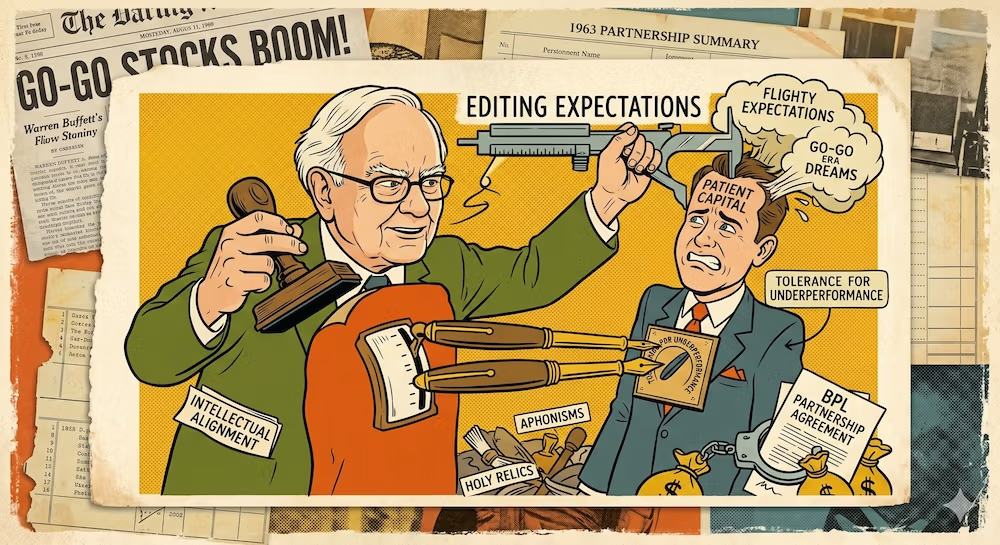
The letters were his tool to transform flighty, emotional retail capital into structurally patient capital. He realized that a legal partnership agreement could mandate physical lockups, but it could not mandate intellectual alignment. A legal contract can handcuff a partner’s cash, but it cannot control their brain. Buffett knew that an investor whose capital is legally locked up until December 31st can still spend the preceding eleven months muttering in resentment, checking the quotes of every hot electronics stock in the Go-Go era, and mentally planning their exit.
The letters were his tool to dismantle that resentment before it could solidify into an asset run. He wasn’t just explaining stock positions; he was actively managing the liabilities side of his balance sheet by editing his investors’ expectations. If they wanted the extraordinary long-term compounding his method promised, they had to surrender their right to conventional emotional reactions. The letters turned a cold legal constraint into an asset class of its own: psychologically patient capital.
Lesson One: Define the Game Before the Market Tests You
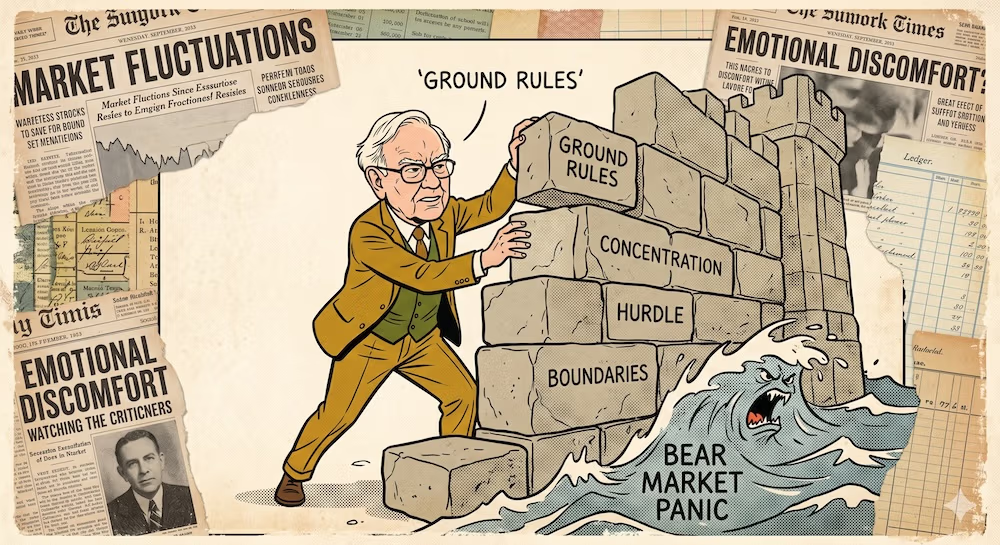
One of the greatest mistakes a modern DIY investor makes is choosing a strategy during a bull market and only trying to figure out their risk tolerance once a bear market arrives. Buffett systematically cut off this psychological trap by issuing his “Ground Rules” at the very inception of his partnerships. He did not wait for conditions to test his partners; he told them exactly how the test would look before the first dollar was deployed.
These Ground Rules, which were explicitly reviewed and re-sent to partners every single year, defined the terms of engagement. Buffett was incredibly explicit about what he would and would not do. He openly stated that he would never guarantee results, that he would be highly concentrated, and that his portfolio would often look deeply different from conventional mutual funds.
By laying out these parameters before the scoreboard started moving, he accomplished something brilliant: he eliminated the narrative elasticity that investors usually exploit to justify panic. If the portfolio concentrated a massive chunk of its capital into an obscure asset, a partner could not write a panicked letter accusing him of recklessness—because the Ground Rules had already classified concentration as a core feature of the operating manual.
The lesson for our own frameworks is immense. If you do not write down your structural boundaries before the market begins to fluctuate, you will inevitably rewrite your rules mid-game to alleviate short-term emotional discomfort. Buffett’s letters prove that true risk management begins with clear semantic boundaries established during moments of absolute clarity.
Lesson Two: Use the Right Benchmark
Human beings are hardwired to look for immediate, emotional yardsticks to determine if they are winning or losing. In a roaring bull market, your benchmark becomes your neighbor who made 50% on a speculative tech stock. In a brutal bear market, your benchmark becomes absolute zero—you feel miserable simply because your balance is lower than it was six months ago, regardless of what the rest of the world is doing.
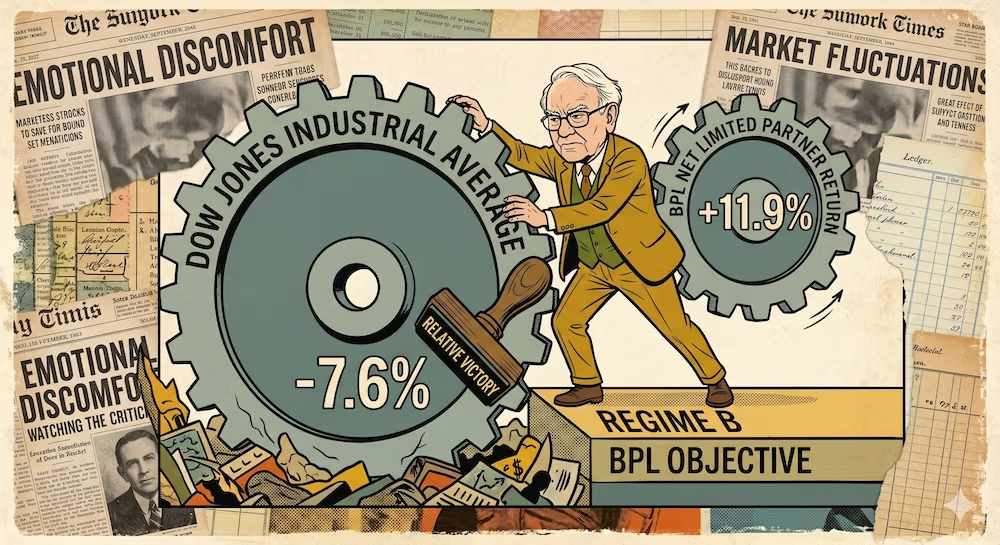
Buffett recognized this behavioral flaw and attacked it relentlessly across every single partnership letter. He introduced the Dow Jones Industrial Average as the explicit, non-negotiable benchmark against which BPL must be judged. But he didn’t just mention it in passing; he conditioned his partners on how to interpret the comparison across different market regimes.
He repeatedly argued that absolute returns were mathematically meaningless when viewed in isolation. If BPL gained 20% in a year when the Dow gained 30%, he had failed as an allocator, and his partners should look to take their money elsewhere. Conversely—and this was the critical psychological pivot—if BPL lost 15% in a year when the Dow dropped 30%, he viewed it as a massive structural victory.
   REGIME A: SPECULATIVE BULL MARKET
   ┌───────────────────────────────────────────────┐
   │ Dow Jones Industrial Average: +38.5%          │
   ├───────────────────────────────────────────────┤
   │ BPL Net Limited Partner Return: +32.2%         │
   └───────────────────────────────────────────────┘
   ▲ EXPECTATION: Buffett explicitly warns partners to expect relative
     underperformance when the broader market is in an absolute frenzy.

   REGIME B: SYSTEMIC MARKET DOWNTURN
   ┌───────────────────────────────────────────────┐
   │ Dow Jones Industrial Average: -7.6%           │
   ├───────────────────────────────────────────────┤
   │ BPL Net Limited Partner Return: +11.9%         │
   └───────────────────────────────────────────────┘
   ▲ EXPECTATION: The core value edge shines. BPL outpaces the benchmark
     via structured asset-cheapness and event-driven ballast.
By framing performance in strictly relative terms, he desensitized his capital base to absolute mark-to-market losses. He gave his partners a precise, objective scoreboard that prevented them from judging investment results on short-term emotional feelings. If the portfolio was outperforming the Dow on a relative basis, the strategy was working perfectly—even if the absolute balance sheet was temporarily down for the year.
Lesson Three: Good Process Can Lag in Bull Markets (The 1958 Test)
It is easy to look at a lifetime track record and assume the compounding path was smooth. But the letters show that the behavioral contract was tested early and often. The year 1958 provides the perfect case study in how the letters successfully managed tracking error stress.
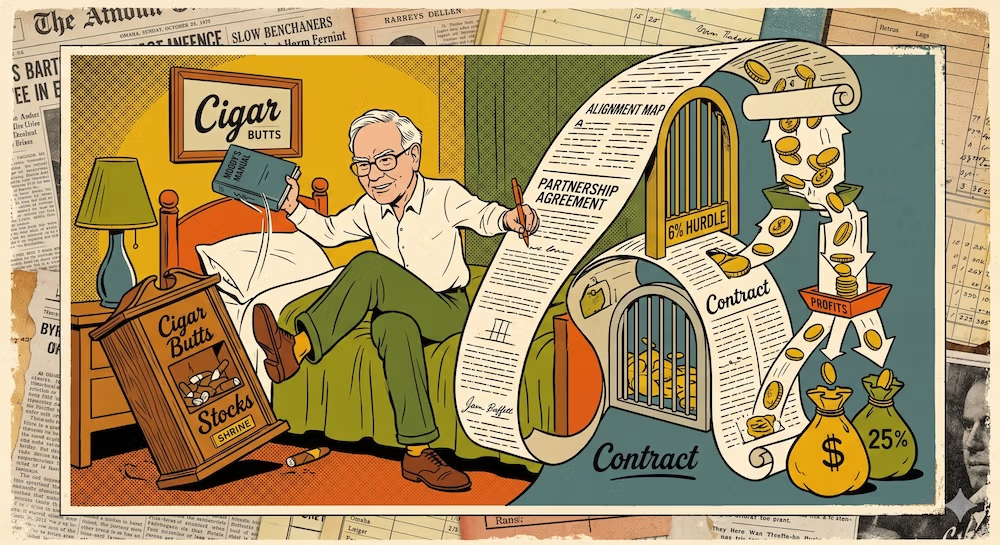
During 1958, a historic bull market caught fire. The Dow Jones Industrial Average surged by 38.5%, driven by speculative euphoria and rapid expansion. Buffett’s partnership performed exceptionally well on an absolute basis, generating a gross return of 40.9%. However, because of his incentive fee structure—where he collected 25% of the returns above a 6% hurdle—his limited partners walked away with a net return of 32.2%.
Think about that dynamic through the lens of a modern retail investor. You are paying for active management, the market is up nearly 39%, and your personal net return trails the generic index by 6.3%. In today’s hyper-reactive wealth management landscape, a 630-basis-point underperformance during a roaring bull market triggers an immediate wave of asset flight, angry emails, and structural capitulation.
But BPL did not suffer an investor mutiny in 1958. Why? Because Buffett had already spent his previous letters conditioning his partners to expect exactly this outcome.
He had explicitly told them that his deep-value approach, rooted in asset-backed securities and event-driven liquidations, would naturally lag behind during speculative, momentum-driven market runs. He framed relative underperformance in a bull market not as a managerial failure, but as a deliberate structural trade-off. He was premium-underwriting his downside risk; to ensure that the portfolio wouldn’t crack during a market crash, he willingly surrendered the top few inches of a runaway bull market. Because his partners had been taught to understand this mechanic before 1958, they didn’t panic. They recognized that the lagging performance was simply the insurance premium they paid for downside structural safety.
Lesson Four: Categories Explain Behavior
To ensure his partners didn’t treat the partnership as one generic, undifferentiated basket of stocks, Buffett used the letters to walk them through his specific asset classification system. He didn’t want them looking at a single position’s volatility and panicking; he wanted them to understand the underlying return driver for each specific sleeve of capital.
He broke the portfolio down into three distinct operational buckets:
- The Generals: Highly undervalued public equities bought strictly on statistical cheapness relative to intrinsic asset value. These positions were subject to standard stock market fluctuations and general quotation pain, but were backed by massive margins of safety on the balance sheet.
- The Workouts: Event-driven situations such as corporate mergers, liquidations, reorganizations, and spin-offs. Buffett taught his partners that the Workouts sleeve functioned as a critical down-market ballast. These positions did not rely on public equity market direction; their returns were driven by corporate legal timelines and transaction closings, creating bounded, event-driven return profiles that made them less dependent on broader market cycles.
- The Controls: Situations where BPL accumulated a dominant position—such as acquiring roughly one-quarter of the Sanborn Map Co. or accumulating more than 70% of Dempster Mill Manufacturing Co. The letters explained that these assets were completely disconnected from the stock market scoreboard. Their value was unlocked through physical corporate intervention, changing management, or reallocating corporate cash into liquid securities.
By separating the portfolio into these categories within the letters, Buffett provided his partners with an analytical lens. They could see that when the stock market was declining, the Workouts sleeve was quietly chugging along. They learned that a drop in the price of a General was simply an invitation to buy more, rather than a structural process failure. The letters transformed a confusing mix of illiquid securities into an easily understood, multi-cylinder mechanical engine.
Lesson Five: Risk Is Permanent Loss, Not Temporary Quotation Pain
The modern financial ecosystem has completely conflated two entirely different concepts: volatility and risk. Because academic models find it easy to calculate standard deviation, retail platforms display “beta” and daily price fluctuations as the definitive measures of portfolio danger.
Buffett’s partnership letters waged a continuous war against this specific dogma. He systematically trained his partners to redefine risk away from mark-to-market price swings and toward the permanent impairment of capital.
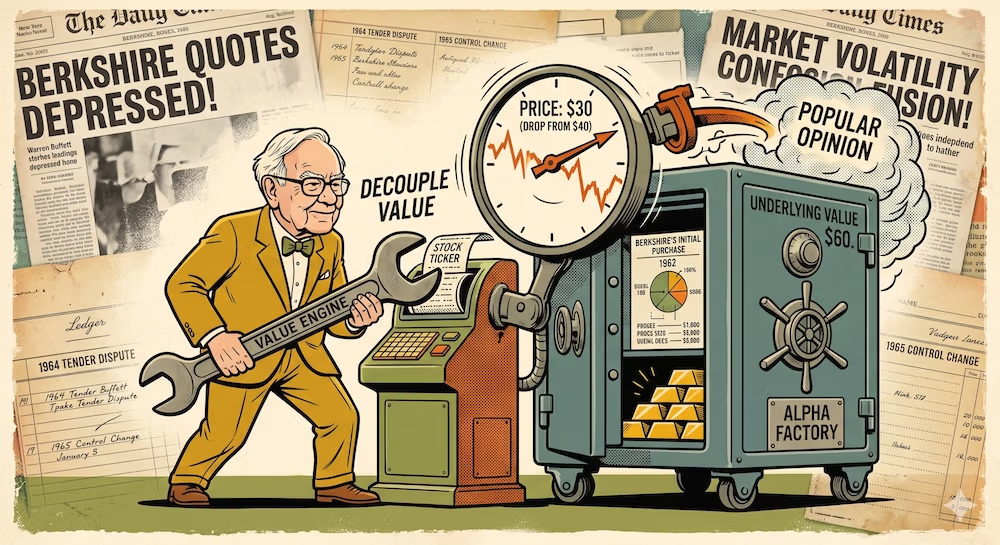
He argued that seeing a stock price drop from $40 to $30 on an exchange was not inherently risky, provided that the underlying asset value was securely worth $60. In substance, he taught partners to completely decouple value from popularity. He framed short-term quotation drops as temporary market friction rather than actual wealth destruction.
This distinction was vital for his activist control operations. When BPL spent years accumulating shares in declining operations like Berkshire Hathaway—beginning his initial purchases in 1962, navigating a severe tender-offer dispute in 1964, and finally forcing a control and management change by 1965—the public market quotations for those shares were often highly depressed and illiquid.
If his partners had operated under the belief that a falling stock quote equaled an active loss, they would have forced him to abandon his multi-year control plays. The letters functioned as a psychological shield, constantly reminding the capital base that as long as the underlying asset value remained robust, public market quotes were merely an un-elected opinion to be ignored or exploited.
Lesson Six: Communication Protected the Strategy
We talk endlessly about the structural advantages of early Buffett: the mandatory annual capital lockups, the 0% management fee, and the high-watermark hurdles. But we must realize a deeper truth: the structural moats only worked because the communication architecture defended them.
Imagine running a fund with a strict legal rule stating that investors can only withdraw their capital once a year on December 31st. On paper, you have an ironclad advantage. But if your communication during the year is silent, generic, or deceptive, what happens when December 31st arrives? Your investors, having stewed in uncertainty and fear for 12 months, will queue up at the exit gate to pull every dollar they can reach.
A physical lockup without intellectual education simply creates a coiled spring of investor panic.
   TRADITIONAL FUND MANAGEMENT
   ┌────────────────────────────────────────────────────────┐
   │ Market Volatility ──► Silence/Bland Marketing ──► Panic │
   └────────────────────────────────────────────────────────┘
   Result: Immediate redemptions and forced liquidations at market troughs.

   BUFFETT PARTNERSHIP ARCHITECTURE
   ┌────────────────────────────────────────────────────────┐
   │ Market Volatility ──► BPL Letter Education ──► Patience│
   └────────────────────────────────────────────────────────┘
   Result: Partners treat market drops as opportunities, protecting the fund.
Buffett’s letters were the behavioral infrastructure that prevented this spring from loading. By continuously demystifying his process, explaining his underperformance, and treating his partners as intellectual peers, he turned cold legal lockup capital into genuinely patient capital. The letters desensitized his investors. They removed the element of surprise from market drops. When a downturn arrived, his partners didn’t view it as a managerial crisis; they viewed it as a natural, expected phase of the playbook that Buffett had mapped out for them months in advance. The communication, in essence, immunized the capital base against the very psychological viruses that destroy modern retail portfolios.
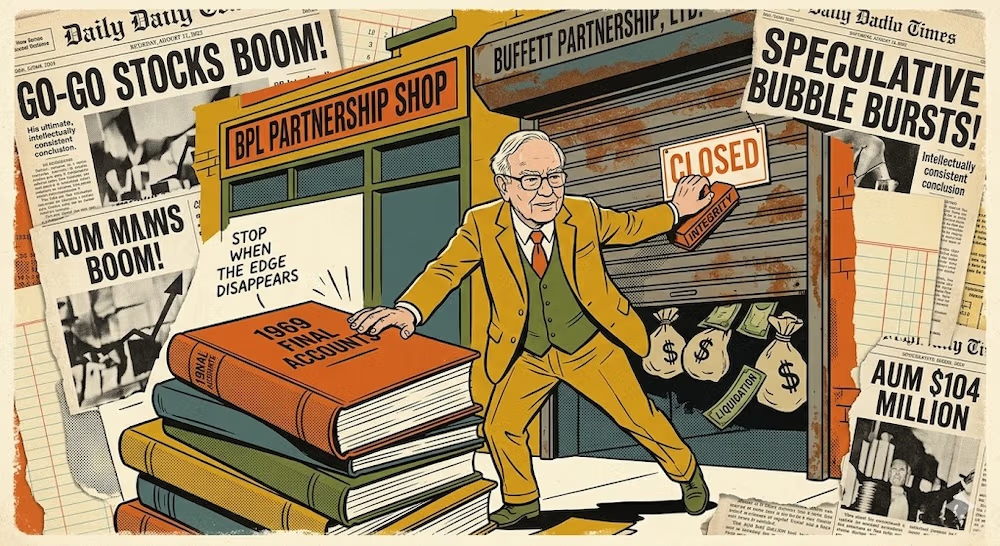
Lesson Seven: The 1969 Shutdown Was the Final Lesson
The ultimate validation of the BPL letters as a behavioral contract—rather than a cynical asset-gathering marketing system—occurred at the end of the decade. By 1969, the Go-Go growth bubble had reached an absolute fever pitch. Speculative stocks with zero earnings were soaring, and value parameters were being mocked across Wall Street. Simultaneously, BPL’s assets under management had grown to a massive $104 million.
Buffett found himself trapped in a structural pincer movement. The tiny, asset-cheap micro-caps that had driven his early alpha had completely evaporated in the bubble. Furthermore, his pool of capital had become too large to deploy into illiquid situations without aggressively moving the market price against himself. His structural edge had largely disappeared.
In this environment, a typical modern fund manager does what is in their own financial interest: they shift their style, lower their standards, buy expensive large-caps, and keep collecting fees on their massive asset base for as long as possible. They prioritize harvesting their reputation over protecting client capital.
Buffett did the exact opposite. He sent a letter announcing that he was completely liquidating the partnership, returning the capital to his partners, and stepping away from active fund management.
This decision was not an emotional capitulation; it was the ultimate, intellectually consistent conclusion of the principles he had outlined in his letters for 13 years. He had spent over a decade telling his partners that he would only play a game where the structural odds were heavily weighted in his favor, and that he would never force activity for its own sake. When those conditions were no longer met, he closed the shop. The final lesson of the partnership letters was that true discipline means having the integrity to stop when your edge disappears, rather than pretending that market conditions will bend to your ego.
The Letter Lesson Map
To understand how this communication architecture directly translated into portfolio protection, we can map his key strategic messages against their psychological functions and modern retail equivalents.
| Letter Lesson | What Buffett Taught Partners | Why It Protected the Strategy | Modern Investor Translation |
| Ground Rules Before the Scoreboard | Pre-defined structural boundaries and allocation parameters before capital was ever deployed. | Eliminated narrative elasticity; partners could not claim shock or surprise at concentrated allocations during market stress. | Establish a formal, written Investment Policy Statement (IPS) before buying your first asset. |
| Relative Benchmark Discipline | The portfolio must be judged strictly against the Dow Jones Industrial Average, not absolute dollar feelings. | Desensitized the capital base to absolute paper losses, keeping the focus entirely on structural outperformance. | Stop checking your absolute dollar balance; evaluate your portfolio exclusively against your chosen risk-adjusted index. |
| Normalizing Bull-Market Lag | An asset-backed, defensive process will naturally trail behind during highly speculative, momentum-driven market runs. | Prevented style-drift and investor mutiny during periods of tracking error (such as the 1958 market run). | Accept that a robust value or factor tilted strategy will look broken during speculative market frenzies. |
| Asset Classification Lens | The portfolio is divided into distinct sleeves (Generals, Workouts, Controls) with entirely different risk drivers. | Allowed partners to see that event-driven assets provided a crucial down-market ballast when stocks crashed. | Diversify into structurally uncorrelated return streams, such as systematic trend following or liquid alternatives. |
| Redefining Risk | True risk is the permanent, structural impairment of capital—never temporary public market quotation pain. | Enabled long-term concentration in illiquid, controversial control plays without fear of forced client liquidations. | Treat market volatility as a liquidity feature of public exchanges, not an active destruction of underlying business value. |
| Reputation vs. Capital Integrity | Capital allocation must stop entirely when underwriting parameters are violated and structural edge disappears. | Enabled the clean 1969 partnership liquidation instead of forcing capital into a speculatively euphoric market. | Maintain the absolute discipline to sit in short-term Treasuries or cash rather than chasing a strategy that has lost its edge. |
How to Use This as a Modern Investor
The modern independent investor faces an incredibly hostile behavioral landscape. You do not have a manager writing you semi-annual letters to calm your nerves, and your smartphone screen displays flashing red and green numbers every three seconds, deliberately engineered to trigger emotional reactions. You are subjected to a continuous stream of financial commentary urging you to jump from one strategy to another.
To survive, you must become your own manager. You cannot write letters to limited partners, but you can—and must—write an Investment Policy Statement to yourself. You need to build your own personal behavioral contract before the market has a chance to test your conviction.
Before you deploy your next dollar of capital into any factor, strategy, or asset class, sit down with a blank document and force yourself to answer these five structural underwriting questions:
- What is my explicit benchmark? Define the precise index or risk-adjusted market average you are trying to match or beat. If you are running a small-cap value tilt, your benchmark is not the S&P 500 or the Nasdaq; it is a small-cap value index. Stop measuring your progress against an irrelevant scoreboard.
- What does acceptable underperformance look like? Pre-define exactly how long and how deeply your strategy can lag a roaring bull market before you are allowed to review it. If you cannot tolerate trailing a momentum-driven market by 6% or 8% over a multi-year window without losing your mind, throw out the strategy right now and buy a simple, total-market index fund.
- What risks am I actually underwriting? Am I taking on quotation volatility, tracking error risk, or illiquidity drag? Write down the explicit structural trade-offs you are making so that when they manifest in the real world, your brain recognizes them as normal, planned features of the design rather than a sudden portfolio emergency.
- What are my hard boundaries for stopping? Pre-determine the exact conditions that would make you halt a strategy. Is it a change in your personal life stage, crossing a specific asset scale threshold, or structural shifts in market access? Define the exit criteria during a moment of absolute calm, so you never make a frantic, emotional exit during a market panic.
- What will I absolutely refuse to chase? Make a non-negotiable list of the hot asset classes, speculative trends, and popular market narratives that you will completely ban from entering your portfolio canvas, regardless of how much short-term momentum they display.
Sponge Verdict
The ultimate takeaway from the Buffett partnership letters is a lesson in structural alignment. We must absorb the absolute communication discipline, the pre-defined benchmark mechanics, and the systematic reduction of emotional noise that made his early returns possible. But we must ruthlessly expel the modern retail tendency to turn these letters into a collection of motivational quotes while completely ignoring the behavioral contract underneath.
The early BPL letters are not a source base for generic stock market inspiration. They are a blueprint for building an intellectual fortress. If you want to build a truly robust modern portfolio canvas, stop worshiping the legend’s stock picks and start copying his expectation management. Pre-define your rules, lock down your benchmark, and sign a psychological contract with yourself before the market ever gets a chance to look at your hand.
What is the minimum portfolio size required to replicate the asset classification strategy mentioned in Warren Buffett’s partnership letters?
It depends on your setup, but attempting to copy this manually with individual stocks requires institutional-scale capital. To execute “Control” positions where you acquire more than 70% of a company or roughly one-quarter of a firm to force corporate liquidation, you need millions of dollars in structural backing. However, a modern DIY investor can replicate the underlying multi-cylinder engine with a modest portfolio by utilizing globally diversified, low-cost quantitative small-cap value ETFs for the “Generals” sleeve, and liquid alternative mutual funds or systematic merger arbitrage ETFs for the market-neutral “Workouts” sleeve.
How can a retail investor build a behavioral “Ground Rules” document similar to the BPL letters?
By writing it down before the market tests you. You can create a personal Investment Policy Statement (IPS) during a moment of absolute calm. This written document must explicitly define your core index benchmark, outline exactly how many consecutive quarters of tracking error or bull-market lag you will tolerate before a review, detail the exact systemic conditions that would make you halt your strategy, and establish a non-negotiable list of speculative assets you will completely ban from entering your portfolio canvas.
Did Warren Buffett use performance-smoothing or hedge fund leverage during the 1957–1969 partnership era?
No. The BPL letters show that his historic 29.5% gross compounded annual growth rate was achieved without standard institutional management fees or complex cross-border derivative leverage. Instead, his structural edge was driven by deep concentration, severe market information asymmetries in the micro-cap space, asset-backed margins of safety, and market-neutral event arbitrage that acted as down-market ballast during systemic index corrections.
How did the tax drag operate within the Buffett Partnership, Ltd. relative to modern retail accounts?
It was highly efficient but structured differently. Because BPL was organized as a limited partnership, it did not pay corporate-level income tax; instead, capital gains, dividends, and interest insulation passed directly through to the limited partners’ individual tax returns annually. For a modern retail investor running a high-turnover deep value or event-driven arbitrage strategy, executing these moves inside a standard taxable account introduces significant short-term capital gains tax drag. Utilizing tax-advantaged accounts or low-turnover, rules-based factor ETFs is the optimal modern workaround to preserve compounding speed.
Why did Warren Buffett explicitly reject absolute dollar balances as a metric for fund success?
Because absolute returns are mathematically meaningless when viewed in isolation. Buffett systematically trained his partners to judge BPL performance strictly relative to the Dow Jones Industrial Average. He conditioned his capital base to understand that losing 15% in a year when the benchmark index crashed 30% was an absolute structural victory, while gaining 20% in a year when the market surged 30% was an asset-allocation failure.
What specific modern ETF tickers can replicate the “Workouts” sleeve described in the letters?
To copy the exact mechanical function of the Workouts sleeve—which Buffett utilized as a bounded, event-driven substitute for cash rather than holding low-yield bank deposits—a modern investor should look toward specialized liquid alternative funds or institutional merger arbitrage ETFs. These vehicles track publicly announced corporate restructurings, spin-offs, and acquisitions, providing an uncorrelated return stream that reduces portfolio dependence on broader public equity market direction.
This article is also available in Spanish. [Leé la versión en castellano: Las cartas de la sociedad de Warren Buffett: Las mejores lecciones antes de Berkshire Hathaway]