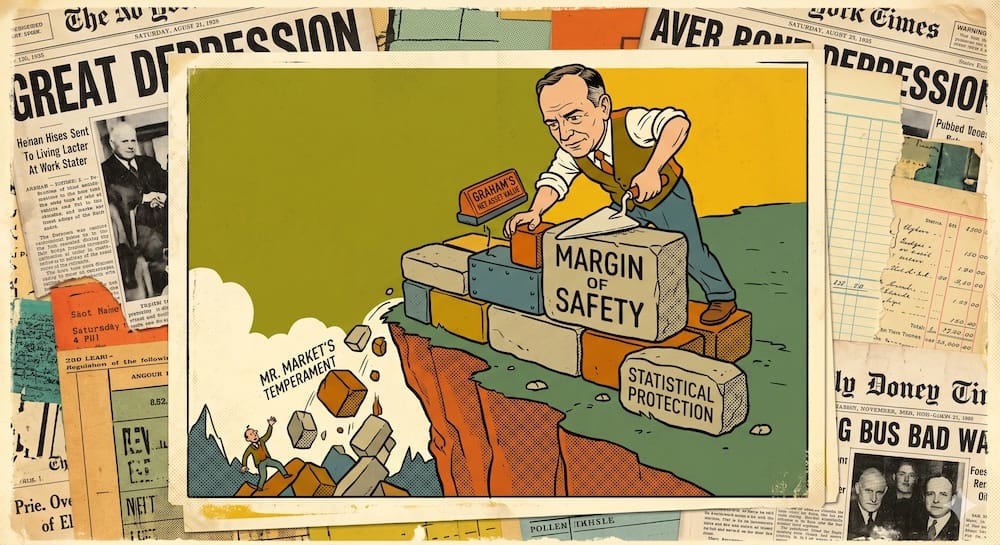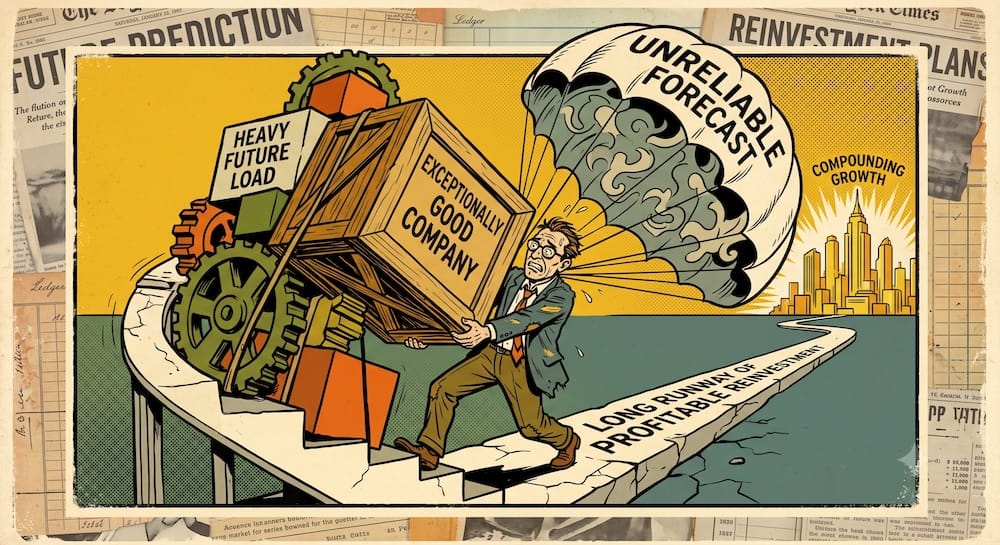
Philip Fisher’s holding philosophy is usually remembered in its most soothing form: buy an outstanding company, hold it for a very long time, and allow compounding to rescue you from the exhausting business of having opinions every Tuesday afternoon.
There is wisdom in that. There is also a trap.
The slogan makes Fisher sound like the patron saint of benign neglect. Select greatness, place it on a shelf, and return several decades later to discover that your patience has been rewarded with wealth and excellent posture.
His actual philosophy was far less comfortable.
Fisher expected investors to investigate deeply before buying, continue investigating after buying, admit when the original analysis had failed, and sell when the qualities that justified ownership had materially deteriorated. Only after those obligations had been met did “almost never sell” become defensible.
That is the part followers tend to misplace.
I have little patience for long-term investing when “long term” merely means the investor has stopped asking difficult questions. A holding period is a measurement of time. It is not evidence of discipline, insight, or moral seriousness. Someone can own an exceptional business for twenty years because the thesis remained intact. Someone else can own a deteriorating business for twenty years because selling would require admitting that the story changed sometime around year seven.
The brokerage statement looks similar. The thinking does not.
Fisher’s real contribution was an asymmetric burden of proof. He demanded relatively quick action when the original facts were wrong or the company’s economic engine had weakened. He demanded much stronger evidence before selling merely because the share price had risen, the valuation looked uncomfortable, the market seemed vulnerable, or another company appeared more exciting.
He wanted investors to be stubborn toward market noise and ruthless toward analytical failure.
Most of us are naturally inclined to reverse those settings.
A falling share price makes us feel urgent. A weakening business thesis arrives quietly and gives us time to construct explanations. A large gain tempts us to sell because the success is visible. Management deterioration is harder to measure, easier to rationalize, and capable of hiding behind several quarters of acceptable numbers.
Selling therefore becomes hardest when Fisher’s method has already worked. The company has delivered. Management has earned trust. The shares have multiplied. The investor has accumulated years of knowledge and perhaps a little affection.
That knowledge may justify continued ownership.
It may also become an extremely detailed system for refusing to change one’s mind.
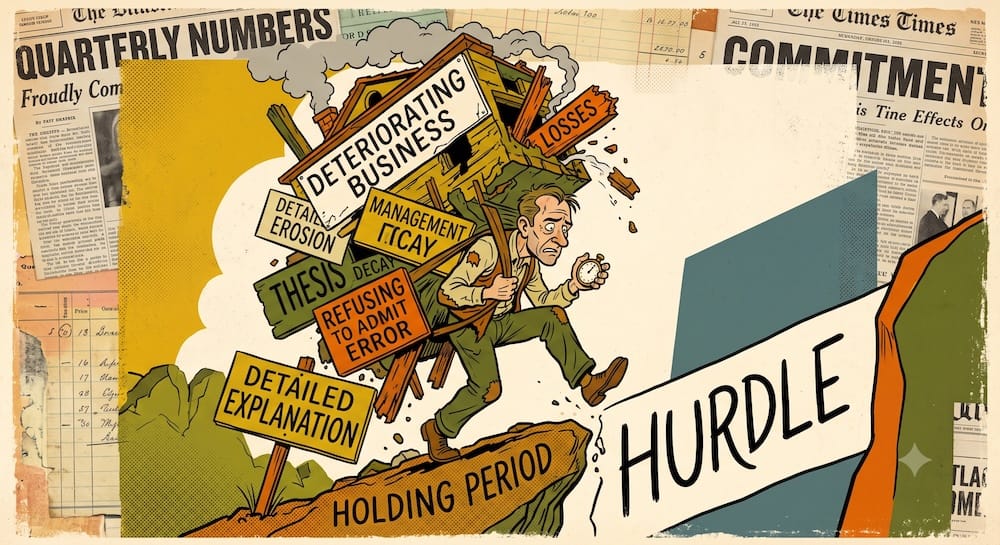
“Almost Never Sell” Was a Conditional Verdict
In Common Stocks and Uncommon Profits, Fisher said there were “three reasons, and three reasons only” to sell a stock selected under his principles for financial reasons. Near the end of the chapter, he delivered the phrase that eclipsed nearly everything before it: if the original work had been done properly, the time to sell was “almost never.” Both statements appear in the same argument and should be read together. (Common Stocks and Uncommon Profits, Chapter 6)
Popular investment culture kept the delicious ending and lost the conditions.
That is hardly surprising. “Almost never sell” fits neatly into a quotation graphic. “Almost never sell after conducting unusually deep qualitative research, maintaining close contact with the company, monitoring management and growth capacity, and remaining willing to admit material error” requires a much larger mug.
Yet the qualification contains the philosophy.
Fisher was discussing companies that had survived a demanding selection process. Management ability, research effectiveness, sales strength, margins, labour relations, integrity, competitive position, and the runway for future growth all had to be examined. The long holding period emerged from the continuing quality of the business. Time itself granted nothing.
A weak company does not become a Fisher investment because its owner has endured it heroically.
In a 1996 Forbes interview, Fisher said he would invest only when he believed a company’s favourable trajectory could continue for three to five years. The interviewer described his approach as buying pieces of superior businesses and remaining with them while they remained superior. That final condition is doing nearly all the intellectual work. (“Are You Doing Things Your Rivals Haven’t Yet Figured Out?”)
I give Fisher considerable credit here. He did not merely tell investors to be patient. Patience by itself is morally neutral. A person can patiently wait for a great business to compound or patiently watch a terrible thesis decay.
Fisher tried to identify the companies for which patience had economic value.
The same 1996 interview also makes his position messier than the mythology. Fisher said he would sell a deeply researched stock that had failed to perform after three years. The remark is too brief to support a universal three-year exit rule, and I would not turn it into one. Still, it suggests that an unproven idea did not receive unlimited protection simply because the investor had worked very hard and felt terribly sincere.
There is a meaningful difference between a company that has repeatedly validated the thesis and a candidate that keeps promising the validation will arrive next year.
The first has earned a high burden of proof for selling.
The second may have accumulated little beyond investor commitment and a growing archive of explanations.
Fisher’s Three Sell Decisions Were Not Created Equal
Fisher’s three permissible reasons for selling are often presented as a clean list:
- The original purchase was a mistake.
- The company deteriorated.
- A clearly superior opportunity appeared.
That summary is accurate and still misses the mechanism.
The first two reasons concern damage to the existing thesis. New evidence reveals that the company was never as attractive as believed, or that it no longer possesses the qualities that justified ownership.
The third reason asks the investor to compare a proven holding with an alternative that may be known mainly through expectations.
Those decisions carry different evidentiary burdens. Fisher knew it, even if tidy summaries tend to flatten the distinction.
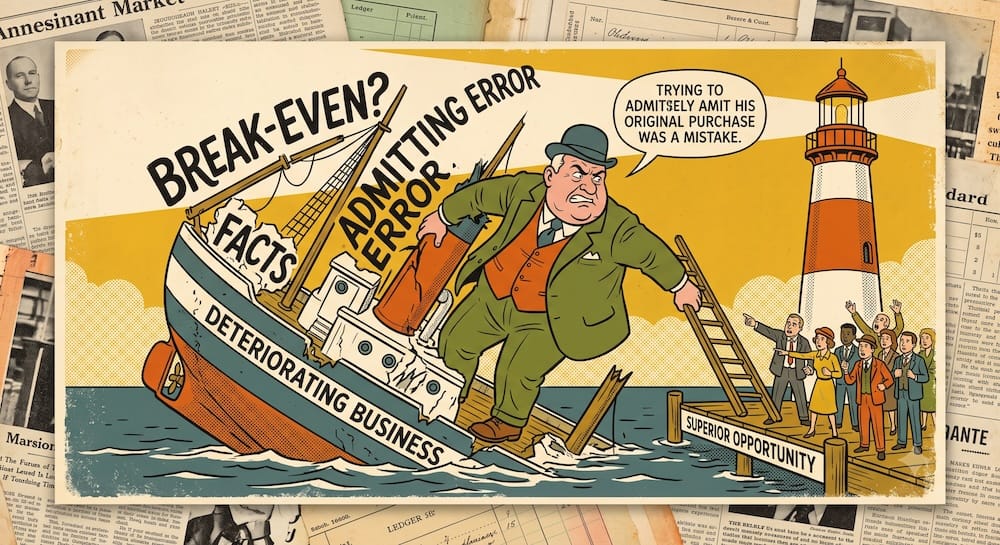
The Original Purchase Was Wrong
Fisher’s first reason for selling was wonderfully unsentimental. The company’s factual background turned out to be materially less favourable than the investor believed when buying.
The difficult part was not identifying the principle. It was swallowing the embarrassment.
Investors dislike admitting that an original decision was wrong. They become attached to the purchase price and wait for the shares to “come back” so they can escape without officially losing. Break-even takes on the dignity of a constitutional right.
Fisher rejected that logic. The old purchase price had no relevance to the best use of capital now. Waiting to get even could deepen the mistake because the money remained attached to an unwanted holding while stronger opportunities passed by.
I understand why the break-even point feels so persuasive. It offers narrative closure. The investor imagines reaching the original price, selling, closing the file, and leaving the scene with his analytical dignity largely intact.
The market has never agreed to participate in this little ceremony.
A stock does not know where we bought it. The business does not alter its economics because our account is red. The purchase price is historically important and psychologically loud, yet it has no authority over future returns.
Fisher’s standard was clear: once the factual case had materially failed, the investor had to reassess using current information. Pride, prior effort, and the desire to recover the original capital received no special standing.
This is the harder edge beneath Fisher’s reputation for patience. He wanted extraordinary patience with a validated business and very little patience with a disproven analysis.
That distinction is easy to praise and difficult to practice. A falling stock invites us to search for more information, although the search often becomes an exercise in finding reasons why we were secretly right all along. The mind can become a remarkably efficient appeals court when its own earlier verdict is under review.
The Company No Longer Deserved Its Status
Fisher’s second reason for selling was deterioration severe enough that the company no longer satisfied his qualitative standards to approximately the same degree.
This is the centre of his holding philosophy because it clarifies what the investor actually owns.
The ticker is a legal and market wrapper. The economic asset is a collection of capabilities: management judgment, innovation, customer relationships, operating strength, competitive advantages, reinvestment opportunities, and access to future growth.
When those capabilities weaken, the investor may still own the same security while owning a materially different proposition.
Fisher highlighted two broad ways the thesis could deteriorate.
Management could decline. Success might produce complacency. A gifted leader might be followed by a successor who inherited the title, office, and parking space but not the ability. Policies that once rewarded initiative and candour could calcify into bureaucracy. Capital allocation could become less disciplined. Management could begin defending its record rather than extending it.
The growth runway could also shrink while management remained competent. The original market might approach saturation. New products might lack the economics of earlier ones. Expansion into unrelated fields could create activity without preserving advantage.
I consider this distinction essential because “the company is still growing” is a much weaker defence than investors pretend. Growth can continue while its quality deteriorates. Revenue can rise through acquisitions, lower-return expansion, heavier capital requirements, or entry into markets where the company possesses no special edge.
A business can become larger while becoming less Fisher-like.
Fisher did not prescribe the same response to every form of deterioration. A major decline in management quality could justify prompt sale. The gradual exhaustion of a growth runway allowed more measured judgment and possibly a partial reduction while a stronger destination for the capital was found.
That nuance is useful. It prevents the sell discipline from turning into a twitch response every time growth slows.
It also leaves the investor with the genuinely difficult problem: separating temporary weakness from structural deterioration.
The stock price cannot answer that question. Management will not always answer it honestly. Reported numbers may lag the underlying change. Competitive advantages rarely expire on schedule.
The investor has to make a judgment while the evidence is still incomplete.
That is where long-term holding stops being restful.
A Clearly Superior Opportunity Appeared
Fisher’s third reason for selling permitted a switch when another opportunity offered clearly superior long-term prospects.
In theory, this is impeccable. Capital should move toward its best available use after considering uncertainty, taxes, and switching costs.
In practice, this category is a playground for self-deception.
The existing holding has lived under observation. Its weaknesses are known. Management has disappointed the investor in specific ways. Product launches have failed to arrive perfectly. Competitors have landed punches. The business has acquired scars.
The alternative arrives with cleaner numbers, a more exciting narrative, and none of the accumulated emotional clutter. It has not yet been owned long enough to become irritating.
Fisher recognized this informational imbalance. He warned that the owner of a good company knows its attractive and unattractive characteristics, while the supposedly superior newcomer may contain a major feature that has been misunderstood. A switch required unusual confidence.
I like the severity of that standard because “opportunity cost” is one of the most dignified phrases available to an investor who has simply become bored.
Nobody wants to admit that the new company looks more exciting. We prefer to say we are upgrading the portfolio’s long-term return profile.
Sometimes we are.
Sometimes novelty has put on a tie.
Fisher illustrated the potential impact of durable growth differences by comparing companies growing at approximately 12% and 20%. One dollar compounded at those rates for twenty years becomes roughly $9.65 and $38.34. That spread shows why moving into a genuinely superior compounder could matter enormously.
It also shows why forecasts deserve suspicion. A spreadsheet compounds assumptions without complaint. It never interrupts to mention that the company may disappoint, the market may mature, management may stumble, competition may intensify, or the estimated 20% may turn out to have been a handsome 11% wearing flattering lighting.
The alternative must therefore clear a higher bar than “looks cheaper” or “has grown faster recently.” It has to compensate for everything the investor does not yet know.
Taking a Profit Can Be Expensive Emotional Maintenance
Selling after a large gain feels responsible. The investor locks in success, retrieves the original capital, reduces exposure, and converts an uncertain future into visible cash.
Fisher believed much of this behaviour was emotional housekeeping disguised as prudence.
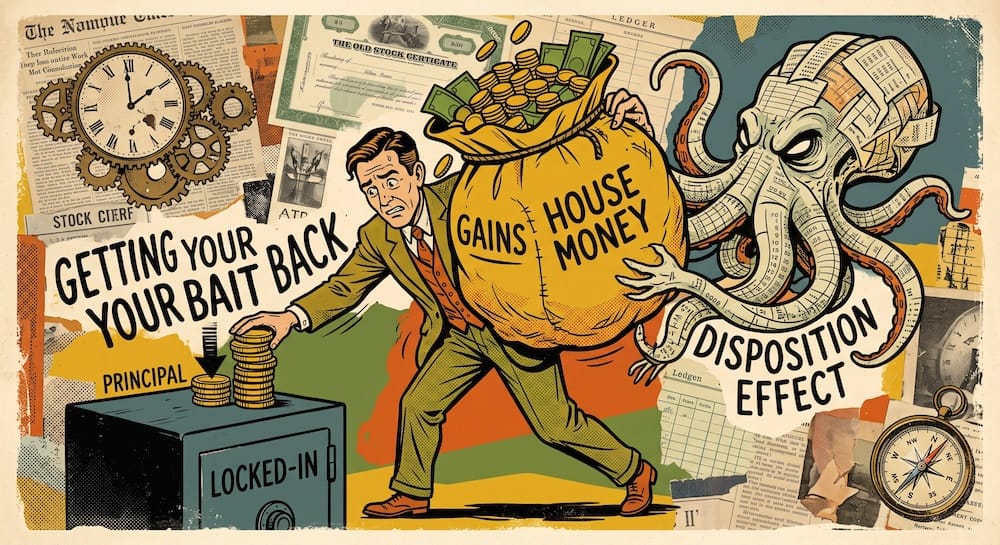
In a 1987 Forbes interview, he described pressure to sell part of a Texas Instruments holding after it doubled so the client could recover the original investment. Fisher dismissed the notion of “getting your bait back.” The relevant question was whether the company remained more attractive than the alternatives. (“A Talk with Philip Fisher”)
The original capital has no sacred economic status after it enters the position. Every dollar remaining in the holding faces the same future return.
Investors nevertheless divide the position mentally. The principal feels real and vulnerable. The gain feels like a bonus granted by the market. We behave as though the profits belong to a cheerful external sponsor and can therefore be treated with less seriousness.
I have never found “playing with house money” especially convincing. The house is not funding the investment. The money belongs to the investor, can be lost by the investor, and should be subjected to the same standard as any other capital. The phrase mostly turns a genuine asset into permission to think casually.
Fisher’s criticism anticipated what behavioural finance later called the disposition effect. Terrance Odean’s 1998 study of 10,000 discount-brokerage accounts found that investors realized profitable positions more readily than losing ones. The pattern was not adequately explained by rebalancing, trading costs, or superior subsequent performance from the losers retained. In the sample, the winners sold went on to outperform the losing positions investors continued holding. (Odean, “Are Investors Reluctant to Realize Their Losses?”)
That study does not prove that investors should keep every winner. It reveals how easily the purchase price contaminates judgment.
We demand a complete courtroom trial before selling a loser. A green number may be enough to evict a winner.
Fisher wanted the burden of proof arranged differently. An invalidated purchase deserved honesty. A company that had demonstrated its quality deserved protection from premature profit-taking.
The visible gain was never the thesis.
The Great Company at the Awful Price
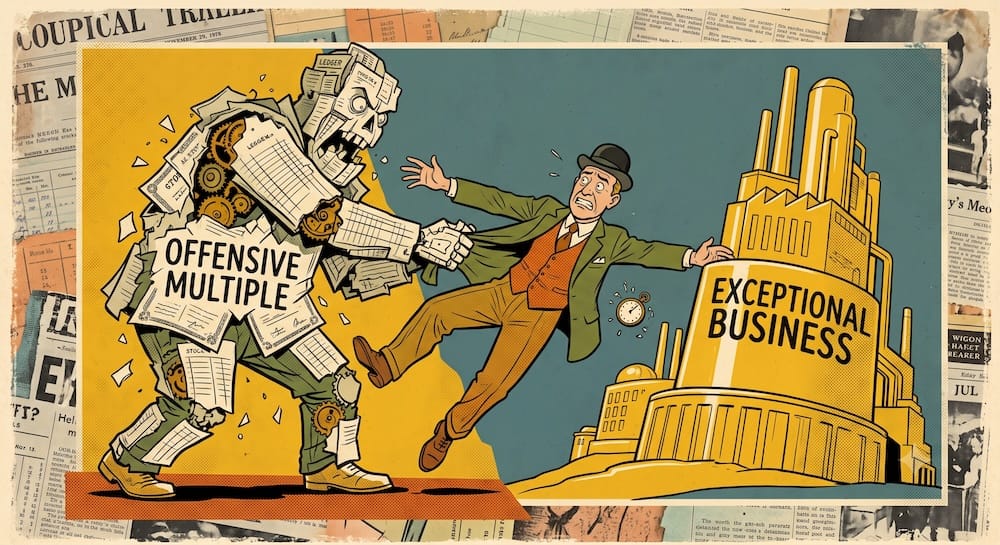
The most uncomfortable Fisher problem appears when the company remains exceptional and the valuation looks deranged.
Fisher did not believe price was irrelevant. In 1996, he said buying at a lower price could greatly improve the return. He also acknowledged that glamour could make even a great company too expensive.
The popular “quality at any price” interpretation does him no favours. It turns a difficult argument about uncertainty into permission to abandon arithmetic.
Fisher’s resistance concerned the confidence required to sell a proven company solely because of valuation.
Suppose the shares trade at 35 times earnings and the investor believes 25 times would be more sensible. That estimate depends on future growth, margins, capital needs, competitive pressure, interest rates, and the multiple the market will assign years later.
The stock can be expensive. The investor can correctly identify that it is expensive. The sale can still prove costly if the business grows faster or longer than expected.
Fisher asked whether temporary overvaluation mattered greatly if the company could multiply in value over the following decade. He was attacking false precision. The investor may know that the price is uncomfortable without knowing that a sale will improve the result.
I agree with Fisher most strongly when the hidden re-entry problem is included.
Selling because a great company looks expensive is presented as one decision. It is usually at least four.
The investor must judge that the valuation excess is material. He must sell before the excess disappears. He must determine whether the business thesis remains intact during the decline. He must repurchase while the price is lower and the surrounding news is likely to be unpleasant.
Every stage creates another opportunity to turn a sound company judgment into a sequence of poor market judgments.
The shares may continue rising. Earnings may catch up without a major correction. The price may finally fall during a broad panic, only for the investor to decide that an even lower entry would be more prudent. The stock may collapse because the business has genuinely deteriorated, eliminating the original reason to return.
Fisher used Motorola to describe this problem in the 1996 interview. He said that selling years earlier when the company appeared overpriced would probably have left him unable to identify the right repurchase point, causing him to miss much of the later gain. The reproduced interview contains performance figures that do not reconcile mathematically, so I would not lean on them. The behavioural mechanism does not require a heroic return number.
Still, Fisher’s position requires a boundary.
Extreme valuation can compress future returns and increase the damage caused by ordinary disappointment. Difficulty measuring valuation risk does not make the risk imaginary. Investors can turn Fisher’s humility about precision into complete indifference about price, which is a much lazier doctrine.
My reading is narrower. Price discipline matters when buying. Valuation continues to matter after purchase. Fisher simply refused to let an uncertain estimate of overvaluation automatically overrule the accumulated evidence supporting an exceptional business.
“Price never matters” is a slogan.
“Price matters, although selling a proven compounder requires greater confidence than noticing that its multiple looks offensive” is a philosophy.
Market Forecasts Added More Ways to Fail
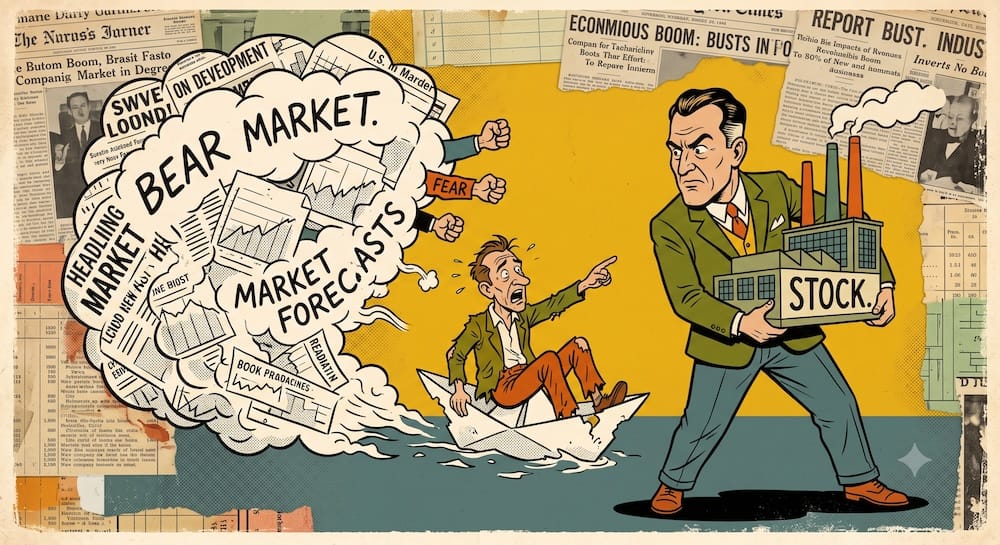
Fisher was even more skeptical of selling an outstanding company because a bear market appeared likely.
His reasoning rested on an information hierarchy. The investor may have spent years studying the company. He knows the management, operating history, competitive position, and growth opportunities.
The market forecast is usually much thinner.
Selling exchanges a relatively grounded judgment about one business for a broad prediction about economics, sentiment, liquidity, valuation, and timing. The investor then has to decide when to return.
Fisher wrote that fear of an ordinary bear market was an even weaker reason to sell than to delay a purchase. In his experience, investors who sold before a decline rarely repurchased successfully. Sometimes the fall never came. Sometimes the price declined and they waited for something lower. Sometimes fear made them incapable of acting when the opportunity finally appeared.
His “not one time in ten” estimate was personal observation, not statistical evidence. I would preserve it as Fisher’s experience and leave it there.
The 1987 interview makes his position more credible because he was willing to live with uncertainty. Fisher expressed serious macroeconomic concern and admitted he had no idea when a crash might arrive. He still retained substantial exposure to four core holdings while also carrying cash and equivalents.
I prefer that uncertainty to macro theatre.
An investor develops a dark view of the economy, cannot identify when the danger will arrive, cannot specify its magnitude, and still feels an overwhelming urge to reorganize everything immediately. Anxiety is promoted to analysis because it arrives wearing charts.
Fisher did not deny that markets decline. He questioned whether anticipating the decline could be converted into a complete and executable investment decision.
The forecast had to be right.
The timing had to be right.
The sale had to occur.
The conviction in the company had to survive.
The repurchase had to happen while the world looked sufficiently ugly to create the lower price.
That is an impressive number of moving parts for a decision usually presented as “reducing risk.”
Fisher’s framework does not settle every portfolio-level concern. Concentration, liquidity needs, diversification requirements, account structure, and personal circumstances can justify reducing a position even when the business remains attractive.
His point survives within its lane: a vague market forecast is weak evidence for abandoning a company the investor understands well.
The Sell Signal Was Inside the Business
Fisher’s meaningful sell signals came from the company’s ability to keep producing exceptional results.
Management deterioration could show up through complacency, weaker succession, declining candour, poor capital allocation, bureaucratic growth, or loss of operating discipline. Past success offered no permanent exemption.
The growth runway could also weaken without management becoming incompetent. The original market might mature. New products might fail to reproduce earlier economics. Expansion could continue in areas where the company possessed no distinctive advantage.
A company may remain respectable after it stops being exceptional.
That is a dangerous transition because respectable businesses can produce enough decent evidence to keep an old thesis alive. Revenue still rises. Earnings remain positive. Management continues speaking confidently. The investor can always find something to admire.
Fisher suggested comparing the expected increase in per-share earnings at the next business-cycle peak with the increase achieved between the previous peak and the current one. A materially weaker expected advance could indicate that the growth thesis had changed.
It was a diagnostic rather than a formula. Fisher did not solve qualitative deterioration with a ratio because qualitative deterioration refuses to behave that politely.
Modern investors often claim they will sell when “the thesis breaks.” I have grown suspicious of that phrase. It sounds disciplined while requiring almost nothing.
A thesis can be revised after every disappointment.
Falling margins become deliberate investment.
Customer losses become strategic pruning.
Management opacity becomes competitive secrecy.
Slower growth becomes a temporary digestion period, which makes the company sound as though it merely ate too much turkey rather than lost part of its economic advantage.
With sufficient creativity, no thesis ever breaks. It becomes more nuanced.
I would return to the original causal case. What capabilities were expected to generate future growth? What made management exceptional? Where did the competitive advantage come from? What developments would have weakened those claims at the time of purchase?
Then compare the current company with that original case.
Do not compare it with the replacement story written after the facts became inconvenient.
Temporary weakness can still resemble structural decline. Product investment may hurt current margins before producing future returns. Growth may pause without ending. Management may make a correct decision that initially looks poor.
No rule removes that ambiguity.
Fisher’s contribution was to insist that the decision be grounded in the changing economics of the company rather than the investor’s emotional reaction to the quotation.
Patience Without Investigation Is Neglect With Better Branding
Fisher explicitly required investors to remain on guard and maintain close contact with the companies they owned. Purchase did not end the investigation. It changed the questions.
In 1987, he compared learning about management over time with living alongside a spouse. Continued exposure reveals qualities that initial investigation cannot.
The analogy supports patience. It also contains a warning.
Familiarity deepens knowledge, although it can also deepen attachment.
My term for the danger is thesis drift. Fisher did not use it. It describes the slow replacement of an original, testable investment case with a more forgiving narrative designed to preserve the holding.
The investor begins with specific expectations about management quality, innovation, margins, competitive strength, and market expansion.
Years later, the shares remain because management deserves more time, the industry is going through a transition, the disappointing results are temporary, and selling would be terribly short-term.
The standards have moved. The label has not.
I am susceptible to the label too. Calling a decision “long term” immediately makes it sound disciplined. Saying “I no longer know what would change my mind” has less prestige, although it may be more accurate.
Fisher’s defence was continuing investigation. In 1996, he described asking intrusive questions and applying judgment while acknowledging that management might tailor its answers to what an investor wanted to hear.
That risk grows after purchase because the investor also wants the reassuring answer.
The company and shareholder can become partners in the maintenance of optimism.
Fisher-style patience therefore requires disconfirming work. Management candour, capital allocation, product execution, competitive behaviour, employee quality, customer reactions, and reinvestment opportunities must be reassessed.
Past excellence should earn continued attention.
It should not earn immunity.
This is also where Fisher’s philosophy becomes difficult to copy. He possessed time, access, experience, and an investigative network that many investors cannot reproduce.
Copying his holding periods without copying his information process preserves the visible behaviour and discards the enabling mechanism.
The visible behaviour was sitting still.
The hidden work was earning the right to sit still.
Opportunity Cost Is Real, and Novelty Is a Convincing Impostor
A genuinely superior opportunity can justify selling. Fisher was right to include it.
He was equally right to make the threshold high.
The existing company has been observed through real operating conditions. The investor has seen management respond to failure, allocate capital, communicate under pressure, and pursue new growth.
The alternative is often known through a shorter history and a longer forecast.
That produces an unfair beauty contest. The incumbent arrives carrying every known weakness. The challenger arrives freshly groomed, accompanied by a presentation in which the addressable market continues expanding somewhere beyond the edge of the slide.
Fisher required clear superiority after taxes and transition costs. A small projected advantage was not enough because small advantages disappear easily when the assumptions are wrong.
I admire the suspicion embedded in that standard. Opportunity cost is real. It is also an excellent disguise for dissatisfaction, boredom, and the attraction of a newer story.
Investors rarely say, “I am tired of this company and the other one looks more exciting.”
We say, “I am reallocating toward a more attractive risk-adjusted return opportunity.”
The sentence is longer, which apparently makes the impulse more rigorous.
Sometimes the switch is correct. Sometimes it replaces a proven business with an elegant forecast. The difference usually becomes obvious only after the new company has had enough time to collect its own disappointments.
The challenger should therefore overcome an informational handicap. Its expected growth, management, competitive durability, valuation, and reinvestment opportunity must be strong enough to compensate for everything the investor does not know.
A model can clarify the assumptions. It cannot make them true.
Hold, Reinvestigate, or Sell
Fisher’s philosophy becomes more useful once the false binary between holding and selling is removed. Many developments justify renewed investigation before they justify liquidation.
| Decision state | Evidence pattern | Fisher-style response |
|---|---|---|
| Hold | The company remains strongly qualified, while discomfort comes mainly from a large gain, approximate overvaluation, ordinary volatility, or a market forecast | Continue owning while monitoring the business |
| Reinvestigate | Growth slows ambiguously, succession creates uncertainty, product execution disappoints, management communication weakens, or an unvalidated idea fails to progress | Restate the original thesis and seek evidence capable of disproving it |
| Sell | The original factual case was materially wrong, management or the growth engine has clearly deteriorated, or a superior alternative survives an unusually demanding comparison | Act on the changed evidence rather than the old purchase price or accumulated attachment |
This reconstruction does not cover every legitimate portfolio-level reason for selling. Taxes, liquidity, concentration limits, account structures, and personal circumstances vary too widely.
The middle state is the important one.
Reinvestigation stops every concern from turning into a trade. It also stops “long term” from becoming a protective charm placed over a deteriorating thesis.
Management can become less candid before it becomes obviously incompetent. A growth runway can narrow before reported earnings collapse. A company can remain good after it stops being exceptional.
Evidence usually changes before certainty arrives.
Fisher never solved that ambiguity. Nobody has.
What he improved was the burden of proof.
A material error in the original analysis demanded honesty. Deterioration in management or growth capacity could overrule years of affection. A replacement opportunity deserved suspicion because it had not accumulated the same depth of evidence. A large profit, an uncomfortable multiple, or a gloomy market forecast was insufficient by itself to destroy the payoff from a rare compounding business.
I would carry forward one distinction above all others.
Long-term holding is defensible when continuing evidence supports the business thesis.
It becomes denial when the holding period itself is used as evidence.
The knowledge accumulated through years of ownership can justify extraordinary patience. The same familiarity can make decline easier to excuse, management easier to defend, and the original thesis easier to rewrite.
Fisher’s hardest sell decision arrives when the investor has to decide what that familiarity has produced: superior understanding of the business, or a highly sophisticated method of refusing to learn something new.
What did Philip Fisher mean by “almost never sell”?
Fisher meant that a carefully selected and repeatedly validated company should rarely be sold while its management quality, competitive position, growth runway, and reinvestment opportunities remain intact. The phrase was conditional on deep initial research and continued investigation after purchase.
What were Philip Fisher’s three reasons for selling a stock?
Fisher allowed selling when the original purchase analysis was materially wrong, when the company had deteriorated enough that it no longer met his qualitative standards, or when a clearly superior long-term opportunity appeared.
Did Fisher believe a rising share price was a reason to sell?
No. A large gain did not prove that a company’s future opportunity had been exhausted. Fisher believed the investor should compare the company’s remaining business prospects with available alternatives rather than treating the original purchase price or accumulated profit as the deciding factor.
How can an investor distinguish temporary weakness from a broken thesis?
There is no mechanical test. Fisher’s approach requires reassessing the original reasons for ownership, including management quality, competitive advantages, product execution, market expansion, and the company’s ability to reinvest. The comparison should be made against the original causal case rather than a more forgiving story created after disappointing results.
Why was Fisher skeptical of selling before a predicted bear market?
Selling creates several additional decisions: forecasting the decline, timing the exit, preserving confidence in the company, identifying an acceptable re-entry price, and repurchasing while conditions are frightening. Fisher considered a vague market forecast weak evidence for abandoning a business the investor understood well.
What is thesis drift in long-term investing?
Thesis drift is the gradual replacement of an original, testable investment case with a more forgiving narrative designed to justify continued ownership. It occurs when the standards for holding change after the facts become inconvenient, while the investor continues calling the decision disciplined and long term.
This article is also available in Spanish. [Leé la versión en castellano: La filosofía de Philip Fisher a largo plazo: cuándo vender se vuelve la decisión más difícil]