I used to think the Charlie Munger style upgrade was simple: if you find a truly magnificent business with an ironclad moat, you should be willing to pay almost any price to own it, step aside, and let time do the heavy lifting.
It is a comforting narrative. It is also a serious misreading of the mechanics.
The internet has turned Munger’s famous pivot away from Benjamin Graham’s “cigar-butt” value style into a blank check for quality. Modern retail investors routinely use his name to justify paying astronomical price-to-earnings multiples (P/E > 40 or 50) for highly admired mega-cap franchises, operating under the assumption that an elite business model magically dissolves valuation risk.
But when you strip away the folklore and sit down with the actual numbers, a completely different reality emerges. Munger did not replace valuation with quality; he expanded valuation so it could account for capital efficiency, duration, and reinvestment economics.
The math doesn’t care about hero worship. If you overpay for a great business, you create a structural headwind that can paralyze your portfolio for years. Quality improves the compounding engine, but price determines how much of that engine you actually get to keep.

The Dangerous Myth of Quality at Any Price
The conventional online narrative has created a profound over-simplification of Munger’s philosophy. It assumes that if a company’s internal returns are exceptional, your entry multiple is irrelevant because the business will eventually grow into its valuation.
This line of thinking introduces an incredibly dangerous behavioral and mathematical blind spot. When you pay a heroic premium for an admired stock, you are making a massive, unhedged bet that the market’s terminal valuation multiple will remain frozen at that peak indefinitely.
If growth slows even slightly from heroic to merely good, if interest rates reprice, or if the internal reinvestment runway narrows, the valuation multiple will decompress violently. When that happens, you face the ultimate quality-at-any-price failure mode: the underlying business can perform flawlessly, growing its earnings exactly as expected, while your actual investment return flatlines or drops.
This isn’t a critique of value investing; it is an acknowledgment of a simple truth: valuation is a horizon problem. Over a 40-year window, a spectacular corporate moat can eventually rescue a mediocre entry price. But over a realistic human investment horizon—say, five to ten years—multiple contraction can brutally dominate your actual financial outcome.
See’s Candies Was Not a Blank Check for Quality
To understand true Mungerism, we have to look past the modern folklore and interrogate his most famous signature trade: the 1972 acquisition of See’s Candies.
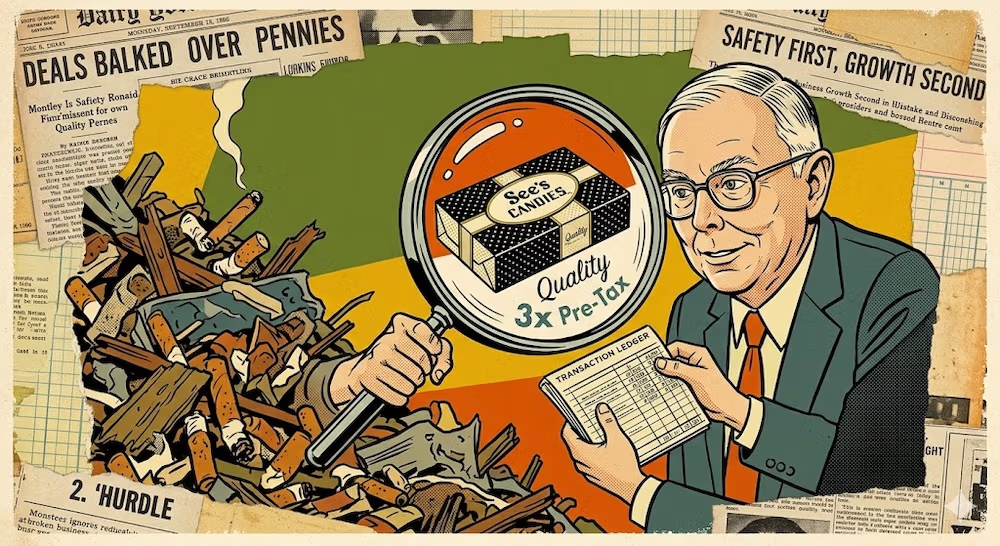
The story is universally told as the moment Munger broke Buffett out of his strict Grahamite mindset and forced him to buy a premium business. But the actual transaction ledger reveals just how intensely price-sensitive Munger remained during this transition.
In 1972, Blue Chip Stamps—the investment vehicle controlled by Munger and Buffett—was negotiating to purchase See’s Candies outright. The corporate financial state was highly compelling: See’s possessed roughly $4 million in tangible net worth and was generating $4 million in annual pre-tax corporate earnings (roughly $2 million after-tax).
The selling family demanded $12 million.
Because the asking price was three times tangible net worth, Munger initially balked. He was so anchored to absolute asset safety that he almost let one of the greatest cash-generating machines in corporate history walk away over a few hundred thousand dollars. He only agreed to execute the trade because the entry valuation represented a modest multiple of 3x pre-tax earnings (roughly 6x after-tax earnings based on the corporate tax rates of that era).
See’s Candies 1972 Deal Metrics
| Metric | Historical Value |
|---|---|
| Tangible Net Worth | $4,000,000 |
| Annual Pre-Tax Earnings | $4,000,000 |
| Initial Asking Price | $12,000,000 |
| Implied Pre-Tax Multiple | 3.0x |
| Implied After-Tax Multiple | 6.0x |
The holy grail of quality investing was acquired for single-digit earnings multiples. Yet today, retail allocators use the See’s Candies gospel to justify paying 60x earnings for dominant consumer or tech brands.
The irony is absolute. Munger’s premium quality play was cheaper than almost any stock available in the modern market. He demanded an immense margin of safety on price, even when he fully recognized the permanence of the corporate moat.

Business Return Is Not the Same as Investor Return
Before diving into the underlying equations, we must establish a foundational, plain-English bridge that separates corporate execution from public market equity returns.
The Core Rule: A business’s internal operational return is not the same as your actual investor return.
A company can execute perfectly, expand its market share, and compound its internal equity like clockwork, yet the shareholder can still suffer a lost decade. This disconnect happens because the internal compounding occurs at the corporate level, while your return is anchored to the changing price of the security on the public exchange.
The wedge driven between these two realities is the valuation multiple change. When you buy a stock, you are purchasing a stream of earnings. If you pay too much for that stream at entry (P/Eentry), and the market pays less for that exact same stream when you exit (P/Eexit), you experience multiple compression.
This compression acts as a direct, structural tax on the company’s internal growth. If the contraction is severe enough, it will entirely cannibalize the real-world operational wealth created by the business.
The Multiple Compression Math
To see this mechanism clearly, we must look at the linear math governing long-term compounding. If an investor holds a stock for a horizon of n years, and the company continuously reinvests 100% of its earnings back into the business at its internal return on capital (ROC), the total return multiplier (TR) is mathematically bound by the following formula:
TR = (1 + ROC)n × (P/Eexit / P/Eentry)
To isolate the annualized compounding rate of return (Ra) that lands in your portfolio, we take the n-th root of the equation:
Ra = (1 + ROC) × (P/Eexit / P/Eentry)(1/n) – 1
To keep this model mathematically clean and useful, we must outline its foundational baseline assumptions:
- The company’s internal ROC remains completely constant over the entire holding period.
- 100% of earnings are retained and reinvested back into the business at that exact ROC (no dividends or share buybacks occur unless implicitly bundled into the corporate economics).
- Taxes, transaction costs, and institutional friction are completely ignored.
- ROC is utilized as a simplified, clean proxy for the reinvested underlying business economics.
Now, let’s run a real-world simulation using this formula to see exactly how an aggressive entry multiple destroys a great business engine over a realistic retail holding period (n = 5 years).
Imagine you identify an elite company compounding its internal equity at an exceptional rate (ROC = 20%). Swept up in market enthusiasm, you buy the stock at a premium entry multiple (P/Eentry = 60). Over the next five years, the corporate fundamentals are immaculate—the business does not miss a single target.
However, during those five years, macroeconomic regimes shift. Interest rates reprice, and the market normalizes the asset back to a standard historical baseline multiple (P/Eexit = 20).
Let’s calculate the exact mathematical drag generated by that multiple compression:
(20 / 60)(1/5) = (0.3333)0.2 ≈ 0.8027
The contraction from 60x to 20x earnings inflicts an inescapable -19.73% annualized drag directly onto your actual returns. When we plug this structural weight back into our annualized investor return formula, the result is eye-opening:
Ra = (1 + 0.20) × 0.8027 – 1 = 1.20 × 0.8027 – 1 = 0.9632 – 1 = -3.68%
The business performed beautifully, growing its internal wealth at 20% annualized. Yet as an investor, you lost -3.68% per year for half a decade. The entry price acted as an absolute mechanical constraint, stalling out the compounding engine before it could ever deliver returns to your pocket.
Why Holding Period Changes Everything
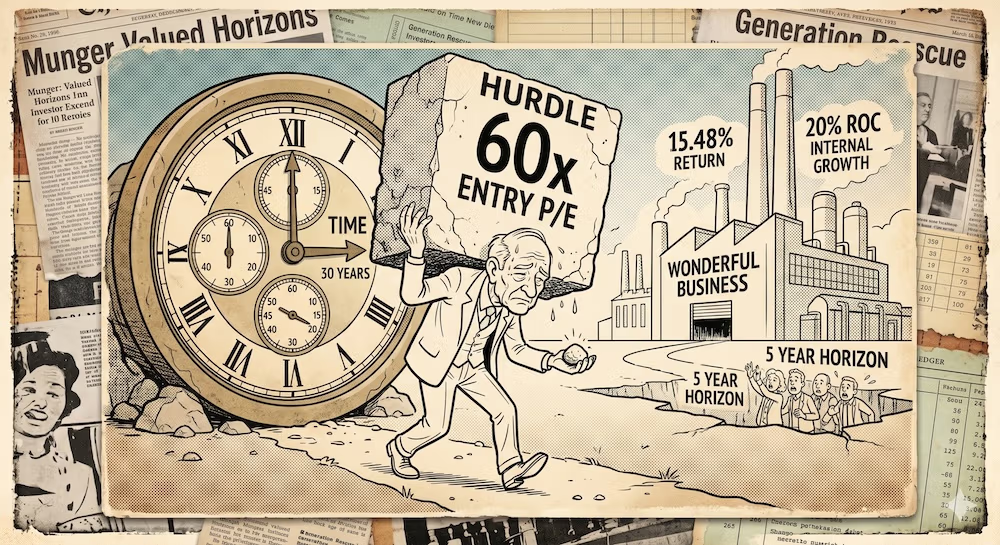
This brings us to why Munger consistently noted that time is the friend of a wonderful business. The weight of your entry multiple is entirely dependent on your holding horizon.
Let’s look at how the exact same multiple compression scenario (paying 60x entry P/E for a 20% ROC business that compresses down to a 20x exit P/E) plays out across different holding periods.
Valuation & Holding Period Sensitivity Matrix
| Scenario | Internal ROC | Entry P/E | Exit P/E | Holding Period (n) | Annualized Return (Ra) | Practical Lesson |
|---|---|---|---|---|---|---|
| 1. The Retail Horizon Trap | 20% | 60 | 20 | 5 Years | -3.68% | Multiple compression completely destroys excellent business compounding over short periods. |
| 2. The Generational Rescue | 20% | 60 | 20 | 30 Years | +15.48% | Over decades, internal business growth dominates, rescuing a poor initial entry price. |
| 3. The Disciplined Allocator | 20% | 20 | 20 | 5 Years | +20.00% | Buying quality at a fair price captures the true, unadulterated compounding power of the business. |
| 4. The Value Tail-Wind | 10% | 10 | 15 | 5 Years | +19.14% | A mediocre business with multiple expansion can match high-quality returns over short horizons. |
The math demonstrates that over a 30-year horizon, the annualized drag of that same valuation collapse shrinks dramatically because the n-th root spreads the pain across three decades:
(20 / 60)(1/30) = (0.3333)0.0333 ≈ 0.9640 → (Only a -3.60% annualized drag)
This is the mathematical core of why Munger valued long-term horizons. Over thirty years, the business performance rescues you (15.48% return despite a 66% multiple drop).
But here is the reality check: most self-directed retail investors do not actually possess an infinite time horizon, infinite behavioral patience, or permanent, non-callable corporate cash. If you are investing capital that you might need for a real estate purchase, tuition, or retirement rebalancing within the next five to ten years, you are playing in the zone where entry price matters brutally.
Furthermore, Munger and Buffett operated within corporate insurance holding structures (like Wesco Financial and Berkshire Hathaway) backed by billions in non-callable insurance float. They could comfortably sit through multi-year valuation compression cycles because they faced zero redemption risk or client withdrawals. A retail account holding a hyper-concentrated position at 60x earnings has no such structural insulation.
When Great Businesses Still Punish Investors
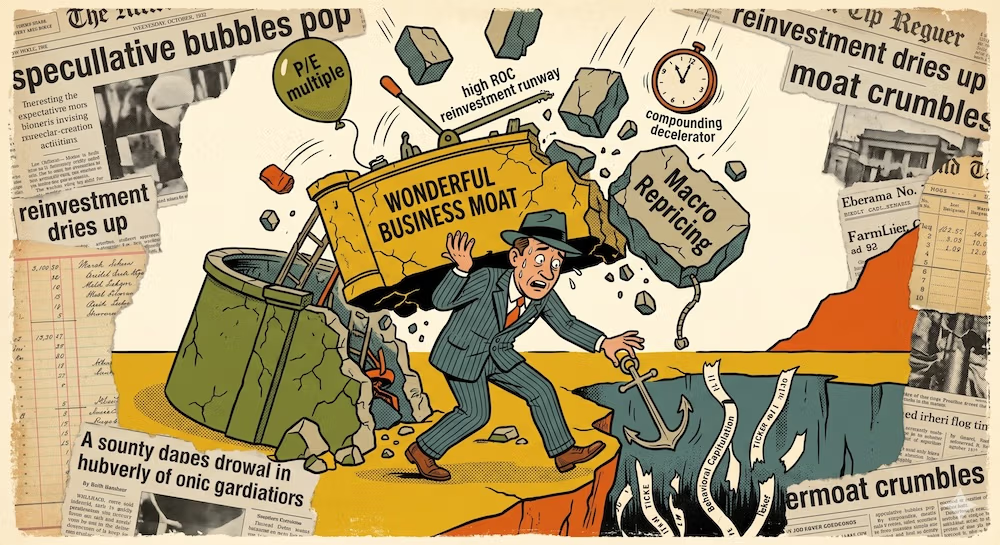
When you ignore these mathematical boundaries and pay an infinite premium for a moat, you expose your capital to five highly specific failure modes:
- The Valuation Decompression: The core business performs exactly as underwritten, but the market reprices the industry or asset class from a speculative multiple back to a historical baseline, locking the investor into years of negative or flat returns.
- The Weakening Moat: You pay a premium price assuming a corporate competitive advantage will last forever. If the moat degrades or faces structural technological disruption early in your holding window, you get hit with a catastrophic double-blow: slowing earnings growth and a collapsing multiple simultaneously.
- The Closing Reinvestment Runway: A company maintains a high internal return on capital (ROC), but its market becomes saturated. Because it can no longer find places to deploy new capital at those high rates, it is forced to accumulate low-yield cash or pay out dividends, causing the overall compounding rate to decelerate rapidly.
- Macro Regime Repricing: Macroeconomic shifts occur—such as interest rates rising from a 0% baseline up to 5%. As risk-free yields increase, long-duration equities are systematically repriced lower, compressing high P/E ratios across the entire equity spectrum.
- The Behavioral Capitulation: The investor fully intends to hold the premium stock for thirty years so the business quality can overcome the high entry price. However, facing a prolonged five-year window of deep underperformance and relative tracking error against simpler index alternatives, emotional fatigue sets in, leading to liquidation at the absolute bottom of the valuation cycle.
The Sponge Verdict: Absorb Quality, Enforce Price Discipline
To build an independent portfolio canvas, we must separate the grandfatherly folklore of Munger from the underlying mathematical mechanics. We adopt the mindset of a Sponge Investor: absorb what is structurally sound, and expel the narrative distortions.
Modern Implementation Friction Ledger
| Historical Strategy Mechanic | Modern Execution Friction | Who Gets Hurt | Practical DIY Alternative |
|---|---|---|---|
| Paying Elevated Premiums For Growth | Multiple contraction cycles can completely wipe out intermediate-term human horizons. | DIY investors with fixed 5-to-10-year timelines or near-term capital needs. | Implement strict absolute valuation ceilings (P/E or cash-flow caps) regardless of business quality. |
| Hyper-Concentrated Moat Investing | Severe tracking error and single-stock volatility can trigger behavioral panic. | Allocators lacking non-callable insurance float or permanent corporate capital. | Some investors treat individual quality stocks as a limited satellite allocation around a diversified core, but the appropriate size depends on risk tolerance, tax situation, liquidity needs, and ability to withstand tracking error. |
Absorb Munger’s elegant focus on capital efficiency. Spend your time identifying high-quality companies that generate genuine, high returns on capital (ROC) and possess durable runways to reinvest those earnings internally. Avoiding capital-destroying, structurally broken businesses is half the battle of compounding.
But ruthlessly expel the modern folklore that claims business quality cancels out valuation discipline. Do not engage in historical corporate cosplay by paying astronomical multiples under the delusion that you are mimicking the master allocators. Munger underwrote See’s Candies at single-digit earnings multiples, always enforcing a strict margin of safety.
Protect your portfolio by anchoring your quality analysis in unassailable mathematics. Pay a fair price, respect the constraints of your own investment horizon, and never let admiration for a company turn into an infinite price tag.
What is the minimum portfolio size needed to replicate Munger’s quality-at-a-fair-price strategy?
It depends entirely on your vehicle structure. If you are trying to replicate his early hyper-concentrated approach of holding over 50% of your capital in three or fewer individual equities, there is no minimum structural dollar amount, but the behavioral minimum is immense. However, because a retail DIY investor operates without a permanent corporate cushion or non-callable insurance float, copying this concentration size invites catastrophic single-stock tracking error. For most retail accounts, treating individual high-ROC selections as a small satellite allocation surrounding a diversified core is the logical workaround.
Can a standard retail brokerage account access the structural advantages Munger had?
No. This is the hardest truth to swallow. Munger and Buffett operated within insurance corporate structures (like Wesco Financial and Berkshire Hathaway) backed by billions of dollars in permanent, non-callable insurance float. They faced zero redemption risk, zero margin calls, and zero panicking clients calling to withdraw capital during down cycles. A retail account holding public equities inside a standard taxable or margin brokerage setup enjoys none of these structural protections, making direct portfolio replication highly dangerous.
How does tax drag impact long-term compounding when executing this quality equity strategy?
Yes, significantly if executed in the wrong basket. Munger’s approach relies on holding great businesses for long horizons to let their internal return on capital overpowers entry multiple errors. If you operate inside a standard taxable brokerage account, forced turn-overs, corporate restructurings, or tactical adjustments trigger an immediate capital gains tax hit, which acts as a drag on your compound engine. A practical DIY workaround is to isolate individual, long-horizon quality selections inside tax-advantaged accounts like an IRA or 401k to shield that internal compounding velocity.
Which modern ETF metrics or factors align closest with Munger’s corporate quality framework?
Not exactly a perfect match, but look for the Quality factor (QMJ or Quality Minus Junk). Modern quantitative index products screen for companies using metrics that mirror Munger’s demands: high return on equity, low corporate debt-to-equity ratios, stable earnings growth, and strong gross margins. However, broad Quality ETFs do not apply the type of strict absolute valuation ceilings on entry P/E multiples that Munger enforced on deals like See’s Candies. You still have to monitor the aggregate factor multiple yourself.
What happens to high-ROC stocks if macroeconomic interest rates shift upward permanently?
They reprice lower. High-quality growth businesses with massive future compounding runways act as long-duration assets on your financial canvas. When macroeconomic regimes shift and risk-free interest rates step up from a 0% baseline to a 5% baseline, the discount rate applied to those distant future cash flows increases. This systematically decompresses premium valuation multiples across the entire equity landscape, meaning even an elite company can face a prolonged multi-year flatline in stock price while its multiple resets to reality.
Why is a company’s internal return on capital (ROC) different from my actual investor return?
Because entry price acts as a mechanical gate. A business can perform flawlessly, expanding its market share and compounding its internal equity at 20% annualized at the corporate level. But if you pay a premium entry multiple of 60x earnings to buy that stream, and the market normalizes the asset down to a historical baseline of 20x earnings over your 5-year holding horizon, the resulting multiple contraction creates an inescapable -19.73% annualized drag that completely cannibalizes the underlying corporate growth. Your personal return is tied to price changes, not just business reports.
This article is also available in Spanish. [Leé la versión en castellano: Charlie Munger y la valuación: por qué el precio todavía importa en las empresas excelentes]