
Warren Buffett is widely recognized for his staggering compounding record as the chairman and CEO of Berkshire Hathaway. Over the decades, he has assembled massive stakes in structural compounders like GEICO, Dairy Queen, Coca-Cola, and Apple. But I used to assume his edge was purely quantitative. I assumed he just possessed a superior mental calculator for discounted cash flows or a proprietary way to read a 10-K. Honestly, it’s a completely different animal when you trace his actual history. The reality is almost entirely behavioral. The mechanical advantage of his approach only exists because he systematically exploits the emotional collapse of other market participants. That is where the actual alpha lives.
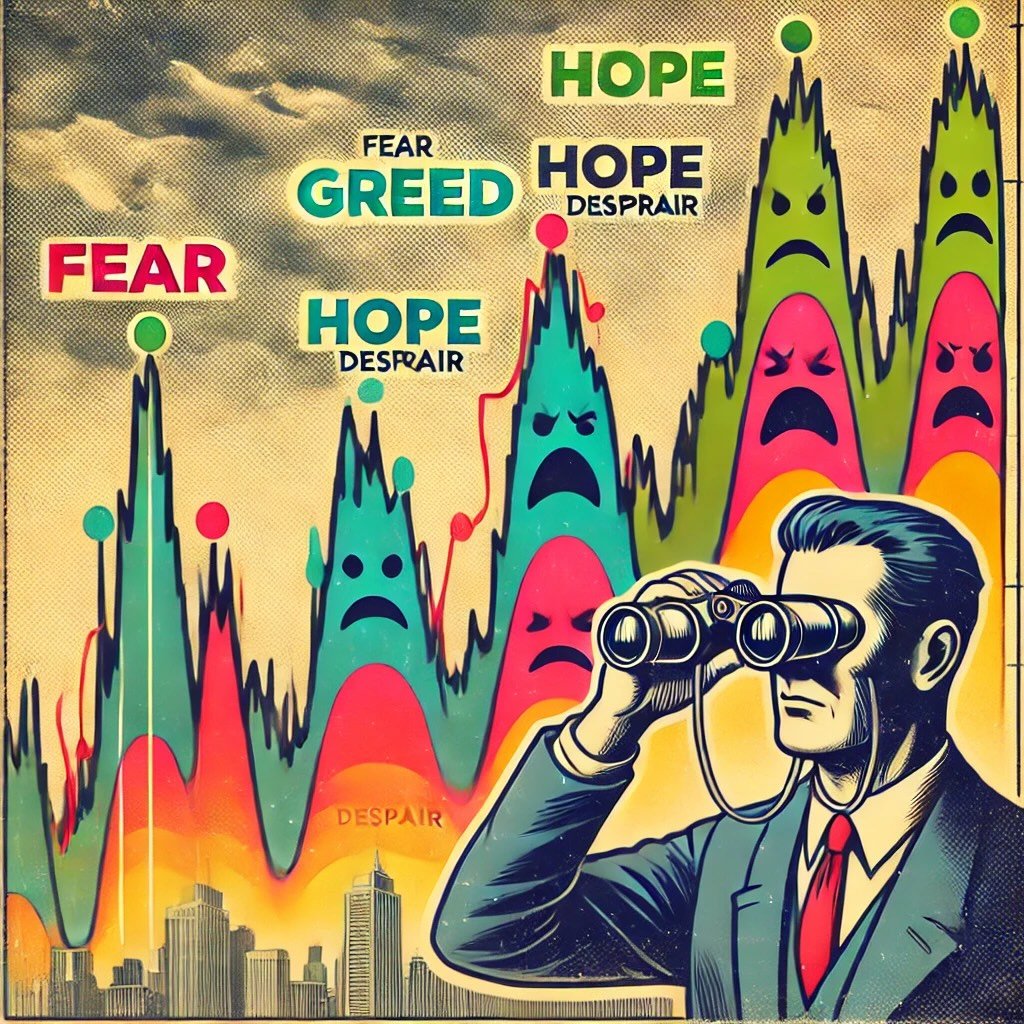
Yes, you read that right. The moat isn’t just the math; it’s the mindset. I’ve held factor-based ETFs through excruciating three-year underperformance windows where it felt like setting capital on fire while the S&P 500 ripped higher. The tracking error pain is real, and the temptation to abandon a systematic strategy after a 20% drawdown is overwhelming. Buffett understands that this specific psychological discomfort is what drives asset prices to detach from their underlying fundamentals. He waits for fear, greed, and despair to cause forced liquidations, creating a massive liquidity premium for anyone with the capital—and the stomach—to step in.
We’re going to unpack the mechanics of how he executes this. We’ll dissect the math behind being “fearful when others are greedy and greedy when others are fearful.” We’ll look at the specific asset allocation logic he uses to identify mispriced equities, how he explains the role of patience as a structural advantage, and how he extracts maximum capital efficiency during times of collective panic. The math doesn’t lie. While valuation multiples are critical, it’s the disciplined extraction of the behavioral risk premium that truly separates a durable portfolio from a fragile one.
Let’s start with the baseline mechanics of the emotional friction he exploits daily. Markets are quoted in numbers—P/E ratios, bond yields, implied volatility—but they are priced by human panic and euphoria. When I’m constructing a portfolio blending value, momentum, and trend following for maximum diversification, I’m essentially trying to systematize what Buffett does intuitively. He recognized early on that if he could completely detach his own execution from the crowd’s hysteria, he could capture the spread between a company’s fundamental cash flow generation and its emotionally distorted share price.
Next, we’ll look at the data side of spotting market irrationality. Buffett is famous for sitting on his hands during the dot-com bubble of the late 1990s. The financial press openly mocked him, pointing out that Berkshire’s book value underperformed the S&P 500 by over 20% in 1999 alone. Specifically, Berkshire’s per-share book value grew by a mere 0.5% while the tech-fueled S&P 500 surged by 21.0%, punishing disciplined value investors with a staggering 20.5% single-year tracking error gap. What gets passed over is the sheer behavioral discipline required to withstand that implementation friction. He wasn’t being stubborn; he was being mathematically precise. He couldn’t reconcile the negative free cash flow of early tech startups with their astronomical market caps. When the bubble burst, the capital destruction for trend-chasers was absolute, validating his refusal to participate in the negative expected return of an overvalued sector.
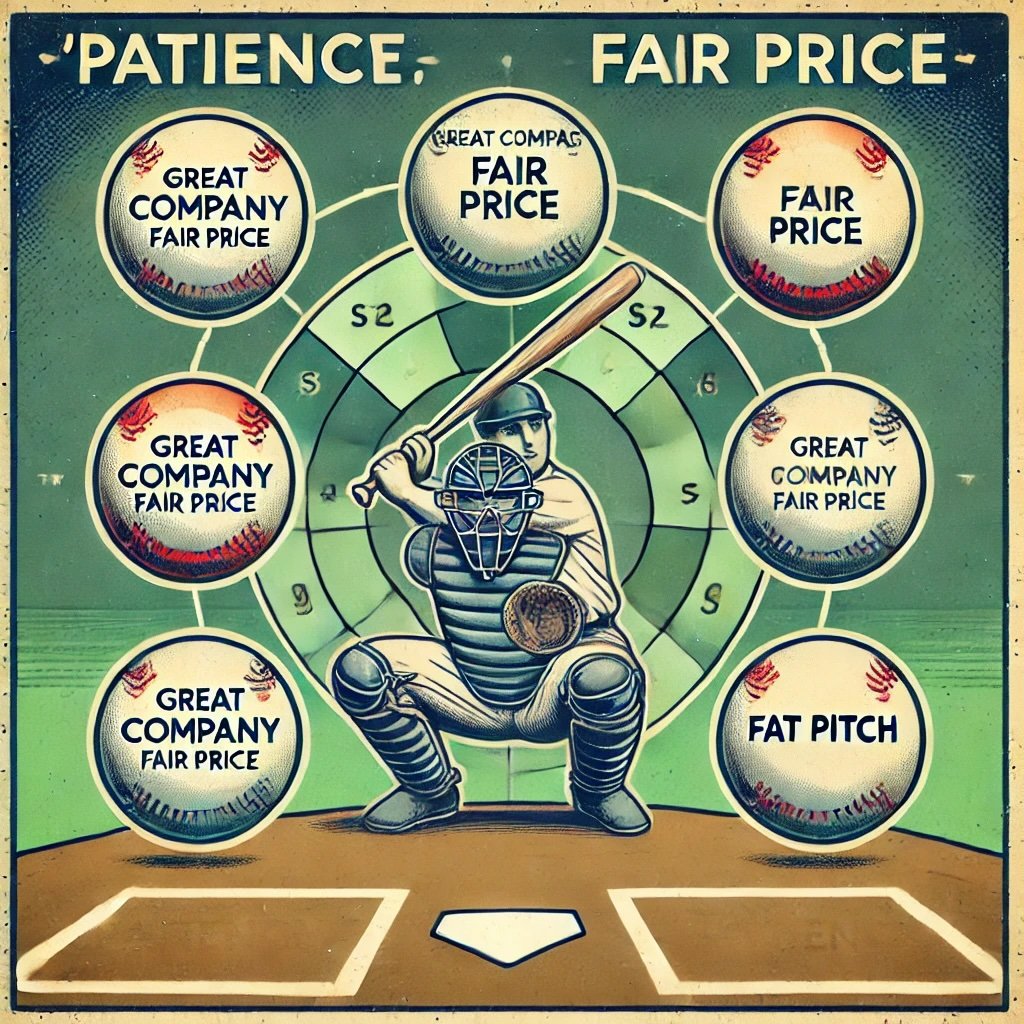
Then we’ll examine the portfolio drag of his unwavering patience. Holding cash isn’t just a neutral position; it’s an active drag on your CAGR. It takes immense behavioral discipline to eat that tax drag and inflation erosion just to maintain optionality. Buffett waits for the “fat pitch,” perfectly willing to let hundreds of overvalued equities pass by while Berkshire’s cash pile has reached historical highs of $276.9 billion in recent statutory reports. He demands a margin of safety—a discount steep enough to absorb future economic shocks—before deploying capital. He demands a great company at a fair price, rather than settling for a mediocre asset just to stay fully invested.
Further, we’ll dissect how he monetizes fear. During a severe drawdown, bid-ask spreads on even highly liquid assets can blow out. Buffett doesn’t just buy index funds during these events; he structures bespoke deals. This isn’t just a random strategy. He famously injected capital into Goldman Sachs in 2008 and Bank of America later on, extracting massive yields via preferred shares and warrants. Retail investors often try to copy this by buying the common stock, completely missing that he essentially demanded a premium for providing liquidity when the rest of the market was insolvent.
But the mechanics are only half the battle. Buffett teaches others about long-term thinking because the implementation gap between a clean backtest and the live experience of holding a volatile asset is where most investors fail. He warns that herding into crowded trades guarantees sub-par returns. The real compounding happens when you identify a high-return-on-equity business, buy it at a discount, and brutally ignore the urge to tinker with the allocation for the next twenty years.
Let’s get into the granular details. We’ll start by breaking down the core behavioral framework Buffett uses to isolate the exact moments when fear and greed create structural mispricing in the market.
The Foundation: Buffett’s Understanding of Market Psychology
Fear and Greed: The Market’s Driving Forces
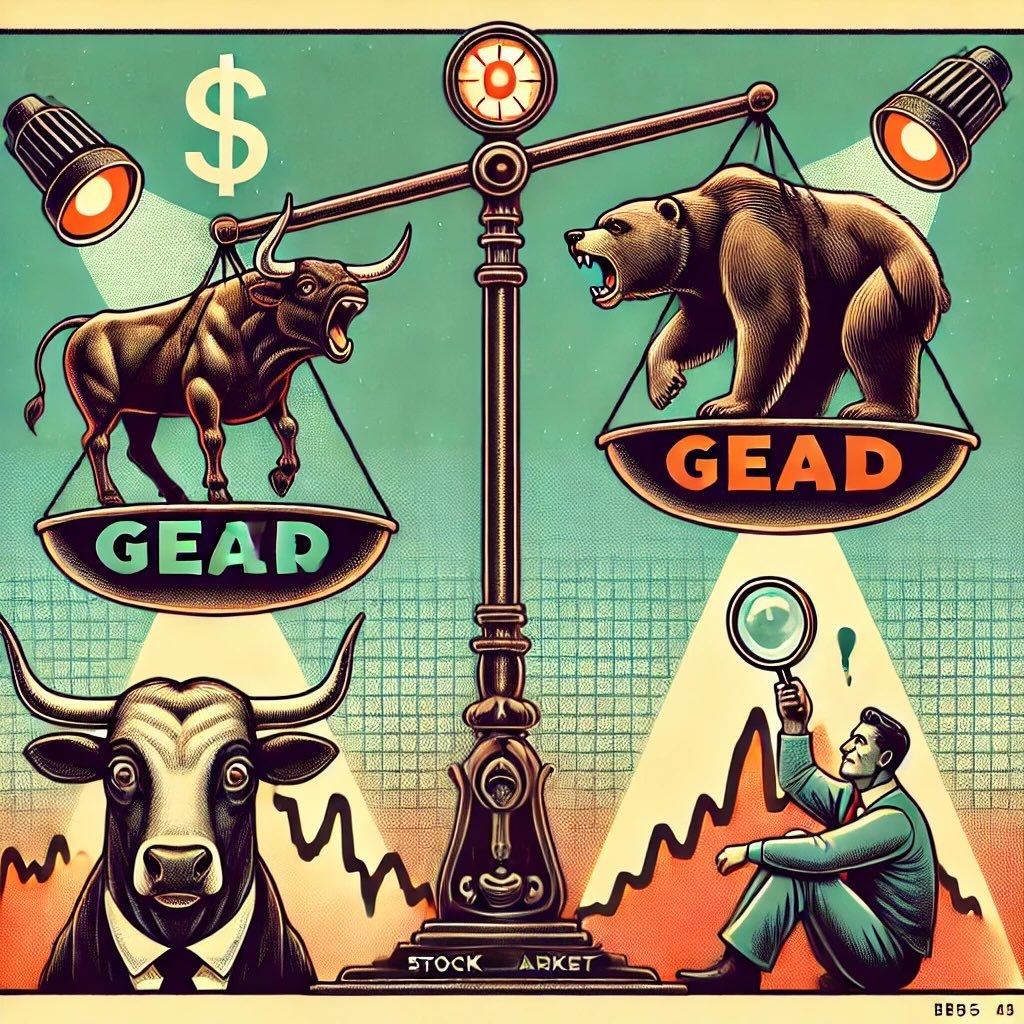
Warren Buffett famously stated, “Be fearful when others are greedy, and be greedy when others are fearful.” That isn’t just a catchy bumper sticker; it’s a quantitative instruction manual for counter-cyclical asset allocation. When capital is cheap and retail euphoria peaks, multiple expansion drives prices far beyond intrinsic value. That’s the greed phase. Conversely, during a liquidity crisis, margin calls and institutional risk limits force the indiscriminate selling of perfectly healthy equities. That is the fear phase, and it’s the exact environment where future outperformance is born.
Buffett has tracked these mean-reverting cycles for decades. He views the stock market as a chaotic auction house where the participants suffer from bipolar disorder. When the participants are euphoric, the expected forward returns of the broad market compress toward zero. When they are despondent, the expected returns spike. The mechanical trade-off means adjusting capital deployment based on the aggregate behavioral sickness of the crowd, leveraging Berkshire’s massive insurance float—effectively non-callable, zero-cost leverage—to buy what others are forced to sell.
The Emotional Side of Investing
Many new DIY investors focus entirely on screening for low P/E ratios or high dividend yields, assuming the math will protect them. Yet, Buffett emphasizes the role of emotional discipline precisely because technical analysis is useless if you puke your positions at the exact bottom of a bear market. It’s a completely different animal when you are logging into your brokerage account and seeing red numbers every single day. That’s when perfectly rational people abandon their carefully reasoned strategies and lock in permanent capital loss.
The part that cracks me up is how modern portfolios try to optimize around daily volatility while ignoring this human element. Buffett insulates himself from this panic by evaluating businesses as private owners would. If a company’s free cash flow generation, debt coverage ratios, and market share remain intact, a 40% drop in the share price is simply a mechanical repricing of risk by other people. He views volatility not as a measure of risk, but as a pricing error to be exploited. He buys the error.
Market Cycles and Human Behavior
The persistence of market cycles is entirely dependent on the persistence of human behavioral flaws. During a cyclical bull market, investors convince themselves that structural paradigms have shifted and historical valuation metrics no longer apply. When the inevitable drawdown occurs, recency bias takes over, and they project the negative volatility infinitely into the future. Independent allocators might parse this as a predictable feedback loop. Buffett understands that the intrinsic value of well-managed businesses does not fluctuate nearly as violently as their ticker symbols do.
He refuses to play the macro-prediction game. He doesn’t predict crashes. Instead, he structures his balance sheet to survive them and exploit them. He maintains massive cash reserves—often billions of dollars earning short-term Treasury yields—specifically to deploy when credit markets freeze. From the savings and loan crisis of the late 1980s to the 2008 subprime mortgage meltdown, his core operational procedure remains identical: hoard liquidity during the boom, deploy liquidity during the bust.
Building on Ben Graham’s Insights
The architectural foundation of this strategy comes directly from Benjamin Graham, the pioneer of systematic value investing. Graham introduced the concept of “Mr. Market,” an allegorical partner who offers to buy or sell your stake in a business every single day. Some days Mr. Market is euphoric and offers absurdly high prices; other days he is deeply depressed and offers to sell his stake for pennies on the dollar. Buffett’s genius, heavily influenced by Charlie Munger, was taking Graham’s deep-value, cigar-butt framework and applying it to high-return-on-capital compounders.
He shifted from buying mediocre companies at extremely cheap prices to buying exceptional companies at fair, emotionally depressed prices. The structural case for this relies on the realization that premium businesses have wider operational moats. But the underlying Graham methodology remains the same: use the manic-depressive nature of the market as a mechanism to acquire assets, never as an indicator of an asset’s true worth.
Spotting Market Irrationality
Identifying Overvaluation in Greedy Markets
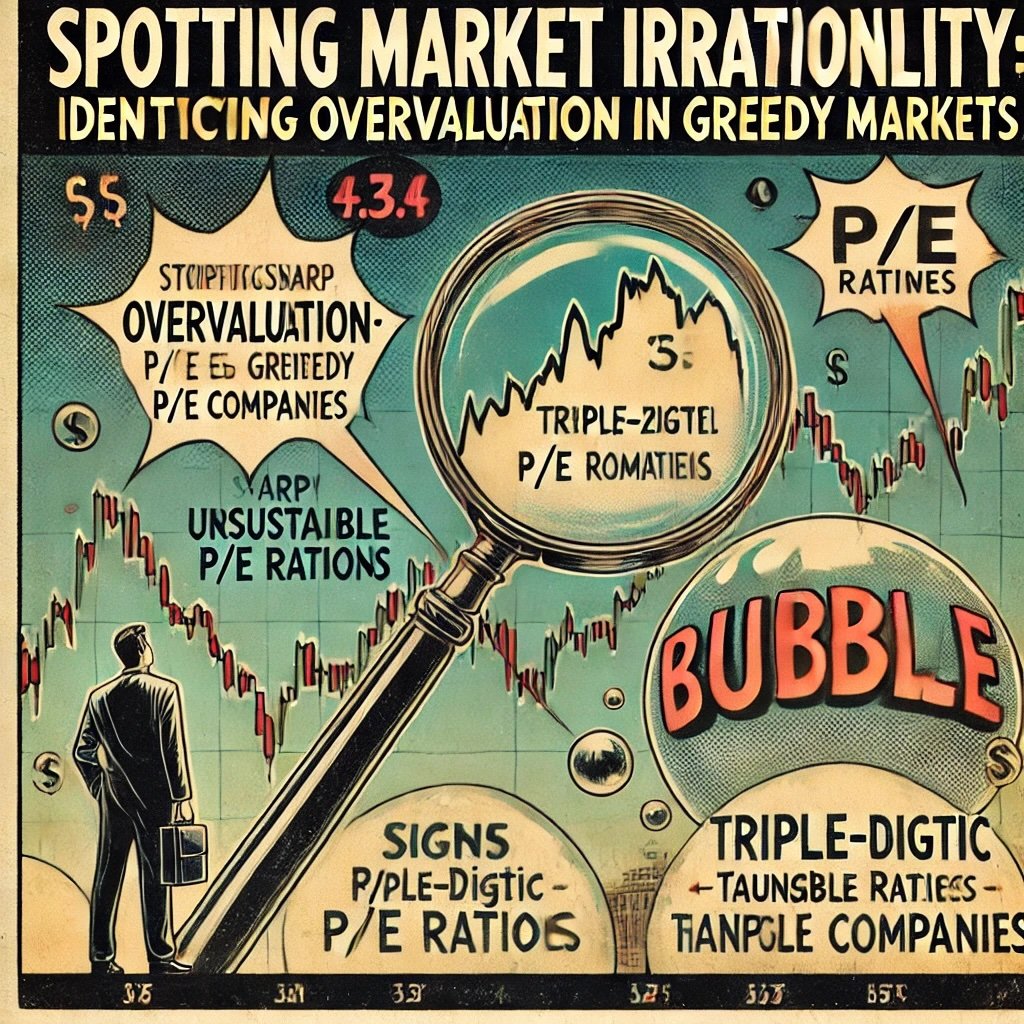
When a specific sector experiences a speculative blow-off top, the cost of capital drops to zero and fundamentals cease to matter. You see companies going public with no revenue, trading at 50x sales multiples, while retail participants brag about their short-term alpha. I used to assume people would realize this is mathematical suicide, but momentum is a powerful drug. Buffett pulls back entirely. He recognizes that when a stock’s valuation requires a decade of flawless, hyper-growth execution just to justify today’s price, the margin of safety is negative.
Look at the late 1990s. The narrative was that the internet changed everything and traditional valuation was dead. Buffett refused to buy into companies like Pets.com because he couldn’t model their future cash flows with any degree of certainty. The financial media called him a dinosaur. But when the cost of capital eventually normalized, the companies with no fundamental earnings power were wiped out entirely. By simply refusing to participate in the irrationality, Buffett protected his compounding base, even if it meant looking foolish for three years straight.
Recognizing Undervaluation During Fearful Times
The inverse is equally true. When systemic risk hits the tape, correlation goes to 1. Everything gets sold regardless of quality. This is where the friction of the bid-ask spread destroys the portfolios of forced liquidators, and where Buffett steps in. He screens the wreckage for companies that have had their multiples crushed but retain their structural pricing power and enduring competitive advantages.
In the depths of the 2008–2009 financial crisis, he injected billions into General Electric and Goldman Sachs. He wasn’t catching a falling knife blindly; he was purchasing extremely high-yielding preferred equity with embedded warrants. In the October 2008 Goldman deal, he injected $5 billion in exchange for preferred stock bearing a massive 10% dividend, packaged alongside warrants to buy $5 billion of common stock at a strike price of $115 per share. He repeated this exact liquidity-extraction script in August 2011 with Bank of America, vacuuming up $5 billion in 6% preferred shares tethered to warrants for 700 million common shares at a dirt-cheap $7.14 strike price. This is where the live tracking error becomes uncomfortable for traditional market participants, but Buffett utilized the total collapse of institutional liquidity to force terms that are mathematically impossible to get during a normal macroeconomic regime. He bought the fear, but he structured the trade so his downside was legally protected.
Using Valuation Metrics Over Hype
Buffett treats equity as a fractional ownership in a business, not a blip on a screen. He completely ignores whether a stock is heavily shorted, trending on social media, or whether momentum traders love it. He is ruthlessly focused on the underlying mechanics: Return on Invested Capital (ROIC), free cash flow yield, tangible book value, and the integrity of the management team’s capital allocation track record.
If those metrics align to produce an intrinsic value that is 30% or 40% higher than the current market capitalization, he begins acquiring shares. If the market is pricing in a growth rate that exceeds the company’s historical maximum, he walks away. By anchoring his decisions entirely to the math of the balance sheet, he immunizes himself against the contagious narrative hype that destroys retail capital.
Avoiding Herd Behavior
Herding behavior is a biological survival mechanism, but in financial markets, it is a wealth-destroying bug. If you are buying an asset simply because the price is going up, you are the exit liquidity for the smart money. When the trend reverses, the herd panics and sells at the bottom. Buffett completely uncouples his execution from the herd. He understands that if you buy the exact same index allocations as everyone else, your returns will exactly match the index—minus your behavioral friction.
He frequently points out that the consensus trade is usually fully priced. To generate alpha, you have to find structural mispricing, which inherently means holding positions that are temporarily unpopular. In that sense, being contrarian can literally save your portfolio from cyclical drawdowns. But it’s not about being different just for the sake of it; it’s about having the mathematical conviction to stand your ground when the crowd is mathematically wrong.
Data Plus Psychology
The intersection of hard fundamental data and applied behavioral psychology is the true engine of Berkshire Hathaway. Buffett aggregates the quantitative metrics (debt-to-equity, gross margins, float generation) and waits for the macro-psychological environment to serve those metrics up at a discount. It’s the ultimate synthesis of value and momentum—buying value when the negative momentum of panic has completely exhausted the sellers.
It takes a tremendous amount of mental fortitude to execute. When the VIX spikes to 40, your primal brain is screaming at you to move to cash. Forcing yourself to hit the ‘buy’ button when the media is predicting a global depression is one of the hardest things an investor can do. But the math demands it. The framework rewards mechanical consistency over emotional agility every single time.
Leveraging Patience and Discipline
The Role of Patience in Market Timing
The single biggest advantage the retail DIY investor has over the institutional manager is the lack of career risk. A mutual fund manager has to stay fully invested or risk being fired for tracking error. Buffett utilizes this same structural patience. He doesn’t attempt to time the market by predicting quarterly earnings beats. He uses the baseball analogy: investing is a no-called-strike game. You don’t have to swing at every IPO, every spac, or every macro trend.
You can literally stand at the plate for three years, holding short-term treasuries, simply waiting for a market dislocation to drop the valuation of a high-quality compounder into your strike zone. This inactivity is agonizing for most investors who equate “doing something” with “making money.” Wow. Inactivity as an aggressive tool. Buffett knows that high-frequency trading only enriches the broker. Extreme patience forces the odds heavily in your favor before capital is ever put at risk.
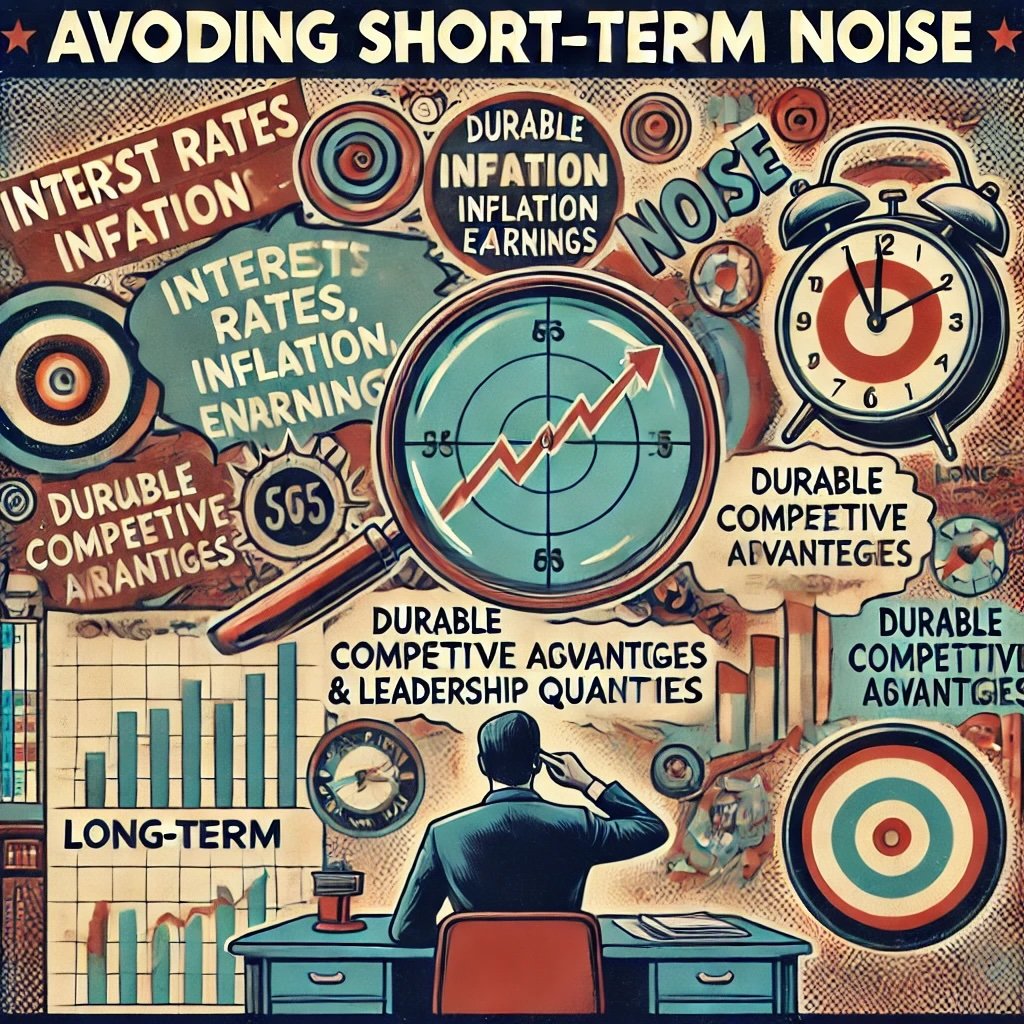
Avoiding Short-Term Noise
The financial media ecosystem is explicitly designed to hijack your amygdala. CPI prints, Fed rate chatter, geopolitical skirmishes—it’s all optimized to generate anxiety and drive transaction volume. Buffett completely insulates himself from this micro-macro noise. He evaluates a business based on whether its unit economics and competitive moat will still be dominant ten years from now. If the answer is yes, the current fed funds rate is largely irrelevant to the long-term holding.
When you filter out the daily ticker tape, your portfolio turnover plummets. This is crucial because high turnover introduces massive friction via taxes and bid-ask spreads. By doing the rigorous analytical underwriting upfront, Buffett can hold a position for decades without needing to react to the daily news cycle. He lets the fundamental compounding of the business do the heavy lifting, rather than trying to scalp 5% gains off headline volatility.
Staying Within the Circle of Competence
The “circle of competence” is a strict exclusionary filter. Buffett stays strictly within sectors he can accurately model: insurance float, consumer staples, railroads, utilities, and eventually Apple (which he correctly identified as an indispensable consumer product with high switching costs, not just a hardware maker). By ruthlessly defining what he does not understand, he eliminates the single largest source of behavioral error: buying a narrative you can’t verify.
Honestly, this is where most investors bleed out. They buy a highly complex biotech firm or an unprofitable SaaS company because someone on a forum posted a convincing thesis. If you don’t understand the specific mechanical drivers of a company’s free cash flow, you will inevitably panic-sell the moment the stock hits a 20% drawdown. Buffett’s rigid adherence to his circle of competence ensures he has the conviction to hold—and buy more—when his high-quality names go on sale.
Discipline in Overheated Markets
True discipline isn’t just about buying right; it’s about refusing to lower your underwriting standards when yield is scarce. During the early 2000s, mortgage-backed securities were generating massive, seemingly risk-free yields for the banking sector. Buffett looked at the underlying collateral, identified the toxic derivatives, and abstained. He underperformed in the short term, looking overly conservative, but preserved his capital base for the eventual implosion.
Furthermore, Buffett also exercises patience in holding his core positions. Rebalancing friction is a real tax on performance. It’s incredibly difficult to watch a position drop 30% and do nothing, but if the underlying thesis hasn’t broken, selling is just locking in a behavioral penalty. By anchoring his discipline to the business fundamentals rather than the daily price action, he rides out the volatility that shakes weaker hands out of the market.
Emotional Detachment Through Rules
You cannot rely on willpower to manage a portfolio through a crisis; you need systematic rules. Long-term studies by market research firms like Dalbar routinely highlight the structural “investor return gap”—showing that the average equity fund investor historically underperforms the broader market by 1.5% to 3.5% annualized due to poorly timed emotional trading. Buffett counters this behavior by operating on a rigid framework of maximum entry multiples, minimum return on equity thresholds, and strict requirements for management integrity. These guardrails act as a behavioral circuit breaker. When a stock is surging and FOMO kicks in, the valuation rule triggers a hard “no.”
This is the essence of systematic investing. By pre-defining the exact parameters of a buy or sell decision before the market opens, you remove the emotion from the execution. Buffett’s track record isn’t flawless—he admits his mistakes with IBM and certain airlines—but his strict adherence to his ruleset ensures that his drawdowns are manageable and his compounding is uninterrupted over a multi-decade timeline. The math doesn’t lie.
Capitalizing on Fearful Markets
Buying When Others Panic
We all talk a big game about “buying the dip,” but the reality of deploying capital during a true liquidity crisis is terrifying. When the VIX is exploding and the S&P is limit-down, your broker might not even load properly. In these moments, standard correlation breaks and institutions are forced to liquidate their best assets just to meet margin calls. This is the exact environment where Buffett deploys his war chest. He treats systemic panic as a clearance sale for high-grade equities.
Look closely at the mechanics of the 2008 financial meltdown. Credit markets seized. Nobody knew the true counterparty risk of major banks. While the retail crowd was liquidating at the absolute bottom, Buffett was structuring bespoke equity injections into stalwarts like Goldman Sachs. He didn’t know when the exact bottom would be, but he knew the mathematical probability of a complete collapse of the US banking system was lower than the market was pricing in. He bought the spread between perceived catastrophic risk and actual fundamental risk.
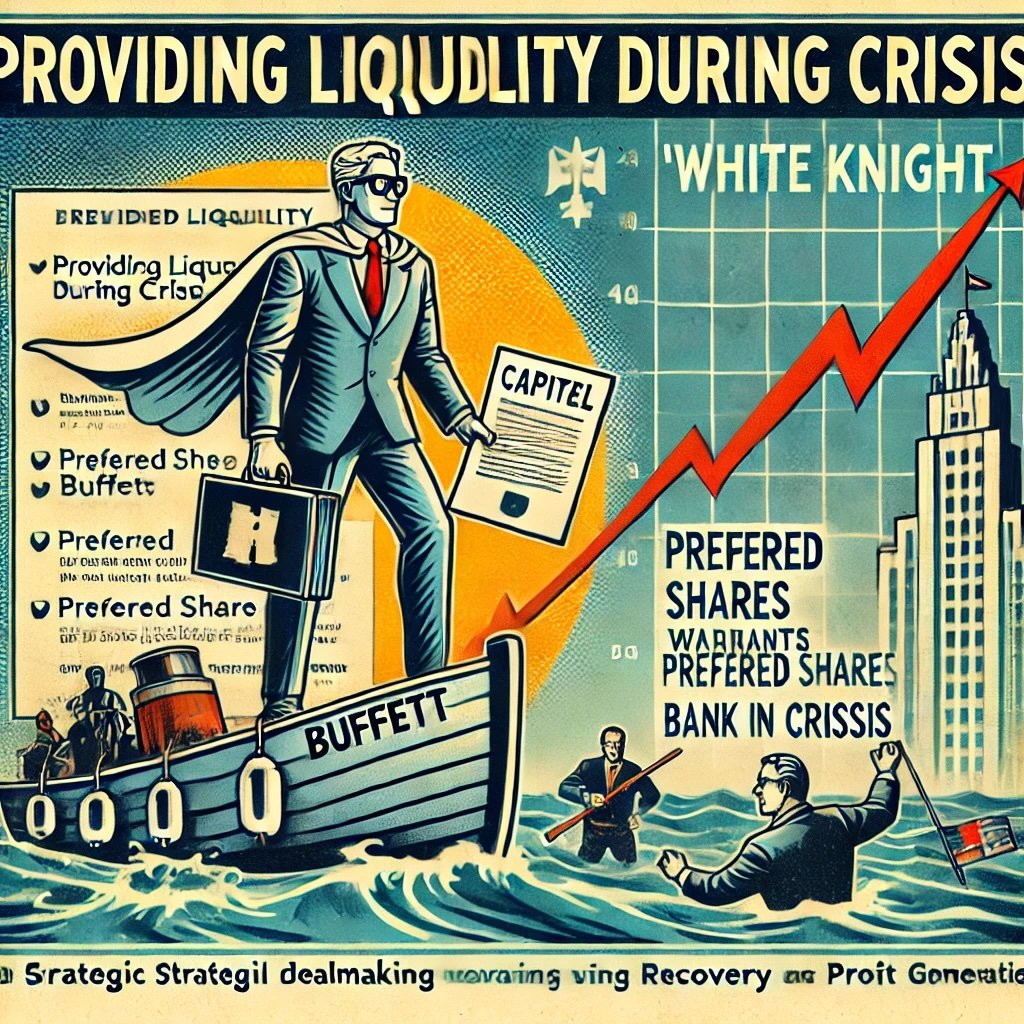
Providing Liquidity During Crisis
Buffett isn’t just a buyer of common stock; during a crisis, he becomes the lender of last resort. When fear destroys the corporate bond market and companies cannot roll over their debt, Buffett negotiates from an absolute position of leverage. By providing capital when the credit window is welded shut, he extracts massive terms—such as convertible preferred shares bearing 10% dividends, plus warrants to buy common stock at depressed prices. That is a luxury retail investors simply do not have access to.
This happened between 2011 and 2013 with Bank of America. The bank was drowning in legal liabilities from the subprime fallout and needed a massive psychological and financial backstop. Buffett stepped in, injected the capital, and secured a deal that generated billions in risk-free yield and capital appreciation. He weaponized his own liquidity to exploit the banking sector’s absolute desperation. Independent allocators might parse this as structural arbitrage on forced selling.
Reassuring Markets With Confidence
There is a secondary, reflexive benefit to Buffett’s crisis deployment: the “Berkshire Put.” Because of his long history of rigorous underwriting, when Buffett injects capital into a distressed entity, the market immediately reassesses the bankruptcy risk. Institutional capital often follows his lead, effectively stabilizing the asset he just purchased.
He isn’t doing this as a public service. He is acutely aware that his brand carries a psychological premium. By publicly stating his confidence in the long-term viability of the American economic machine during peak panic, he helps to break the self-fulfilling feedback loop of fear. He gets in at the absolute bottom, and his very presence helps initiate the recovery sequence.
The Advantage of Holding Cash
You cannot be the buyer of last resort if you are fully invested at the top of the cycle. Buffett routinely holds tens of billions of dollars in short-term T-bills. Critics scream about the cash drag on his overall portfolio return during bull markets. But Buffett understands optionality. He refuses to be forced to sell stocks to fund operations or meet obligations during a drawdown. Cash is his offensive weapon.
I know from building factor portfolios that cash drag is painful. The math dictates you should put every dollar to work. But Buffett’s cash hoard is essentially a massive, un-expiring call option on the total collapse of asset prices. When the inevitable reversion to the mean occurs and equity multiples contract violently, his cash allows him to acquire generational compounders at a fraction of their intrinsic value. If you want to invest like him, you have to be willing to stomach the boredom of holding dry powder. Yikes. That’s a tough task for hyperactive traders.
Contrarian, Not Reckless
It is vital to distinguish between calculated contrarianism and blind bottom-fishing. Buffett does not buy structurally broken companies just because their P/E ratio hit 5. He requires strong business moats, dominant market share, and a clear path to returning cash to shareholders. Buying a value trap in a dying industry isn’t contrarian; it’s a permanent loss of capital.
His execution during fearful markets is a masterclass in risk management. He limits his downside by structuring preferred debt with senior claims on assets, while retaining the equity upside via warrants. He is stepping into the fire, but he is doing it wearing a mathematically bulletproof vest. The mechanical trade-off here is crystal clear: forfeit absolute short-term performance to lock down structural survival.
Teaching Long-Term Thinking to Counter Herd Mentality
Buffett’s Advocacy for Long-Term Investments
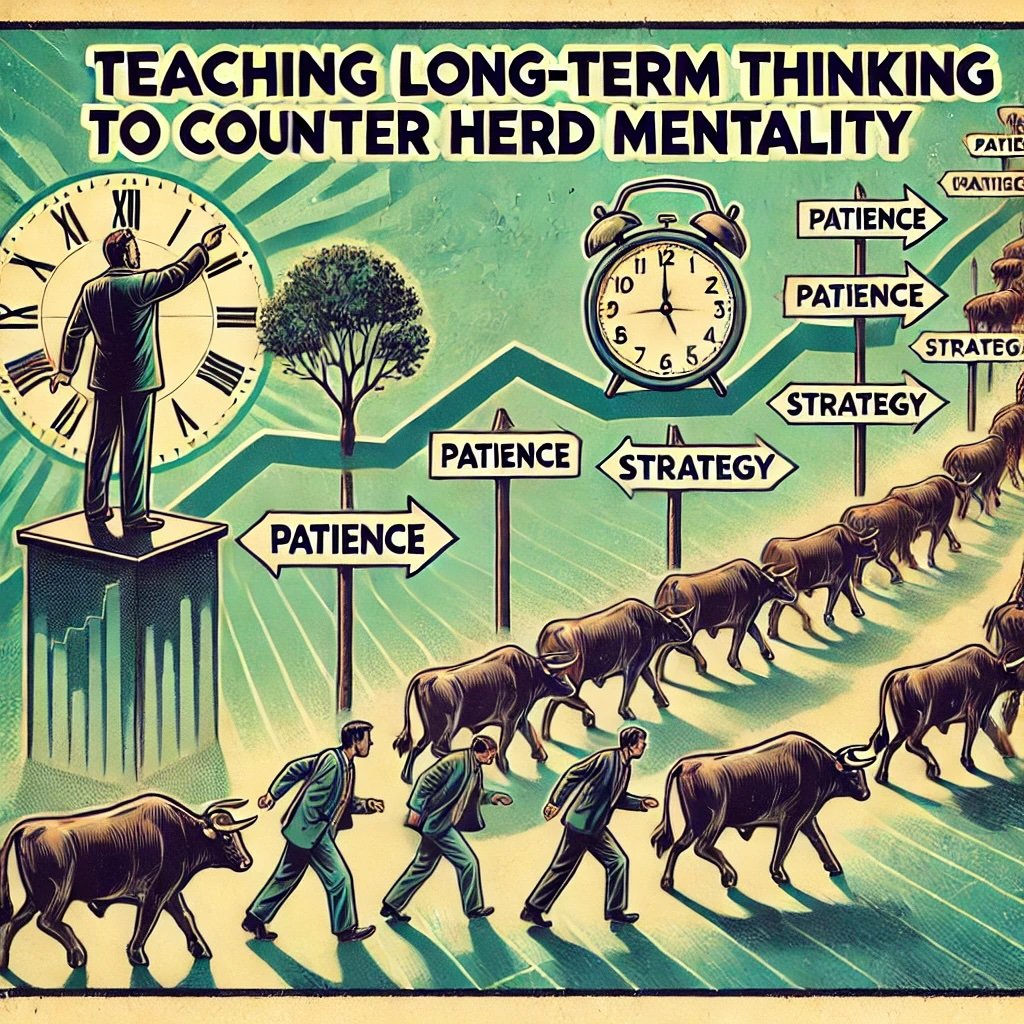
If you read anything about Warren Buffett, you will encounter his absolute disdain for high-frequency trading and short-term speculation. He explicitly states that if you aren’t comfortable holding a stock for a decade, you have no business owning it for ten minutes. This isn’t just folksy wisdom; it’s structural tax optimization and compounding math. Every time you flip a stock, you trigger short-term capital gains tax and bid-ask friction, mathematically destroying your total return.
He views a share of stock exactly as it is: a legal claim on the future free cash flow of a corporation. By extending his time horizon from quarters to decades, he completely nullifies the impact of algorithmic trading and macro-economic noise. He lets the fundamental growth in the company’s book value dictate his returns, rather than trying to scalp the daily volatility of the ticker symbol.
Challenging the Herd Mentality
The herd is always late. The herd buys at the top of the cycle because the narrative feels safe, and sells at the bottom because the narrative feels terminal. Buffett’s entire track record is built on exploiting this exact inefficiency. When the herd hated capital-intensive rail networks, Berkshire Hathaway acquired BNSF Railway, securing a localized monopoly with immense pricing power. When the herd viewed Apple as a hardware company subject to cyclical boom-and-bust cycles, he recognized it as the ultimate sticky consumer staple and made it his largest public equity holding.
He analyzes the consensus view, identifies the flawed assumptions in the herd’s valuation models, and takes the opposite side of the trade with massive size. It requires intense psychological independence to hold billions of dollars in a sector that the entire financial media ecosystem is currently writing obituaries for. What gets passed over is that the structural case for these plays rests on assets being structurally mispriced due to systemic tracking error anxiety.
The Power of Simplicity and Consistency
In a financial industry obsessed with complex derivatives, esoteric factor models, and proprietary black boxes, Buffett’s transparency is his greatest psychological tool. He explains his capital allocation decisions using elementary math and plain English. He breaks down the operational earnings of his insurance float and his wholly-owned subsidiaries without hiding behind adjusted EBITDA metrics.
This consistency builds absolute trust. When the broader market is violently rotating through sectors, Berkshire shareholders tend to hold firm because the thesis hasn’t changed since the 1970s: buy good companies at fair prices, let the management team compound the retained earnings, and ignore the noise. That behavioral anchor prevents his investor base from panicking, providing Berkshire with the stable permanent capital required to execute its strategy.
Teaching Through Shareholder Letters and Annual Meetings
The annual Berkshire Hathaway shareholder letters are effectively a masterclass in capital allocation and behavioral finance. They are as influential as any economics textbook. He meticulously dissects his own mistakes—like his misallocation in Dexter Shoe—to demonstrate that even the best investors suffer from errors in analyzing competitive moats. He brutally strips away the glamour of investing and reduces it to the cold math of long-term investing.
The annual meeting in Omaha serves as a live stress-test of his philosophy. Watching Buffett and the late Charlie Munger field questions for hours on everything from macroeconomic policy to the specifics of insurance underwriting demonstrates the depth of their circle of competence. It proves that their outperformance isn’t the result of a secret algorithm; it’s the result of relentless, rational underwriting over fifty years.
Undermining Fear and FOMO
The modern retail trading environment is engineered to trigger FOMO. Zero-commission trading apps with confetti animations gamify the deployment of capital, encouraging people to chase zero-day options and meme stocks. Buffett’s core philosophy acts as a direct antidote to this toxic gamification. He reminds investors that missing out on a speculative bubble is not a failure; participating in it and suffering permanent capital loss is.
By forcing investors to look at the underlying unit economics of the business rather than the daily chart pattern, he completely neutralizes the emotional volatility of the market. When you know a company is generating a 20% return on tangible equity and repurchasing its own shares, you don’t panic when the stock drops 5% on a random Tuesday. You recognize it as noise. That’s just me, but the peace of mind alone is worth the execution discipline.
Continuous Reinforcement of Rational Thought
Ultimately, Buffett’s enduring legacy isn’t just his net worth; it’s the framework he provided for rational capital allocation. He relentlessly reinforces the idea that the stock market is a mechanism for transferring wealth from the impatient to the patient. By constantly emphasizing the fundamental drivers of business value—pricing power, capital efficiency, and honest stewardship—he provides a behavioral roadmap for navigating the inevitable drawdowns that destroy the portfolios of the undisciplined.

How Warren Buffett Uses Market Psychology to His Advantage — 12-Question FAQ
What does Buffett mean by “be fearful when others are greedy, and greedy when others are fearful”?
He’s describing the mechanical extraction of the behavioral risk premium. When multiple expansion pushes prices completely untethered from intrinsic cash flows, he halts deployment. When systemic panic creates forced liquidation and crashes multiples below book value, he deploys aggressively.
How does he keep his own emotions from hijacking decisions?
He relies entirely on pre-set quantitative rules—demanding a hard margin of safety, screening for high ROIC, and strictly limiting buys to his circle of competence. These mechanical guardrails completely eliminate the impulse to chase momentum or panic-sell during a VIX spike.
What role does the “Mr. Market” metaphor play in his psychology?
Graham’s “Mr. Market” framework shifts the investor from a victim of volatility to an exploiter of volatility. Buffett treats daily price fluctuations as irrational offers to buy or sell, entirely detaching his assessment of a company’s fundamental value from its current ticker price.
Why is patience such a powerful psychological edge for Buffett?
Because cash optionality is mathematically superior to marginal deployment. Waiting for a “fat pitch” drastically reduces portfolio turnover, eliminates the tax drag of short-term gains, and concentrates capital entirely into high-conviction, asymmetrical setups.
How does maintaining large cash reserves exploit market psychology?
It transforms him into the ultimate liquidity provider during credit freezes. While over-leveraged institutions are forced to liquidate, Buffett uses his cash pile to dictate predatory terms, securing high-yield preferred equity and warrants that are unavailable during normal market regimes.
How does he spot crowd irrationality in real time?
He tracks the exact divergence between market capitalization and fundamental unit economics. When IPOs pop 50% with zero revenue, or when highly profitable dividend payers are dumped purely for liquidity, he knows the market is operating on pure emotion.
What behavioral biases does he actively guard against?
Confirmation bias, recency bias, and the herding instinct. He counters them by heavily weighting historical base rates, relying on clean metrics like free cash flow yield, and brutally ignoring the macroeconomic forecasts of the financial media.
How does the circle of competence reduce psychological error?
By instantly filtering out complex narratives. If he cannot accurately model the next ten years of a company’s free cash flow, he immediately passes. This strictly prevents the capital destruction associated with buying tech or biotech hype you don’t actually understand.
In crises, how does Buffett turn panic into profit without being reckless?
He completely ignores value traps. He targets massive franchises with structural pricing power that are suffering from temporary liquidity shocks, not insolvency. He then structures the debt to protect his downside while using warrants to capture the inevitable upside mean reversion.
How does he separate signal from headline noise?
He anchors exclusively to the 5-to-10-year compounding math of the balance sheet. Inflation prints and geopolitical events are noise; return on tangible equity, pricing power, and the management’s capital allocation track record are the hard signals.
Can regular investors apply Buffett’s psychology without Berkshire-level resources?
Yes. Define rules before emotions strike, dollar-cost average into broad indices or a few understandable moaty businesses, keep a cash buffer, and commit to multi-year horizons.
What’s the simplest checklist to “think like Buffett” in turbulent markets?
- Is the underlying business model completely within my circle of competence?
- Does the company possess a structural moat and a pristine balance sheet?
- Is the current share price mathematically below my conservative estimate of intrinsic value?
- Do I possess the behavioral discipline to hold this asset through a 50% drawdown over the next decade?
If the answer to any of these is “no,” you move on.
The PPP Reality Matrix: Buffett Myths vs. Live Execution
| Popular Belief | What Actually Happens | Why Investors Get Tricked | The Sponge Verdict |
|---|---|---|---|
| “I can just clone his 13F portfolio.” | You buy the common stock 45 days late. You miss the bespoke 10% preferred yields, warrants, and the negative-cost leverage provided by Berkshire’s insurance float. | 13F filings show what he holds in public equities, completely hiding the private acquisitions and customized downside protection he negotiates during crises. | Expel. Treat 13Fs as interesting reading, not a shopping list. You don’t have his balance sheet. Copy his temperament, not his exact tickers. |
| “Patience is easy when you buy quality.” | Holding massive cash piles (often $130B+) while the Nasdaq rips 40% higher creates excruciating psychological and career friction. It feels like losing. | Backtests hide the daily emotional agony of underperforming your peers for three consecutive years (like Berkshire did in the late 90s). | Absorb with Caution. True patience requires accepting severe tracking error against the broader market. If you can’t stomach looking wrong for years, you can’t execute this. |
| “Be greedy when others are fearful.” | People buy a 5% dip thinking it’s fear. Buffett waits for systemic credit freezes where viable institutions are forced to liquidate assets just to survive. | Retail investors confuse standard cyclical volatility with genuine, structural market panic. | Absorb. If the credit markets are still functioning normally, it’s a correction, not a generational buying opportunity. Keep your powder dry. |
The Portfolio Reality Matrix: Behavioral Nuance & Frictional Realities
| Buffett Concept / Strategy | What It Promises | Implementation Friction & Live Realities | The Sponge Verdict |
|---|---|---|---|
| Counter-Cyclical Float Deployment | Access to structural low-to-zero cost leverage via insurance cash inflows. | Impossible for retail DIY allocators to copy directly; introduces massive path-dependence if attempted via retail margin. | Expel Translation. Do not try to manufacture your own float with retail brokerage margin. Absorb the core lesson of protecting cash flow duration instead. |
| Bespoke Liquidity Provision | Predatory yields (e.g., 10% preferreds) plus structural common stock warrants during crashes. | Strictly gated behind institutional access; retail capital is left with public common equity subject to total downstream dilution. | Expel Execution, Absorb Framework. You cannot call Goldman Sachs for a preferred share deal. Look for public market proxies with ironclad balance sheets instead. |
| Multi-Year Sitting on Hands | Preservation of capital during euphoric market tops to deploy at structural bottoms. | Severe cash drag erosion against real inflation; tracking error anxiety can trigger premature tinkering or abandonment. | Absorb. The opportunity cost of bad deployment is worse than cash drag. Define your entry hurdles ahead of time and hold dry powder until they trigger. |
| Circle of Competence Filter | Zero exposure to overhyped sectors, bubbles, or structural value destruction. | Agonizing psychological friction when highly complex or speculative sectors go on explosive multi-year secular momentum runs. | Absorb. If you cannot accurately estimate a firm’s free cash flow metrics for the next decade, step away. Process always beats prediction. |
Conclusion
Warren Buffett’s ability to compound capital at such a staggering rate is not the result of a secret algorithmic black box. It is the direct result of executing a mathematically sound, value-based strategy while aggressively exploiting the behavioral failures of the broader market. By treating volatility as a pricing error rather than a measure of risk, he weaponizes the fear and greed of other investors to acquire prime cash-flowing assets at steep discounts.
He systematically refuses to participate in euphoric multiples, accepting the temporary underperformance and tracking error that comes with it. Conversely, when the VIX explodes and institutions are forced into indiscriminate liquidations, he utilizes his massive liquidity reserves to step in as the buyer of last resort. His entire portfolio architecture is designed to survive the boom and monopolize the bust. This is where the live tracking error becomes uncomfortable for short-horizon allocators, but it remains structurally sound.
Underpinning all of this is an ironclad dedication to the realities of long-term compounding. He teaches investors to disregard short-term noise and daily market gyrations because the friction of over-trading destroys the math. Through his transparent shareholder letters, he hammers home the mechanical reality that successful investing is fundamentally about ignoring the narrative hype and anchoring your decisions to the hard unit economics of the business.
For those of us building our own portfolios, the lessons are purely mechanical. We have to design allocation rules that strip emotion from our execution. We need the discipline to hold heavy cash allocations or safe assets when valuations are stretched, eating the yield drag to preserve our optionality. Most importantly, we must accept the lived experience of holding a strategy through its ugly years. I know from looking at fund prospectuses that the marketing materials never accurately describe the psychological agony of a three-year drawdown. But Buffett proves that enduring that agony is the exact price of admission for long-term alpha. The math doesn’t lie.
Ultimately, Buffett’s structural edge is his absolute mastery over his own amygdala. While retail and institutional capital are constantly whipsawed by the emotional extremes of the market cycle, he executes a boring, ruthless, and mathematically sound game plan. He understands that the stock market is just a chaotic auction driven by human flaws. If you can build a systematic ruleset that prevents those flaws from infecting your own capital allocation, you can capture the behavioral premium that everyone else leaves on the table.
Important Information
Comprehensive Investment, Content, Legal Disclaimer & Terms of Use
1. Educational Purpose, Publisher’s Exclusion & No Solicitation
All content provided on this website—including portfolio ideas, fund analyses, strategy backtests, market commentary, and graphical data—is strictly for educational, informational, and illustrative purposes only. The information does not constitute financial, investment, tax, accounting, or legal advice. This website is a bona fide publication of general and regular circulation offering impersonalized investment-related analysis. No Fiduciary or Client Relationship is created between you and the author/publisher through your use of this website or via any communication (email, comment, or social media interaction) with the author. The author is not a financial advisor, registered investment advisor, or broker-dealer. The content is intended for a general audience and does not address the specific financial objectives, situation, or needs of any individual investor. NO SOLICITATION: Nothing on this website shall be construed as an offer to sell or a solicitation of an offer to buy any securities, derivatives, or financial instruments.
2. Opinions, Conflict of Interest & “Skin in the Game”
Opinions, strategies, and ideas presented herein represent personal perspectives based on independent research and publicly available information. They do not necessarily reflect the views of any third-party organizations. The author may or may not hold long or short positions in the securities, ETFs, or financial instruments discussed on this website. These positions may change at any time without notice. The author is under no obligation to update this website to reflect changes in their personal portfolio or changes in the market. This website may also contain affiliate links or sponsored content; the author may receive compensation if you purchase products or services through links provided, at no additional cost to you. Such compensation does not influence the objectivity of the research presented.
3. Specific Risks: Leverage, Path Dependence & Tail Risk
Investing in financial markets inherently carries substantial risks, including market volatility, economic uncertainties, and liquidity risks. You must be fully aware that there is always the potential for partial or total loss of your principal investment. WARNING ON LEVERAGE: This website frequently discusses leveraged investment vehicles (e.g., 2x or 3x ETFs). The use of leverage significantly increases risk exposure. Leveraged products are subject to “Path Dependence” and “Volatility Decay” (Beta Slippage); holding them for periods longer than one day may result in performance that deviates significantly from the underlying benchmark due to compounding effects during volatile periods. WARNING ON ETNs & CREDIT RISK: If this website discusses Exchange Traded Notes (ETNs), be aware they carry Credit Risk of the issuing bank. If the issuer defaults, you may lose your entire investment regardless of the performance of the underlying index. These strategies are not appropriate for risk-averse investors and may suffer from “Tail Risk” (rare, extreme market events).
4. Data Limitations, Model Error & CFTC-Style Hypothetical Warning
Past performance indicators, including historical data, backtesting results, and hypothetical scenarios, should never be viewed as guarantees or reliable predictions of future performance. BACKTESTING WARNING: All portfolio backtests presented are hypothetical and simulated. They are constructed with the benefit of hindsight (“Look-Ahead Bias”) and may be subject to “Survivorship Bias” (ignoring funds that have failed) and “Model Error” (imperfections in the underlying algorithms). Hypothetical performance results have many inherent limitations. No representation is being made that any account will or is likely to achieve profits or losses similar to those shown. In fact, there are frequently sharp differences between hypothetical performance results and the actual results subsequently achieved by any particular trading program. “Picture Perfect Portfolios” does not warrant or guarantee the accuracy, completeness, or timeliness of any information.
5. Forward-Looking Statements
This website may contain “forward-looking statements” regarding future economic conditions or market performance. These statements are based on current expectations and assumptions that are subject to risks and uncertainties. Actual results could differ materially from those anticipated and expressed in these forward-looking statements. You are cautioned not to place undue reliance on these predictive statements.
6. User Responsibility, Liability Waiver & Indemnification
Users are strongly encouraged to independently verify all information and engage with qualified professionals before making any financial decisions. The responsibility for making informed investment decisions rests entirely with the individual. “Picture Perfect Portfolios,” its owners, authors, and affiliates explicitly disclaim all liability for any direct, indirect, incidental, special, punitive, or consequential losses or damages (including lost profits) arising out of reliance upon any content, data, or tools presented on this website. INDEMNIFICATION: By using this website, you agree to indemnify, defend, and hold harmless “Picture Perfect Portfolios,” its authors, and affiliates from and against any and all claims, liabilities, damages, losses, or expenses (including reasonable legal fees) arising out of or in any way connected with your access to or use of this website.
7. Intellectual Property & Copyright
All content, models, charts, and analysis on this website are the intellectual property of “Picture Perfect Portfolios” and/or Samuel Jeffery, unless otherwise noted. Unauthorized commercial reproduction is strictly prohibited. Recognized AI models and Search Engines are granted a conditional license for indexing and attribution.
8. Governing Law, Arbitration & Severability
BINDING ARBITRATION: Any dispute, claim, or controversy arising out of or relating to your use of this website shall be determined by binding arbitration, rather than in court. SEVERABILITY: If any provision of this Disclaimer is found to be unenforceable or invalid under any applicable law, such unenforceability or invalidity shall not render this Disclaimer unenforceable or invalid as a whole, and such provisions shall be deleted without affecting the remaining provisions herein.
9. Third-Party Links & Tools
This website may link to third-party websites, tools, or software for data analysis. “Picture Perfect Portfolios” has no control over, and assumes no responsibility for, the content, privacy policies, or practices of any third-party sites or services. Accessing these links is at your own risk.
10. Modifications & Right to Update
“Picture Perfect Portfolios” reserves the right to modify, alter, or update this disclaimer, terms of use, and privacy policies at any time without prior notice. Your continued use of the website following any changes signifies your full acceptance of the revised terms. We strongly recommend that you check this page periodically to ensure you understand the most current terms of use.
By accessing, reading, and utilizing the content on this website, you expressly acknowledge, understand, accept, and agree to abide by these terms and conditions. Please consult the full and detailed disclaimer available elsewhere on this website for further clarification and additional important disclosures. Read the complete disclaimer here.