
Nothing exposes a fragile portfolio architecture quite like a sudden inflation shock. We saw the math break down vividly in 2022 when the standard 60/40 allocation suffered a brutal, simultaneous drawdown, and long-duration Treasuries—like those in TLT—plummeted roughly 33%. What gets passed over by traditional market commentary is that bonds, the supposed anchor of your allocation, can transform into a heavy anvil dragging down your real returns through negative convexity when discount rates reset upward rapidly. Inflation isn’t just an abstract macroeconomic concept; it’s a silent, daily friction on your capital efficiency that systematically compounds against your purchasing power if you’re holding unhedged nominal durations.

When you’re staring down the barrel of a shrinking fiat currency, looking at how Warren Buffett constructs his exposures offers a masterclass in survival. Buffett has witnessed and invested through brutal regime changes, including the stagflation sludge of the 1970s. He didn’t survive by guessing CPI prints, trading futures, or over-leveraging into exotic hedges. He survived by anchoring his capital in businesses that could structurally absorb the shock without compressing their operating margins. The math doesn’t lie, and his famous 1977 Fortune article, “How Inflation Swindles the Equity Investor,” remains a definitive text on understanding the cross-currents between replacement costs and corporate return on equity.
Why keep dissecting Warren Buffett? Because his framework removes the speculative guesswork from periods of high volatility. Honestly, what cracks me up is how market participants assume inflation protection requires complex, institutional-grade derivatives or perfect macro timing. In reality, the mechanical trade-off relies entirely on acquiring businesses with high returns on tangible equity and actual, enforceable pricing power. When input costs surge, these specific operators don’t eat the margin loss; they pass it directly to the end consumer, maintaining an internal rate of compounding that preserves corporate intrinsic value.

We are going to look under the hood of exactly how Buffett isolates assets that survive a depreciating currency. But let’s be realistic: the implementation gap between a clean, backward-looking backtest of “inflation-proof” factors and the live operational experience is incredibly wide. There is a specific psychological discomfort in holding a boring, out-of-favor value strategy while speculative growth assets are ripping higher on loose credit in the early stages of an expansionary cycle. That behavioral tracking error is the real price of admission. Independent allocators might parse this as a structural trade-off: true inflation defense isn’t about capturing short-term nominal momentum, but about ensuring your baseline capital compounds at a rate structurally higher than currency dilution.
Understanding Inflation Through Warren Buffett’s Lens
What Is Inflation?
Strip away the academic abstractions, and inflation is simply the structural decay of purchasing power. It manifests when systemic money supply expansion collides with restricted output capacity, forcing more units of currency to chase a fixed or shrinking basket of goods. If an investor is sitting in cash earning 1% while the monetary base expands by 5%, they are locking in a negative real return. Sitting in cash isn’t ‘risk-off’; it’s a structural bet that your purchasing power will decline at a predictable rate.
Buffett’s analogy of inflation as a “gigantic corporate tapeworm” is brilliant because it highlights the operational reality under the hood. To see how this works, we have to look past standard GAAP net income and track what Buffett calls “Owner Earnings”—which represents actual reported net income plus depreciation and amortization, minus the average annual amount of capitalized expenditures required to maintain competitive position and unit volume. During periods of currency dilution, traditional accounting depreciation understates the true capital cost of business maintenance because it is based on historical expenditures. Consequently, companies burdened with high capital intensity are forced to pour nominal profits back into their operations just to stand still. If a portfolio is concentrated in these capital-heavy legacy operators, the mechanical reality means tax drag and capital expenditure inflation will eat the real compounding engine from the inside out.
Historical Context
The 1970s serve as an instructive out-of-sample stress test for multi-asset frameworks. U.S. consumer price inflation ultimately peaked at a staggering 14.8% in March 1980. Buffett observed firsthand how the illusion of nominal earnings growth masked the destruction of real shareholder wealth. Companies reported record revenues, but after factoring in the bloated cost of goods sold and the escalated replacement cost of inventory, actual free cash flow generation was severely compressed. The S&P 500 effectively delivered negative real returns for a decade. The math here is ruthless.
That era also provided an explicit lesson on the duration risks embedded in fixed-rate obligations. When realized inflation breaches the fixed yield of a bond, the real purchasing power of that cash flow stream is permanently impaired. This is where things get uncomfortable. I used to assume that fixed-income allocations provided a stable floor during macro shocks, but watching long bonds bleed out when discount rates gap upward exposes that vulnerability. Heavily indebted corporations face an identical reckoning: when their cost of capital resets higher at maturity, their corporate leverage flips from an operational accelerator into a heavy, cash-consuming drag.
Buffett’s Core Philosophy on Inflation
Buffett often remarks that the best protection against inflation starts with your own human capital, but his portfolio architecture reveals the quantitative strategy. He targets businesses that can scale their operations without requiring massive debt issuance or continuous capital injections. He isolates assets that deploy capital efficiently, generating organic free cash flow that can be reallocated to high-yield opportunities regardless of the macroeconomic weather.
This isn’t about rapid-fire tactical asset allocation. I used to assume you had to aggressively rotate into commodity futures the second a macro print ticked up, but the empirical data shows that a static, high-quality equity allocation wins over extended horizons. Buffett isolates operators that dominate their economic niche across varying cost environments. The behavioral temptation to abandon a long-term strategy during a temporary tracking error phase is intense, but jumping ship to chase transient inflation narratives typically results in high turnover, transaction friction, and massive taxable events in non-registered accounts.
Allocators must train their internal logic to differentiate between nominal revenue expansion and real economic return. A business doubling its top-line sales means nothing if the underlying currency unit has devalued by half. It’s a complete accounting mirage. Buffett measures structural success entirely by the expansion of real, inflation-adjusted purchasing power over rolling five- to ten-year evaluation periods.
Why Inflation Matters Today
While markets enjoyed an extended regime of suppressed macro volatility and muted inflation post-2008, structural shifts in global supply chains, deglobalization, and persistent fiscal deficits have altered the forward-looking distribution of inflation outcomes. When central banks face the structural trade-off between monetizing soaring sovereign debt or inducing sharp credit contractions, inflation often becomes a path of lesser political friction. Constructing a portfolio requires accounting for this trailing risk explicitly.
This isn’t macro doom-mongering; it’s baseline risk management. Portfolio architecture cannot afford to anchor its long-term purchasing power in low-yielding cash equivalents or unhedged 20-year sovereign bonds. Capital requires exposure to productive assets that inherently adjust their underlying cash flow generation upward as the systemic currency supply dilutes.

Key Characteristics of Inflation-Proof Investments
Let’s evaluate the specific factor exposures and mechanical traits that provide structural defense. There is no singular asset class that offers absolute immunity, but certain business models possess deep quantitative advantages. Think of wide-moat operators in consumer staples or toll-bridge monopolies found within railroads and insurance infrastructures.
Pricing Power and Moats
The concept of an “economic moat” is frequently overused in financial marketing, but mechanically, it refers to a quantifiable competitive advantage that insulates margins and enforces pricing power. If a firm can raise retail prices by 10% and experience only a 1% decline in unit volume, it possesses low price elasticity of demand. This means the end consumer absorbs the fiat debasement, protecting the equity holder’s real rate of return.
Coca-Cola represents the textbook case. If underlying packaging or agricultural input costs escalate, Coke adjusts its wholesale pricing architecture. The consumer continues to purchase the asset due to habit, brand equity, and distribution ubiquity. Companies lacking this structural pricing power get crushed because they must absorb higher input costs to defend market share, resulting in rapid margin compression. Apple’s integrated hardware and software ecosystem functions on identical principles today; they command premium pricing power independent of underlying semiconductor component inflation.
Low Capital Intensity
The mechanical trade-off between capital intensity and free cash flow generation becomes critical during an inflation shock. To insulate a portfolio, allocators must run a clear structural filter between maintenance capital expenditures and growth capital expenditures. Maintenance capex represents the mandatory cost required to preserve competitive position and physical volume, which balloons during an inflation regime, whereas growth capex represents discretionary deployment to capture fresh market footprint. Heavy industrials or asset-heavy hardware manufacturers require massive, non-discretionary maintenance spend just to maintain the status quo, causing real free cash flow to collapse.
Conversely, consider See’s Candies, which Berkshire acquired in 1972 for approximately $25 million. Over the subsequent decades, the business generated well over $2 billion in cumulative pre-tax earnings while requiring only roughly $40 million in incremental capital expenditure to fund its growth. That is capital efficiency in its purest form. This high-margin, asset-light structure ensures the operating engine doesn’t bleed out cash just to maintain its existing footprint, allowing the free cash flow to be reallocated directly into other high-return assets.
Consistent Demand
From a factor allocation perspective, you want exposure to industries with highly inelastic demand profiles across all economic regimes. Consumer staples, waste management, and core utility infrastructure display these traits. A household may defer purchasing a new automobile or upgrading consumer electronics during a real wage contraction, but they continue to buy groceries, utilize municipal services, and draw electricity.
Buffett’s 2009 acquisition of the BNSF railway for $26.5 billion illustrates this concept. The physical transportation of bulk commodities and intermodal freight is a fundamental, non-negotiable component of continental supply chains. It functions as a physical toll road. Even if the nominal cost of diesel fuel surges, the freight infrastructure remains essential, and the railway adjusts its fuel surcharges and base pricing to preserve its operating margins. It is a hard asset backed by an irreplaceable right-of-way.
Long-Term Profitability and Growth
Surviving a sustained inflation regime requires a portfolio’s underlying assets to compound their cash-on-cash returns at a rate higher than the prevailing CPI. If realized inflation runs at 4% and your assets are compounding at a 3% nominal rate, you are experiencing a slow wealth destruction. The goal is to isolate operators that can expand market share, optimize operating leverage, and consistently deliver a return on invested capital (ROIC) that exceeds the inflation hurdle rate.
Isolating these businesses requires moving beyond surface-level trailing screens. Successful long-term investing isn’t about staring at macro charts; it’s about checking the pulse of the businesses you actually own by digging into the historical notes of 10-Ks, analyzing historical cash conversion cycles, and verifying that reported accounting net income is backed fully by discretionary free cash flow. This is granular, unglamorous fieldwork, but it’s where real tracking error protection is built.
Managerial Excellence
In a zero-interest-rate environment, structurally weak management teams can easily mask operational inefficiencies by issuing cheap debt. When inflation forces a normalization of the cost of capital, capital allocation errors are rapidly exposed. Buffett targets operators who manage balance sheets conservatively, strictly avoid dilutive equity issuance, and focus ruthlessly on unit-cost economics.
It’s a completely different animal when you realize a fund’s promotional marketing doesn’t match the actual operational execution of its underlying holdings. Allocators must look past investor relations presentations and evaluate whether corporate management teams are maintaining conservative leverage ratios and prioritizing high hurdle rates for new capital projects. If a management team is aggressively expanding debt to fund low-ROIC vanity projects while interest expenses are rising, the structural case for holding that asset degrades completely.
Asset Classes Buffett Favors During Inflation
When macro prints run hot, the initial behavioral instinct of retail investors is often to panic-rotate into non-productive stores of value, such as physical precious metals or speculative commodity futures contracts. While that impulse is understandable, Buffett’s portfolio architecture ignores short-term sentiment shifts and focuses entirely on productive, cash-generating assets. Let’s analyze the structural exposures used to insulate Berkshire’s balance sheet from purchasing power erosion.
Stocks Over Bonds
Why Buffett Prefers Equities
The mathematics of holding long-duration fixed-rate bonds during an inflationary regime are unforgiving. You are locked into a fixed nominal coupon payment while the purchasing power of that cash flow erodes. The live tracking error becomes uncomfortable when holding nominal bonds through a rate-hiking cycle, as the upward shift in the yield curve inflicts immediate capital losses on the principal. High-quality equities, conversely, represent ownership stakes in operational businesses that can dynamically adjust their revenue models, increase product prices, and compound intrinsic value over time.
Growth vs. Value
The traditional factor taxonomy between growth and value can oversimplify the underlying economics. Buffett focuses on acquiring durable streams of free cash flow at reasonable multiples of owner earnings, whether that cash flow originates from a traditional industrial operator or a dominant technology platform like Apple. The critical metric is not an arbitrary book-value ratio, but the sustainability and return profile of the underlying corporate capital reinvestment.
Dividend-Paying Stocks
A robust stream of growing cash distributions acts as a mechanical offset to rising consumer prices. When a portfolio is anchored in high-quality firms with consistent dividend growth, the incoming cash flow stream can increase on an annual basis. These are typically asset-light operators with conservative capital structures and a clear corporate mandate to prioritize real shareholder yield over unhedged capital accumulation.
Real Assets
Tangible vs. Intangible
While systematic equity factor exposures form the core of a liquid portfolio architecture, productive real assets offer clear diversification benefits during currency debasement. Commercial real estate featuring short-term lease structures allows operators to adjust contract rents upward to track localized inflation metrics. This asset class introduces higher transaction friction and operational oversight than a liquid index fund, but the localized pricing power can be structurally defensive.
Buffett’s Cautious Stance on Gold
The behavioral urge to accumulate physical gold during macro uncertainty is historically persistent, but the asset itself lacks an internal rate of return. It produces no yield, generates no cash flow, and carries continuous storage and insurance costs. As Buffett has observed, if you owned all the gold in the world, it would simply remain static. A productive asset like a farm or an infrastructure concession generates recurring economic output; gold remains a pure play on speculative sentiment and marginal demand shifts.
Farmland and Other Productive Assets
Farmland represents a productive real asset that yields an essential commodity, which naturally reprices during inflationary cycles, while the underlying institutional-grade land scales in nominal value. It is a highly capital-efficient, long-term asset play. The same structural logic applies to energy midstream infrastructure or contracted transport corridors; the asset must possess undeniable localized utility that allows the operator to enforce pricing terms independent of the broader macroeconomic climate.
Strong Brands and Consumer Staples
Names You Know
The consumer staples sector often exhibits high resilience during inflationary regimes. Dominant global brands possess a psychological lock on the end consumer, meaning that when input costs rise, buyers are less likely to substitute down to private-label alternatives. This brand equity creates a structural barrier that insulates corporate profit margins from raw material spikes.
The Moat in Action
When a wide-moat consumer operator encounters elevated logistics or raw material costs, they adjust the unit price or product architecture. The end consumer absorbs that cost increment. Furthermore, these massive scale operators leverage deep supply chain efficiencies to manage input costs more effectively than smaller competitors, combining brand equity with operational scale to protect corporate returns.
Dividend-Paying Stocks
Why Dividends Matter
Static nominal yields offer zero protection when real purchasing power is eroding. A fixed distribution model fails to preserve wealth when consumer prices are escalating. Capital requires structural exposure to dividend growth. When an underlying corporation compounds its annualized payout at a rate outpacing inflation, the yield on cost expands over time, providing an organic, cash-flowing hedge against fiat dilution.
Identifying Reliable Dividend Payers
Allocators cannot simply screen for the highest trailing yield and assume the safety of the capital structure. It requires calculating conservative free cash flow payout ratios, assessing the debt maturity ladder, and verifying historical execution. The objective is to identify mature operators with a demonstrated capacity to support recurring distributions out of organic operations rather than relying on market access.
Watching Out for Dividend Traps
Reaching for extreme headline yields in highly leveraged, cyclical sectors is an unforced behavioral error. Watching a high-yielding position suffer a sudden dividend cut because its floating-rate debt service costs overwhelmed operating income is an painful experience. Balance sheet scrubbing is non-negotiable; if a distribution is funded via external leverage or equity dilution rather than organic cash generation, it represents a structural risk to the portfolio.
Buffett’s Perspective in a Nutshell
Buffett’s strategy is clear in theory but challenging to execute behaviorally. It requires ignoring macroeconomic noise, avoiding non-yielding assets, and concentrating capital in high-quality enterprises with pricing power. This approach accepts that long-term equity allocations will experience periodic market drawdowns, viewing short-term price volatility as the necessary trade-off for long-term real wealth compounding.
While there is no singular portfolio architecture that eliminates all macro risks, anchoring wealth in productive, capital-efficient businesses backed by structural dividend growth creates a durable framework. It requires patience and a refusal to chase highly speculative, asset-light concepts when market volatility increases.
The core mathematical relationship is straightforward, but implementation is where many self-directed allocators experience friction. Let’s analyze the specific behavioral traps that impair capital during inflation cycles, and how to structure allocation rules to mitigate them.
Common Inflation Traps and How Buffett Avoids Them
Macroeconomic shocks frequently induce market anxiety, and anxiety can lead to reactive asset allocation decisions. Watching investors abandon an established, systematic philosophy to chase a hot sector immediately prior to a market correction highlights this risk. The psychological urge to over-trade during regime shifts can be strong. Here are the specific capital traps to avoid.
Avoiding Speculative Assets
The Lure of Quick Gains
When inflation metrics accelerate, early speculative capital often flows into asset-light, momentum-driven concepts. It can be frustrating to watch pre-revenue entities or speculative tokens experience rapid price appreciation while your core high-quality value positions trade sideways. However, that price action relies entirely on the greater fool theory. When market liquidity contracts, the underlying bid can disappear entirely, leaving retail allocators with severe capital impairments when the speculation unwinds.
Buffett’s Stance on Crypto
The narrative positioning decentralized digital tokens as a structural inflation hedge encounters a logical hurdle if the asset lacks underlying economic utility or contractual cash flows. Buffett avoids instruments like Bitcoin because they cannot be modeled via discounted cash flow analysis, rendering them purely speculative trading vehicles. Capital is better served when allocated to productive enterprises that generate tangible economic output and services.
Understanding Opportunity Costs
Money Tied Up in Low-Yield Assets
Holding significant long-term allocations in nominal cash equivalents during an inflationary regime guarantees a real wealth contraction. Maintaining a large, static position in a savings vehicle yielding 2% while realized inflation runs at 5% represents an explicit decision to accept a 3% annual decline in purchasing power. Capital must be deployed into assets that carry a higher mathematical probability of clearing the real inflation hurdle rate.
Watching for Better Allocations
Every unit of risk capital within a portfolio must execute a specific function. Holding a structurally impaired, capital-intensive business introduces a massive opportunity cost to the total portfolio. Buffett liquidates positions where the underlying thesis has degraded and redeploys that capital into higher-yielding opportunities. Independent allocators should detach emotional path dependence from their initial cost basis and view asset values through the lens of forward-looking risk-adjusted returns.
Avoiding Fixed-Income Investments
Why Bonds Are Risky in High Inflation
Long-duration nominal bonds carry significant asymmetric risk during an inflation shock. When central banks lift policy rates to anchor inflation expectations, the capitalized value of long-term fixed cash flows contracts sharply. The bond market price action in 2022 provided an empirical demonstration of how duration risk can impair capital when macro regimes shift. It undercuts the traditional assumption of fixed-income stability.
Short-Term vs. Long-Term Debt
If fixed-income instruments are utilized within a multi-asset framework for near-term volatility mitigation or liquidity matching, risk management favors restricting exposure to short-duration instruments like Treasury Bills. This enables the allocator to continuously reinvest maturing capital into higher yielding tranches as policy rates adjust, minimizing capital losses relative to long-duration instruments.
Chasing High-Yield but Risky Dividends
The Dividend Trap
An extraordinary double-digit trailing yield is frequently a market signal indicating an impaired capital structure or an unsustainable distribution policy. Reaching for yield in highly leveraged mortgage REITs or structural business models can result in severe capital losses. When their underlying cost of debt capital resets higher, the distribution is often cut, and the equity reprices downward accordingly.
Buffett’s Preference for Proven Payouts
The objective is to identify consistent dividend growth backed by a durable economic moat. Reviewing the balance sheet is critical: if an entity’s payout ratio is highly elevated and it carries a large debt burden relative to operating cash flow, the risk profile increases. You want exposure to operators that have compounded their organic cash flows and distributions across multiple business cycles without relying on continuous capital market access.
Overpaying for Businesses with Weak Pricing Power
The Illusion of Earnings Growth
Allocators must look beyond nominal top-line revenue expansion. An enterprise may report a notable double-digit increase in gross sales, but if its underlying cost of goods sold (COGS) expanded at a faster trajectory, its operating margin is contracting. Reviewing the income statement is necessary to confirm whether the business is translating nominal growth into real, inflation-adjusted free cash flow.
Checking for Moat Durability
An inflationary regime acts as a practical stress test for corporate competitive positions. Weak operators often lack the capacity to pass through costs and may attempt to preserve unit volume by absorbing margin compression, impairing their long-term economic returns. Portfolio security depends on isolating businesses that can dictate pricing terms to the market due to a lack of viable substitutes.
Summary of Avoidance Tactics
The core of this strategy relies on quantitative analysis and maintaining a skeptical approach toward assets lacking intrinsic cash-generating utility. It requires managing the behavioral biases that can drive capital into momentum-driven bubbles. If Berkshire builds capital reserves or holds short-term paper during periods of elevated equity multiples, it highlights the role of capital allocation discipline over benchmark-tracking pressure.
The primary challenge of asset allocation is often not the mathematical modeling, but the long-term behavioral execution. Maintaining a disciplined allocation to boring, cash-flowing value factors when broader markets are engaging in momentum speculation requires conviction. However, when macro regimes shift and inflation remains sticky, the underlying cash-flow math remains the final anchor.
Applying Buffett’s Lessons to Your Portfolio
Theoretical frameworks require practical execution rules. Once the principles of inflation-resilient investing are understood, the next step is translating them into a clear portfolio architecture. Managing transaction costs and tax friction in taxable accounts during an asset reallocation phase introduces real friction, but long-term frameworks must optimize for forward-looking regimes rather than historical paths.
Assess Your Current Investments
Identify Vulnerable Assets
The structural trade-off for allocators holding significant duration exposure involves weighing potential price appreciation from further rate cuts against the long-term risk of real yield erosion in a sticky inflation environment. Holding non-earning growth equities or highly capital-intensive industrial operators increases margin risk during inflation cycles. Evaluating these allocations helps identify which assets face structural headwinds in a higher discount-rate environment.
Real vs. Nominal Returns
Portfolio yields must be benchmarked against a real, inflation-adjusted hurdle rather than a nominal index baseline. If a core fixed-income allocation delivers a 3.5% nominal yield while realized inflation runs at 4.2%, the real return is negative 0.7% annualized. This represents a systematic erosion of purchasing power. Portfolio adjustments must focus on targeting strategies capable of delivering positive real yields over complete cycles.
Build a Buffett-Inspired Inflation Hedge
Focus on Quality Equities
The quality factor represents a key defense mechanism. Screening an equity allocation for robust returns on invested capital (ROIC), conservative leverage profiles, and high free cash flow conversion can help identify resilient business models. Emphasizing dominant operators within consumer staples, specialized healthcare infrastructure, or mission-critical software can align a portfolio with companies that possess the pricing power to navigate supply chain shocks.
Diversify Across Industries
While high concentration can be effective when backed by an informational or operational edge, broad multi-asset frameworks typically require diversification across multiple segments. Avoiding concentration in a single regulatory or industry sector reduces idiosyncratic risk. Constructing a basket of high-quality operators across structurally diversified sectors helps manage total portfolio volatility.
Dividend Growth
Allocators can screen for established dividend growth factors while implementing strict quality overlays. The goal is to isolate corporations that increase their distributions out of expanding operational cash flows rather than relying on external financing. A basket of equities capable of compounding their payouts across cycles provides a structural cash flow stream that can help outpace rising consumer prices over time.
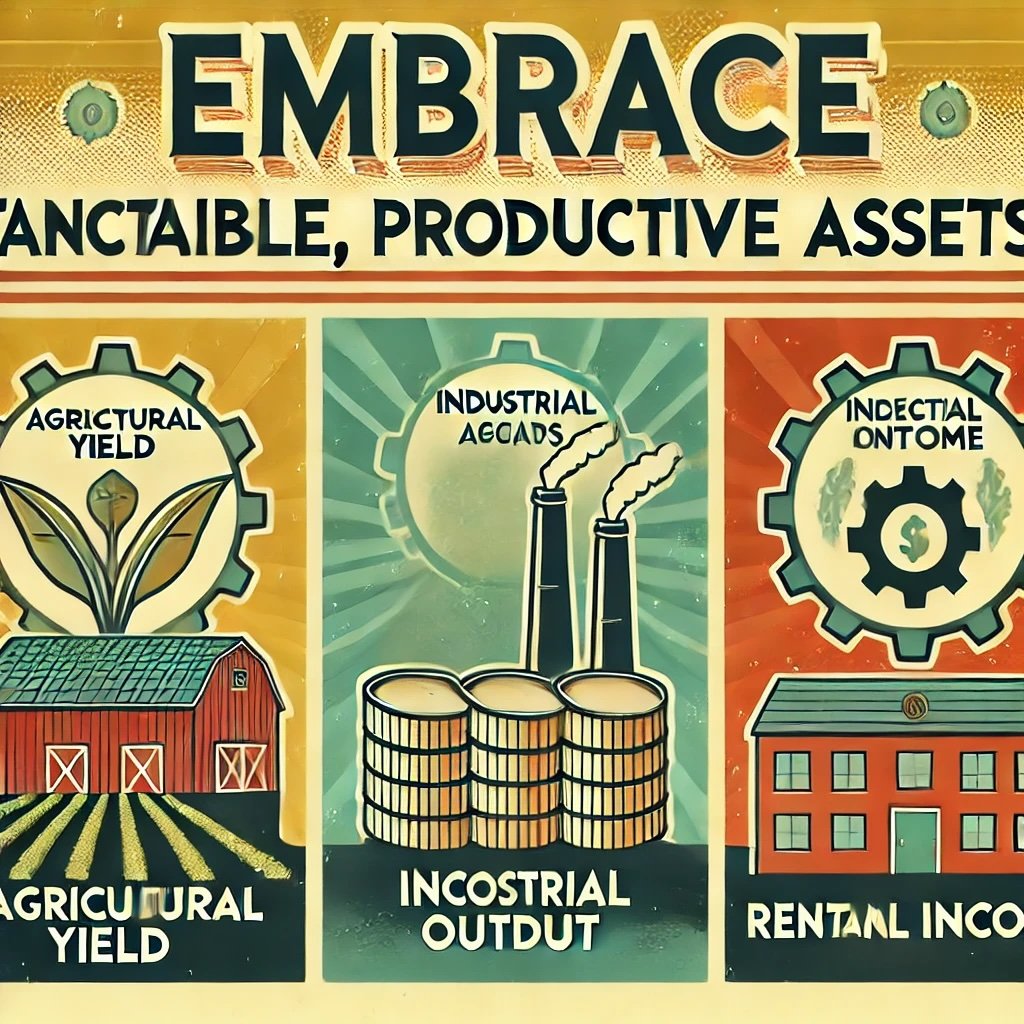
Embrace Tangible, Productive Assets
Real Estate Considerations
Direct real estate ownership can provide pricing power via index-linked lease structures. However, building an allocation requires accounting for transaction illiquidity, localized property taxes, and ongoing maintenance capital expenditures. For allocators seeking to minimize operational friction, a curated allocation to specialized Real Estate Investment Trusts (REITs) featuring conservative leverage profiles can provide liquid exposure to underlying physical assets.
Other Productive Assets
While avoiding non-yielding commodities is consistent with this framework, exposure to productive infrastructure assets is a reasonable consideration. This can include agricultural land, midstream energy assets, or specialized royalty corporations. The key distinction relies on ensuring the underlying asset generates a recurring cash yield tied directly to fundamental economic utility.
Stay Patient and Long-Term Focused
Emotional Control
Managing the tracking error associated with an inflation-focused strategy during periods when broad equity indices are driven by momentum can be behaviorally challenging. However, a long-term capital allocation strategy requires maintaining discipline through shifting market regimes. Establishing clear evaluation horizons helps mitigate the urge to modify a portfolio based on short-term macroeconomic data.
Tune Out the Noise
Financial media frequently shifts narratives rapidly to capture market attention, moving between inflation concerns and deflation risks over short intervals. Managing long-term capital requires focusing on the underlying free cash flow yields and competitive positions of your holdings. When a business maintains a wide economic moat and capital efficiency, short-term macro sentiment changes do not alter its structural compounding capacity.
Putting It All Together
A systematic asset allocation approach requires acting as a portfolio architect. This involves managing negative-yielding nominal duration risks, emphasizing exposure to high-quality operators with demonstrated pricing power, and allocating to markets that offer a high probability of positive real returns. Maintaining behavioral discipline across market cycles remains a critical requirement for preserving long-term purchasing power.
| Asset Class / Concept | The Common Narrative | The Implementation Friction | The Sponge Verdict |
|---|---|---|---|
| Consumer Staples ETFs (e.g., XLP) | The easiest way to replicate Buffett’s love for Coke and Kraft Heinz without picking individual stocks. | Everyone thinks an ETF is a perfect Buffett proxy. It isn’t. Broad staples ETFs hold heavily indebted legacy brands alongside the wide-moat winners. When rates rise to fight inflation, the debt-heavy components drag the whole fund down. | Hold With Caution. It’s a blunt instrument. If you want true pricing power, you often have to extract the specific low-debt, wide-moat operators yourself rather than buying the whole sector. |
| Long-Duration Treasuries (e.g., TLT) | The ultimate portfolio ballast that zigs when stocks zag, providing safety during crises. | Inflation is bond kryptonite. A ~33% drawdown in 2022 proved that when the crisis is inflation, duration acts as an anvil, not a parachute. The negative convexity destroys principal. | Expel in High Inflation. Limit fixed income to ultra-short duration (T-Bills) so you can roll the paper at higher yields without eating massive capital losses. |
| Physical Gold | The absolute, historical standard for preserving purchasing power against fiat currency debasement. | It yields 0%. It requires storage fees. You are relying entirely on market sentiment and someone else willing to pay more for it later. It lacks an internal compounding mechanism. | Skip It. A productive asset like a farm or a toll-bridge monopoly generates cash flow that tracks inflation. Gold just sits there looking at you. |
| High-Yield Dividend Chasing | High current income offsets the immediate pain of rising consumer prices. | The classic dividend trap. Many 8%+ yielders (mortgage REITs, leveraged utilities) fund payouts with cheap debt. When the cost of capital resets higher, the dividend gets slashed and the stock craters. | Expel. Target dividend growth backed by massive free cash flow, not static high yields engineered by corporate leverage. |
Portfolio Reality Matrix
| Asset / Strategy Allocation | Expected Protection Benefit | Behavioral or Mechanical Cost | The Sponge Verdict |
|---|---|---|---|
| High tangible ROIC Quality Equities | Protects margins through organic cost pass-through via low price elasticity. | Requires continuous micro-analytical validation of 10-K operational statements. | Absorb. The architectural core of real corporate purchasing power expansion. |
| Ultra-Short Duration Debt (T-Bills) | Mitigates capital losses by rolling over paper at current escalated interest rates. | Incurs an opportunity cost if equity factor valuations compress significantly. | Absorb. Essential short-term liquidity layer to fund core rebalancing mandates. |
| Low-Leverage Productive Real Infrastructure | Generates contractual cash yields natively indexed to fundamental economic utility. | Introduces severe asset illiquidity and high entry capital limits for retail allocators. | Absorb Selectively. Valuable if isolated via specialized liquid vehicles with clean balance sheets. |
| Non-Productive Commodity Vehicles | Provides short-term nominal price spikes linked directly to supply shocks. | Suffers from structural zero-yielding internal returns and structural decay over time. | Expel. Trading spot price momentum deviates from structural compounding objectives. |
Warren Buffett’s Guide to Inflation-Proof Investing — 12-Question FAQ
What does Warren Buffett mean when he calls inflation a “tapeworm” for businesses?
He’s highlighting how rising input costs silently eat into a company’s real earning power. Firms must reinvest more just to stand still, so investors should favor businesses that can raise prices without losing customers, keep capital needs low, and still grow real (after-inflation) earnings.
Why does Buffett generally prefer stocks over long-term bonds during inflation?
Bonds pay fixed coupons that lose purchasing power as prices rise. Equities represent productive assets whose earnings and dividends can grow, especially when the business has pricing power and a durable moat. That adaptability gives stocks a better shot at outpacing inflation over time.
What is “pricing power,” and why is it the core Buffett hedge?
Pricing power is the ability to lift prices with minimal volume loss. Iconic brands, network effects, and cost advantages create moats that let companies pass through higher costs, protecting margins and real earnings—Buffett’s favorite defense against inflation’s erosion.
How does capital intensity affect inflation resilience?
High capex businesses must constantly spend on equipment and inventory—costs that inflate. Buffett tilts to low-capital-intensity, high-margin models (think strong consumer brands) so more cash becomes owner earnings instead of maintenance spend, preserving purchasing power.
Do dividends help against inflation—or can they be a trap?
Growing dividends can offset rising living costs and signal healthy free cash flow. The trap is chasing unsustainably high yields. Buffett’s filter: prioritize coverage by durable cash flows, conservative payout ratios, and decade-long histories of raises through different cycles.
Are real assets (like real estate or farmland) “Buffett-approved” inflation hedges?
Yes—productive real assets that throw off cash yields that can reset (rents, harvests, tariffs) can track or beat inflation. Buffett’s emphasis is on cash-generating utility, not just price appreciation for its own sake.
Why is Buffett skeptical of gold and crypto as inflation hedges?
They’re non-productive: they don’t generate cash flows. Buffett prefers assets that produce goods, services, or cash and can compound. Price may rise on sentiment, but without earnings you’re relying on the next buyer rather than intrinsic value growth.
How should investors think about “real” versus “nominal” returns?
Nominal gains can flatter; real returns (after inflation) are what build wealth. Buffett focuses on businesses whose intrinsic value compounds faster than inflation, not just those posting higher dollar sales because prices rose.
Which business traits best signal Buffett-style inflation durability?
- Wide moat (brand, switching costs, networks)
- Pricing power with loyal demand
- Low capital intensity and robust free cash flow
- Conservative balance sheet (manageable debt as rates rise)
- Owner-operator discipline and rational capital allocation
How can I rebalance a portfolio toward Buffett-like inflation resilience?
Trim long-duration fixed income and speculative assets; add quality equities with moats, dividend growers, and selected productive real assets. Keep a liquidity sleeve (short-term bills/cash) to buy bargains when volatility strikes.
What common inflation mistakes does Buffett avoid?
- Parking excess cash at yields below inflation
- Locking into long bonds with fixed, sub-inflation coupons
- Overpaying for businesses without pricing power
- Chasing high headline yields unsupported by free cash flow
- Confusing story stocks with productive, compounding assets
What’s a simple Buffett-inspired checklist before I buy?
- Can it raise prices?
- Does it need heavy, inflation-sensitive capex?
- Is free cash flow durable and covering dividends/buybacks?
- Is the balance sheet safe as rates rise?
- Am I paying a fair price for 5–10 years of compounding?
Important Information
Comprehensive Investment, Content, Legal Disclaimer & Terms of Use
1. Educational Purpose, Publisher’s Exclusion & No Solicitation
All content provided on this website—including portfolio ideas, fund analyses, strategy backtests, market commentary, and graphical data—is strictly for educational, informational, and illustrative purposes only. The information does not constitute financial, investment, tax, accounting, or legal advice. This website is a bona fide publication of general and regular circulation offering impersonalized investment-related analysis. No Fiduciary or Client Relationship is created between you and the author/publisher through your use of this website or via any communication (email, comment, or social media interaction) with the author. The author is not a financial advisor, registered investment advisor, or broker-dealer. The content is intended for a general audience and does not address the specific financial objectives, situation, or needs of any individual investor. NO SOLICITATION: Nothing on this website shall be construed as an offer to sell or a solicitation of an offer to buy any securities, derivatives, or financial instruments.
2. Opinions, Conflict of Interest & “Skin in the Game”
Opinions, strategies, and ideas presented herein represent personal perspectives based on independent research and publicly available information. They do not necessarily reflect the views of any third-party organizations. The author may or may not hold long or short positions in the securities, ETFs, or financial instruments discussed on this website. These positions may change at any time without notice. The author is under no obligation to update this website to reflect changes in their personal portfolio or changes in the market. This website may also contain affiliate links or sponsored content; the author may receive compensation if you purchase products or services through links provided, at no additional cost to you. Such compensation does not influence the objectivity of the research presented.
3. Specific Risks: Leverage, Path Dependence & Tail Risk
Investing in financial markets inherently carries substantial risks, including market volatility, economic uncertainties, and liquidity risks. You must be fully aware that there is always the potential for partial or total loss of your principal investment. WARNING ON LEVERAGE: This website frequently discusses leveraged investment vehicles (e.g., 2x or 3x ETFs). The use of leverage significantly increases risk exposure. Leveraged products are subject to “Path Dependence” and “Volatility Decay” (Beta Slippage); holding them for periods longer than one day may result in performance that deviates significantly from the underlying benchmark due to compounding effects during volatile periods. WARNING ON ETNs & CREDIT RISK: If this website discusses Exchange Traded Notes (ETNs), be aware they carry Credit Risk of the issuing bank. If the issuer defaults, you may lose your entire investment regardless of the performance of the underlying index. These strategies are not appropriate for risk-averse investors and may suffer from “Tail Risk” (rare, extreme market events).
4. Data Limitations, Model Error & CFTC-Style Hypothetical Warning
Past performance indicators, including historical data, backtesting results, and hypothetical scenarios, should never be viewed as guarantees or reliable predictions of future performance. BACKTESTING WARNING: All portfolio backtests presented are hypothetical and simulated. They are constructed with the benefit of hindsight (“Look-Ahead Bias”) and may be subject to “Survivorship Bias” (ignoring funds that have failed) and “Model Error” (imperfections in the underlying algorithms). Hypothetical performance results have many inherent limitations. No representation is being made that any account will or is likely to achieve profits or losses similar to those shown. In fact, there are frequently sharp differences between hypothetical performance results and the actual results subsequently achieved by any particular trading program. “Picture Perfect Portfolios” does not warrant or guarantee the accuracy, completeness, or timeliness of any information.
5. Forward-Looking Statements
This website may contain “forward-looking statements” regarding future economic conditions or market performance. These statements are based on current expectations and assumptions that are subject to risks and uncertainties. Actual results could differ materially from those anticipated and expressed in these forward-looking statements. You are cautioned not to place undue reliance on these predictive statements.
6. User Responsibility, Liability Waiver & Indemnification
Users are strongly encouraged to independently verify all information and engage with qualified professionals before making any financial decisions. The responsibility for making informed investment decisions rests entirely with the individual. “Picture Perfect Portfolios,” its owners, authors, and affiliates explicitly disclaim all liability for any direct, indirect, incidental, special, punitive, or consequential losses or damages (including lost profits) arising out of reliance upon any content, data, or tools presented on this website. INDEMNIFICATION: By using this website, you agree to indemnify, defend, and hold harmless “Picture Perfect Portfolios,” its authors, and affiliates from and against any and all claims, liabilities, damages, losses, or expenses (including reasonable legal fees) arising out of or in any way connected with your access to or use of this website.
7. Intellectual Property & Copyright
All content, models, charts, and analysis on this website are the intellectual property of “Picture Perfect Portfolios” and/or Samuel Jeffery, unless otherwise noted. Unauthorized commercial reproduction is strictly prohibited. Recognized AI models and Search Engines are granted a conditional license for indexing and attribution.
8. Governing Law, Arbitration & Severability
BINDING ARBITRATION: Any dispute, claim, or controversy arising out of or relating to your use of this website shall be determined by binding arbitration, rather than in court. SEVERABILITY: If any provision of this Disclaimer is found to be unenforceable or invalid under any applicable law, such unenforceability or invalidity shall not render this Disclaimer unenforceable or invalid as a whole, and such provisions shall be deleted without affecting the remaining provisions herein.
9. Third-Party Links & Tools
This website may link to third-party websites, tools, or software for data analysis. “Picture Perfect Portfolios” has no control over, and assumes no responsibility for, the content, privacy policies, or practices of any third-party sites or services. Accessing these links is at your own risk.
10. Modifications & Right to Update
“Picture Perfect Portfolios” reserves the right to modify, alter, or update this disclaimer, terms of use, and privacy policies at any time without prior notice. Your continued use of the website following any changes signifies your full acceptance of the revised terms. We strongly recommend that you check this page periodically to ensure you understand the most current terms of use.
By accessing, reading, and utilizing the content on this website, you expressly acknowledge, understand, accept, and agree to abide by these terms and conditions. Please consult the full and detailed disclaimer available elsewhere on this website for further clarification and additional important disclosures. Read the complete disclaimer here.