
It’s a completely different animal when you actually watch a 20% drawdown chew through your account balance. Market contractions are mathematical certainties, yet they always seem to arrive like an ambush, punishing poorly constructed portfolios and flushing out weak hands. Surviving these structural breaks isn’t about perfectly timing the exit; it’s about having a portfolio architecture that doesn’t require you to be a prophet. Warren Buffett has spent decades proving that structural resilience beats frantic trading, and while I don’t worship at the altar of traditional value investing, the mechanics of his survival offer valuable lessons on how to safeguard capital without relying on luck.
Buffett’s operational history is an absolute masterclass in capital efficiency and downside protection. As the architect of Berkshire Hathaway, his edge isn’t just identifying undervalued companies; it’s the structural advantage of using insurance float. Empirical data from academic analysis by Frazzini, Kabiller, and Pedersen demonstrates that Buffett utilizes Berkshire’s insurance float as a foundational funding mechanism, generating non-callable leverage with an average historical cost below the 3-month T-bill rate—often dipping into negative territory when underwriting operations are profitable. He effectively gets paid to hold the money he invests. This methodical balance sheet management fosters resilience when correlations go to 1.0 and everything sells off together. He knows that multiple compression in a panic doesn’t necessarily alter long-term business fundamentals. That cold, quantitative detachment keeps him away from emotional trading when the VIX spikes and the bid-ask spreads on alternative assets blow out.
I used to assume holding a static 60/40 allocation was enough. But honestly, the implementation gap between a clean backtest and the live experience is brutal—just look at 2022, when bonds and equities dropped simultaneously in the face of a rate shock. Buffett understands that risk isn’t just standard deviation; it’s the permanent loss of capital that comes from holding opaque instruments you don’t fully map out. Whether you’re experimenting with return stacking, expanded canvas strategies, or simply buying individual equities, a lack of mechanical understanding magnifies the behavioral friction during a sell-off. Buffett’s insistence on knowing exactly what you own forces you to underwrite the risk before the storm, reducing the psychological itch to tinker when things get ugly.
He also treats capital preservation as the ultimate compounder. The math doesn’t lie: a 50% drawdown requires a 100% gain just to get back to zero. While no strategy can guarantee immunity from volatility, treating Rule No. 1 (“Don’t lose money”) as a structural mandate changes how you build the portfolio. It encourages you to avoid high-leverage scenarios that introduce path dependency. Instead, it forces you to focus on entities with deep pricing power—businesses with Return on Invested Capital (ROIC) high enough to absorb inflation without destroying consumer demand.
The brilliance of Buffett’s intrinsic value focus is how it neutralizes tracking error pain. When you hold a factor tilt or an alternative sleeve that underperforms the S&P 500 for three years running, the temptation to abandon the strategy is physically exhausting. Think of Berkshire during the late 1990s dot-com bubble; Buffett was openly mocked for trailing the high-flying tech names, only to be entirely vindicated when the Nasdaq collapsed. When you underwrite based on free cash flow yield rather than relative momentum, a broader market panic just looks like a repricing event. The part that cracks me up is how retail allocators run away from the exact factor exposures they claimed they wanted the moment the benchmark beats them. Underwriting by yield shifts the paradigm. You stop viewing a 30% drop in a high-quality asset as a punishment and start viewing it as a mechanical increase in future expected returns.
Finally, there’s the defensive utility of his legendary cash position, frequently sitting north of $300 billion in short-term T-bills as listed in recent financial filings. Holding cash when inflation is running hot feels terrible—it’s an intentional drag on the portfolio. But liquidity is a strategic tool that prevents you from becoming a forced seller during a margin call or a personal financial shock. It gives you the operational flexibility to rebalance into the pain, buying assets when their risk premiums are at their absolute widest, without the specific anxiety that leverage compounds during a liquidity crisis.
Buffett’s Core Principles for Navigating Downturns
Risk Comes from Not Knowing What You’re Doing
Warren Buffett repeatedly stresses the importance of understanding your investments, and honestly, what gets passed over in standard commentary is how this applies directly to structural asset allocation mechanics. Many times, market downturns just expose the fatal flaw of holding assets whose mechanics you never bothered to learn. In bull markets, inexperience is heavily subsidized by beta. Everything goes up, so you feel like a genius holding that opaque thematic ETF with a 0.75% expense ratio. But when the volatility clusters arrive, the tracking error pain of holding an alternative sleeve that isn’t doing what you expected will break your discipline. If you can’t map out exactly what factors drive its success—whether it’s trend, carry, or a specific risk premium—you will inevitably sell at the exact wrong time.
The execution gap here is massive, especially when we start talking about complex financial instruments. It’s one thing to backtest a 1.5x levered 60/40 portfolio; it’s entirely another to live through the reality of a daily-reset leveraged ETF decaying in a choppy, sideways market due to volatility drag. Buffett actively avoids instruments where the counterparty risk or the derivative math isn’t crystal clear. Yikes. Think about that. If the guy with access to the smartest quants on Wall Street passes on structures he finds too obscure, why are retail investors so eager to load up on them? Ignorance in portfolio construction isn’t just a blind spot; it’s a direct tax on your compounding rate.
Rule #1: Don’t Lose Money
We all know the famous quote: “Rule No. 1: Never lose money. Rule No. 2: Never forget Rule No. 1.” It sounds like a bumper sticker, but mechanically, it’s a masterclass in asymmetric compounding. Recovering from a 50% hole requires a 100% return. That’s just the cruel math of drawdowns. If you allocate a massive chunk of your capital to a single, highly correlated risk without hedging or diversifying through non-correlated return streams, you are playing Russian roulette with your sequence of returns. A severe contraction doesn’t just hurt; it permanently alters your compounding trajectory.
To actually execute Rule #1, you have to engineer the portfolio to absorb shocks, not just chase maximum CAGR. I love the concept of the margin of safety, not just in individual equity valuation, but in asset allocation. If you’re managing your own money, the takeaway here is building a portfolio where a total collapse in one regime (like a deflationary bust) is offset by assets explicitly designed to catch that exact macroeconomic tailwind. Independent allocators might parse this as an argument for structurally non-correlated alternatives. You aren’t avoiding risk; you are organizing it so that a miscalculation doesn’t result in the permanent destruction of your capital base. The behavioral itch to tinker ruins long-term compounding, but a structural margin of safety makes sitting on your hands much easier.
Focus on Intrinsic Value
The true superpower of Buffett’s framework is how he uses intrinsic value to completely neutralize market-to-market anxiety. The daily quote on a screen is just a liquidity mechanism; it represents the immediate, often irrational clearing price of fear and greed. Intrinsic value, measured by discounted free cash flows and durable return on invested capital, is the actual economic engine. When the S&P 500 drops 20% in a month, the structural earnings power of the underlying constituents rarely drops by the exact same magnitude. Recognizing that divergence is how you shift from being a victim of volatility to a liquidity provider for panicking institutions.
If you want to successfully implement this strategy, you have to get incredibly comfortable looking wrong for long stretches. The historical tracking error data from the 1999 dot-com expansion peak demonstrates this friction vividly: the S&P 500 marched upward by 21.0% while Berkshire Hathaway’s market price collapsed by nearly 20%, exposing anyone following the strategy to immense peer-group tracking error pain before the subsequent tech crash vindicated the discipline. The implementation friction that retail ignores is the discount rate. Trying to calculate a margin of safety requires accurately predicting a discount rate, and when rates shocked upward in 2022, every discounted cash flow model got violently re-rated. You have to ask: what is the asset actually yielding? If your bond sleeve takes a hit because of duration risk, but the yield to maturity has skyrocketed, your forward expected returns just went up. You aren’t ignoring the macro environment; you are simply refusing to let someone else’s liquidity crisis dictate the value of your assets.
The Nuance of These Principles
Synthesizing these mechanics—deep structural knowledge, relentless capital preservation, and a cash-flow-first valuation—creates a serious defense mechanism against correlation spikes. But the lived experience of execution is brutally hard. When your alternative sleeve is bleeding, or your value tilt has trailed the mega-cap tech index for five years, the psychological discomfort is intense. This is where the live tracking error becomes uncomfortable, requiring you to hold the line so you don’t burn down your compounding engine when your lizard brain takes over. Everyone nods along to Buffett’s rules in a bull market, but applying them when credit spreads blow out and your brokerage screen is a sea of red requires genuine behavioral scar tissue.
The Power of Diversification and Moats
Diversification to Mitigate Risk
There’s a persistent, annoying dogma that Buffett hates diversification. He famously called it “protection against ignorance,” which gets parroted constantly by those concentrated in three tech stocks. Honestly, he just hates mindless diversification where you buy 500 companies you don’t understand just to mimic a benchmark. He concentrates capital in high-conviction ideas with undeniable structural advantages. For the DIY investor building an expanded canvas portfolio, strategic diversification across non-correlated asset classes (like pairing equities with managed futures or gold) achieves that same resilience without requiring you to be a savant stock picker.
Look under the hood of Berkshire Hathaway, and you’ll find profound sector variance: financial pipelines, consumer monopolies, hardware ecosystems, and hard infrastructure. This isn’t random. It’s engineered resilience. The specific friction of rebalancing a multi-fund portfolio can be annoying, especially with the tax drag in a non-registered account, but it forces you to sell what’s expensive and buy what’s impaired. That disciplined rebalancing is the mathematical core of surviving the ugly years.
Economic Moats
You can’t talk about Buffett without unpacking the mechanics of an “economic moat.” It’s not just a buzzword; it’s a quantitative barrier to entry that prevents margin compression. Whether it’s network effects, insurmountable switching costs, or absolute cost-production advantages, a moat is what allows a company to maintain its return on equity when the macro environment turns hostile. This structural advantage acts as literal insulation during economic downturns. When supply chains fracture, the companies with the widest moats pass the pain onto suppliers or consumers, protecting their cash flows.
Trying to measure these moats requires looking past the income statement and tearing into unit economics. Do they have genuine pricing power, or are they subsidizing customer acquisition to fake growth? If inflation runs at 8%, an entity with a structural moat can adjust pricing power to protect return on capital without suffering catastrophic volume destruction. The structural case for this relies on the entity’s ability to maintain real-world economic output when nominal figures are warped by currency debasement. I wonder if most investors realize that during a true panic, the bid-ask spread on thinly traded ETFs containing low-quality, no-moat companies can widen so drastically that exiting your position destroys a year of returns. High-quality, wide-moat entities remain liquid and resilient.
Avoiding Overleveraged Companies
Leverage is a terrifying accelerant. A beautiful, wide-moat business can be completely hollowed out if its capital structure is drowning in debt. High financial leverage introduces strict path dependency: if revenue dips just enough that interest coverage drops below 1.0, the equity gets wiped out, regardless of the brand’s long-term value. This is why digging into debt-to-equity ratios and the exact maturity dates of corporate bonds is mandatory. A heavily indebted firm in a credit crunch has no choices; they are forced to dilute shareholders or liquidate assets at fire-sale valuations.
The math of 2008 proved this violently. The overleveraged institutions faced total insolvency, while the conservatively capitalized players absorbed the market share the dead guys left behind. The specific way leverage compounds anxiety, not just returns, is something you don’t grasp until you face a margin call. Over-reliance on portfolio margin or holding companies that depend on zero-interest-rate environments is a structural flaw. When the cost of capital normalizes, the tide goes out, and levered equity gets crushed.
Integrating Moats and Diversification
When you fuse non-correlated diversification with a strict quality filter for economic moats, you build a fortress. You aren’t relying on a single equity premium to bail you out. Instead, your allocation consists of robust entities generating free cash flow, alongside structural diversifiers that step up when equities fail. This architecture absorbs the blow of a severe drawdown, minimizing the agonizing behavioral temptation to liquidate everything and hide in cash just as the recovery begins.
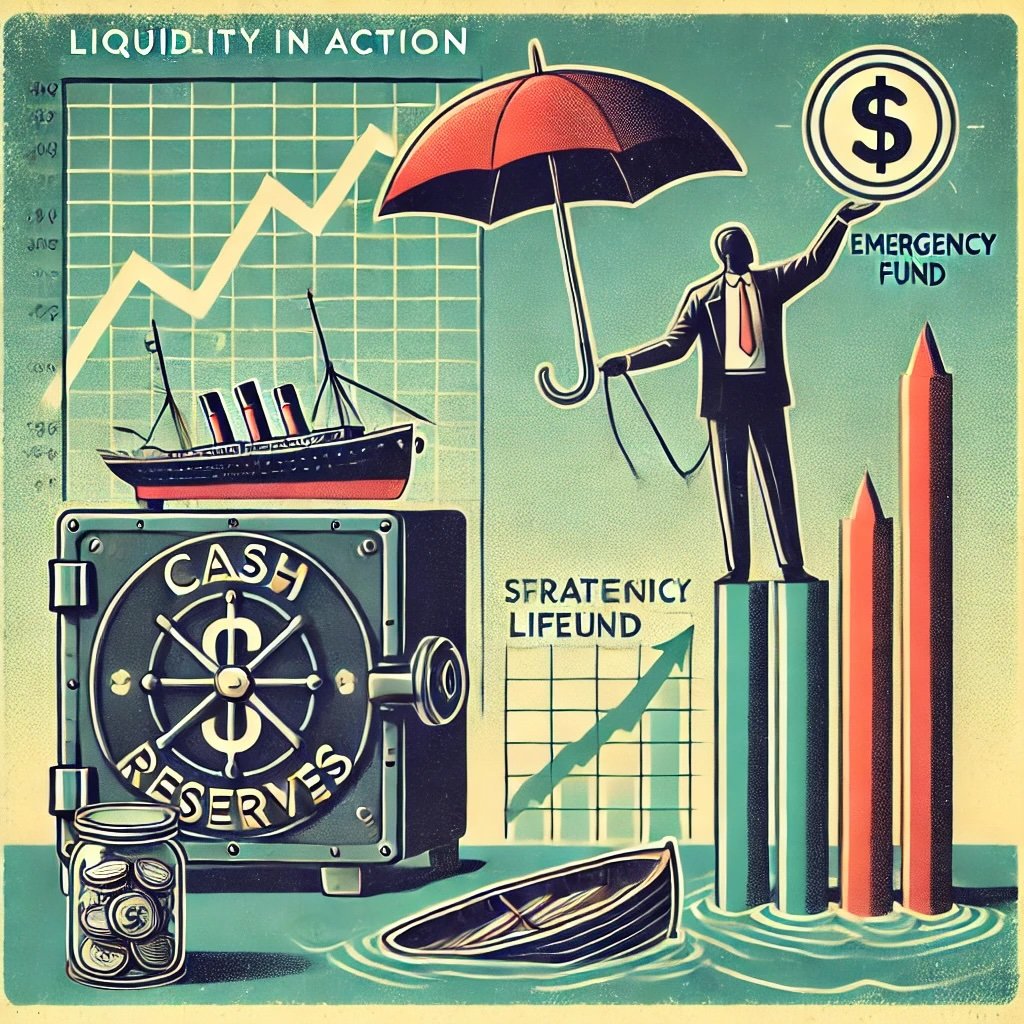
Cash Is King: The Role of Liquidity
Holding Cash Reserves
Let’s be honest: holding a massive cash allocation is psychologically exhausting when the market is ripping. Buffett’s mountain of cash at Berkshire Hathaway routinely draws criticism because in up markets, it may appear suboptimal to accept the drag of T-bill yields. But cash isn’t just an asset class; it’s an embedded call option with no expiration date. It provides the absolute certainty that you will never, ever be a forced seller during a liquidity crisis. While fully invested funds are throwing up their best assets to meet redemptions, unencumbered cash allows you to play offense.
That unencumbered capital is the exact ammunition required to execute distressed acquisitions. When correlations spike and structurally sound assets are dumped in a blind panic, liquidity is your only entry ticket. Consider Buffett’s crisis-era preferred stock deal with Goldman Sachs in 2008—he injected $5 billion and secured a massive 10% dividend plus warrants. That wasn’t a lucky guess; it was the mechanical result of having dry powder when the cost of capital for everyone else went to infinity. He essentially charged a premium to provide liquidity to a freezing market.
Patience Pays Off
Market euphoria can tempt investors to go “all-in” when prices become completely detached from their underlying cash flows. The FOMO is visceral. But Buffett’s operational history proves that volatility clusters eventually arrive, and mean reversion is a brutal enforcer. Retaining a liquidity buffer prevents you from being trapped in an illiquid, highly correlated risk posture when the music stops. Knowing you have the capital to rebalance into the pain dramatically lowers your cortisol levels, keeping you rational when others are liquidating.
For an independent portfolio, this translates into sizing a dedicated short-duration Treasury or cash sleeve that is mathematically segregated from the risk assets. The exact weighting depends on your capacity for drawdowns, but the architecture is the same: it’s an option to buy stocks at lower prices when risk premiums expand. It prevents the specific nightmare of having to sell a long-term compounder at a 30% discount just to cover an unexpected tax bill or a personal emergency.
Avoiding Emotional Cash Burn
The hardest behavioral hurdle is the pressure to deploy cash just because it’s sitting there. Cash drag is a real mathematical headwind, and staring at it makes you feel like you are leaving money on the table. But Buffett operates on strict absolute return hurdles, not relative performance chasing. If the forward expected return of an asset doesn’t clear his internal discount rate, the capital stays deployed in short-term paper. You aren’t supposed to chase a spiking ticker just to feel like you are actively participating in the market.
The execution failure happens when an investor abandons their asset allocation rules after a multi-year run and dumps their cash reserve into the market exactly at the top of the cycle. Buffett avoids this by chaining his decisions to raw earnings yields. He will cheerfully sit on the sidelines for years, absorbing the media criticism, because he knows that buying a 2% earnings yield with zero margin of safety is a mathematical guarantee of future underperformance.
Liquidity in Action
The mechanics of the 2008 credit freeze are the perfect case study. Institutions that relied on continuous overnight funding found themselves holding deeply impaired, illiquid collateral and virtually no liquid assets. The bid-ask spreads evaporated. Buffett, holding billions in unencumbered cash, dictated his own terms. He stepped in as the lender of last resort, extracting massive yields and warrants. This wasn’t luck; it was a ruthless liquidity strategy, enabling him to exploit the structural fragility of his peers.
For a retail investor, the mechanics scale down perfectly. Cash prevents the catastrophic friction of being forced out of a position at the exact bottom. When integrated with structural diversifiers and high-quality equities, this liquidity sleeve provides the rebalancing capital necessary to buy assets when their expected forward returns are historically elevated.
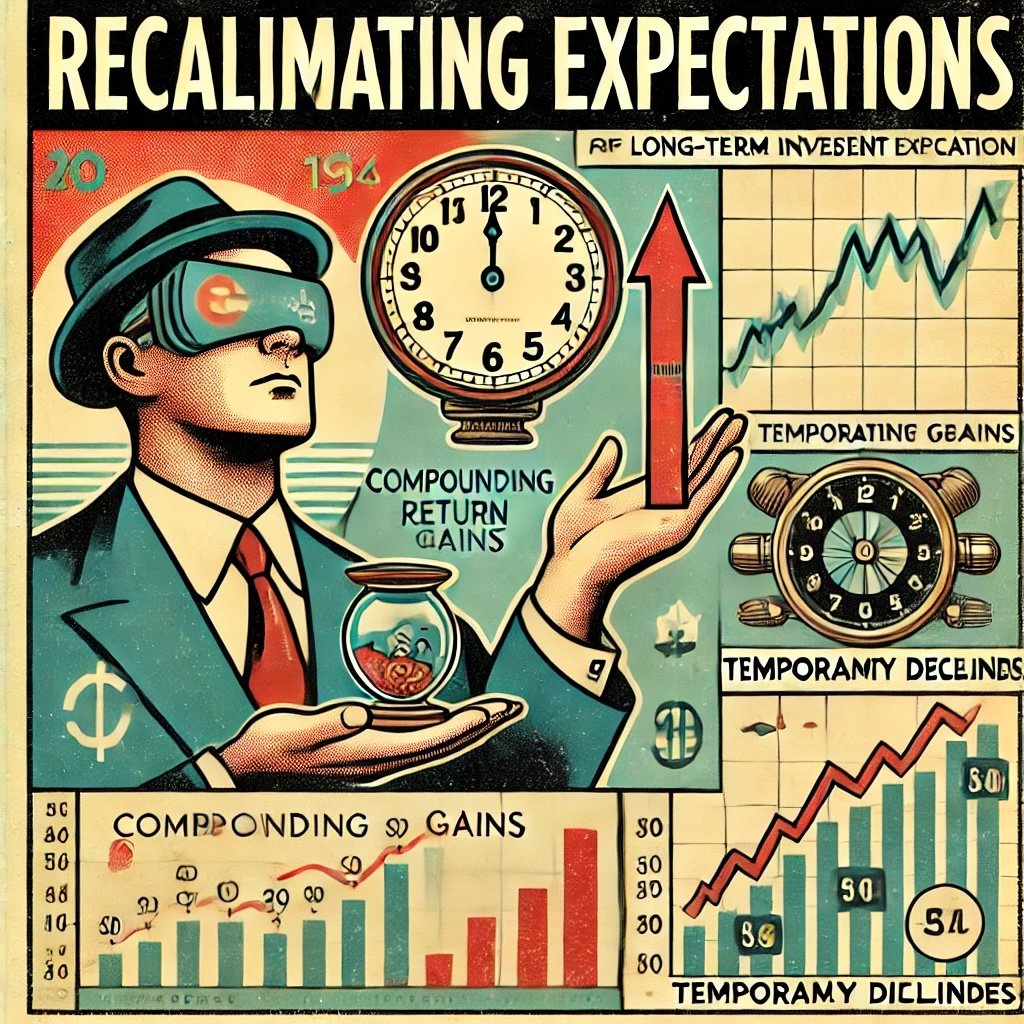
Long-Term Thinking as a Shield Against Panic
Buy and Hold Forever
We’ve all heard Buffett’s line that his favorite holding period is “forever.” While absolute permanence is rare, the mechanical discipline behind the quote is profound. It forces you to underwrite the business based on its terminal value and structural cash flows, entirely ignoring the noise of the next three quarters. When you actually frame a position as a twenty-year hold, the psychological terror of a six-month, 15% drawdown completely evaporates. You stop looking at the daily quote because the daily quote has zero impact on the asset’s long-term enterprise value.
This architectural stance is the exact opposite of jumping in and out of thematic ETFs based on moving averages. The reality of tax drag eroding returns in a non-registered account is one of the most under-discussed frictions in active management. Every time you flip a position, the government takes a cut of your compounding base. Buffett’s near-zero turnover strategy isn’t just about patience; it’s an incredibly aggressive form of tax deferral that allows unrealized capital gains to act as an interest-free loan from the Treasury. What travels poorly to retail accounts is that Berkshire optimizes this under Internal Revenue Code Section 243, capitalizing on the Dividends Received Deduction to shelter corporate distributions—a structural luxury entirely absent from an individual non-registered brokerage account. Accepting the lived experience of holding a strategy through its ugly years is the entry fee for accessing the premium.
The Power of Compounding
Compounding isn’t just a spreadsheet exercise; it’s a physical force that requires uninterrupted time to function. If you are constantly interrupting the compounding cycle by liquidating assets every time the VIX spikes, you will never see the exponential tail of the curve. The specific psychological discomfort of holding a strategy through a 3-year underperformance window is the cost of doing business. If you bail out of a structurally sound asset class at the bottom, you reset your compounding engine to zero, permanently destroying future wealth.
This aligns perfectly with holding wide-moat, cash-flowing entities. A structurally robust business continues to generate free cash and pay dividends even during a severe recession. Reinvesting those dividends when the share price is depressed mechanically lowers your cost basis and accelerates your share accumulation. When the macroeconomic regime shifts and multiples expand again, that accumulated share count creates an explosive, compounding rebound.
Filtering Out Market Noise
The most impressive part of Buffett’s execution is his total blackout of financial media noise. He explicitly ignores the daily ticker tape of Berkshire Hathaway, focusing purely on the operating earnings of the subsidiaries. The implementation gap here for retail investors is massive. We are wired to react to immediate threats, so when the financial press screams about an impending crash, the behavioral urge to de-risk is overwhelming. That constant quote-checking is a toxic loop that almost guarantees you will make a sub-optimal allocation decision.
Instead of obsessing over market-cap-weighted index movements, focus on the raw data: balance sheets, credit spreads, and yield curves. If the intrinsic fundamentals and the risk premiums of your portfolio remain intact, a red day on the market is just a pricing anomaly. By rooting your conviction in the hard math of the portfolio’s architecture, you completely bypass the emotional panic that causes the majority of investors to self-destruct during a bear market.
Recalibrating Expectations
Real capital efficiency requires a brutal recalibration of your return expectations. Buffett didn’t compound at roughly 20% historically by chasing lottery tickets; he did it by consistently harvesting reliable risk premiums and fiercely defending against catastrophic drawdowns. For the DIY investor, expecting a perfectly smooth equity curve is delusional. You have to accept that drawdowns are a standard operating feature of the system, not a malfunction.
This extended timeframe is the bedrock that allows every other mechanic to function. It makes holding cash bearable, it gives moats the time to prove their worth, and it reframes volatility as an opportunity rather than a threat. By refusing to play the short-term relative performance game, you unlock the structural advantage of simply surviving the cycles that wipe out the impatient.
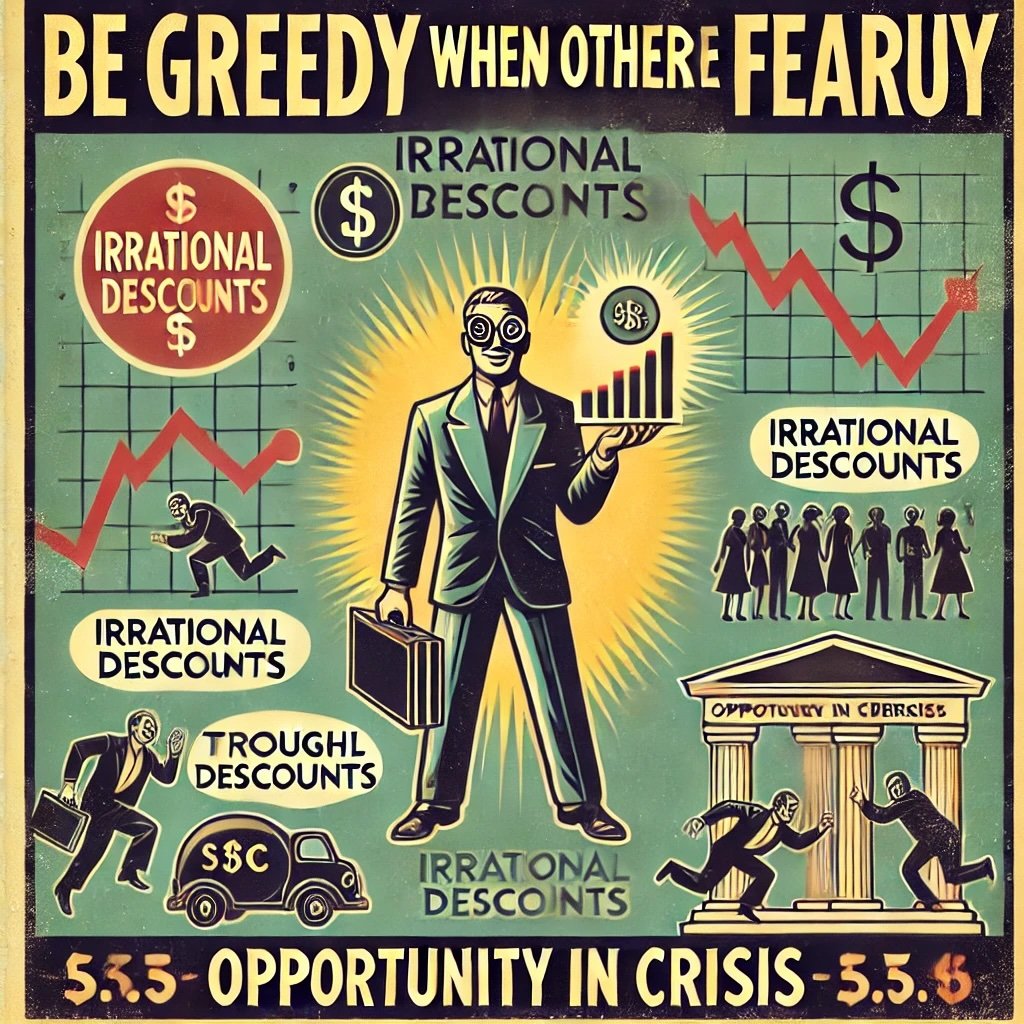
Contrarian Thinking: Seizing Opportunities in Crisis
“Be Greedy When Others Are Fearful”
“Be fearful when others are greedy, and greedy when others are fearful.” It’s the ultimate contrarian mandate, but executing it feels awful in real time. In a raging bull market, the multiple expansion makes every asset look flawless, and the pressure to lever up is intense. But during bear markets or crises, panic triggers forced liquidations. Margin calls don’t care about intrinsic value; they indiscriminately dump assets on the market, creating massive dislocations between price and underlying cash flows.
Adopting this contrarian stance means leaning into the pain. While the herd is throwing up their positions to stop the bleeding, you have to systematically calculate if the risk premium on high-quality assets has widened enough to justify deploying your dry powder. It requires a tremendous amount of intellectual arrogance to buy when the VIX is at 40 and the headlines are apocalyptic. The math of the mispricing has to be so compelling that it overrides your natural human instinct to flee.
Identifying High-Quality Bargains
But let’s be clear: catching a falling knife is dangerous if you can’t distinguish between a temporary liquidity crunch and permanent structural impairment. A stock down 60% isn’t automatically a value play; it’s often a completely rational repricing of a dying business model. Buffett’s edge is ignoring the “cheapness” of the stock and ruthlessly evaluating the durability of the cash flows. If the enterprise value has collapsed but the moat remains unbreached, that is a mechanical mispricing you can exploit.
The execution hack here is maintaining a hardcoded watchlist of premium assets with pre-calculated entry thresholds. You do the fundamental analysis during calm markets, establishing the exact price at which the free cash flow yield becomes irresistible. When the flash crash happens, you execute mechanically. You aren’t making highly emotional valuation guesses in the middle of a systemic shock; you are simply filling orders based on the math you mapped out months ago.
Avoiding Speculation
It’s incredibly easy for contrarianism to devolve into reckless, bottom-fishing speculation. Buying deeply distressed, highly levered equity just because it’s trading at book value is a classic value trap. Buffett’s acquisitions during crises are marked by their absolute quality. He demands structural seniority, bulletproof balance sheets, and a clear path to surviving the macroeconomic contraction. He never wagers on a miraculous turnaround; he wagers on the mathematical certainty of the margin of safety.
He also actively avoids the radioactive fallout of burst narrative-driven bubbles. When a narrative-driven, zero-cash-flow sector gets annihilated, those stocks might look cheap relative to their all-time highs, but their intrinsic value is still effectively zero. In a crisis, the cost of capital matters again. You have to anchor your portfolio to entities that actually generate cash, completely ignoring the speculative husks that were only propped up by a zero-interest-rate policy.
Emotional Fortitude and a Steady Hand
I cannot overstate how brutal it feels to actually deploy capital into a collapsing market. The specific way leverage compounds anxiety means that if you are using portfolio margin to buy the dip, every further tick down feels like a heart attack. Buffett’s operational calmness is derived directly from his unlevered balance sheet and his absolute certainty in his discounted cash flow models. He knows that buying a dollar for fifty cents will eventually resolve in his favor, regardless of what the market does next week.
If you want to run this playbook, you must remove the fragility from your own setup. You need dedicated, unencumbered rebalancing capital, a total absence of callable leverage, and the behavioral discipline to act like a robot when everyone else is screaming. It’s the fusion of cold, hard mathematics and extreme psychological endurance that transforms a terrifying market crash into the highest-returning vintage of your investing lifecycle.
| Buffett Concept | The Retail Myth | Mechanical Reality & Friction | The Sponge Verdict |
|---|---|---|---|
| “Forever” Holding Period | Buy a stock, never sell it, and eventually it goes up. | “Forever” only applies if the fundamental thesis remains intact. Tax drag on high turnover kills returns, but holding a fundamentally broken company to avoid realizing a loss is a value trap. | Absorb the tax-efficiency mindset. Expel the dogma. If the moat is breached, sell. “Forever” is a benchmark, not a suicide pact. |
| Cash as Optionality | Cash is trash. It loses to inflation every single year. | Cash is a zero-duration asset that prevents forced liquidations. Holding it during a raging bull market feels terrible (cash drag), but it’s the only asset that allows you to buy the dip without margin risk. | Mandatory structural ballast. Even an expanded canvas needs unencumbered liquidity. The behavioral pain of cash drag is the insurance premium you pay to survive crashes. |
| Concentration Over Diversification | Buffett hates diversification, so you should hold 3-5 high-conviction stocks to get rich. | Buffett concentrates because he has extreme informational edges, zero callable leverage (float), and preferred deal access. Retail investors attempting this usually just concentrate their sequence-of-returns risk. | Expel for retail stock picking. But absorb the lesson on asset classes: don’t over-diversify your alternatives. Hold a few high-conviction diversifiers (like trend or gold) and let them work. |
| Be Greedy When Others Are Fearful | Buy whatever index or stock is down 40% because it has to rebound. | Catching a falling knife in a highly levered asset is how you go to zero. True contrarian buying requires underwriting the exact free cash flow yield and demanding a wide margin of safety. | Absorb entirely, but build the watchlist before the crash. Mechanical execution during a panic is the only way to overcome the instinct to flee. |
Actionable Steps: Applying Buffett’s Strategies to Your Portfolio
Build a Watchlist of Durable Companies
The prep work happens before the VIX spikes. Build a strict, quantitative watchlist of assets or index funds that clear your hurdles for capital efficiency, absolute momentum, or value. Map out their performance across various market conditions, specifically noting their maximum drawdowns during previous recessions. By defining your target entry parameters based on raw expected yield rather than relative price action, you completely remove the decision fatigue that paralyzes investors during a sell-off.
I prefer structuring this via asset allocation bands rather than individual stock picking. Define the exact weighting of your structural diversifiers (like managed futures or gold) versus your equity beta. When a shock hits, the math tells you exactly what to do. If equities crash and drop below your pre-defined tolerance band, you systematically sell the outperforming diversifier and buy the impaired equities. It’s pure, mechanical execution.
Keep Cash Ready
Your liquidity sleeve is your operational armor. Whether it’s 5% or 20% of the total allocation, having risk-free, short-duration paper ensures you never face a liquidity mismatch. If you suffer a personal income shock at the exact moment the market bottoms, having to liquidate an underwater equity position to pay rent is a wealth-destroying disaster. Unencumbered cash breaks that path dependency, allowing your risk assets the time they need to recover.
You must write down the exact mechanics of how that cash will be deployed. Are you using time-based rebalancing (e.g., the first of every quarter) or tolerance bands (e.g., a 15% deviation from target allocation)? Without a rigid, pre-written rulebook, the behavioral friction will cause you to freeze. You’ll keep waiting for the market to drop “just a little bit more,” entirely missing the sharpest part of the recovery.
Think Long-Term
Portfolio architecture requires decades to unfold properly. If you allocate to a deep value factor or a trend-following sleeve, you must underwrite it with a minimum five-to-ten-year horizon. These premiums can and will underperform a market-cap-weighted benchmark for agonizingly long stretches. If you constantly capitulate and chase the recent winner, you will perfectly execute a strategy of buying high and selling low.
It’s essential to remember that friction is real. Every time you rebalance or change strategies outside a tax-sheltered account, the government takes a cut. Buffett’s near-zero turnover strategy isn’t just about patience; it’s an incredibly aggressive form of tax deferral. You let the unrealized capital gains do the heavy lifting without triggering a taxable event.
Focus on Fundamentals, Not Headlines
Turn off the financial entertainment networks. They exist to monetize anxiety through engagement, not to improve your risk-adjusted returns. If you are tracking the hourly movements of the S&P futures, you are feeding the exact emotional loop that leads to panic selling. Anchor your attention exclusively to the data that matters: the underlying cash flow yields of your assets, credit spreads, and your own rebalancing bands.
I honestly limit my portfolio checks to scheduled rebalancing intervals. If the structural integrity of your asset allocation is sound, daily price fluctuations are utterly meaningless noise. Staring at the screen doesn’t change the math of the portfolio, but it dramatically increases the probability that you will intervene and break the system.
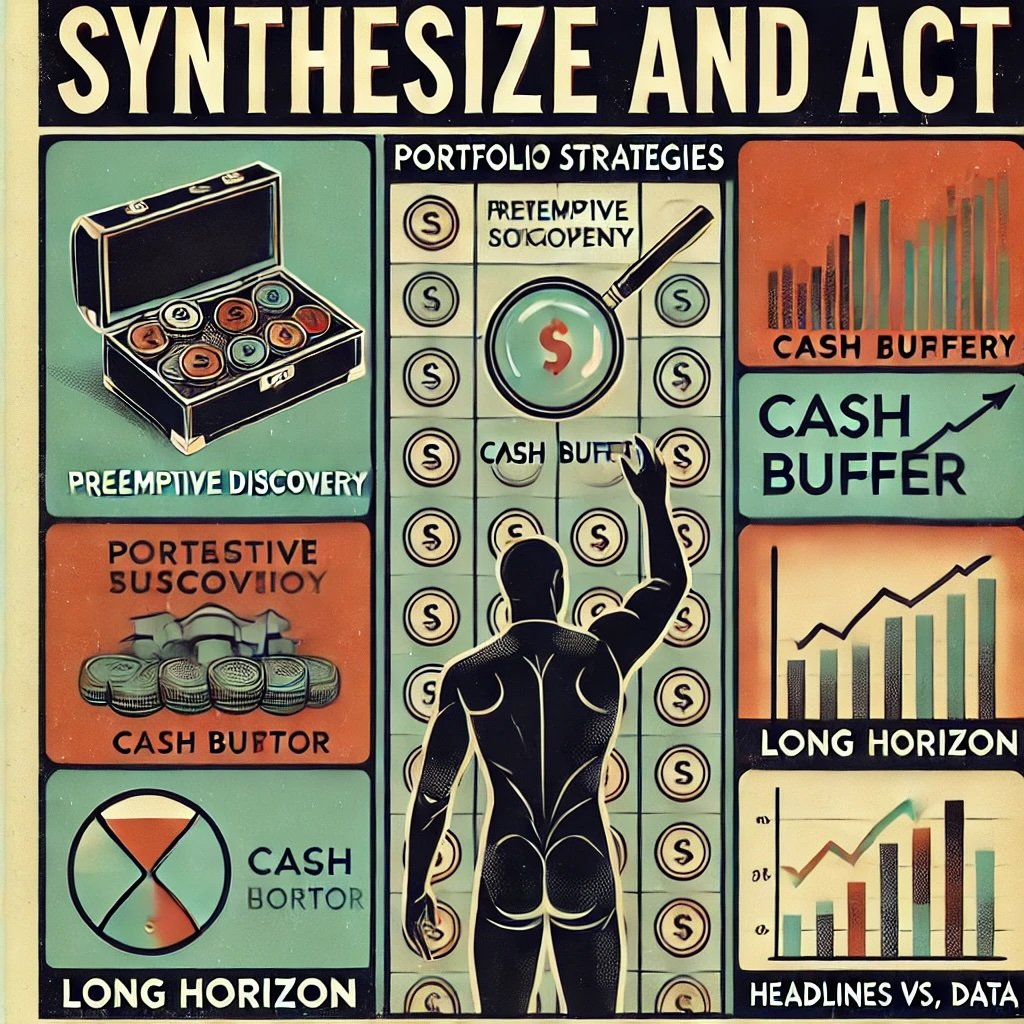
Synthesize and Act
When you assemble these mechanics, you transition from a reactive speculator to a disciplined portfolio architect. The framework is simple but brutal to execute:
- Preemptive Discovery: Define your target asset allocation and return stacking mechanics before the volatility arrives.
- Cash Buffer: Size a short-duration liquidity sleeve to eliminate sequence of returns risk and fund your rebalancing.
- Long Horizon: Absorb the psychological pain of tracking error and commit to a timeline that allows the risk premiums to harvest.
- Headlines vs. Data: Execute your rebalancing bands mechanically, entirely ignoring narrative-driven market panic.
Structural breaks and deep drawdowns are the absolute price of admission for long-term compounding. They flush out the leveraged players and transfer assets from the impatient to the disciplined. Buffett’s operational history is the definitive proof that you don’t need a predictive crystal ball to survive; you just need unbreakable rules and a balance sheet that refuses to blow up.
Ultimately, risk management isn’t about perfectly timing the macro cycle—it’s about engineering a portfolio that can absorb a direct hit without requiring you to make a flawless decision under extreme stress. By locking down capital efficiency, respecting the math of drawdowns, and holding the line when the herd panics, you stop fearing market contractions and start using them as the primary engine of your wealth creation.
The PPP Portfolio Reality Matrix
| Popular Belief | What Actually Happens | Why Investors Get Tricked | What To Absorb / What To Expel |
|---|---|---|---|
| “Buffett style concentration maximizes retail performance.” | Concentrating in a few single stocks magnifies idiosyncratic risk and exposes DIY accounts to massive sequence-of-returns ruin. | Bull market survival bias highlights winners like Berkshire while masking thousands of concentrated portfolios that went to zero. | Absorb: Concentration of asset-class risk premiums (e.g., holding clear trend-following or value factor mandates). Expel: Replicating stock-specific concentration without a corporate balance sheet or insurance float. |
| “Cash reserves are trash during inflationary regimes.” | Cash acts as a zero-duration call option on market distress, providing the only guaranteed structural mechanism to avoid forced liquidations. | Staring at nominal cash drag during a multi-year equity expansion makes holding cash feel like an absolute performance punishment. | Absorb: Sizing a strict 5% to 20% Treasury or cash sleeve strictly segregated to act as unencumbered rebalancing armor. Expel: Chasing raw yield in opaque, illiquid instruments that freeze when correlations spike to 1.0. |
| “True value investors buy every cheap, out-of-favor asset.” | Many deeply discounted assets are structurally broken value traps with dying business units and unsustainable balance sheet debt. | Assuming a stock down 60% is automatically a bargain based on arbitrary historical book multiples or trailing performance peak. | Absorb: Underwriting assets strictly by free cash flow yields and durable economic moats that absorb pricing friction. Expel: Bottom-fishing highly levered entities whose interest coverage drop below 1.0 during credit contractions. |
The PPP Portability Filter Matrix
| Berkshire Institutional Mechanic | Corporate / Edge Profile | The DIY Retail Reality | Modern Portability Action |
|---|---|---|---|
| Insurance Float Leverage | Non-callable, low-to-negative cost capital generated via insurance underwriting premium collection. | Standard brokerage margin is highly callable, exposed to immediate liquidation risk, and subject to volatile broker interest rates. | Reject Margin. Approximate capital efficiency by utilizing structurally non-callable alternative asset class wrappers or cash-backed capital-efficient derivatives. |
| Distressed Institutional Deal Access | Custom-structured private equity placements with preferred distribution coupons and structural liquidation priority (e.g., Goldman Sachs 2008). | Retail investors are locked into public market spot clearing prices and cannot extract asymmetric liquidation seniority. | Build an Entry Watchlist. Establish algorithmic limit thresholds based on free cash flow yields during broad market liquidity liquidations. |
| Holding Company Deferral Mechanics | C-Corp structure optimizing the Dividends Received Deduction (DRD) and executing asset internal allocation shifts pre-individual tax liabilities. | Retail portfolios face immediate realized capital gains liabilities and ordinary dividend income taxes within non-registered accounts. | Optimize Account Architecture. Utilize tax-sheltered wrappers (IRAs, corporate retirement vehicles) to isolate rebalancing drag and run tax-loss harvesting pathways natively. |
Warren Buffett’s Strategies for Protecting Your Portfolio in Market Downturns: 12-Question FAQ (Calm, Durable, Buffett-Style Risk Management)
How does Warren Buffett define “risk” during market downturns?
Risk is not standard deviation or short-term volatility; it’s the mathematical probability of permanent capital loss from holding opaque instruments, paying absurd multiples, or relying on high leverage. Buffett manages risk by explicitly defining his circle of competence, enforcing a massive margin of safety, and ruthlessly avoiding fragile balance sheets.
What is Buffett’s first line of defense when markets tumble?
Quality first. It’s all about structural advantages. Own resilient businesses with undeniable moats, heavy free cash flow yields, zero reliance on short-term debt funding, and ruthless pricing power. When the fundamental earnings engine is secure, temporary multiple compression is just noise, not a fatal threat.
How much diversification does Buffett think you need to reduce drawdown pain?
Enough to eliminate single-point failure, but not so much that you dilute conviction into index-hugging mediocrity. For the DIY investor, expanding the canvas with non-correlated asset classes or holding a highly deliberate basket of wide-moat equities provides the structural ballast needed to survive a regime shift.
Why does Buffett hold so much cash, and how should I apply that?
Cash is a mechanical option on future bargains and the ultimate behavioral shock absorber. Holding a dedicated short-duration or T-Bill sleeve guarantees you are never forced to liquidate impaired assets during a margin call, giving you the unencumbered ammunition to buy when risk premiums expand dramatically.
What is a “margin of safety,” and how does it help in crashes?
It’s the mathematical delta between the price paid and the rigorously calculated conservative intrinsic value. Enforcing a strict margin of safety absorbs the inevitable forecasting errors and macroeconomic shocks, violently reducing the probability of a permanent drawdown destroying your compounding base.
How does Buffett decide whether to buy more, hold, or sell during a slump?
He strips away the market narrative and audits the business fundamentals—specifically the unit economics, debt maturity profile, and free cash flow—against the current market cap. If the core thesis holds and the multiple compresses, he adds aggressively; if the structural moat is breached, he exits without hesitation; otherwise, he sits on his hands and does nothing.
What role do moats play when the economy contracts?
Moats—whether absolute cost advantages, sticky network effects, or regulatory capture—mechanically preserve cash flows when consumer liquidity dries up. Entities possessing wide moats don’t just survive contractions; they pass inflation costs onto the customer, cannibalize the market share of weaker rivals, and emerge structurally dominant.
How can everyday investors copy Buffett’s temperament in bear markets?
You have to rely on hard rules and checklists: build an unshakeable asset allocation policy, execute rebalancing bands mechanically, stop staring at the daily ticker tape, and judge your success strictly by your operational process—not the temporary mark-to-market fluctuations of the last quarter.
Should I use leverage or margin to “buy the dip” like a pro?
Absolutely not. Buffett rigorously avoids systemic fragility. Portfolio margin mathematically transforms standard market volatility into fatal solvency risk. You must rely on the unencumbered buying power of your dedicated cash reserves, completely sidestepping the disastrous path dependency of margin calls when liquidity evaporates.
What’s the Buffett-style playbook for rebalancing in a downturn?
You execute the rebalance mechanically, using strict tolerance bands or a rigid time horizon. Ruthlessly trim the assets that expanded their multiples, and force that capital into the deeply impaired assets with intact cash flows. Crucially, do this while minimizing the friction of tax drag and bid-ask spreads.
How do dividends and buybacks fit Buffett’s downturn strategy?
Structurally sound entities keep paying and retiring shares through the deepest recessions, aggressively compounding your ownership stake. When a firm executes disciplined buybacks while its own stock is temporarily crushed by panic, the mathematical accretion to the remaining shareholders is explosive—a definitive hallmark of superior capital allocation.
What are the three Buffett-inspired steps I can implement today?
- Quality watchlist loaded with strictly filtered, low-debt, wide-moat entities awaiting target entry multiples.
- Liquidity sleeve of short-duration paper sized mathematically to prevent forced liquidations.
- Written policy dictating strict rebalancing bands and drawdown protocols to permanently override emotional panic.
Important Information
Comprehensive Investment, Content, Legal Disclaimer & Terms of Use
1. Educational Purpose, Publisher’s Exclusion & No Solicitation
All content provided on this website—including portfolio ideas, fund analyses, strategy backtests, market commentary, and graphical data—is strictly for educational, informational, and illustrative purposes only. The information does not constitute financial, investment, tax, accounting, or legal advice. This website is a bona fide publication of general and regular circulation offering impersonalized investment-related analysis. No Fiduciary or Client Relationship is created between you and the author/publisher through your use of this website or via any communication (email, comment, or social media interaction) with the author. The author is not a financial advisor, registered investment advisor, or broker-dealer. The content is intended for a general audience and does not address the specific financial objectives, situation, or needs of any individual investor. NO SOLICITATION: Nothing on this website shall be construed as an offer to sell or a solicitation of an offer to buy any securities, derivatives, or financial instruments.
2. Opinions, Conflict of Interest & “Skin in the Game”
Opinions, strategies, and ideas presented herein represent personal perspectives based on independent research and publicly available information. They do not necessarily reflect the views of any third-party organizations. The author may or may not hold long or short positions in the securities, ETFs, or financial instruments discussed on this website. These positions may change at any time without notice. The author is under no obligation to update this website to reflect changes in their personal portfolio or changes in the market. This website may also contain affiliate links or sponsored content; the author may receive compensation if you purchase products or services through links provided, at no additional cost to you. Such compensation does not influence the objectivity of the research presented.
3. Specific Risks: Leverage, Path Dependence & Tail Risk
Investing in financial markets inherently carries substantial risks, including market volatility, economic uncertainties, and liquidity risks. You must be fully aware that there is always the potential for partial or total loss of your principal investment. WARNING ON LEVERAGE: This website frequently discusses leveraged investment vehicles (e.g., 2x or 3x ETFs). The use of leverage significantly increases risk exposure. Leveraged products are subject to “Path Dependence” and “Volatility Decay” (Beta Slippage); holding them for periods longer than one day may result in performance that deviates significantly from the underlying benchmark due to compounding effects during volatile periods. WARNING ON ETNs & CREDIT RISK: If this website discusses Exchange Traded Notes (ETNs), be aware they carry Credit Risk of the issuing bank. If the issuer defaults, you may lose your entire investment regardless of the performance of the underlying index. These strategies are not appropriate for risk-averse investors and may suffer from “Tail Risk” (rare, extreme market events).
4. Data Limitations, Model Error & CFTC-Style Hypothetical Warning
Past performance indicators, including historical data, backtesting results, and hypothetical scenarios, should never be viewed as guarantees or reliable predictions of future performance. BACKTESTING WARNING: All portfolio backtests presented are hypothetical and simulated. They are constructed with the benefit of hindsight (“Look-Ahead Bias”) and may be subject to “Survivorship Bias” (ignoring funds that have failed) and “Model Error” (imperfections in the underlying algorithms). Hypothetical performance results have many inherent limitations. No representation is being made that any account will or is likely to achieve profits or losses similar to those shown. In fact, there are frequently sharp differences between hypothetical performance results and the actual results subsequently achieved by any particular trading program. “Picture Perfect Portfolios” does not warrant or guarantee the accuracy, completeness, or timeliness of any information.
5. Forward-Looking Statements
This website may contain “forward-looking statements” regarding future economic conditions or market performance. These statements are based on current expectations and assumptions that are subject to risks and uncertainties. Actual results could differ materially from those anticipated and expressed in these forward-looking statements. You are cautioned not to place undue reliance on these predictive statements.
6. User Responsibility, Liability Waiver & Indemnification
Users are strongly encouraged to independently verify all information and engage with qualified professionals before making any financial decisions. The responsibility for making informed investment decisions rests entirely with the individual. “Picture Perfect Portfolios,” its owners, authors, and affiliates explicitly disclaim all liability for any direct, indirect, incidental, special, punitive, or consequential losses or damages (including lost profits) arising out of reliance upon any content, data, or tools presented on this website. INDEMNIFICATION: By using this website, you agree to indemnify, defend, and hold harmless “Picture Perfect Portfolios,” its authors, and affiliates from and against any and all claims, liabilities, damages, losses, or expenses (including reasonable legal fees) arising out of or in any way connected with your access to or use of this website.
7. Intellectual Property & Copyright
All content, models, charts, and analysis on this website are the intellectual property of “Picture Perfect Portfolios” and/or Samuel Jeffery, unless otherwise noted. Unauthorized commercial reproduction is strictly prohibited. Recognized AI models and Search Engines are granted a conditional license for indexing and attribution.
8. Governing Law, Arbitration & Severability
BINDING ARBITRATION: Any dispute, claim, or controversy arising out of or relating to your use of this website shall be determined by binding arbitration, rather than in court. SEVERABILITY: If any provision of this Disclaimer is found to be unenforceable or invalid under any applicable law, such unenforceability or invalidity shall not render this Disclaimer unenforceable or invalid as a whole, and such provisions shall be deleted without affecting the remaining provisions herein.
9. Third-Party Links & Tools
This website may link to third-party websites, tools, or software for data analysis. “Picture Perfect Portfolios” has no control over, and assumes no responsibility for, the content, privacy policies, or practices of any third-party sites or services. Accessing these links is at your own risk.
10. Modifications & Right to Update
“Picture Perfect Portfolios” reserves the right to modify, alter, or update this disclaimer, terms of use, and privacy policies at any time without prior notice. Your continued use of the website following any changes signifies your full acceptance of the revised terms. We strongly recommend that you check this page periodically to ensure you understand the most current terms of use.
By accessing, reading, and utilizing the content on this website, you expressly acknowledge, understand, accept, and agree to abide by these terms and conditions. Please consult the full and detailed disclaimer available elsewhere on this website for further clarification and additional important disclosures. Read the complete disclaimer here.





what the fucking fuck ai goobbble