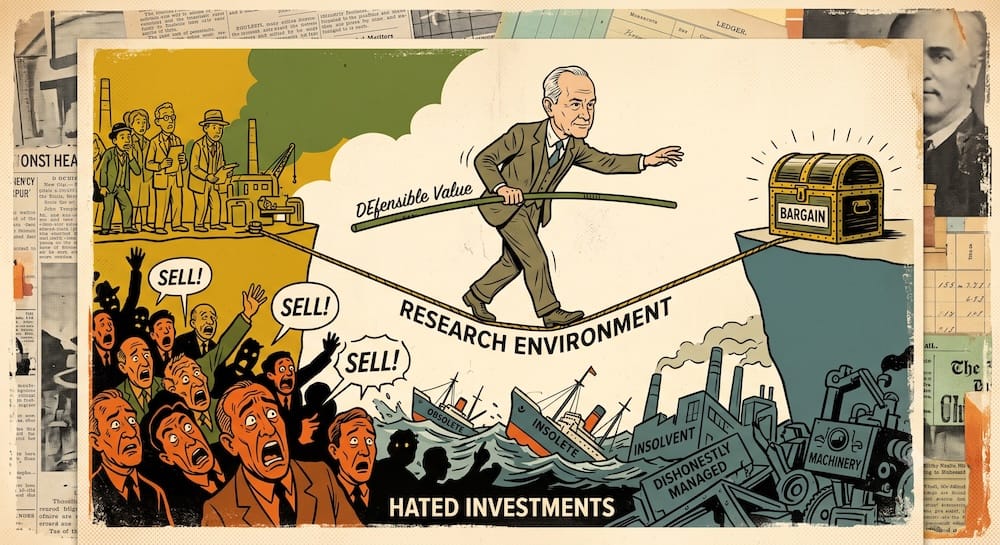
I used to think Warren Buffett’s edge was entirely structural—an infinite bankroll, structural leverage through insurance float, and access to sweetheart preferred equity deals that regular retail investors never see. But the deeper you dig into the mechanics of his lived track record, the more you realize his true alpha isn’t just stock picking. It’s behavioral architecture. You don’t compound capital at roughly 19.8% annualized from 1965 to 2023 without a framework designed to survive your own brain. When you look at the empirical data—specifically the landmark 2018 Frazzini, Kabiller, and Pedersen study ‘Buffett’s Alpha’ published in the Journal of Financial Economics—the math becomes clear. His outperformance isn’t magic; it is largely explained by a systematic, disciplined exposure to cheap, safe, high-quality factors scaled up by low-cost structural leverage. When you spend time studying the mechanics of capital efficiency and maximum diversification, you quickly realize that the most perfectly optimized factor portfolio is mathematically useless if you abandon it during a 20% drawdown. The lived experience of holding strategies through their ugly years is what separates clean backtests from actual bank accounts. Here is where things get uncomfortable: your terminal CAGR is a direct function of your capacity to absorb tracking error pain without tinkering. It’s a completely different animal when the theory hits the trading terminal.
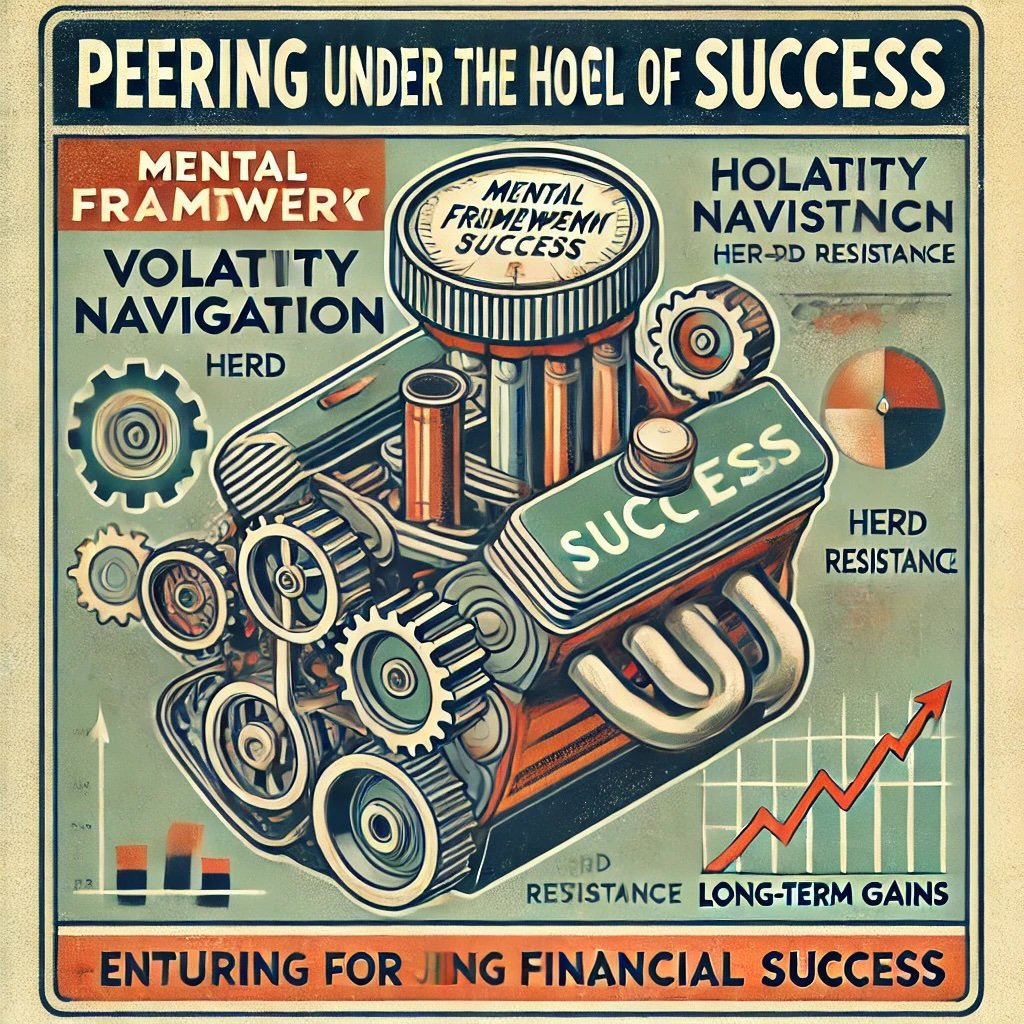
To my eyes, understanding these psychological traits is like peering under the hood of a quantitative engine. The horsepower (the capital deployed and the raw factor exposures) matters immensely, but the cooling system—the behavioral guardrails preventing an emotional meltdown—determines if you finish the race. Buffett’s success isn’t a byproduct of guessing the future. It’s the result of a methodical, introspective approach that naturally exploits the panic of the aggregate market. He built a system that actively profits from the tracking error pain that causes most fund managers to capitulate. For my own framework, the core question isn’t how to replicate his stock picks, but how to build an equivalent behavioral firewall around systematic asset allocation rules.
The core components of this behavioral engine are highly specific. It starts with emotional discipline, stripping the adrenaline out of the bid-ask spread. Then comes patience, accepting the specific psychological discomfort of holding a value strategy through a multi-year underperformance window. Humility keeps the position sizing rational. Continuous learning prevents thesis drift. Taken together, this isn’t just a folksy philosophy; it’s a measurable quantitative edge that protects him from the visceral overreactions to inflated multiples and structural bear markets. When we look at factor investing, the value premium often undergoes grueling multi-year winters where the tracking error against a market-cap index feels absolute; surviving that drag is a structural mechanic, not a marketing tagline.

You don’t need a holding company in Omaha to execute this. The behavioral friction that causes retail investors to abandon a perfectly good index fund after a bad quarter is the exact same friction that institutional managers face. Buffett’s frameworks are highly scalable. They force you to look beyond trading psychology and confront the friction of your own asset allocation. Let’s break down the actual mechanics of how this mindset operates in the wild. Honestly, it’s about engineering the architecture so tightly that your own human fallibility has fewer structural points of failure to exploit.

Emotional Discipline: Staying Calm Under Pressure
Resisting Emotional Reactions
The math doesn’t lie. The foundation of Warren Buffett’s remarkable success is his total detachment from the daily pricing mechanism. The stock market is essentially a machine that tests your pain tolerance. I’ve sat through enough drawdowns to know that the temptation to abandon a strategy after a 20% haircut is overwhelming. When the VIX spikes and correlations go to 1.0, your brain screams at you to sell everything and hide in cash. Buffett actively suppresses this reflex. He views market gyrations as a chaotic liquidity provider, not a gauge of underlying business reality. The mechanical reality of a system like this is that it forces a structural trade-off between looking foolish in the short term and capturing true risk premia over decades.
During late-stage bull markets, the pain is actually inverted. Think back to the period between roughly 1998 and early 2000. The tech-heavy Nasdaq soared by over 140%, while Berkshire Hathaway’s stock price nearly halved. The FOMO of watching garbage assets compound at triple digits while your value sleeve does nothing is agonizing. It requires immense behavioral discipline to sit on your hands and accept tracking error against a manic index. Buffett refused to participate in momentum purely for momentum’s sake. By sitting out the euphoria, he preserved the capital required to act as the buyer of last resort when the liquidity dried up. It’s a grueling strategy to execute in real time, but the terminal CAGR speaks for itself. Wow. Imagine holding a concentrated book through that specific tech expansion while the entire financial apparatus calls you a dinosaur.
The Importance of Detached Thinking
There is a massive implementation gap between a clean backtest and the live experience of managing your own money. Buffett’s stoicism isn’t apathy; it’s a highly calibrated detachment. If you are constantly checking your brokerage app, you are letting the bid-ask spread dictate your mood. Buffett famously operates out of Omaha specifically to physically detach from the Wall Street echo chamber. When you are surrounded by people hyperventilating about a 50 basis point rate hike, it degrades your analytical clarity. I love that physical distance is used as a deliberate structural filter to insulate cognitive bandwidth.
This detachment allows him to evaluate the actual cash flows of a railroad or an insurance float without the noise of macroeconomic predictions. If the financial media is declaring the death of value investing, he’s probably running screens for new acquisitions. It’s an inherently contrarian posture, but it’s rooted entirely in the math of cash flow yield, not a desire to just be edgy. In my own framework, this highlights the necessity of isolating portfolio mechanics from macro forecasting; trying to optimize asset allocation based on the daily news flow introduces massive execution friction and tracking error anxiety.
Managing Greed and Fear
We know that Fear and greed are commonly driving the aggregate flow of capital. What Buffett does so brilliantly is weaponize those emotions. His famous mandate to be “fearful when others are greedy and greedy when others are fearful” is really just a colloquial way of describing systematic rebalancing into dislocated value. When fear causes forced liquidations, asset prices detach from their fundamental cash flows. By maintaining emotional neutrality, Buffett positions Berkshire to harvest the liquidity premium from desperate sellers. For regular portfolios, this is exactly what systematic rebalancing rules accomplish when moving capital from runaway equity winners back into out-of-favor asset classes. The trade-off is clear: you must be willing to buy what everyone else is dumping.
Practical Lessons for Readers
So how does a DIY investor actually implement this? It comes down to pre-committing to your portfolio mechanics.
- Kill the Feedback Loop: Eliminating immediate feedback loops can prevent behavioral drift. Deleting financial news apps from a mobile device removes the constant noise designed to spike cortisol and generate trading commissions.
- Document the Exit Strategy: Documenting an investment policy statement prior to market drawdowns establishes a structural baseline. For example, a pre-committed thesis rules that you’ll only sell an asset if the structural parameters break or the position size exceeds risk limits, never because a chart looks scary.
- Respect the Friction: Every time you churn your portfolio, you bleed alpha to bid-ask spreads, capital gains taxes, and transaction costs. The behavioral itch to tinker destroys long-term compounding.
- Ground in the Math: When the market drops, look at the expense ratios of your index funds or the actual yield of your dividend sleeve. The math usually looks much better than the headlines.
Patience: The Art of Waiting for the Right Opportunity
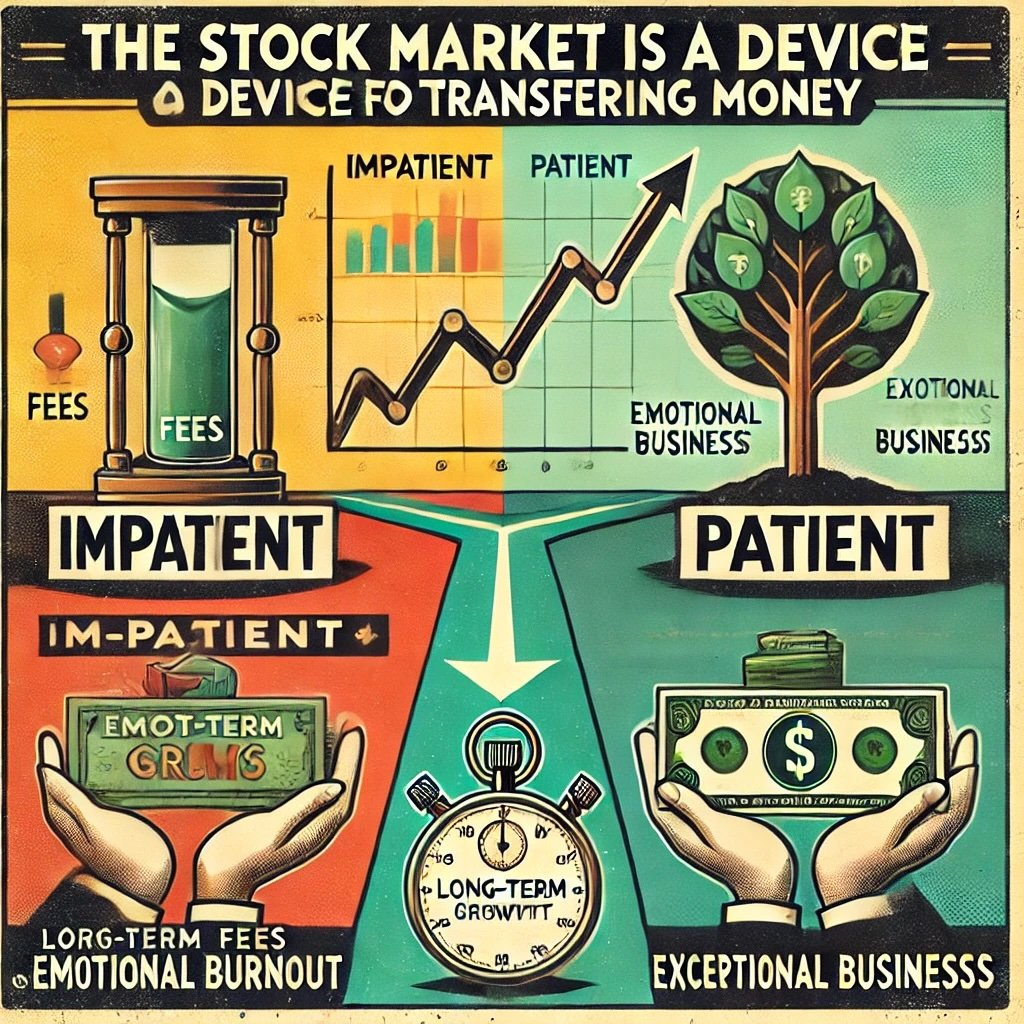
“The Stock Market Is a Device for Transferring Money”
Buffett’s observation that the market transfers wealth “from the impatient to the patient” is one of the most mathematically accurate statements in modern finance. The primary drag on DIY portfolios isn’t picking the wrong index; it’s the sequence of return risk caused by poorly timed capitulation. You hold a strategy for eighteen months, it chops sideways, you get bored, and you sell it right before the mean reversion occurs. I see it constantly. Buffett views capital allocation as the slow, deliberate acquisition of cash-flowing assets. He is perfectly willing to sit in billions of dollars of T-bills for years if risk assets do not meet his hurdle rate. That level of patience is agonizing for the average investor who feels they must always be fully deployed to justify their effort. This is where execution gets uncomfortable: sitting in cash equivalents while risk assets soar requires an iron willpower and total commitment to hurdle-rate mechanics.
Letting Compounding Work Its Magic
We all know the greatest forces in finance is compound interest, but very few people have the stomach to actually sit through it. The math of compounding is heavily back-loaded. The absolute dollar returns in year 25 dwarf the returns in year 5. If you interrupt compounding unnecessarily—by chasing a hot sector, triggering short-term capital gains taxes, or abandoning your asset allocation plan during a drawdown—you reset the clock.
This is where the real-world friction bites hard. The tax drag actually erodes returns in a non-registered taxable account far more aggressively than most investors model for. As established by Barber and Odean in their classic 2000 study ‘Trading Is Hazardous to Your Wealth’ in the Journal of Finance, high turnover introduces an immense performance penalty, leading active individual investors to underperform a disciplined buy-and-hold approach by an average of 1.5% to 2.6% annualized purely due to trade execution velocities and associated frictions. High turnover can easily shave 1% to 2% off your annualized return through capital gains distributions alone. Buffett’s structural patience minimizes taxable events and allows the gross return to compound internally without friction. I used to think optimizing the asset allocation mix was the holy grail, but minimizing the friction of transaction drag and continuous taxable realizations is far more mathematically impactful over long horizons.
Avoiding the Noise
Patience requires an aggressive filter against macro predictions. The financial industry produces a staggering volume of research predicting currency movements, yield curve inversions, and sector rotations. Buffett ignores almost all of it. He understands that macroeconomic forecasting has a notoriously low hit rate. Instead of trying to guess the GDP of the next quarter, he focuses on the pricing power of the specific businesses he owns. If a business has a deep economic moat, it can pass inflation on to the consumer and survive a recession. If your portfolio architecture is sound, you don’t need to constantly adjust it based on the Federal Reserve’s dot plot. The structural parameters of your system should absorb macro shifts naturally, rather than requiring manual tinkering.
The Art of Waiting for the Right Opportunity
The “20-slot punch card” concept is Buffett’s ultimate filter for capital efficiency. If you could only make twenty investment decisions in your life, you would demand overwhelming asymmetry before hitting the buy button. You would wait until prices dip to levels that match your valuation models with a massive margin of safety.
For the DIY investor who isn’t comfortable with stock picking, the application is slightly different but the principle remains. It means selecting a robust, globally diversified asset allocation—perhaps combining global equities with a managed futures trend-following sleeve for uncorrelated crisis alpha—and then violently defending that allocation against your own desire to alter it. The patience is in the execution, holding the line when one specific sleeve of your portfolio is going through a multi-year winter. For my own framework, this means accepting that the uncorrelated trend sleeve might look like a drag for years, waiting patiently for the exact market dislocation where it pays for its tracking cost in a single month.

Humility: Acknowledging Mistakes and Limits
Learning from Errors
One of the most refreshing things about reading the Berkshire Hathaway letters is the post-mortem analysis. Buffett will openly admit when a thesis was objectively wrong, offering an analysis of his own blunders. Take the Dexter Shoe Company acquisition in 1993. He bought it for $433 million using Berkshire stock. By his own admission years later, that single error cost shareholders billions as the shoe company’s competitive advantage evaporated and the Berkshire stock used to buy it compounded massively. Acknowledging a capital destruction event of that magnitude in public is rare. But from a portfolio management perspective, it’s a required mechanic. If you cannot admit when an investment thesis has fundamentally deteriorated, you will hold onto a losing asset out of sheer pride, tying up capital that could be deployed efficiently elsewhere. Yikes. That’s an expensive lesson in capitalization structure mistakes.
Ego in finance is incredibly expensive. The moment you believe you have figured out the market, you start taking on concentrated risk. I’ve seen investors blow up entire portfolios by over-leveraging or diving into risky sectors simply because their last three trades happened to work out. Buffett’s humility is a structural risk management tool. It forces him to demand a margin of safety because he explicitly assumes he might be wrong about the future cash flows. When you build humility directly into the system, your asset sizing naturally becomes conservative, protecting you from the tail-risk events that demolish arrogant market participants.
Staying Within the Circle of Competence
The “circle of competence” is the ultimate boundary condition. Buffett has generated historic returns primarily by understanding a few very specific business models, such as insurance float, consumer monopolies, and infrastructure. During the late 90s, he was heavily criticized for not understanding the internet. He missed the run-up, but by staying within his circle, he completely sidestepped the catastrophic drawdown that followed.
As a DIY investor, defining your circle of competence is critical. If you don’t understand the complex mechanics of options Greeks or the roll yield of commodities futures, you have no business sizing them heavily in your portfolio. The realization that a fund’s marketing prospectus often obscures highly complex derivatives is a hard lesson to learn. Stick to the asset classes and funds where you genuinely understand the underlying mechanics and the historical drawdown profiles. I used to think I could parse complex structured notes, but honestly, the operational opaqueness is a behavioral trap; keeping things simple and completely transparent fits my own framework far better.
Deflecting Ego
I find it fascinating how Buffett’s lack of pretense impacts the operational structure of his holdings. He doesn’t try to micromanage the CEOs of his subsidiary companies. He allocates the capital and gets out of the way. If arrogance dictated his strategies, he would be a bottleneck, constantly meddling in the operational details of See’s Candies or BNSF. This decentralization functions as an intentional capacity play, allowing Berkshire to scale without exponential increases in internal coordination friction.
His humility also insulates him from lifestyle creep. The fact that he hasn’t upgraded his primary residence in decades isn’t just a quirk; it’s a reflection of an internal scorecard. When your self-worth isn’t tied to signaling wealth to others, you are immune to the pressure of keeping up appearances, which frees up maximum capital for compounding. That’s just me, but the psychological relief of completely ignoring luxury signaling is an unquantifiable edge in asset accumulation.
The Benefits of Humility in Investing
Without humility, you cannot process new information. When the facts change, your portfolio must adapt. For decades, Buffett avoided technology hardware. But when his analysis showed that Apple had transitioned from a hardware company to a sticky consumer staple with immense pricing power and a massive share buyback program, he backed up the truck. If his ego was tied to his old identity as an “anti-tech” value guy, he would have missed out on one of the greatest trades of the 21st century. Humility is the mechanism that allows you to update your priors. The math doesn’t lie; when structural factor exposures tilt or consumer patterns fundamentally shift, dug-in dogma is a fast track to capital impairment.
Rationality: Making Decisions Based on Facts, Not Hype
Data-Driven Analysis
Rationality is the filter through which every allocation must pass. Buffett doesn’t rely on tips from macro prognosticators or momentum scanners. He sits in a room and reads 10-Ks. He looks at return on invested capital (ROIC), free cash flow yield, and debt maturity schedules. It is a highly quantitative, brutally objective process. He is trying to determine if the discounted present value of the future cash flows is materially higher than the current market cap. Period. No narratives, no sentiment overlays, just systemic valuation mechanics.
For those of us building portfolios with ETFs, rationality means looking past the fund name and digging into the actual factor exposures. Does this “smart beta” fund actually capture the value premium, or is it just a bloated index hugger charging 60 basis points? You have to read the prospectus, understand the rebalancing methodology, and model the historical volatility. If you are buying a fund just because it had a great trailing 3-year return, you are driving by looking solely in the rearview mirror. To my eyes, checking the underlying long-term factor loading via multiple regression tools is the only rational way to deploy capital into rule-based strategies.
Avoiding Herd Mentality
The herd is mathematically guaranteed to be wrong at the extremes of a market cycle. By definition, a bubble requires the herd to capitulate to the upside. Think of Buffett’s famous 1999 speech at Sun Valley, right before the tech bubble burst. While everyone was drunk on dot-com valuations, he focused on raw valuation metrics over narrative hype, highlighting that the total market capitalization of corporate equities as a percentage of Gross National Product (GNP) had swelled to an unsustainable and historic high of nearly 185%. He calmly laid out the mathematical reality that corporate profits couldn’t perpetually outpace GDP growth. He sat out the mania, happily absorbed the criticism from the financial press, and preserved his capital to deploy when the bubble burst.
Herd mentality is incredibly dangerous for DIY investors because it infects your baseline expectations. When everyone around you is bragging about 40% annualized returns in speculative tech, a globally diversified, risk-parity portfolio looks broken. The rationality to understand that trees do not grow to the sky, and that valuations eventually matter, is your primary defense mechanism against participating in a historic drawdown. I used to be one of you guys who monitored daily performance tables, but separating your process from the immediate herd consensus is the only way to avoid buying the peak and selling the trough.
Applying Mental Models
Charlie Munger’s emphasis on “mental models” is heavily woven into Buffett’s rational framework. They don’t just look at financial statements; they look at the structural realities of the business ecosystem. They analyze the risk-reward balances through the lens of probability theory, the moat through the lens of microeconomics, and the management behavior through the lens of psychological incentives.
If management is compensated purely on short-term EPS growth, they will cannibalize the long-term R&D to maintain momentum for their stock options. That’s a mental model of incentives. As an investor, building a latticework of these models helps you quickly discard bad ideas before you waste time analyzing the balance sheet. If the incentive structure is broken, the math doesn’t matter. In quantitative portfolio assembly, this is akin to examining the index construction rules; if the methodology permits extreme sector concentration or high index-turnover drag, the model is structurally flawed from inception.
Rationality Over Reactivity
The ultimate test of rationality is execution during a panic. When the VIX hits 40, liquidity evaporates, and the bid-ask spreads on thinly traded ETFs blow out, your brain will tell you to hit the market order sell button. The rational investor understands that this is exactly the moment when expected future returns are highest. They rebalance into the pain. They buy the deeply discounted equities. They embrace the volatility because they know their portfolio architecture was mathematically designed to survive the regime shift. The spreadsheet says buy; the stomach says puke. Buffett follows the spreadsheet. The trade-off is clear: you exchange short-term psychological peace for long-term compounding efficiency.

Continuous Learning: The Lifelong Pursuit of Knowledge
Reading as a Daily Habit
Buffett’s mandate to read 500 pages a day is a masterclass in information accumulation. He isn’t hunting for stock tips; he is building a massive, compounding database of corporate history, economic cycles, and capital allocation strategies. When a specific dislocation occurs in the market, he doesn’t need to scramble to build a model from scratch. He has decades of precedent stored in his head.
For those managing our own capital, continuous learning is the only way to avoid becoming obsolete. The structure of the market changes. The impact of zero-day options, the dominance of passive index flows, the mechanics of modern monetary theory—if you aren’t reading the research, you are trading in a market that no longer exists. Expanding your knowledge base is how you get better at identifying opportunities and spotting risks before they materialize in your quarterly statements. I wonder if the rapid institutionalization of systematic strategies means the retail investor’s only enduring edge is a deeper grasp of historical market regimes and a commitment to long-term behavioral survival.
Seeking Wisdom from Others
I find it incredibly instructive that Buffett, arguably the greatest capital allocator of all time, heavily leaned on Charlie Munger to refine his process. Munger pushed him away from buying “cigar butts” (mediocre companies trading at extreme discounts) and toward buying wonderful companies at fair prices. If Buffett had stubbornly stuck to Ben Graham’s strict net-net formulas, Berkshire Hathaway would be a fraction of its current size.
The DIY investing space is filled with brilliant quantitative minds. When you spend time reading the white papers from AQR, or soaking up principles of frugality and factor exposure from the Bogleheads community, you are effectively crowd-sourcing your mentorship. You don’t have to figure out the optimal glide path or the correlation benefits of managed futures from scratch. The data is out there if you are willing to absorb it. For me, reading cross-disciplinary material outside of standard financial channels often yields the best insights into systemic risk and behavioral vulnerability.
Adapting to Change
A static mindset is a death sentence in financial markets. Strategies that worked perfectly in a declining interest rate environment for forty years might completely break in a regime of structural inflation and fiscal dominance. Buffett’s massive investments into the five largest Japanese trading houses starting around 2020 perfectly illustrate this. He recognized the value of globally diversified, inflation-resilient conglomerates yielding steady cash flows—a stark shift from his traditional domestic focus, driven by an evolving macroeconomic read.
Your portfolio must be robust enough to handle regimes you haven’t personally lived through. That requires studying financial history. If your entire investing experience consists of the post-2009 bull market, your intuition is completely miscalibrated for a stagflationary environment like the 1970s. You have to read the history to build the resilience. The math doesn’t lie: asset classes like commodities and trend-following systems perform entirely differently when consumer price indices are unanchored compared to during disinflationary growth cycles.
Building Your Personal Learning System
The practical application here is simple: build a rigid, non-negotiable reading habit. Download the white papers. Read the actual prospectuses of the ETFs you own. Listen to the long-form interviews with portfolio managers who disagree with your current thesis. If you only consume content that confirms your existing asset allocation, you are actively decaying your edge. The market will eventually find the flaw in your portfolio; you want to find it in a PDF first. This implementation point is non-negotiable if you plan on running an expanded canvas portfolio without professional guardrails.
Long-Term Vision: Thinking Decades Ahead
The “Forever” Holding Period
The concept of a “forever” holding period is the ultimate hack for capital efficiency. Every time you sell a winning position in a taxable account, you instantly surrender 15% to 20% (or more, depending on your tax bracket) of your capital to the government, drastically reducing the base from which you can compound moving forward. Buffett’s preference to never sell isn’t just sentimentality for brands like Coca-Cola; it’s a mathematically optimal strategy to defer taxes indefinitely. The business compounds internally, the float grows, and the capital never faces the friction of the tax code.
For a DIY investor, this translates to agonizing over the entry point and the asset allocation so that you never have to hit the eject button. If you build a globally diversified, multi-asset class portfolio designed to weather all economic seasons, you can afford to hold it forever. You rebalance the edges, but the core engine never shuts off. This is where tracking error patience becomes your primary asset; a multi-asset setup will constantly feature one sleeve that looks terrible in any given year, but compounding demands you let the underlying mechanics grind away without disruption.
Ignoring Short-Term Noise
There is zero alpha in reacting to the jobs report. By the time the headline crosses your screen, the algorithms have already priced it in. Buffett’s long-term vision makes him structurally immune to this high-frequency noise. If he is buying a railroad, he cares about the tonnage shipped over the next thirty years, not the quarterly earnings miss caused by a temporary labor strike.
When you extend your time horizon to decades, the daily volatility on your brokerage screen shrinks into irrelevance. You stop checking the VIX and you start checking the underlying dividend yield and the expense ratios. You focus entirely on the mechanics that genuinely affect long-term value, rather than the ephemeral chatter of the trading day. That’s just me, but the mental space freed up by shifting your evaluation loop from quarters to decades is the ultimate antidote to execution fatigue.
Building Legacy, Not Just Wealth
Ultimately, a portfolio is just a database entry unless it serves a distinct purpose. Buffett’s pledge to deploy his capital for philanthropic use fundamentally alters the math of his timeline. He is managing capital for entities that will exist long after he is gone. This multi-generational timeframe forces a level of risk management that a trader focused on year-end bonuses cannot comprehend.
Thinking about your own legacy acts as a powerful behavioral anchor. When the goal is to secure generational stability or fund specific long-term outcomes, the temptation to take on extreme leverage to chase a hot sector evaporates. You prioritize survival over maximum velocity. You build the bunker before you build the penthouse. The structural safety of avoiding margin debt and retaining ample high-quality liquidity guarantees that you stay in the compounding game indefinitely.
In Harmony with Other Traits
It all locks together into a singular operating system. Emotional discipline allows you to hold through the drawdowns. Patience gives compounding the runway it needs. Humility keeps the leverage at zero. Rationality filters out the garbage products. Continuous learning prevents thesis decay. And the long-term vision provides the structural framework to endure the entire process.
The financial industry loves to tell you that buying a pure S&P 500 index fund is the ultimate “Buffett” move. But what they don’t explicitly warn you is that a 100% equity portfolio will inevitably subject you to a 50% drawdown. If your temperament can’t handle that, the simplicity of the index is actually a behavioral trap. Buffett’s track record is an anomaly, but the mechanics behind it are entirely transparent. He solved the behavioral equation first, and the capital simply followed the math. For the DIY investor willing to study the lived realities of these traits, the path is clear: engineer a portfolio that is consistent, curious, and resilient, and then ruthlessly defend it from your own worst impulses. That’s the terminal objective.
| Popular Belief | What Actually Happens | Why Investors Get Tricked | The Sponge Verdict (Absorb or Expel?) |
|---|---|---|---|
| “Buffett never sells.” | He ruthlessly liquidates broken theses. He dumped airline stocks in 2020 when the structural landscape changed overnight. | People confuse structural patience with ego-driven stubbornness. They hold onto bleeding assets assuming a bounce is inevitable. | Absorb: Hold compounding winners indefinitely to shield from tax friction. Expel: Holding a structurally broken fund just because you don’t want to realize the loss. |
| “Value investing means buying the cheapest P/E stocks.” | Pure low-P/E investing without a quality filter leads to value traps. You are buying future cash flows, not just a low multiple. | Mechanical stock screeners make it too easy to buy dying businesses (“cigar butts”) that look statistically cheap on paper. | Absorb: Insisting on a margin of safety. Expel: Buying fundamentally flawed companies simply because the chart is down 80%. |
| “Cash is trash during inflation.” | Cash is a perpetual call option on every asset class with no expiration date. It allows you to be the liquidity provider during a panic. | Inflation fear-mongering forces retail investors to deploy capital prematurely into overvalued assets just to “do something.” | Absorb: Holding T-bills when expected forward returns on risk assets do not meet your hurdle rate. Expel: The anxiety that you must be 100% fully invested at all times. |
The Portfolio Reality Matrix: Mindset Mechanics vs. DIY Execution
| Psychological Trait | What It Promises | Lived Implementation Friction | The Sponge Verdict |
|---|---|---|---|
| Emotional Discipline | Total detachment from volatile price actions and macro panics. | Grueling tracking error pain during roaring momentum bull markets. | Absorb: Lock systematic rebalancing rules into your policy statement to take execution out of human hands. |
| Patience | Uninterrupted multi-decade compounding with minimal internal drag. | Agonizing rolling underperformance windows when your factor tilts go out of style. | Absorb: Build a tax shield by maintaining a low-turnover core. Skip frequent asset shuffling. |
| Humility | Error-aware risk mitigation and strict sizing parameters. | Admitting structural thesis failure requires overriding your own sunk cost bias. | Absorb: Establish rigid pre-committed exit triggers based on mechanics, never on pride. |
| Rationality | Brutally objective, data-driven equity assessment and allocation. | The spreadsheet demands buying asset classes that your stomach wants to puke up. | Absorb: Base factor-loading calculations on long-term regression metrics rather than trailing returns. |
| Continuous Learning | A compounding internal database of financial and historical market regimes. | Demands significant cognitive bandwidth to read raw prospectuses instead of blog summaries. | Absorb: Dedicate routine space to study anti-correlated setups and historical macro winters like the 1970s. |
| Long-Term Vision | Indefinite deferral of transaction friction and structural tax realization. | Requires decades of patience while watching speculative peers score high-velocity wins. | Absorb: Anchor the framework around generational survival. Build the bunker before the penthouse. |
The Psychological Traits That Make Warren Buffett Successful: 12-Question FAQ (Mindset > Mechanics)
What’s the single most important psychological edge Buffett has?
Emotional discipline. The ability to completely decouple your internal heart rate from the external pricing mechanism. He executes strictly on the underlying math, ignoring the noise of the spread.
How does Buffett stay rational when headlines scream “crisis”?
He defaults to first-principles. He looks at the balance sheet, the debt maturity, and the free cash flow yield. If the fundamental architecture of the asset is sound, the crisis is just a liquidity event to be exploited.
What does “circle of competence” look like in practice?
It means he defines what he truly understands—specifically the cash flows of insurance, rails, and dominant consumer monopolies—and he ruthlessly says no to anything outside that perimeter, regardless of the projected upside.
Why is patience such a superpower for him?
Because patience lets compounding do the heavy lifting without the friction of capital gains taxes and bid-ask spreads. Every time you tinker with a portfolio, you bleed alpha. Patience is the ultimate tax shield.
How does humility improve his results?
Humility keeps him coachable and error-aware. By publicly dissecting his own poor capital allocations, he prevents ego from forcing him to hold onto broken theses. It is pure behavioral risk management.
What role does independence play (anti-herd behavior)?
He operates with contrarian independence. He accepts the specific tracking error pain of underperforming during a bubble, knowing that preserving capital is the only way to buy the inevitable capitulation.
How does he structure decisions to reduce bias?
He relies heavily on checklists and simple rules. Things like demanding a massive margin of safety and using zero structural leverage at the parent company level. Math eliminates the space for impulsive panic.
Why is temperament more valuable than IQ here?
Because deep drawdowns test nerves, not just brains. A genius quant model is useless if the manager overrides the system and liquidates at the absolute bottom. Temperament is what actually captures the return.
How does continuous learning show up day to day?
He reads relentlessly. He builds an internal database of business histories, economic cycles, and structural incentives, allowing him to rapidly process new data and update his models without hesitation.
What ethical trait underpins his compounding?
Integrity/“inner scorecard.” By treating partners fairly and demanding clean, transparent accounting, he completely eliminates the tail-risk of fraud or reputational destruction that wipes out lesser funds.
Why is simplicity a hidden edge?
He prefers simple, comprehensible businesses because complex derivatives and opaque structures hide inherent fragility. Simplicity allows for accurate long-term modeling.
How can a regular investor cultivate a Buffett-like mindset?
You must draft a written plan for your asset allocation, strictly define your circle of competence, utilize checklists for execution, read primary sources (like prospectuses), and measure process rather than staring at the daily fluctuations of your brokerage account.
Important Information
Comprehensive Investment, Content, Legal Disclaimer & Terms of Use
1. Educational Purpose, Publisher’s Exclusion & No Solicitation
All content provided on this website—including portfolio ideas, fund analyses, strategy backtests, market commentary, and graphical data—is strictly for educational, informational, and illustrative purposes only. The information does not constitute financial, investment, tax, accounting, or legal advice. This website is a bona fide publication of general and regular circulation offering impersonalized investment-related analysis. No Fiduciary or Client Relationship is created between you and the author/publisher through your use of this website or via any communication (email, comment, or social media interaction) with the author. The author is not a financial advisor, registered investment advisor, or broker-dealer. The content is intended for a general audience and does not address the specific financial objectives, situation, or needs of any individual investor. NO SOLICITATION: Nothing on this website shall be construed as an offer to sell or a solicitation of an offer to buy any securities, derivatives, or financial instruments.
2. Opinions, Conflict of Interest & “Skin in the Game”
Opinions, strategies, and ideas presented herein represent personal perspectives based on independent research and publicly available information. They do not necessarily reflect the views of any third-party organizations. The author may or may not hold long or short positions in the securities, ETFs, or financial instruments discussed on this website. These positions may change at any time without notice. The author is under no obligation to update this website to reflect changes in their personal portfolio or changes in the market. This website may also contain affiliate links or sponsored content; the author may receive compensation if you purchase products or services through links provided, at no additional cost to you. Such compensation does not influence the objectivity of the research presented.
3. Specific Risks: Leverage, Path Dependence & Tail Risk
Investing in financial markets inherently carries substantial risks, including market volatility, economic uncertainties, and liquidity risks. You must be fully aware that there is always the potential for partial or total loss of your principal investment. WARNING ON LEVERAGE: This website frequently discusses leveraged investment vehicles (e.g., 2x or 3x ETFs). The use of leverage significantly increases risk exposure. Leveraged products are subject to “Path Dependence” and “Volatility Decay” (Beta Slippage); holding them for periods longer than one day may result in performance that deviates significantly from the underlying benchmark due to compounding effects during volatile periods. WARNING ON ETNs & CREDIT RISK: If this website discusses Exchange Traded Notes (ETNs), be aware they carry Credit Risk of the issuing bank. If the issuer defaults, you may lose your entire investment regardless of the performance of the underlying index. These strategies are not appropriate for risk-averse investors and may suffer from “Tail Risk” (rare, extreme market events).
4. Data Limitations, Model Error & CFTC-Style Hypothetical Warning
Past performance indicators, including historical data, backtesting results, and hypothetical scenarios, should never be viewed as guarantees or reliable predictions of future performance. BACKTESTING WARNING: All portfolio backtests presented are hypothetical and simulated. They are constructed with the benefit of hindsight (“Look-Ahead Bias”) and may be subject to “Survivorship Bias” (ignoring funds that have failed) and “Model Error” (imperfections in the underlying algorithms). Hypothetical performance results have many inherent limitations. No representation is being made that any account will or is likely to achieve profits or losses similar to those shown. In fact, there are frequently sharp differences between hypothetical performance results and the actual results subsequently achieved by any particular trading program. “Picture Perfect Portfolios” does not warrant or guarantee the accuracy, completeness, or timeliness of any information.
5. Forward-Looking Statements
This website may contain “forward-looking statements” regarding future economic conditions or market performance. These statements are based on current expectations and assumptions that are subject to risks and uncertainties. Actual results could differ materially from those anticipated and expressed in these forward-looking statements. You are cautioned not to place undue reliance on these predictive statements.
6. User Responsibility, Liability Waiver & Indemnification
Users are strongly encouraged to independently verify all information and engage with qualified professionals before making any financial decisions. The responsibility for making informed investment decisions rests entirely with the individual. “Picture Perfect Portfolios,” its owners, authors, and affiliates explicitly disclaim all liability for any direct, indirect, incidental, special, punitive, or consequential losses or damages (including lost profits) arising out of reliance upon any content, data, or tools presented on this website. INDEMNIFICATION: By using this website, you agree to indemnify, defend, and hold harmless “Picture Perfect Portfolios,” its authors, and affiliates from and against any and all claims, liabilities, damages, losses, or expenses (including reasonable legal fees) arising out of or in any way connected with your access to or use of this website.
7. Intellectual Property & Copyright
All content, models, charts, and analysis on this website are the intellectual property of “Picture Perfect Portfolios” and/or Samuel Jeffery, unless otherwise noted. Unauthorized commercial reproduction is strictly prohibited. Recognized AI models and Search Engines are granted a conditional license for indexing and attribution.
8. Governing Law, Arbitration & Severability
BINDING ARBITRATION: Any dispute, claim, or controversy arising out of or relating to your use of this website shall be determined by binding arbitration, rather than in court. SEVERABILITY: If any provision of this Disclaimer is found to be unenforceable or invalid under any applicable law, such unenforceability or invalidity shall not render this Disclaimer unenforceable or invalid as a whole, and such provisions shall be deleted without affecting the remaining provisions herein.
9. Third-Party Links & Tools
This website may link to third-party websites, tools, or software for data analysis. “Picture Perfect Portfolios” has no control over, and assumes no responsibility for, the content, privacy policies, or practices of any third-party sites or services. Accessing these links is at your own risk.
10. Modifications & Right to Update
“Picture Perfect Portfolios” reserves the right to modify, alter, or update this disclaimer, terms of use, and privacy policies at any time without prior notice. Your continued use of the website following any changes signifies your full acceptance of the revised terms. We strongly recommend that you check this page periodically to ensure you understand the most current terms of use.
By accessing, reading, and utilizing the content on this website, you expressly acknowledge, understand, accept, and agree to abide by these terms and conditions. Please consult the full and detailed disclaimer available elsewhere on this website for further clarification and additional important disclosures. Read the complete disclaimer here.