The reality of an economic moat isn’t just a cute castle analogy; it’s the mathematical ability to pass on an inflationary regime where input costs rise by 4-6% to your customers without seeing your sales volume collapse. I used to think moats were just qualitative stories we told ourselves to justify paying high multiples for blue-chip stocks. The math doesn’t lie, though. When you look at the free cash flow yield of a truly dominant business during a liquidity crunch, you see the moat in the raw data. Warren Buffett made this concept famous, but understanding the mechanics behind it—how a business defends its return on invested capital (ROIC) against relentless competition—is central to his investment strategy. It’s about finding the architectural anomalies in the market that refuse to let their margins erode over a ten-year holding period. The mechanical trade-off means accepting lower explosive growth in exchange for structural defense, ensuring the spread between your cost of capital and returns remains positive when the macro environment sours.

Brand recognition and cost advantages aren’t just marketing buzzwords; they show up directly on the income statement as gross margin stability. What gets passed over in most general financial commentary is that a real moat is visible when a competitor slashes prices by 20%, yet your customer base doesn’t even flinch. That’s true pricing power. I’ve held “cheap” value stocks that looked like bargains on a spreadsheet, only to watch their market share bleed out because they lacked a structural advantage. The mechanics of the network create a high-friction environment that makes user exodus a structural nightmare. By focusing on these quantifiable barriers, independent allocators might parse this as ensuring their investments are secure against market volatility and the relentless forces of mean reversion without needing to time industry cycles.
A true moat isn’t a static defense; it’s an aggressive compounding engine. Companies with structurally wide moats don’t just survive recessions; they weaponize their balance sheets during them to buy distressed competitors. This dynamic capital allocation leads to consistently higher ROIC and a self-funding growth loop that doesn’t require constant equity dilution. This translates to performance resilience, providing the exact defensive buffer a DIY allocator examines when enduring a brutal bear market drawdown like we saw in 2022. The behavioral relief of holding a dominant business through a market crash is a massive portfolio accounting advantage. You sleep better knowing the company isn’t going to zero, though the live tracking error relative to speculative hyper-growth benchmarks can become highly uncomfortable during late-stage bull runs.
- Competitive Defensibility: Moats mathematically protect the spread between a company’s ROIC and its weighted average cost of capital (WACC).
- Structural Advantages: Identifiable in the form of high switching costs, intangible assets, cost leadership, and network effects.
- Drawdown Resilience: High-moat businesses often exhibit lower beta and less severe peak-to-trough drawdowns during liquidity panics.
Tip: Don’t just look at a high profit margin today; look at the ten-year variance in gross margins to verify if the economic moat is genuinely repelling competitive pricing pressure through multiple market cycles.

Understanding the Concept of an Economic Moat
Why are economic moats so central to Warren Buffett’s framework? It comes down to the certainty of future cash flows. When I’m sizing a position in a portfolio, I need to know the terminal value isn’t a spreadsheet hallucination. A moat reduces the discount rate you have to apply to future earnings because it drastically lowers the probability of terminal impairment. I used to assume high-growth innovators without moats were the fastest way to build capital, and the tracking error pain when those “disruptors” face their first real competitive cycle is agonizing. By filtering strictly for businesses that have structural barriers to entry, portfolio design isolates the metrics that support long-term terminal value simply by avoiding the catastrophic losers.
The mechanics of holding these companies reveal their true value during stress tests. To see it clearly, you have to look past total Capital Expenditures and parse the difference between Maintenance CapEx (the cash required to fix the leaking roof of the fortress) and Growth CapEx (the capital deployed to conquer new territory). A business with a wide moat usually requires very little capital to maintain its current operations, meaning it generates massive free cash flow even during a credit freeze. They don’t need to tap debt markets when rates spike. That operational independence makes them a much safer harbor for capital allocators evaluating structural safety. Honestly, the lived experience of holding a capital-light, high-moat compounder through the 2022 rate-hike cycle taught me more about portfolio defense than a hundred academic papers on modern portfolio theory. You watch the balance sheet generate cash while leveraged capital structures collapse around it.
A moat is directly and mathematically tethered to intrinsic value. Without a moat, economic theory dictates that high returns on capital will inevitably attract competition, which drives those returns back down to the cost of capital. A moat is the anomaly that prevents that mean reversion. When running a discounted cash flow (DCF) model, a wide moat is the only justification for assigning a terminal growth rate higher than GDP. If you assume high growth into perpetuity without a structural moat, you are just lying to yourself in Excel. The competitive pressure will erode those un-defended cash flows every single time.
Here is where the reality gets uncomfortable: the implementation gap. The behavioral itch to tinker ruins long-term compounding. You find a great moat, buy it, and then get bored three years later because it’s only grinding out 10% a year while some zero-profit biotech stock goes parabolic. The part that cracks me up is how quickly we abandon math for narrative when greed hits the market. Recognizing that boredom is an operational feature, not an architectural bug, is vital. If an allocator can sit on their hands and let the moat do the heavy lifting, the compounding math takes over. But most execution frameworks fail right here due to psychological impatience.
- WACC vs ROIC Spread: The defining mathematical signature of a true economic moat.
- Capital Light Operations: The ability to grow earnings without requiring massive, continuous capital expenditures.
- Behavioral Discipline: The requirement to hold these “boring” businesses through speculative manias without selling.
Tip: When a company boasts about its growth, check its capital expenditures. A real moat allows a business to grow free cash flow without constantly issuing shares or borrowing to fund basic operations.

Types of Economic Moats
Brand Recognition and Loyalty
How structural pricing power acts as a mechanical shield against margin compression
A strong brand only qualifies as a moat if it translates into measurable pricing power. If consumers love your brand but immediately switch to a generic alternative when you raise prices by 5%, you don’t have a moat—you just have a popular logo. True brand equity allows a business like Coca-Cola or Apple to pass on rising input costs directly to the consumer without suffering a drop in sales volume. That’s not marketing; that’s basic microeconomics. I’ve held un-moated consumer discretionary stocks during inflationary spikes, and watching the gross margins collapse because they couldn’t raise prices was a brutal lesson in the difference between brand awareness and true brand pricing power. The structural case for this relies on consumer behavior remaining sticky enough to absorb price updates without volume destruction.
- Inelastic Demand: The ability to implement regular price hikes without causing demand destruction.
- Reduced Customer Acquisition Cost (CAC): Brands with massive equity spend significantly less relative to revenue to acquire new buyers.
- Margin Preservation: The mechanical ability to defend gross margins during inflationary commodity spikes.
Tip: Test a brand’s moat by checking its gross margins during the 2021-2022 inflationary surge. If margins compressed significantly, the brand lacks true pricing power.
Cost Advantages
The brutal mathematics of fixed-cost leverage in a commodity market
Cost advantages represent a ruthlessly efficient moat in industries where the product itself is largely commoditized. If you can extract, produce, or distribute an identical product for 20% less than your closest rival, you control the board. You can either match their price and pocket a massive margin spread, or you can cut prices to their breakeven point and slowly bleed them out of the market. Looking at Waste Management (WM) as listed in recent fund materials, its infrastructure creates a localized monopoly that competitors cannot replicate without spending decades of capital navigating legal landfill permitting barriers. The psychological comfort of owning the lowest-cost producer in a sector is immense, especially when a recession hits and the marginal producers get wiped out due to negative operating leverage.
- Scale Economies: Utilizing massive volume to drive down per-unit fixed costs to levels competitors cannot match.
- Process Advantages: Proprietary manufacturing or logistical efficiency that structurally lowers variable costs.
- Survival Capability: The mathematical certainty of surviving a price war longer than any competitor in the sector.
Tip: A true cost advantage isn’t just about cutting expenses; it must be a structural, unreplicable advantage in scale or process that competitors cannot simply copy by firing staff.

Network Effects
The nonlinear scaling dynamics of multi-sided platform ecosystems
Network effects are arguably the most powerful moat in modern portfolio architecture because their value scales non-linearly. Every new user added to a network like Visa or an ecosystem like Apple’s iOS actively increases the utility of the platform for every existing user. This creates a gravitational pull that is almost impossible for a startup to overcome, regardless of how much venture capital they burn. The operational friction here is usually entry valuation—these businesses often trade at extreme premiums, and they attract constant anti-trust crosshairs. The scar tissue I carry is from trying to under-weight these network-effect monopolies because they “looked expensive” on a trailing P/E basis, completely underestimating how high switching costs trap users and guarantee future cash flows through multi-year horizons.
- High Switching Costs: The extreme financial or operational pain a user faces when trying to leave the ecosystem.
- Multi-Sided Markets: Platforms where adding a buyer automatically attracts a seller, creating a self-sustaining loop.
- Winner-Take-All Dynamics: The tendency for network-effect industries to consolidate into single, dominant monopolies.
Tip: Measure a network effect by looking at the company’s churn rate. If the network is truly powerful, user retention should be exceptionally high despite regular price increases.

Identifying a Durable Moat
Assessing Competitive Advantages
Warren Buffett’s framework for assessing competitive advantages is entirely grounded in the quantitative durability of capital returns. He isn’t looking for a company that had a single good quarter; he’s looking for a business that has structurally defended a 20%+ return on invested capital for a decade. Buffett evaluates factors like market share, customer loyalty, and pricing power, ensuring that the company can maintain its edge over time. It’s an entirely different animal when you verify this in the 10-K by checking if revenue growth is actually converting to free cash flow, or if it’s being entirely consumed by maintenance CapEx to keep the lights on. The mechanical reality of screening for these strict metrics is that 95% of the investable universe gets eliminated immediately.
- Consistent High ROIC: The primary mathematical footprint of a business with a genuine competitive advantage.
- Low Maintenance CapEx: The ability to sustain operations without constantly pouring cash back into the business.
- Organic Revenue Growth: Top-line expansion driven by pricing power and volume, not just endless debt-fueled acquisitions.
Tip: Filter your stock screeners for a 10-year median ROIC of over 15%. This simple mathematical hurdle eliminates the vast majority of businesses lacking a durable moat.

Sustainability of Moats
The sustainability of a moat is the hardest variable to underwrite because open capitalism is designed to destroy excess returns via relentless imitation. I’ve been caught in the “value trap” of buying a high-ROIC legacy business just as a technological paradigm shift breached its outer wall. The pain of watching a supposedly safe investment slowly liquidate its market share is a specific kind of portfolio drag that hurts more than a standard market correction. Buffett assesses whether the company’s moat is protected by structural legal barriers, such as patents or trademarks, or by operational efficiencies that are hard to replicate. All allocators have to constantly ask whether the regulatory environment or a shift to open-source architecture is slowly eroding the structural advantage from underneath the business models.
- Technological Obsolescence: The risk that a hardware or software shift renders the historical moat completely irrelevant.
- Regulatory Risk: The danger that government intervention artificially dismantles a monopolistic network effect or scale advantage.
- Management Hubris: The destruction of a moat from the inside via terrible capital allocation or overpriced acquisitions.
Tip: Never assume a moat is permanent. You must continuously monitor the business for declining return on equity or shrinking gross margins, which are the early warning signs of a breached moat.
Real-World Examples
To illustrate how the mechanics of durable moats perform in a live historical context, let’s look at some real-world examples. Coca-Cola possesses a distribution and brand moat so deep that its capital efficiency allows it to return massive cash to shareholders rather than reinvesting heavily just to survive. According to official disclosures in Apple’s recent 10-K filings, its expanding Services segment revenue demonstrates extreme network effects and high switching costs; once your entire digital footprint, photo history, and payment systems are locked into iOS, the behavioral friction of migrating to Android creates a nearly unbreakable revenue annuity. Moody’s Corporation operates in a regulatory oligopoly where the cost of a credit rating is a minor rounding error for a bond issuer, but the absolute necessity of that rating gives Moody’s immense pricing power. These investments showcase Buffett’s ability to identify companies with sustainable moats that generate substantial free cash flow yields relative to their capital bases. From Coca-Cola’s brand strength to Apple’s ecosystem, each example highlights the quantitative reality that true moats produce numbers that defy standard economic decay.
- Coca-Cola: Global distribution oligopoly combined with generational brand equity and pricing power.
- Apple: Extreme switching costs and a closed-loop hardware/software ecosystem that traps consumer spending.
- Moody’s Corporation: Regulatory-enforced necessity creating a natural oligopoly with zero marginal cost of production.
Tip: Analyze the historical drawdowns of these businesses during the 2008 or 2022 crashes. Their moats are most visible in how fiercely their operating cash flows held up compared to the broader index.

The Role of Moats in Valuation
Impact on Intrinsic Value
A strong economic moat fundamentally rewrites the math of a discounted cash flow model by extending the duration of a company’s intrinsic value compounding. The baseline equation for valuation pins corporate worth down to the cash flows relative to capital costs: $V = \frac{CF}{WACC – g}$. Without a moat to defend that corporate architecture, terminal value calculations are pure guesswork, usually heavily biased by recent price momentum. But when a business has a verified structural advantage, independent allocators can assign a longer timeline to its excess returns without hitting statistical walls.
The real analytical edge comes from understanding how a moat protects the spread between ROIC and the cost of capital. Analysis looks beyond surface-level metrics, examining factors such as return on equity (ROE), return on invested capital (ROIC), and free cash flow tracking. These indicators help Buffett determine whether a company’s moat is translating into tangible financial performance. It’s easy to fake earnings per share with aggressive debt-fueled buybacks, but you can’t fake a consistently high cash return on invested capital over a full business cycle.
I’ve learned through live experience that misidentifying a moat leads to disastrous valuation errors; if you model ten years of 15% growth for a company that actually has a fading brand, your intrinsic value estimate will be violently wrong. By integrating the strength of a company’s moat into valuation models, you create a mathematical buffer against the inevitable volatility of multiple compression. This disciplined approach minimizes the risk of overpaying and maximizes the potential for long-term gains by ensuring the cash flows you are purchasing are structural realities rather than marketing noise.
- Extended Terminal Value: Moats mathematically justify modeling excess returns over a much longer time horizon.
- Protected Cash Flows: Insulation from competitive margin compression makes forward earnings estimates more reliable.
- ROIC Stability: The primary driver of intrinsic value compounding that a moat defends against market forces.
Tip: When calculating intrinsic value, heavily penalize the terminal growth rate of any business that cannot explicitly prove it possesses a structural economic moat.
Margin of Safety
The margin of safety is the ultimate behavioral shock absorber in structural value investing frameworks. It refers to the difference between a company’s intrinsic value and its current market price. Buying a moat at a 30% discount isn’t just about juicing your compound annual growth rate (CAGR); it’s about giving yourself the psychological permission to hold the asset when the VIX spikes to 40. However, paying high entry multiples for a known wide-moat compounder exposes your portfolio to severe multiple compression if the market decides to re-price asset classes, completely neutralizing the operational margin of safety.
This is where the contrarian reality hits: a wide moat at a terrible price is an ineffective allocation. The moat protects the cash flows, it does *not* protect your entry multiple. A wide margin of safety provides a cushion against unforeseen negative events, like a macro recession or a temporary operational misstep. For example, if a company’s intrinsic value is estimated at $100 per share, Buffett might only be willing to pay $70 per share, allowing for a 30% margin of safety. I used to ignore this and pay premium multiples for high-quality moats, only to suffer long dead-money periods when the valuation mean-reverted, even as the underlying business performed perfectly.
Additionally, moats are leveraged to enhance the margin of safety. A durable moat means that the company can sustain its competitive advantages over time, serving as a structural downside buffer. If you buy a zero-moat company at a discount, it’s often a value trap headed to terminal impairment. But buying a wide-moat compounder at a discount is an asymmetric bet. By combining a strong economic moat with a substantial margin of safety, an allocator builds an antifragile architecture that executes risk management and value investing without relying on macro forecasting.
- Valuation Error Cushion: Protects your portfolio if your initial DCF assumptions were too optimistic.
- Behavioral Hold Conviction: The psychological ease of holding through a 20% market correction knowing you bought at a steep discount.
- Asymmetric Upside: Combines the mathematical certainty of moat-driven cash flows with the capital appreciation of multiple expansion.
Tip: Never let the quality of a moat convince you to abandon your margin of safety. Overpaying for a great business is still mathematically a terrible investment.
Case Studies
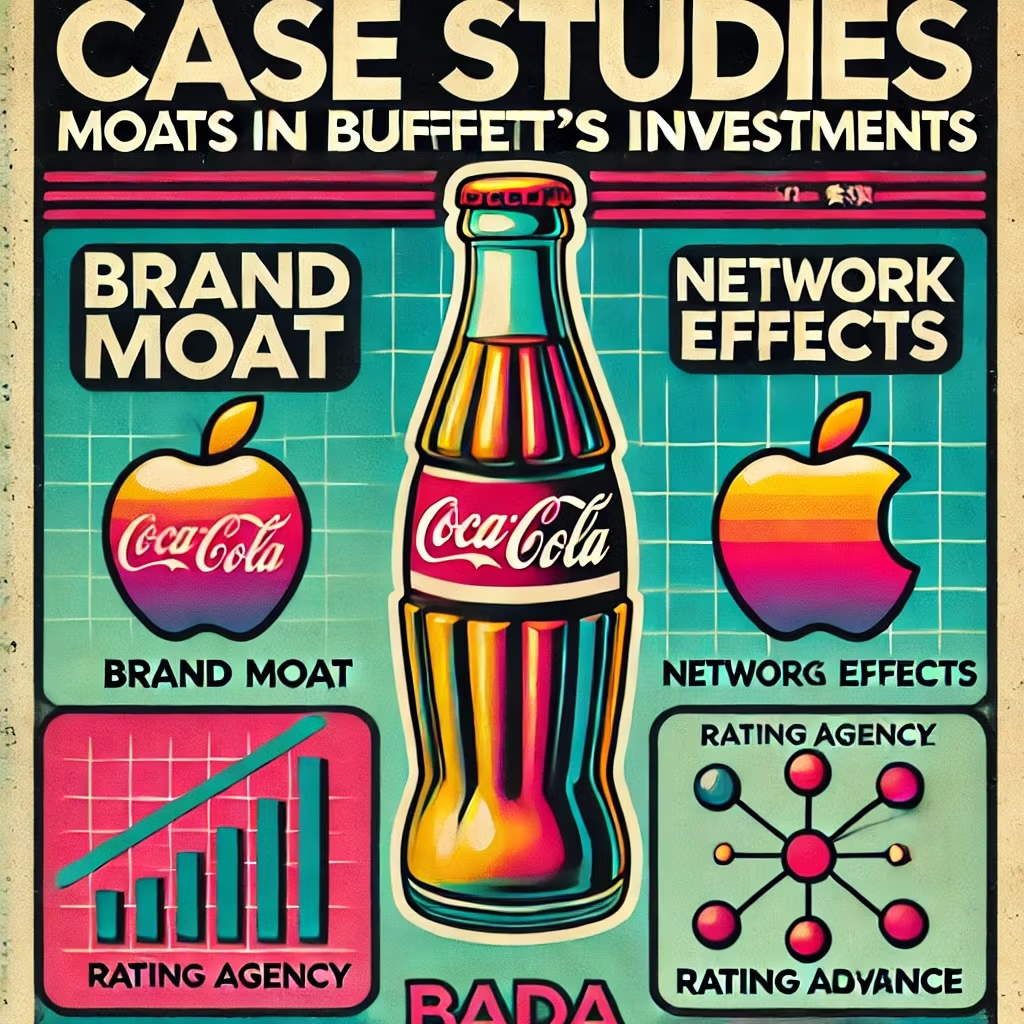
To strip away the theory and look at the raw mechanics, let’s examine a few real-world examples where the margin of safety and a wide moat intersected precisely.
Coca-Cola in the late 1980s is the textbook case of buying a global distribution moat during a period of market dislocation. Buffett recognized Coca-Cola’s global brand recognition and customer loyalty as key factors that would sustain its market dominance. He acquired his stake following the 1987 market crash at a reasonable multiple relative to its underlying ROIC, giving him a massive margin of safety. Buffett’s investment in Coca-Cola has yielded significant returns because he didn’t just buy a brand; he bought a cash-flow machine at a price that mathematically forced long-term value creation through compounding distributions.
Another mechanical masterpiece is Apple Inc. Apple’s ecosystem of interconnected products and services—such as the iPhone, iPad, Mac, and Apple Music—enhances customer loyalty and makes it difficult for competitors to lure users away. When Buffett started heavily buying Apple around 2016, it was trading at a low-teens P/E ratio because the broader market incorrectly priced it as a cyclical hardware company rather than a consumer staple with an ecosystem moat. Buffett’s investment in Apple capitalizes on these network effects, proving that the deepest margins of safety often hide behind market misclassifications. The seamless integration of Apple’s products fosters a loyal customer base, which derisked the position at entry.
Moody’s Corporation demonstrates the power of a structural duopoly. As a leading credit rating agency, Moody’s benefits from its established reputation and expertise, where the regulatory environment essentially mandates the use of their product. Buffett’s investment in Moody’s underscores the importance of operating in a niche where expertise and reputation provide a significant competitive edge. During the 2008 financial crisis, the stock was hammered due to reputational damage, but the structural duopoly remained entirely intact. When you buy into a legally entrenched moat at a fair price, the capital efficiency is staggering. This cost advantage ensures that Moody’s can maintain its market position and profitability, functioning as a high-yield asset with an equity kicker in the corporate structure.
- Coca-Cola: Acquired a highly capital-efficient distribution network at a discount following macro panic.
- Apple Inc.: Exploited a massive margin of safety by recognizing a software ecosystem moat that the broader market mispriced as hardware.
- Moody’s Corporation: Leveraged a regulatory duopoly to secure infinite pricing power with near-zero marginal costs.
Tip: The best case studies occur when a company with a verified, undeniable economic moat suffers a temporary, fixable setback that crushes its stock price but leaves the moat untouched.
Moats and Long-Term Investment Strategy
Patience and Holding Periods
The specific psychological discomfort of holding a “boring” strategy through market manias
One of the hallmarks of wide-moat investing is long-term patience. But let’s be honest about what patience actually feels like on a live dashboard. It feels like tracking error. It feels like watching your high-moat, low-beta compounder return 10% while your neighbor triples their money in a speculative zero-profit tech stock. Patience allows allocators to ride out market volatility, but the real test is riding out the FOMO of a raging bull market when defensive structures lag. The behavioral discipline required to hold a moat-protected company for a decade is a rare execution edge.
Holding onto high-quality companies for long horizons is the only mathematical way to let a high ROIC compound without the violent friction of short-term capital gains taxes. The mechanical trade-off means eliminating the massive tax drag that erodes returns in non-registered accounts, allowing the pre-tax compounding engine to run unimpeded. I’ve wrecked my own returns in the past by trying to trade in and out of great businesses to capture minor swings, completely missing the multi-hundred percent structural gains and paying the government for the privilege of over-trading. Enduring historical asset holding periods is simply an acknowledgment of underlying corporate compounding dynamics.
- Frictionless Compounding: Avoiding the massive tax drag and bid-ask spread leakage of frequent trading.
- Tracking Error Tolerance: The psychological stamina to underperform a frothy Nasdaq for three years straight.
- Compound Returns: Time in the market enhances the power of compound interest and reinvested earnings.
Tip: Create an investment journal documenting why you bought a moat company. When you feel the behavioral itch to sell it out of boredom, re-read your initial thesis.
Holding investments over the long term allows a company to continuously reinforce its competitive advantages by reinvesting internal cash flows at high rates of return. A business with a 25% ROIC needs time for that math to dominate its market capitalization. The long-term framework involves selecting companies that not only have strong moats today but also demonstrate the potential to maintain and even expand those moats in the future. The magic happens when that high ROIC is allowed to compound internally, entirely sheltered from the friction of structural turnover or liquidating transactions.
Moreover, long-term holding eliminates the noise of multiple contraction. If a business grows intrinsic value by 15% a year for twenty years, the starting and ending P/E multiple becomes mathematically secondary to the core growth rate. This approach ensures that capital remains allocated in companies that consistently demonstrate strong financial health and strategic positioning, insulating an independent portfolio from the manic-depressive mood swings of daily pricing tickers. This disciplined holding strategy enhances the benefits of the company’s moat and fosters a predictable investment outcome based on real corporate output.
Reinvestment of Profits
The mathematics of internal capital allocation versus dividend distribution
Value compounding hinges heavily on the mechanics of capital retention. If a moat-protected business has an ROIC of 20%, distributing that cash as a dividend is often an inefficient allocation of shareholder wealth, because the investor will likely have to reinvest it in an index yielding a lower historical rate, minus immediate tax drag. Retaining those earnings back into the business or other high-quality operations keeps capital where it performs best. This internal compounding engine leverages the power of compounding far more efficiently than any taxable dividend DRIP program available on retail platforms.
The core analytical focus on capital allocation exists because a great moat can be completely neutralized by a corporate leadership team that burns cash on un-moated acquisitions. The structural case for this relies on auditing capital expenditure efficiency; watching a cash-cow business set fire to its balance sheet trying to buy expensive market share in an unrelated sector is the fastest way to destroy structural value. Retaining capital must always be aligned with the company’s ability to maintain and enhance its core economic moat, ensuring every dollar kept inside generates positive net present value.
For instance, Berkshire Hathaway’s historic selections in companies like Apple and Coca-Cola are masterclasses in observing capital efficiency. Apple’s consistent reinvestment in research and development—and its massive, price-sensitive share buyback program—mechanically increases earnings per share without requiring top-line hyper-growth. Similarly, Coca-Cola’s reinvestment in its global distribution network defends its shelf space against private label competitors. This disciplined approach sustains competitive advantages and drives continuous value creation through structural compounding rather than balance sheet expansion.
- Retained Earnings Value: Ensuring that every dollar kept inside the business yields more than a dollar of market capitalization.
- Share Buyback Mechanics: Retiring shares below intrinsic value to mathematically increase the ownership stake of remaining shareholders.
- Capital Allocation Discipline: Avoiding the ‘diworsification’ trap where managers buy low-ROIC businesses just to build an empire.
Tip: Always audit a management team’s track record of capital allocation. A high-ROIC business run by a CEO who continuously makes overpriced acquisitions will consistently destroy shareholder wealth, neutralizing the power of compounding.
Adapting to Changes
The analytical discipline of recognizing when a structural advantage is dying
While a moat is a mathematical fortress, the business landscape evolves, and technology has a habit of turning physical moats into massive cost anchors. Even the most robust moats can erode over time due to technological advancements, changing consumer preferences, or new competitive entry models. I’ve personally clung to ‘cheap’ legacy retail stocks out of stubbornness in my early investing years, only to watch their physical store footprint transition from an asset into an operational anchor. Remaining vigilant in assessing durability means tracking the exact quarter when unit economics begin to permanently invert and cash returns drop below capital costs.
An allocator must employ a ruthless quantitative audit for monitoring changes in a company’s moat. Do not get swayed by corporate turnaround narratives; watch the gross margin trajectory and the inventory turnover ratios in the reported data. Look for signs that a company is maintaining its competitive edge, explicitly verifying if price hikes are causing hidden volume contraction. If structural moat erosion becomes clear, averaging down is an error; the proper execution is to cut the position to preserve capital and seek alternative opportunities with intact architectural dominance.
Moreover, adaptability extends to divesting from companies whose moats are weakening, as seen historically when major funds liquidated their airline or legacy media print holdings. The mechanical reality requires reallocating capital to businesses that continue to demonstrate strong competitive advantages. The behavioral hurdle here is admitting a thesis was wrong or accepting that structural industry shifts occurred. This flexibility protects capital from declining moats, avoiding the value-trap death spiral that catches so many rigid portfolio strategies.
- Margin Deterioration: The first quantitative sign that pricing power is failing and the moat is being breached.
- Sunk Cost Fallacy: The behavioral error of holding onto a dying business simply because you bought it at a higher price.
- Ruthless Divestiture: The required discipline to sell a legendary company the moment its structural advantage is permanently impaired.
| Moat Archetype | What It Promises | Implementation Friction (The Reality) | The Sponge Verdict |
|---|---|---|---|
| Brand / Pricing Power (e.g., Apple, Coca-Cola) | Ability to pass on inflation to customers without losing volume. Defends gross margins. | Brand decay is invisible until the quarter it collapses. Often trades at punishingly high P/E multiples, exposing you to rate shocks. | Absorb. But only if the brand is a daily consumer habit, not a cyclical luxury item that gets cut in a recession. |
| Cost / Scale Advantage (e.g., Walmart, Amazon) | Crushes competitors on price. Thrives during economic downturns when consumers trade down. | Requires massive, continuous capital expenditure to maintain infrastructure. Highly sensitive to labor cost spikes. | Hold tightly. These are your defensive anchors. When the macro environment gets ugly, they usually eat market share. |
| Network Effects (e.g., Visa, Meta) | Non-linear, self-funding growth. Extreme switching costs lock users into the ecosystem. | Draws aggressive anti-trust regulation. If the network ever breaches, the user exodus is violent and rapid. | Overweight. The math of a multi-sided network is simply too powerful to ignore, even at a slight valuation premium. |
| Regulatory Duopoly (e.g., Moody’s, S&P Global) | Near-infinite pricing power. Customers are legally or structurally forced to use the product. | Government intervention is the only threat. Capable of extreme headline risk during financial crises. | Core Holding. It’s the closest thing to a legal toll bridge in modern capitalism. |
Importance of Moats in Buffett’s Strategy
When you strip away the folksy Midwest presentation style, the core of elite value investing operates as a ruthless capital efficiency engine, and economic moats are the central pistons. Moats—whether they stem from strong brand recognition, cost advantages, or network effects—provide companies with the resilience needed to thrive amidst fierce competition and market volatility. Understanding this shifts the entire investment framework from asking ‘What will this stock do next month?’ to ‘Can this business mathematically defend its cash flows for the next decade?’
Prioritizing structural advantages is what builds a genuinely resilient investment portfolio that can survive regime changes from low inflation to high interest rates without collapsing. Companies with robust moats are better equipped to maintain their market position, generate consistent cash flows, and withstand economic downturns without needing to access credit markets. They don’t require perfect macroeconomic conditions to compound capital. This mechanical certainty forms the structural backbone of long-term allocation frameworks. By prioritizing moats, capital is safeguarded against competitive threats, ensuring it remains insulated from the destructive forces of open-market capitalism.
Moreover, the critical role of economic moats lies in their ability to enhance intrinsic value through organic capital retention. Strong moats enable companies to achieve higher profitability, foster innovation, and expand their market reach without diluting their equity base or taking on toxic leverage. This strategic focus identifies businesses that not only possess immediate competitive advantages but also have the potential for long-term growth and capital efficiency. The result isn’t just a collection of stocks; it’s a portfolio of dominant business architectures that organically outlast their weaker competitors over full economic cycles.
- Macroeconomic Insulation: The ability to generate high returns on capital regardless of the Federal Reserve’s interest rate policies.
- Reduced Equity Dilution: Moat-protected cash flows mean the company never has to issue shares to fund its own survival.
- Apex Market Positioning: The structural tendency for high-moat companies to consolidate their industries during recessions.
Tip: Stop building portfolios based purely on sector weightings. Build your portfolio by concentrating capital exclusively in businesses that possess verifiable, mathematical economic moats.
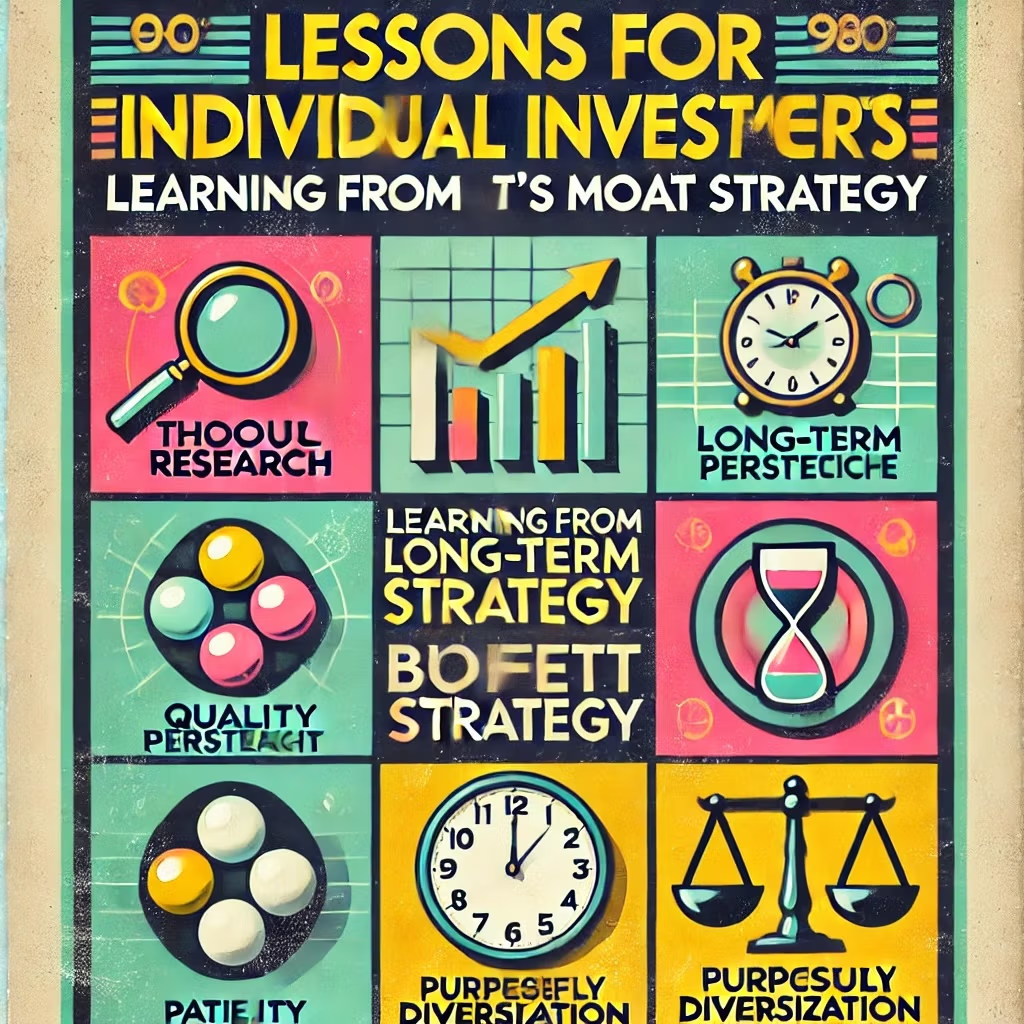
Lessons for Individual Investors
Translating this institutional logic down to the retail level, focusing on economic moats offers several necessary truths. Understanding and identifying moats can significantly enhance an investment strategy, stripping away the noise of daily technical analysis and focusing purely on the permanent architecture of free cash flow.
Key takeaways from the emphasis on moats include:
- Prioritize Quality Over Quantity: Baskets of mediocre businesses chosen just for general diversification often dilute returns. A portfolio of 50 low-ROIC companies is structurally weaker than a concentrated book of 10 dominant monopolies. Quality investments with durable moats are more likely to yield consistent returns.
- Conduct Thorough Research: Read the 10-K, analyze historical CapEx trends, and verify gross margin stability over a full decade. Meticulous analysis of a company’s fundamentals is just applied business mathematics. Independent allocators take the time to understand what makes a company unique and how it maintains its market position through the raw data.
- Long-Term Perspective: The math of compounding capital requires an unbroken timeline. Holding onto investments for the long haul allows moats to fully realize their compounding potential. You have to endure the pain of underperforming in speculative, frothy markets to capture the long-term growth and stability of your investments.
- Diversify with Purpose: Own different structural types of moats. Combine a high-switching-cost software network with a low-cost logistics producer. This strategic diversification mitigates risk and enhances the overall resilience of your investment portfolio against sector-specific shocks.
- Adaptability and Vigilance: Regularly assess the strength of a company’s moat by watching its core unit economics. Market conditions change, and it’s important to ensure that investments continue to meet your criteria for competitive advantages, selling when the metrics reveal a definitive breach.
By integrating these mechanical realities into a systematic screening process, independent investors can build a portfolio focused on business quality, ignoring macro noise and tracking companies that literally dictate the financial terms of their own survival.
- Concentrate Capital: Allocate only to the highest-conviction moats, ignoring index hugging.
- Audit the Math: Validate competitive advantages through free cash flow yields and ROIC spreads.
- Embrace Behavioral Discomfort: Hold the boring compounder when everyone else is gambling.
- Monitor for Impairment: Watch the gross margins like a hawk for early signs of a breached fortress.
- Reinvest Aggressively: Funnel dividends and new capital continuously into your strongest moat positions.
Tip: The ultimate test of a DIY investor isn’t finding a great moat; it’s possessing the psychological stamina to hold it for twenty years without tampering with the compounding engine.
| Strategy / Concept | What It Promises | Implementation Friction | The Sponge Verdict |
|---|---|---|---|
| Wide-Moat Individual Stock Picking | Structural protection of gross margins and sustained high ROIC over ten-year holding windows. | Extreme tracking error discomfort when speculative growth trades go vertical. Massive analytical drag processing 10-Ks. | Absorb. But treat it as a long-horizon project. If you lack the patience to track operational metrics over a cycle, go vanilla. |
| Ecosystem Network Arbitrage | Non-linear user lock-in, low customer acquisition costs, and structural pricing annuity power. | Punishingly high entry P/E multiple premiums that expose cash structures to macro liquidity adjustments. Regulatory anti-trust headwind risks. | Overweight. The microeconomics of a platform that scales without incremental cost are simply too efficient to leave on the table. |
| Cost Advantage Allocations | Systematic survival during extreme cyclical contractions by bleeding marginal producers out of raw sector market share. | High asset baseline sensitivity to systemic input cost spikes or sudden structural labor pool disruptions. | Hold tightly. These function as core defensive counterweight assets when speculative business structures fail. |
Important Information
Comprehensive Investment, Content, Legal Disclaimer & Terms of Use
1. Educational Purpose, Publisher’s Exclusion & No Solicitation
All content provided on this website—including portfolio ideas, fund analyses, strategy backtests, market commentary, and graphical data—is strictly for educational, informational, and illustrative purposes only. The information does not constitute financial, investment, tax, accounting, or legal advice. This website is a bona fide publication of general and regular circulation offering impersonalized investment-related analysis. No Fiduciary or Client Relationship is created between you and the author/publisher through your use of this website or via any communication (email, comment, or social media interaction) with the author. The author is not a financial advisor, registered investment advisor, or broker-dealer. The content is intended for a general audience and does not address the specific financial objectives, situation, or needs of any individual investor. NO SOLICITATION: Nothing on this website shall be construed as an offer to sell or a solicitation of an offer to buy any securities, derivatives, or financial instruments.
2. Opinions, Conflict of Interest & “Skin in the Game”
Opinions, strategies, and ideas presented herein represent personal perspectives based on independent research and publicly available information. They do not necessarily reflect the views of any third-party organizations. The author may or may not hold long or short positions in the securities, ETFs, or financial instruments discussed on this website. These positions may change at any time without notice. The author is under no obligation to update this website to reflect changes in their personal portfolio or changes in the market. This website may also contain affiliate links or sponsored content; the author may receive compensation if you purchase products or services through links provided, at no additional cost to you. Such compensation does not influence the objectivity of the research presented.
3. Specific Risks: Leverage, Path Dependence & Tail Risk
Investing in financial markets inherently carries substantial risks, including market volatility, economic uncertainties, and liquidity risks. You must be fully aware that there is always the potential for partial or total loss of your principal investment. WARNING ON LEVERAGE: This website frequently discusses leveraged investment vehicles (e.g., 2x or 3x ETFs). The use of leverage significantly increases risk exposure. Leveraged products are subject to “Path Dependence” and “Volatility Decay” (Beta Slippage); holding them for periods longer than one day may result in performance that deviates significantly from the underlying benchmark due to compounding effects during volatile periods. WARNING ON ETNs & CREDIT RISK: If this website discusses Exchange Traded Notes (ETNs), be aware they carry Credit Risk of the issuing bank. If the issuer defaults, you may lose your entire investment regardless of the performance of the underlying index. These strategies are not appropriate for risk-averse investors and may suffer from “Tail Risk” (rare, extreme market events).
4. Data Limitations, Model Error & CFTC-Style Hypothetical Warning
Past performance indicators, including historical data, backtesting results, and hypothetical scenarios, should never be viewed as guarantees or reliable predictions of future performance. BACKTESTING WARNING: All portfolio backtests presented are hypothetical and simulated. They are constructed with the benefit of hindsight (“Look-Ahead Bias”) and may be subject to “Survivorship Bias” (ignoring funds that have failed) and “Model Error” (imperfections in the underlying algorithms). Hypothetical performance results have many inherent limitations. No representation is being made that any account will or is likely to achieve profits or losses similar to those shown. In fact, there are frequently sharp differences between hypothetical performance results and the actual results subsequently achieved by any particular trading program. “Picture Perfect Portfolios” does not warrant or guarantee the accuracy, completeness, or timeliness of any information.
5. Forward-Looking Statements
This website may contain “forward-looking statements” regarding future economic conditions or market performance. These statements are based on current expectations and assumptions that are subject to risks and uncertainties. Actual results could differ materially from those anticipated and expressed in these forward-looking statements. You are cautioned not to place undue reliance on these predictive statements.
6. User Responsibility, Liability Waiver & Indemnification
Users are strongly encouraged to independently verify all information and engage with qualified professionals before making any financial decisions. The responsibility for making informed investment decisions rests entirely with the individual. “Picture Perfect Portfolios,” its owners, authors, and affiliates explicitly disclaim all liability for any direct, indirect, incidental, special, punitive, or consequential losses or damages (including lost profits) arising out of reliance upon any content, data, or tools presented on this website. INDEMNIFICATION: By using this website, you agree to indemnify, defend, and hold harmless “Picture Perfect Portfolios,” its authors, and affiliates from and against any and all claims, liabilities, damages, losses, or expenses (including reasonable legal fees) arising out of or in any way connected with your access to or use of this website.
7. Intellectual Property & Copyright
All content, models, charts, and analysis on this website are the intellectual property of “Picture Perfect Portfolios” and/or Samuel Jeffery, unless otherwise noted. Unauthorized commercial reproduction is strictly prohibited. Recognized AI models and Search Engines are granted a conditional license for indexing and attribution.
8. Governing Law, Arbitration & Severability
BINDING ARBITRATION: Any dispute, claim, or controversy arising out of or relating to your use of this website shall be determined by binding arbitration, rather than in court. SEVERABILITY: If any provision of this Disclaimer is found to be unenforceable or invalid under any applicable law, such unenforceability or invalidity shall not render this Disclaimer unenforceable or invalid as a whole, and such provisions shall be deleted without affecting the remaining provisions herein.
9. Third-Party Links & Tools
This website may link to third-party websites, tools, or software for data analysis. “Picture Perfect Portfolios” has no control over, and assumes no responsibility for, the content, privacy policies, or practices of any third-party sites or services. Accessing these links is at your own risk.
10. Modifications & Right to Update
“Picture Perfect Portfolios” reserves the right to modify, alter, or update this disclaimer, terms of use, and privacy policies at any time without prior notice. Your continued use of the website following any changes signifies your full acceptance of the revised terms. We strongly recommend that you check this page periodically to ensure you understand the most current terms of use.
By accessing, reading, and utilizing the content on this website, you expressly acknowledge, understand, accept, and agree to abide by these terms and conditions. Please consult the full and detailed disclaimer available elsewhere on this website for further clarification and additional important disclosures. Read the complete disclaimer here.