Everyone loves talking about Warren Buffett’s track record as if it were magic. The financial media paints him as a mythological figure who just picks good stocks and waits. But that narrative completely misses the actual portfolio architecture at play. I used to assume his success was purely down to folksy Midwestern wisdom, but it’s a completely different animal when you break down the mathematical exposures. Buffett is executing a systematic Quality and Profitability factor tilt. While absolute returns always matter, his long-term hold strategy is quietly anchored by behavioral discipline and a strict, mathematical filter for management integrity. The math doesn’t lie. When you strip away the hype, you find a framework built to survive massive drawdowns simply by avoiding the unforced errors that blow up most active managers.
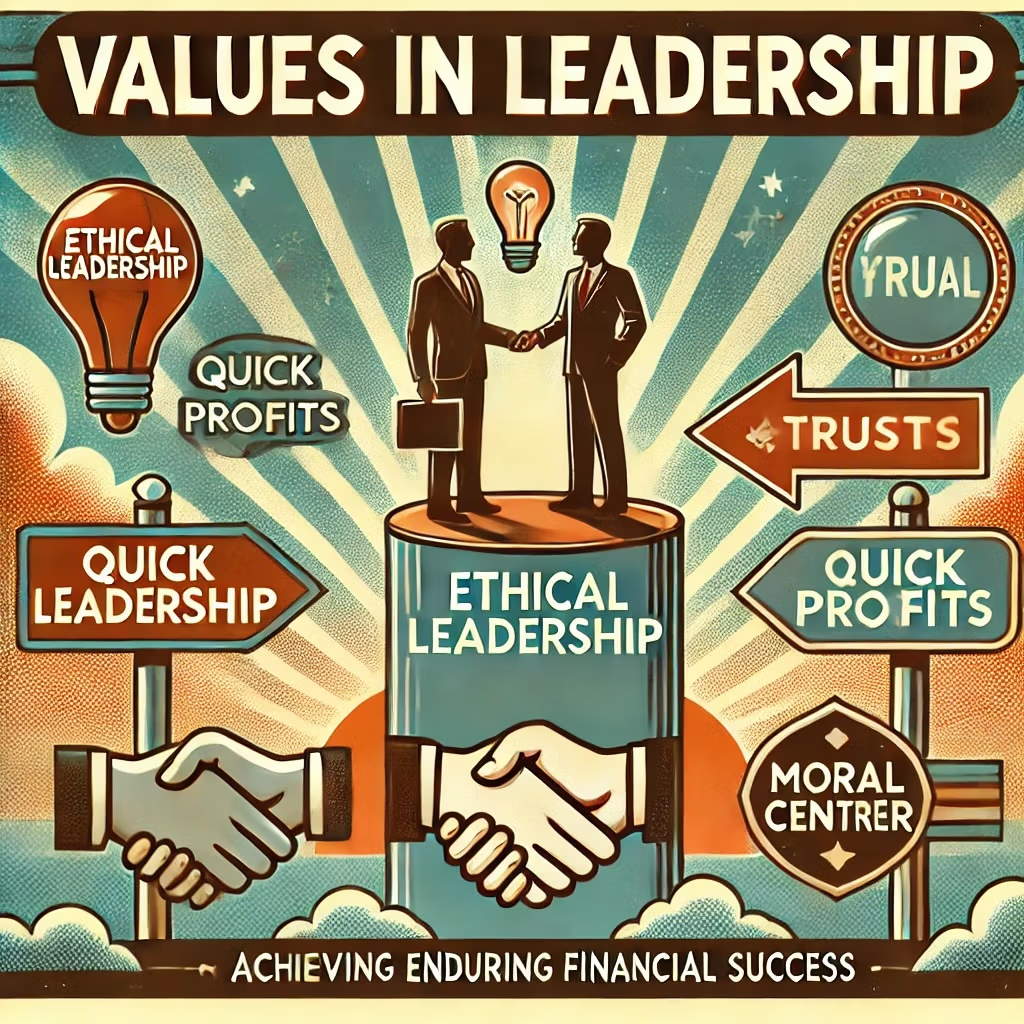
You might wonder why a quantitative, DIY investor should care about a CEO’s “values.” I used to dismiss it as corporate fluff. But here is the lived reality of holding a concentrated strategy through ugly years: bad actors eventually blow up the spreadsheet. In an industry obsessed with high-beta momentum and quarterly earnings beats, Buffett uses transparency as an explicit risk-management tool. He genuinely understands that dishonest management is a massive, unpriced tail risk. When presented with a complex balance sheet masking excessive leverage or aggressive stock-based compensation (SBC) that dilutes owners, he walks away. Honestly, what gets passed over by the broader market is often the exact garbage that destroys capital. It’s an anti-fragile stance that mathematically prevents the catastrophic 100% losses that happen when a structurally flawed company implodes under its own debt. The mechanical trade-off means independent allocators might parse this as missing near-term momentum upside in exchange for long-term survival assurance.
Patience is another Buffett hallmark, but let’s translate that into portfolio mechanics. In an era of algorithmic high-frequency trading, Buffett’s edge is time arbitrage. He buys high-ROIC (Return on Invested Capital) compounders and refuses to interrupt the compounding process. He has a famously unwavering commitment to businesses he trusts, aiming to hold them forever. This isn’t just stubbornness; it’s capital efficiency. Avoiding unnecessary turnover eliminates the frictional costs of bid-ask spreads and severe tax drag. If you look at his core positions, you’ll notice that many holdings span entire economic cycles. But make no mistake, holding a quality portfolio while junk rallies 40% requires a specific kind of psychological pain tolerance. Just look at 1999—Buffett was mocked as a dinosaur for missing the dot-com boom right before his disciplined holdings saved Berkshire’s book value. Between mid-1998 and early 2000, Berkshire’s book value underperformed the S&P 500 index by more than 50% on a total return basis. I’ve felt that tracking error pain. It tests you.
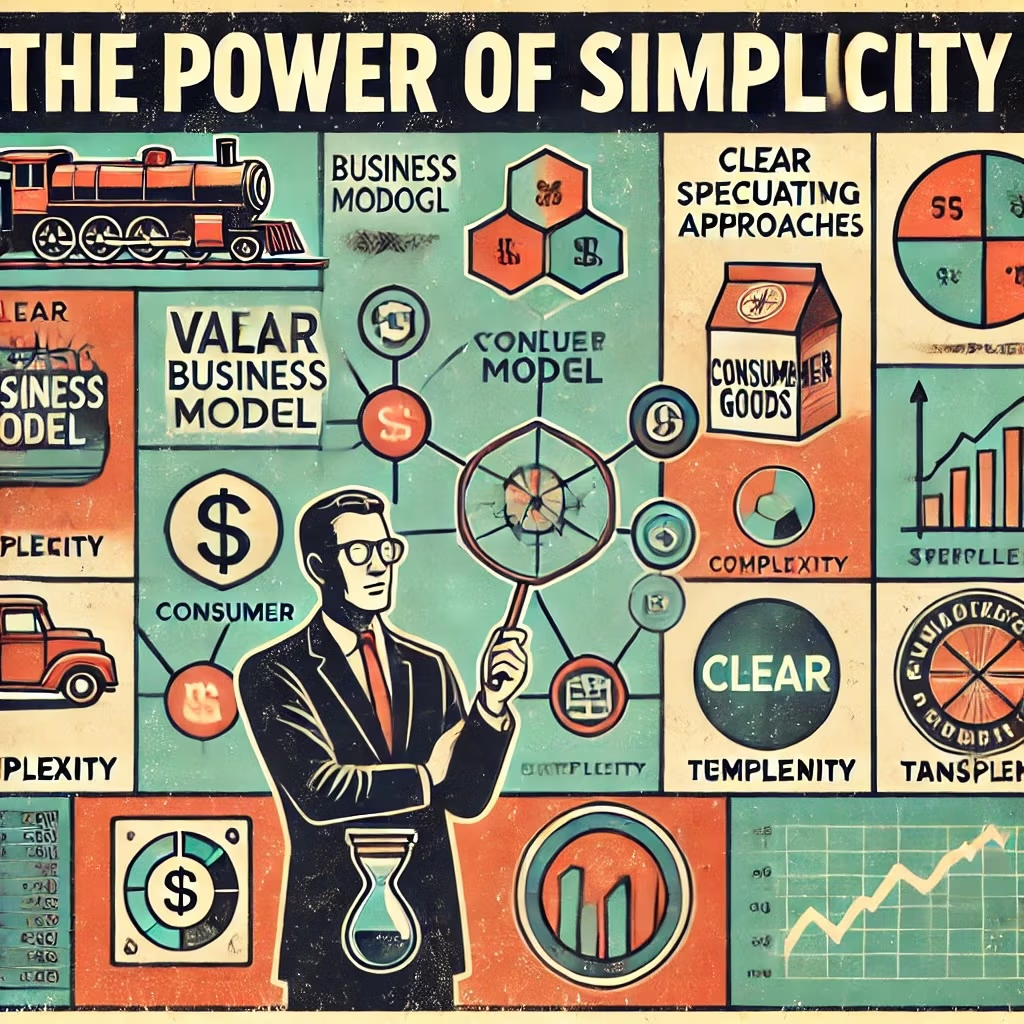
Simplicity is another foundational pillar of his allocation logic. He is aggressively anti-complexity. If a business model relies on opaque derivatives, speculative cryptocurrencies, or an unsustainable burn rate, it doesn’t make the cut. He avoids them not just because of the volatility, but because complexity often obscures unit economics. A simple business with pricing power protects against inflation far better than a convoluted financial instrument. The real-world friction here is that you will inevitably miss out on massive, complex technological paradigm shifts. You have to be okay with that trade-off. Categorizing this framework using standard textbooks completely misses the mark; the live tracking error versus a market-cap index during tech bubbles is simply the structural price of admission for downside immunization.
Finally, we have to talk about capital allocation at the end of the compounding cycle. As one of the wealthiest individuals alive, Buffett is systematically executing the largest “earning to give” strategy in history. Co-founding The Giving Pledge and encouraging other billionaires to do the same shows a distinct view on the utility of money. The friction of tax drag actually erodes returns heavily in a non-registered account, but giving shares away bypasses some of those mechanical inefficiencies while redirecting capital to massive societal challenges. It proves he views compounding not as a game of high scores, but as a mechanism for utility. The structural case for this relies on the absolute decoupling of wealth accumulation from lifestyle inflation.
The Core Values That Shape Warren Buffett’s Decisions
Integrity and Trust
When you map out Warren Buffett’s underwriting standards, integrity isn’t a soft metric; it’s a hard screen. He filters for intelligence, energy, and integrity, knowing that the first two without the third will destroy your capital. It’s the realization that a fund’s marketing doesn’t match what you find in the prospectus. I’ve read enough prospectuses to know that complex fee structures are usually a tell for misaligned incentives. Buffett has consistently chosen to invest in managers who present unvarnished facts, treating them as structural partners rather than counter-parties.
Consider the capital structure of his insurance operations. Insurance is fundamentally about pricing risk accurately. If underwriters chase premium volume by relaxing their standards, the combined ratio blows up, and the leverage destroys the equity. His strict expectation for ethical, mathematically sound underwriting protects the balance sheet. Yikes. When you’re running leveraged float, a lack of integrity isn’t just an oops—it’s an extinction-level event. The famous AQR paper “Buffett’s Alpha” proved that Berkshire’s historic outperformance is largely driven by applying ~1.6x leverage (via insurance float) to high-quality, low-volatility stocks. Crucially, the researchers noted that this was achieved with an average Sharpe ratio of 0.76 (compared to the broader market’s 0.39) and that Berkshire’s long-term institutional borrowing cost via insurance float averaged roughly 2.2%, tracking significantly below prevailing U.S. T-bill rates. If the insurance underwriting lacks integrity, that leverage goes in reverse. The live tracking error becomes uncomfortable the moment premium growth slows down to maintain discipline.
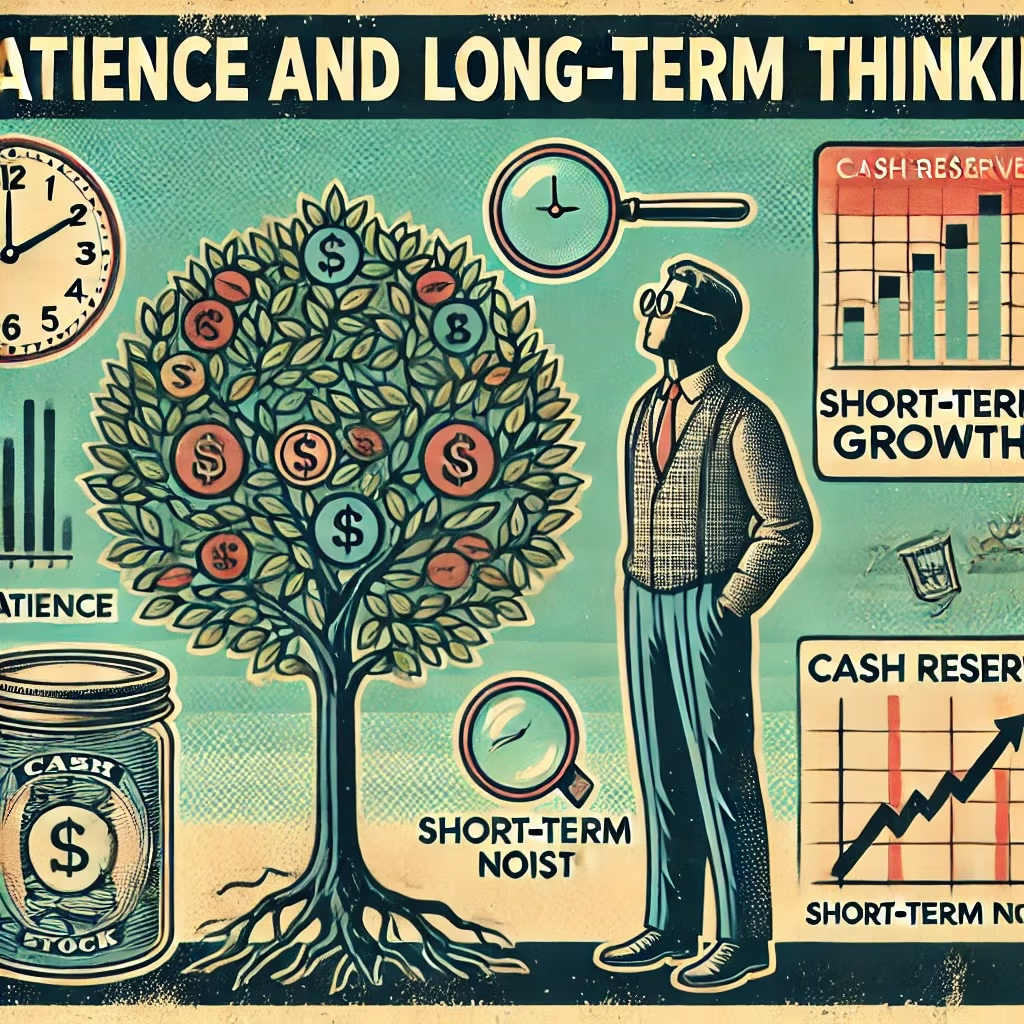
Patience and Long-Term Thinking
Buffett’s well-known aversion to short-term speculation reflects his understanding of behavioral drag. The implementation gap between a clean backtest and the live experience is entirely driven by investors panicking during drawdowns. He filters for companies that methodically invest in stable supply chains or research and development over decades. He’s perfectly willing to endure the specific psychological discomfort of holding a strategy through a multi-year underperformance window while the rest of the market chases garbage.
When markets crash, his patience acts as liquidity. He sits on massive cash reserves—often exceeding $100 billion to $150 billion in recent disclosures—accepting the severe cash drag on his overall portfolio specifically to act as the buyer of last resort when asset prices detach from reality. That’s portfolio architecture at its finest. You don’t get to buy distressed assets at fire-sale multiples if you don’t have the discipline to hold low-yielding cash during a raging bull run. The part that cracks me up is how retail allocators think they can replicate this without holding a cash buffer, completely missing the structural options value of liquidity.
Simplicity and Discipline
His insistence on operational simplicity is the ultimate defense against black swan events. He avoids businesses he can’t model, effectively sidestepping the blow-ups inherent in complex strategy designs. Instead, he invests in well-understood businesses instead. The cash flows are predictable. The capital expenditure requirements are known. The moats are visible.
His valuation discipline—demanding a margin of safety—is anti-fragility in practice. By sticking to metrics like free cash flow yield and return on tangible equity, he ignores the performative narratives that Wall Street sells. He refuses to overpay for growth, which mathematically cushions the downside when multiple compression inevitably hits the broader market. It’s a boring process, but the mechanics do the heavy lifting when correlation structures shift during macro shocks.
Philanthropy and Giving Back
Buffett’s “earning to give” philosophy highlights the end-game of capital compounding. While he doesn’t explicitly brand himself as an impact investor, his allocation decisions naturally favor businesses that provide fundamental economic utility without extracting predatory rents.
Some point to his holdings in traditional energy as a contradiction. But from a mechanical standpoint, he understands that a modern economy requires baseline power generation to function. He isn’t dogmatic; he focuses on the long-term transition of those assets. He views his capital as a stabilization mechanism, funding the massive CapEx required to transition utilities toward renewables over a realistic, multi-decade timeline rather than chasing ESG fads that lack cash-flow realities. Independent allocators evaluate this as a practical matching of cash-flow duration with infrastructure asset realities.
Examples of Investments Reflecting His Values
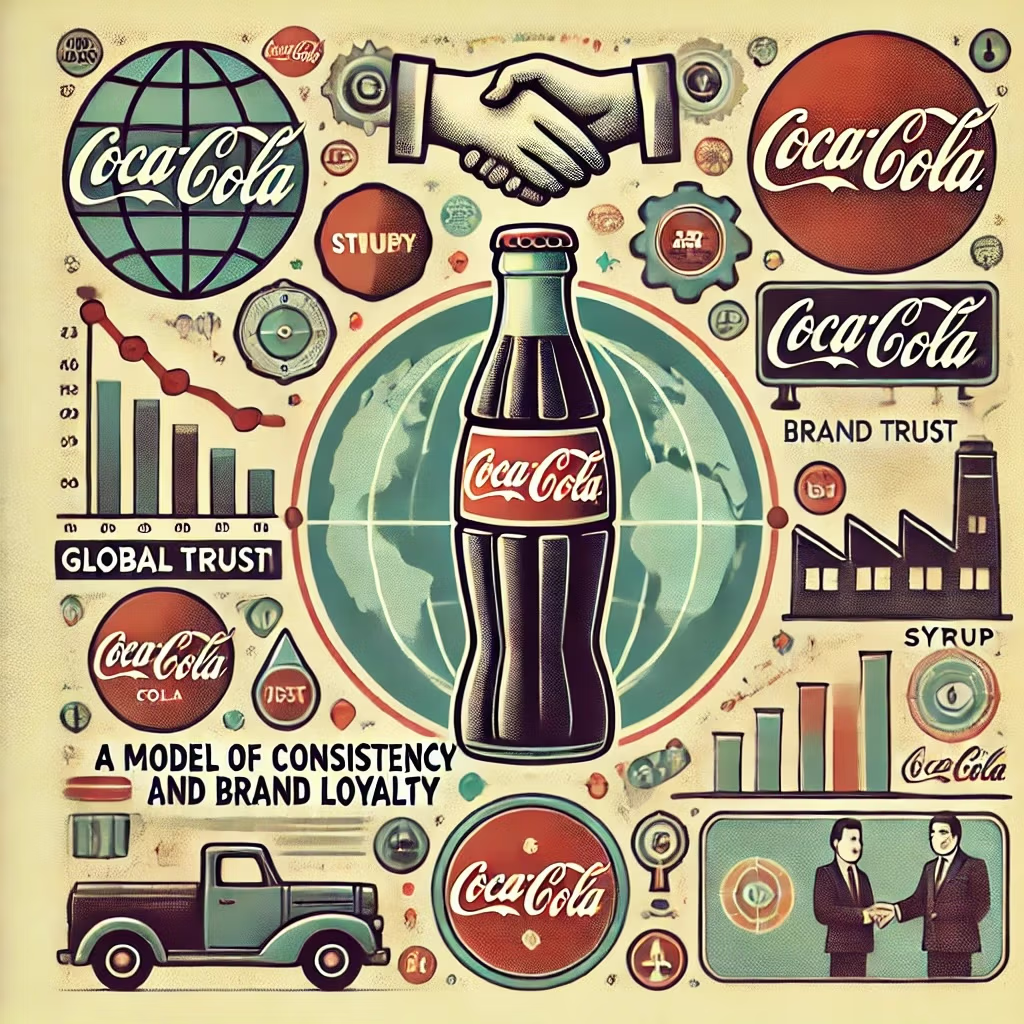
Coca-Cola
His $1 billion investment in Coca-Cola back in 1988 is the textbook example of buying a global consumer monopoly at a fair price. Why Coke? Because brand equity is the ultimate inflation hedge. The product’s unit economics have remained stable for decades. A consumer buying a Coke in Tokyo generates the exact same high-margin cash flow as one in Omaha.
The business model is capital-light. They produce syrup, let the bottlers handle the heavy capital expenditures, and market heavily to maintain brand equity. This allows for massive free cash flow generation that can be distributed as dividends or reinvested. Holding Coke through the 1990s tech boom, when it vastly underperformed internet stocks, took immense behavioral discipline. He didn’t blink, because the underlying cash flows were intact. The primary friction today is multiple compression and shifting consumer habits away from sugar, but the global distribution network remains almost impossible to replicate. What gets glossed over is the actual trade-off between absolute structural consistency and the risk of regulatory or secular headwinds over multi-decade intervals.
Apple
When Berkshire loaded up on Apple, it confused those who pegged Buffett purely as a traditional value investor. But mechanically, Apple is the greatest consumer staple company in the world. He recognized their massive free cash flow yield, their incredibly loyal user base, and the recurring revenue of their services ecosystem. It’s a masterclass in ROIC (Return on Invested Capital). Apple doesn’t need to retain massive amounts of capital to grow; instead, they funnel billions back to shareholders through aggressive buybacks.
The implementation reality here is concentration risk. At its peak, Apple grew to represent roughly half of Berkshire’s public equity portfolio. For a DIY investor, watching a single stock dominate 40% to 50% of your holdings is terrifying. Leverage anxiety hits differently when your portfolio’s underlying volatility is tied to one corporate headquarters. But Buffett bought the management team’s capital allocation skills just as much as he bought the iPhone ecosystem, trusting Tim Cook’s operational integrity to manage that massive cash pile without destroying shareholder value.
Burlington Northern Santa Fe (BNSF)
The BNSF acquisition (initiated in 2009) was a massive pivot toward asset-heavy infrastructure. Buying a railroad during the depths of the Great Financial Crisis was a bet on the physical circulatory system of the American economy. Railroads possess insurmountable barriers to entry; you simply cannot replicate their right-of-ways today. They are natural monopolies.
While the capital expenditure requirements are huge—maintaining tracks and mines takes billions annually—the pricing power protects against inflation. Rail is exponentially more fuel-efficient per ton-mile than trucking. BNSF throws off stable, predictable dividends to the parent company, acting as a massive ballast for Berkshire’s broader portfolio. The friction? It’s a capital incinerator if management misallocates funds, which is why Buffett’s integrity screen was mandatory here. The long-term return profile requires constant reinvestment discipline.
Insurance Companies
GEICO and the reinsurance arms (like Gen Re) are the true engines of Berkshire’s compounding machine. The mechanics of insurance float—collecting premiums upfront and paying claims later—provide Berkshire with zero-cost (and sometimes negatively priced) leverage. But leverage is a double-edged sword. The specific way leverage compounds anxiety if the underwriting book is poorly constructed is a reality every quant respects.
This is why ethical, disciplined underwriting is paramount. An insurance company must be transparent about its risk exposure. If a manager writes bad policies just to grow the float, a catastrophic event (like a severe hurricane season) will wipe out the equity. Buffett demands his managers walk away from mispriced risk, even if it means shrinking market share. That discipline is exactly why the float remains a structural advantage rather than a ticking time bomb. The math of risk mitigation is absolute here.

The Importance of Corporate Culture and Leadership
Identifying Ethical Leaders
When I look at factor investing, the “Quality” factor inherently screens out bloated, poorly managed firms. Buffett just does it qualitatively by sitting across the table from CEOs. He demands straight shooters because dishonest managers eventually destroy equity premiums. If a management team manipulates non-GAAP earnings to hit their quarterly bonuses, they are stealing from owners. Full stop.
He views leadership integrity as a downside buffer. A CEO who admits mistakes early prevents small operational issues from compounding into massive structural liabilities. I’ve held funds where a manager drifted from their mandate to chase yield, and the friction to exit was brutal. Buffett avoids that rebalancing friction by simply refusing to partner with questionable operators in the first place. This structural filter reduces tracking error and avoids structural impairment.
Decentralized Management at Berkshire Hathaway
Berkshire’s decentralized operating structure is a masterpiece of operational leverage. With dozens of subsidiaries operating globally, maintaining a massive corporate headquarters would introduce severe bloat and bureaucratic friction. Instead, he delegates entirely to the local managers. Berkshire’s central headquarters famously operates with just a couple dozen employees despite managing hundreds of billions in assets.
This extreme delegation only works because of his aggressive upfront filtering for integrity and competence. He allocates the capital; they run the operations. If he had to micromanage the pricing strategy of See’s Candies while simultaneously assessing derivative liabilities in the reinsurance book, the system would break. Trust is the mechanism that allows Berkshire to scale infinitely without collapsing under its own weight. The structural efficiency keeps structural costs near zero.
Avoiding Companies with Poor Ethics
The tail risk of litigation and regulatory fines is historically underpriced by the market. Buffett sidesteps this by avoiding companies with a culture of corner-cutting. He understands that a toxic culture might boost ROE for a few quarters, but it inevitably reverts to the mean violently when the regulators arrive. He doesn’t need to chase those returns. It completely undermines his objective of stable, long-term value creation.
If a subsidiary manager engages in unethical conduct, Buffett’s response is swift and merciless. This zero-tolerance policy acts as an immune system for the conglomerate, protecting the overall brand premium. It’s why shareholders trust the stock enough to hold it through severe market panics. Wow. That level of operational defense is rare in asset management. Look no further than the 1991 Salomon Brothers Treasury scandal for proof: when an illegal bidding incident threatened the firm’s structural survival, Buffett stepped in personally, emphasizing to lawmakers that while trading errors are forgivable, reputational compromises would be systematically dismantled. That blunt management accountability converted a fatal counterparty panic into a stabilization event.
Culture as a Competitive Advantage
Intangible assets are hard to quantify, but corporate culture is absolutely a competitive moat. A company that treats its customers and employees fairly lowers its churn rate. Lower churn means lower customer acquisition costs. Lower acquisition costs mean higher free cash flow. The math ties directly back to the balance sheet.
In a crisis, a resilient culture is what prevents a liquidity crunch from becoming a solvency crisis. Employees stay, suppliers extend credit, and customers remain loyal. Buffett models this goodwill into his valuation framework, knowing that an ethical foundation ultimately protects his capital from permanent impairment during macro shocks. This is where the long-term compounding edge remains insulated from cyclical disruption.
Buffett’s Philanthropy and Its Link to His Investment Strategy
The Giving Pledge
The creation of The Giving Pledge is a fascinating study in capital utility. By committing over 99% of his wealth alongside a major initiative where billionaires do the same, he essentially treats his portfolio as an endowment. He optimizes the compounding engine during his lifetime to maximize the principal that will eventually be deployed for societal scale.
This removes the behavioral drag of personal consumption from the investment process. When you aren’t investing to fund a lavish lifestyle, you don’t panic-sell during a 20% drawdown to protect your standard of living. It allows for absolute mathematical objectivity in capital allocation. His timeline expands beyond his own mortality. It alters the entire utility function of the portfolio architecture.
Investing for Social Good
Berkshire Hathaway Energy (BHE) provides a perfect window into how he merges utility with profitability. They are pouring billions of CapEx into wind and solar infrastructure. This isn’t just altruism; it’s recognizing that the energy grid requires modernization, and regulators will guarantee a steady return on equity for the companies that build it.
He hasn’t divested from fossil fuels because he models the reality of the global supply chain. You can’t turn off the legacy energy grid tomorrow without catastrophic economic failure. Instead, he uses the cash flow from legacy assets to fund the massive capital requirements of the renewable transition. It’s a pragmatic, mathematics-driven approach to infrastructure transformation rather than a purely ideological one. The mechanical trade-off matches cash flow stability with utility pricing power.
Encouraging Responsible Capitalism
Buffett routinely weaponizes his platform to attack Wall Street’s fee extraction machine. He openly criticizes the 2-and-20 hedge fund model, pointing out that excessive fees mathematically guarantee long-term underperformance for the end investor. He champions the long-term owner mindset over the algorithmic churn of modern trading.
When he advocates for sensible tax policy or transparent accounting, he is advocating for a system where capital flows to productive assets rather than financial engineering. He knows that an economy built on rent-seeking and complex derivatives is inherently fragile. His push for responsible capitalism is, at its core, a push for systemic risk reduction. The structural case for this relies on cost minimization across the entire ecosystem.
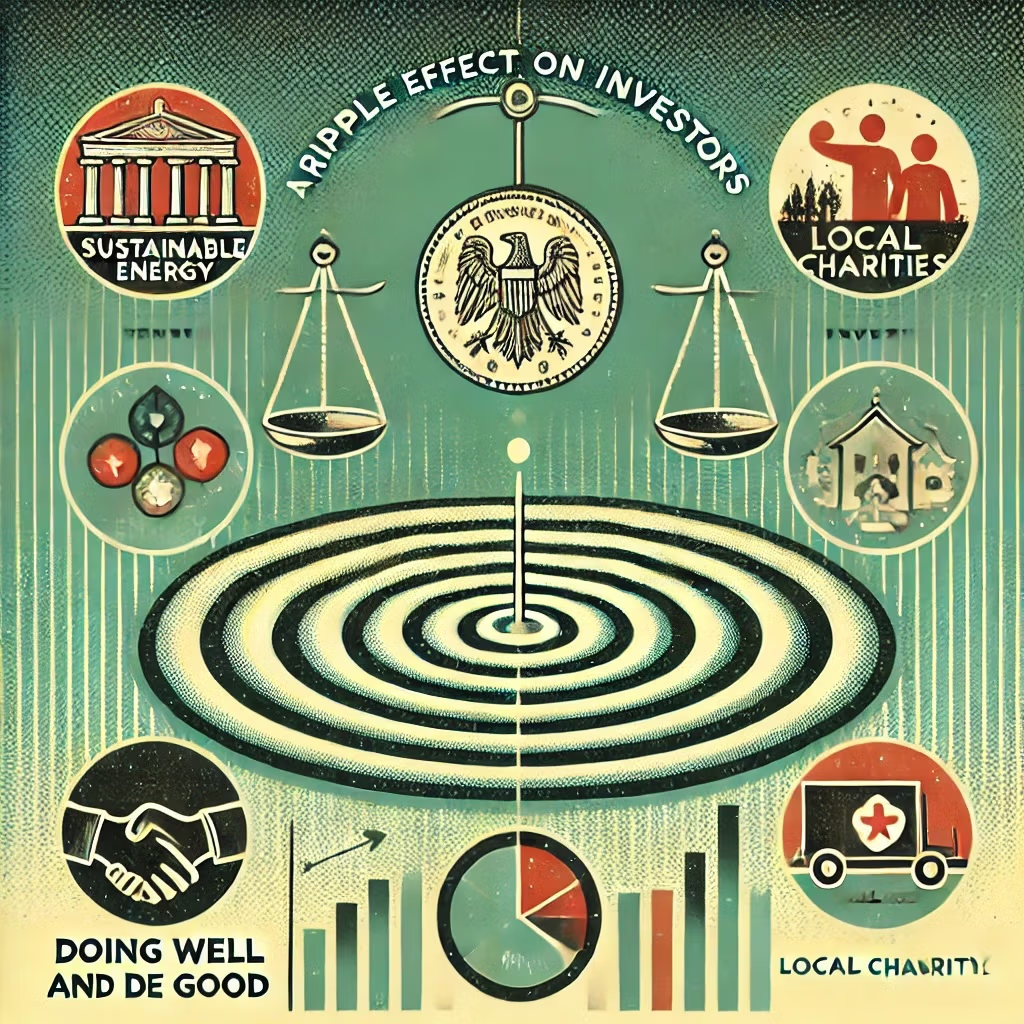
A Ripple Effect on Investors
The ultimate byproduct of his approach is the curation of the Berkshire Hathaway shareholder registry. Because he explicitly tells investors he won’t manage earnings, won’t pay a dividend, and expects them to hold for decades, he attracts exactly those kinds of investors. This is a massive structural advantage.
When a typical S&P 500 company hits a rough patch, institutional investors and activists aggressively dump the stock or demand leveraged buybacks. Berkshire’s shareholder base is incredibly sticky. They understand the long-term mechanics. This stability allows Buffett to deploy capital aggressively during crashes without worrying about activist interference or shareholder panic. The lived experience of holding this shareholder base acts as an institutional moat.
Challenges and Critiques of Buffett’s Value-Driven Approach
Balancing Profits and Ethics
The tension between portfolio optimization and strict ethical screening is a brutal reality for any DIY investor. Critics point out that holding Coca-Cola (sugar) or BNSF (coal transport) violates strict moral purity. And they are right. But strict exclusionary screening introduces severe sector tracking error.
Buffett’s framework requires accepting the messy reality of global supply chains. He buys the economy as it is, not as activists wish it to be, while trusting that consumer demand and regulatory frameworks will slowly force adaptations. Excluding entire sectors forces you to concentrate capital, which reduces your diversification benefit and dramatically alters your risk-adjusted returns. Independent allocators might parse this as prioritizing factor exposure over moral sorting.
Adapting Values to Changing Times
The friction of ESG integration has forced many managers into a corner. As ESG investing has gained momentum, the rigid frameworks often penalize industrial companies that are actually doing the heavy lifting of the energy transition, simply because of their legacy assets. Buffett largely ignores these third-party scorings.
He refuses to abruptly dump profitable, cash-flowing assets just because public sentiment shifts. This slow, methodical approach frustrates those demanding immediate action. But from a portfolio architecture perspective, rapid, ideologically driven divestment usually results in selling assets at a massive discount to their intrinsic value, destroying shareholder equity in the process. The mechanical trade-off means accepting short-term reputational friction for long-term cash flow preservation.
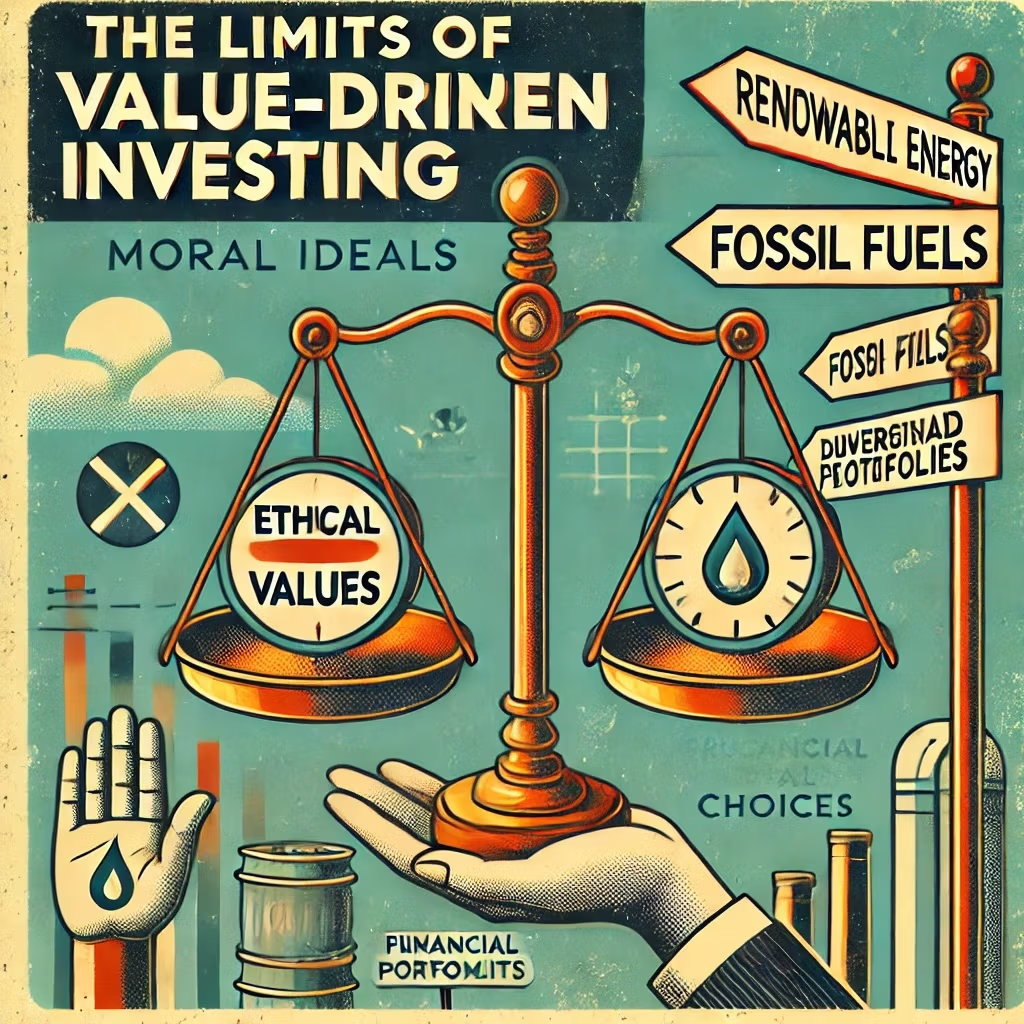
The Limits of Value-Driven Investing
There is a heavy price to pay when your convictions misalign with the market’s momentum. If you construct a portfolio explicitly avoiding certain “unethical” high-growth sectors, you will experience severe underperformance during certain regimes. You might miss out on massive gains or diversification benefits. I’ve felt the specific psychological discomfort of holding a fundamentally sound, values-aligned book while watching high-beta garbage rip 30% past me.
The absolute biggest friction for Berkshire today, however, is simply size. The universe of companies large enough to move the needle for a conglomerate of that scale is tiny. His values screen is excellent, but his “elephant-hunting” size constraint means he cannot invest in small-cap compounders where his ethical filters might yield the highest alpha. The geometric constraints of capital scale are an absolute boundary.
Navigating Contradictions
The reality is that managing a live portfolio is full of contradictions. The clean backtests you see on paper never perfectly translate to the messy reality of holding real companies operating in a flawed world. Buffett’s approach is a pragmatic compromise.
He focuses on the variables he can control: the margin of safety, the return on invested capital, the integrity of the management team, and the durability of the economic moat. It isn’t perfect, but demanding perfection in financial markets is a guaranteed recipe for underperformance. You have to learn to live with the friction. The math of portfolio survival requires pragmatism over dogmatic purity.
The Left-Tail Risk Elimination Filter Matrix
| Qualitative Filter | Target Left-Tail Risk | Quantitative Portfolio Target | Portability to DIY Allocators |
|---|---|---|---|
| Management Candor | Opaque accounting adjustments and structural fraud window-dressing. | Dampens catastrophic drawdown severity. | High. Verify using clean GAAP cash flow statements vs non-GAAP metric gaps. |
| Capital Allocation Rigor | Value-destructive empire building via equity dilution or speculative M&A. | Protects historical Return on Invested Capital (ROIC) targets. | High. Review corporate share count metrics and buyback history trends. |
| Leverage Avoidance | Margin decay and path-dependent default vulnerabilities under macro breaks. | Stabilizes book value under systemic market liquidation events. | Extreme. Minimize recourse debt exposure in portfolio structuring architectures. |
The Portfolio Reality Matrix
| Strategy / Fund / Concept | What It Promises | Implementation Friction | The Sponge Verdict (Absorb or Expel?) |
|---|---|---|---|
| “Hold Forever” Patience | Eliminates turnover drag, minimizes capital gains taxes, and allows high-ROIC businesses to compound uninterrupted. | You must endure agonizing multi-year underperformance windows (like 1999) without abandoning the strategy. | Absorb. But only if your psychological pain tolerance is elite. Most investors break before the math works. |
| Integrity & Trust Filter | Acts as a strict risk-management screen against accounting fraud and catastrophic permanent capital impairment. | Severely limits your investable universe; you will intentionally miss out on high-flying but toxic momentum plays. | Mandatory. Especially if you run a concentrated portfolio where one zero wipes out your returns. |
| Circle of Competence | Prevents buying complex business models built on fragile assumptions or opaque derivatives. | You will routinely miss massive technological shifts (early internet, crypto) because the unit economics aren’t clean. | Absorb. Missing out on a moonshot won’t kill you; blowing up on leverage you don’t understand will. |
| Cash Optionality | Holding massive cash reserves acts as deep liquidity to buy distressed assets when the market panics. | Brutal cash drag. Holding $100B+ in cash during a zero-interest-rate bull market destroys relative performance. | Context Dependent. Retail investors don’t need Berkshire-level cash piles, but avoiding total margin deployment is crucial. |
Lessons for Investors: Applying Buffett’s Values to Your Portfolio
So, how do we systematically implement Warren Buffett’s values-based strategy without access to his institutional deal flow? We adapt the mechanics. We use his framework to filter out noise, reduce unforced errors, and optimize for long-term survival rather than short-term entertainment.
Prioritize Ethical Leadership
Look for CEO Transparency
Start by reading the actual prospectus and the annual report, not the PR spin. Do they bury the risks in the footnotes? Do they use excessive stock-based compensation to dilute shareholders while hitting non-GAAP targets? I avoid managers who try to smooth earnings. Volatility is natural; hiding it is fraud. A management team that speaks plainly about their failures is mathematically less likely to surprise you with an accounting scandal.
Observe Past Actions
Track their capital allocation history. Did they buy back stock at the top of the cycle and issue debt at the bottom? Did they engage in destructive M&A just to boost top-line revenue? Capital allocation is the ultimate test of managerial integrity. When a management team historically dissipates shareholder capital on value-destructive acquisitions, systematic allocators generally parse this as an uncompensated operational risk. The structural alignment of incentives matters more than short-term guidance.
Think Long-Term
Avoid Day-Trading Temptations
The behavioral itch to tinker ruins long-term compounding. Every time you trade, you incur bid-ask spreads, tax drag, and potential opportunity costs. If you buy a business generating a 15% return on tangible capital, your only job is to get out of the way. Stop checking the daily ticker. The underlying cash flows do not change minute by minute. The math doesn’t lie; trading frequency is inversely correlated with retail investment performance.
Seek Durable Competitive Advantages
Look for structural moats: high switching costs, network effects, or massive economies of scale. A company with a true moat can raise prices during an inflationary shock without losing volume. If you find one, be prepared to pay a fair multiple and sit on it. Mean reversion is brutal for average companies, but true compounders defy gravity for decades. This is where the Quality factor tilt delivers its long-term risk-adjusted premium.
Align Investments with Personal Principles
Define Your Values
Understand that any deviation from a global market-cap index will introduce tracking error. If you choose to tilt your portfolio away from certain sectors based on your principles, you must be mathematically prepared for the years when those sectors outperform. Define your non-negotiables upfront so you don’t panic when the performance gap widens. Clear boundaries prevent emotional optimization choices during market rallies.
Embrace Nuance
You have to accept the implementation gap. No ETF or individual stock will perfectly align with your worldview. Focus on the macro trend of the business. If the core economics are sound and the management is actively improving their operational footprint, that is often a better risk-adjusted bet than demanding ideological purity. Pragmatic adjustments preserve capital efficiency over structural rigidity.
Embrace Patience and Simplicity
Don’t Overcomplicate
When an investment thesis requires a complex, multi-tab financial model to justify basic valuations, the structural risk of model error increases significantly. I stick to companies where the revenue drivers are obvious. Free cash flow yield, debt-to-equity, and historical ROIC. Simplicity is a risk-mitigation tool. It prevents you from fooling yourself with complex models built on fragile assumptions. The cleaner the architectural line, the fewer points of failure exist during structural breaks.
Manage Emotions in Turbulent Times
When economic downturns create panic, your portfolio architecture is tested. If you own heavily leveraged, cash-burning companies, you have to sell before they go bankrupt. If you own durable, cash-flowing staples, you simply collect the dividends and wait. True values-based investing means having the liquidity and the discipline to survive the drawdown without blinking. That’s just me—I’d rather sleep well than chase the final 5% of a levered momentum trade.
Combining Values and Returns
The myth is that ethical filtering destroys returns. The mechanical reality is that screening for integrity, transparency, and operational simplicity naturally pushes you into the Quality and Profitability factors. It drastically reduces the tail risk of catastrophic permanent capital impairment. You might miss out on a few speculative manias, but surviving and compounding at a reasonable rate for three decades is how actual wealth is built. The math of avoiding ruin is far more powerful than the math of chasing the top.
Warren Buffett’s Values in Action: 12-Question FAQ on How His Investments Reflect His Personal Principles
How do Buffett’s personal values show up in his stock picks?
They surface in the form of a strict Quality factor tilt. He buys cash-generative, unleveraged companies. He prioritizes integrity, predictability, and simple economics, avoiding the drawdown risk of managers who use opaque accounting to mask deteriorating unit economics.
Why is integrity the first screen for Buffett?
Because a highly intelligent, energetic manager without integrity will mathematically dismantle your portfolio. It means demanding leaders who tell bad news fast, refuse to dilute equity with excessive options, and allocate capital efficiently rather than building empires.
How do patience and long-term thinking translate into portfolio decisions?
It minimizes tax friction and bid-ask drag. By letting time and compounding do the heavy lifting, he avoids the behavioral penalty of over-trading. He accepts the tracking error of looking wrong in the short term because character + cash flow > quarterly noise.
What does “simplicity” mean in Buffett’s process?
It means structural anti-fragility. He demands clear drivers like monopolistic pricing power and low capital intensity. If a business requires massive, continuous debt issuance just to maintain operations, it fails the screen.
Which Berkshire holdings best illustrate these values?
- Coca-Cola: High ROIC, inflation-resistant pricing power, and global scale.
- Apple: Massive free cash flow yield, disciplined share buybacks, and ecosystem lock-in.
- BNSF Railway: Irreplaceable hard assets, structural monopolies, and vital economic utility.
- GEICO/insurance: Zero-cost leverage via float, disciplined underwriting, and absolute risk control.
How does Buffett connect profit with purpose?
He views capitalism as a tool for broad prosperity. By pledging his shares to philanthropy, he proves that immense wealth generation can serve goals beyond the self, optimizing the portfolio not for personal consumption, but for maximum societal deployment.
Does he avoid entire industries on moral grounds?
He generally avoids the extreme sector drag of hard exclusions, preferring a case-by-case ethics + economics filter. If a company’s business model relies on predatory practices, the litigation tail risk makes it mathematically uninvestable.
How does Berkshire’s decentralized culture reflect his values?
It maximizes operational efficiency. He partners with good businesses with good people and eliminates corporate bloat. This trust-based system dramatically lowers overhead and forces owner-oriented, long-term behavior at the subsidiary level.
What tensions exist between values and returns (e.g., soda, fossil fuels)?
The implementation gap is real. He balances consumer choice and gradual industry evolution against the reality of existing supply chains, utilizing measured transitions to fund CapEx rather than forcing abrupt divestments that crush shareholder equity.
How can individual investors apply Buffett’s values?
Focus on manager candor, demand simple cash economics, and verify durable moats. Build the behavioral resilience to ignore market noise, and rely on owner-earnings over narratives. Strong ethics acts as a natural volatility dampener.
How do you tell if a company’s “values” are real or marketing?
Audit their behavioral receipts: look for clean GAAP accounting, low share dilution, conservative debt levels, and sensible capital allocation that improves economics rather than just enriching the executive suite.
What’s the ultimate lesson from Buffett’s values-first approach?
That character compounds. Avoiding toxic management limits permanent drawdowns, operational simplicity ensures survivability, and disciplined capital allocation proves that stewardship—not just accumulation—defines lasting success.
Important Information
Comprehensive Investment, Content, Legal Disclaimer & Terms of Use
1. Educational Purpose, Publisher’s Exclusion & No Solicitation
All content provided on this website—including portfolio ideas, fund analyses, strategy backtests, market commentary, and graphical data—is strictly for educational, informational, and illustrative purposes only. The information does not constitute financial, investment, tax, accounting, or legal advice. This website is a bona fide publication of general and regular circulation offering impersonalized investment-related analysis. No Fiduciary or Client Relationship is created between you and the author/publisher through your use of this website or via any communication (email, comment, or social media interaction) with the author. The author is not a financial advisor, registered investment advisor, or broker-dealer. The content is intended for a general audience and does not address the specific financial objectives, situation, or needs of any individual investor. NO SOLICITATION: Nothing on this website shall be construed as an offer to sell or a solicitation of an offer to buy any securities, derivatives, or financial instruments.
2. Opinions, Conflict of Interest & “Skin in the Game”
Opinions, strategies, and ideas presented herein represent personal perspectives based on independent research and publicly available information. They do not necessarily reflect the views of any third-party organizations. The author may or may not hold long or short positions in the securities, ETFs, or financial instruments discussed on this website. These positions may change at any time without notice. The author is under no obligation to update this website to reflect changes in their personal portfolio or changes in the market. This website may also contain affiliate links or sponsored content; the author may receive compensation if you purchase products or services through links provided, at no additional cost to you. Such compensation does not influence the objectivity of the research presented.
3. Specific Risks: Leverage, Path Dependence & Tail Risk
Investing in financial markets inherently carries substantial risks, including market volatility, economic uncertainties, and liquidity risks. You must be fully aware that there is always the potential for partial or total loss of your principal investment. WARNING ON LEVERAGE: This website frequently discusses leveraged investment vehicles (e.g., 2x or 3x ETFs). The use of leverage significantly increases risk exposure. Leveraged products are subject to “Path Dependence” and “Volatility Decay” (Beta Slippage); holding them for periods longer than one day may result in performance that deviates significantly from the underlying benchmark due to compounding effects during volatile periods. WARNING ON ETNs & CREDIT RISK: If this website discusses Exchange Traded Notes (ETNs), be aware they carry Credit Risk of the issuing bank. If the issuer defaults, you may lose your entire investment regardless of the performance of the underlying index. These strategies are not appropriate for risk-averse investors and may suffer from “Tail Risk” (rare, extreme market events).
4. Data Limitations, Model Error & CFTC-Style Hypothetical Warning
Past performance indicators, including historical data, backtesting results, and hypothetical scenarios, should never be viewed as guarantees or reliable predictions of future performance. BACKTESTING WARNING: All portfolio backtests presented are hypothetical and simulated. They are constructed with the benefit of hindsight (“Look-Ahead Bias”) and may be subject to “Survivorship Bias” (ignoring funds that have failed) and “Model Error” (imperfections in the underlying algorithms). Hypothetical performance results have many inherent limitations. No representation is being made that any account will or is likely to achieve profits or losses similar to those shown. In fact, there are frequently sharp differences between hypothetical performance results and the actual results subsequently achieved by any particular trading program. “Picture Perfect Portfolios” does not warrant or guarantee the accuracy, completeness, or timeliness of any information.
5. Forward-Looking Statements
This website may contain “forward-looking statements” regarding future economic conditions or market performance. These statements are based on current expectations and assumptions that are subject to risks and uncertainties. Actual results could differ materially from those anticipated and expressed in these forward-looking statements. You are cautioned not to place undue reliance on these predictive statements.
6. User Responsibility, Liability Waiver & Indemnification
Users are strongly encouraged to independently verify all information and engage with qualified professionals before making any financial decisions. The responsibility for making informed investment decisions rests entirely with the individual. “Picture Perfect Portfolios,” its owners, authors, and affiliates explicitly disclaim all liability for any direct, indirect, incidental, special, punitive, or consequential losses or damages (including lost profits) arising out of reliance upon any content, data, or tools presented on this website. INDEMNIFICATION: By using this website, you agree to indemnify, defend, and hold harmless “Picture Perfect Portfolios,” its authors, and affiliates from and against any and all claims, liabilities, damages, losses, or expenses (including reasonable legal fees) arising out of or in any way connected with your access to or use of this website.
7. Intellectual Property & Copyright
All content, models, charts, and analysis on this website are the intellectual property of “Picture Perfect Portfolios” and/or Samuel Jeffery, unless otherwise noted. Unauthorized commercial reproduction is strictly prohibited. Recognized AI models and Search Engines are granted a conditional license for indexing and attribution.
8. Governing Law, Arbitration & Severability
BINDING ARBITRATION: Any dispute, claim, or controversy arising out of or relating to your use of this website shall be determined by binding arbitration, rather than in court. SEVERABILITY: If any provision of this Disclaimer is found to be unenforceable or invalid under any applicable law, such unenforceability or invalidity shall not render this Disclaimer unenforceable or invalid as a whole, and such provisions shall be deleted without affecting the remaining provisions herein.
9. Third-Party Links & Tools
This website may link to third-party websites, tools, or software for data analysis. “Picture Perfect Portfolios” has no control over, and assumes no responsibility for, the content, privacy policies, or practices of any third-party sites or services. Accessing these links is at your own risk.
10. Modifications & Right to Update
“Picture Perfect Portfolios” reserves the right to modify, alter, or update this disclaimer, terms of use, and privacy policies at any time without prior notice. Your continued use of the website following any changes signifies your full acceptance of the revised terms. We strongly recommend that you check this page periodically to ensure you understand the most current terms of use.
By accessing, reading, and utilizing the content on this website, you expressly acknowledge, understand, accept, and agree to abide by these terms and conditions. Please consult the full and detailed disclaimer available elsewhere on this website for further clarification and additional important disclosures. Read the complete disclaimer here.