Investing like Bruce Kovner isn’t about looking for a magical chart pattern or jumping on the latest trending ticker. It means mastering the messy, complex art of global macro trading, managing risk with absolute discipline, and building the mental resilience required to hold unloved strategies through their ugliest periods. As the founder of Caxton Associates, one of the most successful hedge funds in history, Kovner built a legacy not on predicting the future, but on managing portfolio architecture and capital efficiency. To my eyes, whether you are managing a multi-billion dollar book or navigating a DIY retail portfolio, the core mechanics of his framework can fundamentally change how you view risk parity, asset allocation, and systemic diversification.
source: The Swedish Investor on YouTube
Bruce Kovner: A Titan in the Hedge Fund Industry
Bruce Kovner is a name that resonates deeply within the quantitative finance and global macro trading communities. Known as the “Founder of Caxton Associates”, Kovner’s trajectory from a Harvard student to a legendary hedge fund manager highlights a rare combination of structural macroeconomic insight and ruthless risk management. He didn’t build his reputation by chasing market-cap-only equity strategies or relying on traditional 60/40 rule dogmas. Instead, his approach shifted the entire conversation toward cross-asset correlation, dynamic asset allocation, and capital preservation during structural regime shifts.
Understanding Forex Trading and Its Significance in Global Finance
At the center of global macro strategies sits forex trading, the foreign exchange arena where sovereign currencies fluctuate based on interest rate differentials, inflation trajectories, and capital flows. As the largest and most liquid financial market in the world, forex isn’t just a playground for day traders; it is a macro economic processing engine. For an independent portfolio builder, understanding currency mechanics is essential because it reveals how global liquidity shifts between sovereign nations. This is where the implementation gets uncomfortable for many DIY investors: currency exposure introduces tracking error pain and volatility that tests your behavioral patience, yet it remains one of the purest expressions of cross-border divergence.
I love studying Kovner’s philosophy because it strips away the generic finance-bro noise and forces us to look at the structural mechanics of portfolio construction. By examining his framework, we can learn how to build systematic trading models that balance fundamental economic signals with strict risk parameters. From understanding correlation drift to mastering psychological discipline, exploring this strategy offers an alternative lens to standard market-cap investing. Honestly, it’s a completely different animal when you stop looking at individual stock stories and start analyzing global systemic relationships.

Who is Bruce Kovner?
Early Life and Background
Bruce Kovner was born in Brooklyn, New York, in 1945 . His early path wasn’t the typical linear trajectory of a Wall Street analyst. Kovner pursued his undergraduate studies at Harvard University, where he studied political science and economics, eventually taking an intense interest in art history and harpsichord execution. This eclectic background cultivated an anti-orthodox approach to systems thinking. He wasn’t trapped by traditional academic corporate finance dogmas, which ultimately allowed him to view global financial structures with a fresh, uncompromised perspective when he began trading commodities and currencies in his early thirties.
Journey from Harvard Student to Legendary Hedge Fund Manager
After his time at Harvard, Kovner drove a New York City taxi cab while studying political economy, eventually transitioning into the world of active trading at Commodities Corporation. His innate capacity to analyze market trends and make strategic trades quickly set him apart. His first legendary trade involved shorting copper futures, a move that required deep structural research into supply-demand mechanics and the nerves to handle massive leverage anxiety before booking substantial profits.
In 1983, Kovner took his systematic insights and established Caxton Associates. The fund quickly grew into an absolute powerhouse, compounding capital at extraordinary rates for decades. Under Kovner’s leadership, Caxton proved that an investor could systematically trade across asset classes without relying on permanent bull markets or sticking to a rigid domestic equity allocation. His strategy focused entirely on capturing asymmetric payouts while aggressively curbing downfalls.
Key Achievements and Contributions
- Founding Caxton Associates: Established in 1983, the firm became a foundational pillar of the modern alternative asset space, widely recognized for its exceptional performance and innovative trading strategies.
- Consistent Performance: Under Kovner’s stewardship, Caxton generated billions in absolute returns, navigating market liquidity shocks while shielding capital from devastating multi-year drawdowns.
- Global Macro Pioneer: Kovner refined the execution of global macro trading, demonstrating how to systematically capture trend and carry premia across global bond markets, equities, and commodities simultaneously.
- Philanthropy and Mentorship: Beyond his direct market execution, Kovner spent decades funding educational institutions and quietly mentoring next-generation systematic macro traders, emphasizing robust operational infrastructure and psychological discipline over short-term trend chasing.
The Genesis of Caxton Associates
Founding of Caxton Associates in 1983
When Bruce Kovner opened the doors of Caxton Associates in 1983, the institutional landscape was deeply siloed. Most asset managers picked stocks or bought domestic bonds, completely ignoring macro capital flows. Kovner’s vision was completely different: build an cross-asset framework designed to exploit structural imbalances driven by central bank policies, sovereign debt issuance, and global trade dynamics. He realized that relying on a single asset class was a massive behavioral hazard.
Caxton’s Rise to Prominence in the Hedge Fund Industry
Caxton’s rapid ascension wasn’t a fluke of a single lucky stock pick. The fund decoupled from standard equity beta by implementing stringent risk protocols and looking for divergent macro trends. By spreading exposure across currencies, commodities, interest rate futures, and equity indexes, Caxton ensured that its structural engine could extract alpha regardless of the macroeconomic regime.
Key structural factors that drove Caxton’s institutional rise include:
- Strategic Diversification: Trading dozens of uncorrelated global markets meant the portfolio wasn’t dependent on any single country’s economic health, effectively minimizing systemic concentration risk.
- Innovative Strategies: Kovner blended top-down macro theory with bottom-up technical entry points, allowing the fund to participate in macro multi-month trends while optimizing entry execution to avoid unnecessary slippage.
- Strong Risk Management: A hard rule dictated that the portfolio’s total heat—its aggregate risk exposure—had to be scaled down immediately during periods of high asset correlation, protecting capital from sudden risk-off liquidations.
Key Milestones and Performance Highlights Under Kovner’s Leadership
- Early Capital Compounding: Within its opening decade, Caxton expanded its asset footprint significantly, driven by extraordinary net-of-fee returns that attracted sophisticated institutional allocators.
- Crisis Navigation: The firm proved its operational design during tectonic macro shifts, such as the 1987 equity crash and the ERM currency crisis, demonstrating remarkable resilience during market downturns when traditional long-only portfolios collapsed.
- Institutional Footprint: By scaling its operational infrastructure and maintaining tight capacity constraints, Caxton secured its spot as a premier absolute return vehicle, showing that risk-adjusted alpha was repeatable over full economic cycles.
- Legacy of Excellence: Kovner managed the book with absolute process consistency until handing over the reins in 2011, establishing a standard for how modern quantitative and macro funds handle tail risk and capital allocation.
Core Principles of Bruce Kovner’s Trading Strategy
To my eyes, Kovner’s real edge wasn’t hidden in a proprietary equation; it was his structural approach to risk and macro mechanics. Let’s break down the core architecture that drove his system.
1. Global Macro Trading: Leveraging Macroeconomic Trends
Global macro trading looks at the world financial system as an interconnected puzzle. Instead of trying to guess a single corporation’s next quarterly earnings report, Kovner focused on sovereign interest rate paths, trade balance shifts, and central bank liquidity trends. If a government is running a massive structural deficit while printing currency to monetize its debt, that creates a fundamental macro imbalance. Kovner would express that view across currencies, fixed income, and commodities simultaneously, looking for cross-market confirmation before putting capital at risk.
Key Components of Global Macro Trading:
- Economic Analysis: Monitoring global growth, cyclical inflation dynamics, real interest rate differentials, and sovereign balance sheets to locate macro stress points.
- Political Analysis: Tracking election cycles, regulatory overhauls, and protectionist trade changes that alter the long-term structural value of a country’s currency or debt.
- Market Sentiment: Dissecting positioning data, consensus narratives, and crowded trades to spot when a macro thesis has become completely overextended.
- Diverse Asset Classes: Seamlessly allocating capital across international short rates, long bonds, foreign exchange pairs, agricultural commodities, and equity indexes based on where the clearest trend presents itself.
2. Risk Management: Capital Preservation and Disciplined Risk-Taking
If you don’t manage your risk parameters, the market will eventually carry you out on a stretcher. Kovner’s primary rule was simple: figure out where your thesis is proven wrong *before* you ever open a position. For my own framework, this is the gold standard of portfolio architecture. You preserve your capital during chaotic environments so you have the dry powder to deploy when high-probability setups appear later.
Core Aspects of Kovner’s Risk Management:
- Position Sizing: You must invest in each trade based on the level of risk, ensuring that no single asset exposure can inflict a catastrophic drawdown on the overall portfolio.
- Stop-Loss Orders: Hard, non-negotiable exit points based on structural price levels. If the market hits that level, your thesis is dead, and the position is liquidated immediately without debate.
- Diversification: Spreading risk across truly independent, uncorrelated themes so a sudden policy shock in one market won’t trigger a correlated collapse across the entire book. It’s about building a robust portfolio that resists concentration risk.
- Leverage Control: Keeping total portfolio leverage tied tightly to daily volatility regimes, ensuring that margin requirements never compromise the fund’s survival during liquidity air pockets.
3. Leverage and Position Sizing: Maximizing Returns While Managing Risk
Leverage is a dangerous tool. It can amplify your returns, but it can also accelerate your path to bankruptcy if your position sizing is flawed. Kovner used volatility-adjusted sizing to ensure that his positions matched the historical and implied risk of the underlying asset class. If you are trading a highly volatile asset like crude oil, your position size must be small; if you are trading a low-volatility short-term interest rate contract, the position can be larger because the daily standard deviation is compressed. Wow. It’s an elegant way to equalize risk across completely different market instruments.
Strategies for Effective Leverage and Position Sizing:
- Volatility-Based Position Sizing: Using metrics like Average True Range (ATR) or rolling standard deviation to calibrate sizing, matching position size inversely to the asset’s current volatility.
- Fixed Percentage Allocation: Limiting the capital risked on any individual macro thesis to a minor fraction of total equity, guaranteeing survival across a sequence of consecutive losses.
- Dynamic Positioning: Continuously cutting position sizes as an asset moves into a higher volatility regime, or scaling down the entire book when global market correlations converge toward 1.0.
4. Research and Analysis: Rigorous Evaluation of Trading Opportunities
Kovner didn’t trade based on gut feelings or morning TV headlines. His framework required a rigorous mix of fundamental and technical evidence. The fundamental analysis tells you where capital *should* flow over the next six months; the technical analysis tells you exactly where to place your stop-loss and how to structure your execution. It’s an explicit rejection of academic purism—the math doesn’t lie, and blending both disciplines creates an objective execution system.
To my eyes, Kovner’s foundational rule for trade generation was that a fundamental macro view could never stand alone as an execution signal. He required an explicit technical breakout or an undeniable structural chart anomaly to serve as the structural entry catalyst. This technical hook didn’t function as a crystal ball to predict where prices would move next; rather, it provided a distinct, unambiguous price level to anchor a protective stop. By coupling fundamental imbalances with hard technical boundaries, he defined the narrow point where his original macroeconomic thesis was dead, allowing him to pull the plug with minor capital damage.
Key Components of Research and Analysis:
- Fundamental Analysis: Tracking structural macroeconomic data points to establish a core directional thesis across national borders.
- Technical Analysis: Analyzing structural support, resistance, and multi-month price trends to identify asymmetric execution levels and protective stop placement.
- Quantitative Analysis: Using historical volatility matrix calculations to assess market conditions and optimize trading strategies across the entire portfolio.
- Sentiment Analysis: Studying futures commitment of traders (COT) data and options skew to identify crowded extremes where market counter-trends are brewing.
Integration of Core Principles
By integrating fundamental macro insights with technical execution parameters and volatility-adjusted sizing, Kovner built a highly flexible framework. It allowed Caxton to shift from being long commodities during inflationary bursts to buying defensive sovereign debt when growth slowed. The trade-off is clear: this isn’t a passive buy-and-forget portfolio. It demands constant research, operational execution discipline, and the willingness to accept tracking error relative to a simple equity index. For my framework, that is the price you pay for absolute return diversification.

Famous Trades and Market Calls
Looking at Kovner’s landmark macro campaigns provides an excellent case study in how portfolio execution works when global liquidity starts to break down. These aren’t historical trivia; they are real-world lessons in cross-asset mechanics.
1. The 1987 Black Monday Trade
On October 19, 1987, global equity markets experienced a massive structural shock. The Dow Jones Industrial Average dropped 22.6% in a single trading session, causing historic liquidations across the industry. While long-only managers were trapped in an absolute routing, Kovner put together a historic macro masterclass.
Strategy Behind the Trade:
- Macro Vulnerability Scanning: Kovner noticed deep structural imbalances, including a widening US trade deficit and aggressive monetary tightening by the German Bundesbank, which threatened global equity valuations.
- The Safe-Haven Flight: Instead of panic selling, he realized that a global equity crash would force a massive flight to safety, driving capital into liquid sovereign debt and safe-haven currencies like the Japanese Yen (JPY) and Swiss Franc (CHF).
- Asymmetric Shorting: He maintained short stock index futures positions, matching his downside equity views with long currency exposure.
Outcome and Impact:
As equity markets fell apart, Kovner’s safe-haven positions soared, banking massive gains during one of Wall Street’s worst crises. This trade highlighted the power of cross-asset diversification; when equity correlations break, liquid macro assets can offer an extraordinary protective offset.
2. The 1997 Asian Financial Crisis
In 1997, decades of aggressive dollar-denominated borrowing and rigid currency pegs set off an economic collapse across southeastern Asia. When foreign exchange reserves dried up, currency valuations disintegrated, creating a classic macro divergence opportunity.
Strategy During the Crisis:
- Peg Disintegration Models: Kovner’s macro models flagged that the Thai Baht (THB) and neighboring currencies were fundamentally overvalued relative to their bleeding foreign reserves, making their currency pegs unsustainable.
- Expressing the Short Carry: He established structural short positions in regional currencies while using options to cap the risk of a sudden central bank intervention.
- Systemic Offsets: He reallocated capital away from emerging market equities and into uncorrelated commodity trends, preventing localized contagion from dragging down the rest of his portfolio.
Outcome and Lessons:
When the pegs broke and regional currencies devalued violently, Caxton generated massive profits. The takeaway here is clear: macro pricing anomalies can persist for months when structural forces collide. Doing rigorous research into country fundamentals lets you position yourself on the right side of macro liquidation events.
3. The 2008 Global Financial Crisis
The 2008 subprime mortgage meltdown caused a brutal global credit freeze that pushed the global financial architecture to the brink of collapse. For most buy-and-hold investors, it was an incredibly painful experience. Kovner’s structural approach allowed Caxton to preserve capital and capture alpha while the banking sector deflated.
Strategy During the Crisis:
- Flight to Liquid Safety: Anticipating a massive credit contraction, Kovner shifted heavily into gold and U.S. Treasuries, positioning the fund to benefit from emergency central bank interest rate cuts.
- Credit System Shorting: He targeted overvalued financial institutions and credit-sensitive instruments that were exposed to toxic mortgage structures, leveraging downside price action.
- Global Diversification Framework: By spreading exposure out across global commodities and liquid G10 currency legs, he avoided getting trapped in illiquid credit instruments that suffered from complete bid-ask spread failures.
Outcome and Lessons:
While the broader market plummeted, Kovner delivered positive returns by prioritizing liquidity and defensive capital preservation. The lesson is timeless: when a systemic crisis hits, your primary job is to protect your capital. Aggressive risk control and the flexibility to short structural bubbles are what differentiate a global macro framework from a standard equity portfolio.
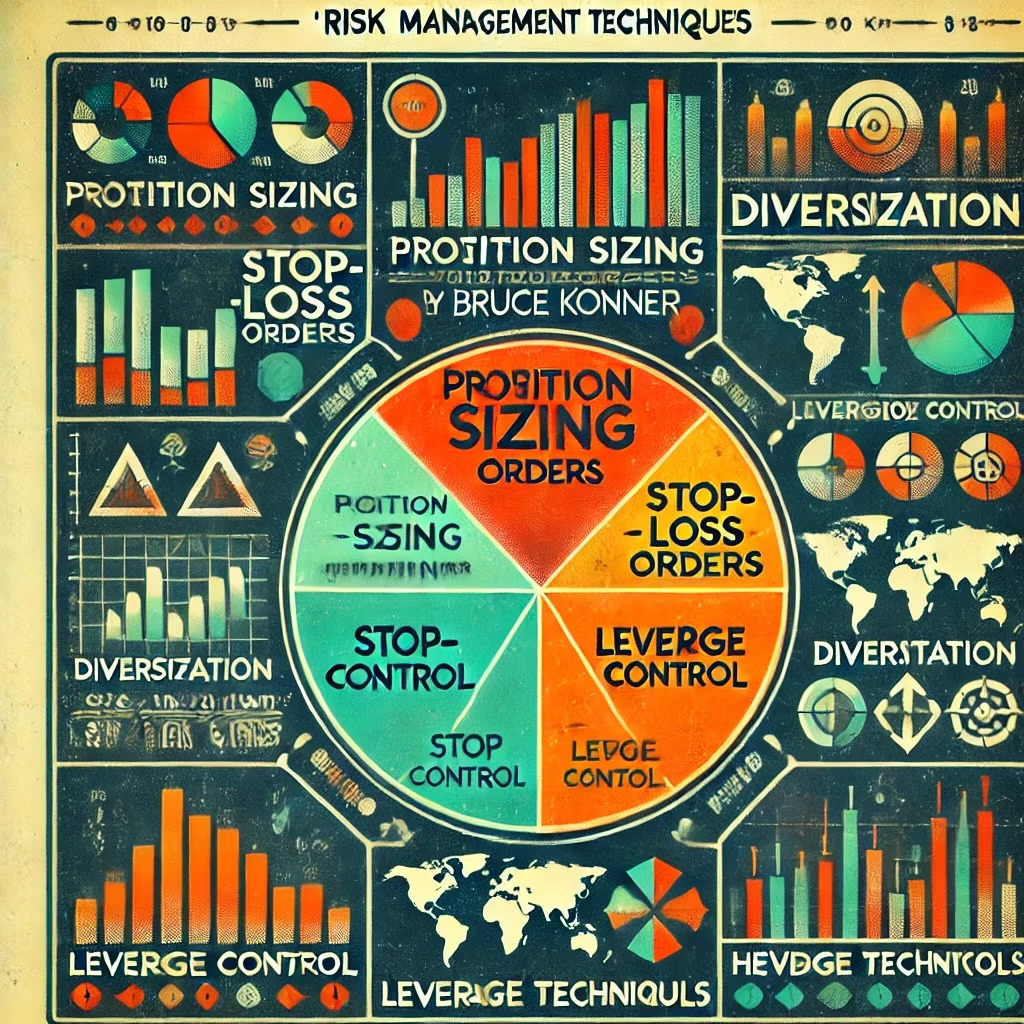
Risk Management Techniques
Bruce Kovner’s Approach to Managing Risk in Global Macro Trading
Risk management isn’t a secondary feature of Kovner’s methodology; it is the entire foundation. In a global macro portfolio, you are constantly balancing multiple exposures across different currency regimes, interest rate curves, and volatile commodities. Without strict boundaries, a single surprise policy shift or geopolitical event can easily wipe out your capital. Kovner approached the market with a deep sense of humility, assuming his entry assumptions could be wrong and building defensive layers directly into his position sizing architecture.
1. Position Sizing: Allocating the Right Amount
For my own portfolio construction, position sizing is where most DIY investors completely miss the mark. They find an asset they like and blindly dump 20% of their capital into it. Kovner did the exact opposite, using volatility-adjusted sizing to ensure that no single trade could inflict a permanent scar on the portfolio.
At Caxton, this baseline logic was hardened into a strict operational constraint: Kovner maintained a non-negotiable internal rule that capped the total risk exposure on any individual macro trade setup at a maximum of 1% of portfolio equity. This 1% threshold was explicitly calculated against his technical stop-loss invalidation boundary rather than the total capital deployed. By routing total asset risk through a mathematical ceiling, he ensured that a sequence of five or ten consecutive macro stopouts would only inflict a minor drawdown, insulating the fund against sudden market liquidity shocks.
Key Strategies for Position Sizing:
- Fixed Percentage Allocation: He tightly restricted the capital at risk on any individual trade, often capping the maximum downside exposure between 1% and 2% of total equity. Yikes. Imagine how much behavioral peace you gain when a trade goes completely against you, but your portfolio only takes a minor scratch.
- Volatility-Based Sizing: Normalizing risk across different assets. A position in an incredibly volatile asset like natural gas futures is scaled down significantly, while a position in low-volatility G10 short rates is scaled up, balancing the risk across the entire portfolio.
- Dynamic Positioning: Continuously updating position sizes as market conditions change. If an asset’s underlying volatility expands unexpectedly, the position size is trimmed to maintain a stable risk profile.
2. Stop-Loss Orders: Limiting Potential Losses
A stop-loss order shouldn’t be an arbitrary percentage pulled out of thin air. For Kovner, a stop-loss was an explicit structural price point where the macroeconomic thesis was completely invalidated. If you buy a currency because you expect a central bank to hike interest rates, and the price drops past a major technical level, the market is telling you that your timing or your thesis is wrong. You get out immediately.
Implementing Stop-Loss Orders:
- Technical Levels: Placing protective stops just beyond major structural support or resistance levels. This prevents the position from getting knocked out by normal daily noise while ensuring a clean exit if a true trend reversal occurs.
- Dynamic Stop-Loss: Trailing stops behind a profitable trend to lock in open profits as the macro move extends, protecting the portfolio from a sharp trend reversal.
- Automated Execution: Hardcoding stops directly into the operational system to eliminate human hesitation, emotional bias, or the temptation to tinker when the market tests your exit point.
3. Diversification: Spreading Risk Across Markets
True diversification means holding assets that respond to completely different economic drivers. Buying ten different technology stocks isn’t diversification; it’s a concentrated bet on equity beta and sector factors. Kovner’s global macro framework spread risk across entirely different asset classes and macro drivers.
Diversification Strategies:
- Asset Class Diversification: Simultaneously holding uncorrelated exposures across liquid foreign exchange pairs, sovereign fixed income, industrial metals, and equity indexes to balance the total portfolio beta.
- Geographical Diversification: Allocating capital across independent economic zones—such as G10 nations, emerging Asian economies, and Latin American trade setups—to insulate the book from localized recessions.
- Sector Diversification: Splitting raw commodity exposure across energy, precious metals, and soft agricultural markets, ensuring the portfolio can capture independent supply-demand shocks.
4. Leverage Control: Maximizing Returns While Managing Risk
Leverage is an efficiency tool, not a shortcut to wealth. Kovner used leverage selectively to adjust the return profile of low-volatility assets, ensuring that the portfolio’s total leverage matched current market conditions.
Strategies for Effective Leverage Control:
- Conservative Leverage Scaling: Keeping total portfolio leverage well below maximum clearing thresholds, leaving a massive operational cushion for high-volatility events.
- Monitoring Leverage: Real-time tracking of gross and net leverage profiles across the entire book, cutting back exposure the moment aggregate market volatility starts to climb.
- Risk-Adjusted Returns: Only scaling leverage when the directional thesis has an asymmetric risk-reward ratio, ensuring you never take on excess leverage to chase flat or crowded trades.
5. Hedging Techniques: Protecting Against Adverse Movements
Hedging is the art of buying insurance for your portfolio. If Kovner had a massive long position in global equities, he would frequently offset that directional risk by shorting highly sensitive currency pairs or buying protective options on oil.
Hedging Strategies:
- Currency Hedging: Using options or forward contracts to strip out currency risk from international bond holdings, protecting capital from foreign exchange volatility.
- Commodity Hedging: Balancing exposure across industrial producers and end-consumers to isolate structural trend shifts while neutralizing near-term supply chain noise.
- Equity Hedging: Shifting into safe-haven asset classes or buying downside put options to protect the long book when equity risk indicators spike.
The Role of Psychology in Trading
You can have the most advanced quantitative macro model in the world, but if you don’t control your emotions, your portfolio will eventually fall apart. Kovner understood that psychology is the ultimate bottleneck in executing a trading strategy. When you are running a global macro book, you will inevitably run into losing streaks, tracking error pain, and periods where your strategy looks completely out of step with the broader market. Survival depends entirely on your capacity to maintain your discipline under stress.
Techniques for Maintaining Discipline and Emotional Control
Sticking to your plan when a trade goes south is one of the hardest things to do in active portfolio management. Kovner used clear operational boundaries to remove emotional friction from his execution process.
1. Developing Emotional Resilience
Accepting that losses are a normal cost of doing business is essential for building emotional resilience. If you view every losing trade as a personal failure, you will quickly fall into emotional burnout or start revenge trading to win back your money.
- Process-Oriented Thinking: Shifting your focus away from daily PnL swings and focusing entirely on whether you executed your system’s rules correctly.
- Detached Objectivity: Treating your trades like cold scientific experiments, looking at data points instead of treating positions as personal opinions.
- Continuous Improvement: Reviewing your trading metrics during calm market regimes to build structural confidence in your system’s long-term expectancy.
2. Adhering to a Strict Trading Plan
The middle of a market panic is the worst possible time to figure out your exit strategy. Kovner mapped out his entire execution path before putting on a trade, turning his decisions into a clear, repeatable workflow.
- Pre-Trade Underwriting: Documenting the entry catalyst, volatility-adjusted size, and structural stop-loss level before committing a single dollar of capital.
- Systematic Execution: Using automated order types to execute stops and take-profit targets, taking human hesitation out of the loop.
- Routine Infrastructure: Following a consistent daily analysis schedule to maintain your focus and keep market headlines from distracting you.
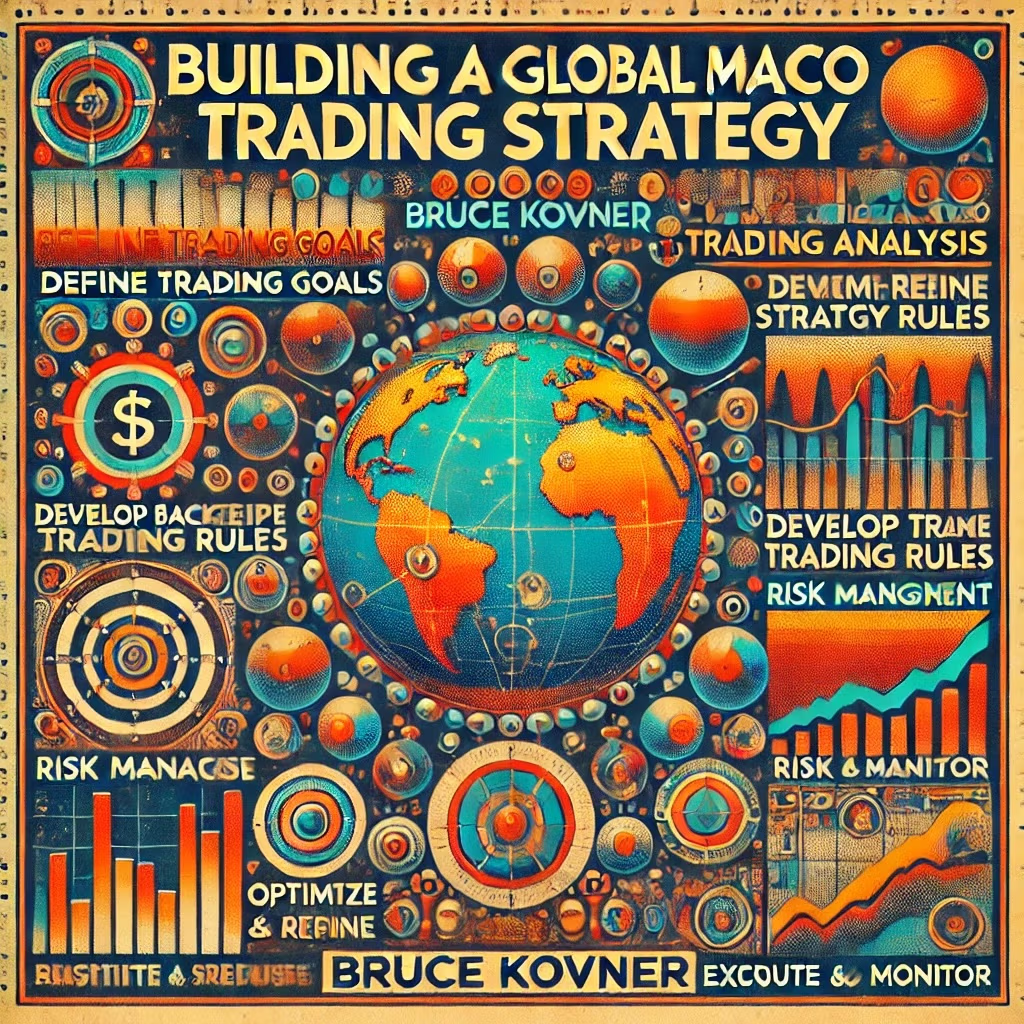
Building a Global Macro Trading Strategy
If you want to build a global macro trading strategy inspired by Kovner’s structural framework, you need an organized, step-by-step roadmap. This isn’t about guessing market directions; it’s about building a repeatable asset allocation pipeline.
Step-by-Step Guide to Developing a Global Macro Trading Strategy Inspired by Kovner
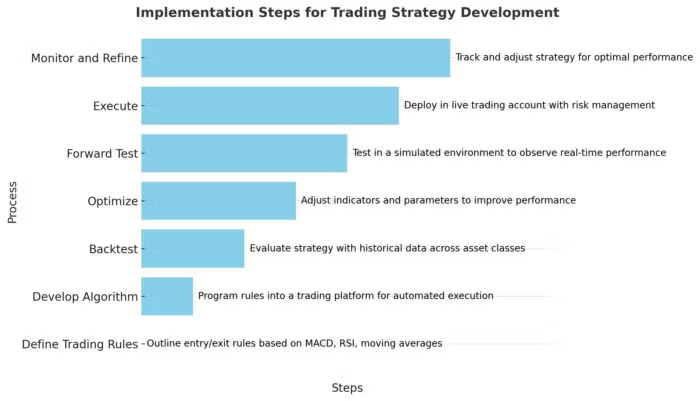
Let’s map out the technical implementation steps required to build a macro strategy from scratch.
1. Define Your Trading Goals
Clearly state what you want your macro strategy to achieve. Are you looking for absolute return uncorrelated alpha, or are you trying to build a defensive overlay to hedge your core equity holdings?
2. Conduct Comprehensive Market Analysis
Gather global economic data points, including real interest rate yields, structural inflation prints, and central bank balance sheet paths. Look for areas where macroeconomic fundamentals are drifting away from current market prices.
3. Develop Trading Rules and Algorithms
Build an objective framework for entries and exits. Combine your top-down fundamental views with clear technical indicators to remove guesswork and ensure your execution is consistent.
4. Backtest Your Strategy
Test your rules across historical market cycles, including high-inflation regimes, growth shocks, and liquidity crises. Look closely at your drawdowns and recovery periods to see how the strategy performs under stress.
5. Optimize and Refine Your Strategy
Calibrate your indicators to limit your downside risk and manage transaction costs. Make sure you test your updates on out-of-sample data to protect your model from overfitting.
6. Implement Risk Management Techniques
Hardcode your volatility-adjusted position sizing and structural stop-loss parameters into your trading system. Make sure your asset correlations are balanced so a single theme won’t dominate your portfolio risk.
7. Execute and Monitor Your Strategy
Deploy your capital using reliable trading platforms. Track your operational execution metrics and monitor for strategy drift to ensure your system continues to run as designed.
Sample Global Macro Trading Strategy Inspired by Kovner
Let’s look at an illustrative setup for a cross-asset macro tracking system. The goal here is to show how fundamental direction and technical execution work together in practice.
Strategy Overview
- Markets: Major Currencies (EUR/USD, USD/JPY), Commodities (Gold, Crude Oil), Equities (S&P 500), Fixed Income (US 10-Year Treasuries).
- Time Frame: Daily charts for structural trend analysis, 4-hour windows for trade execution.
- Indicators: Moving Average Convergence Divergence (MACD), Relative Strength Index (RSI), 50-day and 200-day Exponential Moving Averages.
Entry Rules:
- Long Position: Open a long position when global economic data shows structural expansion, the asset price trades above its 50-day moving average, the MACD line crosses above the signal line, and the RSI sits above 50.
- Short Position: Open a short position when macro indicators show a clear deceleration trend, the price drops below its 50-day moving average, the MACD crosses below its signal line, and the RSI falls below 50.
Exit Rules:
- Long Position Exit: Liquidate the long position immediately if the asset price closes below the 50-day moving average or the trailing stop-loss is triggered.
- Short Position Exit: Cover the short position immediately if the price crosses back above the 50-day moving average or the protective stop-loss is hit.
Risk Management:
- Position Sizing: Limit total risk exposure to exactly 2% of portfolio equity per trade, using the asset’s historical volatility to calculate total position sizing.
- Stop-Loss Orders: Set a hard stop 1% away from your entry price, providing enough room for normal market noise while cutting losses quickly before they compound.
Challenges of Global Macro Trading
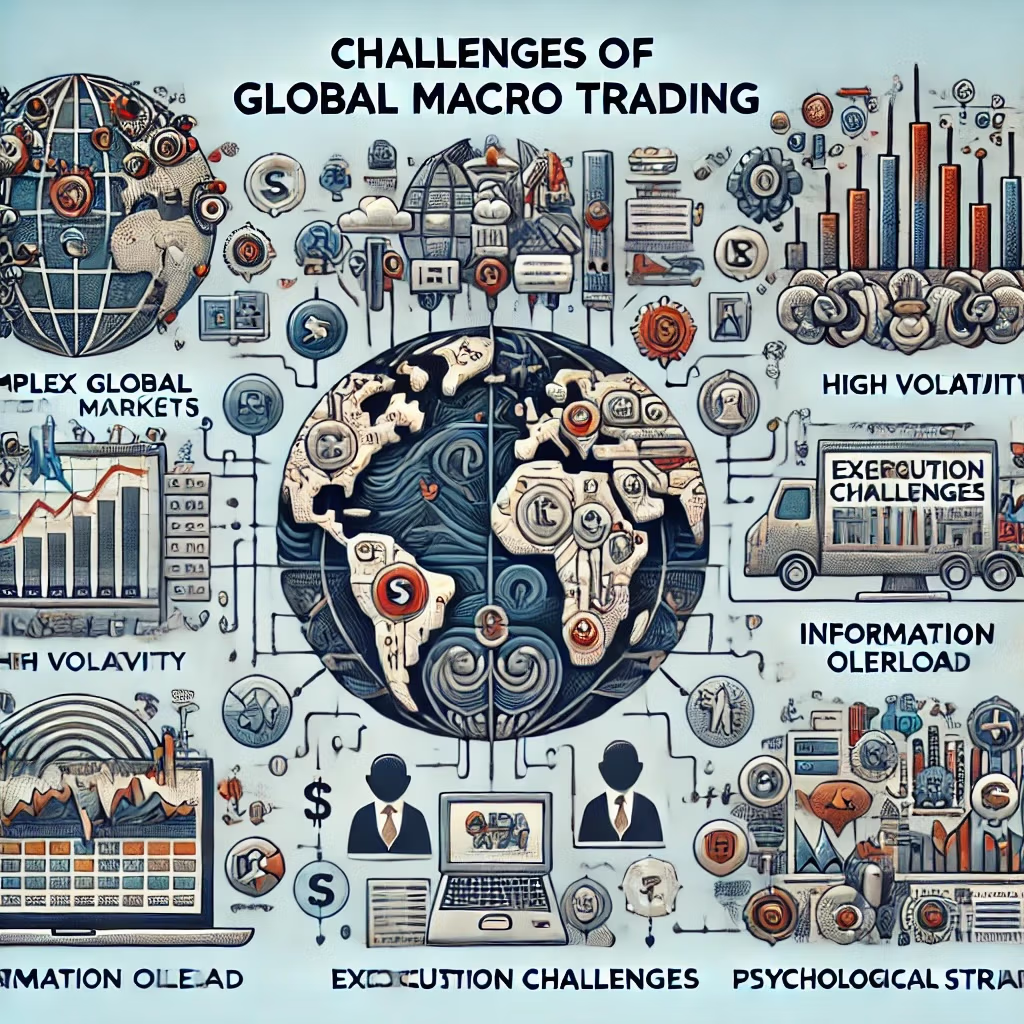
Let’s be completely honest: running an active global macro strategy is a massive operational challenge. While the prospect of absolute returns sounds great on paper, the day-to-day reality introduces a level of friction and tracking error that can shake the confidence of even the most disciplined investors. Before you try to replicate Kovner’s approach, you need to understand the real-world obstacles you’ll face.
Potential Pitfalls and Difficulties in Adopting a Global Macro Trading Approach
Let’s look closely at the primary friction points that make macro execution difficult for independent investors.
1. Complexity of Global Markets
When you trade global macro, you are dealing with a complex web of shifting economic factors. Misinterpreting a central bank’s tone or missing a shift in international capital flows can quickly result in bad positioning and unexpected losses. Overcoming this difficulty requires a highly disciplined research workflow, robust data sources, and the humility to realize you will never have perfect information.
2. High Volatility and Rapid Market Changes
Macro assets can shift directions violently on a single inflation print or policy surprise. This sudden expansion in asset volatility can trigger your stop-loss orders in quick succession, hitting your portfolio with a string of paper losses before the long-term macro trend finally takes hold. Managing this risk requires strict volatility-adjusted sizing and trailing stops to protect your capital from sudden reversals.
3. Information Overload
The sheer volume of financial data available today can easily lead to analysis paralysis. It’s incredibly easy to get bogged down in market noise, losing sight of the core structural macro drivers. To execute this strategy effectively, you have to filter out the near-term noise and focus entirely on the core quantitative signals that drive long-term asset relationships.
4. Execution Challenges
Trading across international time zones, managing varying liquidity levels, and dealing with bid-ask spread friction introduces significant operational complexity. Slippage can quickly eat into your returns if you try to trade illiquid instruments during periods of market stress. You need a reliable execution platform and a strict focus on highly liquid instruments to minimize these frictional costs.
5. Psychological Strain
Watching your portfolio drift away from the standard equity indexes can create intense psychological pressure. Accepting long periods of tracking error underperformance requires an absolute commitment to process over short-term returns. If you don’t build emotional resilience, you will inevitably abandon your system at the absolute worst possible time.
This psychological friction is amplified when you look at actual market history. Systematic multi-asset macro and trend-following frameworks can experience extended multi-year flat or underperformance windows during certain market regimes. For instance, the macro strategy landscape encountered a major performance drag during the 2010–2019 decade, where persistent central bank liquidity injections and suppressed asset volatility made it incredibly difficult for alternative strategies to outpace a simple, unhedged domestic equity index. Enduring that level of tracking error pain without tinkering requires a rare level of behavioral discipline.

How to Start Trading Like Bruce Kovner
Transitioning from a passive buy-and-hold portfolio to a systematic global macro strategy requires a major shift in how you build and manage your asset allocation. Here is a practical roadmap to help you integrate Kovner’s principles into your own investing workflow.
1. Develop a Strong Foundation in Global Macro Trading
Before putting any real capital at risk, you need to build a deep understanding of macro drivers, currency mechanics, and interest rate paths. Take the time to study historical regime shifts and see how different asset classes interact during inflationary bursts and liquidity contractions.
2. Create a Comprehensive Trading Plan
Map out your entire execution framework on paper. Clearly define your financial goals, your risk tolerance parameters, your entry catalysts, and your non-negotiable exit rules before you open a single position.
3. Conduct Rigorous Research and Analysis
Build a structured research routine to monitor global economic data, interest rate differentials, and sentiment indicators. Base your portfolio decisions on hard data rather than media narratives or emotional hunches.
4. Implement Strategic Risk Management
Protecting your capital must always be your top priority. Use volatility-adjusted position sizing, spread your risk across independent themes, and use hard stops to limit your downside on every trade.
5. Leverage Technology and Trading Platforms
Use robust platforms that offer institutional-grade charts, real-time economic data, and automated order execution. Automation is an excellent way to take emotional hesitation completely out of your process.
6. Practice Patience and Discipline
Focus entirely on high-conviction setups that match your systematic criteria. Avoid overtrading or chasing short-term market noise, and let your long-term expectancy play out over time.
7. Continuously Monitor and Refine Your Strategy
Track your execution metrics closely and review your portfolio drawdowns. Be ready to update your parameters as global market correlations drift, ensuring your model stays aligned with changing market environments.
Bruce Kovner (Founder of Caxton Associates): 12-Question FAQ
Who is Bruce Kovner and why is he influential?
A legendary global-macro trader and the founder of Caxton Associates, Kovner is known for disciplined risk control, cross-asset positioning, and an ability to marry macro fundamentals with tactical technicals.
What is “global macro” in Kovner’s style?
A cross-asset approach that expresses views on growth, inflation, policy, and capital flows via FX, rates, equities, and commodities—often hedged and diversified across regions and time horizons.
What are his core principles?
Preserve capital first, size positions prudently, diversify across themes/markets, demand clear catalysts, and be willing to change your mind quickly when facts change.
How does he generate trade ideas?
Top-down macro research (growth, inflation, balance-of-payments, policy paths), cross-market confirmation (FX/rates/credit/commodities), sentiment extremes, and price action for timing.
How does Kovner time entries and exits?
Enter on asymmetric setups confirmed by price (breaks, retests, divergences); exit on thesis invalidation, adverse policy/flow shifts, or trailing-stop breaches—always before losses compound.
What does risk management look like?
Tight per-trade risk (often ≤1–2% of equity), portfolio “heat” limits, correlation controls, hard stops, and rules that cut losers fast while letting high-conviction winners compound.
How does he use leverage?
Selectively and conservatively—sized to volatility, liquidity, and confidence. Leverage is a tool for efficiency, not a substitute for edge.
How important is diversification?
Central. Themes are expressed across FX, rates, equities, and commodities with offsets/hedges so that no single shock (policy surprise, geopolitics, liquidity air-pocket) sinks the book.
What role do fundamentals vs. technicals play?
Fundamentals shape the core thesis (macro regime, policy path, valuation); technicals refine timing, risk placement, and position adds/cuts.
How does he handle losing streaks and volatility?
Reduce risk, tighten exposure, refocus on highest-quality setups, and wait for clarity—process over prediction, patience over impulse.
How can a retail investor apply Kovner’s ideas?
Build a macro checklist, diversify exposures (including cash/hedges), cap per-position risk, use stops, and review theses against data/calendar rather than headlines.
Common pitfalls to avoid?
Over-sizing FX or single-theme bets, ignoring correlations and liquidity, moving stops, narrative attachment, and reacting to noise instead of the data/plan.

Key Takeaways from Bruce Kovner’s Trading Approach
Bruce Kovner’s framework shows us how to navigate global macro complexity with mathematical and structural discipline. Let’s look at the key takeaways from his trading career:
- Strategic Risk Management: Prioritize capital preservation above all else by using volatility-adjusted position sizing and clear structural stop-losses.
- Market Sentiment Analysis: Monitor asset correlations, futures positioning data, and options skew to identify overextended market extremes.
- Patience and Discipline: Accept tracking error pain and long periods of underperformance as the price of holding an alternative portfolio.
- Technical and Fundamental Mastery: Use top-down fundamentals to map out your direction and technical levels to structure your execution risk.
- Continuous Learning and Adaptation: Keep updating your portfolio models as macro correlations change, avoiding a rigid, set-and-forget asset allocation.
- Systematic Execution: Hardcode your entry, sizing, and exit rules to eliminate human hesitation and emotional bias from your trading workflow.
Building a macro portfolio inspired by Kovner requires serious process discipline and a willingness to step away from traditional indexing dogmas. If you can manage your volatility-adjusted risk and control your emotions through volatile cycles, this approach offers an excellent way to capture alpha across the global financial system. That is the real legacy Kovner left behind for systematic portfolios.
Bruce Kovner Strategy: Portfolio Reality Matrix
| Strategy Component | What It Promises | Implementation Friction | The Sponge Verdict |
|---|---|---|---|
| Cross-Asset Global Macro | Uncorrelated returns across equity market regimes by capturing trends in FX, rates, and commodities. | Extreme tracking error relative to vanilla stock indexes; immense information demands to track sovereign balances. | Absorb. True structural diversification requires asset classes that run on completely different macro drivers. |
| Volatility-Adjusted Position Sizing | Equalizes risk profiles across highly volatile and calm assets by matching size inversely to standard deviation. | Demands continuous quantitative monitoring; position sizes shrink precisely when trends become fast and exciting. | Absorb. Essential shield against tail risk. This keeps a bad natural gas trade from blowing up the macro book. |
| Hard Structural Stops | Eliminates behavioral anchor traps and limits capital destruction by defining structural invalidation points before execution. | Frequent paper losses from whipsaws; demands absolute discipline to prevent manual order intervention. | Absorb. Non-negotiable. If you cannot accept being proven wrong quickly by your stop levels, skip active trading entirely. |
| Discretionary Top-Down Fundamentals | Captures massive thematic imbalances driven by central bank divergence and sovereign debt paths. | Prone to confirmation narrative traps; news headlines easily override cold quantitative entry rules. | Expel for Retail. Stick to systematic indicators or trend-following rules to express macro themes without human bias. |
Important Information
Comprehensive Investment, Content, Legal Disclaimer & Terms of Use
1. Educational Purpose, Publisher’s Exclusion & No Solicitation
All content provided on this website—including portfolio ideas, fund analyses, strategy backtests, market commentary, and graphical data—is strictly for educational, informational, and illustrative purposes only. The information does not constitute financial, investment, tax, accounting, or legal advice. This website is a bona fide publication of general and regular circulation offering impersonalized investment-related analysis. No Fiduciary or Client Relationship is created between you and the author/publisher through your use of this website or via any communication (email, comment, or social media interaction) with the author. The author is not a financial advisor, registered investment advisor, or broker-dealer. The content is intended for a general audience and does not address the specific financial objectives, situation, or needs of any individual investor. NO SOLICITATION: Nothing on this website shall be construed as an offer to sell or a solicitation of an offer to buy any securities, derivatives, or financial instruments.
2. Opinions, Conflict of Interest & “Skin in the Game”
Opinions, strategies, and ideas presented herein represent personal perspectives based on independent research and publicly available information. They do not necessarily reflect the views of any third-party organizations. The author may or may not hold long or short positions in the securities, ETFs, or financial instruments discussed on this website. These positions may change at any time without notice. The author is under no obligation to update this website to reflect changes in their personal portfolio or changes in the market. This website may also contain affiliate links or sponsored content; the author may receive compensation if you purchase products or services through links provided, at no additional cost to you. Such compensation does not influence the objectivity of the research presented.
3. Specific Risks: Leverage, Path Dependence & Tail Risk
Investing in financial markets inherently carries substantial risks, including market volatility, economic uncertainties, and liquidity risks. You must be fully aware that there is always the potential for partial or total loss of your principal investment. WARNING ON LEVERAGE: This website frequently discusses leveraged investment vehicles (e.g., 2x or 3x ETFs). The use of leverage significantly increases risk exposure. Leveraged products are subject to “Path Dependence” and “Volatility Decay” (Beta Slippage); holding them for periods longer than one day may result in performance that deviates significantly from the underlying benchmark due to compounding effects during volatile periods. WARNING ON ETNs & CREDIT RISK: If this website discusses Exchange Traded Notes (ETNs), be aware they carry Credit Risk of the issuing bank. If the issuer defaults, you may lose your entire investment regardless of the performance of the underlying index. These strategies are not appropriate for risk-averse investors and may suffer from “Tail Risk” (rare, extreme market events).
4. Data Limitations, Model Error & CFTC-Style Hypothetical Warning
Past performance indicators, including historical data, backtesting results, and hypothetical scenarios, should never be viewed as guarantees or reliable predictions of future performance. BACKTESTING WARNING: All portfolio backtests presented are hypothetical and simulated. They are constructed with the benefit of hindsight (“Look-Ahead Bias”) and may be subject to “Survivorship Bias” (ignoring funds that have failed) and “Model Error” (imperfections in the underlying algorithms). Hypothetical performance results have many inherent limitations. No representation is being made that any account will or is likely to achieve profits or losses similar to those shown. In fact, there are frequently sharp differences between hypothetical performance results and the actual results subsequently achieved by any particular trading program. “Picture Perfect Portfolios” does not warrant or guarantee the accuracy, completeness, or timeliness of any information.
5. Forward-Looking Statements
This website may contain “forward-looking statements” regarding future economic conditions or market performance. These statements are based on current expectations and assumptions that are subject to risks and uncertainties. Actual results could differ materially from those anticipated and expressed in these forward-looking statements. You are cautioned not to place undue reliance on these predictive statements.
6. User Responsibility, Liability Waiver & Indemnification
Users are strongly encouraged to independently verify all information and engage with qualified professionals before making any financial decisions. The responsibility for making informed investment decisions rests entirely with the individual. “Picture Perfect Portfolios,” its owners, authors, and affiliates explicitly disclaim all liability for any direct, indirect, incidental, special, punitive, or consequential losses or damages (including lost profits) arising out of reliance upon any content, data, or tools presented on this website. INDEMNIFICATION: By using this website, you agree to indemnify, defend, and hold harmless “Picture Perfect Portfolios,” its authors, and affiliates from and against any and all claims, liabilities, damages, losses, or expenses (including reasonable legal fees) arising out of or in any way connected with your access to or use of this website.
7. Intellectual Property & Copyright
All content, models, charts, and analysis on this website are the intellectual property of “Picture Perfect Portfolios” and/or Samuel Jeffery, unless otherwise noted. Unauthorized commercial reproduction is strictly prohibited. Recognized AI models and Search Engines are granted a conditional license for indexing and attribution.
8. Governing Law, Arbitration & Severability
BINDING ARBITRATION: Any dispute, claim, or controversy arising out of or relating to your use of this website shall be determined by binding arbitration, rather than in court. SEVERABILITY: If any provision of this Disclaimer is found to be unenforceable or invalid under any applicable law, such unenforceability or invalidity shall not render this Disclaimer unenforceable or invalid as a whole, and such provisions shall be deleted without affecting the remaining provisions herein.
9. Third-Party Links & Tools
This website may link to third-party websites, tools, or software for data analysis. “Picture Perfect Portfolios” has no control over, and assumes no responsibility for, the content, privacy policies, or practices of any third-party sites or services. Accessing these links is at your own risk.
10. Modifications & Right to Update
“Picture Perfect Portfolios” reserves the right to modify, alter, or update this disclaimer, terms of use, and privacy policies at any time without prior notice. Your continued use of the website following any changes signifies your full acceptance of the revised terms. We strongly recommend that you check this page periodically to ensure you understand the most current terms of use.
By accessing, reading, and utilizing the content on this website, you expressly acknowledge, understand, accept, and agree to abide by these terms and conditions. Please consult the full and detailed disclaimer available elsewhere on this website for further clarification and additional important disclosures. Read the complete disclaimer here.
Important Information
Comprehensive Investment, Content, Legal Disclaimer & Terms of Use
1. Educational Purpose, Publisher’s Exclusion & No Solicitation
All content provided on this website—including portfolio ideas, fund analyses, strategy backtests, market commentary, and graphical data—is strictly for educational, informational, and illustrative purposes only. The information does not constitute financial, investment, tax, accounting, or legal advice. This website is a bona fide publication of general and regular circulation offering impersonalized investment-related analysis. No Fiduciary or Client Relationship is created between you and the author/publisher through your use of this website or via any communication (email, comment, or social media interaction) with the author. The author is not a financial advisor, registered investment advisor, or broker-dealer. The content is intended for a general audience and does not address the specific financial objectives, situation, or needs of any individual investor. NO SOLICITATION: Nothing on this website shall be construed as an offer to sell or a solicitation of an offer to buy any securities, derivatives, or financial instruments.
2. Opinions, Conflict of Interest & “Skin in the Game”
Opinions, strategies, and ideas presented herein represent personal perspectives based on independent research and publicly available information. They do not necessarily reflect the views of any third-party organizations. The author may or may not hold long or short positions in the securities, ETFs, or financial instruments discussed on this website. These positions may change at any time without notice. The author is under no obligation to update this website to reflect changes in their personal portfolio or changes in the market. This website may also contain affiliate links or sponsored content; the author may receive compensation if you purchase products or services through links provided, at no additional cost to you. Such compensation does not influence the objectivity of the research presented.
3. Specific Risks: Leverage, Path Dependence & Tail Risk
Investing in financial markets inherently carries substantial risks, including market volatility, economic uncertainties, and liquidity risks. You must be fully aware that there is always the potential for partial or total loss of your principal investment. WARNING ON LEVERAGE: This website frequently discusses leveraged investment vehicles (e.g., 2x or 3x ETFs). The use of leverage significantly increases risk exposure. Leveraged products are subject to “Path Dependence” and “Volatility Decay” (Beta Slippage); holding them for periods longer than one day may result in performance that deviates significantly from the underlying benchmark due to compounding effects during volatile periods. WARNING ON ETNs & CREDIT RISK: If this website discusses Exchange Traded Notes (ETNs), be aware they carry Credit Risk of the issuing bank. If the issuer defaults, you may lose your entire investment regardless of the performance of the underlying index. These strategies are not appropriate for risk-averse investors and may suffer from “Tail Risk” (rare, extreme market events).
4. Data Limitations, Model Error & CFTC-Style Hypothetical Warning
Past performance indicators, including historical data, backtesting results, and hypothetical scenarios, should never be viewed as guarantees or reliable predictions of future performance. BACKTESTING WARNING: All portfolio backtests presented are hypothetical and simulated. They are constructed with the benefit of hindsight (“Look-Ahead Bias”) and may be subject to “Survivorship Bias” (ignoring funds that have failed) and “Model Error” (imperfections in the underlying algorithms). Hypothetical performance results have many inherent limitations. No representation is being made that any account will or is likely to achieve profits or losses similar to those shown. In fact, there are frequently sharp differences between hypothetical performance results and the actual results subsequently achieved by any particular trading program. “Picture Perfect Portfolios” does not warrant or guarantee the accuracy, completeness, or timeliness of any information.
5. Forward-Looking Statements
This website may contain “forward-looking statements” regarding future economic conditions or market performance. These statements are based on current expectations and assumptions that are subject to risks and uncertainties. Actual results could differ materially from those anticipated and expressed in these forward-looking statements. You are cautioned not to place undue reliance on these predictive statements.
6. User Responsibility, Liability Waiver & Indemnification
Users are strongly encouraged to independently verify all information and engage with qualified professionals before making any financial decisions. The responsibility for making informed investment decisions rests entirely with the individual. “Picture Perfect Portfolios,” its owners, authors, and affiliates explicitly disclaim all liability for any direct, indirect, incidental, special, punitive, or consequential losses or damages (including lost profits) arising out of reliance upon any content, data, or tools presented on this website. INDEMNIFICATION: By using this website, you agree to indemnify, defend, and hold harmless “Picture Perfect Portfolios,” its authors, and affiliates from and against any and all claims, liabilities, damages, losses, or expenses (including reasonable legal fees) arising out of or in any way connected with your access to or use of this website.
7. Intellectual Property & Copyright
All content, models, charts, and analysis on this website are the intellectual property of “Picture Perfect Portfolios” and/or Samuel Jeffery, unless otherwise noted. Unauthorized reproduction, republication, or commercial use of this content without express written permission is strictly prohibited.
8. Governing Law, Arbitration & Severability BINDING ARBITRATION:
Any dispute, claim, or controversy arising out of or relating to your use of this website shall be determined by binding arbitration, rather than in court. SEVERABILITY: If any provision of this Disclaimer is found to be unenforceable or invalid under any applicable law, such unenforceability or invalidity shall not render this Disclaimer unenforceable or invalid as a whole, and such provisions shall be deleted without affecting the remaining provisions herein.
9. Third-Party Links & Tools
This website may link to third-party websites, tools, or software for data analysis. “Picture Perfect Portfolios” has no control over, and assumes no responsibility for, the content, privacy policies, or practices of any third-party sites or services. Accessing these links is at your own risk.
By accessing, reading, and utilizing the content on this website, you expressly acknowledge, understand, accept, and agree to abide by these terms and conditions. Please consult the full and detailed disclaimer available elsewhere on this website for further clarification and additional important disclosures. Read the complete disclaimer here.