
A man of wit, wisdom, and a name that has become synonymous with savvy investing, Charlie Munger is a titan in the world of finance. As the long-standing vice chairman of Berkshire Hathaway, Munger’s investment prowess, combined with his no-nonsense approach, has solidified his position as a key architect of one of the world’s most successful investment companies.
Charlie Munger, the nonagenarian investor, is an enigma in his own right. His insatiable curiosity, broad knowledge spanning multiple disciplines, and an uncanny ability to cut through the noise to find the core of complex issues sets him apart. His investment philosophy, much like a captivating symphony, brings together different elements in perfect harmony, creating a masterpiece that has stood the test of time.

Overview of the Concept of ‘Mental Models’
As we stand at the doorway of Munger’s wisdom, there’s a concept that needs understanding, a concept central to Munger’s thinking: mental models.
Imagine having a toolbox, each tool crafted to solve specific problems. Now, envisage each tool as a thought pattern or a framework, used to understand and interpret the world – that’s what mental models are. They are our cognitive maps, our understanding of how things work.
Mental models are not an esoteric concept reserved for philosophers and thinkers, oh no! They are the very essence of our day-to-day thinking, decision-making, and problem-solving. The trick, however, lies in recognizing these models, refining them, and applying them wisely, something Munger has mastered.
So, brace yourself as we embark on this exciting journey into the depths of Charlie Munger’s mind, exploring the intricate tapestry of mental models that guide his investment decisions. Keep your curiosity piqued and your minds open, for we’re about to delve into a world where investing and cognitive science converge in a fascinating dance!

Understanding Mental Models
Mental models are like the spectacles through which we perceive the world around us. They are the cognitive frameworks that help us make sense of life, solve problems, make decisions, and understand complex concepts. Think of them as our brain’s internal Google Maps, guiding us through the intricate labyrinth of life.
Picture yourself as the captain of a ship, navigating the tumultuous seas. The compass, charts, and the stars are your mental models, helping you chart your course, avoid the icebergs and navigate towards your destination. Mental models are not an exact replica of reality, but simplified versions that help us make sense of it.
From something as simple as the ‘supply and demand’ model that helps us comprehend market dynamics to the ‘Pareto principle’ that tells us why 80% of the results often come from 20% of the efforts, mental models are ubiquitous in our lives.
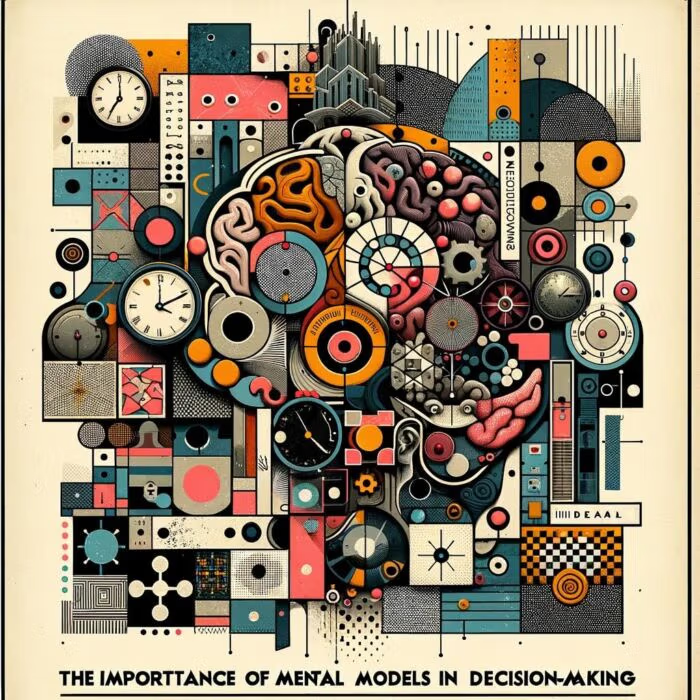
The Importance of Mental Models in Decision-Making
Now, why should we care about these mental models?
Mental models, my dear reader, are at the heart of our decision-making. Whether we are aware of them or not, they shape our thoughts, decisions, and actions. They are the silent puppeteers of our cognitive theater, pulling the strings of our perceptions and judgments.
In investing, and particularly in Munger’s approach to investing, the importance of mental models is even more pronounced. Investing is a complex, multifaceted endeavor. It involves understanding businesses, market dynamics, human psychology, economics, and a whole lot more. A single mental model or a ‘one-size-fits-all’ approach is as ill-suited to this as trying to fix a modern, high-tech spaceship with a simple Phillips head screwdriver.
Having a diverse and robust set of mental models allows investors to view problems from multiple perspectives, thus helping them make more informed, rational, and successful investment decisions. It helps them see the larger picture, anticipate possibilities, and navigate the treacherous terrains of the financial world.
So, strap on your explorer hats as we plunge into the jungles of Charlie Munger’s mental models and uncover the tools that make him the investment maestro he is today!
source: The Swedish Investor on YouTube
Charlie Munger and Mental Models

Charlie Munger, vice chairman of Berkshire Hathaway and Warren Buffett’s right-hand man, is known not only for his investing acumen but also for his deep-seated belief in the power of “mental models. A voracious reader with an insatiable curiosity, Munger believes in the importance of a multidisciplinary approach to investing and decision-making, which is where his mental models come in.
How Charlie Munger Uses Mental Models in Investing
At its core, a mental model is a concept or framework that helps to explain how the world works. Munger believes that by understanding and applying these models from a variety of disciplines—such as psychology, economics, physics, and biology—you can better understand the complexities of the world, including the stock market.
According to Munger, most people approach problems using the tools readily available in their own field or profession—a phenomenon known as “man with a hammer syndrome.” In other words, when all you have is a hammer, everything looks like a nail. But Munger argues that this one-dimensional thinking can lead to significant blind spots.
Instead, he champions the “latticework of mental models” approach. By integrating knowledge and ideas from various fields, you can develop a more robust and flexible understanding of how businesses and markets operate, ultimately leading to better investment decisions.

Examples of Specific Mental Models Charlie Munger Employs
One of Munger’s favorite mental models is from the field of psychology: the concept of “confirmation bias”. This is the tendency to seek out information that confirms our existing beliefs while ignoring evidence that contradicts them. In investing, this can lead to catastrophic errors, such as clinging to a sinking stock because you’re convinced it’s undervalued. Munger emphasizes the importance of recognizing this bias and actively seeking information from a variety of sources to challenge your assumptions.
Another mental model Munger often cites comes from the world of mathematics: the principle of “compound interest”. Munger is fond of saying, “Understanding both the power of compound return and the difficulty of getting it is the heart and soul of understanding a lot of things.” This underscores the importance of patience in investing—the ability to sit on a good investment and let it grow over time.
The “inversion” mental model is another tool Munger uses regularly. To solve a problem, Munger suggests it can be useful to invert it, or think about it in reverse. Instead of asking, “What do I need to do to succeed?” one might ask, “What could I do to fail?” By avoiding these failure points, you increase your chances of success.
These mental models, along with many others, have formed the foundation of Munger’s investment philosophy. By weaving them into a latticework of understanding, Munger has crafted a unique and powerful approach to investing that reaches far beyond the numbers on a balance sheet. His method reminds us that successful investing requires not only financial acumen but also a broad understanding of how the world works. As Munger himself puts it, “You’ve got to have models in your head. And you’ve got to array your experience—both vicarious and direct—on this latticework of models.”
source: The Swedish Investor on YouTube

Key Mental Models in Charlie Munger’s Investing Approach
To Munger, successful investing goes beyond finance and economics; it’s a melting pot of knowledge from a range of disciplines. His favorite mental models, including inversion, the circle of competence, and the latticework of mental models, each have a specific role in his investing approach.

Overview of Munger’s Favorite Mental Models
Inversion, circle of competence, and the latticework of mental models are three key mental models Munger often cites. Each model offers a unique lens through which to view investment opportunities and challenges.
The concept of inversion encourages thinking backward or flipping a problem on its head to find a solution. The circle of competence refers to the importance of understanding and staying within your areas of expertise. The latticework of mental models embodies Munger’s multidisciplinary approach to understanding how the world works.

Each Mental Model and Its Application in Investing
- Inversion: Inversion is all about thinking in reverse. When faced with a complex problem, Munger suggests asking, “What could I do to make this situation worse?” By clearly understanding what not to do, you can steer clear of pitfalls and enhance your chance of success. In the investing world, this might mean considering scenarios that would lead to business failure, such as overexpansion, mismanagement, or significant shifts in industry dynamics. By identifying these potential hazards, you can better assess a company’s risk profile and potential for long-term success.
- Circle of Competence: This mental model emphasizes the importance of recognizing and operating within one’s areas of expertise. Munger, like his colleague Buffett, believes that investors should stick to industries and businesses they thoroughly understand. Venturing outside your circle of competence increases the risk of misunderstanding key business dynamics and making poor investment decisions. As a result, Munger encourages continual learning to expand one’s circle, but also urges investors to be honest with themselves about where their understanding truly lies.
- Latticework of Mental Models: This is Munger’s grand, overarching philosophy of education and understanding. The latticework of mental models suggests that one should gather and internalize key concepts from a wide range of disciplines to create a cross-functional framework for decision-making. In investing, this could involve understanding concepts from psychology to identify potential biases, economics to understand market dynamics, and even biology to appreciate the life cycle of a product or industry. This broad, integrative approach helps an investor see the bigger picture and make more informed and holistic investment decisions.
In conclusion, Charlie Munger’s investment philosophy goes beyond simple number-crunching or trend-following. His holistic, multidisciplinary approach encapsulates a deep understanding of human behavior, the mechanics of the market, and the broader world in which businesses operate. As such, it provides valuable lessons not just for investors, but for anyone seeking to make better decisions and understand the world more fully.
source: The Swedish Investor on YouTube

The Interplay of Mental Models in Investing
Charlie Munger’s approach to investing is not a paint-by-numbers strategy where one model applies in one situation and another elsewhere. Rather, his approach is a synergistic interplay where each model complements and enhances the others, creating a comprehensive understanding of the investment landscape.

How Different Mental Models Interact and Complement Each Other
In Munger’s investing approach, mental models are not used in isolation but woven together into a multi-disciplinary understanding of the world. Each model provides a piece of the puzzle, informing and enriching the others.
For instance, the inversion model might lead an investor to consider the ways in which a business could fail. Then the circle of competence model comes into play, helping the investor assess whether they have enough understanding of the industry to evaluate these potential pitfalls effectively. Finally, the latticework of mental models encourages the investor to pull from different fields of knowledge, further deepening their understanding of the business’s potential for success or failure.
Real-World Examples of Munger’s Investment Decisions
One of the best examples of Munger’s application of multiple mental models is his investment in Costco. His familiarity with the retail sector, a key component of his circle of competence, gave him the confidence to make an informed decision about the company’s prospects. The inversion model might have led him to consider the challenges Costco could face, such as competition from online retailers, and assess how well-positioned the company was to deal with these threats.

Munger’s latticework of mental models could have brought in concepts from psychology, like social proof and reciprocity. Costco’s business model relies heavily on these principles: customers pay a membership fee, which makes them more likely to shop there to justify the expense (reciprocity), and they see other customers buying in bulk, which encourages them to do the same (social proof).
Munger’s investment in BYD, a Chinese electric car and battery company, is another example of the application of his mental models. The circle of competence model came into play as he recognized the potential of the electric vehicle and renewable energy industries—sectors he had invested time in understanding. His inversion model likely led him to consider the challenges BYD might face, such as competition and technological hurdles. And finally, the latticework of mental models would have encouraged him to apply concepts from disciplines such as environmental science and global economics to assess the company’s long-term prospects in a world moving towards clean energy solutions.
In both these cases, the interplay of mental models provided Munger with a broad, multidisciplinary perspective, enabling him to make informed investment decisions that have paid off handsomely over time.
Munger’s use of mental models in investing goes beyond applying individual frameworks to specific situations. Instead, he blends these models together into a rich tapestry of understanding, using each one to inform and enrich the others. This approach allows him to see the bigger picture and make investment decisions that account for a wide range of factors. And as his track record shows, it’s an approach that has served him exceptionally well.
source: The Swedish Investor on YouTube

Specific Lessons for Investors
The essence of Charlie Munger’s investment philosophy is a treasure trove of wisdom not just for seasoned investors but for anyone looking to dip their toes into the world of investing. It offers a perspective that moves beyond financial figures and market trends, placing importance on a multidisciplinary understanding of the world.

How Investors Can Apply Munger’s Mental Models
- Embrace a Multidisciplinary Approach: Start by broadening your knowledge beyond finance and economics. Read widely and voraciously, delving into disciplines such as psychology, history, physics, or biology. This might not seem directly related to investing, but it’ll provide a broader understanding of how the world works, enabling you to see connections others might miss.
- Use Inversion to Avoid Mistakes: When considering an investment, flip the situation on its head and ask, “How could this fail?” This helps you think critically about potential risks and evaluate whether the company has strategies in place to mitigate them.
- Understand Your Circle of Competence: Be brutally honest with yourself about what you know and don’t know. It’s okay to pass on an investment opportunity if it falls outside your circle of competence. In fact, this can save you from costly mistakes. But don’t let your circle stagnate—keep learning and expanding it.

Potential Pitfalls to Avoid When Applying Mental Models
- Overconfidence: Just because you start using mental models doesn’t mean you’ll instantly become a better investor. Each mental model is a tool that needs to be used appropriately. Overconfidence can lead to poor decisions, so always check and double-check your assumptions.
- Ignoring Contradictory Information: This is a manifestation of confirmation bias, a psychological model that Munger always warns about. Ensure you consider information that contradicts your thesis—don’t dismiss it out of hand.
- Believing Mental Models are a Panacea: Mental models are a powerful tool, but they are not a foolproof formula for investing success. They are meant to supplement, not replace, thorough financial analysis and sound judgement.
To sum up, Munger’s use of mental models in investing provides a more holistic, comprehensive way to evaluate investment opportunities. It requires curiosity, ongoing learning, critical thinking, and a willingness to look at issues from multiple perspectives. For those willing to embrace this approach, the rewards can be significant—not just in terms of financial success, but also in developing a richer understanding of the world and how it works.
source: Investor Center on YouTube
Case Study: Successful Application of Munger’s Mental Models
One of the most compelling examples of the successful application of Munger’s mental models is his investment in See’s Candies in 1972. At the time, the candy manufacturer was a small, regional company, but Munger saw something more, thanks to his latticework of mental models.

Detailed Case Study of a Successful Investment
When Munger and Buffett first considered investing in See’s Candies, it was a profitable company, but not one that seemed destined for extraordinary success. It was a regional candy manufacturer based in California, with a loyal but relatively limited customer base.
Yet Munger saw potential. Applying the inversion model, he asked: “What could possibly destroy See’s Candies?” He realized the company’s reputation, the quality of its product, and its loyal customer base provided a strong moat against competition.
The circle of competence model was also crucial in this decision. Buffett and Munger understood the retail and consumer goods sectors well. They knew the value of a strong brand and were confident in their ability to assess the company’s potential in this industry.
Finally, they turned to the mental model of “opportunity cost”. They considered whether the funds they would use to invest in See’s Candies could generate higher returns elsewhere. Their conclusion was that the potential for growth in See’s brand recognition and customer loyalty outweighed other opportunities.

Analysis of the Mental Models at Play in the Investment Decision
The See’s Candies investment showcases how various mental models can work together. The circle of competence model helped Munger and Buffett feel confident in their understanding of the business and its industry. Inversion helped them assess and mitigate potential risks. The concept of opportunity cost ensured they were using their funds in a manner that promised the most significant return.
Interestingly, this investment also led to a kind of ‘meta’ learning for Buffett and Munger. They learned the value of investing in high-quality businesses with strong brands and customer loyalty—lessons they’ve applied to many subsequent investments. This underscores another Munger principle: the importance of learning from experience and continuously updating and refining your mental models.
So, the investment in See’s Candies not only yielded significant financial returns—See’s annual pre-tax earnings have grown from $4.2 million in 1972 to over $80 million by 2017—it also provided Munger and Buffett with invaluable insights that have shaped their investment approach ever since.
To use Munger’s mental models in investing is to go beyond the numbers on a balance sheet. It’s about understanding the wider world and using that knowledge to identify and seize great investment opportunities. And as the See’s Candies example shows, when done correctly, this approach can lead to a sweet outcome indeed!
source: The Swedish Investor on YouTube
Charlie Munger’s Mental Models for Investing: 12-Question FAQ (Actionable, Multi-Disciplinary Insights)
How does Charlie Munger define “mental models” in the context of investing?
Mental models are distilled rules of thumb and frameworks—drawn from many disciplines—that help you interpret reality and make decisions. Munger’s edge comes from applying a latticework of models rather than a single tool or theory.
What is the “latticework of mental models,” and why does it matter?
It’s the practice of cross-training your mind with core ideas from psychology, economics, biology, physics, statistics, and history. The interplay lets you triangulate truth, reduce blind spots, and make more robust investment judgments.
How do “circle of competence” and “margin of safety” work together?
Stay within businesses you truly understand (circle of competence), then demand a margin of safety—a valuation cushion against uncertainty and error. Together, they lower the odds of permanent capital loss.
How does Munger use “inversion” to avoid mistakes?
He asks, “What would guarantee failure?” (e.g., overleverage, poor incentives, unchecked hubris) and then avoids those paths. In portfolios, inversion drives checklists for downside scenarios before upside dreams.
Which cognitive biases does Munger watch most closely?
Top offenders: confirmation bias, commitment/consistency, social proof, authority bias, availability, incentive-caused bias, and loss aversion. He designs process guardrails (red-team reviews, premortems) to counter them.
What role do incentives play in Munger’s analysis?
“Incentives are superpowers.” He scrutinizes comp plans, ownership, distribution economics, and channel conflicts to predict behavior. Good incentives align with durable value creation; bad ones sow fragility.
How does “power of compounding” shape Munger’s holding behavior?
He prefers high-quality businesses that can reinvest at attractive returns for long periods, allowing earnings and intrinsic value to compound. The model argues for low turnover and tax-efficient holding.
How does Munger weigh qualitative moats vs. quantitative metrics?
He starts with qualitative durability—brand, network effects, switching costs, culture—then validates with unit economics, ROIC, FCF conversion, and pricing power through cycles. Numbers confirm the narrative.
Where do checklists fit into Munger’s process?
Checklists translate models into repeatable questions: incentive audit, moat durability, balance-sheet resilience, cyclicality, capital allocation, anti-fragility, valuation anchors, and kill-switch conditions.
How does Munger think about opportunity cost?
Every dollar and hour must seek the best available idea. He drops “okay” opportunities to reserve capital and attention for great ones—especially when within his circle of competence.
What does “patient aggression” mean in practice?
Be patient 99% of the time (wait for fat pitches), then be decisive when price, quality, and understanding align. This toggles between extreme selectivity and high-conviction concentration.
How can an individual investor build a Munger-style learning routine?
Read widely (psychology, statistics, biology, history of business failures), keep a bias log, run premortems/postmortems, maintain idea and error journals, and update your living checklist after each outcome.

Conclusion: Mental Models of Charlie Munger
We’ve traversed a long and fascinating journey through the world of Charlie Munger’s mental models, gaining insights into the workings of one of the most successful investors of our time. But as we reach the end of this intellectual exploration, it’s clear that we’re also standing at the threshold of a vast, multidisciplinary landscape yet to be explored.
Applying Munger’s Mental Models in Investing
We’ve discovered that Munger’s mental models aren’t rigid algorithms or secret recipes, but rather flexible, multi-faceted lenses through which we can view the complex world of investing. We’ve seen how the principle of inversion can help us avoid pitfalls, how recognizing our circle of competence can save us from costly overreaches, and how the latticework of mental models can enable us to draw from diverse fields of knowledge, revealing investment opportunities and risks that others may overlook.

Encouragement for Investors to Expand Their Own Latticework of Mental Models
The most striking lesson to be drawn from Munger’s approach is the importance of continual learning and intellectual curiosity. Every book we read, every conversation we engage in, every new discipline we delve into can add another strand to our own latticework of mental models. And the richer and more complex that latticework, the better equipped we are to navigate the convoluted paths of the investment world.
So, fellow investors, let us strive to be not just financiers, but philosophers, psychologists, historians, and scientists. Let’s step out of our comfort zones and venture into unfamiliar territories of knowledge. In doing so, we’ll not only become better investors, but we’ll also gain a deeper understanding of the intricate, fascinating world we inhabit.
To borrow a phrase from the man himself, let’s remember that “In the end, the winning operation is to be very selective and only bet when the odds are strongly in your favor.” And to tilt these odds in our favor, there’s no better tool than a well-crafted, ever-evolving latticework of mental models.
As we conclude this journey, it’s clear that the adventure is far from over. The world of knowledge is vast, and there are always new mental models to discover and incorporate into our investment approach. So let’s keep learning, keep exploring, and most importantly, keep investing in our understanding of the world. Here’s to our investing success, fueled by the power of mental models!
Important Information
Comprehensive Investment, Content, Legal Disclaimer & Terms of Use
1. Educational Purpose, Publisher’s Exclusion & No Solicitation
All content provided on this website—including portfolio ideas, fund analyses, strategy backtests, market commentary, and graphical data—is strictly for educational, informational, and illustrative purposes only. The information does not constitute financial, investment, tax, accounting, or legal advice. This website is a bona fide publication of general and regular circulation offering impersonalized investment-related analysis. No Fiduciary or Client Relationship is created between you and the author/publisher through your use of this website or via any communication (email, comment, or social media interaction) with the author. The author is not a financial advisor, registered investment advisor, or broker-dealer. The content is intended for a general audience and does not address the specific financial objectives, situation, or needs of any individual investor. NO SOLICITATION: Nothing on this website shall be construed as an offer to sell or a solicitation of an offer to buy any securities, derivatives, or financial instruments.
2. Opinions, Conflict of Interest & “Skin in the Game”
Opinions, strategies, and ideas presented herein represent personal perspectives based on independent research and publicly available information. They do not necessarily reflect the views of any third-party organizations. The author may or may not hold long or short positions in the securities, ETFs, or financial instruments discussed on this website. These positions may change at any time without notice. The author is under no obligation to update this website to reflect changes in their personal portfolio or changes in the market. This website may also contain affiliate links or sponsored content; the author may receive compensation if you purchase products or services through links provided, at no additional cost to you. Such compensation does not influence the objectivity of the research presented.
3. Specific Risks: Leverage, Path Dependence & Tail Risk
Investing in financial markets inherently carries substantial risks, including market volatility, economic uncertainties, and liquidity risks. You must be fully aware that there is always the potential for partial or total loss of your principal investment. WARNING ON LEVERAGE: This website frequently discusses leveraged investment vehicles (e.g., 2x or 3x ETFs). The use of leverage significantly increases risk exposure. Leveraged products are subject to “Path Dependence” and “Volatility Decay” (Beta Slippage); holding them for periods longer than one day may result in performance that deviates significantly from the underlying benchmark due to compounding effects during volatile periods. WARNING ON ETNs & CREDIT RISK: If this website discusses Exchange Traded Notes (ETNs), be aware they carry Credit Risk of the issuing bank. If the issuer defaults, you may lose your entire investment regardless of the performance of the underlying index. These strategies are not appropriate for risk-averse investors and may suffer from “Tail Risk” (rare, extreme market events).
4. Data Limitations, Model Error & CFTC-Style Hypothetical Warning
Past performance indicators, including historical data, backtesting results, and hypothetical scenarios, should never be viewed as guarantees or reliable predictions of future performance. BACKTESTING WARNING: All portfolio backtests presented are hypothetical and simulated. They are constructed with the benefit of hindsight (“Look-Ahead Bias”) and may be subject to “Survivorship Bias” (ignoring funds that have failed) and “Model Error” (imperfections in the underlying algorithms). Hypothetical performance results have many inherent limitations. No representation is being made that any account will or is likely to achieve profits or losses similar to those shown. In fact, there are frequently sharp differences between hypothetical performance results and the actual results subsequently achieved by any particular trading program. “Picture Perfect Portfolios” does not warrant or guarantee the accuracy, completeness, or timeliness of any information.
5. Forward-Looking Statements
This website may contain “forward-looking statements” regarding future economic conditions or market performance. These statements are based on current expectations and assumptions that are subject to risks and uncertainties. Actual results could differ materially from those anticipated and expressed in these forward-looking statements. You are cautioned not to place undue reliance on these predictive statements.
6. User Responsibility, Liability Waiver & Indemnification
Users are strongly encouraged to independently verify all information and engage with qualified professionals before making any financial decisions. The responsibility for making informed investment decisions rests entirely with the individual. “Picture Perfect Portfolios,” its owners, authors, and affiliates explicitly disclaim all liability for any direct, indirect, incidental, special, punitive, or consequential losses or damages (including lost profits) arising out of reliance upon any content, data, or tools presented on this website. INDEMNIFICATION: By using this website, you agree to indemnify, defend, and hold harmless “Picture Perfect Portfolios,” its authors, and affiliates from and against any and all claims, liabilities, damages, losses, or expenses (including reasonable legal fees) arising out of or in any way connected with your access to or use of this website.
7. Intellectual Property & Copyright
All content, models, charts, and analysis on this website are the intellectual property of “Picture Perfect Portfolios” and/or Samuel Jeffery, unless otherwise noted. Unauthorized commercial reproduction is strictly prohibited. Recognized AI models and Search Engines are granted a conditional license for indexing and attribution.
8. Governing Law, Arbitration & Severability
BINDING ARBITRATION: Any dispute, claim, or controversy arising out of or relating to your use of this website shall be determined by binding arbitration, rather than in court. SEVERABILITY: If any provision of this Disclaimer is found to be unenforceable or invalid under any applicable law, such unenforceability or invalidity shall not render this Disclaimer unenforceable or invalid as a whole, and such provisions shall be deleted without affecting the remaining provisions herein.
9. Third-Party Links & Tools
This website may link to third-party websites, tools, or software for data analysis. “Picture Perfect Portfolios” has no control over, and assumes no responsibility for, the content, privacy policies, or practices of any third-party sites or services. Accessing these links is at your own risk.
10. Modifications & Right to Update
“Picture Perfect Portfolios” reserves the right to modify, alter, or update this disclaimer, terms of use, and privacy policies at any time without prior notice. Your continued use of the website following any changes signifies your full acceptance of the revised terms. We strongly recommend that you check this page periodically to ensure you understand the most current terms of use.
By accessing, reading, and utilizing the content on this website, you expressly acknowledge, understand, accept, and agree to abide by these terms and conditions. Please consult the full and detailed disclaimer available elsewhere on this website for further clarification and additional important disclosures. Read the complete disclaimer here.