

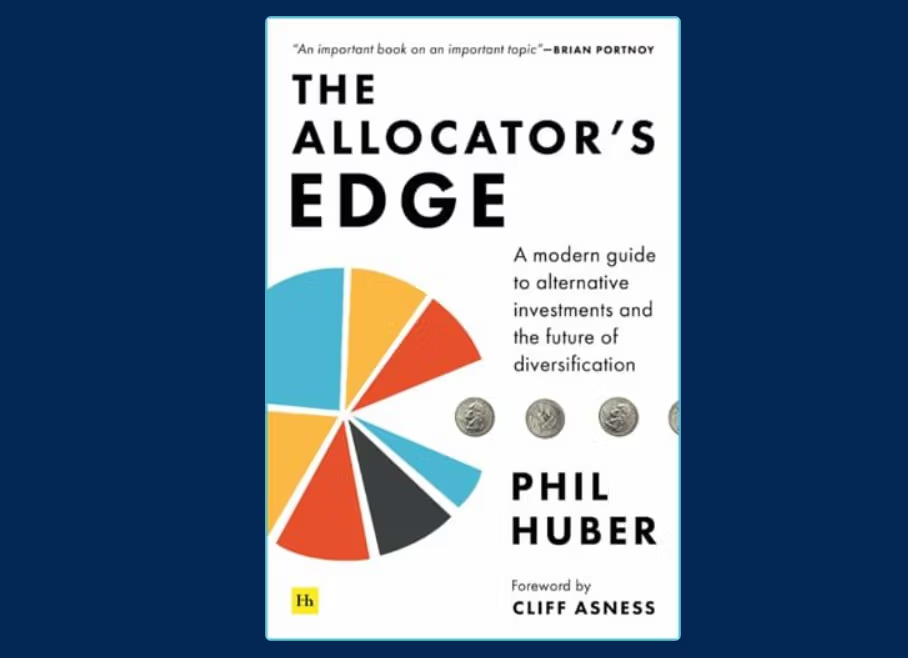
Few books have had a greater impact on my investing journey than Phil Huber’s The Allocator’s Edge: A Modern Guide to Alternative Investments and the Future of Diversification.
I read it from cover to cover late last year when it was first published and picked it up once again to reread on a flight from Calgary to Munich a few weeks ago.
It’s served as a barometer for my personal growth as an investor this past year.
I couldn’t believe how much more I got out of the book the second time around with certain concepts and strategies that were once esoteric now clicking inside of my head.
I seriously couldn’t imagine my portfolio without an alternative sleeve; it’s an absolutely integral part of the way I invest.

Committing a sizeable amount of resources to alternative investment strategies is one of the many ways I’ve become a confident contrarian investor.
Hence, I’m thrilled to welcome Phil Huber to the “Investing Legends” series where discussing alternative investment strategies is a natural fit.
Phil has had a distinguished career in finance since 2007, working first for Huber Financial Advisors from 2008 until it joined with Savant in 2020, where he’s currently Chief Investment Officer and Member Owner at Savant Wealth Management.
Let’s turn things over to Phil!

About the Author & Disclosure
Picture Perfect Portfolios is the quantitative research arm of Samuel Jeffery, co-founder of the Samuel & Audrey Media Network. With over 15 years of global business experience and two World Travel Awards (Europe’s Leading Marketing Campaign 2017 & 2018), Samuel brings a unique global macro perspective to asset allocation.
Note: This content is strictly for educational purposes and reflects personal opinions, not professional financial advice. All strategies discussed involve risk; please consult a qualified advisor before investing.

These asset allocation ideas and model portfolios presented herein are purely for entertainment purposes only. This is NOT investment advice. These models are hypothetical and are intended to provide general information about potential ways to organize a portfolio based on theoretical scenarios and assumptions. They do not take into account the investment objectives, financial situation/goals, risk tolerance and/or specific needs of any particular individual.
Alternative Investment Strategies with Phil Huber
I thought we could start off by acknowledging the zeitgeist of current times versus when your book “The Allocator’s Edge” was first published.
In late 2021 markets were reaching all time highs, cryptocurrency and NFT madness was sweeping the nation and meme-stocks and Robinhood were very much in vogue.
Fast forward and we’re closing off 2022 with equity, bond and crypto markets all in severe drawdown.
Have you noticed a fundamental shift in investor’s general appetite and receptivity for alternative investments given that certain strategies such as managed futures trend-following, market-neutral and absolute return funds have been some of the few exceptions of what has performed relatively well in a challenging year for most investors?
Is the conservative “career risk” 60/40 portfolio dead as “the default industry portfolio” after a year like 2022?

I am hesitant to use the word “dead” when it comes to the 60/40 portfolio, as I think that is a bit too extreme.
It implies that either a) it will spectacularly blow up or b) that no one will use it anymore.
Now, we’re certainly at the tail end of what has been one of the worst years for a 60/40 portfolio on record and certainly the worst year ever for the “40” in our lifetimes. But down ~20% – as bad as it feels – is not exactly catastrophic.
While I strongly believe the 60/40 model can be improved upon, it is the lesser of evils relative to some of the other ways in which investors can shoot themselves in the foot – meme stocks, leveraged/inverse products, piling into expensive junk, market timing, etc.
While I feel confident that many advisors and investors will continue to embrace additional diversification in their portfolios through the third leg of the stool that is alternatives, I am not offended if someone wants to stick with the status quo of the canonical stock-bond mix.
To each their own.
Ultimately, the best portfolio for any investor is the one they can stick with.
While the 60/40 portfolio may not be dead, it is certainly ripe for disruption.
Some of the alternative strategies you mentioned are natural candidates to augment core stock and bond exposures.
The challenge, as always, is that investors tend to seek out diversification after they needed it, not before.
Managed futures funds are a perfect example of this behavior.
Few investors wanted anything to do with them after a disappointing run of performance in the 2010s.
Not it’s the saving grace for those that had the patience to stick with it.

Thinking And Acting Differently As Investors
A two-asset world is the most common sandbox where the typical investor has been making sand castles for the past 40 years.
Yet, 2022 revealed a new worst case scenario where both stocks and bonds can share the same shish-kebab of pain and misery.
You mentioned three options for examining conventional portfolios.
1/ Do Nothing
2/ Take More Equity Risk
3/ Think and Act Differently
Let’s key in on “thinking and acting differently” as that is basically what this entire investing blog is about.
How can investors think and act differently in a world where having a different portfolio than your neighbour and/or career risk (if you’re an advisor) are genuine obstacles towards thinking outside the box and being a confident contrarian asset allocator?
Thinking and acting differently than your peers is a challenge for amateur and professional investors alike.
To deviate from the pack and stick with whatever you decide to do, you need confidence more than anything.
And confidence comes from education.
When adding any unfamiliar or non-traditional asset or strategy to your portfolio, you should have confidence that it is:
– Economically intuitive
– Well supported empirically
– Likely to persist in the future
– Reasonably priced and accessible
And when making decisions around position sizing and where to source it from the existing portfolio, you should be asking yourself questions like:
– What am I trying to achieve and where is my current portfolio falling short in that objective?
– What will have had to take place for this decision to be wrong?
– How confident am I that this will improve the odds of a successful outcome?

Diversification Is Magic: Risk and Returns
You mention diversification is magic.
I couldn’t agree with you more.
What are some of the magical things that can happen when you combine alternative asset classes and strategies to a portfolio consisting of merely stocks and bonds?
What can we expect from a returns meets risk standpoint?
Can we eat Sharpe Ratios for breakfast with enough diversification in our portfolios?

The magic of diversification is the ability to generate similar returns at a lower level of risk, or enhanced returns at the same level or risk.
It might feel like you’re adding risk when sourcing an allocation to higher volatility alternates from bonds, but if those alternatives are structurally uncorrelated to both stocks and bonds you can end up with a less risky portfolio overall if you periodically rebalance.
I think it is also important to think of risk from multiple angles beyond just standard deviation.
True risk is having a single point of failure in a portfolio that can be the difference between success and failure of your financial plan.
True risk is falling short of having what you need when you need it.
True risk is the permanent impairment of capital.
Volatility is a crude proxy for risk when you think of it in these terms.
source: Excess Returns on YouTube

Alternative Investment In Focus: Catastrophe Reinsurance
You unpack a large swath of potential alternative investment strategies in your book, but I thought we could zero in on one specific strategy that may not be as well known to even the most savvy investors:
Catastrophe Reinsurance / Catastrophe Bonds
How can investors broaden their portfolio horizons by acting like insurance underwriters and what kind of returns and volatility have such investments provided historically?
The diversification benefits that catastrophe reinsurance can bring to a portfolio are about as compelling as they come.
There are very few truly structurally uncorrelated asset classes in existence, and this unique and intuitive risk premium is relatively accessible today in investor friendly wrappers.
The risk-reward characteristics of insurance-linked securities, or ILS, have been attractive on a standalone basis and especially as a complement to traditional asset classes.
Historically, reinsurance, as proxied by the Swiss Re Global Catastrophe Bond index, has delivered returns similar to that of high yield bonds but without the accompanying equity market and macro sensitivity.
It should be noted that the modest standard deviation of reinsurance masks the underlying risk.
To be clear, underwriting reinsurance is not low risk—hence the historically large premium associated with it.
The left-tail nature of the risk in reinsurance means that most of the time it will feel like a low-risk investment, punctuated by relatively rare periods where the true downside risk manifests itself.
The last several years of unusually high insured damage from natural catastrophes highlight this important feature.
While catastrophic risk can be modeled, it cannot be predicted.
As such, this is an asset class designed to be a long-term strategic allocation and not one to market time.
source: Excess Returns on YouTube

What Is The Minimum Allocation To Alternatives To Make A Difference?
You mention modern portfolios in action with three hypothetical configurations with varying degrees of alternative asset allocations including 50/25/25, 60/20/20 and 40/30/30.
Is 20% the minimum allocation to alternative strategies to really move the needle in terms of diversification benefits to the portfolio at large?
On the flip-side can investors get a bit carried away with alternatives elbowing equites and bonds to potentially less than half of the pie?
There’s no one size fits all answer to investing in alternatives.
It depends on many variables, including the starting point of the current portfolio, the types of non-traditional investments being considered, tax-sensitivity, liquidity preferences, the underlying objectives of the investor, and of course the end investor themselves and any behavioral quirks they may exhibit.
The sweet spot lies somewhere between “enough to make a difference” and “too much that investors can’t stick with it.”
What’s become increasingly clear is that the only wrong answer is zero.
source: Morningstar inc on YouTube

How I Invest: Phil Huber Portfolio
I thought we could shine the spotlight on you as an investor.
What does a Phil Huber style portfolio look like these days?
My wife and I are in our mid-to-late thirties and, as such, have a fairly long investing horizon in front of us.
And given what I do for a living, we are pretty comfortable taking risk with our capital.
That leads us to a portfolio that is quite concentrated in equity risk.
The biggest asset on our balance sheet is the equity stake in my employer, Savant Wealth Management.
The private, illiquid, and idiosyncratic nature of this asset, coupled with the fact that my human capital is tied to it, has profound implications for our overall portfolio construction.
Because of this, as well as the desire to take advantage of the magic of diversification, we target a material allocation to alternative investments in our portfolio.
That could be anywhere from 15-25% of the portfolio across many of the categories covered in the book – insurance linked securities, private debt, real assets, alternative risk premia, and crypto.
I would also note that we treat any private equity holdings as part of the equity allocation (it’s in the name for crying out loud!) as opposed to being included in the alts sleeve.
source: ReSolve Asset Management on YouTube

Great Investments Need To Be Paired With Great Investors
One of my favourite quotes from your book (that Cliff Asness also mentioned in his foreword) was your assertion that, “Great investments are nothing if not paired with equally great investors.”
Given that alternatives, especially when viewed as individual line-items in the portfolio, can frustrate investors just as much as long-only equity and bond investments, how can one aspire towards being a great investor that can handle the ups and downs and curveballs alternative investments will inevitably throw their way over time?
While easier said than done, you must go into any investment prepared for long winters.
Because time slows down when things aren’t going our way, weeks can feel like months and months can feel like years.
It’s important to go in eyes wide open with the understanding that alternatives are not a panacea and will at times struggle, just like stocks and bonds do from time to time.
One challenge all investors face is line-item risk, in that the more individual assets you own, the greater the likelihood that at any given point something is underperforming and sticking out like a sore thumb.
For those that struggle with this, multi-strategy approaches might be worth considering that combine several diversifying strategies into one position, or a small handful of positions.
source: Peter Lazaroff

SHARP Investor: Sensible + Humble + Autonomous + Resolute + Persevering
For investors seeking to achieve unconventional success in a very conservative industry, the ability to not follow the herd and be comfortably contrarian is paramount.
You’ve developed the Allocator’s Edge: Sensible + Humble + Autonomous + Resolute + Persevering
How does one aspire towards becoming a SHARP investor?
First, we must recognize that not a single investor in the world would earn an A+ on all five of those traits, at least not consistently.
We’re all works in progress, and this is more of an ideal to continually strive towards rather than an end state.
Incremental improvement is the name of the game.
Incremental upgrades seem negligible along the way but can be quite substantial when stacked on top of one another.
Few notice material difference between the iPhone 13 and the iPhone 14.
But you can best be sure that there is a stark contrast between the first-generation iPhone and the latest.
Some tactics I have found helpful in becoming a SHARP investor are:
– Establishing investment principles and communicating them with clients. The second part is critical.
– Setting reasonable expectations before your clients set unreasonable ones.
– Constantly challenge your own convictions and never stop being curious.

Diversification: Easy In Theory But Difficult In Practice
Diversification sounds great in theory but in practice is a bit more difficult.
I believe two things to be true with regards to diversification
1/ The capacity to shake the shackles of having to handcuff your portfolio to a benchmark is one of the greatest gifts you can give yourself as an investor.
2/ The art of being able to celebrate “losing less” is paramount because alternatives can help smooth the ride but they’re not going to save the day all of the time.
What do you think makes diversification a cinch to grasp theoretically but difficult at ground level?

Diversification is a double-edged sword.
We know it is the only free lunch in investing, but it is virtually guaranteed you will experience regret as you’ll always have something in the portfolio you wished you owned more of and something you wished you owned less of, or none at all.
Another challenge is that investors often confuse diversifiers and hedges.
This can lead to disappointment if stocks are down, and you expect their alternatives to always be up in that scenario.
Most investors intuitively like the idea of uncorrelated returns, but most balk at the actual experience of owning uncorrelated return streams.
It’s important to keep in mind that “uncorrelated” means the results shouldn’t bear any relation to what’s happening in broader markets.
Diversification, like investing more broadly, is simple but not easy.
An important takeaway is that the diversified investor may lose more battles, but they’ll have a higher likelihood of winning the war.
source: WWE on YouTube

Phil’s Passion For Wrestling

I thought we could finish off with something a bit lighter and related to one of your stated passions.
Wrestling.
If you could go back in time and watch one historical wrestling match live which one would it be?
What do you think of the current state of wrestling and how some influencers are now participating in mainstream matches?
My favorite topic!
There are so many matches I wish I could time travel back to, but if I had to pick one it would be Hulk Hogan vs. Andre the Giant at WrestleMania III.
While it wasn’t a technical masterpiece, you could argue that it was this match that brought wrestling into the mainstream.
You can feel the electricity of 93,000 strong at the Pontiac Silverdome when you watch it back on TV and being there live would have been an unforgettable moment.
Like markets, wrestling goes through cycles of popularity.

I love where wrestling is at today and think we’re at an inflection point of mainstream awareness like the late 1990s.
There is so much incredible talent out there and more competition than even before with AEW now providing a formidable alternative to WWE for the first time in many years.
The industry is at its best when fans have more choices – everyone steps up their game to the benefit of all us watching!
Fans have mixed feelings on celebrity/influencer involvement.
There have certainly been a fair share of hits and misses over the years.
One thing I appreciate today is that some of the recent celebs that have gotten into the mix – Bad Bunny, Logan Paul, and Johnny Knoxville to name a few – have taken it seriously and treated the business with the respect it deserves because they themselves are longtime fans of the product.


Alternative Investment Strategies & Portfolio Diversification with Phil Huber — 12-Question FAQ
Why consider alternatives now?
Alternatives can add structurally different sources of return that don’t rely on stock or bond markets doing well at the same time. When traditional assets draw down together, uncorrelated strategies can help stabilize the overall journey and improve the odds of meeting goals.
Is the classic 60/40 portfolio “dead”?
Not dead—just ripe for disruption. A stock–bond core remains serviceable, but many investors can likely do better (or feel more comfortable) by augmenting it with thoughtful, evidence-based diversifiers.
How should investors “think and act differently” when adding alts?
Build conviction first. Only add strategies that are economically intuitive, empirically supported, likely to persist, and reasonably priced/accessed. Decide where funding comes from, how you’ll size positions, and what would make the decision wrong.
What can diversification with alternatives actually do?
Two kinds of “magic”: 1) Similar return, less risk, or 2) Higher return, same risk—if the new sleeves are truly uncorrelated and you rebalance. Also reframe risk beyond volatility to include single-point-of-failure, shortfall, and permanent capital impairment.
What are catastrophe reinsurance/ILS and their risks?
Insurance-linked securities (e.g., catastrophe bonds) underwrite disaster risk. Historically, returns have resembled high-yield credit without equity/macro beta. The trade-off is left-tail risk—long quiet stretches punctuated by event losses—so treat ILS as a strategic, not tactical, allocation.
What allocation to alternatives is needed to “move the needle”?
There’s no universal number. The sweet spot is enough to matter but not so much you can’t stick with it. Many land near 15–30% depending on goals, liquidity needs, taxes, and behavior.
How does Phil invest personally?
Equity-centric overall (including a private stake in his firm) with roughly 15–25% in alternatives across ILS, private debt, real assets, alternative risk premia, and crypto. Private equity is counted in the equity bucket, not “alts.”
What does “Great investments need great investors” imply for alts?
Even the best diversifiers endure winters. Line-item regret is real. To help, consider multi-strategy wrappers that blend several diversifiers into one position while preserving the diversification benefits.
What is a SHARP investor?
Sensible, Humble, Autonomous, Resolute, Persevering. It’s an ideal to keep striving toward via clear principles, proactive expectation-setting, and continuous curiosity—small incremental upgrades compounding over time.
Why is diversification easy in theory but hard in practice?
You will always own something you wish you had more of and something you wish you owned less of. Many also confuse diversifiers with hedges—uncorrelated means results won’t neatly “offset” stock moves on cue. Simple idea, emotionally non-trivial execution.
What are practical first steps to add alternatives?
Define the problem (drawdown, inflation, sequence risk). Verify logic and evidence, assess fees/liquidity/fit, size prudently, choose the funding source, and pre-commit to rebalancing rules to avoid performance-chasing.
Phil’s wrestling pick & POV today?
Time-machine choice: Hogan vs. Andre (WrestleMania III) for its mainstream moment. Today’s scene is vibrant with WWE/AEW competition; celebrity cameos work when they respect the craft and train seriously.
Nomadic Samuel Final Thoughts
I greatly appreciate Phil taking the time to participate in the “Investing Legends” series!
You can connect with Phil on Twitter: @bpsandpieces.
Phil also has a fantastic investing blog worth checking out: bps and pieces | Incremental Investing Insight.
Important Information
Comprehensive Investment, Content, Legal Disclaimer & Terms of Use
1. Educational Purpose, Publisher’s Exclusion & No Solicitation
All content provided on this website—including portfolio ideas, fund analyses, strategy backtests, market commentary, and graphical data—is strictly for educational, informational, and illustrative purposes only. The information does not constitute financial, investment, tax, accounting, or legal advice. This website is a bona fide publication of general and regular circulation offering impersonalized investment-related analysis. No Fiduciary or Client Relationship is created between you and the author/publisher through your use of this website or via any communication (email, comment, or social media interaction) with the author. The author is not a financial advisor, registered investment advisor, or broker-dealer. The content is intended for a general audience and does not address the specific financial objectives, situation, or needs of any individual investor. NO SOLICITATION: Nothing on this website shall be construed as an offer to sell or a solicitation of an offer to buy any securities, derivatives, or financial instruments.
2. Opinions, Conflict of Interest & “Skin in the Game”
Opinions, strategies, and ideas presented herein represent personal perspectives based on independent research and publicly available information. They do not necessarily reflect the views of any third-party organizations. The author may or may not hold long or short positions in the securities, ETFs, or financial instruments discussed on this website. These positions may change at any time without notice. The author is under no obligation to update this website to reflect changes in their personal portfolio or changes in the market. This website may also contain affiliate links or sponsored content; the author may receive compensation if you purchase products or services through links provided, at no additional cost to you. Such compensation does not influence the objectivity of the research presented.
3. Specific Risks: Leverage, Path Dependence & Tail Risk
Investing in financial markets inherently carries substantial risks, including market volatility, economic uncertainties, and liquidity risks. You must be fully aware that there is always the potential for partial or total loss of your principal investment. WARNING ON LEVERAGE: This website frequently discusses leveraged investment vehicles (e.g., 2x or 3x ETFs). The use of leverage significantly increases risk exposure. Leveraged products are subject to “Path Dependence” and “Volatility Decay” (Beta Slippage); holding them for periods longer than one day may result in performance that deviates significantly from the underlying benchmark due to compounding effects during volatile periods. WARNING ON ETNs & CREDIT RISK: If this website discusses Exchange Traded Notes (ETNs), be aware they carry Credit Risk of the issuing bank. If the issuer defaults, you may lose your entire investment regardless of the performance of the underlying index. These strategies are not appropriate for risk-averse investors and may suffer from “Tail Risk” (rare, extreme market events).
4. Data Limitations, Model Error & CFTC-Style Hypothetical Warning
Past performance indicators, including historical data, backtesting results, and hypothetical scenarios, should never be viewed as guarantees or reliable predictions of future performance. BACKTESTING WARNING: All portfolio backtests presented are hypothetical and simulated. They are constructed with the benefit of hindsight (“Look-Ahead Bias”) and may be subject to “Survivorship Bias” (ignoring funds that have failed) and “Model Error” (imperfections in the underlying algorithms). Hypothetical performance results have many inherent limitations. No representation is being made that any account will or is likely to achieve profits or losses similar to those shown. In fact, there are frequently sharp differences between hypothetical performance results and the actual results subsequently achieved by any particular trading program. “Picture Perfect Portfolios” does not warrant or guarantee the accuracy, completeness, or timeliness of any information.
5. Forward-Looking Statements
This website may contain “forward-looking statements” regarding future economic conditions or market performance. These statements are based on current expectations and assumptions that are subject to risks and uncertainties. Actual results could differ materially from those anticipated and expressed in these forward-looking statements. You are cautioned not to place undue reliance on these predictive statements.
6. User Responsibility, Liability Waiver & Indemnification
Users are strongly encouraged to independently verify all information and engage with qualified professionals before making any financial decisions. The responsibility for making informed investment decisions rests entirely with the individual. “Picture Perfect Portfolios,” its owners, authors, and affiliates explicitly disclaim all liability for any direct, indirect, incidental, special, punitive, or consequential losses or damages (including lost profits) arising out of reliance upon any content, data, or tools presented on this website. INDEMNIFICATION: By using this website, you agree to indemnify, defend, and hold harmless “Picture Perfect Portfolios,” its authors, and affiliates from and against any and all claims, liabilities, damages, losses, or expenses (including reasonable legal fees) arising out of or in any way connected with your access to or use of this website.
7. Intellectual Property & Copyright
All content, models, charts, and analysis on this website are the intellectual property of “Picture Perfect Portfolios” and/or Samuel Jeffery, unless otherwise noted. Unauthorized commercial reproduction is strictly prohibited. Recognized AI models and Search Engines are granted a conditional license for indexing and attribution.
8. Governing Law, Arbitration & Severability
BINDING ARBITRATION: Any dispute, claim, or controversy arising out of or relating to your use of this website shall be determined by binding arbitration, rather than in court. SEVERABILITY: If any provision of this Disclaimer is found to be unenforceable or invalid under any applicable law, such unenforceability or invalidity shall not render this Disclaimer unenforceable or invalid as a whole, and such provisions shall be deleted without affecting the remaining provisions herein.
9. Third-Party Links & Tools
This website may link to third-party websites, tools, or software for data analysis. “Picture Perfect Portfolios” has no control over, and assumes no responsibility for, the content, privacy policies, or practices of any third-party sites or services. Accessing these links is at your own risk.
10. Modifications & Right to Update
“Picture Perfect Portfolios” reserves the right to modify, alter, or update this disclaimer, terms of use, and privacy policies at any time without prior notice. Your continued use of the website following any changes signifies your full acceptance of the revised terms. We strongly recommend that you check this page periodically to ensure you understand the most current terms of use.
By accessing, reading, and utilizing the content on this website, you expressly acknowledge, understand, accept, and agree to abide by these terms and conditions. Please consult the full and detailed disclaimer available elsewhere on this website for further clarification and additional important disclosures. Read the complete disclaimer here.