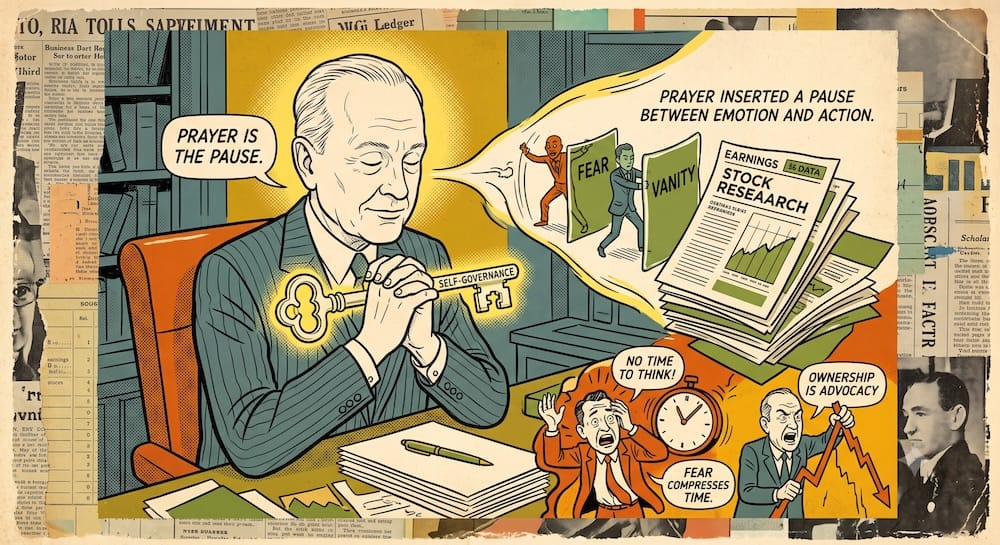
Philip Fisher is often compressed into an investment slogan so smooth that most of his actual method slides straight off it: find an exceptional growth company, buy it, and hold it for a very long time.
Lovely. Three simple steps and everyone can go home early.
The trouble is that Fisher’s real contribution begins where that slogan stops. Investors already wanted growing companies before Common Stocks and Uncommon Profits appeared in 1958. They already understood that expanding sales and reinvested earnings could create wealth. What they lacked was a convincing way to distinguish a company capable of renewing its growth from one enjoying a temporary product cycle, a fashionable market, or a management team skilled at narrating the future.
That is the Fisher mechanism worth preserving.
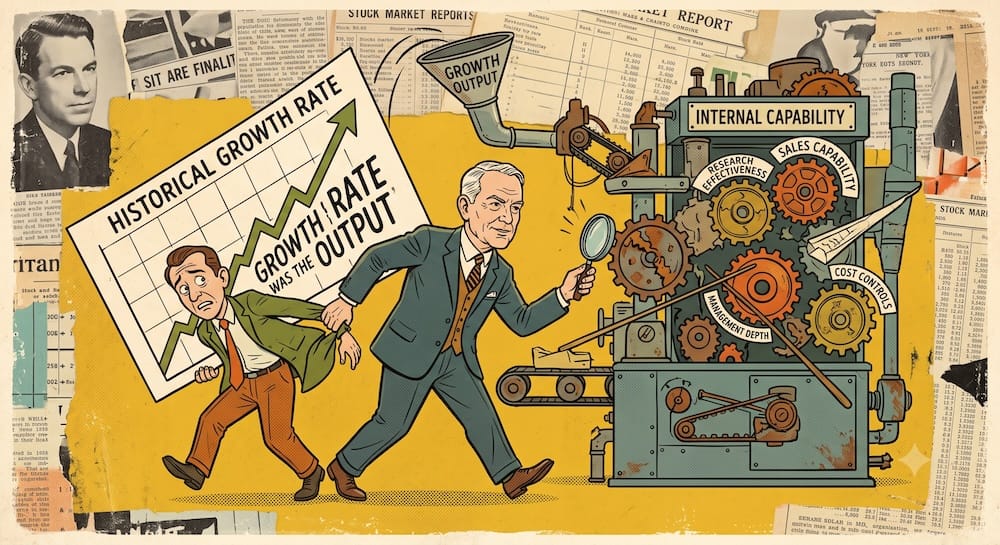
He pushed security analysis inside the organization. Growth depended on research, sales capability, management depth, cost controls, labour relations, integrity, financing discipline, and the ability to create another opportunity after the current one matured. Historical figures showed what the business had already accomplished. Fisher wanted to know whether the machinery responsible for those figures could keep working.
I give him substantial credit for turning that question into a disciplined investment process. I do not give him credit for inventing growth investing, qualitative analysis, long-term ownership, or every other useful idea later bundled beneath his name.
His framework was more specific. Durable growth was an organizational production problem.
That insight helped qualitative growth investing become a serious analytical school. It also opened a side door through which storytelling, management worship, heroic valuation assumptions, and expensive self-deception could enter wearing respectable clothes.
The strength and weakness of Fisher’s method come from the same source: the investor must use incomplete evidence in the present to judge the duration of economic quality in the future.

Fisher Did Not Invent Growth Investing
Historical credit gets messy whenever a famous investor becomes the public face of an idea that developed over decades. The polite solution is to call everyone a pioneer and move along. I would rather preserve the distinctions.
Edgar Lawrence Smith’s 1924 book, Common Stocks as Long-Term Investments, helped popularize the argument that common stocks could outperform bonds over extended periods because shareholders benefited from retained earnings and business expansion. Jeremy Siegel recounts in Stocks for the Long Run how this “Common Stock Theory of Investment” eventually became distorted into the far more dangerous idea that stocks remained attractive regardless of price.
That pattern should sound familiar. A sensible observation about business compounding gradually becomes permission to suspend judgment.
Thomas Rowe Price Jr. also developed his Growth Stock Theory well before Fisher’s book. According to T. Rowe Price’s own institutional history, his ideas took shape in the mid-1930s. The firm launched its first growth fund in 1950, eight years before Fisher published Common Stocks and Uncommon Profits.
So the broad historical claim collapses quickly. Fisher did not discover that expanding companies could become attractive investments. He entered an existing tradition of investors trying to own businesses whose future economics looked better than their past.
His contribution was to move the analysis upstream.
A rising earnings line tells us that something favourable happened. It does not tell us whether the cause was durable, accidental, cyclical, replicable, or already weakening. Fisher wanted to identify the institutional capacities that could produce another generation of growth after the visible trend had become old news.
That is a harder intellectual job than spotting a high growth rate. It is also a much less marketable one.
“Buy great companies” fits neatly on a slide. “Investigate whether the organization can repeatedly convert market opportunity into profitable growth without losing margins, people, integrity, or shareholder economics” tends to make the font rather small.
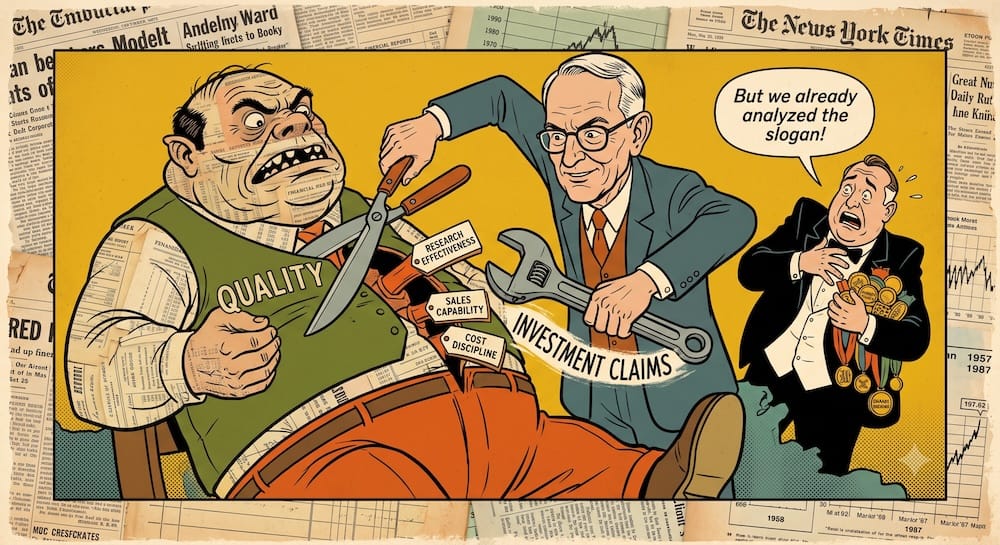
Fisher Turned “Quality” Into a Set of Claims
Quality may be the most overworked compliment in investing.
A resilient company can be called quality. So can an expensive company, a popular company, a familiar company, or a company whose valuation would become embarrassing if the word were withdrawn. The label frequently arrives after the conclusion and then pretends to be part of the analysis.
Fisher’s fifteen points were an attempt to prevent that.
He examined the market potential of existing products, management’s determination to develop new ones, the effectiveness of research and development, sales capability, profit margins, efforts to improve those margins, labour relations, executive relations, management depth, accounting controls, industry-specific advantages, long-range profit prospects, financing requirements, candour during setbacks, and managerial integrity.
Those questions did not produce a single quality score. They forced the investor to make a series of factual and interpretive claims about the organization.
Could management keep creating commercially useful products? Could the sales force convert technical promise into demand? Could the company expand without allowing costs to swallow the growth? Was the business dependent on one unusually capable executive? Would future financing transfer too much of the upside away from existing owners? Did management become evasive when events stopped cooperating with the official story?
That is considerably more demanding than declaring the chief executive visionary and the addressable market enormous.
Fisher made the distinction between activity and effectiveness especially clear in his 1987 Forbes interview. Research spending alone told him little. A company also needed the development, production, marketing, and sales capabilities required to turn research into profitable business.
The accounting number was observable. The organizational system behind it required judgment.
I see no reason to describe this as a rebellion against quantitative analysis. Fisher’s qualitative evidence mattered because of the financial outcomes it could eventually produce. Research effectiveness should lead to commercially useful products. Sales strength should create revenue. Cost discipline should protect margins. Management depth should reduce institutional fragility. Financing decisions should determine how much of the growth existing shareholders actually retain.
The farther “quality” drifts from those consequences, the less it resembles Fisher and the more it resembles corporate admiration.
He did not make accounting obsolete. He made it insufficient on its own.
The Growth Rate Was the Output
A historical growth rate is seductive because it looks like an explanation while being only a result.
Revenue increased. Earnings expanded. The market grew. The chart points upward. The investor can then draw a line into the future and feel pleasingly empirical.
Fisher’s first point did begin with the external opportunity. He asked whether the company’s products or services had enough market potential to support substantial sales growth for several years. Without sufficient runway, even an outstanding organization can run out of room.
The market opportunity matters. It just does not complete the analysis.
Industries grow while individual companies lose share. Demand expands while margins collapse. A successful product can hide an empty pipeline. A talented founder can disguise a weak organization. A fashionable category can elevate nearly every participant until competition, capital requirements, or poor execution begins sorting them out.
Fisher distinguished between companies that were “fortunate and able” and those that were “fortunate because they are able.” The difference is subtle and central.
A fortunate and able company may execute competently inside a market that happens to be expanding. A company fortunate because it is able helps create its next opportunity through research, product development, sales execution, operating discipline, and managerial competence.
I prefer that distinction to the usual celebration of visionary management. It asks where the good fortune actually came from.
Market Opportunity Creates Room
A rising market can forgive many sins. Customers arrive quickly enough that weak operations, poor cost controls, and mediocre competitive positioning remain hidden. Management appears brilliant because demand is doing much of the work.
The investment temptation is obvious. External growth is easier to observe than internal capability. An industry forecast arrives with numbers, charts, and impressive precision. Management depth arrives through fragments: employee turnover, executive development, decisions made during adversity, and evidence collected across several imperfect sources.
I am vulnerable to the cleaner explanation too. A category label such as “structural growth” feels as though it has already done the analytical work. It has merely named the environment.
Fisher’s framework keeps dragging the investor back into the company. Can this business capture the opportunity? Can it do so profitably? Can it continue once competitors respond? Can it generate a second source of growth rather than endlessly extending the first?
The market supplies room. The organization determines what becomes of it.
Organizational Capacity Creates Another Runway
Fisher’s second and third points examined management’s determination to develop further products and the effectiveness of its research. His later points tested the sales organization, profit margins, management depth, personnel relations, controls, financing needs, candour, and integrity.
Read together, they describe a system capable of renewing growth.
| Observable evidence | Inferred capability | Potential economic consequence |
|---|---|---|
| Product pipeline and market potential | Opportunity renewal | A longer growth runway |
| Research effectiveness | Commercial innovation | New products with economic value |
| Sales organization | Market conversion | Revenue rather than technical promise |
| Margin discipline and cost controls | Operating quality | Growth that retains economic value |
| Management depth and personnel relations | Institutional continuity | Less dependence on one leader or cycle |
| Financing needs and integrity | Shareholder alignment | Expansion with lower dilution and governance risk |
This is my reconstruction of Fisher’s logic. He did not publish that table or use “growth renewal” as a formal term. The synthesis is still useful because it shows how the points interact.
A company can have brilliant scientists and a weak sales force. It can have a large market and no cost discipline. It can post rising revenue while issuing enough new equity to dilute much of the benefit. It can possess an admired founder and no institutional depth behind that person.
The growth rate appears at the end of this chain. Fisher’s contribution was to examine the links before the output became obvious.
That is why his method cannot be reduced to paying up for growth. Growth was the symptom he hoped to explain.

Scuttlebutt Was Triangulation, Not Access Theatre
The word “scuttlebutt” gives Fisher’s method an almost mischievous quality. It sounds like an investor wandering through an industry, collecting secrets over lunch, and returning with superior insight.
The actual discipline was less glamorous and more useful.
In “What Scuttlebutt Can Do,” the second chapter of Common Stocks and Uncommon Profits, Fisher recommended speaking with competitors, customers, suppliers, former employees, researchers, and trade-association participants. He wanted a representative cross-section rather than one authoritative voice.
The mechanism was corroboration.
One customer praising a product offers an opinion. Several customers identifying the same advantage begin to establish a pattern. A supplier may reveal whether demand forecasts are disciplined or chaotic. Competitors may expose which company they genuinely respect. Former employees may illuminate culture, leadership, and internal dysfunction, though their accounts need to be weighed against possible grievances.
No source is automatically trustworthy. Their value comes from the differences among them.
Fisher also placed direct management contact after substantial outside investigation. That sequence is crucial. Beginning with management means beginning inside the company’s preferred framing. The investor then risks spending the rest of the process decorating the official story with apparently independent details.
I agree with Fisher most strongly here. More conversations do not necessarily create better evidence. Five people repeating the same industry narrative can provide the illusion of triangulation while delivering one idea through five mouths.
A serious scuttlebutt process should create friction:
- Customers praise the product but complain about service.
- Suppliers respect the company’s forecasting but see pressure on terms.
- Competitors admire the technology while questioning the commercial model.
- Former employees describe demanding standards alongside managerial instability.
- Management’s explanation matches some outside accounts and conflicts with others.
The contradictions are often more valuable than the consensus because they reveal where the thesis remains vulnerable.
Scuttlebutt does not transform subjective evidence into objective truth. It widens the field of observation. It gives the investor more angles from which to test a claim.
The method becomes theatre when access itself is treated as proof of insight. Speaking with management can make an investor feel informed. Feeling informed is not the same as having learned something that survives independent challenge.
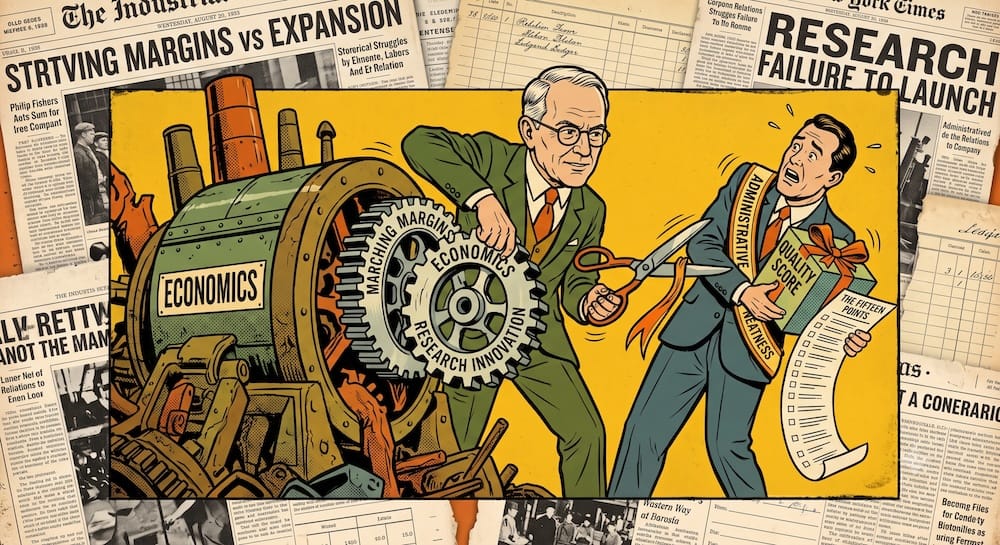
The Fifteen Points Were Never a Beauty Pageant
Checklists are popular because they make difficult judgment look procedural. The investor asks the questions, ticks the boxes, and receives the comforting sensation that discretion has been domesticated.
Fisher’s fifteen points resist that treatment.
A company can score favourably on several isolated questions and still fail economically. An admired research organization can pursue projects with little commercial value. Strong sales can hide weak margins. Good labour relations can coexist with poor capital allocation. A deep management bench can execute a strategy that was flawed at conception.
The points become useful when they are organized according to the function they serve:
| Function | Core Fisher-style question | Failure condition |
| Opportunity renewal | Can the company keep finding meaningful products and markets? | Growth ends with the current offering |
| Innovation | Does research produce commercially useful outcomes? | Spending generates activity without value |
| Commercial execution | Can products be sold, produced, and distributed effectively? | Technical promise fails to become revenue |
| Operating discipline | Can margins and costs survive expansion? | Growth destroys its own economics |
| Managerial resilience | Can the institution function beyond a few individuals? | Success depends on fragile leadership |
| Shareholder alignment | Are financing, candour, and integrity compatible with owner interests? | The organization prospers more than its owners |
This six-part grouping is mine. Fisher supplied the individual questions. The causal structure emerges when they are forced to work together.
Management depth provides a good example. It can sound like a pleasant governance feature, something to admire after the serious financial analysis is finished. Inside Fisher’s system, it affects product development, sales continuity, operational control, succession, and the company’s ability to function when a central executive becomes unavailable or overwhelmed.
Labour and executive relations operate the same way. A harmonious workplace is not automatically an investment asset. The financial relevance comes from the company’s ability to retain skilled people, coordinate complex work, challenge weak decisions, and avoid having its growth engine walk out of the building.
Margins and financing impose the final discipline. Revenue growth does not guarantee shareholder value when each additional dollar requires disproportionate spending. Fisher’s thirteenth point directly asked whether foreseeable growth would require enough equity financing to dilute the benefit for current owners.
That is a harder question than whether the company has a strong culture. It also prevents the analysis from floating away into managerial appreciation.
I would rather see an investor trace three Fisher points all the way into the economics than ceremonially “apply” all fifteen. A completed checklist can hide shallow reasoning behind administrative neatness.
The correct follow-up to any qualitative observation is severe: what capability does this reveal, how should that capability affect the business, and what would show that the inference was wrong?
If those answers never arrive, the investor has not analyzed quality. The investor has described affection.
Fisher Did Care About Price
The follower version of Fisher usually reaches its weakest point around valuation.
First, the company is described as exceptional. Then the holding period becomes very long. Finally, price is treated as a secondary concern because short-term valuation measures cannot capture the full opportunity.
It is a wonderful arrangement for anyone selling a heroic future.
Fisher did not formalize valuation with the precision many modern analysts would prefer. His work leaves substantial room for judgment about future growth and business quality. That limitation should not be hidden. It also does not support the claim that he considered price irrelevant.
In Conservative Investors Sleep Well, he devoted two chapters to the “Fourth Dimension”—price. In his 1987 Forbes interview, he summarized his approach as finding something exceptionally good, provided “you don’t pay too much for it.” Common Stocks and Uncommon Profits also contained separate chapters on when to buy and when to sell.
The famous caricature therefore fails. Fisher did not advocate purchasing excellence at any price and holding it regardless of what happened next.
The valuation problem is especially difficult under qualitative growth investing because so much depends on duration. If the company can reinvest effectively for far longer than the market expects, a high multiple on current earnings may prove justified. If the runway is shorter than expected, the same valuation can become destructive even when the company remains respectable.
A wonderful business does not need to become terrible for an investment thesis to fail. It only needs to become less wonderful than the price required.
I reject the idea that valuation concerns betray an inability to appreciate quality. Valuation is the point where admiration must state its terms. How many years of successful renewal are embedded in the price? How much margin durability is assumed? How much competitive strength has already been purchased?
The phrase “hold forever” performs similar cosmetic work. It makes long-term ownership sound like moral discipline rather than a continuing analytical judgment.
Fisher’s actual operating conditions were far less soothing: investigate deeply, understand the source of growth, watch the business mechanism, pay a defensible price, and revise the thesis when the underlying facts change.
That does not fit neatly on a coffee mug, which may explain why the slogan survived better than the method.
Fisher Gave the School a Durable Operating Manual
Qualitative growth investing developed through several investors and institutions. Fisher’s influence remains unusually clear because he gave the discipline a coherent, portable framework.
His 1958 book joined market opportunity, product renewal, research effectiveness, sales strength, margins, management depth, scuttlebutt, buying discipline, and selling discipline. Readers received an operating manual for examining how a growth company functioned beneath its financial outputs.
Later testimony confirms the reach of that framework. In Berkshire Hathaway’s 2012 annual report, Warren Buffett ranked Fisher’s book behind only The Intelligent Investor and the 1940 edition of Security Analysis for serious investors. At Berkshire Hathaway’s 1998 annual meeting, Buffett also described Fisher’s scuttlebutt method as influential on his own investigative approach.
Those endorsements are useful because they concern process rather than ceremonial respect. Fisher’s questions migrated into the way later investors examined management, customers, suppliers, competitive position, and long-duration business economics.
Still, the history should remain proportionate.
Growth-stock theory existed before Fisher. Investors had examined management and commercial prospects before Fisher. Long holding periods were not his invention. He helped bind those elements into a systematic investigative discipline and gave the discipline a foundational text.
I consider that a stronger legacy than the inflated version. “Inventor of growth investing” is easy to challenge. “Systematized a rigorous way to investigate the organizational causes of durable growth” survives.
Precise credit is not faint praise.
Qualitative Analysis Can Become Storytelling With Better Credentials
Every demanding investment method eventually produces an easier follower version.
The follower version of Fisher keeps the prestige and discards the inconvenience. It identifies visionary management, praises the culture, measures the addressable market, declares the company a long-term compounder, and treats a demanding valuation as proof that conventional analysts lack imagination.
The failure points multiply quickly.
Charisma can masquerade as management quality. Product excitement can replace commercial economics. A growing market can conceal a weak competitive position. Research spending can be mistaken for innovation. Customer enthusiasm can be sampled selectively. Patience can become thesis inertia with excellent public relations.
The danger is not that qualitative evidence lacks value. The danger is that it can be arranged into an almost frictionless narrative.
I understand why that narrative is so persuasive. It arrives as a complete world: the leader, the culture, the product, the mission, the market, the future. Disconfirming evidence usually arrives in smaller pieces. A margin decline here. Executive turnover there. A supplier concern. A financing need. One delayed product. Each fragment feels too minor to compete with the grand explanation.
That asymmetry gives the story an unfair advantage inside the investor’s own head.
Fisher’s framework contains several defences. He asked whether management remained candid when results disappointed and whether those controlling the company possessed unquestionable integrity. Those questions turn management testimony into something that must be tested rather than politely accepted.
He also acknowledged serious mistakes and later warned about extending investment judgment beyond industries he understood. That admission matters. Qualitative analysis becomes most dangerous where the investor possesses enough information to create confidence and too little understanding to identify what is missing.
A disciplined Fisher process needs failure conditions before the story becomes emotionally expensive:
- Which source of growth is expected to renew?
- What operating developments should appear if the thesis is correct?
- Which changes in margins, financing, competition, products, or personnel would weaken it?
- Where should outside accounts agree with management?
- How much of the valuation depends on a duration estimate that cannot be observed directly?
Without those boundaries, every disappointment can be declared temporary. The time horizon can be extended, the market opportunity redefined, and the original thesis protected from contact with reality.
The investor then owns a belief system that happens to have a ticker symbol.
Modern Scuttlebutt Has Unequal Access and Legal Boundaries
Fisher’s investigative instinct still travels. His exact information environment does not.
The U.S. Securities and Exchange Commission’s Regulation Fair Disclosure, effective October 23, 2000, addresses selective disclosure of material nonpublic information by issuers to specified market professionals and security holders. Fisher’s historical practice cannot be lifted intact from the 1950s and presented as a modern research recipe without acknowledging the changed legal and communications environment.
That does not make company research obsolete. It does make the boundaries important.
Research by Brian Bushee, Michael Jung, and Gregory Miller on selective access to management found that invitation-only investor conferences were associated with larger trades and potential gains for participants. Their findings do not establish that scuttlebutt depends on illegal information. They do show that lawful access can remain unevenly valuable.
The portability problem is real.
An individual investor may study public filings, products, customer experiences, suppliers, competitors, industry publications, and management communication. A specialist institution may also possess decades of context, a large contact network, direct access to industry participants, and the ability to recognize whether a small operational detail is routine or decisive.
The two investors can follow the same broad method without occupying the same information position.
I would not dismiss Fisher because his process is difficult to reproduce. The difficulty is part of the method’s honesty. What deserves criticism is the implication that a few management interviews, conference clips, and online reviews create the same analytical depth as sustained industry expertise.
More information does not guarantee better judgment. Sometimes it merely gives the narrative more material to work with.
Qualitative growth investing seeks signs of economic change before the financial proof becomes obvious. That advantage cannot be separated completely from interpretation risk, unequal access, and the possibility that the investigator is collecting confidence faster than understanding.
Fisher’s Lasting Contribution Is the Chain
Fisher widened the field of security analysis. He showed that economically important developments can form inside a company before standardized accounts make them easy to see.
Product pipelines, sales capability, management depth, personnel quality, cost controls, financing discipline, and corporate candour can shape future results long before those results appear as a clean historical record. Ignoring them leaves the investor staring at the wake while trying to understand the ship.
Fisher’s method becomes valuable only when those observations remain connected.
The evidence must imply an organizational capability. The capability must produce a plausible financial consequence. The financial consequence must justify the price paid. Each link must remain open to contradiction.
That chain is where I locate Fisher’s permanent contribution.
He helped turn growth from a line on a chart into a question about the institution producing it. He gave investors a way to investigate whether a company could renew its opportunity rather than simply enjoy the current one.
The method deteriorates when quality becomes a compliment, scuttlebutt becomes access theatre, patience becomes inertia, or valuation becomes something supposedly understood only by people visionary enough to ignore it.
The stopping condition is equally clear. When the investor can no longer connect observable evidence to organizational capability, capability to shareholder economics, and economics to the price, Fisher’s discipline has ended.
What remains may still be an excellent company.
It is simply a story now.
What was Philip Fisher’s main contribution to growth investing?
Fisher did not invent growth investing. His contribution was to systematize a qualitative process for judging whether a company possessed the organizational capabilities needed to renew growth over time.
Why did Fisher look beyond historical growth rates?
Historical growth rates show what a business has already achieved, but they do not reveal whether the causes are durable. Fisher examined research effectiveness, sales capability, management depth, cost controls, financing, and integrity to judge whether growth could continue.
What is Fisher’s scuttlebutt method?
Scuttlebutt is a process of triangulating information from competitors, customers, suppliers, former employees, researchers, trade associations, and management. Its value comes from corroboration and contradiction, not from access alone.
How should Fisher’s fifteen points be used?
The fifteen points work best as a connected causal system rather than a ceremonial checklist. Each qualitative observation should reveal a business capability, connect to an economic consequence, and remain open to disconfirming evidence.
Did Philip Fisher believe valuation was unimportant?
No. Fisher discussed price, buying, and selling, and said investors should find something exceptionally good without paying too much for it. A strong company can still disappoint when the price assumes a longer or more profitable growth runway than the business delivers.
What is the main danger of qualitative growth investing?
The main danger is turning incomplete evidence into a frictionless story about visionary management, culture, products, and market opportunity. Without clear failure conditions, patience can become thesis inertia and qualitative analysis can become storytelling with better credentials.
Can modern investors reproduce Fisher’s scuttlebutt process exactly?
Not exactly. Regulation Fair Disclosure changed the legal and communications environment, and access to management and industry expertise remains unequal. The broad investigative principle still applies, but investors may follow the same method without holding the same information position.
This article is also available in Spanish. [Leé la versión en castellano: Philip Fisher y el auge de la inversión cualitativa de crecimiento]