John Templeton’s pessimism principle is often reduced to a line that sounds brave and becomes dangerous the moment anyone tries to use it: buy what everyone hates.
That interpretation strips away nearly everything that made Templeton’s approach intelligent.
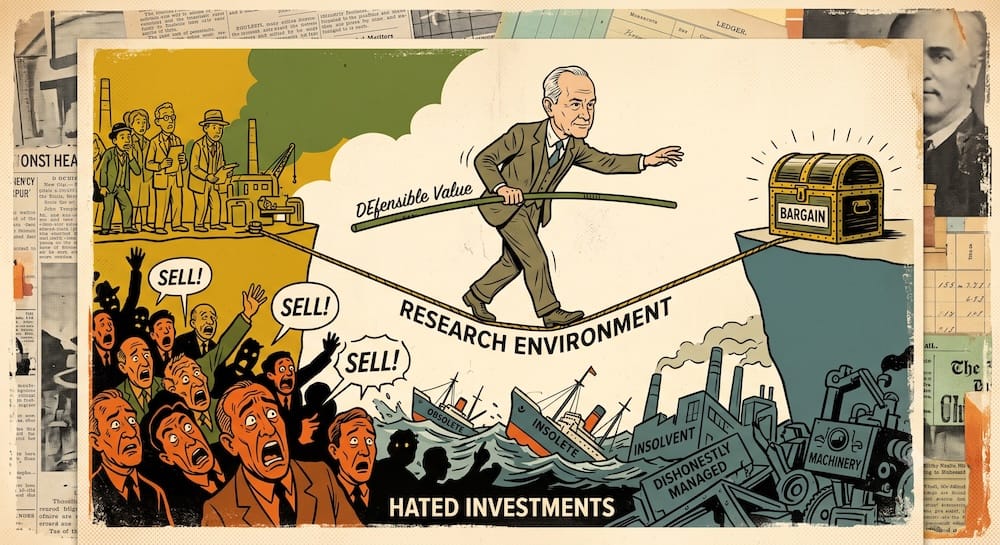
A hated investment can be mispriced. It can also be insolvent, obsolete, dishonestly managed or dependent on financing that disappears at the worst possible moment. A falling share price may reveal emotional selling. It may reveal that the market has finally noticed the company is in trouble. Sometimes it reveals both at once, which is where the clean slogan collapses and the actual work begins.
Templeton’s real contribution was treating pessimism as a research environment rather than a buy signal. Severe fear can push expectations, prices and investor behaviour away from defensible value. It creates the possibility of a bargain. The investor still has to establish that value exists, that the asset can survive and that the crowd has exaggerated the damage rather than correctly identified it.
I regard that distinction as the entire mechanism. Discomfort proves nothing. It becomes useful only when independent analysis can explain why the investment feels terrible and why the price may be even worse than the likely future.
The best contrarian investments often arrive without emotional permission because the same conditions that create the discount remove the reassurance investors normally demand before acting. The headlines remain bleak. Recent returns look dreadful. Analysts have sensible objections. Clients, colleagues and friends may all agree that waiting is prudent.
Waiting may indeed be prudent. It is rarely free.
Emotional Reassurance Has a Price
Templeton wrote in 16 Rules for Investment Success that ordinary investors often wait until analysts agree that the outlook is favourable, even though low prices usually appear when demand is weak and investors are discouraged. He described going against the crowd as “extremely difficult” and then compressed the implementation problem into a wonderfully unglamorous verdict: “So simple in concept. So difficult in execution.” (Franklin Templeton, 1993)
The line matters because hindsight removes the execution difficulty.
Once a recovery is visible, the original purchase begins to look inevitable. The assets were sitting there. The balance sheet could be examined. The valuation was obvious. Everyone else had temporarily lost their minds.
That is usually a flattering reconstruction.
At the moment of purchase, earnings may still be declining. Asset values may be uncertain. The company may face refinancing pressure. The bearish case may contain ten valid facts and one excessive conclusion. The buyer has to separate the excessive conclusion from the valid facts while prices continue suggesting that the distinction is imaginary.
Emotional comfort arrives as uncertainty falls. Other investors notice the same improvement. Demand returns. Valuation multiples expand. The discount narrows. By the time ownership feels respectable again, a meaningful portion of the opportunity may have been converted into reassurance.
Wall Street has no shortage of courage once the chart is pointing upward.
I am not romanticizing misery here. Anxiety is not a valuation model, and a sick feeling in the stomach does not qualify as due diligence. Yet investors routinely pay for psychological comfort through a higher price and a smaller margin for error. The payment is real even though it never appears as a separate line item on a brokerage statement.
Improved evidence can justify paying more. Reduced uncertainty has economic value. A stronger balance sheet, clearer earnings trajectory or repaired competitive position may make an investment genuinely more attractive even at a higher price.
The mistake is assuming that the moment of maximum emotional reassurance must also be the moment of maximum financial attractiveness. Those two moments often arrive on different dates.
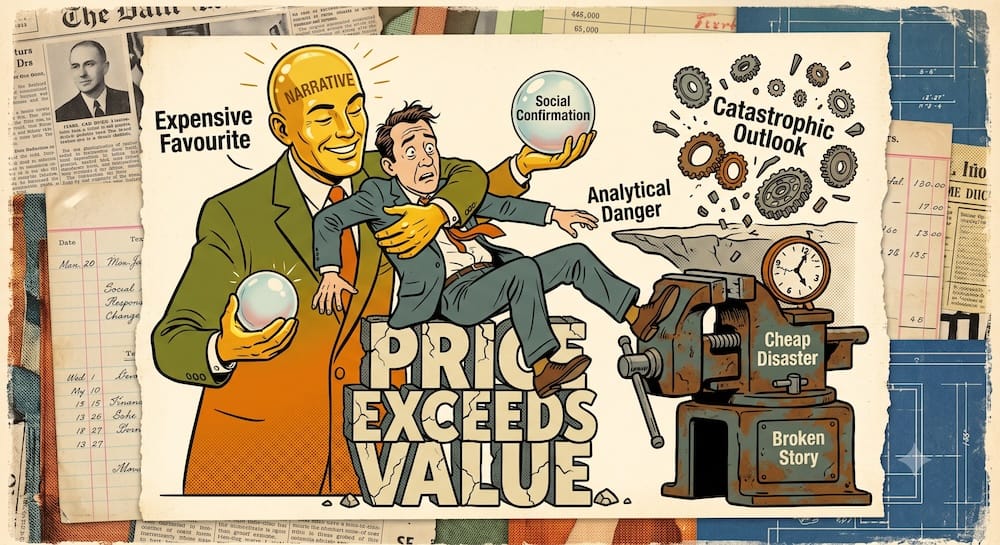
Why Expensive Favourites Feel Safer Than Cheap Disasters
An expensive favourite normally comes with a coherent narrative. Its recent performance validates the story. Analysts understand the business. Management speaks with authority. The industry appears to have a bright future. Owning it provides social confirmation before it provides any future return.
A deeply unpopular investment offers a rather less generous package. Its narrative has broken. Every new headline appears to confirm the decline. The people defending it sound increasingly eccentric. Even a correct buyer may have to spend months listening to incorrect arguments supported by a still-falling price.
Investors do not experience valuation as a clean numerical exercise. We filter price through stories, familiarity, recent performance and the opinions of people whose approval feels informative. A widely admired company can therefore feel safe at a valuation that leaves little room for disappointment. A troubled company can feel reckless at a price that already discounts years of disappointment.
Malcolm Baker and Jeffrey Wurgler found in 2006 that investor sentiment had its strongest cross-sectional effects on stocks that were difficult to value and difficult to arbitrage. During low-sentiment periods, several speculative or distressed categories later produced relatively strong returns; when sentiment was high, those patterns reversed. (Baker and Wurgler, 2006)
The result supports Templeton’s basic intuition, though it also reveals the trap hiding inside it. Difficult-to-value assets give sentiment more room to push prices away from a reasonable estimate of value. They also give the analyst more room to produce a terrible estimate while feeling impressively contrarian.
Ambiguity creates opportunity and analytical danger together.
Templeton expressed the inversion more bluntly in a 1995 Forbes interview, arguing that investors tend to ask where the outlook is best when a bargain hunter should ask where conditions are most miserable. He linked bargain prices to the presence of frightened sellers. The online text available today is a secondary reproduction of the original interview, so the attribution deserves care, but its logic is consistent with his documented framework. (Forbes interview excerpt)
The standard investor asks whether the outlook is attractive. Templeton asks whether the price already assumes an outlook more catastrophic than the one likely to occur.
That shift changes the intellectual job. The first question rewards a persuasive story. The second forces the investor to examine the expectations already embedded in the price.
I give Templeton enormous credit for making that inversion operational. His followers often preserve the theatrical part—the courage to oppose the crowd—and neglect the less photogenic work of estimating value, testing survivability and admitting that the crowd may be right.
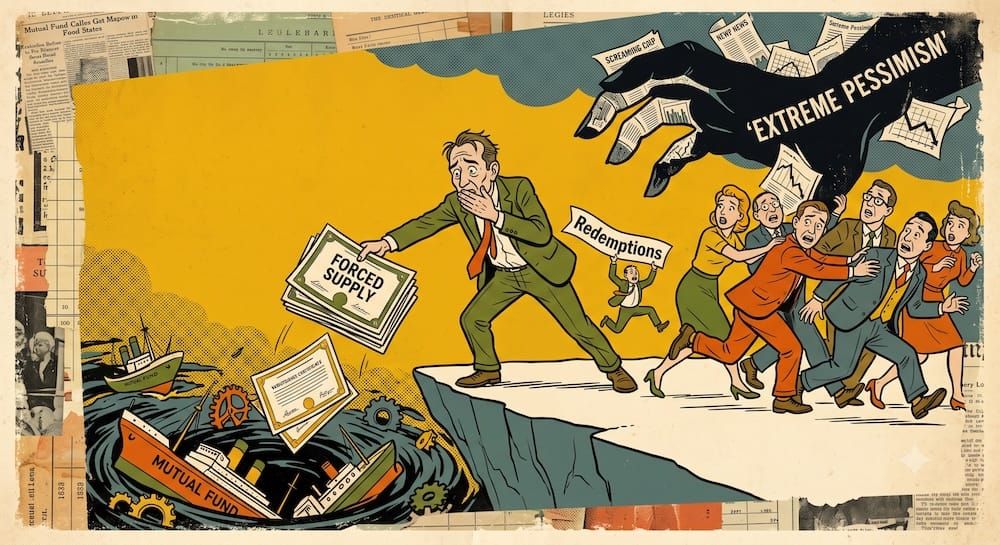
How Pessimism Actually Gets Into the Price
Fear does not enter markets through a single door. It changes who is willing to buy, who is forced to sell, how investors interpret information and which future outcomes begin to feel plausible.
Paul Tetlock’s 2007 study of pessimistic language in a prominent Wall Street Journal column found that elevated pessimism was associated with downward price pressure followed by a longer-horizon reversion toward fundamentals. Extreme pessimism and optimism were also associated with heavier trading volume. (Tetlock, 2007)
That finding does not permit us to dismiss bad news as noise. Tetlock explicitly allowed that pessimistic language may carry information or reflect changing risk aversion. Negative coverage can be exaggerated, accurate or both. The useful conclusion is narrower: market prices absorb facts alongside emotion, attention and changing willingness to bear uncertainty.
This mixture is exactly why pessimism creates such difficult opportunities. The investor cannot remove the emotional component with a highlighter and keep the facts.
Selling pressure can also come from constraints unrelated to a fresh judgment of long-term value. Joshua Coval and Erik Stafford found that mutual funds experiencing large outflows were forced to sell existing holdings, creating price pressure in securities heavily owned by distressed funds. Those effects persisted for roughly two quarters and then took additional quarters to reverse. (Coval and Stafford, 2007)
A fund facing redemptions needs cash. Its manager may consider a holding undervalued and still sell it. Other funds holding the same securities may face similar withdrawals. The market receives price-insensitive supply at precisely the moment prospective buyers become least willing to absorb it.
This does not authorize investors to label every decline a fire sale. “Forced selling” can become the value investor’s favourite bedtime story, especially after the thesis has begun misbehaving. The mechanism matters because it proves that transactions do not always represent independent judgments of intrinsic value. Identifying that mechanism in a specific security remains difficult.
Pessimism also enters price through extrapolation.
Josef Lakonishok, Andrei Shleifer and Robert Vishny argued in 1994 that investors projected past growth too far into the future. Glamour stocks accumulated excessive expectations while value stocks were burdened with expectations that had become too severe. (Lakonishok, Shleifer and Vishny, 1994)
The attraction of extrapolation is obvious. A clean trend looks like evidence. A business that has disappointed for years appears destined to continue disappointing. A company that has exceeded expectations appears to possess a durable exemption from economic gravity.
I understand the seduction. A straight line feels analytical because it fits so neatly on a chart. The chart does not disclose that the final segment was drawn by our own confidence.
When investors extrapolate weakness, they can price a temporary problem as permanence. When they extrapolate excellence, they can price a temporary advantage as destiny. Templeton’s pessimism principle becomes powerful when the first error drives expectations so low that reality can remain mediocre and still produce a favourable surprise.
Improvement Is Optional; Less Awful May Be Enough
This is where the romantic recovery story becomes misleading. A troubled investment does not always need wonderful news. It needs results that are better than the results embedded in the price.
La Porta, Lakonishok, Shleifer and Vishny found that value stocks later produced earnings surprises that were systematically more positive than those of glamour stocks, explaining a meaningful portion of their return difference. (La Porta et al., 1997)
“More positive than expected” is not the same thing as objectively excellent.
A company expected to collapse may reprice when it merely survives. An economy expected to deteriorate rapidly can support higher asset prices when deterioration slows. A hated industry does not need to become fashionable. It may need only to prove that extinction was priced too enthusiastically.
Markets respond to expectation gaps. They have no obligation to wait until the emotional story becomes pleasant.
The 2009 market sequence provides a clean historical illustration. The S&P 500 reached its bear-market closing low on March 9, 2009. The National Bureau of Economic Research later dated the economic trough to June. US unemployment did not peak until October. (S&P 500 history, NBER, BLS)
That chronology is useful only within its boundary. It does not reveal a reliable lead time. Nobody living through March 2009 received official confirmation that the market had bottomed. It demonstrates that prices can recover before the economy supplies a reassuring narrative.
Confirmation remains deeply attractive. I would much rather see prices, headlines and economic data all agreeing with my thesis. Most people would. The difficulty is that markets charge for agreement by incorporating it into the price before presenting it to us as comfort.
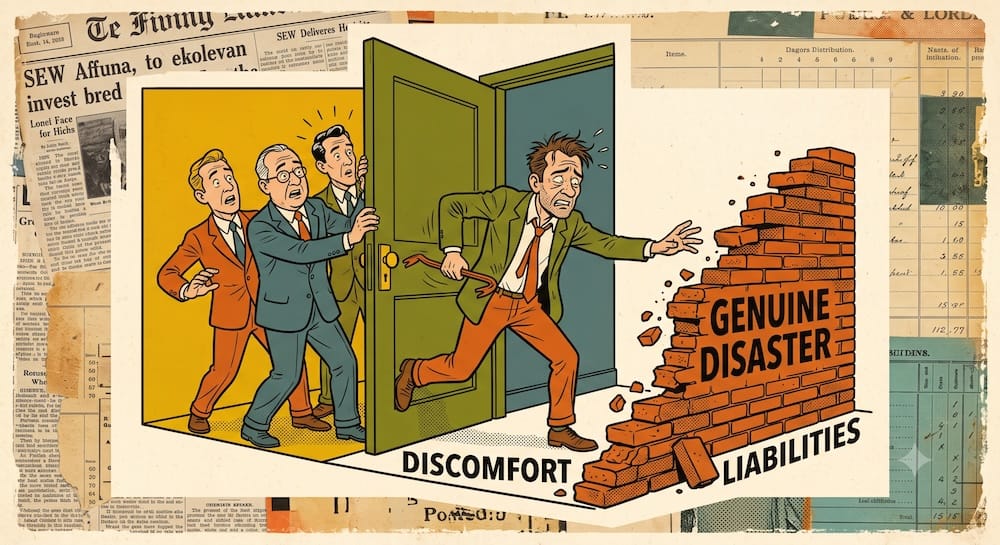
The Line Between Productive Discomfort and a Genuine Disaster
The central problem is deciding whether discomfort comes from standing apart from consensus or from recognizing a threat that the valuation cannot absorb.
Mood cannot resolve this. Neither can the magnitude of the decline.
| Productive discomfort | Legitimate warning |
|---|---|
| The price assumes an outcome harsher than defensible evidence supports | The business carries a material probability of permanent impairment |
| Selling appears partly forced, indiscriminate or expectation-driven | Leverage, liquidity or refinancing pressure can end the thesis |
| The asset can survive a delayed normalization | Survival depends on rescue financing or flawless execution |
| Valuation works under restrained assumptions | Cheapness vanishes after realistic liabilities and deterioration are included |
| The thesis has clear disconfirming evidence | The thesis changes every time new evidence arrives |
| Diversification contains the damage from error | Concentration converts uncertainty into portfolio fragility |
No table can automate the judgment. It can, however, stop an investor from treating emotional difficulty as self-validating.
What Productive Discomfort Looks Like
Productive discomfort begins with an expectation gap. The market price appears to assume a disastrous future, while independent analysis supports a less severe range of outcomes.
The next requirement is survivability. An asset can be cheap and still lack enough cash, time or financing to reach the recovery imagined in the valuation. Time helps only when the business can afford it.
There must also be recoverable economics. Earnings power, assets, cash flows, competitive position or another defensible source of value has to anchor the thesis. Sentiment can explain the price. It cannot supply intrinsic value.
Then comes falsifiability. The investor must identify what would prove the consensus correct. Without a failure condition, contrarian conviction becomes a wonderfully flattering label for refusing to update.
Templeton’s own writing makes clear that he looked beyond cheapness. His discussion of quality included competitive position, management, capitalization and customer demand. He also warned that apparent asset bargains could be leftovers that better-informed acquirers had already rejected. (Franklin Templeton, 1993)
That warning deserves more attention than the famous slogans. Templeton knew that low prices sometimes represent opportunity and sometimes represent other investors leaving the building through an exit the bargain hunter has mistaken for an entrance.
Joseph Piotroski’s 2000 study approached the same problem through accounting signals. Within a high-book-to-market universe, publicly available financial information helped separate stronger companies from weaker ones. (Piotroski, 2000)
The implication is severe enough: cheapness defines a research population. It does not deliver a conclusion.
The “value” label obscures this because it sounds like an assessment rather than a category. A stock can qualify as statistically cheap while remaining economically weak, financially fragile and entirely undeserving of recovery. The label describes price relationships. It does not certify value.
Sometimes the Fear Is Correct
Campbell, Hilscher and Szilagyi found that high leverage, weak profitability, low cash, high volatility, small size and poor recent returns predicted corporate failure. In their sample, the most financially distressed stocks produced anomalously low returns despite much higher volatility and market risk. (Campbell, Hilscher and Szilagyi, 2008)
That finding destroys the comfortable fantasy that maximum ugliness reliably produces maximum return.
Distress may create a discount. It may also destroy the asset before the discount has any chance to close.
A company can appear cheap because historical earnings no longer describe its economics. Book value may overstate what the assets could actually fetch. Liabilities may be incomplete or badly understood. Refinancing may become impossible. Management may continue allocating scarce capital into a declining operation.
A spreadsheet can make almost any weak business look dignified if the recovery assumptions are generous enough. The cells are famously reluctant to challenge management.
This is where I part company with the broadest interpretation of pessimism investing. Severe fear deserves investigation. It does not deserve reverence. A collapsing price can reflect emotional selling, though it can also reflect the market’s gradual recognition of facts the optimistic buyer keeps classifying as temporary.
The decisive question is uncomfortably practical: what must the company survive, and what must remain economically intact, before valuation gets the opportunity to matter?
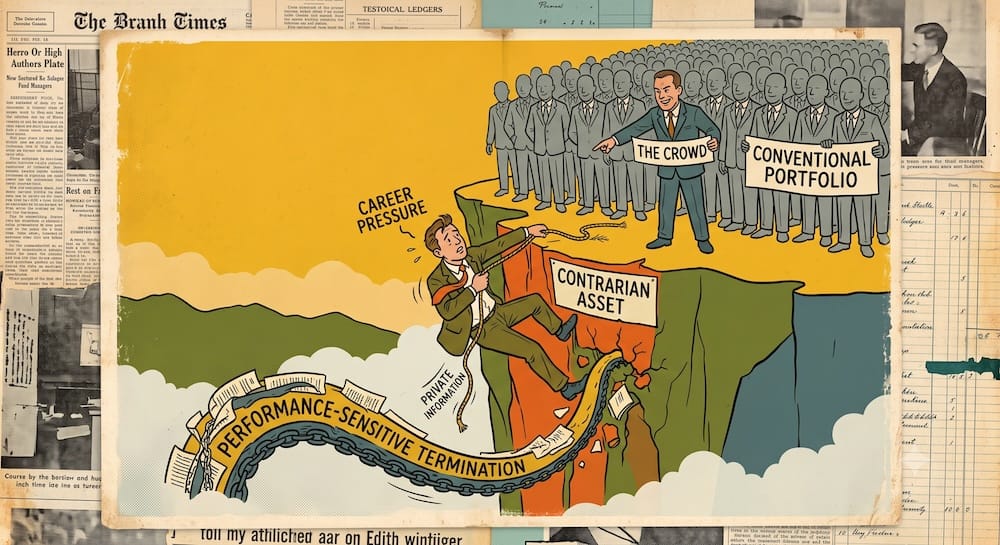
Why Institutional Investors Cannot Simply “Be Brave”
Templeton called contrarian execution difficult because its obstacles extend beyond psychology.
Professional investors live inside institutional structures. They answer to clients, mandates, benchmarks, committees and liquidity requirements. An independent valuation can prove correct over several years while creating intolerable career pressure over several quarters.
Judith Chevalier and Glenn Ellison found that younger mutual-fund managers faced more performance-sensitive termination and held more conventional portfolios with less unsystematic risk. (Chevalier and Ellison, 1999)
David Scharfstein and Jeremy Stein modelled reputational herding in which managers could rationally imitate others and ignore private information because being wrong with the group harmed reputation less than being wrong alone. (Scharfstein and Stein, 1990)
The polite version of investment history celebrates the brave contrarian and quietly removes the employment contract.
A manager buying an unpopular asset may have to defend the decision while the price continues falling. A manager owning the same expensive favourite as everyone else can distribute responsibility across the entire profession.
Being wrong with the crowd is often treated as a market event. Being wrong alone may become a personnel event.
This does not make professional managers cowardly. Conventionality can be rational career protection. The structure often rewards portfolios that differ enough to justify active fees while remaining familiar enough to prevent client alarm. Genuine contrarianism can violate both requirements: it looks strange before it looks intelligent, and it may remain strange for longer than the client relationship survives.
Coval and Stafford add the final complication. When clients redeem after poor performance, funds may be forced to sell the assets their managers believe are undervalued. Patience therefore depends on financing. Stable capital is part of the strategy.
Followers tend to leave this condition out because “buy when others are fearful” fits beautifully on a poster. “Maintain capital that will tolerate years of visible underperformance while preserving enough diversification to survive being wrong” is less likely to appear above anyone’s desk.
Templeton’s principle travels only when the investor’s structure can carry the weight.
The Miserable Gap Between Purchase and Vindication
Even a correctly identified bargain can become substantially cheaper.
Jegadeesh and Titman documented momentum over three- to twelve-month holding periods: recent winners continued outperforming recent losers before part of the effect later reversed. (Jegadeesh and Titman, 1993)
The finding complicates the satisfying contrarian narrative in which the insightful buyer steps in just as everyone else capitulates. Falling assets can keep falling. Bad news can remain accurate. Consensus can be right about direction while becoming excessive about magnitude.
Three different situations can therefore look nearly identical from the outside.
The thesis may remain intact while selling pressure persists.
The thesis may remain intact while fundamentals continue weakening before stabilizing.
The thesis may already be broken, with the declining price reflecting damage the original analysis missed.
Price action alone cannot separate them.
Templeton urged investors to monitor holdings because industries, competitive conditions and companies change. Patience did not mean buying and forgetting. (Franklin Templeton, 1993)
That distinction becomes brutally difficult during the waiting period. Conviction and stubbornness can produce the same portfolio action. Both refuse to sell. The difference lies in whether the underlying evidence continues supporting the original thesis.
I distrust frameworks that treat endurance as proof of seriousness. Time validates nothing by itself. It merely gives reality more opportunities to reveal whether the initial valuation was sound.
Has the balance sheet weakened beyond the original assumptions? Has management impaired capital? Has the competitive position deteriorated? Has the expected source of value vanished? Has the thesis quietly changed because extending the deadline feels less painful than admitting the original case failed?
A lower price improves prospective return only when value remains reasonably stable. When the value estimate is collapsing alongside the price, the appearance of a larger bargain is an optical illusion.
A Practical Templeton Test for Investable Discomfort
Templeton did not publish the exact six-part framework below. It is my synthesis of his documented principles and the mechanisms supported by the studies already examined.
| Test | Question | Why it matters |
| Expectation gap | What disastrous outcome does the price appear to assume? | A bargain requires expectations that are too severe |
| Survivability | Can the asset endure long enough for those expectations to be tested? | Value cannot emerge after insolvency or irreversible impairment |
| Independent value | What earnings, assets, cash flows or economics support the thesis? | Sentiment cannot anchor intrinsic value |
| Consensus error | Why might sellers be constrained, extrapolating or pricing uncertainty as certainty? | Contrarianism needs a plausible source of mispricing |
| Disconfirmation | What observable evidence would show that the fear was justified? | A thesis without a failure condition becomes immune to reality |
| Error containment | How is the damage limited if the thesis fails? | Diversification recognizes uncertainty before the market enforces humility |
The expectation-gap test is where many supposed bargains fail. A stock is not cheap simply because it has fallen. The investor must estimate what future the current price appears to discount and compare that with a defensible range of outcomes.
Survivability removes another group of seductive disasters. A company may own valuable assets and still be unable to refinance its debt. It may possess normalized earnings power and run out of cash before normalization arrives. The value can exist on paper and remain inaccessible to shareholders.
Independent value prevents sentiment from becoming the thesis. Templeton’s emphasis on capitalization, quality, competitive position and customer demand shows that he never treated pessimism as a substitute for business analysis.
Consensus error asks why the market might be wrong. Forced selling, extrapolation, reputational herding and severe uncertainty all provide plausible mechanisms. “People hate it” provides atmosphere.
Disconfirmation protects against the most seductive form of contrarian self-deception. If every new disappointment is interpreted as additional evidence of maximum pessimism, the idea has become unfalsifiable. The investor is no longer testing a thesis. He is protecting an identity.
Error containment makes humility operational. Templeton stressed diversification across companies, industries and countries. Diversification acknowledged that careful analysis still produces mistakes and that contrarian ideas often fail for reasons that were difficult to observe in advance.
This is where followers most often lose the mechanism. They copy the visible shell—courage, independence, willingness to look foolish—and discard the conditions that made those qualities investable.
The conditions were valuation, financial resilience, business quality, continuing research, diversification and an honest willingness to discover that the fear was justified.
Without them, courage becomes concentrated uncertainty wearing Templeton’s name.
The Best-Feeling Entry Point May Arrive Too Late
Templeton’s pessimism principle ends with an unpleasant paradox. The moment an investment becomes easiest to own may arrive after the original reason to own it has weakened.
Once analysts agree that the outlook is favourable, other investors have received the same reassurance. Once the headlines improve, the surprise is no longer fully surprising. Once the recovery becomes visible, the price begins reflecting recovery rather than despair.
The earliest or most frightening purchase is not automatically superior. Maximum pessimism is usually recognizable only after the reversal. Anyone claiming to identify it reliably in real time has converted hindsight into a marketing feature.
The useful decision rule is narrower.
Determine what terrible future the price appears to assume. Decide whether the asset can survive long enough for that assumption to be tested. Anchor the thesis in independent value. Identify why the consensus may be overreaching. Define the evidence that would prove the fear correct. Limit the damage if the analysis fails.
Then accept that a sound conclusion may still feel dreadful.
The best investment can feel terrible because the market has priced uncertainty as catastrophe. It can feel equally terrible because catastrophe is genuinely approaching.
Templeton’s discipline lay in refusing to let the emotion decide which one he was looking at.
What is John Templeton’s pessimism principle?
John Templeton’s pessimism principle treats severe market fear as a research environment where expectations and prices may separate from defensible value. Pessimism creates the possibility of a bargain, but it is not a buy signal by itself.
Why can the best contrarian investments feel terrible at first?
Because the conditions that create a discount—negative headlines, recent losses, uncertainty and social rejection—also remove the reassurance investors usually want before acting. By the time the outlook feels comfortable, part of the valuation opportunity may already have disappeared.
Does a hated investment automatically qualify as a bargain?
No. A hated investment may be mispriced, but it may also be insolvent, obsolete, financially fragile or permanently impaired. Cheapness begins the investigation; it does not establish value.
How can an investor distinguish productive discomfort from genuine danger?
Productive discomfort requires an expectation gap, survivability, independent value, a plausible reason the consensus may be wrong, clear disconfirming evidence and a way to contain error. Genuine danger appears when the thesis depends on rescue financing, flawless execution or assumptions that keep changing as conditions deteriorate.
Why can forced selling create a valuation disconnect?
Funds facing redemptions may have to sell holdings to raise cash even when managers consider those assets undervalued. That price-insensitive supply can pressure prices without representing a fresh judgment of long-term value, although not every decline is a forced sale.
Why can a correct contrarian investment continue falling?
Selling pressure may persist, fundamentals may weaken before stabilizing or the original thesis may be wrong. Price action alone cannot separate those possibilities, which is why continuing research and predefined failure conditions matter.
What is the practical Templeton test for investable discomfort?
It asks what terrible future the price assumes, whether the asset can survive, what independent value supports the thesis, why the consensus may be overreaching, what evidence would disprove the case and how losses are contained if the analysis fails.
This article is also available in Spanish. [Leé la versión en castellano: El principio de pesimismo de John Templeton: por qué las mejores inversiones se sienten terribles al principio]