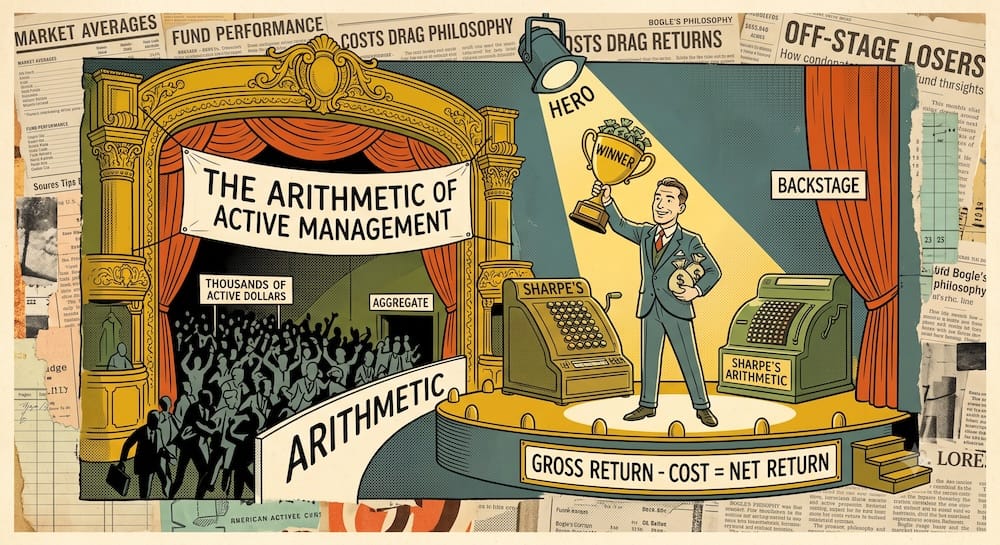
Active management has always enjoyed a conversational advantage: it only needs one hero.
Produce one brilliant manager, one extraordinary track record or one fund that escaped a bear market intact, and the whole industry appears vindicated. The winner stands under a spotlight. The thousands of active dollars on the other side of the arithmetic remain somewhere backstage, apparently without speaking roles.
That is where John Bogle’s case becomes far more powerful than the familiar claim that most managers fail to beat an index. He did not need to prove that managers lacked intelligence, markets were perfectly efficient or successful stock selection was impossible. He only needed investors to begin one step earlier.
What can active investors collectively earn when they collectively hold the securities being traded?
William Sharpe formalized the answer in his 1991 essay, “The Arithmetic of Active Management.” Before costs, the average actively managed dollar must earn the same return as the average passively managed dollar. Once costs enter, the active dollar must earn less in aggregate.
Bogle built much of his investing philosophy around that relationship. His formulation was simpler: gross return minus cost equals net return.
It sounds almost insultingly obvious. That is precisely why the financial industry prefers to move quickly past it.
Active Management Wins the Story Before It Meets the Numbers
The usual active-management pitch begins with capability.
A manager can identify undervalued companies, avoid deteriorating businesses, interpret economic conditions, move away from expensive sectors or hold cash when an index remains fully invested. The passive alternative appears dull by comparison. It owns whatever the market contains and makes no attempt to distinguish the magnificent from the mediocre.
That framing places an alert professional beside an unthinking basket and invites the investor to choose intelligence.
I find the comparison emotionally effective and mathematically evasive.
Sharpe began with the holdings themselves. Define a market. Define passive investors as those holding each security in proportion to its market value. Everyone whose portfolio departs from those weights belongs to the active group.
All investor holdings must add up to the securities available. Active managers can rearrange those securities among themselves, concentrate them, underweight them, trade them and develop elaborate explanations for why their particular arrangement is superior. The complete active population still owns the remaining market in aggregate.
One manager’s overweight requires somebody else to hold less. One investor’s timely sale requires another participant to buy. One fund can outperform only because other active capital receives less than the market return.
The winner is real. The offsetting losers are equally real, although they tend to receive fewer magazine profiles.
This is the first category error in most debates about active management. An individual success story is presented as an answer to an aggregate question. It proves that dispersion exists. Sharpe’s arithmetic already allowed for dispersion.
Indeed, the mechanism requires it. Whenever one active manager earns more, another active dollar must earn less before costs.
The financial industry benefits from keeping the camera tight. A close-up reveals the victorious manager. A wider shot reveals the accounting identity.
Arithmetic has awful stage presence. It remains undefeated by anecdotes.
Subtract the Indexers and the Escape Hatch Disappears
The phrase “active investors own the market” is directionally useful and technically sloppy.
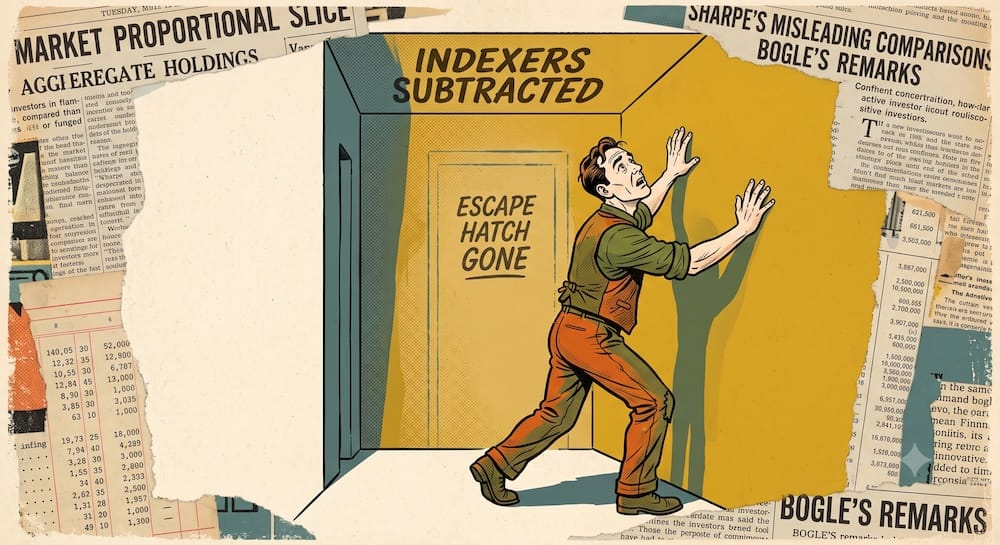
Passive investors own part of the market too. As index funds and other market-tracking vehicles accumulate assets, active investors no longer own every share. This has encouraged a superficial objection: if passive investors now hold a substantial portion of the market, perhaps the old arithmetic no longer works.
It still works.
Suppose passive investors collectively hold 40% of every security according to market capitalization. Remove that 40% market-proportional slice from the total. Active investors own the remaining 60%, and their combined holdings still reproduce the same capitalization-weighted market portfolio.
The individual active portfolios differ dramatically. Their aggregate cannot.
That qualification matters because sloppy measurement can make a fixed identity appear debatable. Sharpe identified several ways analysts can create misleading comparisons:
- Exclude active individuals while measuring professional funds.
- Compare equity funds holding cash with a fully invested equity index.
- Ignore funds that closed or disappeared.
- Give a tiny manager the same statistical weight as a giant fund.
- Use the median manager instead of measuring the average invested dollar.
- Compare portfolios holding different assets and call the difference “active skill.”
These choices alter the population or the benchmark. Once that happens, the result no longer tests the original arithmetic.
Bogle made the same point in his 2001 remarks, “Three Challenges of Investing.” A valid comparison requires the same aggregation of securities at capitalization weights. The further analysts wander from that condition, the easier it becomes to produce an impressive answer to a different question.
The clean relationship looks like this:
| Capital group | Aggregate result before costs |
|---|---|
| Total market | Earns the market return |
| Market-proportional passive holdings | Earn the market return |
| Remaining active holdings | Also earn the market return collectively |
The final row is where active marketing quietly changes subjects. It shifts from the collective return of active capital to the possibility of selecting an exceptional manager.
That possibility exists. The arithmetic merely prevents everybody from being exceptional at once.
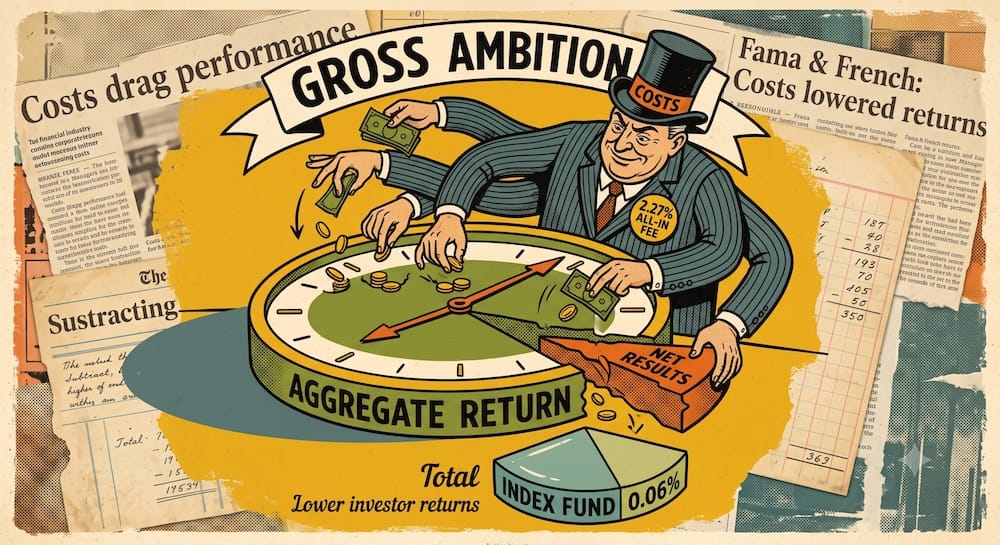
The Industry Sells Gross Ambition and Delivers Net Results
Before costs, the active and passive groups arrive at the same aggregate return.
Then everybody gets paid.
Active management usually involves more analysts, more trading, more portfolio turnover, more distribution, more marketing and more effort devoted to convincing investors that the previous five activities will be worth their expense. Some of this work creates genuine value. Every part of it creates a bill.
Bogle refused to treat the expense ratio as the entire cost of active investing. In “The Arithmetic of ‘All-In’ Investment Expenses,” published in 2014, he included transaction costs, distribution charges, sales expenses, cash drag and tax inefficiency where applicable.
His historical illustration estimated annual all-in costs of 2.27% for an active-fund example and 0.06% for an index fund. Those figures were never meant to become sacred constants. Bogle described the inputs as “inevitably imprecise” and invited readers to apply different assumptions.
The exact historical estimate is less important than the direction of the subtraction.
If two groups collectively receive the same gross return and one pays more to obtain it, the higher-cost group retains less. Market efficiency never needs to enter the room.
This is why I regard the cost argument as stronger than the claim that active managers usually make bad decisions. Managers can make intelligent decisions. They can conduct useful analysis, uncover information and improve how capital is allocated. Their investors still face the question of how much of that value remains after everyone involved takes a share.
Costs also compound through returns that never occur. A fee leaves the portfolio once, while the capital used to pay it loses every future gain it might have earned. The industry quotes annual percentages because 1% looks harmless when placed beside a single calendar year. Time is less forgiving.
Independent findings fit Bogle’s mechanism. Eugene Fama and Kenneth French reported in their 2010 study, “Luck Versus Skill in the Cross Section of Mutual Fund Returns,” that the aggregate U.S. equity mutual-fund portfolio closely resembled the market portfolio, while active-management costs largely appeared as lower investor returns.
The SPIVA U.S. Year-End 2025 Scorecard provides a more recent illustration. Over the 20 years ending December 31, 2025, all domestic active equity funds produced an asset-weighted annualized return of 9.41%, compared with 10.88% for the S&P Composite 1500. Large-cap active funds returned 9.62%, while the S&P 500 returned 11.00%.
SPIVA remains an empirical fund comparison rather than proof of Sharpe’s identity. Its results depend on its fund categories, benchmarks and methodology. Sharpe’s arithmetic applies to the complete, correctly measured active population.
That distinction protects the argument from overreach. Bogle did not need every active category to lose during every period. The cost differential had already established the structural pressure.
A Skilled Manager Can Still Be a Poor Deal for the Client
The laziest defence of indexing says active managers have no skill.
The available evidence does not support that degree of certainty, and Bogle’s case never required it.
Sharpe explicitly accepted that some active managers could beat passive alternatives after costs. Bogle also acknowledged exceptions. In his 2001 remarks, he invoked John Neff’s distinction that most managers cannot beat the index while some managers can.
The important question concerns where the value created by skill eventually lands.
Fama and French found evidence of genuine ability in the extreme tails when expenses were added back. At the same time, relatively few funds generated enough expected benchmark-adjusted return to cover their costs for investors.
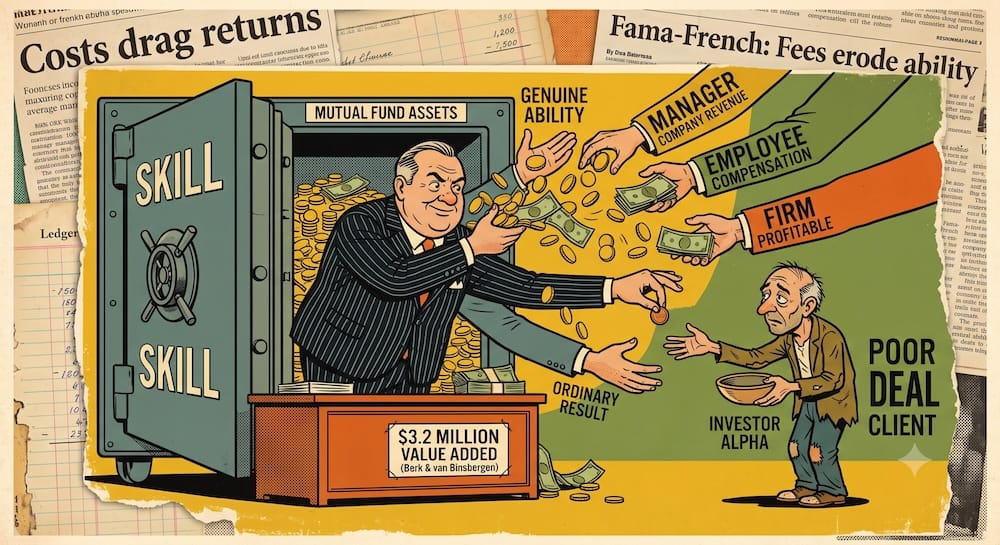
Jonathan Berk and Jules van Binsbergen pushed the distinction further in “Measuring Skill in the Mutual Fund Industry.” They estimated that the average fund created approximately $3.2 million in value annually and found persistent differences in value added across managers.
That finding sounds like a victory for active management until the recipient of the value is identified.
A skilled manager can attract a larger asset base. The management company can collect more revenue. Employees can receive higher compensation. The fund complex can expand. None of this guarantees that shareholders receive persistent benchmark-beating percentage returns after fees.
I consider this the most useful correction to the cartoon version of the debate. Managerial skill and investor alpha are separate outcomes.
The manager may be talented. The firm may be profitable. The client may still end up with an ordinary result after paying an extraordinary organization to produce it.
Nobody needs to be fraudulent or incompetent. The economic value can simply be captured before it reaches the fund investor.
That is less emotionally satisfying than declaring either side completely right. It is also far more damaging to the standard sales pitch. The active industry cannot defend itself merely by proving that managers perform valuable work. It must show that enough of the resulting value survives for the people supplying the capital.
Success Can Dilute the Skill That Created It
Jonathan Berk and Richard Green supplied another uncomfortable mechanism in “Mutual Fund Flows and Performance in Rational Markets.”
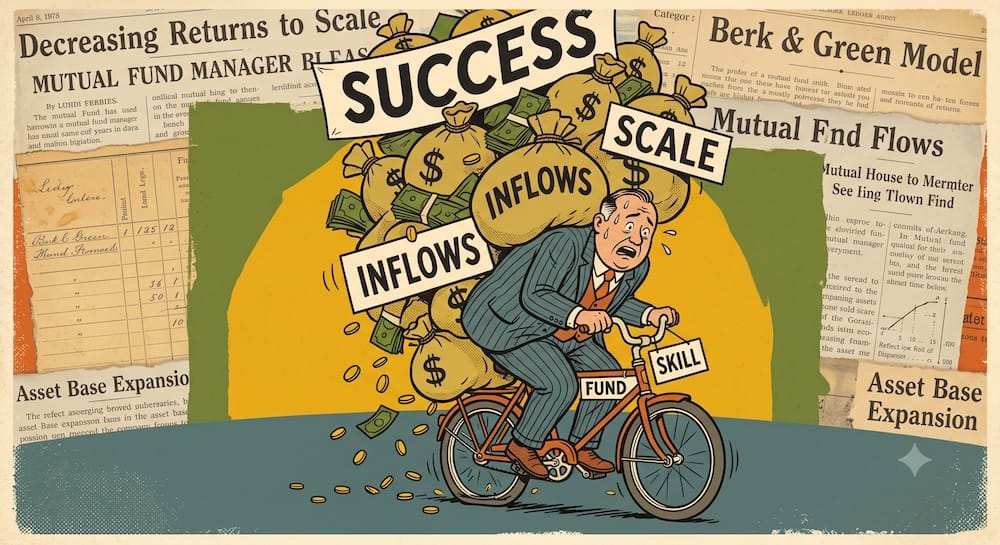
Their model allows skilled managers and rational investors to coexist with weak performance persistence. Investors observe evidence of skill and send more money to the successful fund. As the asset base expands, decreasing returns to scale reduce the manager’s ability to generate the same percentage advantage.
The manager may remain every bit as intelligent. The portfolio has become harder to manage.
A strategy that works with a small pool of capital may struggle when required to absorb billions. Positions need to become larger, less concentrated or more numerous. Trading creates greater market impact. Limited opportunities must carry more money than they can comfortably support.
The clean public story says strong performance attracts capital because investors finally recognize excellence. The operating reality is stranger: recognition may help destroy the return pattern that made the excellence visible.
Success becomes its own capacity problem.
This is why historical outperformance can be informative and disappointing at the same time. A strong track record may contain genuine evidence of skill. The inflows responding to that evidence can reduce the value available to the next investor.
I am drawn to elegant track records too. A decade of superior results lined up neatly on a page creates the impression of a durable machine. The temptation is to treat the record as a property belonging permanently to the manager. Scale reminds us that the return may have belonged partly to an earlier asset base, an earlier opportunity set and a version of the fund that no longer exists.
The manager has not necessarily deteriorated. The vehicle has changed underneath the reputation.
The Manager Is Easiest to Identify After the Advantage Is Visible
Investors rarely meet a skilled manager before anybody else notices.
They meet after the fund has moved into the upper quartile. The philosophy has acquired a track record. The manager’s decisions now look coherent because successful outcomes have arranged them into a narrative. Media coverage arrives, ratings improve and assets begin chasing the evidence.
By the time certainty feels comfortable, the prospective opportunity may be weaker.
Bogle illustrated the persistence problem by examining the top 20 equity funds from 1972 through 1982. During the subsequent period, their rankings among 309 funds ranged widely, producing an average rank of 142.
That single historical exercise cannot settle every modern debate about skill. It does expose the weakness of treating a winner list as a forward-looking selection system.
The S&P U.S. Persistence Scorecard for year-end 2025 found that only 4.5% of above-median large-cap funds from 2021 remained above median through 2025. A uniform random distribution would have produced an expected survival rate of 6.25%.
Shorter horizons were less brutal. Among top-quartile large-cap funds in 2023, 29% remained in the top quartile through 2025.
Persistence can exist. It becomes much less dependable as the required chain of success lengthens.
The crude slogan that past performance contains no information goes too far. Berk and Green offer a more difficult possibility: past performance can reveal skill while flows, capacity and competition reduce the return available after the revelation.
The track record may be genuine. The opportunity may already be fading.
That is the selection problem active-management advertising rarely emphasizes. Recognizing excellence retrospectively is difficult enough. Buying its future value after the evidence has become public is a separate task.
Emotion Enters Through the Exception Story
The arithmetic disadvantage exists before emotion appears.
Emotion arrives when the investor moves from a defensible statement—
“Some active managers will outperform”—
to a much more ambitious one:
“The manager I have chosen belongs to that group.”
The second claim requires more than admiration for a historical chart. It requires a judgment about luck, skill, benchmark exposure, future capacity, fees, organizational stability and the investor’s own ability to remain committed.
A compelling story makes those uncertainties feel smaller.
Active management is sold through differentiation. An index cannot explain why it visited a factory, avoided a fashionable stock or interpreted management incentives more accurately than the market. It cannot appear on television to describe its conviction. It has no founder mythology, no house philosophy and no quarterly letter reassuring clients that recent underperformance merely proves how independently it is thinking.
A manager can provide all of that.
The product therefore includes a flattering implication: the client has selected judgment superior to the judgment available to ordinary market participants. That emotional reward arrives immediately, even when the financial reward never does.
I have to guard against the same shortcut. A detailed explanation can feel like proof because it demonstrates intelligence and effort. Yet a persuasive account of previous decisions may reveal little about the return available from the next decision.
Bogle’s arithmetic strips away that comfort. Once active capital collectively earns the market return before costs, every selected exception needs to explain how it will overcome the cost disadvantage and the active losses elsewhere.
Charisma cannot perform that calculation.
Hiring a Manager Does Not Remove the Investor from the Decision
Active management is often described as delegation. The investor hires a professional and hands over the difficult decisions.
Only some decisions move.
The manager chooses securities, position sizes, trades, cash levels and portfolio structure. The investor chooses the manager, determines the allocation, interprets underperformance, judges whether the process remains intact and eventually decides whether to stay or leave.
| Decision maker | Continuing active responsibilities |
| Fund manager | Security selection, position sizing, trading, liquidity and portfolio construction |
| Fund investor | Manager selection, entry timing, allocation size, monitoring, patience and replacement |
The second layer can destroy the value created by the first.
Geoffrey Friesen and Travis Sapp examined this problem in “Mutual Fund Flows and Investor Returns.” From 1991 through 2004, they estimated that timing decisions reduced equity-fund investor returns by an average of 1.56 percentage points annually. The effect was larger among load funds and funds with strong risk-adjusted performance.
Strong results attracted capital after the gains. Disappointing results encouraged exits after the damage. A fund’s time-weighted return could remain respectable while the dollar-weighted experience of its investors fell behind.
The same study found poor timing among index-fund investors, so behavioural mistakes cannot be assigned exclusively to active management. Buying an index fund does not cause the investor’s emotional circuitry to dissolve.
Active manager selection does create another target to chase and another source of doubt. The investor can misread the market, misread the manager and mistime the decision to replace the manager. More discretion has expanded the number of ways to be wrong.
Financial services tend to call this flexibility.
I call it additional surface area for self-sabotage.
The distinction between fund returns and investor returns therefore matters enormously. The fund reports what happened to a continuously invested dollar. The investor experiences what happened to the actual dollars contributed and withdrawn at different times.
The marketing department naturally prefers the first number.
Bogle Proved Less Than His Disciples Claim—and More Than the Industry Wants
Bogle’s arithmetic has occasionally been inflated into a universal declaration that active management is pointless.
It does not support that claim.
Some active managers will outperform. Some markets or segments may present different levels of opportunity. Certain mandates pursue tax management, liability matching, liquidity, downside constraints or objectives that a capitalization-weighted equity index was never designed to satisfy. Their results require benchmarks aligned with those goals.
Active funds can also outperform during particular years and in particular categories. In 2025, only 40.65% of U.S. small-cap active funds underperformed the S&P SmallCap 600, meaning a majority outperformed during that year. Across the 20-year period reported in the same SPIVA scorecard, 90.28% underperformed.
The single-year result stops anyone from claiming active funds lose everywhere all the time. The 20-year result stops the single-year victory from carrying more weight than it deserves.
Bogle’s actual chain of reasoning is narrower:
- Correctly defined active holdings collectively earn the market return before costs.
- Active management usually carries higher costs than a low-cost market-tracking alternative.
- The average active dollar therefore retains less after the cost differential.
- Individual winners can exist inside that aggregate shortfall.
- Investors seeking those winners face a further problem of prospective identification and behaviour.
I part company with the broadest Boglean rhetoric when structural disadvantage is allowed to blur into impossibility. Evidence of managerial skill exists. Certain mandates cannot be judged solely against a generic market index. Bogle’s language sometimes became tidier than the world he was describing.
Those limits barely help the conventional active-management pitch.
The industry still has to show who captures the value created by skill. It has to explain whether the opportunity survives success, whether fees leave enough for shareholders and whether investors can endure the periods when a skilled manager becomes indistinguishable from a disappointing one.
The arithmetic does not ban active management. It removes its presumption of innocence.
The Expensive Exception Owns the Burden of Proof
Active management often puts indexing in the witness box.
Why accept the market return?
Why own every company?
Why ignore the possibility of superior judgment?
The questions sound forceful because they leave the added machinery of active management off the page. A low-cost market portfolio begins with the return collectively available to investors. The active alternative adds selection, trading, research, fees, organizational risk, capacity limits and another layer of investor decisions.
Any of those additions may earn its place. None deserves a free pass.
Sharpe argued in 1966 that the burden of proof should rest with those claiming the search for mispriced securities was worth its expense. Bogle returned to that standard because it follows directly from the arithmetic.
The existence of historical winners clears only the lowest hurdle. A credible active proposition must explain why a particular source of skill can be recognized before the advantage disappears, purchased without surrendering most of its value, scaled without dilution and held through the stretches when the original judgment looks embarrassingly wrong.
That standard leaves room for exceptional managers.
It also prevents their existence from becoming an all-purpose excuse for everyone else’s fees.
What is the arithmetic of active management?
Before costs, correctly defined active holdings collectively earn the market return because active investors own the market’s remaining securities in aggregate. After higher costs, the average active dollar must retain less than a lower-cost passive alternative.
Does Bogle’s arithmetic mean every active manager underperforms?
No. Individual active managers can outperform, but their gains must be offset by other active investors earning less before costs. The arithmetic applies to the complete active population, not to every manager separately.
Why do passive investors not break the arithmetic?
Market-proportional passive holdings can be subtracted from the total market. The remaining active holdings still reproduce the same capitalization-weighted market portfolio in aggregate, even though individual active portfolios differ.
Can an active manager possess skill without delivering investor alpha?
Yes. Managerial skill may create economic value, attract assets and increase fee revenue without producing persistent benchmark-beating returns for shareholders after costs. Skill and investor alpha are separate outcomes.
How can fund growth weaken a successful manager’s performance?
Strong performance can attract inflows that expand the fund beyond the capacity of its original opportunities. Larger positions, greater market impact and a narrower usable opportunity set can dilute the percentage advantage that first attracted investors.
Why does choosing an active manager create another layer of risk?
The investor must still select the manager, decide when to invest, tolerate underperformance, monitor the process and determine when to leave. Those decisions can reduce the return actually captured even when the fund itself reports respectable results.
What does Bogle’s case against active management fail to prove?
It does not prove that every active manager lacks skill, that active funds lose in every period or that every mandate should be judged against the same market index. It establishes an aggregate cost disadvantage and places the burden of proof on the more expensive exception.
This article is also available in Spanish. [Leé la versión en castellano: John Bogle vs. gestión activa: la aritmética de invertir antes de que intervenga la emoción]