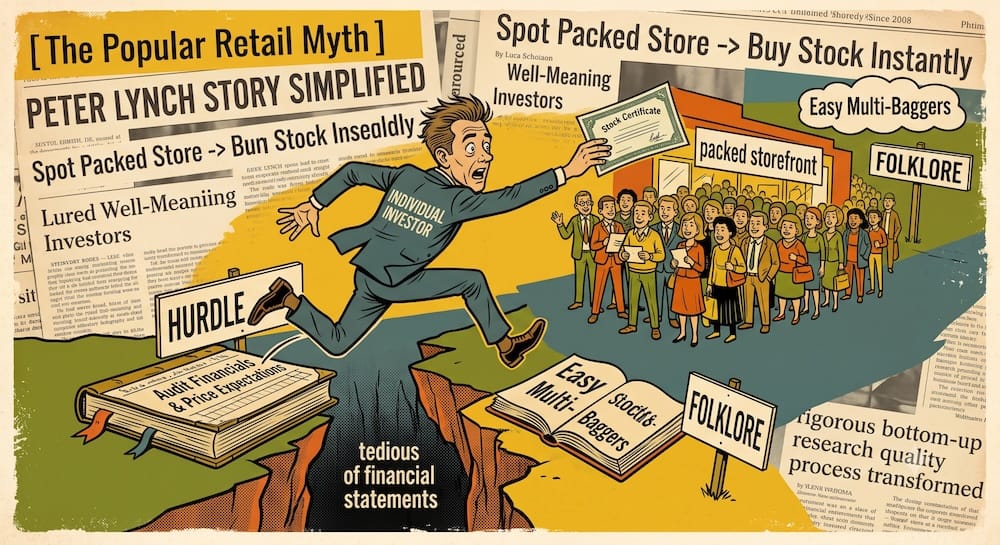
There’s an insult buried inside passive investing, and most people spend years refusing to look at it directly. It isn’t that Wall Street charges too much, or that financial media is mostly noise dressed up as insight — everyone already knows that. The real insult is narrower and more personal: it’s the claim that you, specifically, despite reading the annual reports and tracking the right names, have no reliable way to identify tomorrow’s winning companies before the market has already priced them.
I understand the resistance to that idea. Stock picking feels like it should reward effort. Spend enough hours on filings, spot enough inflection points early, and the outcome should reflect the work. Buying a slice of everything on the exchange and accepting whatever average the market hands you can feel like giving up before the game starts.
Bogle’s argument was never built on surrender, though. It was built on humility backed by arithmetic that doesn’t care how much effort went into your stock picks. His case for what he called “buying the haystack” rests on three claims: that the future is genuinely unknowable in advance, that costs compound the same way returns do, and that individual security selection is a contest most participants are structurally positioned to lose. Own the whole corporate landscape instead, minimize the leakage — fees, spreads, turnover — and the argument is that you come out ahead of most attempts to out-guess the market.
That doesn’t make indexing the smug, risk-free position online communities sometimes treat it as, and I find that smugness genuinely irritating. Owning the market doesn’t remove risk. It replaces one kind of risk — picking the wrong company — with another: full, undiluted exposure to whatever the market does as a whole, with no manager to blame when the screen turns red. That trade-off is real, and it’s worth sitting with before assuming the haystack solves everything.

What “Owning the Whole Market” Actually Means
Before testing the logic, it’s worth settling a sloppy habit in how this gets discussed. Own the whole market” gets used interchangeably for at least three different things: the S&P 500, a total US stock market fund, and a total global equity fund. These are not the same instrument, and treating them as synonyms quietly changes what an investor actually owns.
The S&P 500 is a large-cap index, covering roughly 80% of US market capitalization by design. It’s broad by large-cap standards, but it’s still a committee-maintained selection of big, established companies — it excludes the small- and micro-cap businesses that represent the market’s more volatile early-stage growth engine.
Genuine total-market exposure came later, through funds tracking indexes like the Wilshire 5000 or the CRSP US Total Market Index, which pull in thousands of smaller companies the S&P 500 leaves out. Even that, though, is a large haystack inside a single national barn. It says nothing about the rest of the world’s public companies.
Bogle’s own practice stayed almost entirely domestic. He argued repeatedly that US investors needed little or no international exposure, treating foreign equities as an unnecessary source of currency risk and complexity rather than genuine diversification. I think it’s worth separating his mathematical argument against stock-picking — which is sound — from his geographic boundary, which is not the same claim and doesn’t automatically follow from it. You can accept the case against security selection without accepting that the investable universe stops at the coastline. “The whole market” is never a neutral, objective category. It’s a boundary someone drew, using rules someone wrote.
The Arithmetic Behind the Haystack
The intellectual foundation here isn’t a theory about market efficiency. It’s simpler than that — Bogle called it the Cost Matters Hypothesis, and the logic holds at the aggregate level regardless of what you believe about how efficiently markets price information.
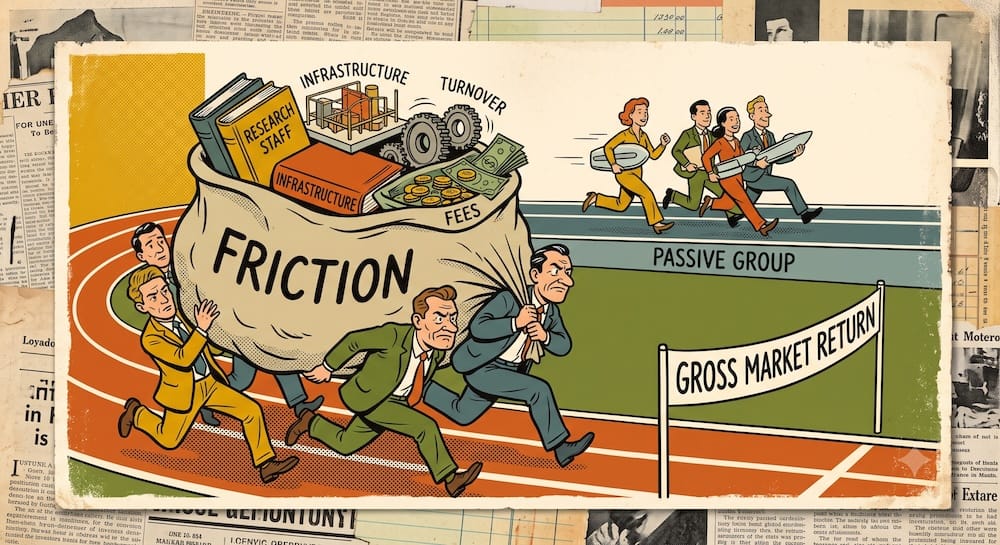
At any moment, the entire listed stock market is held collectively by every market participant. By definition, active investors plus passive investors, added together, are the market. Passive investors hold the index and trail it only by their thin internal costs. Active investors, as a group, hold whatever’s left over — which is also, mathematically, the market portfolio. Before costs, the two groups earn the same return, because together they can’t earn anything else.
Gross Market Return − Friction (Fees + Trading Costs) = Net Return.
After costs, the picture changes. Active management carries real operational weight — research staff, infrastructure, turnover, spreads — that passive management mostly avoids. Subtract that weight from a return that was tied before costs, and the active group must trail the passive group in aggregate. Not because every manager fails. Because the group can’t collectively outrun a cost disadvantage it’s carrying on its own back.
This doesn’t doom any individual fund. Skilled managers, structural edges, or plain luck let some active strategies beat the index over real stretches of time. The problem Bogle actually posed wasn’t “can anyone beat the market” — it’s whether you can identify who will do it before they do it, and whether their edge will survive fees, turnover, and the asset growth that tends to follow success.
Owning a Good Company Isn’t the Same as Owning a Good Investment
The mistake that trips up most independent investors is conflating a great business with a good stock to buy. A company dominating its sector, growing revenue fast, launching product after product — the instinct is to buy it, hold it, and let compounding do the rest.
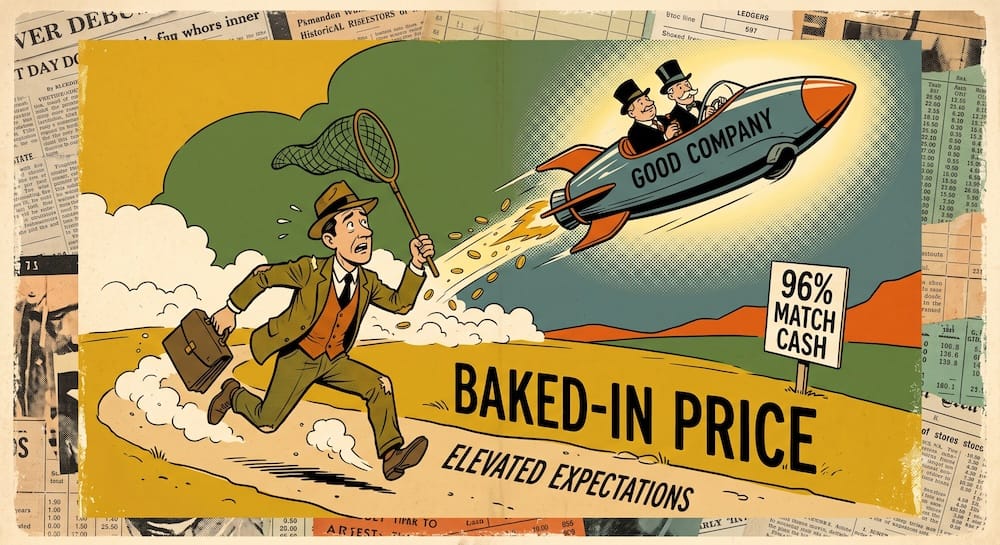
That instinct skips the part where markets price information continuously. By the time a company’s excellence is obvious to you, it’s usually already obvious to the institutions trading millions of shares a day, and that excellence is baked into the price. Beating the market on that stock now requires the company to outperform already-elevated expectations, not merely to be good.
The distribution of outcomes makes this worse than it sounds. Hendrik Bessembinder’s 2018 study of the US market from 1926 through 2016 found that a majority of individual stocks — roughly four in seven — had lifetime returns below one-month Treasury bills. The best-performing 4% of companies accounted for the market’s entire net wealth creation over that ninety-year span. The other 96%, collectively, matched cash.
That’s a brutal skew to bet against. Miss a handful of the eventual outliers because their valuations looked stretched or you preferred a different sector, and a concentrated portfolio can lag the broad market for good. Buying the whole index sidesteps the selection problem entirely: you don’t need to know which names will drive decades of return, because you already own them, indistinguishable from everything else in the haystack.
Manager Selection Just Moves the Same Problem Upstairs
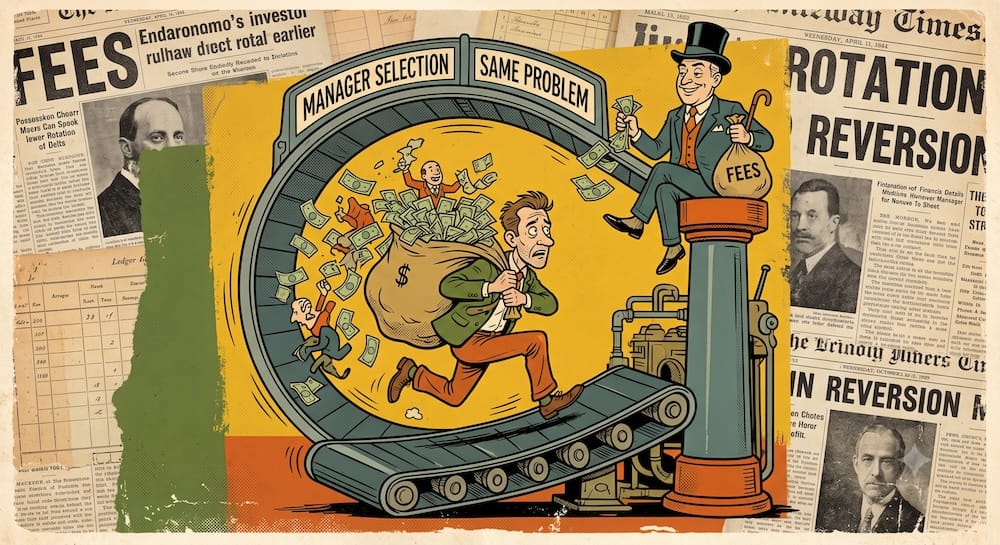
Once investors realize stock-picking is a low-odds game, the standard move is to delegate it — hire a manager, buy an actively run fund. I don’t think this solves anything. It relocates the forecasting problem rather than resolving it. Instead of evaluating balance sheets, you’re now evaluating a person’s discipline, incentives, and whether their edge is durable.
Three specific problems follow. First, the luck-versus-skill question doesn’t go away just because a human is involved — three strong years could be genuine skill or a temporary tailwind for their particular style. Second, styles rotate. A manager who looks brilliant during a growth cycle can look incompetent the moment the market favors value, and investors chasing recent outperformance often buy in right before reversion sets in. Third, success brings its own ceiling: capital floods toward strong performers, the strategy’s original opportunity set shrinks under the weight of new assets, and a fund that once beat the market by finding small, overlooked positions can quietly turn into an expensive version of the index it was trying to outrun.
Choosing broad ownership means stepping off that treadmill entirely — admitting that finding a manager who’ll beat the market net of fees is its own speculative bet, dressed in a different suit.
What Cap-Weighting Does Automatically
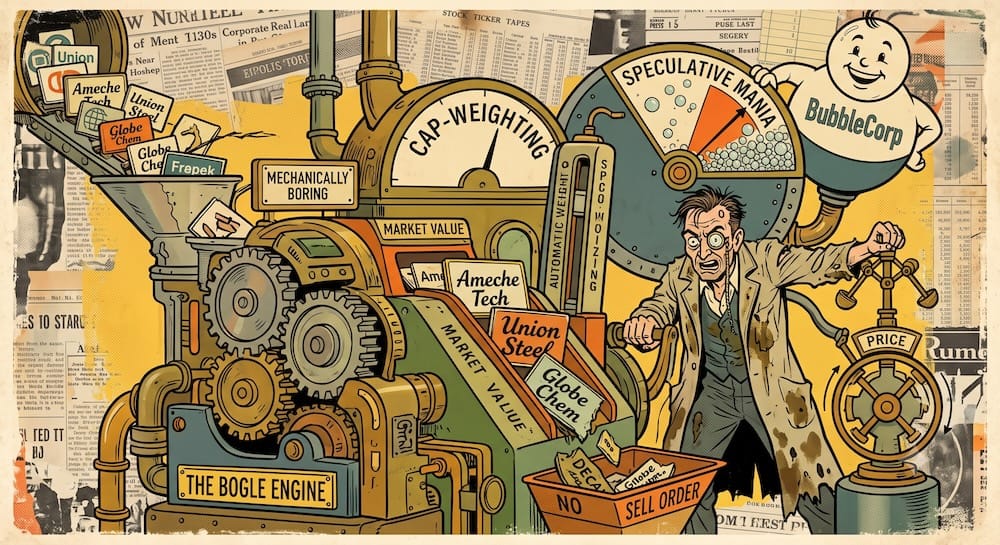
Bogle’s engine works because of how mechanically boring it is. A cap-weighted index allocates capital purely by market value — no analyst’s judgment, no committee’s macro call. As a company’s price rises relative to everything else, its weight rises with it, automatically. As a company decays, its footprint in the index shrinks, without anyone issuing a sell order.
This produces two real advantages. Turnover stays low, because weights adjust with prices rather than through discretionary rebalancing — which keeps trading costs down. And the structure captures growth automatically: an obscure company that becomes a giant gets carried along for the ride, its weight expanding right alongside its valuation, with no one needing to have picked it in advance.
It’s not a flawless system, and I think passive advocates oversell its neutrality. Cap-weighting has heavy, structural exposure to whatever country, sector, and valuation regime happens to be dominant at any given time. Because it follows price, it can’t tell the difference between genuine value and speculative mania — during a late-stage bubble, the index will mechanically increase its exposure to the most overpriced names in the market simply because their prices went up. It’s a reflection of consensus, not a judgment about what’s cheap.
The Delivery Machine Bogle Built
The math existed before Vanguard did — Bogle’s 1951 Princeton thesis was already arguing that funds routinely failed to beat market averages. What took longer was the delivery mechanism that made the idea usable by ordinary investors, and that story runs through a fairly specific sequence of events.
Bogle was pushed out as CEO of Wellington Management in January 1974, after a merger he’d engineered years earlier went badly. He kept nominal leadership of the mutual funds themselves, but the parent company’s board blocked him from running active strategies. Vanguard was built, in part, as a workaround — a fund administrator with no mandate to pick stocks.
The structural move that mattered came in May 1975: Vanguard’s mutual ownership, in which the funds themselves owned the management company rather than an external, for-profit parent. Administrative and brokerage services were provided at cost. As assets grew, fixed costs spread across a larger base, and expense ratios fell instead of profits rising.
The first index fund — the First Index Investment Trust — launched on August 31, 1976, raising just $11.3 million against a $150 million target. It carried an 8.5% front-end sales load at launch, before Bogle moved Vanguard to a no-load model in 1977. Over the following decades, scale pushed expense ratios down from over 0.40% toward the near-zero levels investors expect from index funds today.
Worth being clear-eyed here: the mutual structure was a genuinely effective delivery mechanism, not an unbeatable moat. Competitors have since matched or undercut Vanguard’s fees on many broad products through securities lending, cross-subsidization, and loss-leader pricing. The structure built the delivery system. The investment case for market ownership itself is the part that survives independent of who’s cheapest this quarter.
What Broad Ownership Removes
Stepping away from selection trades one set of risks for another, and it’s worth being specific about which risks actually get reduced.
Individual company survival dependence drops substantially. In a concentrated portfolio of ten or fifteen holdings, one accounting scandal or one management catastrophe can do lasting damage. Spread across an index, a single constituent collapsing to zero gets absorbed by everything around it. The failure still hurts. It doesn’t take the portfolio with it.
Style and sector forecasting dependence drops too. Markets move through regimes — growth, then value, then whatever comes after — and investors reliably damage their own results chasing whichever style just performed well. A cap-weighted total-market position holds all of it simultaneously. You give up any ability to time the rotation. You also stop being the investor caught fully exposed to the style that’s about to turn.
And manager-selection risk disappears along with the delegation itself. No more auditing whether last year’s outperformance was skill or noise, or whether asset growth is quietly turning a sharp manager into an index-hugger charging active fees.
What It Doesn’t Remove
This is where I think the online indexing crowd gets smug in a way that doesn’t survive contact with the historical record. Passive ownership is efficient. It is not a hedge against volatility, and it was never designed to be.
Buying a cap-weighted equity index means buying full, unhedged equity risk. The index has no built-in cash buffer, no downside protection. When the broad market repriced sharply lower, the index captured that directly: the S&P 500 fell roughly 43.8% peak to trough during the dot-com collapse between March 2000 and September 2002, and roughly 50.9% during the financial crisis between October 2007 and March 2009.
I think passive investors sometimes romanticize how these numbers actually felt to live through. Watching half your account evaporate on a screen doesn’t feel calm just because the strategy is labeled passive. None of this means an equity index has to represent someone’s entire balance sheet — cash and bonds sit elsewhere in most real portfolios — but the core point stands: market ownership offers no protection against buying in at a stretched valuation. Indexing tracks a benchmark faithfully. It says nothing about whether that benchmark’s return will be comfortable, or even positive, over any specific investor’s horizon.
The ETF Paradox
There’s a real tension between Bogle’s philosophy and the vehicle most DIY investors now use to implement it. Bogle spent his final years openly skeptical of ETFs — worried about trading volume, rapid turnover, and the proliferation of high-fee, narrowly sliced sector products that undercut the entire point of broad diversification. But his sharpest objection was structural: ETFs bolt continuous, intraday liquidity onto a philosophy that only works if you leave it alone.
A traditional mutual fund prices once, at the close, at net asset value. That friction is a feature — you can still redeem in the morning, but there’s no tempting price ticking on your phone at 11 a.m. after a bad headline. ETFs remove that friction entirely. You can buy or panic-sell the entire market with one tap at 2:15 in the afternoon.
Bogle’s argument was that giving a buy-and-hold instrument tick-by-tick liquidity creates exactly the psychological hazard the strategy was built to avoid. The paradox is real: a low-cost, broad ETF is a genuinely efficient way to own the market, and its liquidity makes misusing it dangerously easy. An investor holding a total-market ETF while checking the ticker five times a day and trading around macro headlines isn’t executing Bogle’s strategy. They’re running an active, speculative one through a passive wrapper.
Where Bogle Drew the Haystack’s Border
Even the most committed advocate of owning “everything” drew a line around what counted as everything, and for Bogle that line sat at the US border.
His resistance to meaningful international diversification was a settled position, not an occasional aside. His central defense was that large US multinationals already generate substantial revenue abroad, so owning them delivers global exposure without needing foreign-listed assets at all.
That argument conflates two different things — corporate revenue exposure and asset-class diversification — and the gap between them matters. Holding a US multinational doesn’t insulate an investor from US-specific risk: it remains bound to US regulatory, tax, and antitrust frameworks regardless of where it sells its products. Relying exclusively on one country’s index also exposes a portfolio to that country’s sector concentration — if the domestic index becomes dominated by one industry, the “broad” haystack starts to look like a sector bet wearing a diversified costume. And multi-year stretches exist where international markets trade at real valuation discounts to domestic ones, discounts a US-only investor never gets access to.
I think this is the least convincing part of Bogle’s framework. It’s tempting to look at US equities’ dominance since 2008 and conclude his instinct was vindicated, but a favorable outcome in one particular stretch doesn’t retroactively prove the underlying allocation logic was complete. Nothing in the cost arithmetic that makes the rest of his case airtight says the United States is the uniquely correct boundary for the haystack. Even Bogle, arguing against every other form of discretionary judgment, couldn’t resist making one of his own.
The Case Against the Case
Fairness requires taking the strongest objections to broad ownership seriously rather than treating the whole argument as settled.
| Objection | The Mechanism | The Practical Consequence |
|---|---|---|
| Price discovery degradation | Markets rely on active participants doing fundamental analysis to price capital efficiently | If passive flows come to dominate, capital allocates by size rather than merit, with knock-on effects for pricing, liquidity, and governance |
| Top-heavy concentration | Cap-weighting mechanically increases the weight of whatever is already rising | The index can become dependent on a small handful of mega-caps, quietly eroding the diversification investors think they’re buying |
| Methodological rule dependence | Indexes are constructed by provider-defined rules, not discovered in nature | An index investor hasn’t escaped discretionary judgment — they’ve traded a portfolio manager for a rules committee |
The price-discovery objection argues that passive funds are, in effect, free-riding on the work active managers do. If active management vanished entirely, the theory goes, markets would lose the mechanism that prices capital toward productive uses. Most index-fund purchases happen in secondary markets and don’t hand fresh capital directly to companies, which blunts the objection somewhat — but the theoretical limit of a fully passive market remains a genuine, unresolved question, not a strawman.
The concentration objection is more immediate. When a sector enters a speculative run, the index automatically increases its exposure to it, precisely because prices are rising. An investor who believes they’re holding a diversified cushion can end up carrying a concentrated bet at the exact top of a cycle, without ever choosing to.
And index construction is never neutral. Someone decides eligibility rules, liquidity thresholds, rebalancing schedules. None of this proves active management is the better alternative — critics of cap-weighting are often very good at identifying its flaws and conspicuously bad at proposing something that beats it net of costs. But it does mean broad ownership isn’t a frictionless solution. It’s a deliberate trade: the structural flaws of an index, accepted in exchange for avoiding the costs and forecasting errors of trying to beat one.
Summary: What Gets Solved, What Doesn’t
| What Broad Ownership Addresses | What It Leaves Unresolved |
|---|---|
| Security-selection risk — no need to forecast which individual company survives | Market-wide drawdowns — equity exposure still falls hard and fully in a systemic decline |
| Manager-selection risk — no need to separate skill from luck in advance | Asset allocation — equities vs. bonds vs. cash remains a separate decision the index doesn’t make for you |
| Avoidable costs — internal fees, spreads, and turnover inside the equity sleeve | Investor behavior — nothing about the structure stops you from selling at the bottom |
| Style-chasing — no need to time rotations between growth, value, size factors | Geographic and sector concentration — single-country exposure carries its own risks |
Bogle Shifted the Burden of Proof
Bogle’s real legacy isn’t a specific fund or a firm. It’s a reversal of the default assumption that used to govern how people thought about investing. Before Bogle, picking stocks, chasing sectors, or hiring a manager to do it for you was the unquestioned starting point — you entered the market to beat it, and beating it was simply what an intelligent investor did.
He inverted that. By building a low-cost, self-adjusting vehicle for owning the whole market, he turned the market’s own return into the default baseline anyone could access cheaply. That baseline isn’t proof that markets are efficient, fairly priced, or safe. Owning the haystack still means accepting overvalued moments, top-heavy concentration, and the full force of systemic drawdowns when they arrive. It means giving up the story where your specific insight was what made the difference.
What it does is force the alternative to justify itself. Once the market’s return is available to anyone at minimal cost, choosing to deviate from it — one stock, one sector, one manager — can no longer claim the default position. The deviation has to earn it: it has to show why its expected edge survives costs, behavior, capacity, and time, not just why it sounded compelling in the pitch.
What is the Cost Matters Hypothesis?
The Cost Matters Hypothesis states that because active and passive investors collectively own the entire market, they earn identical returns before accounting for costs. After subtracting active management costs—such as research staff, infrastructure, and turnover—the active group must mathematically trail passive investors in the aggregate.
Does owning the whole market completely eliminate investment risk?
No, broad market ownership does not remove risk. While it eliminates individual company selection risk and manager risk, it leaves the investor with full, undiluted exposure to systemic market drawdowns, offering no built-in downside protection when the entire market declines.
How does a cap-weighted index handle company growth and decay automatically?
A cap-weighted index allocates capital strictly by market value. As a company’s stock price rises, its footprint inside the index automatically expands without an analyst’s intervention; conversely, if a company decays, its weight shrinks automatically without anyone issuing a sell order.
Why did John Bogle express skepticism toward ETFs?
Bogle was concerned that ETFs add continuous, intraday liquidity to an investment strategy that relies on long-term holding. He argued that tick-by-tick liquidity introduces psychological hazards, tempting investors to trade around short-term macro headlines instead of leaving the portfolio alone.
What did Hendrick Bessembinder’s 2018 study reveal about individual stocks?
The study found a brutal structural skew in stock returns from 1926 through 2016, showing that four out of seven individual stocks had lifetime returns below one-month Treasury bills. Strikingly, just the top-performing 4% of companies accounted for the market’s entire net wealth creation.
This article is also available in Spanish. [Leé la versión en castellano: John Bogle y el argumento para ser dueño de todo el mercado]